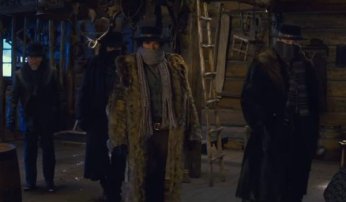
Quentin Tarantino is possibly the most uncompromising director in Hollywood. Even when he’s not at his best, he can still make a statement. I gave The Hateful Eight a look. I have to say I found it had a lot to like.
It starts in post-Civil War America in the frontiers. It’s a cold day and there’ signs that there’s a blizzard coming soon. Major Warren, an African-American bounty hunter, has three bodies to take back to Red Rock. He hitches a ride with a stagecoach despite being told by driver O.B. Inside the current passenger wants to be alone. Warren does get the ride and meets his other passengers: another bounty hunter by the name of John Ruth who has his bounty, the ruthless Daisy Domergue, with him handcuffed to him also headed to Red Rock. The ride is not pleasant as Daisy should racial slurs at Warren. To which Ruth response with a punch in her face. However Warren and Ruth are able to bond as Warren reads him his letter from Abraham Lincoln.
Along the way, the coachman comes across a Lost Causer by the name of Chris Mannix who claims he’s to be the new sheriff of Red Rock. Mannix is welcome but tension between him and Warren start over each other’s war records. However both Ruth and Warren make a pact to protect each other’s bounties.
The blizzard becomes so powerful, the four have to take refuge at the nearby Minnie’s Haberdashery, a stagecoach lodge. Minnie’s not there and the four are greeted by Bob, a Mexican who claims Minnie is visiting her mother and he’s in charge. Also at the Haberdashery are Red Rock hangman Oswaldo Mobray, cowboy Joe Gage who’s simply traveling to visit his mother, and former Confederate general Sanford Smithers. Ruth knows they will all be in the lodge overnight and trouble is bound to brew with all these differing and conflicting people. So he gets all but Warren to disarm.
They even try to get the eight to have a civilized dinner of stew at the same table. However Mannix points out to Warren that his letter from Abraham Lincoln is a forgery. Warren admits it, stating his letter gets him respect from white people that he’d otherwise be denied. Ruth is outraged when he hears this. Warren also has another confession, but to Smithers. He provokingly confesses to him that he tortured, sodomized and killed his son in lawful self-defense in revenge for his son executing black soldiers during the Civil War.
Another incident happens known only to Domergue, the coffee was poisoned. She alerts no one of this and allows for Ruth and O.B. to pour a mug. After drinking they both vomit and collapse. Mannix is fortunate enough not to drink the cup he poured after he saw what happened. Domergue is able to kill Ruth but through her own gun. Warren attempts to be the master of justice, determined to find out who poisoned the coffee. Only to uncover that Bob is possibly an impostor because Minnie’s haberdashery does not allow Mexicans. He suspects from the start that Minnie was killed and executes the Mexican. To the surprise of everyone, Warren is shot from below. Further shootouts follow leaving Mannix and Mobray wounded.
The film then flashes back to the beginning of the day when it was to be a typical day for Minnie’s Haberdashery. However a robbery happened where everyone including Minnie were killed. Only Smithers is still alive. The leader of the heist was Jody Domergue, Daisy’s brother, who plans to ambush Ruth knowing they’ll eventually stop here because of the anticipated blizzard and his gang will take Daisy away. Returning back to the current situation, the story goes into various confrontations and leads to an unpredictable ending.
Of all the films that are happening around this Oscar season, this appears to be the one film that shows no real intention of making a political statement or social statement of any kind. Actually what it is doing is telling a story that for the whole of it only takes place not even for a full day. It’s starts with a free African-American major wanting a stagecoach ride only to end up in the same coach as two others. Then another. All of which are polar opposites and you know a fight would start any minute. Then the four get to a shelter during the blizzard which happens to be a haberdashery place with four others, also a set of characters too with traits you know could add to the conflict.With eight spiteful people in the same place at the same time with a bone to pick with at least one of them, you know hell will break loose any minute and you wonder who will be the first to get killed. Even as you watch the whole film unravel, you will end up surprised to see anyone at the end of the movie alive.
Once again Quentin Tarantino delivers. He’s one of few directors that doesn’t have to succumb to the pressures of parental guidance groups, family values groups or even the pressures of Hollywood and be able to deliver his stuff his way. As I said at the beginning, he’s possibly the most uncompromising director in Hollywood. He is no holds barred in terms of the use of profanity and racial slurs in this film and uses no restraint. As is common in his movies, he divides his film into segments or even chapters as he does here. Also like his past films, he plays with the chronology of time as the incidents of what happened before the eight got together is shown as the fifth chapter rather than a simple flashback as most film makers would do.
Another thing Tarantino does here like he does in some of his other films is throw in some subtle humorous moments. One example is the case of a cowgirl from New Zealand. Another is getting all of the eight at a table to eat their dinner in a civilized manner, or as civilized as it can get. Another example of his dark humor is the gory effects of when one gets shot in the face or when one drinks the poisonous coffee. And an additional example is how he has items be a significant part of the film. The same way the watch, Kahuna Burger, suitcase and wallet fit the story of Pulp Fiction to a tee, we have Warren’s letter from Abraham Lincoln. He does the type of movie violence that can even make Martin Scorsese jealous. He always was a film maker who didn’t play by the rules. He always made his own rules.
I will admit being a longtime fan of his movies, I was wondering what The Hateful Eight would be like. His last two films weren’t exactly his best: Inglourious Basterds could dazzle at first but would later be seen as ridiculous in afterthoughts and Django Unchained look both ridiculous and redundant as revenge being rehashed. Here Tarantino takes a chance by having most of the situation happen in a single physical location. Most of the time you have that in the case of student films or feature-length films of rising directors. Here Tarantino uses his experience and his knowledge of directing and writing to create a full intense film that’s predominantly set in a single place. That was very creative of him as he does a good job in the story and directing and delivers a movie that gives you the sense anything can happen any minute.
However the film is awfully long and there are many scenes that seem like they are drawn out. Sometimes there are times you’re actually wondering why something hasn’t happened yet.I do give Tarantino credit for delivering a story that’s unpredictable but I still feel almost three hours is too long for such a film.
SPOILER ALERT: Ending Will Be Revealed In This Paragraph. Bypass This Paragraph If You Want The Ending To Be a Surprise. If there’s one surprise Tarantino gave me, it’s the ending. Usually Tarantino is one film maker that doesn’t usually have sentimentality in his films. I have never seen a sentimental moment in any of his previous films. However the ending as Mannix and Warren appear dying was possibly the most sentimental thing I’ve ever seen in a Tarantino film. Sure, that’s not saying much but it’s still atypical enough to notice. No, I didn’t shed a tear as didn’t anyone else in the theatre but it was still a surprise.
Tarantino may be the brains behind what’s all happening in the film but it’s the actors that make it come alive. All eight of the main actors had to deliver a character that was as likable as they were hateable. Basically the type of characters whom you wouldn’t shed a single tear over when they die. They succeed in doing so and even make you welcome their deaths at times. Samuel L. Jackson and Kurt Russell were the ones able to command the most attention. However the biggest scene stealer will have to be Jennifer Jason Leigh. Her performance as the uncoothed Daisy Domergue really caught everyone’s attention. Her character of Daisy could have been considered annoying or even a distraction but she made it work. Her turn will also surprise you how a woman can be as ruthless as the men. The second show stealer would have to be Walton Goggins as Sheriff Mannix. Goggins also had a character that could have easily been dismissed as annoying or over the top but he became more likable and oddly enough appreciable by the end. If there was one more scene stealer, it had to be Bruce Dern as the spiteful Confederate General. Even the minor roles such as Minnie and Six Horse Judy were played well.
The film also did well in terms of its technical aspects. Robert Richardson did a very good job of cinematography both among the outside shots and inside shots. The natural and created sets works well too. Once again, Tarantino delivers a film with an excellent mix of songs from the past that fit the film well. However it’s the addition of the score from Ennio Morricone that give the film an added boost.
The Hateful Eight is not Tarantino’s best film ever. In fact it’s imperfections are noticeable. Nevertheless the film rarely gets boring and will still please Tarantino fans.
 Jon The Blogcentric