This year’s Copa America final is the classic battle of Brazil vs. Argentina.
I’ve been so focused on the Euro 2020, I completely forgot that the CONMEBOL’s Cop America was happening this year! And the final is the very night before the final of the Euro! Interesting that both major tournaments are taking place around the same time. Nevertheless they’re both worth predicting to winner for. Before I give you my Euro pick, I will give my prediction for the Copa America final.
Copa America Summary
It seems like there hasn’t been a major event in the world that hasn’t been affected by COVID. Copa America is one of those events affected too. It was supposed to be held from June to July of 2020 in Argentina and Colombia. COVID caused its eventual cancellation and rescheduling to 2021. The twelve-month wait also led to the Copa being rebooked to another nation in May 2021. Colombia went through political unrest with protests against the president and Argentina had issues with the severity of its COVID situation. This led the Copa to be rebooked to Brazil: five venues in four cities.
For the tournament, it was originally scheduled to be twelve teams competing: the ten CONMEBOL nations, special guests Australia, and 2022 World Cup host nation Qatar. The pandemic is what caused the limit of nations to be just the ten CONMEBOL nations. The pandemic is also the reason why all matches have been contested behind closed doors. The preliminary matches were contested under five groups of two. The two groups were decided under the ‘South Zone’ or the ‘North Zone.’ In Group A, Argentina topped with Uruguay second. In Group B, Brazil topped with Peru second. For the knockout rounds, Brazil qualified with 1-0 scores against Chile and Peru. Argentina qualified with a 3-0 win over Ecuador in the quarterfinals and a penalty kick shootout against Colombia in the semis.
This is the eleventh time the Copa America final is Argentina vs. Brazil. Messi leads Argentina while Neymar leads Brazil.
Now that I did my brief summary, here’s my summary of the two teams and my prediction for the win for the Copa America:
Team By Team Analysis:
Argentina: The South American team with the second-biggest legacy in football is undoubtedly Argentina. We’re talking about a nation that has won the World Cup twice, made the World Cup finals a total of five times, and won the Copa America fourteen times. A notion that has had their share of legends on the international scene like Guillermo Stabile, Daniel Passarella, Mario Kempes, Diego Maradona, Gabriel Batistuta, Claudio Cannigia, and the latest being Lionel Messi. Messi is often seen as the tour-de-force of the Albiceleste, but playing football is not a one-man job. In fact even at this tournament, Argentina has had other top scorers like Lautaro Martinez and Alejandro Gomez.
The Argentine team has underperformed in tournaments in the past. The most recent World Cup, they bowed out at the Round of 16. The previous Copa America, in 2019, they finished third. Their last Copa America win was back in 1993. And to think Messi has not won either a World Cup or a Copa America. This is not just a burden for Messi but the whole team as I sure they would want some big international glory too. In fact their losses in the 2015 and 2016 Copa America finals to Chile were to penalty kicks. The team however have been playing very well. Their last loss was to Brazil in the 2019 Copa semifinals. Since then they’ve had seven wins and five draws before this Copa, including a 1-0 win against Brazil back in November 2019. Here at the Copa, they showed moderate but strong play against their rivals. Even in their draws, Argentina always scored first. However in their semifinal against Colombia, they drew 1-1 and it had to come down to penalty kicks. Argentina will definitely have to be on and in control if they want to take the Copa this year.
Brazil: And now onto the nation with not just the biggest football legacy of South American teams but of all teams worldwide! Brazil has won the World Cup five times in the seven finals they’ve played in and have won nine Copas. If you started a list of the legendary Brazilian players in history, you’ll end up writing forever. However Brazil is not perfect. In fact the last fifteen years have been very good at exploiting Brazil’s weaknesses. Three of the past four World Cups, they’ve been out in the quarterfinals and talk about the humiliating semifinal against Germany at the 2014 World Cup which they hosted. And if there are any teams that are best at exploiting Brazil’s weaknesses, it’s the South American teams. In fact their 2019 win was their first Copa win since 2007. In between, there were three Copas and they were out either in the quarterfinal or group play.
Brazil is currently coached by Tite, who has coached many Brazilian clubs before heading the national team in 2016. Neymar is not the captain, but Thiago Silva is. The team has some good veterans, but they also have a wealth of new young talent. In the 28 matches Brazil has played since their quarterfinal ouster at the 2018 World Cup, they have won 21 of them and only lost three. Their last loss was to Argentina back in November 2019. Here at the Copa, their one game they didn’t win was a 1-1 draw against Ecuador. They won their other three preliminary matches well. However in the knockout rounds, all their wins were 1-0. Brazil will have to contend well against Argentina if they want to take their tenth Copa.
Final Verdict: This is tough one. Especially since this is one of football’s fiercest rivalries. Argentina is the team Brazil has played the most and Brazil Argentina has played the second-most (they’ve only played Uruguay more). Brazil and Argentina have played each other 107 times. 43 of those times, Brazil won. 39 of those times, Argentina won. The last head-to-head match, as I mentioned previously, Argentina won 1-0. I predict this game will go to a 1-1 draw with Argentina taking it on penalties.
And there you go! That’s my prediction for the final of the 2021 Copa America. Good to see a tournament to take our eyes off the Euro for a bit. And for a lot of good reasons!
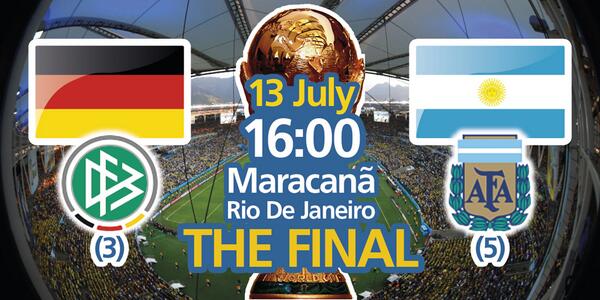
What can I say about the World Cup? All I can say is that it starts with 32 teams, takes a month and at the end, only one country’s left smiling. And so after 62 games and loads of surprises, they’ve weeded out the thirty pretenders and gave us the two contenders: Germany who has won the Cup three times before and Argentina who have won it twice before. The Maracana will be the stage for deciding the World Cup winners. Here I’ll do a rundown of the two teams and even make my prediction on who I think will win the Cup.
First an interesting note I came about. Isn’t it ironic that both the final for the Cup and the 3rd-place match are both like rematches of quarterfinals of the last World Cup? Anyways I’ll get on with it.
Past Head-To-Head Results:
Germany and Argentina have squared off against each other 20 times. Argentina has won the most often with nine times. Germany has won six and five were draws. Both Germany and Argentina have scored 28 goals against each other. Germany and Argentina have crossed paths at seven World Cups starting in 1958. Surprisingly this is the third World Cup in a row they both challenge each other. The previous two were in quarterfinals. In 2006 when Germany hosted, they tied 1-1 and it took a round of penalty kicks to decide Germany the winner. Last World Cup it was Argentina that had their own version of the Mineirazo as Germany won 4-0. Also as surprisingly, this is the third World Cup Final they both face each other: the most World Cup finals pairings ever. The first was in 1986 when Maradona and the boys won 3-2. The following World Cup they met again and it was German revenge 1-0. In both cases, that was the last World Cup either team won.
ARGENTINA: One word that can best describe Argentina here at the World Cup is consistent. They won all three of their Group Stage games: 2-1 against Bosnia, 1-0 against Iran, and 3-2 against Nigeria. They also won their Round of 16 match against Switzerland in extra time 1-0, their quarterfinal against Belgium 1-0 and their semifinal against the Netherlands in a penalty shootout.
There’s another word to describe Argentina’s play at this World Cup: lackluster. The phenomenal big play that Argentina has been known for was missing. Instead it looked like they were focusing on the conservative. Sure, the conservative style worked for France last world Cup but this is not what you’d expect from Argentina. Sure Lionel Messi has been one of the stars of the tournament and has lived up to his reputation during the World Cup but other Argentinians like Gonzalo Higuain and Angel di Maria have been playing rather modestly than what they’re reputed for. That scoreless draw should be cause for concern since it was mostly a contest of ball control and very little attacking. In fact I remember a scene near the end of regulation where it appeared Dutch players were lollygagging with the ball.
Whatever the situation, conservative play will not come in handy, especially against a team that annihilated the host country on Tuesday. That game has to be the biggest signal to Argentina that if they were to win the Cup, they will be pressed to pour it on like never before at this Cup. There’s no doubt Messi and Higuain have what it takes here. They have to be prepared for a similar attack like Germany gave Brazil on Tuesday. It’s evident that Germany can take full advantage of an opponent’s vulnerability and come down hard on them. They should know because Germany beat them in the quarterfinals at the last World Cup 4-0, just after winning every other previous game they played.
As for the team, I’m not worried about Messi. I think of him as Maradona without the ego. Especially since it’s evident he knows what he needs to do to deliver here and he’s done that. Sergio Romero has been an excellent goaltender as he has delivered each time and has only conceded three goals. The rest of the team will have to be prepared for anything from Germany whether it be conservative play or an all. And with Angel di Maria out, they will have to step up their midfield. Coach Sabella knows the job he has to deliver and I’m sure he’ll mean business, especially to bring Argentina back on top after 28 years.
GERMANY: What can I say? They are not called the Mannschaft for nothing. What we have is a team that is lacking in superstars and celebrity. Heck, Miroslav Klose has scored the most goals in World Cup history and he doesn’t have the star power as say Neymar, Messi or Cristiano Ronaldo. Instead we have a team full of players that are focused, know what they have to do and deliver. And they definitely know how to pour it on as evident in the Mineirazo and their opener of 4-0 against Portugal. You can bet Germany is a team that knows how to deliver.
Or do they? Sure, they had big wins against Portugal and Brazil but they have had their share of tight matches at the World Cup, like when they temporarily trailed Ghana before they tied 2-2. Or even going scoreless against Algeria in regulation before winning 2-1. It’s evident in those matches that Germany has weaknesses of their own and could be made vulnerable by Argentina. Argentina is a team very familiar with them and knows how to rival them. It’s also very possible Argentina will want to avenge Germany for the last two World Cup quarterfinals. Sure, Argentina has not been too spectacular but they could just pour it on when they have to. It’s happened before in major play.
One thing about Tuesday’s game, it’s that coach Joachim Löw doesn’t want that big win to make his team overconfident. Even Miro Klose stated that he doesn’t want the win to get to the team’s head. What they’ll have on Sunday is a new team and will need a new plan to win. It’s evident with each passing match, it’s all about knowing the rival, controlling them and monopolizing on your chances. And that’s what Germany will have to do on Sunday to win the Cup for the fourth time and for the first time ever as a unified nation.
MY PREDICTION: Okay. So here goes. My prediction for the winner of the 2014 World Cup. I believe it will be Germany 2-1 in extra time. Wow! I’ve been making a lot of predictions where the score is 2-1, haven’t I? But that’s what I believe it will be. Germany have that edge in terms of delivering goals and will continue to be the case if Argentina don’t step up their game. Argentina know how to defend and control opponents but they lack the ability to monopolize on their chances. So that’s why I give Germany the edge.
So there you go. It was fun making predictions for the World Cup. I hope to do football/soccer predicting again sometime soon. Maybe my next chance will be for next year’s Copa America. Provided if TSN or ESPN broadcast it.
The World Cup in 1950 was to be Brazil’s shining moment. Instead it delivered a heartbreak that still haunts them to this day.
You may remember a while back I talked about Brazil’s football legacy but refrained from talking about 1950, the first time they hosted. The first time they hosted was intended to be a grand moment for the country and especially their football team. In fact the Maracana was built to be the grand stage for Brazil’s win. Unfortunately the Cup ended with a heartache that still haunts the country to this day.
WAR IS OVER, THE WORLD CUP IS BACK
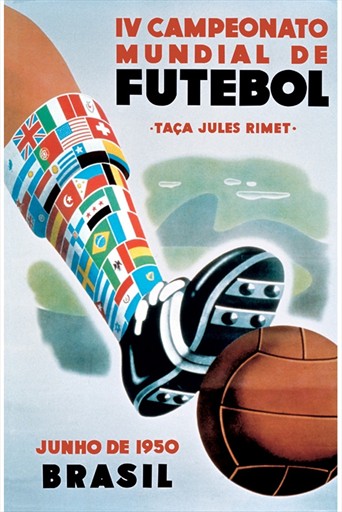
1950 was to be the fourth time the FIFA World Cup would be held. It started in 1930 but the 1942 World Cup had to be cancelled because of World War II. The 1946 World Cup was also cancelled as the world was still recovering from the end of that war just one year earlier. Just like 1948 was the year that brought the Olympic Games back to life, 1950 was the year the World Cup came back. However Germany and Japan were still part of the international sanctioned list and were banned from competing, just like they were banned from the 1948 Olympic Games. Brazil and Italy were given automatic berths: Brazil as host country and Italy as defending champions. The four British nations of England, Scotland, Wales and Northern Ireland returned to FIFA after seventeen years of ‘exiling’ themselves.
WE WANT OUT
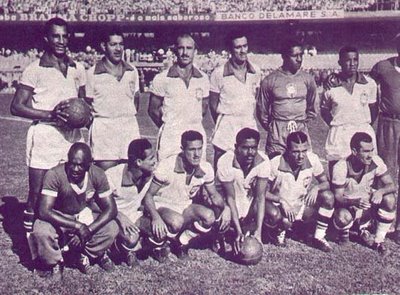
The 1950 Brazil team. Before 1950, Brazil’s best finish at the World Cup was third in 1938.
Seven spots were allocated to European countries, six to American countries and one to an Asian country. If you think it’s hectic getting teams to qualify for the World Cup, you should hear about 1950. Not because of competitive play but more because of international politics and football politics. Iron curtain countries like the USSR and two countries that participated in 1938–Hungary and finalist Czechoslovakia– refused to participate. Argentina, Peru and Ecuador withdrew after the qualifying round, possibly because of a dispute with the Brazilian Football Federation. The Philippines, Burma and Indonesia withdrew leaving India to receive the Asian berth by default. Austria declined to participate in qualifying feeling its team wasn’t good enough and Belgium withdrew from the qualification tournament which allowed Switzerland and Turkey to qualify without playing their final round of matches.
With the qualification done, it was off to the World Cup, right? Scotland withdrew because the very prideful chairman of the Scottish Football Federation insisted Scotland would only travel to Brazil as winners of the Home Championship. When England showed up, Scotland withdrew, even though England planned to attend even without the Championship. Turkey withdrew because of the huge cost of traveling to Brazil. FIFA invited two European nations who failed in qualifying–Portugal and France–to fill the gap. Only France accepted.
Now with the fifteen teams set for Brazil, that should lead to straight competition, but that led to more withdrawals. First came the draw on May 22, 1950 in Rio de Janeiro. India was the first drawn team to withdraw because of travel costs. France then withdrew because of the cost and time to travel between the cities. That left the World Cup with a field of only thirteen teams. Just like 1930 again! After all that, here’s how the teams worked out:
Group 1: Brazil, Mexico, Switzerland and Yugoslavia
Group 2: England, Chile, Spain and the United States
Group 3: Italy, Paraguay and Sweden
Group 4: Uruguay and Bolivia
ON WITH THE CUP
After all that hassle, the World Cup finally began on June 24, 1950. This would be the first world Cup since the inaugural 1930 World Cup where group play would be contested and would be the only World Cup where group play would decide the winner. It was Brazil’s idea to do this because more games meant more ticket sales to help compensate for the expenses of the stadiums. FIFA at first rejected the idea but agreed when Brazil threatened to pull out as hosts. The matches were held in six stadiums in six cities: Rio De Janeiro, Sao Paulo, Belo Horizonte, Curitiba, Porto Alegre and Recife. Four of the six stadiums were long into existence before the World Cup. There were only two that were build especially for the Cup: Estadio Raimundo Sampaio in Belo Horizonte and the Maracana in Rio.
Because of the uneven number of teams per group, it was decided that only the team that finished first advances. Group 4 had no problem deciding the advancer as that only required a single game, which Uruguay won 8-0 over Bolivia. In Group 3, Sweden was the winner with a win against Italy 3-2 and a draw against Paraguay 2-2.
Groups 1 and 2 were the two fully contested groups and they provided the most action. Group 1 was a no-brainer right from the start. Brazil delivered an attack style of play that would take them to the top of the group with a 4-0 win over Mexico, a 2-2 tie against Switzerland and a 2-0 win over Yugoslavia.
World Cup 1950 wasn’t all Brazil, Brazil. It also was the stage for the American’s 1-0 upset over England with Joe Gaetjens (right) scoring the winning goal.
Group 2 was not exactly remembered for its winner Spain or for Spain’s wins of 3-1 over the US, 2-0 over Chile or 1-0 over England. Instead Group 2 was known for one of the biggest soccer upsets of the time. The US vs. England match first appeared to be England’s for the taking since England, known then as the ‘Kings of Football,’ had the pros on their team while the American team was made up of part-time players who made their income from the jobs they worked. However the English and the 13,000 in attendance at the Estacio Independencia in Belo Horizonte were stunned when American Joseph Gaetjens, who was actually not an American citizen, scored the first goal in the 38th minute. Despite strong challenging play from both sides throughout the game, there were no other goals scored. The Americans’ 1-0 win over the English is still considered one of the biggest upsets in World Cup history.
The aftermath of this was also interesting. It made huge news in World Cup countries and almost made huge news in England but was trumped by the news the English cricket team lost to the West Indies for the first time ever. The English were nitpicky about the win saying that the team ‘had arrived through Ellis Island,’ referring to the assumption most Americans on that team were children of immigrants or immigrants themselves. For the record, three members of the American team including Gaetjens were not yet American citizens. In the United States, the win only made sidelined news. The Americans were still disinterested in soccer as they still promoted their ‘all-American’ sports like baseball, football and basketball. The win would gain appreciation by the Americans over time and especially in the last 25 years with the Americans slowly welcoming soccer especially after hosting the 1994 World Cup and the formation and success of MLS (Major League Soccer). The game has recently been dubbed by the Americans as the ‘Miracle Match’ and even spawned a small 2005 film “The Game Of Their Lives.’
ANOTHER SET OF GROUP PLAY?
Because of the uneven numbers of the groups in the first round, it was not only decided that only those that finish first in their group advance but also that it be group-style play to decide the winner.Also that ticket sales thing also has a lot to do with it too. This would be the only time in World Cup history in which group play would decide the winner. In group order, the finalists were Brazil, Spain, Sweden and Uruguay. All of the games in the ‘winners group’ were played either in Sao Paulo’s Estadio de Pacaembu or the Maracana. All teams played all their matches on the same day and at the same time. Brazil’s matches in this round were all contested at the Maracana.
The group play of the winners started July 9th with a 2-2 draw between Uruguay and Spain. Brazil delighted a crowd of 139,000 with a 7-1 win against Sweden which included four goals from Ademir. On July 13th Brazil continued their winning ways in front of a crowd of 153,000 with a 6-1 victory over Spain which included the Cup’s only ‘own goal’ by Spaniard Jose Parra Martinez. Uruguay gained some boost with a 3-2 win over Sweden with the winning goal coming with five minutes to go. The two games on July 16th were still group games however many still believed they played the role as 3rd Place Final and Final because of the end result and the team’s overall placing. Sweden beat Spain 3-1 in Pacaembu with a measly attendance of 11,000 and would finish the World Cup in third place.
A FINAL GAME TO BE REMEMBERED
“Down through its history, only three people have managed to silence the Maracana: the Pope, Frank Sinatra and me.”
-Alcides Ghiggia
Okay, here it was. This was Brazil’s for the winning. They were in excellent position to win the World Cup. They’ve already proven to the world their greatness. Even if Brazil tied Uruguay, they could still win the World Cup because Brazil had two wins while Uruguay had a win and a tie. The general public were not the only ones claiming Brazil to be the victors days before the match even started. The specialized press were too. In fact the Brazilian newspaper O Mundo printed an early edition paper that day with the Brazilian team on the front page with the headline ‘These are the World champions.” There was a song composed days before the game entitled Brasil os vencedores (Brazil The Victors) and was to be played once Brazil won. Even Julie Rimet, president of FIFA and founder of the World Cup, anticipated Brazil would win and even had prepared a speech in Portuguese to congratulate anticipated winners Brazil after their win. Unlike now, medals were not awarded to teams at the World Cup who finished in the Top 3 but the Brazilian Football Confederation has already made 22 gold medals with the names of the players engraved on them.
On the morning of July 16th, the streets were already full of energy and there was even a ‘makeshift carnival’ with thousands of signs celebrating the world title and chants of ‘Brazil must win!” The Maracana was bustling in its own way. One thing we should remember is that the Maracana stadium consisted of two tiers of stands and much of the stands were standing area. This is the reason why unlike today they could field a capacity of over 100,000. At this match, the official paid attendance registered 173,380 attended while many estimate the actual attendance was over 210,000. This still remains as a world record for attendance for a team sports match.
As Brazil were in the dressing room, confident of victory in their spiffy white shirts and blue collars, Uruguay has other plans. Uruguay’s captain Obdulio Varela brought as many copies of O Mundo that had ‘These are the World champions” on the front page, laid them on their bathroom door and encouraged his teammates to urinate on them. In Uruguay’s locker room prior to the match, coach Juan Lopez informed the team that their best chance of surviving of surviving the powerful offensive line of Brazil would come through adopting a defensive strategy. After he left, Varela stood up and addressed the team himself, saying “Juancito is a good man, but today, he is wrong. If we play defensively against Brazil, our fate will be no different from Spain or Sweden”. Varela then delivered an emotional speech about how they must face all the odds and not to be intimidated by the fans or the opposing team. In response to his squad’s underdog status, the captain delivered the memorable line, “Boys, outsiders don’t play. Let’s start the show.”
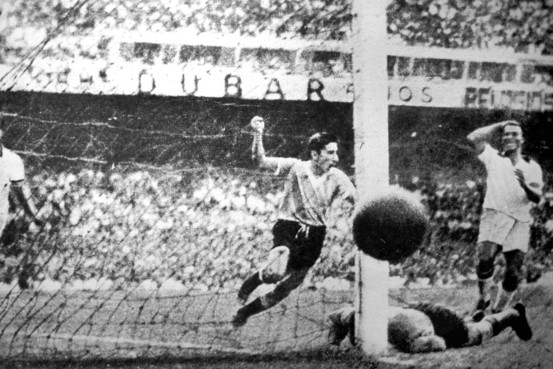
The goal scored by Alcides Ghiggia (centre) in the 79th minutes stunned the Maracana silent and would break the hearts of Brazil.
As expected, the game began with Brazil playing aggressively and attacking against the majority of the Uruguayan defensive line for the first half. However unlike Spain and Sweden, Uruguay was successful in maintaining their defense and the first half ended scoreless.
First blood was drawn at the 47th minute when Sao Paulo forward Friaca shot low past the goalkeeper to give Brazil the first goal of the game. Captain Varela immediately took the ball after the goal and disputed its validity, arguing that it was offside. Varela’s argument was obviously intentional to the point he even forced the referee, Englishman George Reader, to bring out an interpreter. The protest was unsuccessful but it succeeded in calming the crowd down. Then Varela took the ball to the centre of the field and shouted to his teammates: “Now it’s time to win.”
Uruguay was able to find control of the game and Brazil soon had its defensive frailty exposed. Juan Alberto Schiaffino scored the equalizer for Uruguay in the 66th minute. Then in the 79th minute, Alcides Ghiggia ran down the right side of the field, dribbled past Brazilian defender Bigode and scored another goal. The crowd was virtually silenced; Uruguay was now the leader. The silence continued for the remainder of the play until Reader blew the final whistle. It was official: Uruguay won the Cup by defeating Brazil 2-1.
THE AFTERMATH: BOTH IMMEDIATE AND IN THE LONG RUN
“The maximum punishment in Brazil is 30 years imprisonment, but I have been paying, for something I am not even responsible for, by now, for 50 years.”
-Moacir Barbosa
When the sudden news was official, many said there was a ‘traumatic and disturbing absolute silence’ except for the celebrating by the Uruguayan team and delegation. In Brazil, many newspapers refused to accept the fact that their team had been defeated. Radio journalist Ary Barroso retired, albeit briefly. At least two or three people on the top tier of the stands of the Maracana were so distraught by the loss, they committed suicide. Yes, there were peole so distraught over Brazil’s loss, they committed suicide. One man in the stands even had a heart attack. The gold medals were immediately disposed of. The song Brazil the Victors was never played. The nation was just heartbroken over the loss. The game remains one of the biggest upsets in football history and Brazil commonly refers to that game as the Maracanazo, or “blow at the Maracana.” Even Pele talks of how his father cried saying: “Brazil lost!”
In the years to come, the game was influential for a lot of superstition. For one thing, Brazil refused to have a white-and-blue uniform and would soon adopt their famous yellow shirt with blue collar that still exists today. White is seen as bad luck in Brazil. The players of the time were vilified by the fans and were sometimes seen as bad luck. Many went into silent retirement while some never played for the national team again. Only two players that didn’t play in the final played for Brazil’s team in later World Cups. The defeat would weigh down on Brazil’s team so much, they brought a psychiatrist to the 1958 World Cup to remove the haunts of the memories of that game. Whatever the situation, the Brazilian team of 1958 which featured a 17 year-old Pele capturing the world’s imagination won the World Cup: the first of five total World Cups won by Brazil.
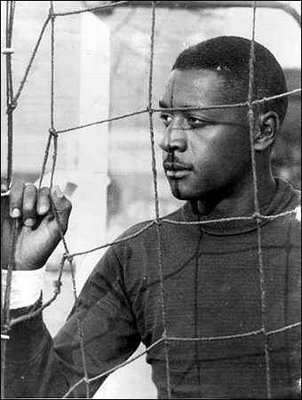
Brazilian goalkeeper Moacir Barbosa would be blamed and even vilified for Brazil’s loss for the rest of his life.
However of all the players from Brazil, it was goalkeeper Moacir Barbosa that got hit the hardest. He received the biggest flack and biggest blame for the Maracanazo and it seems like Brazil never forgave him. He was still able to play professionally for another thirteen years and was even part of Brazil’s national team until 1953 but he was commonly shunned by the nation. There was even one time he was in a store in Brazil and a mother pointed at him and said to her small son: “Look at him, son. He is the man who made all of Brazil cry.” Little changed over the years. In 1993 the president of the Brazilian Football Confederation refused to let him be a commentator. In 1994, the Brazilian national team did not want him to visit them because they feared he would give them bad luck. If there was one good thing, his wife stayed married to him for a total of 50 years until her death in 1997. He managed administration at the Maracana but was always at a shortage for money after leaving. He did however received assistance from sources such as Brazilian football team Vasco da Gama and his wife’s friend after her death. The friend remembered his last years: “He even cried on my shoulder. Until the end he used to always say: ‘I’m not guilty. There were 11 of us.'” Moacir Barbosa died of a heart attack in 2000 at the age of 79. He was penniless at the time.
One interesting note is what happened to Alcides Ghiggia who scored that heartstopping goal. He would continue to have a prolific career as a professional player until 1968 and was even signed onto European teams like AC Milan and AS Roma during a time when it was extremely rare for South American players to play for teams outside their home country. As of today, the 87 year-old Ghiggia is the only surviving member of Uruguay’s World Cup winning team from 1950.
Interesting note is that on December 29, 2009, Brazil honored Ghiggia by celebrating that decisive goal by having Ghiggia plant his feet in a mould to take his place along greats like Pele, Eusebio and Franz Beckenbauer. The reception to Ghiggia was surprisingly warm and Ghiggia himself was overcome by emotion to the warmth. Ghiggia also made a return appearance to Brazil during the draw for the groups of the 2014 World Cup in December 2013. Each country that had won a World Cup in the past was allowed to send one of its great players to participate in the draw. Uruguay sent Ghiggia. There was however one negative thing as of recent. Ghiggia has been invited to the opening games of both the 2006 and 2010 World Cup but it was revealed by him that he was not on the guest list for this World Cup. I wonder who did it too? Whatever the situation, FIFA spokesperson Delia Fischer insisted the day before that Ghiggia and a guest will have at ticket. Ghiggia has also commented on this World Cup: “I hope Brazil become world champions, so they can all enjoy it here.”
The Brazilian team this year are hoping to finally make that bad memory of 1950 a think of the past. So far Brazil have been doing very well even if they’re not the most spectacular team out there. They opened with a 3-1 win over Croatia but left people shocked with a 0-0 draw against Mexico. They did reassure people that they will win with a 4-1 win over Cameroon to close out the Group Stage. They did win the Round of 16 match against Chile on penalty kicks after a 1-1 draw. For those concerned since that, don’t be. There have been many teams in the last 28 years that had a match lead to penalty kicks before they played in the final for the Cup and won.
Brazil is often praised and even fancied in the way they treat football like a religion. However their reaction to their loss in 1950 is a negative side of that. Sure the loss to Uruguay was a shock but it’s a shame how they went about it. You know how when the Boston Red Sox won the 2004 World Series and fans then showed a sign saying “We forgive Bill Buckner” in reference to Buckner’s Series-costing fumble in Game 6 of the 1986 Series? I hope that if Brazil wins the World Cup, there should be someone in the stands with a sign saying: “Nós perdoamosMoacirBarbosa (We forgive Moacir Barbosa).”
Funny how people refer to ‘Groups Of Death’ to groups packed full of the best talent in the world. Group H consists of four teams that are not considered major threats to the World Cup but any of the two can move to the Round of 16. Also don’t count any of them out as possible challengers for the cup. So for my final group rundown, here’s my take on Group H:
-Belgium (12)- If you thought it was a surprise to see Switzerland among the seded team in FIFA’s World Cup draw, it should have been just a surprising to see Belgium. Even though Belgium was in the FIFA Top 8 at the time, Belgium is a country one would not normally expect to see as a seded team. Their best World Cup finish ever of the eleven previous World Cups they’ve played in was fourth in 1986. The last World Cup they played in was 2002 and they didn’t even qualify for Euro 2012. However that all changed in 2012 when they hired Marc Wilmots as head coach after being assistant coach for three years. Wilmots himself had played for Belgium in four World Cups and even scored five goals in World Cup play. Belgium was placed in possibly the most difficult European qualifying group for 2014 but they played like magic. They won eight games and tied the other two en route to coming first in their group and automatically qualifying with just one game to go. The spirit of the Red Devils was felt again in their homeland as the country greeted them upon their return in big fanfare. Their success helped put them in FIFA’s Top 8 around the time of the draw which led to them classed as one of the seded teams. Their performance in qualifying was so impressive, Wilmots was signed on to be coach for another four more years. However Belgium’s play in friendlies have not been so spectacular as they’ve lost to Romania, Colombia and Japan. They do have impressive wins against the U.S.A. and Sweden and even tied France. Nevertheless their lackluster friendly play has dropped them from the Top 8 and now stand 12th. Nevertheless this is a big boost for country as this will be their first World Cup in 12 years. Half the team play for top European teams like Manchester United, Bayern Munich and Atletico Madrid. Whatever the situation, no doubt they’ll send the message that Belgium is back.
-Algeria (25)- Algeria is another team coming to this year’s World Cup hoping for a breakthrough moment. They’ve competed in three World Cups before: in 1982, 1986 and 2010. They have had better luck defining themselves at the Africa Cup of Nations where they’ve made it as far as the semifinals five times and even won back in 1990. However they’re hoping this World Cup to finally progress past the Group Stage. Their squadron is coached by Bosnian Vahid Halilhodzic who coached the Ivory Coast at the 2010 World Cup. Top players include Madjid Bougherra, Islam Slimani and Sofianne Feghouli who’s already being called ‘the New Zidane.’ Algeria won their opening group in qualifying for the World Cup. They would then face Burkina Faso for the berth. The first game ended with a 3-2 loss but Algeria came back 1-0 to clinch their trip to Brazil. They’ve also not lost a friendly in the past two years and would include wins against Slovenia and Romania and ties to South Africa and the Ivory Coast. If they play consistently, Algeria could have their best ever World Cup here.
-Russian Federation (18)- Russia is a team that has struggled to prove itself since the breakup of the USSR back in 1991. Back during the days when the USSR did well by advancing past the Group Stage in all but one of their seven World Cup appearances and even finishing fourth in 1966, the majority of Soviet players were Russian. Since the collapse of the USSR in 1991, Russia has continued to shell out remarkable talents in the years since. However the national team has always fallen short of making a statement of their prowess. They’ve only qualified for two World Cups–1994 and 2002– and only went as far as the Group Stage in both cases, even though Ukrainian-born Oleg Salenko set a World Cup record in 1994 with the most goals in a single World Cup game: five. They did however have a moment of glory by finishing third at Euro 2008. However they come to Brazil looking for more as they will have the task of hosting the next World Cup in 2018. No doubt they want to create an impression here. Although all the players play for Russian League teams with many playing for Dynamo Moscow, their coaching staff is almost all Italians and the head coach is Fabio Capello who has coached AC Milan, Real Madrid, Juventus and England up to 2012. Russia performed well enough in qualifying to win their qualifying group over heavily-favored Portugal. They’ve showed their abilities by scoring wins against Portugal, Slovakia, South Korea and Morocco. They’ve also tied countries like the U.S.A. 2-2, Serbia 1-1 and Brazil 1-1. It’s make or break for the Russian team here in Brazil. They come to play well and learn.
-South Korea (55)- Isn’t it interesting that Group H has two teams named The Red Devils? There’s Belgium, where the Belgians call them les Diables Rouges or de Rode Duivels, and there South Korea who also go by the name the Taegeuk Warriors. South Korea has traditionally been the best team in Asia. None of the other Asian countries here in Brazil have as much of a track record as South Korea who will be playing in their eighth straight World Cup. Their best finish ever was a fourth-place finish in 2002 when they co-hosted with Japan. Much of their prowess has to be with the K-League that was started in 1983 and has really taken off since. However South Korea appears they don’t have the prowess they’re used to showing. They’ve had wins against Greece and Switzerland in the past two years. However they’ve had to endure losses to Brazil, Croatia, the U.S.A., Russia and Mexico. Since qualifying for the World Cup, they’ve changed coaches to Hong Myung-Bo who’s had experience coaching in the MLS. They’re hoping he can make an improvement for the team and he’s already helped Korea move up to 55th from 59th a month ago. It’s quite possible they might prove in Brazil those low FIFA rankings are just bad estimates.
And now my prediction for the two advancers: I predict Belgium and Russia with Algeria the one most likely to upset.
STADIUM SPOTLIGHT
Okay, I’m done reviewing the last World Cup group. Now time to focus on the last two World Cup stadiums. My final Stadium Spotlight focuses on the two stadiums in two of Brazil’s biggest cities. One is a new stadium, the other is old and legendary. On will be hosting the opening ceremonies and opening match. The other will be the stage for deciding the winner of the Cup, just like it did 64 years ago.
-SAO PAULO : Arena de Sao Paulo
Year Opened: 2014
World Cup Capacity: 61,606
World Cup Groups Hosting: A, B, D, H
Additional World Cup Matches Contested: Round of 16 (F1 vs. E2) & a semifinal
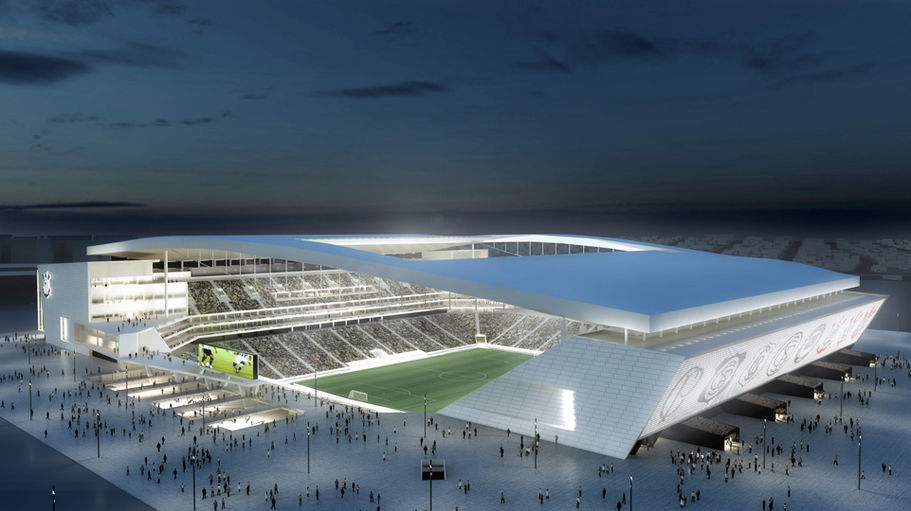
Sao Paulo’s new stadium came about as Estadio Pacaembu was too small to host World Cup games and was getting too old. Also the much bigger Estadio de Morumbi was judged by FIFA as unsuitable to hold World Cup games. Thus the creation of the Arena de Sao Paulo. However creating the stadium came with difficulties. First, national funding for the stadium was delayed for two years. Secondly, the Arena originally planned to hold 72,000 for World Cup games. Relocation of TV Equipment and VIP seating reduced the capacity to 61,606. Even though the stadium has officially been opened on May 10th, it was noted modifications were still underway two weeks ago and people are still unsure if the stadium has been finished. They better be ready June 12th because they’re hosting the opening ceremonies and first match: Brazil vs. Croatia. After the World Cup, the seating will be reduced to 48,234 and will be managed by the Corinthians football team who will have the stadium renamed Arena Corinthians. The stadium is also a venue for the 2016 Summer Olympics.
-RIO DE JANEIRO : Estadio do Maracana
Year Opened: 1950
World Cup Capacity: 78,838
World Cup Groups Hosting: B, E, F, H
Additional World Cup Matches Contested: Round of 16 (C1 vs. D2), a quarterfinal & final for the Cup
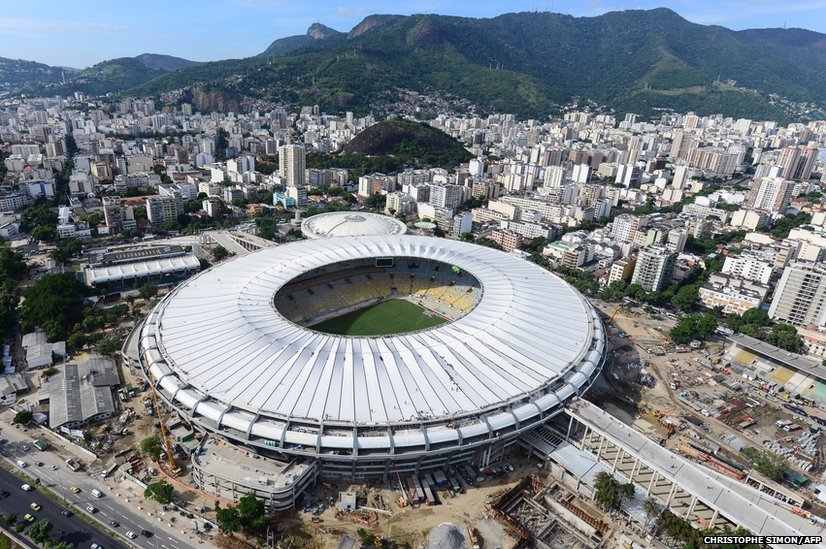
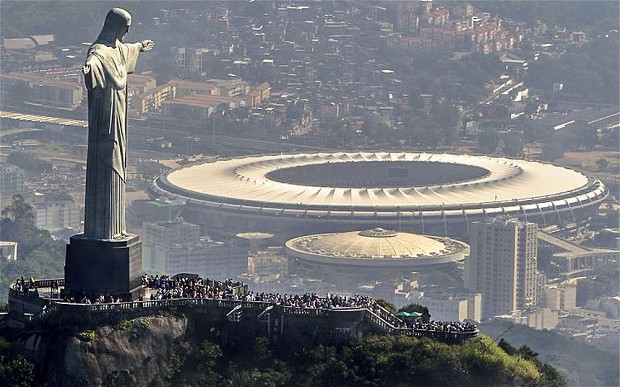
If many people view football as a religion, then the Maracana has to be one of its prize temples, especially for Brazilians. This stadium was opened in 1950 to host the World Cup. The final game of that World Cup set a world record that stands today of the largest attendance of a soccer game: official count at 199,854 but actual attendance is estimated around 210,000. Since the World Cup, the Maracana has continued to attract large crowds to games for clubs like Vasco da Gama, Botafogo, Flamengo and Fluminese. The latter two still have the Maracana as their home stadium. However the capacity was greatly reduced in 1992 when an upper stand collapsed, killing three and injuring 50. Remember there was a time when stadiums allowed for both seats and standing area which allowed for such big totals I talked about. The Maracana was converted into an all-seater stadium since the accident. A bit of trivia: The Maracana can never be demolished as it was classified as a national landmark in 1998.
For the 2014 World Cup, major preparations and changes had to take place. The irony being the stadium had already underwent major renovations starting in 2000 just after it celebrated its 50th anniversary and completed in 2007. The original seating bowl that had a two-tier configuration was demolished and made way for the construction of a one-tier seating bowl. New seats in colors of yellow, blue and white form among the green match of the field to create the national colors of Brazil. The renovated Maracana played host to the Confederations Cup last year. After the World Cup, the stadium will return to being the host venue for Flamengo and Fluminese, continue to host major concert and will be the stage during the 2016 Summer Olympics for football games and the opening and closing ceremonies.
And that wraps it up. I’m done predicting World Cup groups and I’m done reviewing World Cup stadiums. All that needs to be done is let the show begin. I’m sure it will be a memorable one.


 Argentina: The South American team with the second-biggest legacy in football is undoubtedly Argentina. We’re talking about a nation that has won the World Cup twice, made the World Cup finals a total of five times, and won the Copa America fourteen times. A notion that has had their share of legends on the international scene like Guillermo Stabile, Daniel Passarella, Mario Kempes, Diego Maradona, Gabriel Batistuta, Claudio Cannigia, and the latest being Lionel Messi. Messi is often seen as the tour-de-force of the Albiceleste, but playing football is not a one-man job. In fact even at this tournament, Argentina has had other top scorers like Lautaro Martinez and Alejandro Gomez.
  Brazil: And now onto the nation with not just the biggest football legacy of South American teams but of all teams worldwide! Brazil has won the World Cup five times in the seven finals they’ve played in and have won nine Copas. If you started a list of the legendary Brazilian players in history, you’ll end up writing forever. However Brazil is not perfect. In fact the last fifteen years have been very good at exploiting Brazil’s weaknesses. Three of the past four World Cups, they’ve been out in the quarterfinals and talk about the humiliating semifinal against Germany at the 2014 World Cup which they hosted. And if there are any teams that are best at exploiting Brazil’s weaknesses, it’s the South American teams. In fact their 2019 win was their first Copa win since 2007. In between, there were three Copas and they were out either in the quarterfinal or group play.




 Jon The Blogcentric