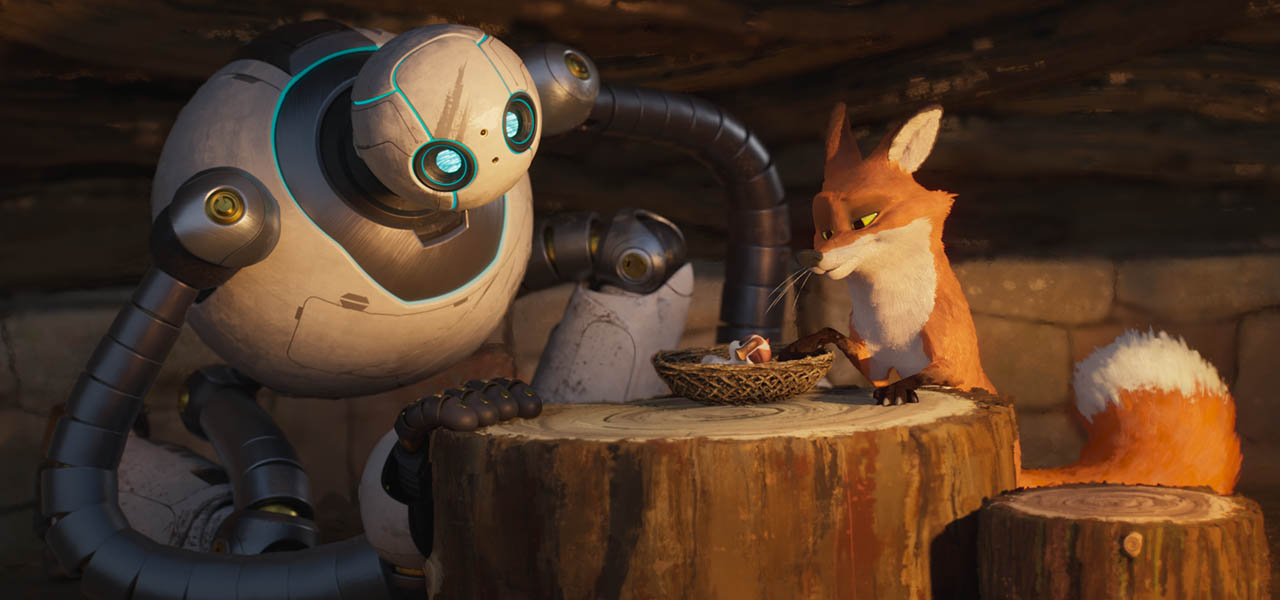
Movie Review: The Wild Robot

This year is one Oscar year where predicting the Best Animated Feature winner will be difficult. One of the favorites is The Wild Robot. Does it have what it takes to win?

The film begins in a remote forest land on an uninhabited island unblemished by human intervention. The coast soon becomes an unintentional wash-up ground for Universal Dynamic’s ROZZUM robots coming from a capsized ship. Only one robot, Unit 7134, survives and running wildlife activate it. It’s obvious the robot has no place on the island as it can’t interact properly with animals. The robot is intended to be a customer service robot with a female voice. Nothing the robot does helps any of the animals and the animals respond in a hostile manner, chasing 7134. Upon falling from running away, 7134 crushed a mother goose to death and all but one of the nest eggs on its landing. The lone egg that was unharmed hatches the baby gosling. 7134 takes a fascination in it. Plus 7134 is programmed to continue with whatever mission she’s given until completion. She puts the egg inside her chest.

7134 finds a memory card in herself to make her communicate with animals better and inserts it. Soon after, she encounters Fink: a sly hungry fox who knows of the egg and wants to eat it. 7134 is able to prevent the theft. Soon the egg hatches and a male gosling is born and imprints himself on 7134. 7134 now has a mission to raise the gosling to adulthood, but how? 7134 first finds guidance from a mother opossum who’s currently mothering six babies. Fink returns but instead of eating the gosling, he makes a deal with 7134 to help raise the feller for a shelter in return. 7134 agrees and creates a hut for them all to live. In the naming of the gosling, 7134 gives the gosling number-names which annoys Fink. Fink gives 7134 naming tutelage and the gosling is given the name ‘Brightbill.’ 7134 even gets a new name of her own: Roz.

Over the months, Brightbill grows, albeit awkwardly. While the other goslings are goose-like and grow as naturally as geese do, Brightbill acts more like Roz than a goose. The other teen goslings taunt him for his awkwardness. Then one day, another flop day of goose training for Brightbill, one of the peers tells Brightbill that Roz killed his mother. It’s there Brightbill turns against Roz.  Even though Roz still wants to mother Brightbill, a ROZZUM unit she reconstructs tells her to return to Universal Dynamics. Roz is determined to reconcile with Brightbill and raise him. That sends a signal back to Universal Dynamics. Meanwhile Roz finds the right bird to teach Brightbill how to fly: a falcon named Thunderbolt. With help from goose master Longneck, Thuynderbolt succeeds in making Brightbill able to fly in time for migration.

The migration is not what it seems. The birds encounter a thunderstorm as they fly in San Francisco. They hope the greenhouse from Universal Dynamics they spot in San Francisco is the temporary shelter they need, but the Universal Dynamics technology detects the birds as contaminant and a multitude of reconnaissance, or RECO, robots that look exactly like Roz go shooting at the birds. The island which has the hibernating animals goes through a severe snowstorm and they fear they will freeze to death. Roz and Fink build a shelter for all animals but demand a truce of all of them not to harm each other.

As spring returns, Brightbill and the geese return, Roz repowers herself and the animals are free to roam the island. Unfortunately, Universal Dynamics has sent a robot to retrieve Roz named VONTRA and she’s troublesome, reckless and remorseless. VONTRA is not even afraid to start a forest fire on the island to get Roz. It’s then the animals group together to rescue Roz and battle VONTRA as their land is burning in a bright red fire. I won’t spoil the ending but the film then ends not with the battle but the aftermath, reminding us of the bond between Roz, Brightbill and all the animals.

This film is based upon the 2016 children’s novel The Wild Robot by Peter Brown. The story itself is a story about togetherness. In many ways, children who watch this film can learn about the importance of getting along and actually coming as one. If animals who attack eat other or treat each other as prey can get along, so can other kids. Same way as a robot, who has no qualities to bond with animals, learns to have those qualities and does bond. Even raise a baby gosling to goose. The film also has other themes too of the environment and how development threatens animal’s habitats. Even the threat of having technology run things and make decisions with no human feelings is another thematic element of the story. At the beginning, I didn’t think Roz would be of any help to the animals of the island. Just an interference that acts on her own programmed logic to do only the things she’s programmed to do. A change of things changes everything and Roz becomes an unlikely hero.

The film’s quality is in its story. It plays the story well. The animals act like animals and Roz acts with her programmed logic. Over time we see the story develop. Roz goes from being an interference on the island to becoming a big help. Fink goes from a sly conniver to being a big help to the animals too. Brightbill also goes from being a robot-like gosling to the goose he was meant to be. It succeeds in making moments you think won’t develop properly develop into the way it was meant to be. At the same time, the film also adds in the other threats like how robots are sent to the island as Roz is not doing her commanded duties and VONTRA threatens to get her even at the cost of the island’s destruction. Unexpected moments like these and the film ending in the manner you didn’t expect add to the story. Also since this film is an adaptation of the first book of a Wild Robot trilogy of books, it also sets up well for the sequel that will be adapted from The Wild Robot Escapes novel. The box office results of this film have opened the door for the development of a sequel, but filming details and release date have not yet been confirmed.

The biggest credit should go to director/writer Chris Sanders. Sanders has over 40 years of experience in animation having first worked as a scriptwriter for the Muppet Babies cartoons and then becoming story writer for five of Disney’s films in the 1990’s during the ‘Disney Renaissance.’ He then broke out into directing with 2002’s Lilo and Stitch which is the first film he directed, co-directing with Dean De Blois. Since then, he moved onto Dreamworks Animation and has co-directed How To Train Your Dragon with de Blois, The Croods with Kirk DeMicco and his first solo project The Call Of The Wild. In this film, he succeeds in delivering an excellent story mixed with dazzling effects. He does a great job in making a film that can easily make Disney and even Pixar jealous!

Also great voice acting from Lupita Nyong’o. She knows how to make Roz the unfeeling robot at times she needs to be and help her develop into having feelings. Kit Connor also does a great job in playing Brightbill from his awkwardness to his anger. Pedro Pascal is excellent as the sly Fink. Stephanie Hsu is also great as the villainous VONTRA. Actually the mix of vocal talent is great throughout the film. Adding to the film is the musical score by Kris Bowers and the work from the film’s sound team and the visual effects team.

In the Oscar category of Best Animated Feature, this film has been in a tight battle against Flow. To think, its biggest rival is an independent film from Latvia! In this category, Flow has won the National Board of Review award, the Golden Globe, and the Online Film Critics Society Award. The Wild Robot has won the Critics Choice Award and the Producers Guild Award in this category. At the Annie Awards for animated films, it achieved ten nominations in nine categories including Best Animated Feature and it won in all nine!

The Wild Robot delivers in what one would commonly expect in an animated film. Although it’s more oriented for children than it is for adults, the parents will have no problem being entertained by the story. Don’t be surprised if it wins the Oscar on Sunday!

VIFF 2023 Review: Last Summer (L’Été Dernier)

Samuel Kircher and Lea Drucker play stepson and stepmother that goes too far in the French film Last Summer.

For those that attend film festivals, there are many patrons who hope to catch a film with a bizarre storyline that looks good. One film that attempts to do it is the France film Last Summer. It’s a bizarre story that comes with unexpected twists.

Anne is an attorney in family law. She knows the system well and what works and what doesn’t in the Corts, but she will fight for her clients. Especially children. Anne is well-respected with how she works with rape cases, especially those involving minors. Anne is married to Pierre and has two adopted daughters from China. She does a very good job of balancing family life with her career.

Things change when Theo enters the picture. Theo is the 17 year-old son of Pierre’s from his first marriage. Theo is a troubled boy frequently getting in and out of trouble. Pierre is hoping a summer stay at his house will help improve him and improve his relationship with his son. In fact Pierre picks Theo up after his release from a detention centre. Anne is hoping to have this time to establish a mother-son relationship with her stepson.

Over time, Theo has no problem with being one of the family. He comes to family occasions well. He’s able to be a fun brother to his step-sisters. Anne has also found Theo to be a lot of fun to be around. It seems like they’ve developed a good relationship…or it’s something more. Anne is attracted to Theo and lets him know it. Theo is attracted to Anne in turn. Their closeness becomes more. A lot more.

Only problem is secrets don’t stay secret for long. The first exposure comes at a family birthday party. Anne’s sister catches them too close. She is disgusted and hurls an insult. Soon Pierre hears the news from Theo. Anne insists it’s all a lie. Whenever Pierre tries to bring it up, Anne knows of the right thing to say. When Theo confronts her in her office, she levels with him. She reminds him of his bad reputation and that no one will believe him. As time passes, Anne has successfully convinced Pierre and her sister that what they thought all along isn’t true. Soon Anne has one last encounter with Theo, which shocks everyone in the end.

Now this film is something. Very rarely do we have a film about incest created. And rightly so. Incest is a topic that almost all of us find disturbing and still churns a lot of people’s stomachs. This is a bizarre case. Theo is the stepson of Anne. Even if you get yourself questioning your morality as he’s not a blood relative of hers, he’s still the son of Pierre. Theo is a boy Anne is not to be attracted to in more ways than one. Seeing how the romance that is not to be unravel itself is enough to shock the pants out of the audients.

The funny thing about this film is that this film appears be about an incident of incest but if you look closer, you’ll see the film looks to be about Anne. Anne is a lawyer and an advocate: a respected woman who appears to champion the causes of exploited children. Soon she finds herself in a ‘tangle’ with Theo — a tangle that would lead anyone in the hottest of hot water — but she’s able to state her innocence and successfully convince those closest to her that it’s all a lie. We often forget that is the profession of lawyers and politicians: the power of the talk. Talk that wins cases, talk that wins minds, talk that can even trump proven truths. Anne has that ability to deliver that type of talk power and we see it throughout. She has the talk to win cases for young girls in family court, talk that can convince her husband and even her sister who catches her in the act that there’s no incest, and talk to convince Theo he won’t win his case against her. Usually a film about such an incident would be a film consisting of the incident, arrest, trial, conviction and any aftermath. I think that theme of Anne and the power of her talk may be the reason why the film ended in the way it did.

This is an incredible film by Catherine Breillat. Breillat is not well known outside of France. Her films in France have been known for decades to do about sexuality and family conflict. Her most notable works are 2001’s Fat Girl and 2007’s The Last Mistress. This film which she directed and co-wrote with Pascal Bonitzer is her first release in ten years and is actually an adaptation of a 2019’s Danish film Queen Of Hearts. Breillat does a great job in capturing the intensities of moments and having only us the viewer knowing the truth of the story. She knows how to capture what’s at stake should Anne be found guilty and expose a power play between the accuser and the accused.

The thing to make a film like this work is the acting. Lea Drucker was excellent as Anne, the one calling the shots. She knew how to make Anne the imposing figure that she is with the ability to be convincing to everyone even if we know it’s all a lie. Olivier Rabourdin was great as the husband who’s struggling to make sense of the whole situation of whether this really happened, what type of father he is. He was excellent at playing the man caught in the middle. Also great is newcomer Samuel Kircher. He gives Theo his recklessness, his innocence and his vulnerability without missing a beat. Very well done for a first performance.

Let’s just say Last Summer is a film of intrigue. It’s a film that features of an unspeakable happening and it comes with a lot of surprises including an ending nobody anticipated to happen. It’s a film that will get you thinking of what you saw over and over again!

VIFF 2021 Review: Zo Reken

The driver of the minivan in Zo Reken, Pascal Antoine, is a fictional driver. The passengers are real minivan passengers and they have a lot to tell.

What do I look like in this vehicle?

This van draws attention for all the wrong reasons.

I’m sure most people outside of Haiti have never heard of a ‘Zo Reken.’ The documentary Zo Reken is as much about the vehicle itself as it is about the political and living situation in Haiti.

The film begins with Pascal Antoine performing his music at a night club. After the show, he and his bandmates have drinks and then pack their gear up in a vehicle they call a ‘Zo Reken’ and head off. We learn a ‘Zo Reken’ is the nickname in Haiti for a Toyota 4-by-4 Land Cruiser minivan. It’s named after the ‘Zo Reken’ drink which consists of letting a shark bone sit in it. The vehicles most commonly called a ‘Zo Reken’ in Haiti are normally used to transport humanitarian aid to hospitals or various other sites.

However a violent coup to overthrow Haitian president Jovenel Moise has happened and brutal protests in the streets of capital Port-au-Prince have occurred. The nation is in a strict lockdown and Zo Rekens are no longer allowed for humanitarian aid. Antoine hacks a Zo Reken and uses it to help transport other Haitians around the capital. One thing is he will have to find routes along the bumpy roads that don’t collide with the violent fiery protests. Also he must he aware of people he passes throwing rocks at the vehicle.

The first passenger he transports is a man up a hill and avoiding barricades of fire set by protesters. As the man is transported, he talks about the humanitarian aid from non-governmental organizations, or NGO’s as they’re commonly called, that it’s more hinderance than a help. In a lot of ways, he sees the humanitarian aid from the NGO’s and international community as broken promises from these nations. They promised to bring Haiti out of the poverty and recover, but the poverty continues, as it has for decades. That explains why he and other Haitians see the Zo Rekens that transport the aid representing the NGOs or the continued repression, or simply power.

Later on, he transports another man. This Zo Reken is intended to be a vehicle to protectively transport many people across the capital during this turmoil. Soon this Zo Reken comes to represent a bus for many Haitians who otherwise would have to walk on foot. The second man he transports talks about the hidden anger among the impoverished to the rich. He understand why many would want to throw rocks at the Zo Reken. Anything that represents the wealth gap is seen as a target of wrath from the people. The types of people he transports along the way are various. He transports one man as he’s to have a job interview for a very rare opportunity for prosperity and timeliness is make-or-break. He transports a woman passenger and she has a lot to say of the situation for the women in Haiti.

The Zo Reken he drives soon finds itself in part of the drama. A man is badly injured during the protests. Protests have been violent to the point they’ve claimed a lot of lives. Pascal has to transport this man to a hospital. It’s not an easy thing as he has to avoid other protesters and barricades. He comes across one barricade: a burning trunk of a tree. He has to find detours to get the man to the hospital as one person carries an IV bag. It’s like this Zo Reken becomes like an ambulance.

late at night, Pascal is relaxing outside a bar, sitting outside his Zo Reken. His friends come and drink, but they speak their mind about all that has happened in recent days and what is happening in the country. They talk of the rich and powerful and how they kill the people and how they may face their own comeuppance one day. They talk of the international community that they feel they do not help the nation and more the cause of the problem than the solution. Many feel feel they don’t want international aid and feel that it’s better off Haiti hold its own and develop on its own terms. They have that much of a lack of trust to foreigners. The documentary ends with Pascal driving the Zo Reken off as we see a rear-view image of the path he’s leaving behind.

The driver Pascal Antoine is fictional. Pascal acts as the driver of the Zo Reken each and every time. The passengers are real. Their situations are real. The Haitian riots of 2018-2020 and the overthrow of president Jovenel Moise are real. Haiti is the most impoverished nation in the Americas. The country has been through decades of brutal rule, whether be it in the form of dictatorships or democracies. You can go back as far as 1957 with the Duvaliers until Baby Doc fled the country in 1986, then Aristide in the 1990’s and now Moise.

What you have is an angry country. Most of the nation has known nothing but a lifetime of disease, death and poverty. The nation is mostly known as the world’s biggest producer of baseballs, but their economy is not known for much more. You have a big gap between the rich who own most of the nations wealth and the poor who struggle for simple change to get food to eat. It’s like the coup d’etat to overthrow Moise exposed a lot of anger inside the Haitian people. It was like their anger was inside a bubble and the bubble burst.

The Zo Rekens became a huge presence after the 2010 Haitian earthquake that claimed anywhere from 100,000 to 160,000 Haitians and affected 3,000,000. As aid workers are not allowed in the vehicle and one man uses it to transport people, you can hear from people the voice of the common Haitian. You hear the anger of what people feel in a country with a huge wage gap and poverty all around it. You hear the anger they have towards the international community upon the failure of these nations to live up to the promises of helping build up a stronger Haiti. You hear the anger of the neocolonialism percieved among the people. You hear the anger people have towards the soon-to-be-deposed president and their feelings that he was worse than the Duvaliers. You hear how people fear for the most vulnerable during this critical time in their nation.

As you hear their voice, you can easily see why these Zo Rekens during a time of political turmoil are now seen as oppressors to the people. As you see Pascal wash the Zo Reken in the morning, you can feel he can’t wash away its bad image. Equally, you can also see why this depot holding the medical supplies and various goods for transporting could be seen as a bigger villain than the Zo Rekens that transport those goods. As you see the depot holding these goods in place, you sometimes wonder why is this depot holding everything in place? Why can’t the hospitals simply have these items in need rather than have them waiting at a centralized depot? Why should the Zo Reken take all the blame from the people?

This documentary is a very good eye opener. It sheds a light on a nation few people outside of it know of other than the time it makes the news. Most of the time, the news is dreadful, whether it be of a deposed ruler or of a natural disaster that devastates most of the nation. As Antoine transports the people in the Zo Reken, you hear the voice of the common Haitian among the passengers and those just standing outside. You see the wrath and contempt of the people as the Zo Reken passes them on the street. You even see how Antoine uses the Zo Reken in a crisis situation as it transports a wounded protester to the hospital. During the film, you’re left with the impression that this is the biggest help this Zo Reken did in its entirety in Haiti.

Admiration from writer/director Emanuel Licha. He creates a scenario of a fictional driver in a real crisis situation. He does a good job of not just showing life in an impoverished country like Haiti, but a scenario that exposes poverty through a global lens. What you see happening in Haiti can happen in other impoverished countries too. The marginalization of people in Haiti and the anger of the people can represent the anger of people in any impoverished nation in the world. Pascal Antoine may be the fictional driver of the Zo Reken in the film, but he does a good job of being the centrepiece of this documentary. Him being the central focal point helps as you see Haiti unfold as we watch this documentary.

The documentary Zo Reken is a big eye-opener. It not only introduces you to a country most of us don’t know enough about, but fills you in on the people too. The people are shown as they are in a heated moment in Haiti’s history and what you hear from their mouths say as much about them as their personal feelings.