VIFF 2017 Review: Tehran Taboo

Tehran Taboo
Tehran Taboo is an animated look at the business of prostitution in modern-day Iran.

I started my trip to the Vancouver International Film Festival seeing an animated film called Tehran Taboo. This film is a very telling film in its subject matter and how it plays out in animation.

The story begins with Pari. She’s recently separated from her drug-addicted husband who’s now in prison. To get anywhere in Iran, including getting better things for her 5 year-old mute son Elias, she needs her husband’s signature on documents. She pleads to a judge with religious connections to no avail, but makes her an offer for her to be a ‘madam’ under his system. She refuses at first, but soon changes her mind. She is introduced to the prostitution business and is even given residency for her and her son.

Sara appears to have a happy marriage with her banker husband Mohsen, but it’s not. She finds the marriage discomforting especially since her in-laws are in the way. She finds a way into the system of prostitution. She even ‘works’ with Pari.

Babak is a traditional musician trying to make a name for himself. One night after a lousy show, he has sex with a woman she dances with. The next day, she comes to him saying she needs an operation in her vagina to make her appear like a virgin. She claims she’s getting married in five days. If her fiance finds out, he’ll have her killed. It’s up to Babak to get the money for the operation or find a serum. He even meets up with a hard man she claims to be her fiance.

All three situations criss-cross in the middle of Tehran. All three meet different endings. In the end, the truth about Sara is revealed to Mohsen. It’s right after she makes a phone call for a prostitution request to a man of high government ranking. The man then orders her number traced by the morality police. Sara eventually loses it all. Babak would also lose it all. Just as he is on the verge of coming across the money needed for the operations, he witnesses public hangings. That could be an omen of his own demise. We also learn that the woman was not to be married, but part of a prostitution business where virgins are paid higher money. Despite the difficulties, things work out for Pari. She’s able to make a good income and be able to send Elias to a good school.

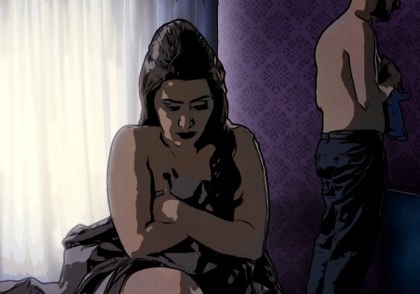
This animated film– animated through rotoscope– is an impressive story about three situations all intersecting with the world of prostitution. They all face their own challenges as all have to deal with the laws in Iran: both law-based and religion-based. The influence of religion is seen throughout the film as there’s cases where the husband is required to authorize along with the wife, religious clerics hold high jobs, and the morality police all around ready to arrest even on public signs of affection. Even the fact that there’s such thing as a Morality Police gives an insight of what type of system Iran has been under since the Islamic Revolution of 1978.

Prostitution is very much a hush-hush business almost universally but you can bet it is especially secretive in Iran. We’re talking about a country where adultery is considered grounds for execution. However it’s seen by these three women as a chance to make a higher income. This is especially beneficial since the income for the average Iranian is very low. Pari has a chance to receive a better life for herself and her son thanks to her work, and the red tape of a judge involved. Sara sees prostitution as a chance to escape the strain of her marriage, especially with pushy in-laws. However this ring of prostitution is a detriment for Babak as he finds himself dealing in this business without him knowing. We learn that ‘fiance’ is actually part of the business too much too late for Babak.

This is a story that takes three situations in Tehran and often has them criss-crossing together through each of the characters. Even the protagonists in one of the sub-plots will find themselves involved in the other two plots too. The three stories intersect with both the photo studio where the photographer would take pictures of those involved and Elias the mute son who says nothing, but is a witness to all that goes on. The story plays itself out both as a story with a lot of intrigue and even some comedic moments, like when they have to deal with a gynecologist with poor personal hygiene or the photographer always changing backgrounds.

SPOILER WARNING: In the end, it’s Pari who’s the one that benefits most from this system of prostitution, if not the only one benefiting at all. Babak finds himself stuck in the middle of what would become what many believe to be his tragic fate in the end. Sara loses it all in the end, and it’s obvious her drug-induced jump at the end is a suicide. It’s evident she feels like she has nothing to live for. Pari, on the other hand, had the unfairness in her favor. She struggled with the unfairness of the Iranian legal system demanding her husband’s signature for many things; that’s the law in Iran. How could she when her ex-husband is in prison? But when the Iranian judge offered her an entry into the prostitution business, it opened doors for her and Elias. It even allowed her to achieve things without her husband’s signature. Despite the struggles, it appears Pari is the only one who won.

This is the first feature-length animated film for Ali Soozandeh. Ali was born in Iran but would emigrate to Germany. It’s easy to see why the film’s countries of production are listed as Germany and Austria. There’s no way Iran would allow for a film like this to be released! The film which he directed and co-wrote with Grit Kienzlen is a very good story of intrigue and will raise a lot of eyebrows about what’s going on ‘underground’ in a country like Iran. All the actors did their parts very well, whether it be doing their voices or acting for their rotoscope images. I feel the rotoscope method of animation fits the film very well in terms of telling its story. Rotoscope also helped well with Waltz With Bashir a few years ago.

Tehran Taboo is an excellent animated film about the secrets of Iran few know about. The stories of those involved, and why they do it, are made very clear.
Movie Review: Argo

“So you want to come to Hollywood, act like a big shot without actually doing anything? You’ll fit right in.”

Argo is a story about an important moment in American History: The Iran Hostage Crisis. This focuses on the part that would be known as The Canadian Caper. What we get is more than just a reenactment of history.

The film starts in November of 1979. Iran has gone through its Islamic Revolution. The Shah had been dethroned. Ayatollah Khomeini was the figure of a revolution of Islam in the country and the people wanted justice. They wanted the Shah tried and hanged and were outraged he was housed in the United States, which was already denounced by Khomeini as ‘The Great Satan’. On November 4th, Iranians stormed the American embassy, captured at least 50 Americans and held them hostage. Some managed to escape and six were given refuge in the Canadian embassy under Ken Taylor.

More than ten weeks would pass and the Americans held hostage were still held captive facing an unknown fate with a kangaroo court of Iranian students. Those six in the Canadian embassy were still being sheltered with a future just as uncertain. Now it was a matter of finding them ways of getting them all out safe and sound. Some Americans thought military intervention and even a war was the thing to do but it would cause more bloodshed to the American and even could lead to the embassy being bombed. This was an embarrassment weighing heavily on the entire United States at the time. President Jimmy Carter made it clear he will not back down to terrorist demands. That left the CIA to decide what actions to pursue especially as time was running out and the fates of all were uncertain.

Enter CIA Tony Mendez. He hears about the six from people at the CIA table trying to devise rescue plans for the six. None come up as good ideas. It’s when he’s talking to his son from his failing marriage that his son’s talk of science fiction entertainment sparks an idea about a fake film production as the rescue mission. First: find the right Hollywood people for the idea. He finds it in makeup artist John Chambers and film producer Lester Siegel. Second: find the right movie title and subject line. Siegel finds it in a rejected script titled Argo. Third: give all those in refuge Canadian identities and a trial run through the local bazaar. Tony himself poses as the director. Fourth: know the ins and outs of how to make it out of Iran. One thing we’re reminded is there are guards at the airport who could arrest any American or even a citizen with an American name in their documents for possible connection to the Shah. It all sounds good but it’s not going to be easy. CIA may feel this mission is not as important as the main issues to deal with. Cooperation from the Canadian government would have to occur. President Carter giving the okay on the Swissair plane tickets to get them out would have to happen. The Hollywood people would have to be there whenever a guard questions Kevin, Tony’s guise. And this all has to be done before the Iranian people find out the secret of the hidden Americans and they eventually will. Will this mission succeed? History has already told us so. Nevertheless it’s all how it plays out in the film.

The best quality of the movie is not just its redirectioning of the events of the time but capturing the pressure of the moment. I was a child when the hostage crisis occurred and I knew that the six would all make it out alive. I knew the Shah would eventually be moved to Egypt where he’d spend his last months. I knew that all the other American hostages would be freed almost a full year after the six escaped. Nevertheless watching the movie made me forget all the facts I knew and made me wonder what will happen next? Will they succeed in their mission? Will something go wrong? It captures the sense of everything that was happening at the moment. It also captures the reasons why such an operation was necessary instead of an act of war. It captured the reasons why a war would only escalate the situation. This was not a simple political situation. This was a moment in history almost reminiscent to the French Revolution of 1789 where it was a revolution of the people consisting of a kangaroo court of trial, verdict and sentencing of even death. Anything more than the Canadian Caper would be disastrous and bloody. Anything less would be disastrous and humiliating.

Meanwhile it’s not just about a rescue mission. It’s also about people and what they mean to others. There’s Tony, a CIA agent who has the responsibility of these Americans in their hand. He’s also a father who values his time with his son even though it’s not often. There are the hostages who are fearing for their lives and nervous if this mission will fail. Especially the Lijeks, a married couple. There are all those involved in the mission–Tony, the six Americans, the film producers and the CIA–that feel the weight of this mission and know it’s can’t fail. Not with the eyes and hopes of all the USA watching. This was as much a human story as it was a thriller.

Often when a piece of history is reenacted on the big screen, it’s often a question if this moment is relevant today. I feel it is. Khomeini may have died in 1989 but anti-American sentiment is still present in many of the predominantly Muslim countries. The Iranian people have calmed down a lot since the Islamic Revolution of the late 70’s and have become somewhat more American-friendly, if imperfect. Nevertheless Mahmoud Ahmadinejad, the current President of Iran, is a man who idolizes Khomeini and his beliefs. We should keep in mind Ahmadinejad was 22 when the shah was overthrown and the Islamic Revolution began. Ahmadinejad has spoken narcissistically and even eccentrically about the ‘end of the American empire’ and has spoken openly about his nuclear ambitions. Most Iranians do not accept Ahmadinejad’s views but they’re either too afraid to speak or they’ve been punished criminally. This comes at a tense time as the US is trying to improve relations with the Muslim world. So I can see what happened in Argo quite possible to happen again now.

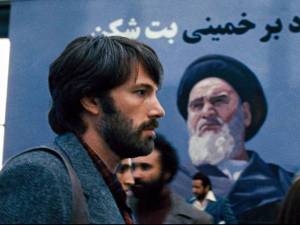
Ben Affleck did an excellent job in directing the movie. He took a smart script from Chris Terrio and directed an excellent movie out of it that was as much thought provoking as it was thrilling. He did a very good job of acting too. I liked how right during the very first scene I saw Ben play a role instead of coming across in typical Ben Affleck style. Mind you Ben was not the complete standout. Alan Arkin gave a great turn as Lester Siegel that stole the show many times. John Goodman was also a show stealer as John Chambers. Victor Garber also held his own as Canadian ambassador Ken Taylor.The script from Chris Terrio was also smart, funny at times, touching and thrilling. It also did a very good job of capturing the chaos of the times from the riots in the town to people being hanged from cranes. The inclusion of news footage added to the drama both before and after. Even hearing Jimmy carter speak during the credits added to the story and its significance in history. Other standout efforts are Rodrigo Prieto in cinematography and Alexandre Desplat in film scoring.

Argo is a movie about a piece of history that we often forget but is very relevant towards the poitical situation in the world now. Seeing it played out on screen does more than just retell history.