2023 Oscars Best Picture Review: The Holdovers

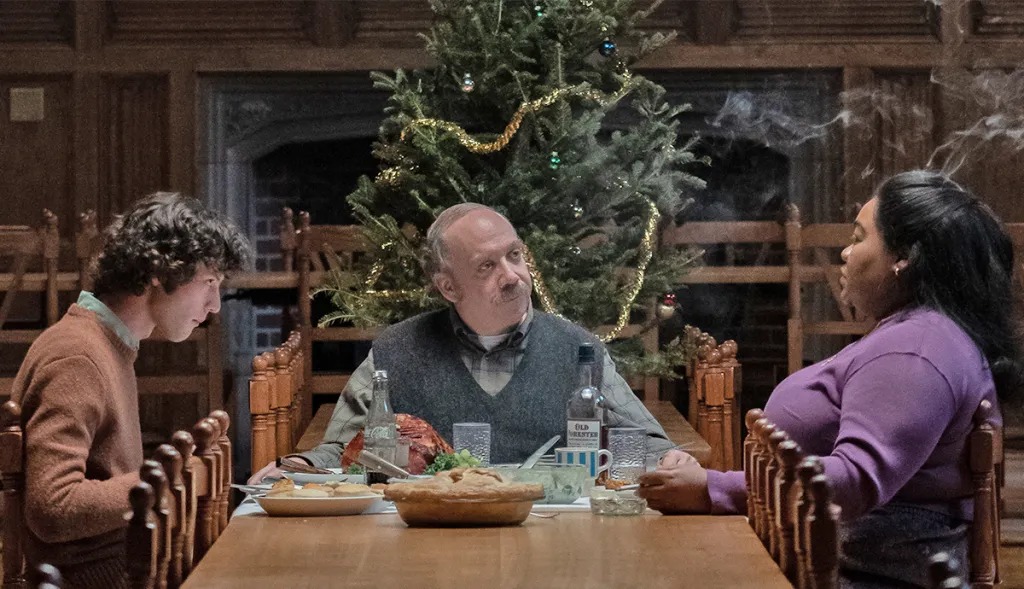
From left to right: Dominic Sessa, Paul Giamatti and Da’Vine Joy Randolph make for unlikely Christmas guests in The Holdovers.

DISCLAIMER: This is from a blog of four reviews I originally posted on March 2, 2024. The original blog has been removed.

At first, you’ll wonder if The Holdovers is the right movie for the Christmas Season or a bad movie for the Season. Not every Christmas movie is a guaranteed hit and there have been some bad ones in the past. Can The Holdovers do all the right moves?

There have been Christmas movies in the past that start as downers but then develop into a film that doesn’t just celebrate Christmas, but celebrates humanity too. It’s A Wonderful Life is possibly the biggest such film that comes to mind. Here we have another story. Set in 1970, we have a teacher at a boarding school whom all the students hate and has no real family or friends. A student of his who gets left behind at the school during Christmas because of his mother leaving him behind for Christmas with her new boyfriend. The school cook who has lost her son in the Vietnam War and feels the hurt at Christmas time. Can the Christmas spirit be present with these three together?

In a film like this, it’s hard to sense if this film has a social theme. We see see how so many of the Best Picture nominees have a social theme in the film which has something to say. I can’t really sense a theme or topic in this film that stands out in a grand way. If a theme made in a soft way, I think it’s about classism and elitism. We should remember Paul Hunhan is a teacher at the Barton Academy boarding school full of boys of some of the most privileged backgrounds. He teaches the classics and is not afraid to fail them if they’re bad, even if the student’s father is wealthy and powerful. That annoys his boss Dr. Woodrup as one of the students Hunham failed, the father stopped donating and that stopped Woodrup from being promoted to Princeton. Adding to the theme of elitism, Hunham himself was a student at the school and attended on a scholarship. Hunham almost sank his future after he deliberately hit one of his Harvard classmates with a car, but Barton was sympathetic enough to hire him as their classics teacher. Adding to elitism is the cook Mary Lamb: an African-American woman who was able to get her son Curtis to attend the Academy because of her employment. After he graduated, he had to pay his way through college and enlisted in the army to do so, only to die in the Vietnam War.

There’s no doubt the themes of privilege and classism abound in this film. There are also parts in the film that remind us all that privilege and classism is not a shelter for everything. The one who best reminds us of that is Angus Tully. Angus is a student who actually does very well in Hunham’s class, but still shows the common troubling behavior of teens, which gets on Hunham’s nerves a lot. Over time, Hunham learns Tully is not the typical privileged brat he sees him as. He learns that Tully is a lonely boy from a broken home. Tully first tells Hunham his father’s dead, but soon learns his father is in a mental hospital. A privileged background doesn’t prevent you from having parents with mental illness. On top of that, Tully has a mother who seems to care more about her new boyfriend than him. That’s another thing with privileged children; having hyper-ambition parents who care more about themselves and often neglect their kids. While Hunham and Mary appear to be victims of a system of classism and privilege, Tully appears to be one living in this privilege but experiencing the harsh side-effects of it. Seeing Tully’s background could give you empathy for Barron Trump! Even that scene where they show a memorial on Veteran’s Day and they memorialize the alumni killed in wars, it’s a reminder that privilege won’t stop you from dying young in a war.

I know I talked a lot about privilege and classism in this film, but it’s an underlying theme in the story. The story is about three different people who don’t want to be together trying to have a Christmas together. We have the classics teacher who has made the boarding school his home since his job and has no problem making a loner of himself or being hated by the students. We have one of his students who can’t stand Hunham and is frustrated with having no one for Christmas. We also have the cook who is not only struggling to be happy after the death of her son but trying to find reason to live. Can they have a good Christmas? Can they get along together? In the end, the Christmas becomes a time when they warm up to each other and get to understand each other better. Angus doesn’t see Hunham as a jerk teacher and starts to understand his love for the classics. Hunham doesn’t see Angus as a jerk student, but rather a boy who needs the closeness of his family. Most importantly, to be reunited with his mentally ill father. Mary Lamb falls in love with the janitor Danny and is reunited with her sister and her family. That scene with the four celebrating New Year’s together shows they did have a Merry Christmas after all. Even if Hunham would get fired for his actions being out of Barton protocol.

This is another great achievement from Alexander Payne. In the past, most of his films have been stories about a man’s feelings of failures. The films he’s done in the past have won him acclaim and even three Best Director nominations. Here he takes a change of direction with a Christmas story with a man as the protagonist, but also as much a story of a student who’s lonely and a cook who feels empty on the inside. It’s a story that makes for the most unlikely of Merry Christmases and somehow makes the merriness happen. We should also thank scriptwriter David Hemingson for that. Hemingson has established himself as a renowned sitcom writer. This is his first film screenplay and it comes out shining. It gets into a deep story but it also remains humorous and keeps the Christmas merry.

Excellent acting again comes Paul Giamatti. If you’ve seen Giamatti act before, you know he knows how to do excellent character work. Giamatti has worked with Payne before in 2004’s Sideways: the film that got Payne his first Best Director Oscar nod. Here, Giamatti is the perfect fit as the curmudgeonous sadistic teacher who actually is a disheartened man who becomes an unlikely friend to a troubled teen. Also worthy of respect is Da’Vine Joy Randolph. Her performance of the cook who lost her soon and tries to keep from hurting is great. Especially since you could sense that there would be a time she can’t hold it in any longer. Her performance stands out and even makes you think the story is as much about Mary Lamb as it is about Hunham. Also great is the performance of Dominic Sessa. He has never acted before and he had the luck as the prep school he attended happened to be the location of this film’s shooting location and he caught the eyes of the casting directors. He’s the right fit in playing a boy who’s smart and arrogant about it, but lonely and hurting on the inside. Sad Fact: Sessa’s own father died when he was 14. Also a great job of Eigil Bryld with the cinematography. Normally for a Payne film, it does a good job of capturing the region. This cinematography was different as it added to the story.

Some of you may remember I wrote a review of a film from the VIFF called The Sacrifice Game. Isn’t it a coincidence that two films of similar storyline of boarding school students left behind during Christmas in the early-70’s get released this very year? Sure, one is a dark comedy while the other is a supernatural horror thriller, but it is quite the coincidence!

The Holdovers is an unlikely Christmas film that does what a Christmas film should, despite the story appearing to pave the way for something depressing, at first. In the end, it’s about three people unlikely to be friends whose lives improve because of each other. An unlikely treat for those lucky to see it.

2023 Oscars Best Picture Review: Barbie

Margot Robbie (right) stars as Barbie and Ryan Gosling (left) star as Ken as Barbie bring the legendary dolls to life.

DISCLAIMER: This is from a blog of four reviews I originally posted on March 2, 2024. The original blog has been removed.

Unless you’ve been under a rock, you would know that Barbie was the big hit movie of 2023. You may also ask did it deserve its box office success or its Oscar acclaim?

I actually learned about the Barbie movie over a year before its release. I saw photos of it on social media. During the time, I thought it was odd. A movie about the Barbie doll coming to life? Could it work? Would it be a dud? I know Greta Gerwig was directing it. I already knew Greta had established herself as a force to be reckoned with in films like Lady Bird and her adaptation of Little Women. Nevertheless I was skeptical that even a director with her accomplishments could make a good film about the Barbie doll. It was up for the release and the reception to tell the full story.

I have to say before I saw it in theatres, I first thought this would be a fail waiting to happen. A big-budget movie about Barbie dolls coming to life didn’t sound like a winner to me at all. Then once the film hit the theatres, it was obvious Greta created a winner. Instead of the film about Barbie dolls, the film’s focus was about feminism and how the patriarchy had made it hard and continues to make it hard. One would ask “Why would one make a movie with a feminist focus by including Barbie dolls?” Simple. Ever since the Barbie doll came, it has been widely blamed for the image problems of young women and commonly seen as “setting the woman’s movement back.” We’ve all heard the arguments and the controversies for decades.

Here, Gerwig settles the score. She creates a world of different Barbie’s based on the owner’s own making of the Barbie. In the middle is “Stereotypical Barbie:” a carefree girl who lives a life of blissful joy which comes to a screeching halt as her owner goes through her frustrations of life. She attempts to go to the real world and the Mattel headquarters to sort things out, only for Ken to piggyback his way in and adopt a patriarchal attitude as a way to fix his own identity crisis.  That leads to the group of Ken’s overtaking Barbieland and claiming it as their own. Meanwhile Barbie’s frustrations grow and grow even after she meets her owner, who happens to be a Mattel employee. Her owner’s frustrations become her own. It’s through meeting women in the real world that don’t look like her and are happy that she gets a sense of what happiness is. Over time, Ken learns he doesn’t have to start the patriarchy in Barbieland to get his sense of self-worth back, but Barbie’s still in a struggle.

It isn’t until he finally meets Ruth Handler, the creator of the Barbie doll, that she finally gets her sense of self back. I feel that scene at the end where Barbie meets up with Ruth is the best scene as it settles the score on the Barbie doll debate, too. After decades of debate and dispute about the doll, we get a moment in the film that finally settles the score about the doll and the image it’s to project. It’s through that ending we learn Barbie was not meant to be the stereotypical ditzy blond we commonly see it as. The Barbie doll was meant to be the epitome of her daughter Barbara. Something beautiful. Mattel may have toyed with the Barbie doll over the decades, but that scene finally settles the score on the matter. The Barbie doll is the result of mother-daughter love. And Stereotypical Barbie finally gets a sense of the never ending story of herself, as well as the human touch which is better than anything she could get in Barbieland.

Top respect should go to Greta Gerwig. Even without the whole Barbie phenomenon of 2023, Gerwig, who directed and co-wrote the film with husband Noah Baumbach, deserves credit for making a hit and a critical success for something that many felt was a bomb waiting to happen. She takes a common theme about the Barbie doll, of how many feel it is a bad influence to young girls and feminism as a whole, and makes it thought-provoking. Despite it being a thought-provoking film, she also keeps it comical and even entertaining to watch. I mean we are talking about a movie about Barbie dolls. Nevertheless, the film shows it can be funny and entertaining and still be able to get its message across strongly. As well as settle the score on the Barbie doll itself. Not to mention, achieve the first ever billion-dollar blockbuster directed by a woman! Congratulations, Greta, for doing all what we thought was impossible!

The film also finds its strength firstly in the acting of Margot Robbie. To take a character like “stereotypical Barbie” and make her three-dimensional without compromising the comedy is an excellent effort. They always say comedy is the hardest thing to do. Try doing comedy while trying to send an important message at the same time. Robbie succeeds in doing that. Also succeeding in achieving that is Ryan Gosling as Ken. Ryan gives personality to the Ken doll that the actual Ken doll has seemed to lack over the years. He succeeds in making Ken an insecure one and one to see patriarchy as the answer to his self-esteem. The performance is as bizarre as it is comical and entertaining. He even manages to make comedy of the patriarchy. Also worthy of acclaim is the performance of America Ferrera. While Barbie and Ken bring on the entertainment, it’s the character of Gloria who brings the movie’s darkness. America succeeds in creating an insecure Mattel employee whose personal insecurities influence Barbie’s insecurities and finding herself happening along Barbie finding herself. Also adding to the film is the narration from Helen Mirren. Her narration adds more charm.

For technical credits, Barbie has to get the biggest respect. Creating something like Barbieland and the Barbie dolls that live there is as much of an accomplishment as the film itself. First, there’s set designers Sarah Greenwood and Katie Spencer. They succeeded in making Barbieland into a land of Barbies that we can’t see anyone else doing a better job. It’s as big and colorful as it should be. Also top respect for costume designer Jacqueline Durran for designing the right type of costumes that look like perfect looks for Barbie dolls but very wearable for the actors and actresses. And then there’s the music. Those who saw it will know there are musical moments without the film being a full musical. Songs like “What Was I Made For?” “Dance The Night,” and “I’m Just Ken” add to the entertainment factor of the film. You can thank the many established songwriters who added their talents to this film.

For technical credits, Barbie has to get the biggest respect. Creating something like Barbieland and the Barbie dolls that live there is as much of an accomplishment as the film itself. First, there’s set designers Sarah Greenwood and Katie Spencer. They succeeded in making Barbieland into a land of Barbies that we can’t see anyone else doing a better job. It’s as big and colorful as it should be. Also top respect for costume designer Jacqueline Durran for designing the right type of costumes that look like perfect looks for Barbie dolls but very wearable for the actors and actresses. And then there’s the music. Those who saw it will know there are musical moments without the film being a full musical. Songs like “What Was I Made For?” “Dance The Night,” and “I’m Just Ken” add to the entertainment factor of the film. You can thank the many established songwriters, and main musical writers Mark Ronson and Andrew Wyatt, who added their talents to this film.

Barbie is more than just a humorous story. It’s a story that takes on the patriarchy, highlights feminism and has something to say about a doll that has delighted billions of girls. And thousands of boys, too. It also lives up to all the “Barbenheimer” hype of the summer of 2023 and entertains the theatregoer easily.

2023 Oscars Best Picture Review: American Fiction

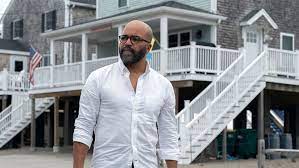
Jeffrey Wright portrays a serious African American writer who faces pressure from a white-dominated entertainment society in the comedy American Fiction.

DISCLAIMER: This is from a blog of four reviews I originally posted on March 2, 2024. The original blog has been removed.

Not that often are the Academy Awards friendly to comedy films. American Fiction is just the type of comedy that can do the trick.

Those of you on social media must be very familiar with the #OscarsSoWhite campaign. Despite there being seven acting nominees that are racial minorities this year, we need to have things more consistent over the years. Focusing back on the film, the Oscars and their lack of consistency in making their nominees diverse is just one of the problems with Hollywood and the entertainment system as a whole in dealing with racial minorities. Hollywood is gratefully responsible for this. Those who’ve seen classic films of the past will have seen a negative or mocking depiction of a racial minority. Awareness groups in the last decade have helped to make Hollywood think twice about how racial minorities are depicted in entertainment. Even though they won’t stop an insulting depiction from happening again, they will raise hell when it does and make people think twice.

In this film, it’s very obvious the theme of the film is about African-Americans depicted in all forms of arts and entertainment. It’s not only about how they’re depicted in entertainment. It’s also about an entertainment system where top sales and ratings are the bottom line. African Americans have various personalities and life goals and directions, but it’s always about the images that sell the most. And that’s the problem Thelonious “Monk” Ellison has to deal with. His novels are of excellent quality and good for how they give a good atypical depiction of African American life. Nevertheless there’s the problem of his works not selling. That frustrates him to the point he feels he has to sell out and do a “gangsta” novel. I’m sure many others feel the same pressure.

The film is a humorous look of an African-American author trying to get respect in the literary world which all-too-often seems to favor quantity over quality. It spoofs the whole system and how the white-dominated public treats works from African-Americans from his latest manuscript being rejected for not being “black enough” to his books being sold in the African-American section of a bookstore to his adding clout to his author’s guise as a criminal on the run from the law to a jury of a book festival consisting mostly of white limousine liberals lauding his upcoming novel. It also includes the irony of the one African-American member of the jury, rival author Sintara Golden, panning his novel as pandering. Meanwhile Monk himself finds her novel pandering.

Although the story is obviously about a significant topic, the story also has a lot of personal elements for Monk. This story is also about the author’s difficulty of trying to create and market his breakthrough novel right during a load of sudden complications in his life. He’s put on a sabbatical by his college because of his frequent confrontations with students. While reuniting with his family in Boston, his sister suddenly dies. His mother’s Alzheimer’s worsens and she needs to be placed in a care facility. The maid who he grew up with has to leave her job and eventually marries. His brother is going through a divorce and drug addiction after his wife caught him with another man. In addition, he is developing a relationship with an established lawyer named Coraline but the relationship ends as he disagrees with her about Sintara’s book. Try plugging a breakthrough novel with all this happening!

Top respect should go to director/writer Cord Jefferson. This film is actually based from a 2001 novel Erasure. Jefferson does a great job in satirizing the difficulty of trying to make it as a “black writer” from the difficulty of doing his work his way to the pressure of dropping his artistic integrity and selling out by writing a pandering “gangsta” work to the “liberal elite” (full of mostly white people) taking it as serious literature worthy of acclaim to the media machine building up the hype to Monk taking his pandering further to add to the hype. It’s both funny and smart at the same time. Mixed with its humor, it’s very much an eye opener about the pressures African-Americans go through to make it in arts and entertainment. It pokes fun at the expectations of what African-American literature is expected to be from the elite of the arts who are mostly not African-American and an entertainment industry where top sales have always been the bottom line. It also pokes fun at the “liberal elite” who are mostly of white people who want diversity but are clueless in how to do it right, despite being the ones pulling the strings. Despite the themes, it also includes the human elements like Monk’s connection with his family and love interest and how it helps him understand himself better as a writer and as a person. Even that element of Monk dealing with his ‘genius’ characteristic adds to the story.

Respect should also go to Jeffrey Wright in playing Monk Ellison. It’s not an easy thing to do a comedic performance with intelligence, even though the story does just that. Wright does a great job of a ‘genius’ writer who feels compelled to throw away his dignity as he’s on a sabbatical and just sell out with a pandering novel. At the same time, Wright adds dimension with his role as Monk tries to keep family ties together and tries to start a relationship with Coraline, only for his ‘genius’ characteristics to interfere. That’s quite an effort to do and to keep comedic for the sake of the film. There are some great supporting performances. First is from Sterling K. Brown as the brother dealing with the frustrating addiction and troubling changes in his life. There’s Lessie Uggams as the mother with Alzheimer’s robbing her of her quality of life but also able to say something to help Monk get a better focus of himself. There’s also Erika Alexander as the girlfriend who knows how to draw the line with Monk’s attitude and arrogance. With the musical score of Laura Karpman added in, you have a winning film.

American Fiction is just the intelligent comedy we need right now. It makes the difficulties of African Americans trying to make it in arts mixed with the attitudes of the mostly-white elites in the business look like the circus that it is. At the same time, it makes it as much about the author as a friend and a member of the family and his difficulty with his personality interfering with that. Already I declare this the Comedy Of The Year.

2023 Oscars Best Picture Review: Anatomy Of A Fall (Anatomie d’Une Chute)

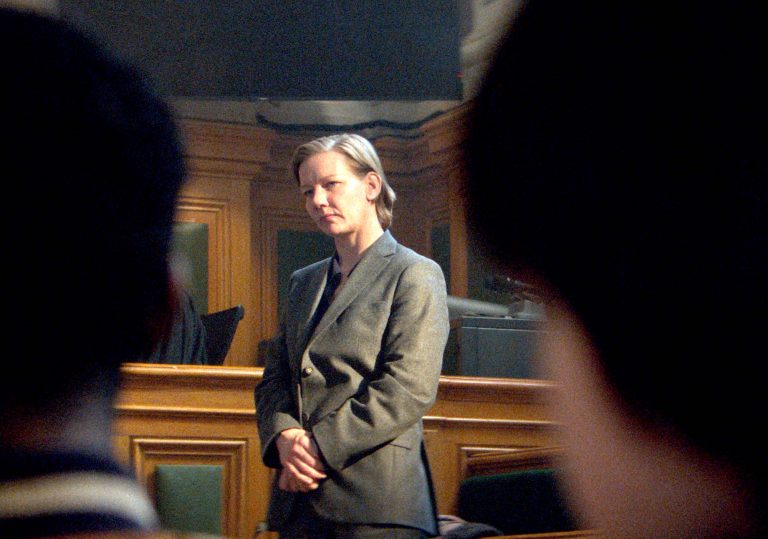
Sandra Huller plays writer Sandra Voyter suspected of killing her husband in the courtroom thriller Anatomy Of A Fall.

DISCLAIMER: This is from a blog of four reviews I originally posted on March 2, 2024. The original blog has been removed.

Anatomy Of A Fall first appears to be a common courtroom drama with a story of intrigue. Over time, you’ll learn it’s a film that’s a lot more.

Courtroom dramas have caught our intrigue time and time again. We’re presented with a criminal scenario or a legal scenario, but it’s up for us to decide whether they’re guilty or innocent or who to side with in a dispute. We learn the verdict and we’re left to decide if it’s the right verdict or not. This story is a unique story. It presents a case of a death from a fall. The deceased is the French husband of a German novelist. The fall happens from a chateau in a remote mountainous area of Grenoble. The first to notice the fall is the seeing-eye dog of the blind son. Questions arise. We learn of the troubled marriage. People turn against the woman. The prosecutor is determined to prove her guilty. The son watches despite his blindness, and seems like he doesn’t know what to think. Could he hold the truth? Could his seeing-eye dog also provide clues to the truth?

This isn’t simply a story of whether Samuel’s death is a murder, a suicide or an accident. It’s a story that develops over time with each new fact exposed, opinions from people in the story coming about, and your own opinions being formed. As we learn of Sandra Voyter, her turbulent marriage, and her recent liaisons, some of us are tempted to look down upon her and even suspect her of possible murder. As we learn about Samuel and his immaturities and later of his depression over the last few years, will that change our mind? The film is as much about how we see things and see people as it is about our story itself. Even possibly exposing sexist attitudes we didn’t think we had. There’s even the angle of the trial as seen through Daniel: the child caught in the middle. A blind boy, he has the biggest sense of the friction his parents have been going through. He lost his father and he’s at risk of losing his mother if she’s found guilty. During the time, he doesn’t know what to think of his mother and often feels lonely. Almost as if Snoop, his seeing-eye dog, is the only one who loves him and he can trust. Sometimes your concern shifts from how Sandra will be found by the courts to what will happen to Daniel. It’s like the film is two stories in one. Even Daniel’s testimony at the end will make you reconsider your stance in the case.

Top respect goes to director/writer Justine Triet. Triet has become only the eighth female director to be nominated for the Best Director Oscar. This film is actually a project she co-wrote with Arthur Haran for actress Sandra Huller to star in after the two worked together in 2019’s Sibyl. She creates a great story that presents a death and the question if it’s an accident or a murder. She presents it as a story of a French-speaking wife and a German-speaking husband who use English as a common ground to sort things out, but it adds friction. The death, the courtroom drama, the turbulent marriage, the communication barrier, and the son caught in the middle adds to the story. Even the ending which allows you to draw your own conclusion of the incident adds to the film.

Along with Triet, there was great acting from Sandra Huller. Her acting in this story helps create the character along with the actions and allows the audience to make their decisions in the case. Huller is as much of a storyteller as Triet herself. Also great is the performance of Milo Machado-Graner: the son caught in the middle. There are many times in the story, some thanks to camera shots of the courtroom drama, where one can think the film is as much about Daniel as it is about Sandra. He’s trying to make sense of what is happening. He is suspicious of his mother but is scared he will lose it all. There are times he tries to be tough with him teaching himself piano by sound clips, but you can tell he could break down. It seems like the dog Snoop is his one friend, especially with his sheltered upbringing. Graner makes him a boy you want to hug. Adding to the film is Messi The Dog as Snoop. Through Messi, we see Snoop is more than Daniel’s seeing-eye dog and best friend. He’s also one that hold clues to what could expose the truth. Additional great acting performances include Samuel Theis as Samuel Maleski, the husband that struggled with mental illness whose struggles threatened the family, and Antoine Reinartz as the prosecutor who will get you wondering if he wants justice done or simply to have Sandra found guilty.

This film has been lauded with buzz since the Cannes Film Festival. The film won the Palme d’Or at the and Triet became only the third female director in history to win. You know how I talked about Messi The Dog adding to the story? At Cannes, Messi was even given the Golden Dog Award for his efforts! Even after Cannes, film festival after film festival it was entered in would have this come away as the big winner. The film also won six European Film Awards. The film was not France’s official submission in the Best International Feature Film category. I assumed it’s because there’s too much English in the film, but other articles are suggesting there may be politicking.

Anatomy Of A Fall is a great legal drama that tells the story of a death in question and doesn’t only leave its fate to the juries, but for the audience to decide for themselves what they believe to be the truth. Even Triet herself won’t say if Sandra is guilty or not. All your call!