Movie Review: The Wild Robot

This year is one Oscar year where predicting the Best Animated Feature winner will be difficult. One of the favorites is The Wild Robot. Does it have what it takes to win?

The film begins in a remote forest land on an uninhabited island unblemished by human intervention. The coast soon becomes an unintentional wash-up ground for Universal Dynamic’s ROZZUM robots coming from a capsized ship. Only one robot, Unit 7134, survives and running wildlife activate it. It’s obvious the robot has no place on the island as it can’t interact properly with animals. The robot is intended to be a customer service robot with a female voice. Nothing the robot does helps any of the animals and the animals respond in a hostile manner, chasing 7134. Upon falling from running away, 7134 crushed a mother goose to death and all but one of the nest eggs on its landing. The lone egg that was unharmed hatches the baby gosling. 7134 takes a fascination in it. Plus 7134 is programmed to continue with whatever mission she’s given until completion. She puts the egg inside her chest.

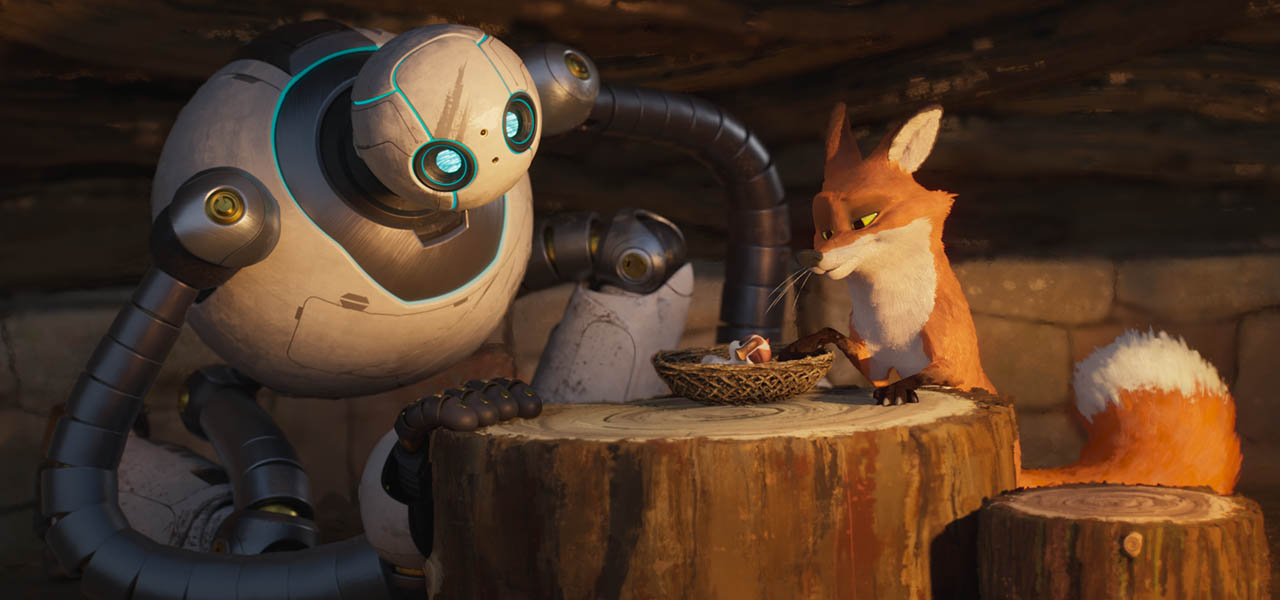
7134 finds a memory card in herself to make her communicate with animals better and inserts it. Soon after, she encounters Fink: a sly hungry fox who knows of the egg and wants to eat it. 7134 is able to prevent the theft. Soon the egg hatches and a male gosling is born and imprints himself on 7134. 7134 now has a mission to raise the gosling to adulthood, but how? 7134 first finds guidance from a mother opossum who’s currently mothering six babies. Fink returns but instead of eating the gosling, he makes a deal with 7134 to help raise the feller for a shelter in return. 7134 agrees and creates a hut for them all to live. In the naming of the gosling, 7134 gives the gosling number-names which annoys Fink. Fink gives 7134 naming tutelage and the gosling is given the name ‘Brightbill.’ 7134 even gets a new name of her own: Roz.

Over the months, Brightbill grows, albeit awkwardly. While the other goslings are goose-like and grow as naturally as geese do, Brightbill acts more like Roz than a goose. The other teen goslings taunt him for his awkwardness. Then one day, another flop day of goose training for Brightbill, one of the peers tells Brightbill that Roz killed his mother. It’s there Brightbill turns against Roz.  Even though Roz still wants to mother Brightbill, a ROZZUM unit she reconstructs tells her to return to Universal Dynamics. Roz is determined to reconcile with Brightbill and raise him. That sends a signal back to Universal Dynamics. Meanwhile Roz finds the right bird to teach Brightbill how to fly: a falcon named Thunderbolt. With help from goose master Longneck, Thuynderbolt succeeds in making Brightbill able to fly in time for migration.

The migration is not what it seems. The birds encounter a thunderstorm as they fly in San Francisco. They hope the greenhouse from Universal Dynamics they spot in San Francisco is the temporary shelter they need, but the Universal Dynamics technology detects the birds as contaminant and a multitude of reconnaissance, or RECO, robots that look exactly like Roz go shooting at the birds. The island which has the hibernating animals goes through a severe snowstorm and they fear they will freeze to death. Roz and Fink build a shelter for all animals but demand a truce of all of them not to harm each other.

As spring returns, Brightbill and the geese return, Roz repowers herself and the animals are free to roam the island. Unfortunately, Universal Dynamics has sent a robot to retrieve Roz named VONTRA and she’s troublesome, reckless and remorseless. VONTRA is not even afraid to start a forest fire on the island to get Roz. It’s then the animals group together to rescue Roz and battle VONTRA as their land is burning in a bright red fire. I won’t spoil the ending but the film then ends not with the battle but the aftermath, reminding us of the bond between Roz, Brightbill and all the animals.

This film is based upon the 2016 children’s novel The Wild Robot by Peter Brown. The story itself is a story about togetherness. In many ways, children who watch this film can learn about the importance of getting along and actually coming as one. If animals who attack eat other or treat each other as prey can get along, so can other kids. Same way as a robot, who has no qualities to bond with animals, learns to have those qualities and does bond. Even raise a baby gosling to goose. The film also has other themes too of the environment and how development threatens animal’s habitats. Even the threat of having technology run things and make decisions with no human feelings is another thematic element of the story. At the beginning, I didn’t think Roz would be of any help to the animals of the island. Just an interference that acts on her own programmed logic to do only the things she’s programmed to do. A change of things changes everything and Roz becomes an unlikely hero.

The film’s quality is in its story. It plays the story well. The animals act like animals and Roz acts with her programmed logic. Over time we see the story develop. Roz goes from being an interference on the island to becoming a big help. Fink goes from a sly conniver to being a big help to the animals too. Brightbill also goes from being a robot-like gosling to the goose he was meant to be. It succeeds in making moments you think won’t develop properly develop into the way it was meant to be. At the same time, the film also adds in the other threats like how robots are sent to the island as Roz is not doing her commanded duties and VONTRA threatens to get her even at the cost of the island’s destruction. Unexpected moments like these and the film ending in the manner you didn’t expect add to the story. Also since this film is an adaptation of the first book of a Wild Robot trilogy of books, it also sets up well for the sequel that will be adapted from The Wild Robot Escapes novel. The box office results of this film have opened the door for the development of a sequel, but filming details and release date have not yet been confirmed.

The biggest credit should go to director/writer Chris Sanders. Sanders has over 40 years of experience in animation having first worked as a scriptwriter for the Muppet Babies cartoons and then becoming story writer for five of Disney’s films in the 1990’s during the ‘Disney Renaissance.’ He then broke out into directing with 2002’s Lilo and Stitch which is the first film he directed, co-directing with Dean De Blois. Since then, he moved onto Dreamworks Animation and has co-directed How To Train Your Dragon with de Blois, The Croods with Kirk DeMicco and his first solo project The Call Of The Wild. In this film, he succeeds in delivering an excellent story mixed with dazzling effects. He does a great job in making a film that can easily make Disney and even Pixar jealous!

Also great voice acting from Lupita Nyong’o. She knows how to make Roz the unfeeling robot at times she needs to be and help her develop into having feelings. Kit Connor also does a great job in playing Brightbill from his awkwardness to his anger. Pedro Pascal is excellent as the sly Fink. Stephanie Hsu is also great as the villainous VONTRA. Actually the mix of vocal talent is great throughout the film. Adding to the film is the musical score by Kris Bowers and the work from the film’s sound team and the visual effects team.

In the Oscar category of Best Animated Feature, this film has been in a tight battle against Flow. To think, its biggest rival is an independent film from Latvia! In this category, Flow has won the National Board of Review award, the Golden Globe, and the Online Film Critics Society Award. The Wild Robot has won the Critics Choice Award and the Producers Guild Award in this category. At the Annie Awards for animated films, it achieved ten nominations in nine categories including Best Animated Feature and it won in all nine!

The Wild Robot delivers in what one would commonly expect in an animated film. Although it’s more oriented for children than it is for adults, the parents will have no problem being entertained by the story. Don’t be surprised if it wins the Oscar on Sunday!

2023 Oscars Short Films Review: Documentaries

Once again with the Academy Award nominations being awarded for the biggest feature-length films of the year, the AMPAS Academy also rewards the short films in three categories. I’m lucky to live in Vancouver where I can see the short films on the big screen.

The first set of films I will be focusing on is Documentaries. In each of my blogs about the short films, you will also get my predictions for which films Should Win and Will Win:

The ABC’s Of Book Banning (dirs. Sheila Nevins, Nazenet Habtezghi and Trish Adlesic) – This documentary focuses on recent regulations implemented in American school systems in the past ten years to ban certain children’s books. Most notably in Florida. There are three classifications: Restricted – disallowed to children unless permission from parent; Challenged – at risk of being banned from school libraries; and Banned – completely banned from school libraries. The books banned are mostly to do about the themes of racism and racial empowerment, sexism and female empowerment, and LGBT pride. The authors are unhappy and the children can’t fathom why they’re banned and are disappointed with the reading material they are allowed to read.

This is a smart documentary that highlights the problem from all angles. It doesn’t just show the classification system but also the books that have fallen prey to this system. We hear verses from the book and we sense why they’re banned, but still wonder what’s the problem? We hear from some of the authors of these banned books and what they have to say. We hear what the children have to say and how they can’t understand why they’re banned and what they’re left with are books with weak material. You’re left feeling for those children and the lack of knowledge they’ll be receiving. You’re also left wondering about how the USA — a nation that advertises itself as “the land of the free” — can allow for book banning to happen. I thought book banning and book burning were considered “Un-American!” Not anymore? That’s why I pick this as my Should Win and Will Win picks.

The Barber Of Little Rock (dirs. John Hoffman and Christine Turner) – In this documentary, we are introduced to Arlo Washington. He started as a barber in Little Rock, Arkansas to help raise and provide for his younger siblings after his mother died shortly after his graduation. Over time, he progressed to opening his own barber shop, then his own haircutting school, and then opening a loan company that gives loans to African Americans and other impoverished people the banks normally reject. The film not only showcases what Washington has accomplished but also interviews some of his loan customers from his bank and gets them to describe systemic racism.

The best thing about this documentary is its insightfulness. It touches on a topic we commonly hear about, but know very little of the stories of people who live it. We learn of the man who beat the odds, but he’s not hoarding all his wealth to himself. He’s a man who knows the problem and is willing to create things to empower people like never before and even fight a centuries-long problem like never before in the community. The film also reminds us that what he’s fighting is a nation-wide problem. The opinions from his interviewed clients about the topic of economic discrimination and systemic racism will open your eyes to the very people who have been hurt by this. Although Washington is doing a great job fighting it in Little Rock, he can’t fight it alone and there’s lots to be done nationwide. This documentary is very much an eye-opener.

Island In Between (dirs. S. Leo Chiang and Jean Tsien) – The film is about S. Leo Chiang, a Taiwanese-born American filmmaker, who returns to his nation of birth, but to an area he only knows from his family’s past military duties. The part of Taiwan he returns to is the Island of Kinmen. Kinmen is a set of Taiwanese islands that are closer to Mainland China than the main island of Taiwan. Actually the area of Kinmen he lives in has just a three-mile separation from the island city of Xiamen through the Tuyu Islet. As he sees this seemingly-short gap of water between the two islands and the rusty military guns that sit by the coast, he reflects how he was taught Taiwanese pride in his childhood and of anti-China propaganda he was taught. He talks of his confusion of his citizenship as he mentions of using his Taiwan passport to return to the US, but use his American passport to visit China. He talks of radio messages sending messages of freedom to the citizens of Xiamen and continue to be sent. He talks of the fear of war with Mainland China that could erupt and how tensions appeared to be easing in the last twenty years. One of the breakthroughs was a ferry system that could allow Taiwanese people to visit Mainland China that went well until the COVID pandemic hit.

This film serves as a reminder of the Cold War we forgot still exists. The Iron Curtain that was broken down in Eastern Europe in the early 1990’s overshadowed that hard-line Communism still exists in a few nations like the People’s Republic of China. Those unfamiliar with history will need to know China underwent a Cultural Revolution shortly after World War II which separated the Communist mainland from the capitalist Taiwan. The two nations have been bitter political enemies since the start. There was warfare between the two in the 1950’s. Despite the war ending many decades ago, the fear of another war still continues despite the guns rusting away on the coasts of the island. Chiang shows how all this has had a hard time for him establishing his identity. The national politics, the use of passports and the recent slow breakdown of political barriers leaving him wondering how should he identify himself? Chinese? Taiwanese? American? This is another documentary that’s insightful about a topic we so easily overlook.

The Last Repair Shop (dirs. Ben Proudfoot and Kris Bowers) – This film focuses on a shop in Los Angeles that repairs musical instruments. It’s not just any repair shop. This repair shop repairs musical instruments for the 80,000 school students in the Los Angeles Unified School District area free of charge. It’s the last shop of its kind left in LA. Featured are the repair people: Dana, who repairs stringed instruments; Paty, who repairs and cleans brass instruments; Duane, who takes care of woodwinds; and Steve, who repairs and tunes pianos. In the film we learn Dana is a gay man who had to be closeted in his early years, even as he did music in his prime. Paty, a single mother, first appeared to have a limited future as a music teacher until a chance to show her skills opened doors for her and a better income for her family. Duane used to be a banjo player who performed for the President of the United States. Steve learned music in his home nation of Armenia until a war in 1990 where his father was killed caused his family to flee to the US. The film also shows some of the students whom benefit from the repairs performed. Most are from underprivileged areas. The film ends with a final symphony with all.

This is one of the least heavy documentaries of the five nominated. This is a film that will remind you not to take things for granted. We learn of the students whom are benefiting from this. Students that value the music lessons and see ambition in their instruments and their lessons. Students that wouldn’t have much of a chance elsewhere, or would come at a cost. We learn of the people in charge of the shop. We learn of their backgrounds and how music either was always part of their life or changed their lives for the better. We learn of how some like Paty have this as an opportunity to beat the odds and have something better for herself and her family. As we watch the final symphony, we see how for all involved that music is not just music. It’s a crucial part of their lives and represents a future of promise for the young. This is not simply a documentary that’s light-hearted. It’s as much insightful as it is a delight to watch and enjoy.

Nǎi Nai & Wài Pó (dir. Sean Wang) – Two grandmothers. Both in-laws. One grandmother goes by the name Nǎi Nai. The other goes by the name Wài Pó. One is in her 80’s, but still feels young. The other is 94, but feels like she’s 100. They both live in the same house and sleep in the same bed. The two talk of their history and of how they first met. The two talk of how both of them, each different in their own way, manage aging and still do their best efforts to maintain a vital life. The two also talk about the fears of aging. Especially as one looks through an old personal phone list and notes how it has the numbers of those that are deceased.

This is a documentary that’s sweet, funny and sad at times. We see two grandmothers of the filmmaker who go by different names and live together. Their friendship is surprising since in-laws are known to be at odds with each other. They show how they continue to pursue vitality in their ages and will do it in their own way, whether by one doing cultural sword arts or one drinking shamelessly. They also show that they won’t shy away from some of the dark realities of aging. They know that despite the vitality they pursue and odds they aim to beat, there are some sad reminders of some realities around the corner. It’s a mix of bitter and sweet that is impressive to watch. Including the ending where one calls Sean a brat!

And there you have it. That’s my review of the five documentaries nominated in the category Best Documentary Short Film for this year’s Oscars. I know I described many of them as “insightful,” but all of them are eye-openers that will get you to see more about topics you may already be familiar with, topics you never know about or even topics you may have overlooked before.