VIFF 2024 Review: The End

I find it quite fitting that the last film of VIFF I saw was titled The End. It’s also interesting that there would be an attempt to create a musical on a subject one would not normally create a musical about.

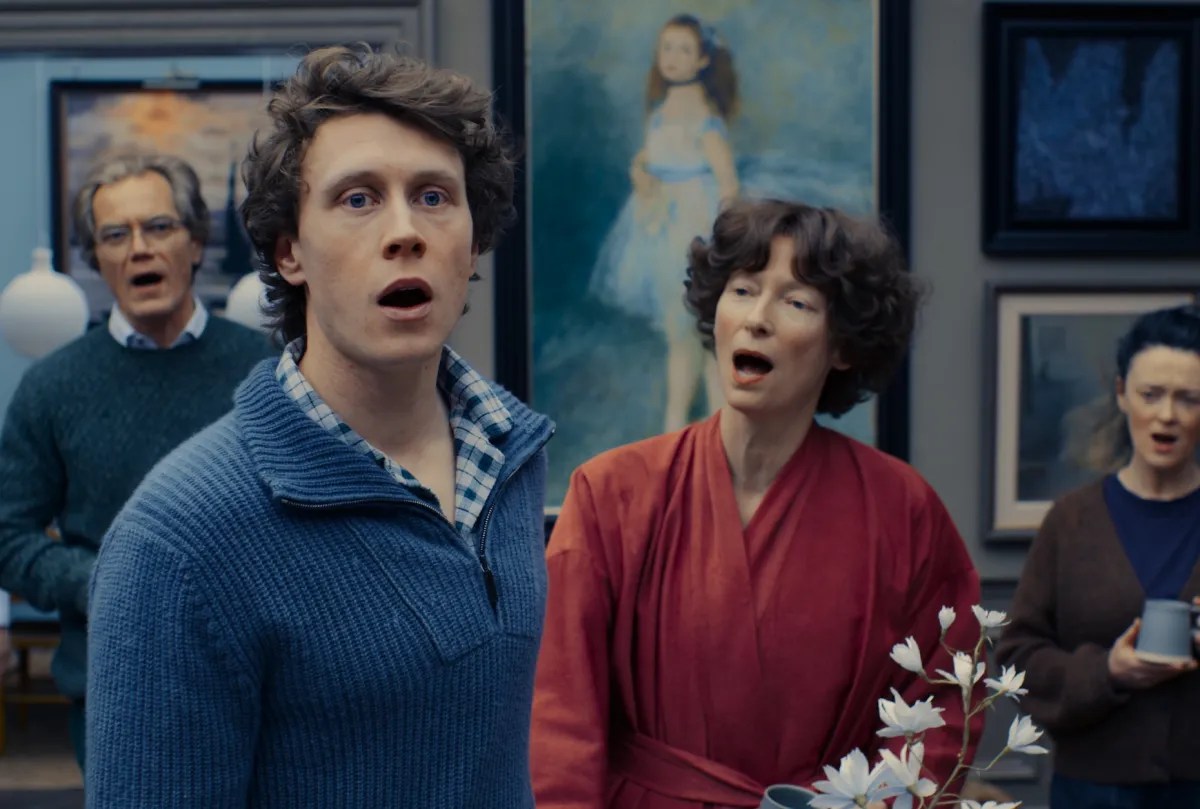
The musical begins in what appears to be a home of a wealthy family. The son is happy with the diorama of America he has. The father and mother consider it the idea life or the dream life. Or is it? Is it the dream life when all people need to participate in emergency raids? Turns out this ideal place of the family is a bunker underneath a salt mine they need to live in because the planet is unlikeable. The mother, father and son are among the lucky few to survive this ‘end of the world’ and this bunker is their refuge. The three aren’t the only ones living in the bunker. Also ‘lucky’ to be living there is a family friend, a doctor, the butler and the son’s ex-wife Mary. They’re the only other people the parents were willing to trust while still living on Earth’s ground. The father was an oligarch who faced death threats in his lifetime on Earth.

It should appear like they have it all in their underground bunker. They have all the luxuries they need for themselves, the friends they could trust the most on Earth living with them, samples of plants and species to keep, grow and breed for themselves, and there’s even a diorama of Earth’s site for the son to marvel at. Actually the son feels something missing in his life as he spent almost all of it below ground. Then one day, an ‘intruder’ is detected in their shelter. The intruder is a young African-American woman. She was one of the few that managed to survive the devastation as her family have all been killed. The son is attracted to her as he sees something captivating in her. Possibly because she’s the only person in his life who has lived recent time at the surface.

The romance between the son and the girl kindle, but the mother and father are not happy about it. She’s an outsider. She’s an interference to the ideal life they envisioned having once the apocalypse happened. The mother even suspects her of having an ‘agenda.’ Soon awful truths begin to unravel from the girl as she has the most knowledge of the devastation at the surface. All the pollution that was caused killed her family. Soon the news hits Mary as she learns the pollution is what caused her son’s terminal cancer and she neglected him in the end by bringing him to the surface to die. She soon dies in heartbreak. Then the parents learn of the hurt they caused. Mostly the father as on Earth, he bribed corruption in developing countries to happen for his gain, his company caused massive pollution around the world and his political ties allowed his influence and policies to be adopted around the world. A world he did his part to destroy. The mother tries explaining to her son she did all this to protect him, but he doesn’t buy it. The parents wonder is there any way they can find any redemption or forgiveness for what they’ve done? They do find it, but not in the way anyone expects.

It shouldn’t be too much of a surprise that there would end up being an ‘end of the world’ musical. Creativity is just waiting to happen. I’m sure this is not the first apocalyptic musical ever done. The story itself is an ambitious story. An oligarch family live in a bunker below the devastated Earth and live happily with themselves and the people they want. Suddenly they find an outsider in their area. The parents don’t know what to do with her. The son falls in love with her. Meanwhile as the two become closer, ugly truths about the parents and the choices they enforced caused much of this earthly destruction and they are finally facing the music about it. This musical does touch on a lot of things such as environmental damage, blood money and people who ‘ruled the world’ facing the music for the devastation they cause.

The thing about this musical is that it doesn’t feel all that together. I know it’s a musical that has most of the activity taking in one small place and it doesn’t lead too much outside, but one does get the sense a musical like this could have been done much better. Its biggest flaw is there are many times in which during many dialogue parts of the song, you forget it’s a musical until a song is thrown in. Now don’t get me wrong. Cinematic musicals are as hard to create for the big screen as stage musicals are hard to adapt to the big screen, but one can’t help but think as they watch along that this could have been a way better musical. I’ve often sensed that if Adam McKay were to do an ‘end of the world’ musical like this, it would be a lot angrier and with humor that delivers a lot more hard blows as McKay is known to do.

Despite its flaws, I give credit to Joshua Oppenheimer for his ambitious attempt to create such a musical. This film is not only Oppenheimer’s first attempts at a big-screen musical but also his first attempt at a feature-length film that isn’t a documentary. His two documentaries The Act Of Killing and The Look Of Silence have both been nominated for Oscars in the Best Documentary Feature category. In this film he directs and co-wrote the screen play with Rasmus Heisterberg, his lack of experience in directing live action shows as it’s not all together. Mind you those that know the story know it’s not an easy story to direct and set. Never mind throw in songs ever now and then. Some critics have labeled such a film an ‘experiment.’ If this film is a successful experiment, it’s an uneven success where the flaws are noticeable. The songs composed by Marius de Vries and Joshua Schmidt are good but there aren’t as many as there should be in a musical.

By the looks of screen time, it looks like George Mackay is the lead actor in this film. I’m unfamiliar with his experience at singing or musical theatre but he does a very good job in this film. He plays the naive son clueless about the outside world very well. His chemistry with the girl is often because she symbolizes the outside world he craves to live in. Also playing the role well is Moses Ingram. She’s most famous for playing Jolene in The Queen’s Gambit. She does a great job at playing the survivor of this catastrophe who’s able to capture the son’s love. Michael Shannon and Tilda Swinton do a good job of playing the parents. Curiously, Shannon is only 17 years older than Mackay. I didn’t think Michael looked that old! They both do a good job who are first in love with what they have and then learn this paradise is an illusion and they confront the truth of what they caused. Also great is Danielle Ryan who plays the first love of the son who soon confronts her role in the responsibility of her son’s death.

The End attempts to create a musical that attempts to be like a sad comedy. The energy and overall mood are not as fluid as they should be. The acting and singing are both good, but the film doesn’t seem to be all together.

And there you have it! Finally the last of my reviews of films from the Vancouver Film Festival of 2024. You’ll be getting my wrap-up blog soon.

Oscars 2019 Best Picture Review: 1917

1917 Chapman mackay
A journey to deliver a message to stop a battle during World War I leads to an intriguing drama in 1917.

There has been a lot of anticipation of what will win Best Picture for the past two months. Lately the recently-released 1917 has become the front-runner. Does it have what it takes to win it?

One thing we should keep in mind is that this is not a completely true story that takes place during World War I on April 6, 1917. This is a story about a messenger delivering a message during the war. According to Sam Mendes, this is a story that has been lodged with him as a child. It’s quite likely the stories came while listening to the tales his grandfather, Lance Corporal Alfred H. Mendes, would tell. In fact he dedicates the film to him ‘for telling us the stories.’

Another thing we should remember about World War I is not just how it would be the most brutal war in history before World War II, but also of how it changed how wars are fought. In the past, soldiers would fight on horses with swords. Here in World War I, it was mostly ammunition related which made horse fighting useless from this point on. Also with the airplane being invented back in 1903, this was the first war ever that would involve airfighting. That would present a new danger for soldiers fighting on the ground as they would also have to avoid shooting from the air.

We should also take into account that despite the advances in warfare, communication between infantries were limited. It seems odd to see the need for a message to stop a battle to be sent through two men. I remember seeing messages submitted in such fashion in Lincoln which was set during the Civil War. One in today’s modern world would find ‘walking’ this message from the trenches to former enemy territory to the infantry to be an odd thing, considering the technologies we now have. We shouldn’t forget that during World War I, the most communication they had was either Morse Code or landline telephone. As you would see when the scene approaches, the infantry of which the leader would need to receive the message would have no access to any of those forms of communication. Telephone lines were cut out in the field and ‘walking’ the message to the infantry would be the only way they can be reached.

We’ve seen war movies in the past. Most war movies consist of frequent battles and action scenes. Mostly to stir up excitement for the purpose of being an action movie. This is a different story. This is a message of two men who are given the responsibility to deliver a message to a battalion to cease fighting and prevent huge loss. This is not just a message a soldier has to relay to prevent a devastating battle, but one in which threatens his brother. Blake not only must deliver the message but have someone else as the second should one die. He chooses his best friend Schofield who’s reluctant at first. The two put themselves out in the mission but encounter danger after danger. Blake is stabbed to death and then it becomes Schofield’s mission to deliver the message. This is a story that focuses less on battles and more on getting a task done. If you get into the story, you will see this is a task which will put one in the middle of the horrors of war. This being a war movie, there are scenes of action and intensity. Those are scenes that can’t be compromised in a war movie and there’s no compromise here. This film also shows a lot of the horrors and devastations caused during World War I like a devastated town, a brutal plane crash, rat-infested areas, bodies left around decaying, and even how every soldier had to see people from another army as the enemy. No exceptions. This story is a telling account of what those fighting in the war had to deal with.

I know I’ve seen many films by Steven Spielberg where he not only tells a war story but also shows how the war was done back then. Often when he does his story that occurs during times of war, it’s like we receive a lesson of how war was done and are even reminded of the politics and hostilities of the time. Sam Mendes takes a different approach in telling his story in 1917. It’s not as telling as how World War I was done as a Spielberg movie would be, but it does remind you of many horrors a soldier would endure. Keep in mind, this is a single story of a message to be delivered and the treacherous journey to deliver it. One can go through enough horrors in that one journey to know how much war is hell. Even the stories from one person is enough to be a telling account.

Mendes does do something in which Spielberg never did in any of his war movies. Mendes makes this a ‘follow-around’ story. I’ve seen films which have been cases where the story is told by following the lead protagonist around. It’s added to the story in most cases. Here in this film, it not only tells the story but makes one part of the journey. It makes the audience experience the horrors and dangers as they happen. Another addition to the story is how it makes like this film is all one take. It’s not really a single take for almost two hours. In fact I saw in Birdman how they’re able to make a film set in real-time appear to be only one take through some cinematography and editing angles. This is the same here where it does an excellent job of making it look like one take from start to finish. There are many times in which the story is done in real-time and there are time elapses where the audience won’t notice. Nevertheless it works for the film and for the storytelling.

Top acclaim has to go to Sam Mendes. I have something to tell you all. Back when I first arrived in Vancouver, I celebrated my first weekend there watching American Beauty in the movie theatres. It left me captivated from start to finish and I never checked my watch once! Which was rarely the case for me back then. That film, as well as other films that made 1999 a landmark year for film, and the Oscar race that followed would kick-start my enthusiasm for film and the Oscar Race.

Mendes does an excellent job in directing the story and using multiple angles that add to the story instead of distract. The story in which he co-wrote with Krysty Wilson-Cairns is actually the very first feature-length film script both have written! Wilson-Cairns however has had more experience as she’s written for television and various short films. This is a unique story and a unique way in filmmaking of telling the story. The story succeeds in delivering excitement and intensity as the viewer watches it. The journey ends in a manner different from how the viewer would expect it to end, but it ends on the right note. It even ends on a personal note as Schofield confronts Blake with the bad news. The ending is possibly the most human note of the film and it reminds you of the dignity of the soldiers who sacrificed their lives to fight or prevent tyranny. I admire Mendes and Wilson-Cairns for incorporating that in the story.

As for acting, this is a film that doesn’t allow too much in terms of a developed ensemble cast. Many action films and war films usually don’t have room for well-developed acting; it’s mostly action-oriented. Even the role of the protagonist Schofield, played by George MacKay, is not exactly a role with too much dimension. I do give it credit as the film is more about the story than it is about the characters. Nevertheless I do admire for MacKay delivering a solid performance with a role that lacked dimension. Actually he succeeds in giving the role its most feeling at the very end. The acting of the main supporting role of Dean-Charles Chapman was also very good. His role was given more feeling as this was the character’s brother he was most concerned about. Chapman also does a good job with his role. Most of the other supporting roles had minimal screen time in the film. Nevertheless the performances of Colin Firth, Benedict Cumberbatch, Robert Maaser and Richard Madden were well-acted despite how limited their roles were.

The film also has a lot of stand-out technical efforts too. First is the cinematography of Roger Deakins which is unique for a war-film and it adds to the thrills and excitement. Next is the film editing by Lee Smith who successfully makes it look like a single take. Next is set designers Lee Sandales and Dennis Gassner for recreating the trenches, battlefields and sunken bridges of the war. Another of top acclaim is the score from Thomas Newman. Newman has composed scores for six of Mendes’ seven films and this is his fourth Oscar nomination for a score for a Mendes film. The score fits the intensity of the story and moments of action. Finally the visual effects team did an excellent job of recreating the war and the battle scenes.

1917 isn’t your typical war movie. It’s a movie that takes you on the journey and involves you in the drama. It even reminds you of the horror while restoring your belief in humanity.

And there you have it! That’s the last of my reviews of the Best Picture nominees! This makes it nineteen straight years of seeing all the Best Picture nominees before Oscar Night! Just a review of the Oscar Shorts and my Oscar-winner predictions yet to come.