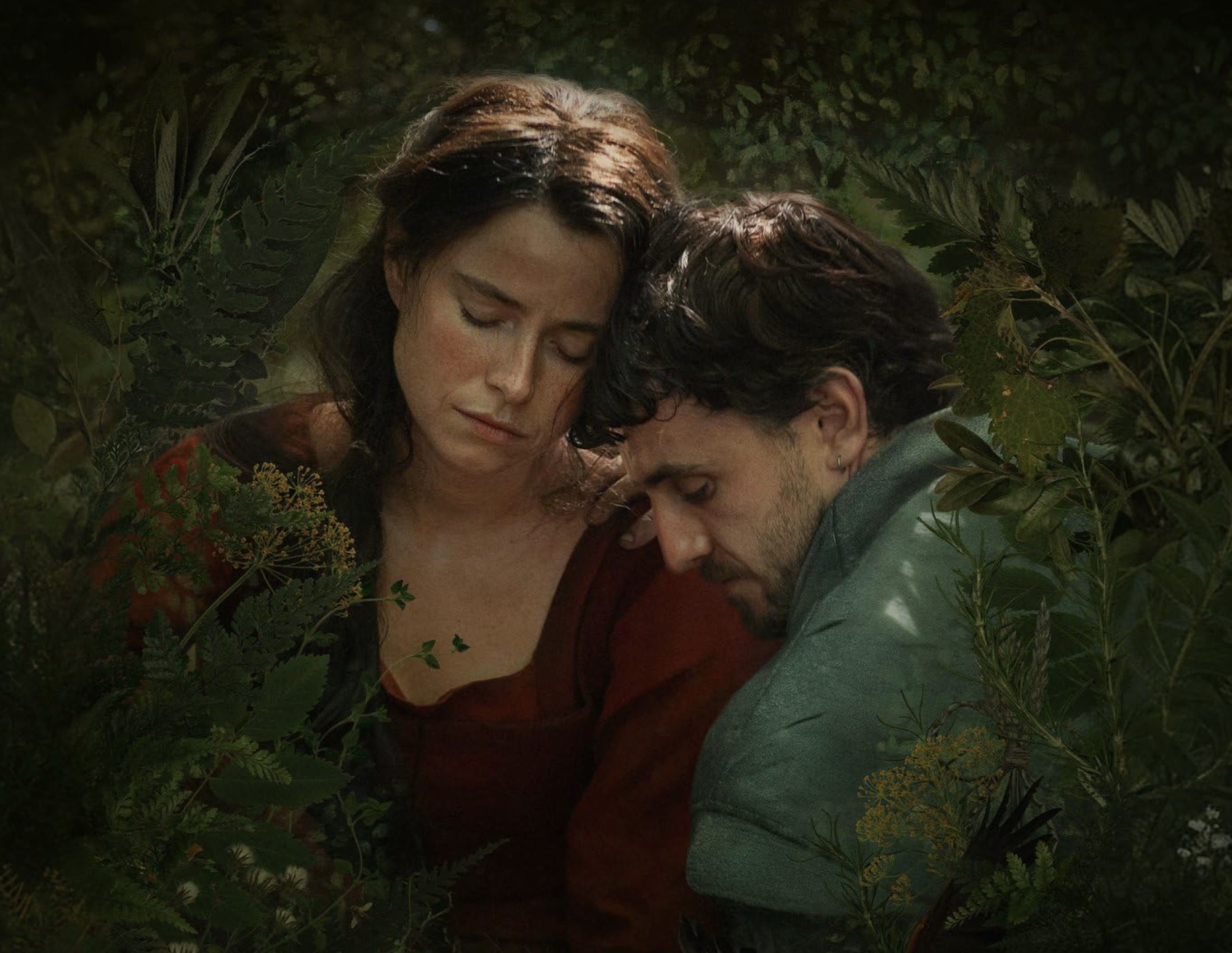
The Scout is about a film location scout names Sofia played by Mimi Davila (left) who discovers more than film locations.
With the Vancouver Film Festival, you can get a wide variety of styles of film showing throughout the Festival. One unique film is the American film The Scout. It’s unique in its own way, even if it is confusing.
Sofia is a location scout in New York City for a film company. Most of the day, she drops flyers into the mailboxes of surrounding houses or apartment suites saying she’s interested in having the inside of their places as set pieces with her phone number listed. After sending out a set of flyers, she makes a trip to an apartment of an older woman as she listens to her voicemail responses. The voicemail range from people interested to those thinking it’s stalking to some unhappy she hasn’t come to her place yet. As she photographs the suite of the older woman, she learns more about her life. She learns the mother has two grown children who have moved out and never returned to see her.
Her second trip is to another apartment. At the house is a man who works from home and often spends time looking after his infant daughter Sophia. Sofia takes a special liking as they’re names are similar. As she photographs the house, she learns more about him and has a sense from the talk that his marriage is falling apart. Her third trip is to another apartment, but that will require crew from the film company to also review. This will be busy for Sofia, the crew and the suite holders. The resident is quite welcoming. The talk from the film crew makes obvious a lot of thought is to go into selecting. Some like it, some are critical of it. Sofia is hoping it will work out.
The day continues as Sofia goes to another apartment of one who accepted. She finds out it’s her friend from her college days. Both of them are shocked. They reminisce about the good times of the past and they talk about what’s happening in the present. Not all of it is pleasant, especially in terms of their relationships. Sofia’s last appointment is to be with a pet store. She’s a half-hour late and the owner is unhappy with it as he’s locking his store. Despite his anger, she’s able to convince him for the appointment. The appointment goes so well, they even have dinner together going into the night. As great as that was, Sofia finds out it took so long, the traffic police clamped her car and she’ll have to pay a fine of more than $400!
The next morning, she attends a meeting at her company’s office. There they talk about certain locations for a scene. Judging by the discussion, it looks like one of Sofia’s discoveries won’t be considered for this scene. After the meeting, she spends the rest of the day over at an urban beach. She just goes there onto the sand holding a coffee and stands there looking out. You can tell on her face something is wrong.
The thing about this film is that it has a good beginning and a good end, but an unsolid middle. In seeing the film, it’s hard to understand what it’s all about. It does show a lot about what it’s like to be a location scout for a New York City film company, but it doesn’t fully make clear what it’s about. You don’t know if it’s intended to be a day-in-the-life film. You don’t know if it’s about the loneliness Sofia’s going through. You also don’t know if it’s to do about the frustration of working a film job in New York. The film could be a case that the director wants us to decide for ourselves what the story is, but I wish it was clearer.
If this film is intended to be one of those day-in-the-life films, it’s not an easy genre to accomplish as the day could present itself as a story to tell or just a portrait of daily life. The film does have a lot to say as Sofia goes from place to place and either meets with her crew or has an ordeal to deal with. It doesn’t make it too clear about what it’s trying to say. One can think of many themes this film could be about like the demandingness of a filming job, life inside different from what we see on the outside, or the story of a successful but lonely young woman. Scenes like when Sofia goes into her parents’ house and call out for her mother make you question if loneliness is the theme. You may have to watch it a second time to make up your own mind what this film is about.
This is the directorial debut of Paula Gonzales-Nasser and the first feature-length script she wrote. Paula has been in the New York film industry for eight years and has made a jack-of-all-trades of herself in doing set design, cinematography, art direction, location managing and producing. The first six years she spent being a location scout so it becomes pretty clear she’s basing this story on her own experiences. The story she writes and directs is a telling story of a location scout trying to make it, but it’s not the clearest in telling its story or making its main point of focus. Despite the lack of overall theme, the performance of Mimi Davila is great. Davila has had an acting career of over 15 years in various roles. In this film, she keeps her performance low-key but she can send a lot of messages even in her moment of silence. She makes for a very believable performance. The supporting performances from the people Sofia visits to the crew she works with also add to the film and make like you’re watching a real situation instead of seeing them act.
The Scout is a unique drama. It could easily be dismissed as a ‘boring movie,’ but you have to look closer. One thing is that the message or theme are not the clearest to understand.
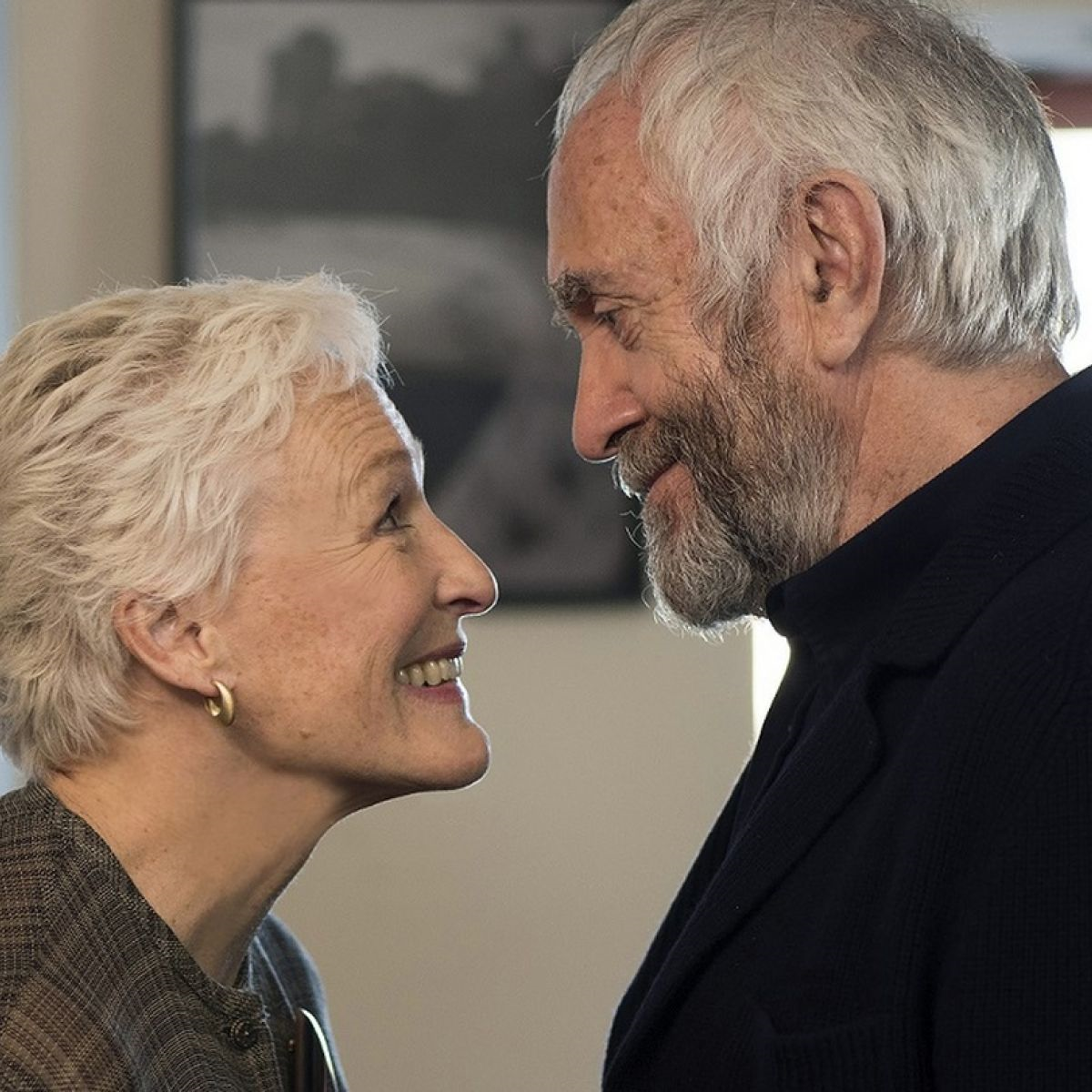
Joan (Glenn Close) may appear to be the happy wife of author Joseph (Jonathan Pryce), but The Wife will slowly expose the truths.
The Wife is another summer release I missed out on seeing at the box office. Ever since its Oscar chances for Best Actress, it sparked my interest. I’m glad I saw it.
The film begins in 1992 with Joan Castleman and her husband Joseph just waking up. Joan appears to be the happy wife of a renowned author. They receive the news that Joseph has won the Nobel Prize for Literature. Both are overjoyed, at least on the outside. At the party to celebrate, their daughter Susannah, who’s having a baby, is happy, but son David is less so. David has desires to be a writer, but seems to consider his talent inferior to his father’s. Especially since he’s hesitant about hearing his father’s critique of his short story. As Joan and Joseph fly to Stockholm, a reporter named Nathaniel Bone tries to congratulate Joseph. That only causes discomfort for the two, but you notice a certain bitter feeling in Joan. A bitterness that grows even further whenever he acknowledges Joan in public.
The film goes frequently from 1992 to the past to back to 1992. In the flashbacks starting in 1958, Joan Archer is a writing student at her university. Her writing and her looks have impressed a young Joseph Castleman who’s a college professor. Joan refutes his advances at first, but things change when she works at a publishing company and hears from her boss Elaine Mozell that female writers don’t have a chance at competing against men. Joan continues to attend more classes with Joseph teaching and his encouragement wins her love to him. Joseph tries to make it as a writer while Joan just wants to be a housewife. But when Joseph’s writing is declined by publishers, Joan starts tutoring him. By 1968, it’s a case where Joan ghostwrites novels Joseph is to be credited with while he plays ‘househusband’ to the kids. Over the decades after many novels, and adulterous affairs, the narcissistic Joseph has become a Nobel Prize winner.
Back to Stockholm, Joseph and Joan are put in a hotel with all of his books present. Joan appears to be excite over seeing all of his books published in other languages. Later, Joseph meets with many important people leading up to the Prizes ceremony. Joseph has a heart condition that comes without notice and requires medication, as noticed during the ceremony rehearsal. One night, Joseph is lured away by a young female photographer named Linnea. Joan leaves, unhappy with what she saw. Nathaniel notices an unhappy Joan in the hotel lounge and invites him to drinks. Nathaniel reveals he’s been studying up on Joseph and has gotten the sense that it was Joan who was doing all the writing. Joan tries to call them lies and tell him to go away. Meanwhile Linnea comes onto Joseph. Joseph accepts, but his heart condition acts back up. Both confront each other about what was going on, but the heated argument ends when they receive a phone call learning of their newborn grandson.
The night of the ceremony occurs. before the Awards, David arrives. He confronts the two about what he heard from Nathaniel Bone. The two deny everything. As Joseph receives the Prize, Joan’s bitterness grows first at the Prizes ceremony and then at the dinner banquet. In the limo to the hotel, they get into a heated argument which causes Joseph to give the prize to Joan, only for her to refuse it. The argument continues on as Joan throws books at Joseph and tells him she’s divorcing him. Joseph goes into a heart attack. It’s apparent it’s fatal. As Joseph is dying awaiting paramedics, Joan tells Joseph she loves him. Joseph’s last words to her are “You’re such a good liar.” On the airplane home with David, Nathaniel Bone acknowledges the loss, but Joan’s response, and the film’s ending, will surprise you in a subtle way.
This year’s Oscars appear to be full of films with social messages. This film has a message about sexism in the arts. We have Joan who wants to write, but it’s Joseph who takes the credit for it. It’s not that uncommon as I once read a 1975 book called The People’s Almanac and they had an article in their chapter on literature titled “She Wrote It, He Got The Credit.” We shouldn’t forget that the time Joan chose to ghostwrite for Joseph was back in the early 1960’s. Female writers may have better chances not, but it’s still hard. Don’t forget J.K. Rowling went by her initials instead of Joanna Rowling with that belief she won’t be taken seriously as a writer. The story is very similar to Big Eyes as Margaret Keane ‘ghostpainted’ under the name Walter Keane because of the sexism in art. I think that explains why Joan was very willing to ghostwrite for Joseph back then. Because she felt the only way she can show her writing to the world was under a male name.
Nevertheless the film is more about the story and the woman rather than the social message. Joan is a woman who appears to be happy on the outside and very in love with her husband. However as each passing moment and instance comes up, Joan’s hidden anger of being the true writer and the wife of an adulterous man becomes more obvious in her silence. You had the feeling that Joan would explode any minute and her true feelings would show. It happens right there after Joseph wins the big prize. However the thing about Joan is that she is willing to keep her peace after his death and make the truth known to just David and Susannah, but hidden from everyone else including Nathaniel Bone. It takes a person of that much self-control underneath the hidden rage to have that much strength to let things be.
The story itself is pieced together very well. We have that moment in 1992 in the days from when Joseph’s award is announced to his eventual death. We also have the past where Joseph and Joan meet, and then become the ‘writing pair’ over time. We also have Joseph being lured to Linnea which would unravel another dirty secret. The film does a good job in moving scenes from 1992 to back in the past to returning to Stockholm to returning to the past and so on. The quality is that it keeps the audience in the wonder. You have the audience thinking one thing at first, sensing something’s wrong later on, and then finding out the truth near the climactic end. That’s an excellent quality because it provides the film with the mystery to keep the audience intrigued.
This is the first English-language film directed by Swedish director Bjorn Runge. He does a very good job of directing the film and the story. I have never read the novel The Wife, but scriptwriter Jane Anderson does a very good job in adapting Meg Wolitzer’s novel into a story to keep the audience intrigued. The highlight of course is Glenn Close’s acting. The best thing about the performance is not just how she delivers, but how she’s able to keep so many things hidden in her character only to come out at the right time. You could see the hidden hurt and disappointment in her character and that was the best quality. Acting is more of what’s unsaid than said. However the film is not only Glenn’s. Jonathan Pryce also delivered well as the husband who can’t confront his problems right. Annie Starke, daughter of Glenn, did a very good job of playing the younger Joan. She did a good job of showing Joan’s disappointment that early in her life, but mix it with her willingness. Max Irons, son of Jeremy Irons, played David very well, butI was not happy about seeing him have a role where he appears like he’s always hurting.
The Wife is more about the character than the social message. However it’s also about the story that makes it so intriguing to watch.
I know I’ve done individual reviews of Best Picture nominees in the past. This year I thought I’d try something new. I thought I’d do summaries of the nominees. Three blogs analyzing three of the nominees. It’s something new this year and I hope you like it. For my first summary, I’ll be reviewing the first three Best Picture nominees I saw: Arrival, Hacksaw Ridge and Moonlight.
ARRIVAL
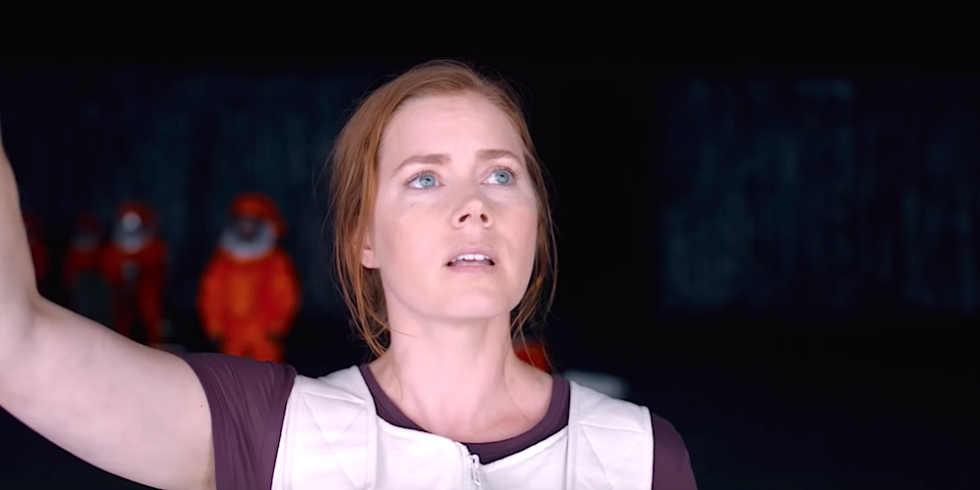
Amy Adams knows how to communicate with aliens in Arrival.
When you learn Arrival is about aliens, I’m sure you have an idea of what you’d anticipate what a movie about aliens would be about. However, you’re in for a big surprise.
This is probably the first movie about aliens to earn a Best Picture nomination. The film appears to set up for a story that would most likely lead to big-time action sequences. Instead we get a film that’s very intellectual in dealing with aliens. Don’t forget Louise is a linguistics professor who was hired for this duty because of her language expertise. In this film, the focus is on communication. Louise has a way to communicate with the aliens and earn their trust even while those around her grow more hostile to the beings. Louise’s gift for communication goes beyond the aliens and she’s able to say to General Shang the words his late wife said to her. It’s like she has a sense for this.
Even with all this, the film is not just about aliens and preventing a human-alien war. The film is about Louise trying to heal after her daughter’s death. Her marriage is no more as well and she’s looking for her purpose. It’s even about Louise and her ability to foresee the future and the possibilities they can unfold. Louise is the central protagonist whom the whole story revolves around. She finds her true gifts at a time she least expects it and she’s able to find her life again. It’s almost like this alien invasion is like a godsend to her life. Right after her daughter dies, she learns of her purpose to the world and to others.
Denis Villeneuve did a top job of directing this film. He already has a reputation for films like Maelstrom, Incendies and Sicario. He’s also been hired to do the Blade Runner sequel. This film he directs is very tricky but he does all the right work for it. The script by Eric Heisserer is very smart and very deep. It does a very good job of getting the right moments of action and the right moments of drama pieced out.
The story also rested on the performance of Amy Adams. She knew the story was primarily about Louise and she had to make it work. Although the role didn’t have too much in terms of character development, her performance was solid and it held the story together. The supporting performers may not have had as big of roles but they still did well with their performances. Jeremy Renner definitely could have had more depth in his role. The music from Johann Johannson and Max Richter fit the movie perfectly. The visual effects were also excellent and just what the movie needed.
Arrival is a very intelligent movie. It’s an alien movie not like one you’d anticipate at first but you will leave the theatre pleased.
HACKSAW RIDGE
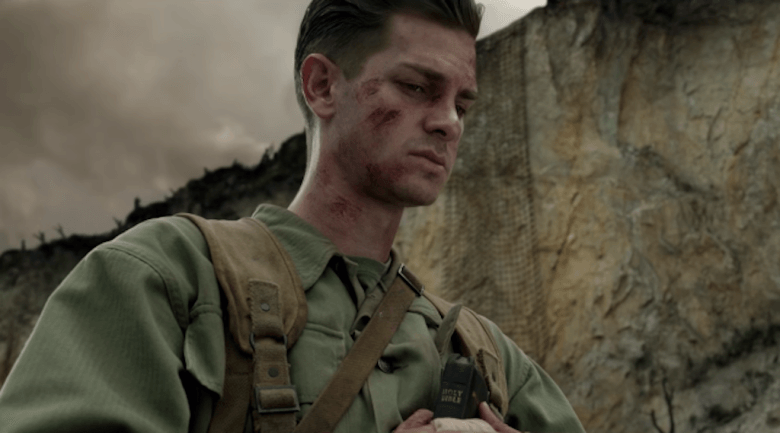
Hacksaw Ridge is about Desmond Doss (portrayed by Andrew Garfield) in both his convictions and his sacrifice.
Mel Gibson is back. This time he has Hacksaw Ridge. It’s a war drama that’s about more than just the war.
This film makes for an interesting topic: conscientious objection. I know all about it. For years I went to a Protestant church where the people were known for their anti-war beliefs. Conscientious objection is something that’s bound to make one question their morals and even act out of hostility. I know that we have conservative pundits who insist that fighting in a war is the definition of patriotism and will even use scriptures to justify why was is the right thing. Upon release of this film, I was anticipating a conservative backlash against it. So far no ‘Diss The Doss’ movement has happened. No movement to have his Medal Of Honor posthumously revoked. Nothing. It’s a good thing because the film does make one reconsider what defines a ‘patriot.’ I’m glad this story was told.
One of the biggest complaints from conservatives in the last 40 years has been either the negative depictions of religion or lack of positive depictions of religion in movies. True, this is not the Hollywood where the Hays Code calls the shots. For those that read my review of Of Gods And Men, I have a quote from Barbara Nicolosi about why that’s the problem. That explains why it’s hard to get a pro-religion movie to compete for Best Picture nowadays. There’s a fine line of showing a film with a positive depiction of Christianity without it being schmaltzy, hokey or overly sentimental. Plus with all the ‘game changers’ in the last few decades, writing a winning script or creating a winning film is just that much of a challenge.
I feel they did a very good job in Hacksaw Ridge. It was a very good story of the persecution Desmond Doss had to face for his beliefs. It was a very gritty story of the war and all the damage it caused. Some say the graphicness was comparable to Saving Private Ryan. It was an honest portrayal about someone’s faith. However there was one point when I felt it was borderlining on hokey during the scenes of: “Please, Lord. Help me find one more.” I know that was something Doss said in real life but I’m just wondering if it could have been done better.
This film is the first film directed by Mel Gibson in a decade. I know he had to take a break as he had a very public meltdown with the things he said about others and problems with alcohol. You could rightfully call this film the redemption of Mel Gibson. He directs an excellent film that took a lot of effort to make. 14 years to be exact even while Doss himself was still alive going from one writer to the next until finally they had the right script and right story thanks to Andrew Knight and Robert Schenkkan. Gibson and the writers did an excellent job with the film with the story and the depiction of war.
In addition, the story was made thanks to the performance of Andrew Garfield. This was more than just a war story. This was a story of a person’s heart and soul. Garfield knew he had to personify Doss in his convictions in order to make this story work. He did it excellently. It’s hard to pick out any supporting players who stood out. None of the roles of the supporting actors were as developed. However Teresa Palmer did a very good job as Dorothy Doss and portraying the concerned fiancee, as is Hugo Weaving as the father Tom Doss and Vince Vaughn as the hard Sargent Howell. The visual effects and the sound mixing were top notch, as it should be in a film like this. The score from Rupert Gregson-Williams fit the film excellently.
Hacksaw Ridge is a surprising film. Who would’ve thought that the best war movie in years would be about a man that didn’t fire a single bullet? Definitely a story worth telling.
MOONLIGHT
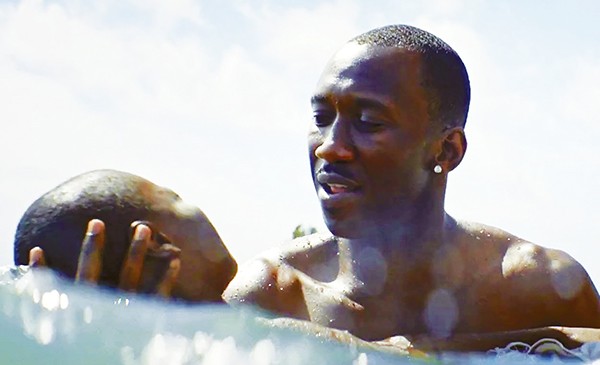
Mahershala Ali (right) portrays a mentor to a boy named Chiron (played by Alex Hibbert at left) in Moonight.
At some point, you gotta decide for yourself who you’re going to be. Can’t let nobody make that decision for you.
This year’s surprise critical success is Moonlight. It’s a very unique film like no other seen this year.
The film is unique as it sets itself around three key periods in the life of Chiron. There’s his childhood where he’s known as Little, there’s his teenagehood where he’s simply known as Chiron and there’s his adulthood where he’s known as Black. The film does tell a story of a man who you think would die young. He has all the ingredients: gay, living in inner city Miami, a verbally-abusive mother addicted to crack, arrested at a young age and a future of being a pusher himself. Somehow he finds the will to survive. He’s able to withstand the bullying he faces for being gay, he’s able to decide his life to the best of his abilities without his mother. Often it’s not the best choices he makes in his life but he finds the ability to survive. You wonder how does he do that? Was it from that brief time with Juan and his mentoring? Was it the love from Kevin he always knew was there? I remember that scene of Little in the school dancing classes dancing like he was in 7th heaven: his escape from the bullying. Was it a spark within Chiron himself? Whatever the situation, it results in beauty at the end.
The film is not just about Chiron. As one can see, it showcases the lives of many different African-American people living in the inner city. It may show some of the more negative depictions like drug dealers, poverty and drug addicts but it also shows positive images too like in the case of Juan and his girlfriend or even in music being played. It showcases some surprising things as well as how Juan the pusher can be a very smart man. It even dispels some myths we have of inner city people. Like how Juan was good at handling Chiron’s homosexuality and gave him words of comfort while Paula acted out in hostility. Usually you’d expect ‘gangstas’ to have a homophobic attitude. It showcases what it’s like to be black and gay in the inner city. It also showcases people’s insecurities. It is overall one man’s attempt to find himself in the harsh world that he lives in. Yet despite all its harshness, it becomes something beautiful in the end.
The film is a triumph for Barry Jenkins. This is actually his second feature as a director. His first film, 2008’s Medicine For Melancholy, won a lot of attention and even earned him many directorial debut awards. Moonlight is only his second feature. This film which he adapts a script from a drama school project from Tarell McCraney is a masterpiece in both the story and its direction. The script is also excellent that there is not too much dialogue but is able to say lots even in the silent parts. Another quality of the film; it says a lot while saying very little. Overall the film is a real delight to watch and leaves one wondering what Jenkins will have next.
The three actors who portrayed Chiron– Alex Hibbert, Ashton Sanders, and Trevante Rhodes- all did a very good job with the role and portraying him at the right ages. Mahershala Ali was excellent as Juan: the pusher who becomes a mentor to little Chiron for that brief period of time. Ali had to bring the right charisma and character for a role like Juan to work not just in his scenes but to have an influence throughout the whole film. He did a stellar job. Also excellent was Naomie Harris. Possibly the one actor or actress to be a part of all three scenes, Harris was excellent as the drug-addicted mother Paula. She had to go through three stages with her role from a simple crack user to a crack addict to recovering in rehab. Each time she had to give her role dimension and inner depth to keep it from being cardboard. She did excellent too. There were additional supporting roles that were also good like Janelle Monae as Teresa and Andre Holland as the adult Kevin.
The technical bits were also excellent. The film was edited very well, the cinematography from James Laxton was possibly the best of the year. The score from Nicholas Britell was excellent but the inclusion of track music from classical to Latin to funk to hip-hop to Aretha Franklin to Motown really added to the feel of the movie. Almost feels like an anthology. In fact that scene when Kevin sees Chiron (as Black) after so many years and plays the classic Hello Stranger is one of the best scenes of the film.
Moonlight is a story of a young black man coming of age in the big city but it’s a lot more too. Those who’ve seen it will know why this film is a masterpiece.
And there’s the first of my Best Picture summaries for this year. Next one coming up in a few days.
“If things were easy to find, they wouldn’t be worth finding.”
I know many of you would be nervous at first of attending a movie like Extremely Loud And Incredibly Close. 9/11 films aren’t exactly crowd-winners. Ever since United 93 and even up to now, it still isn’t. It’s still a tense topic to this day and doesn’t make for good subject matter for people to see a movie about. Nevertheless Extremely Loud And Incredibly Close is a good film of its own, if imperfect.
Oskar Schell is a young boy who’s a smart but fearful and eccentric brainiac often mistaken for having Asperger’s. However he’s dealing with an inner pain. His father Thomas died in the Twin Towers on 9/11, a day Oskar refers to as ‘the worst day’. His father was a jeweller who spent a lot of time with Oskar nurturing his creative and eccentric quest for knowledge. He would create puzzles, help him develop his own business cards (which lists him as inventor, Francophile and pacifist), have oxymoron challenges while practising karate, and even have scavenger hunts. You could tell Oskar is still very much an intellectual now. He keeps his collection of butterflies. He has his collection of facts and figures. He’s even intellectual in his lewd talk: “Succotash my Balzac, dipshiitake!” Yeah, real charming.
However his father’s death still upsets him. He died in the first tower and his body was never found. His mother held a fake funeral with an empty coffin in hopes that it would help them both heal. But Oskar is still hurting and lonely to the point he has distanced himself from his mother and even hurts himself physically. He still has the answering machine of the last six messages his father left before he was killed and replays all but the sixth and last one often, something he has hidden from his mother and replaced with a new answering machine on ‘the worst day’. The only person he talks to regularly is his grandmother who lives in an apartment next door..He feels that the missing ‘puzzle piece’ from the last scavenger hunt he had with his father could keep him from losing the spirit of his father altogether. The quest is to find out what to search for and find it.
One year later while Oskar goes through his father’s clothes and olf belongings, he accidentally breaks a vase. In it is a key inside a small envelope with the name black. Oskar believes this key may be the clue to the last scavenger hunt. He looks in the phone book for all the people in New York named Black: over 400 in total. He vows to search every Saturday for the person with the last name Black who knew his father and refuses to quit until its done. He won’t take any public transit, has a camera to keep a scrapbook of all the Blacks he sees, and he walks shaking his tambourine to keep his sanity while dealing with the world.
The first Black he sees is Abby Black, a woman just recently divorced form her husband. She says he doesn’t know his father. He visits other people named Black who don’t know his father but reach out to him: one hugs, one offers her prayer group to pray over him, another is a cross dresser, another gives him a ride upon her horse. One day, Oskar goes to visit his grandmother but meets the man his grandmother refers to as ‘the renter’.’The renter’ doesn’t talk because of witnessing a bombing during his childhood. The two become friends in the search and he learns from the man when to intervene and how to face his fears. Oskar stars to sens that the man is in fact his grandfather. Oskar even plays the messages from ‘the worst day’ for the stranger but he cannot bear to hear and demands it to stop before hearing the sixth and last message. The renter than moves out and begs Oskar not to search anymore.
When all seemed lost, Oskar notes a phone number on the newspaper clipping his father left a hint. It returns him to Abby Black. It turns out her ex-husband, whom she was divorcing the first time she met Oskar, may know about the key. He does meet with Mr. Black and learns about the key only to learn it’s not for Oskar at all. Disappointed and disheartened, Oskar destroys everything from his search until he learns that his mother was secretly helping him all along and even contacted all the Blacks even before Oskar had visited. Oskar compiles a scrapbook of his search and is able to find the last link of the scavenger hunt in the most overlooked of places. His fears had been conquered.
One strength of the movie is that it uses a creative puzzle and the Oskar’s intellectual way of thinking to help Oskar through the healing process and conquering the simplest of his fears. The scavenger hunt becomes like the journey to healing and along the way the healing comes in the moment he least expects it. The scavenger hunt is also that connection where Oskar searches for that connection that keeps him from being completely lost form his father. He finds it and learns that his bond with his father is still alive and something that ‘the worst day’ can never take away. Another thing Oskar receives is the love and care from people he never met before. It was all the people with the surname Black he encountered that shares some amount of care for him from the start of his journey to the end. It was also where his relationship with his mother heals. It was her own help with Oskar’s mission that showed the bond between the two never died. It also helped her heal too.
One glitch with the movie is that it doesn’t make the best of efforts of being watchable. Yes, the movie has the theme of healing but many times it focuses on the pain Oskar and his mother are going through. Especially the scenes where Oskar is shown with self-inflicted scabs. There were many times I was sitting there feeling that there would be many movie audients turned off this movie. People who have lost loved ones in 9/11 may themselves find the movie uncomfortable to watch too. Another glitch is that many feel this is a flawed look at autism. There’s no mention of autism in the movie but it has been sensed by many critics.
Tom Hanks did a good job of character acting as Thomas Schell, the intellectual father who always taught in character. Sandra Bullock was also very good as the grieving wife and mother. Max von Sydow was the biggest standout amongst the supporting actors playing the mute renter. Interesting how silence can make a role more that dialogue in a lot of cases. Without a doubt, the movie belonged to young Thomas Horn. This is his first ever acting role and he shines as the boy who’s both brilliant, puzzled, grieving, driven and eccentric. He doesn’t play a sugar-coated child character but one who’s very three-dimensional. Stephen Daldry is one lucky director. Ever since his first feature Billy Elliot, each of his four feature films have earned him either a Best Director Oscar nomination and/or receive Best Picture nomination. This is his fourth feature but the first one where he wasn’t nominated for Best Director. Nevertheless he does another excellent job in directing. Eric Roth does and excellent, if not glitchy, scriptwriting effort that makes this story as much our puzzle as it is Oskar’s puzzle. The score from Alexandre Desplat also fit the movie well.
Extremely Loud And Incredibly Close is a good adaptation of a 9/11 novel but it’s not the best at being a watchable 9/11 movie which has always been a difficult task. The effort to create a mostly watchable 9/11 movie continues.
And there you have it. I have now finished reviewing all the Best Picture nominees of 2011. My Oscar predictions are coming Friday.