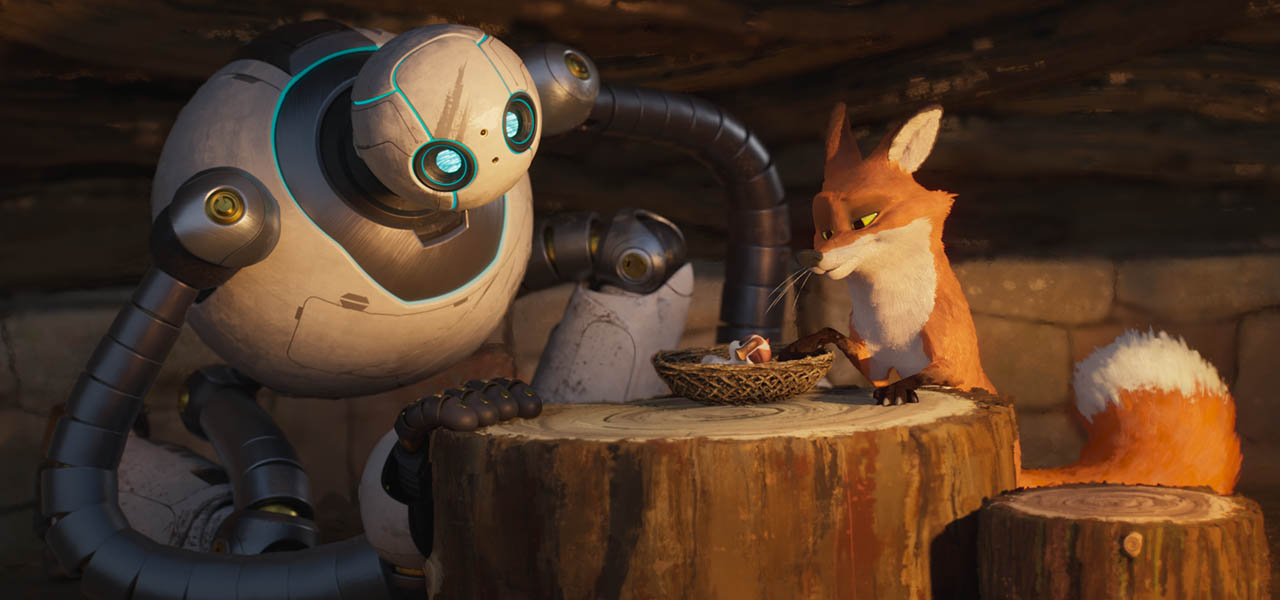
Movie Review: The Wild Robot

This year is one Oscar year where predicting the Best Animated Feature winner will be difficult. One of the favorites is The Wild Robot. Does it have what it takes to win?

The film begins in a remote forest land on an uninhabited island unblemished by human intervention. The coast soon becomes an unintentional wash-up ground for Universal Dynamic’s ROZZUM robots coming from a capsized ship. Only one robot, Unit 7134, survives and running wildlife activate it. It’s obvious the robot has no place on the island as it can’t interact properly with animals. The robot is intended to be a customer service robot with a female voice. Nothing the robot does helps any of the animals and the animals respond in a hostile manner, chasing 7134. Upon falling from running away, 7134 crushed a mother goose to death and all but one of the nest eggs on its landing. The lone egg that was unharmed hatches the baby gosling. 7134 takes a fascination in it. Plus 7134 is programmed to continue with whatever mission she’s given until completion. She puts the egg inside her chest.

7134 finds a memory card in herself to make her communicate with animals better and inserts it. Soon after, she encounters Fink: a sly hungry fox who knows of the egg and wants to eat it. 7134 is able to prevent the theft. Soon the egg hatches and a male gosling is born and imprints himself on 7134. 7134 now has a mission to raise the gosling to adulthood, but how? 7134 first finds guidance from a mother opossum who’s currently mothering six babies. Fink returns but instead of eating the gosling, he makes a deal with 7134 to help raise the feller for a shelter in return. 7134 agrees and creates a hut for them all to live. In the naming of the gosling, 7134 gives the gosling number-names which annoys Fink. Fink gives 7134 naming tutelage and the gosling is given the name ‘Brightbill.’ 7134 even gets a new name of her own: Roz.

Over the months, Brightbill grows, albeit awkwardly. While the other goslings are goose-like and grow as naturally as geese do, Brightbill acts more like Roz than a goose. The other teen goslings taunt him for his awkwardness. Then one day, another flop day of goose training for Brightbill, one of the peers tells Brightbill that Roz killed his mother. It’s there Brightbill turns against Roz.  Even though Roz still wants to mother Brightbill, a ROZZUM unit she reconstructs tells her to return to Universal Dynamics. Roz is determined to reconcile with Brightbill and raise him. That sends a signal back to Universal Dynamics. Meanwhile Roz finds the right bird to teach Brightbill how to fly: a falcon named Thunderbolt. With help from goose master Longneck, Thuynderbolt succeeds in making Brightbill able to fly in time for migration.

The migration is not what it seems. The birds encounter a thunderstorm as they fly in San Francisco. They hope the greenhouse from Universal Dynamics they spot in San Francisco is the temporary shelter they need, but the Universal Dynamics technology detects the birds as contaminant and a multitude of reconnaissance, or RECO, robots that look exactly like Roz go shooting at the birds. The island which has the hibernating animals goes through a severe snowstorm and they fear they will freeze to death. Roz and Fink build a shelter for all animals but demand a truce of all of them not to harm each other.

As spring returns, Brightbill and the geese return, Roz repowers herself and the animals are free to roam the island. Unfortunately, Universal Dynamics has sent a robot to retrieve Roz named VONTRA and she’s troublesome, reckless and remorseless. VONTRA is not even afraid to start a forest fire on the island to get Roz. It’s then the animals group together to rescue Roz and battle VONTRA as their land is burning in a bright red fire. I won’t spoil the ending but the film then ends not with the battle but the aftermath, reminding us of the bond between Roz, Brightbill and all the animals.

This film is based upon the 2016 children’s novel The Wild Robot by Peter Brown. The story itself is a story about togetherness. In many ways, children who watch this film can learn about the importance of getting along and actually coming as one. If animals who attack eat other or treat each other as prey can get along, so can other kids. Same way as a robot, who has no qualities to bond with animals, learns to have those qualities and does bond. Even raise a baby gosling to goose. The film also has other themes too of the environment and how development threatens animal’s habitats. Even the threat of having technology run things and make decisions with no human feelings is another thematic element of the story. At the beginning, I didn’t think Roz would be of any help to the animals of the island. Just an interference that acts on her own programmed logic to do only the things she’s programmed to do. A change of things changes everything and Roz becomes an unlikely hero.

The film’s quality is in its story. It plays the story well. The animals act like animals and Roz acts with her programmed logic. Over time we see the story develop. Roz goes from being an interference on the island to becoming a big help. Fink goes from a sly conniver to being a big help to the animals too. Brightbill also goes from being a robot-like gosling to the goose he was meant to be. It succeeds in making moments you think won’t develop properly develop into the way it was meant to be. At the same time, the film also adds in the other threats like how robots are sent to the island as Roz is not doing her commanded duties and VONTRA threatens to get her even at the cost of the island’s destruction. Unexpected moments like these and the film ending in the manner you didn’t expect add to the story. Also since this film is an adaptation of the first book of a Wild Robot trilogy of books, it also sets up well for the sequel that will be adapted from The Wild Robot Escapes novel. The box office results of this film have opened the door for the development of a sequel, but filming details and release date have not yet been confirmed.

The biggest credit should go to director/writer Chris Sanders. Sanders has over 40 years of experience in animation having first worked as a scriptwriter for the Muppet Babies cartoons and then becoming story writer for five of Disney’s films in the 1990’s during the ‘Disney Renaissance.’ He then broke out into directing with 2002’s Lilo and Stitch which is the first film he directed, co-directing with Dean De Blois. Since then, he moved onto Dreamworks Animation and has co-directed How To Train Your Dragon with de Blois, The Croods with Kirk DeMicco and his first solo project The Call Of The Wild. In this film, he succeeds in delivering an excellent story mixed with dazzling effects. He does a great job in making a film that can easily make Disney and even Pixar jealous!

Also great voice acting from Lupita Nyong’o. She knows how to make Roz the unfeeling robot at times she needs to be and help her develop into having feelings. Kit Connor also does a great job in playing Brightbill from his awkwardness to his anger. Pedro Pascal is excellent as the sly Fink. Stephanie Hsu is also great as the villainous VONTRA. Actually the mix of vocal talent is great throughout the film. Adding to the film is the musical score by Kris Bowers and the work from the film’s sound team and the visual effects team.

In the Oscar category of Best Animated Feature, this film has been in a tight battle against Flow. To think, its biggest rival is an independent film from Latvia! In this category, Flow has won the National Board of Review award, the Golden Globe, and the Online Film Critics Society Award. The Wild Robot has won the Critics Choice Award and the Producers Guild Award in this category. At the Annie Awards for animated films, it achieved ten nominations in nine categories including Best Animated Feature and it won in all nine!

The Wild Robot delivers in what one would commonly expect in an animated film. Although it’s more oriented for children than it is for adults, the parents will have no problem being entertained by the story. Don’t be surprised if it wins the Oscar on Sunday!

2023 Oscars Best Picture Review: Oppenheimer

Oppenheimer will get you questioning whether J. Robert Oppenheimer (played by Cillian Murphy) deserves to seen as a hero or villain, or neither.

Would a film about J. Robert Oppenheimer attract crowds to the cinema this summer? Oppenheimer proved to have the right stuff to make it happen.

When the film first arrived, there was the big question. Would a film about the inventor of the atomic bomb fly or would it flop? Would today’s audience care about a story of the inventor of the atomic bomb? Especially with this being a film with a budget of almost $100 million. Would it be a box office hit during the summer? In addition, does the film justify its three-hour running time? Oppenheimer surprised all naysayers by answering “yes” in all cases. It even succeeded in being a hit right while the Barbie phenomenon was in full-swing. No wonder 2023 will be remembered as the summer of “Barbenheimer!”

This film succeeds in justifying it’s importance. It’s easy to develop a fascination for the man who pioneered the “Nuclear Age.” Hiroshima and Nagasaki are still as intriguing and haunting today as they were when the bombs were dropped in August 1945. Even how this would pave the way for the introduction of the nuclear bomb and how it would cause the most intense moments of the Cold War of the past can make people intrigued in the man that started it all. Even though the most intense days are gone, it doesn’t mean the threat is no longer. There’s still Communist China, North Korea and even Putin taunting the world with threats. As long as nuclear bombs exist and are ready to use, J. Robert Oppenheimer will remain a man of intrigue.

The film can’t just be about building the nuclear bomb. The film is about the man himself. Oppenheimer himself started his career off as an aggressively ambition physics professor who had a clever and creative way of describing complicated things. It’s after he learns of nuclear fission in 1938 that he senses that it’s something that can be weaponized. The timing of this comes just as World War II dawns. The Manhattan Project is commissioned in 1942 to create such a weapon. J. Robert, who was Jewish himself, knew of the importance of stopping the Nazis. J. Robert didn’t simply agree to create such a bomb for the sake of having one created. He created one because he sensed the Germans themselves could learn of this and create one of their own. The war ends in Germany without a single use of such a weapon, but as its relevance is questioned, J. Robert suggests it could end the war in the Pacific. The bomb is tested successfully and that prompts President Truman to order them used in the war.

Then Hiroshima and Nagasaki happen. Everything changes for Oppenheimer. He is now ridden with guilt, feeling responsible for all the deaths that happened. The American people, on the other hand, see him as a hero for ending the war. President Truman, full of excitement with winning the war, taunts J. Robert’s empathy and rejects his wish to end further atomic development. It’s at the 1954 hearings that J. Robert, his legacy and his ties to communists are put under question and he has to confront himself on who he is. Eventually his arrogance and competitiveness would take his toll on him in the end. He’d have to face the music of the new world order he helped pioneer.

It’s also about the personal side of the man. J. Robert was a man of ambition in his early days of studies. He was also a man who thrived on knowledge and frequently consulted with Albert Einstein many times, relying on his knowledge. He was a man who liked difficult things and took an interest in the mystical and the cryptic. He was also the husband of Kitty Puening, but the marriage was rocky and riddled with J. Robert’s infidelity. His ties to communists in the intellectual community, and even with wife Kitty being a former writer for a communist newspaper, is something that could easily cause the suspicion in the 1950’s communist crackdown. J. Robert Oppenheimer was as much a complicated person as he was an important part of history.

This film should be seen as the crowning achievement of writer/director Christopher Nolan. His career has spanned over half a century starting in 1998 with Following, making his North American breakthrough with 2001’s Memento. His career would be full of landmark films like The Prestige, The Dark Knight, Inception, Interstellar, and Dunkirk. Until this film, only the latter has earned him an Oscar nomination in directing. He’s frequently delivered remarkable storytelling and has often found big box-office success, but many feel he’s missing the big renown he deserves. This film, which is an adaptation of the 2005 book American Prometheus, not only makes us take interest in the man who pioneered the nuclear age, but take us into the times and in the person Oppenheimer was. He succeeds greatly in creating a film that keeps out intrigue in the man himself as our intrigue into the creation of his bomb. Definitely the best film in an illustrious career he’s created.

We should also give many top accolades to Cillian Murphy. As much as this is Nolan’s masterpiece, we should also admire Cillian for making the film work for his portrayal of J. Robert. He does a great job in portraying the man and his genius, his weaknesses, his arrogance, and his hidden frailties. Definitely one of the film’s biggest highlights. Also excellent is the performance of Emily Blunt as Kitty Oppenheimer. Not only does she show her struggles with J. Robert’s infidelity and the potentially-destructive work he’s carrying out, but she’s able to tell J. Robert bluntly some awful truths about him, the world and all he caused. Also excellent is Robert Downey Jr. playing Lewis Strauss, the former colleague who turns against him and vilifies him in the end. Additional excellent performances come from Matt Damon as Ge. Leslie Groves who’s cynical and fearful of J. Robert’s work, Florence Pugh as J. Robert’s “other woman,” and Tom Conti as Albert Einstein, whom J. Robert often confides in and confesses to.

The technical feats of Oppenheimer are also excellent. There’s the cinematography of Hoyte van Hoytema, a frequent collaborator of Nolan’s, who did a great job of using the black-and-white and color imagery to showcase the two sides of the story. There’s the excellent editing from Jennifer Lame which showcased the story well and justified the film’s three-hour length. There’s also the costuming, hairstylists and makeup personnel that did a great job in recreating the looks of the past. The production design team also did a great job in their recreation of past buildings and the empty town meant to test the bomb’s effects. There’s also the great musical score from composer Ludwig Goransson that adds to the suspense and eeriness of the film and the sound team that delivers the right sound mixing needed for the story.

Oppenheimer is a deserving summer movie hit, an accomplishment for Christopher Nolan, and one of the best films of 2023. It’s a film that can get you feeling sorry for a historical person we should really hate and also show how important the story of his invention is for our times.

Oscars 2019 Best Picture Review: 1917

1917 Chapman mackay
A journey to deliver a message to stop a battle during World War I leads to an intriguing drama in 1917.

There has been a lot of anticipation of what will win Best Picture for the past two months. Lately the recently-released 1917 has become the front-runner. Does it have what it takes to win it?

One thing we should keep in mind is that this is not a completely true story that takes place during World War I on April 6, 1917. This is a story about a messenger delivering a message during the war. According to Sam Mendes, this is a story that has been lodged with him as a child. It’s quite likely the stories came while listening to the tales his grandfather, Lance Corporal Alfred H. Mendes, would tell. In fact he dedicates the film to him ‘for telling us the stories.’

Another thing we should remember about World War I is not just how it would be the most brutal war in history before World War II, but also of how it changed how wars are fought. In the past, soldiers would fight on horses with swords. Here in World War I, it was mostly ammunition related which made horse fighting useless from this point on. Also with the airplane being invented back in 1903, this was the first war ever that would involve airfighting. That would present a new danger for soldiers fighting on the ground as they would also have to avoid shooting from the air.

We should also take into account that despite the advances in warfare, communication between infantries were limited. It seems odd to see the need for a message to stop a battle to be sent through two men. I remember seeing messages submitted in such fashion in Lincoln which was set during the Civil War. One in today’s modern world would find ‘walking’ this message from the trenches to former enemy territory to the infantry to be an odd thing, considering the technologies we now have. We shouldn’t forget that during World War I, the most communication they had was either Morse Code or landline telephone. As you would see when the scene approaches, the infantry of which the leader would need to receive the message would have no access to any of those forms of communication. Telephone lines were cut out in the field and ‘walking’ the message to the infantry would be the only way they can be reached.

We’ve seen war movies in the past. Most war movies consist of frequent battles and action scenes. Mostly to stir up excitement for the purpose of being an action movie. This is a different story. This is a message of two men who are given the responsibility to deliver a message to a battalion to cease fighting and prevent huge loss. This is not just a message a soldier has to relay to prevent a devastating battle, but one in which threatens his brother. Blake not only must deliver the message but have someone else as the second should one die. He chooses his best friend Schofield who’s reluctant at first. The two put themselves out in the mission but encounter danger after danger. Blake is stabbed to death and then it becomes Schofield’s mission to deliver the message. This is a story that focuses less on battles and more on getting a task done. If you get into the story, you will see this is a task which will put one in the middle of the horrors of war. This being a war movie, there are scenes of action and intensity. Those are scenes that can’t be compromised in a war movie and there’s no compromise here. This film also shows a lot of the horrors and devastations caused during World War I like a devastated town, a brutal plane crash, rat-infested areas, bodies left around decaying, and even how every soldier had to see people from another army as the enemy. No exceptions. This story is a telling account of what those fighting in the war had to deal with.

I know I’ve seen many films by Steven Spielberg where he not only tells a war story but also shows how the war was done back then. Often when he does his story that occurs during times of war, it’s like we receive a lesson of how war was done and are even reminded of the politics and hostilities of the time. Sam Mendes takes a different approach in telling his story in 1917. It’s not as telling as how World War I was done as a Spielberg movie would be, but it does remind you of many horrors a soldier would endure. Keep in mind, this is a single story of a message to be delivered and the treacherous journey to deliver it. One can go through enough horrors in that one journey to know how much war is hell. Even the stories from one person is enough to be a telling account.

Mendes does do something in which Spielberg never did in any of his war movies. Mendes makes this a ‘follow-around’ story. I’ve seen films which have been cases where the story is told by following the lead protagonist around. It’s added to the story in most cases. Here in this film, it not only tells the story but makes one part of the journey. It makes the audience experience the horrors and dangers as they happen. Another addition to the story is how it makes like this film is all one take. It’s not really a single take for almost two hours. In fact I saw in Birdman how they’re able to make a film set in real-time appear to be only one take through some cinematography and editing angles. This is the same here where it does an excellent job of making it look like one take from start to finish. There are many times in which the story is done in real-time and there are time elapses where the audience won’t notice. Nevertheless it works for the film and for the storytelling.

Top acclaim has to go to Sam Mendes. I have something to tell you all. Back when I first arrived in Vancouver, I celebrated my first weekend there watching American Beauty in the movie theatres. It left me captivated from start to finish and I never checked my watch once! Which was rarely the case for me back then. That film, as well as other films that made 1999 a landmark year for film, and the Oscar race that followed would kick-start my enthusiasm for film and the Oscar Race.

Mendes does an excellent job in directing the story and using multiple angles that add to the story instead of distract. The story in which he co-wrote with Krysty Wilson-Cairns is actually the very first feature-length film script both have written! Wilson-Cairns however has had more experience as she’s written for television and various short films. This is a unique story and a unique way in filmmaking of telling the story. The story succeeds in delivering excitement and intensity as the viewer watches it. The journey ends in a manner different from how the viewer would expect it to end, but it ends on the right note. It even ends on a personal note as Schofield confronts Blake with the bad news. The ending is possibly the most human note of the film and it reminds you of the dignity of the soldiers who sacrificed their lives to fight or prevent tyranny. I admire Mendes and Wilson-Cairns for incorporating that in the story.

As for acting, this is a film that doesn’t allow too much in terms of a developed ensemble cast. Many action films and war films usually don’t have room for well-developed acting; it’s mostly action-oriented. Even the role of the protagonist Schofield, played by George MacKay, is not exactly a role with too much dimension. I do give it credit as the film is more about the story than it is about the characters. Nevertheless I do admire for MacKay delivering a solid performance with a role that lacked dimension. Actually he succeeds in giving the role its most feeling at the very end. The acting of the main supporting role of Dean-Charles Chapman was also very good. His role was given more feeling as this was the character’s brother he was most concerned about. Chapman also does a good job with his role. Most of the other supporting roles had minimal screen time in the film. Nevertheless the performances of Colin Firth, Benedict Cumberbatch, Robert Maaser and Richard Madden were well-acted despite how limited their roles were.

The film also has a lot of stand-out technical efforts too. First is the cinematography of Roger Deakins which is unique for a war-film and it adds to the thrills and excitement. Next is the film editing by Lee Smith who successfully makes it look like a single take. Next is set designers Lee Sandales and Dennis Gassner for recreating the trenches, battlefields and sunken bridges of the war. Another of top acclaim is the score from Thomas Newman. Newman has composed scores for six of Mendes’ seven films and this is his fourth Oscar nomination for a score for a Mendes film. The score fits the intensity of the story and moments of action. Finally the visual effects team did an excellent job of recreating the war and the battle scenes.

1917 isn’t your typical war movie. It’s a movie that takes you on the journey and involves you in the drama. It even reminds you of the horror while restoring your belief in humanity.

And there you have it! That’s the last of my reviews of the Best Picture nominees! This makes it nineteen straight years of seeing all the Best Picture nominees before Oscar Night! Just a review of the Oscar Shorts and my Oscar-winner predictions yet to come.