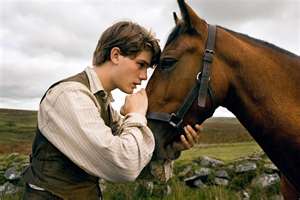
2011 Oscars Best Picture Nominee: War Horse

War Horse is the latest live-action drama by Steven Spielberg. It was originally a children’s story written in 1982 and later adapted into a stage play which debuted on Broadway in 2011 and even won a lot of Tonys. Now War Horse comes to the big screen and it’s only right that Steven Spielberg be the one to create it into an epic movie.

The film opens as young Devon boy Albert Naracott watches the birth of thoroughbred colt and watches him grow up. The colt would become his, but at a cost to the family. The father Ted wins him at an auction at an enormously high 40 guineas, thanks to his intent to spite his landlord. The high price would cause him to miss his rent and he would have to pay by autumn. That’s not an easy thing for Ted as he has an injured leg from the Boer War for which he’s not proud of and drinks to hide his guilt. He even hides his medals away.

Meanwhile Albert grows a friendship out of the horse whom he names ‘Joey’. Each time Ted threatens to shoot the horse, Albert tries to prove Joey is worthy of staying. Albert trains Joey into plowing the farm and succeeds in having it all plowed in a single day. However the farm fails because of heavy rain and Ted sells Joey to an Army Captain as World War I has just started. This breaks Albert’s heart and he even tries to enlist, even though he’s underage. However Captain Nicholls ensures Albert Joey will be fine and will make it home. Albert even ties his father’s war pennant to Joey’s bridle.

Joey is trained for battle and faces his first battle with Nicholls on top against the Germans. The Germans however have the latest artillery which are capable not only of killing horses from far away but making horses now useless in war battle. Nicholls is killed in battle but Joey is one of few horses to survive, only to be captured by the Germans and used as an ambulance horse along with Topthorn, a black horse whom was trained by the British. Joey and Topthorn become friends. The two horses then become owned by two young German brothers who plan to desert the army and flee to Italy. Even though they hide themselves and the horses in a French windmill, the brothers are discovered by the German soldiers and executed by firing squad.

The two horses are discovered by a French farm girl named Emilie, an orphaned girl who has brittle bones and lives with her grandfather. They soon become hers and she’s able to hide them successfully after German soldiers raid their house and take their food. She finally rides Joey on her birthday only to have the horse stolen by German soldiers. The horses are then put to the task of pulling heavy artillery. Joey and Topthorn are the only two pulling horses to survive this.

Meanwhile it’s 1918 and Albert is now a soldier for Britain. He and his allies are wounded by a mustard gas explosion in German trenches. Joey and Topthorn are still alive after years of brutal labor by the Germans but Topthorn can’t take it anymore and dies. Soon after, Joey tries to flee and advancing tank only to end up tangled in barbed wire and fall down in the mud. A British and German soldier clip off the wires together and the British soldier wins possession of Joey in a coin-toss. While Albert is recovering from his gas attack, he learns the story of the miracle horse. Meanwhile Joey is to be put down because he is too injured. Just before he’s to be shot, Joey responds to an ‘owl call’ from Albert. Albert and Joey are back together again but it doesn’t end there as there is still the auctioning of the war horses. What happens after is something for you to see for yourself.

One thing about the movie is that this, like a lot of epic films, does not have that stellar of a script or of acting. The script is good in how it takes one through the adventure from one place to the next with its various twists and turns, but nothing really deep. There are even times in which it comes off as fluffy as a movie-of-the-week script. The acting is flawless but nothing of any real challenge either. There was no real actor that stood out with Emily Watson being the top billed actor of the film and newcomer Jeremy Irvine being the lead human protagonist. The acting roles are well-played but often end up as cardboard as your typical acting in an epic movie.

The lead role and the protagonist in the movie is actually Joey the Horse. The story may mainly be about Albert trying to get Joey back to Devon but it’s Joey’s adventure and trials of it all which is what the story is all about. He goes from being born to Albert’s best friend to a horse in battle for Britain to befriending another war horse named Topthorn to a horse on the German side to being a horse of a French farm family to being back with the German side to being found stuck in barbed wire to being reunited with Albert. I may have knocked the script a while back in my review but I have to say one of the best attributes of the script is that it was able to make Joey into a horse with feelings without coming across as cheesy. That scene where Joey says his last goodbye to the deceased Topthorn didn’t come across as cheesy or manipulative. Also the movie ends with some unexpected twists and turns. Just when you think Albert and Joey are finally reunited, it doesn’t guarantee Albert will be taking him back to Devon. Interesting note is that the scriptwriters worked with Michael Morpurgo, author of the novel, to get the right adaptation of the movie.

Although the script and the acting are not the best attributes of the movie, the cinematography, set design and the accompanying score are the best technical qualities. Spielberg picked out some of the best and most appropriate areas of England for filming this movie, including Devon for the countryside and town scenes, Hampshire for cavalry scenes and an airfield in Surrey for the battle scenes. Janusz Kaminski did an excellent job of cinematography. His cinematography duties for this movie were complex as he had to both capture the grittiness of war for the battle scenes and capture the glamor and beauty of the countryside for the various country scenes. Plus you can’t go wrong when you have John Williams to compose your movie’s score.

However the best overall attribute is its ability to capture battles of World War I. Steven Spielberg is already known for his movies that depict wars and it only seemed right that he should be the one to recreate World War I in this movie. Here, he doesn’t disappoint. He’s able to recreate everything from the horse battles to the ground artillery to the trenches of the World War I battles to the first tanks. He also shows the grittiness of war too with the laying of the dead horses in battle to the execution of boys not yet adults to the rats in the trenches to the explosion of mustard gas bombs. Grittiness of war is something Spielberg doesn’t avoid and he doesn’t avoid it here. It’s also interesting noting the horse statistics of World War I that Morpurgo researched to create the War Horse novel. It is believed that there were 10 million horse deaths during the whole war. Of the one million horses sent from the UK to battle, only slightly more than 60,000 returned alive. The rest were killed in battle or slaughtered in France for meat. So War Horse is quite a story of survival.

War Horse may not deserve to win Best Picture as its acting performances, direction and script lack the winning edge but it’s a very good movie on its own. It’s a good family drama for families with older children. I commend Steven Spielberg for making the adaptation of this children’s novel possible on the big screen.

Oscars 2011 Best Picture Nominee: The Tree Of Life

The Tree Of Life won the Palme d’Or at the 2011 Cannes Film Festival. The film isn’t the typical drama you’d come to expect. Instead it’s more introspective and delivers a message of a common theme of the human existence.

The movie’s story starts upon Mrs. O’Brien receiving the news of her son’s death. Mrs. O’Brien had always been taught everyone must choose between the path of grace or the path of nature. The son’s death would throw the family in turmoil. The movie then focuses on present-day Jack O’Brien, now an architect. When a tree is planted in front of his building, he reminisces about his life as a young boy during the 1950’s.

A pre-teen Jack is living with his family in suburban Waco, Texas and is now forced to choose the path for himself. His parents have equal bout opposite influences on him. His mother represents grace as she is gentle and nurturing but authoritative, presenting the world as a place of wonder. His father represents nature as he is loving but strict and authoritarian as he tries to make his boys tough for a world here perceives as corrupt and exploitative. He often questions giving up his passion of becoming a musician and instead became an engineer and hopes to achieve wealth through filing patents of his inventions.

Before Mr. O’Brien goes on a trip to market his inventions, a drowning death of a child at the town pool happens. Mr. O’Brien suddenly turns violent and unleashes an abusive rage on his boys and Mrs. O’Brien. While he’s away, Jack and the boys are raised exclusively by their mother and his feelings of rebelliousness start happening. Jack follows along with the other boys in his town and commits acts of vandalism and animal abuse, even theft of women’s underclothing from a neighbor’s house. It’s after that where Jack gets the first natural sense of his consequences and throws the stolen underwear in the river. Mr. O’Brien returns home having failed to sell his inventions. His plant closes and is given the option of staying with the company with an unpromising job or be terminated. He chooses the unpromising job which means the O’Brien family would have to move away from Waco. Upon leaving he asks Jack to forgive him for the harsh treatment of him.

What I just stated in the above synopsis was of the events that happened in the drama. That’s only half of it. The other half is what happens in the more sublime parts. The opening image of the movie is the mysterious flame that flickers in the darkness. We see it at the beginning of the film as it leads to the opening scene of Mrs. O’Brien receiving the news of her son’s death. Just as soon as an older Jack O’Brien reminisces of his childhood in the 50’s, the movie doesn’t shift back to Jack in the 50’s but of the very beginning of the universe. Galaxies are formed, planets are formed, volcanic activity and the existence of life begin on Earth, dinosaurs fight to survive and fight to conquer, an asteroid hits the Earth, and then the O’Briens marry and have Jack and his two brothers. This leads into the main drama of the story.

After Jack reconciles with his father the sublime returns as it fast forwards to an Earth five billion years later incinerated and shrunken by the sun and left completely devoid of any life. The movie returns to the present as Jack leaves work and encounters a vision of walking on rocks. As he walks through a lone wooden door frame, which is probably the door from the house in Waco which doesn’t exist, and is reunited with his family and all those who were in his life. Even those that died including his brother have been resurrected. The movie ends with the mysterious flame seen at the beginning continuing to flicker in the darkness.

For those who’ve seen the movie, there’s no question that the movie is very much thematic and gets you thinking. The biggest theme of the movie has to be the constant dilemma of the way of grace vs. the way of nature. It’s a constant choice everyone has to face in their life. It’s also made present in the movie that this dilemma has existed ever since there was life on Earth even before the human race. It’s a dilemma Jack is forced to confront as a child and witness his parents representing the two opposites. The way of grace is given additional support by the messages given by the priest. The way of nature is given additional support by all the rough, even destructive games the boys play. That theme and the various part of the film, both in terms of the plot and the sublime, focus on the theme of grace vs. nature being the universal pulse.

If there’s one weakness of the film that stands out, it’s that it tries too hard to be artistic and creative. I actually admire films that try to be original and take artistry to new levels. The only problem is all too often, many artistically inclined films look like they forget they are to be shown in front of an audience. When I critique movies, my attitude towards the more artsy films is: “Okay, I know you are trying to be artistic and creative but don’t forget you’ll be seen in front of an audience.” I also have a tough attitude towards commercial movies: “Okay, I know you want to make big money but give the audience their money’s worth.” Overall I feel a film doesn’t have to be entertainment but it should do something with the audience, like connect with them or get them thinking.

Enough about my critiquing guidelines. The problem with the Tree Of Life is that firstly it takes a subject matter that is common. It also tries to connect the dealings of loss and lost innocence with the existence of earth and the universe itself and even the spiritual world. Yes, it makes for some creative film crafting and original themes but it doesn’t succeed in grabbing the crowd or make them involved in the story line. Often the story tries too hard to let its sublime side get inside the audience that the story comes across as humorless and even unwatchable or confusing at times. That has to be the biggest glitch and that’s why I feel it doesn’t deserve to win Best Picture. Terrence Malick does his best to write and direct a watchable movie about lost innocence and reconciling with the past that tries to get inside the audience, but it misses in a lot of ways.

The best acting performance overall had to come from then-newcomer Jessica Chastain. It was her performance as Mrs. O’Brien, the struggling housewife, that was the most complex as she plays a character who struggles to keep the calm of the family despite the many fierce adversaries that come their way. Even though Chastain earned an Oscar nomination in The Help, I felt her supporting performance here was much scronger and deeper. Brad Pitt also did well but it was not his best acting performance. Actually his performance was more of a supporting performance as was that of Sean Penn. The leading performance of the movie actually comes from young Hunter McCracken. As young Jack O’Brien, he embodies the loss of innocence unraveling through its joy, anger and its heartbreak. Through young Jack, we see the embodiment of what being a young boy is all about in both a boy’s toughness and tenderness. Young Jack sees all that is happening and what would lead to the decline in relationship with his father that would pave the way for the reconciliation. The film’s best qualities are the cinematography by Emmanuel Lubezki and the musical score by Alexandre Desplat.

The Tree of Life tackles familiar themes of coming of age, loss of innocence and reconciling with the past. The problem with it is it tries too hard to connect it with the existence of the universe, all life on earth, the end times and even the spiritual world. Although it didn’t really appeal to me, I’ll just sum it up by saying it’s a love-it-or-hate-it film.

Oscars 2011 Best Picture Nominee: The Artist

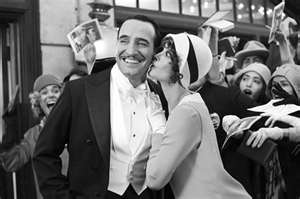
Georges and Peppy's fates are sealed with a kiss in 'The Artist'.

Miss silent movies? Some of you are too young to know what silent movies are, never mind appreciate them. Anyways The Artist is a throwback to the days of the silent movie and it does a top notch job of it.

It’s 1927 and the era of silent films. Georges Valentin is the king of the big screen. The premiere of his latest release A Russian Affair is applauded greatly. He is quite the charmer with his debonair looks and his mall dog Jack by his side. Zimmer, his boss at the Kinograph Studios, loves him. Clifton, his valet, considers him his best friend. Outside he’s signing autographs when a young wannabe named Peppy Miller accidentally falls into him after dropping her purse. The incident is an event for photographers and even leads her to the cover of Variety magazine with the title ‘Who’s That Girl?”

Peppy and Georges meet again as she auditions as a dancer for his latest movie. He insists on giving her a role and even gives her a fake beauty mark for a competitive edge in Hollywood. It works as her fame is soon rising. Meanwhile Georges has a nightmare one night where he’s in a world of sound and he’s the only one who can’t talk.

It’s 1929 and Zimmer announces that Kinograph will now be doing movies with sound, or ‘talkies’ from now on. Valentin is unhappy feeling talkies are a passing fad. He stubbornly makes and directs his own silent film with his own finances. Unfortunately it opens on the same day as Peppy’s latest talkie release. Before the release, she’s being interviewed in a restaurant where she proudly talks of herself as ‘fresh meat’ and ‘out with the old, in with the new’ until she comes face to face with Valentin. Peppy’s movie is a hit while Georges’ silent movie is a flop. Georges’ wife kicks him out of the house and he takes up an apartment with Clifton. Meanwhile Peppy is a major Hollywood star. Despite her stardom, she never loses her thoughts and concerns for Georges. She even attends the premiere of his silent film.

Things turn for the worse for Georges especially after the stock market crash where it gets to the point he auctions everything off and fires Clifton who he hasn’t paid for a year. One day in a drunken rage, he burns all the copies of his movies save one. He’s trapped in the fire and can’t get out until Jack the Dog is able to attract a policeman’s attention. He’s rescued and taken to a hospital where Peppy soon takes him to her house to recuperate.

Georges awakes not only to find himself in Peppy’s house but to learn Clifton now works for her. Peppy then pleads to Zimmer to get Valentin to star in her next film, even going as far as threatening to quit Kinograph  if he doesn’t agree. Meanwhile Georges discovers all his auctioned-off items at Peppy’s house and then returns to his burned-out apartment. Peppy arrives at George’s apartment just as he’s about to commit suicide. It’s then when they reconcile and she persuades Georges let go of whatever pride is eating him and star in her next film. I won’t tell you how it ends exactly but it does end happily and on a surprise note.

It’s unique that it shows the swing from the silent world to the sound world as a personal trial of Georges Valentin. The world of silence made him a star, made him beloved and helped define him. When talkies came into play, silent movies went out of fashion and Valentin faded with them. Even despite his insistence of them being an art form, silent movies were not liked anymore. Valentin’s devotion to silence and his anger to his lost fame almost becomes like a source of pride for him as he even goes as far as neglecting the help given from those who act like ‘guardian angels’ to him: Jack, Clifton and Peppy. It’s only in the world of sound, a world Georges feared, that he’s able to recover.

Another thing this movie reminds us is that this world of disposable stars in Hollywood is nothing new. The movie does show a truth that a lot of stars popular during the era of silent films would lose their stardom during the start of talkies to a new era of stars. Does John Gilbert come to mind? And that line from Zimmer that: “The public wants fresh meat and the public is never wrong.” gives us a reminder of what Hollywood is about and always was about. Those who complain that Hollywood is not about the art of filmmaking and ‘all about the money’ are reminded in this film that it always was that way. Even while it has churned out some of the most classic and most beloved movies of all-time, it was still a profits-first system even during its Golden Age. The battle between ‘film as art’ and ‘film as entertainment’ still continues now.

Overall this was an excellent movie that is the brainchild of French director Michel Hazanavicius. He directs, writes and even edits the film. He also includes Jean DuJardin and Berenice Bejo who have worked with him in two of his past productions. Their performances on their own stand out as two of this year’s finest. Often one thinks that a lot of acting involves annunciation of words but a lot of acting is also done in silence too. In fact there’s even one completely mute performance–Holly Hunter in The Piano–that even won an Oscar. And we see the quality of the silent performances in this movie. Supporting performances from James Cromwell and John Goodman also add to the movie and stand well on their own. Also we have the dog Uggie as Jack the Dog who’s as much of a charmer as he is a scene stealer. The accompanying score from Ludovic Bource is also another top quality of the movie that adds to its highlights. The set design and costuming also work perfectly to set the time period. You’d hardly know this was made in 2011. Overall this is a well-organized film that’s as entertaining as it is artistically merited.

The Artist is a very charming throwback to the silent movie age. It retains the charm of silent movies and the era while maintaining an intriguing story and top notch acting. The big question is will its silence be golden on Oscar night? It’s heavily favored. We’ll just wait and see.

2011 Oscars Best Picture Nominee: Hugo

Hugo is a delightful movie based on the book The Invention of Hugo Cabret by Brian Selznick. It’s a unique story about how a chance stealing by a young boy changed everything forever.

It all starts in a train station in Paris in 1930. Hugo Cabret has a life no child would want. He lives in the train station completely orphaned and with nothing but a bed and an automaton from his late father whom he hopes to repair. He ended up there after his widowed father was killed in a fire and taken by his alcoholic uncle who would look after the station clock. After his uncle died, Hugo steals food and runs the clock himself from revealing the death of his uncle. If the truth is found out, he will be sent to an orphanage.

One steal by Hugo of a toy part from the station’s toy store owner would change everything. Hugo was able to escape the station policeman thanks to his leg brace being caught in a train. Hugo however loses a book of animated drawings to the toy store owner. For Hugo to get it back, the toy store owner punishes Hugo by making fix his broken toys. The toy store owner is surprised to see that Hugo is very skilled at fixing toys thanks to his father’s teachings.

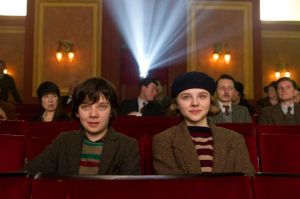
Soon Hugo catches the attention of Isabelle, the girl who frequently visits the train station. She is an orphan too who is being looked after by the toy store owner, whom she refers to as Papa Jacques. He notices the key she wears: it is heart-shaped. His automaton has a heart-shaped lock. Another link to the mystery. The two spend time together. She sees the clock area Hugo lives and the view of Paris. The two sneak into a movie theatre and see a movie, something Papa Jacques forbids her to see. Later Hugo uses Isabelle’s heart-shaped key on the automaton. The automaton draws a picture of the moon with a spaceship in his eye and the name Jacques Melies.

The two try and search further to see if Papa Jacques really is Jacques Melies. Upon a return visit to the house, they try to uncover the top drawer in his bedroom. Out comes a wide variety of imaginative artist images. Nevertheless Jacques is distraught to learn the children have learned of his secret. It’s only until the children bring a young film student to Jacques that Jacques finally reveals that he really is Jacques Melies, director extraordinaire of the early 20th Century. He explains to all why he became a recluse, because of his films failing as the First World War was taking place. He even burned most of the master copies of his films in a fit of rage during his downtime.  It is through Hugo and the film student that he’s able to receive an acclaim from a new generation of film enthusiasts. It is also where Hugo finally finds a family.

The movie is more than just a salute to Jacques Melies and his contribution to film in general. This movie is also a salute to moviemaking and movie watching. Movies achieved their greatness by making people’s fantasies come to life. They took them to worlds never before imagined. They took them to adventures and thrills they wouldn’t experience in their own lives. And to think it all started when a film of a train approaching the station made the audience duck for their lives. Nowadays movies face a lot of rivalry from many entertainment sources. Its biggest rival is now video games which allow the viewer to live the fantasy via an avatar, but movies still capture people’s attention and take them to worlds they never dreamed of.

Even though the movie is very much a salute to movies, it’s also a reminder that even then, great directors like Melies faced downtimes too. Jacques created hundreds of movies in his lifetime but as soon as most of the French public lost their liking for movies his fortune disappeared, his studio became useless, burned his films in anger and lived in obscurity for years. Nowadays we hear countless stories of people, especially greats, who had their moment but fade fast and die in obscurity without a penny. It happens to greats as often as it happens to ‘one-hit wonders’. Showbiz is cruel. Fortunately there does come a time long after their downfall when their achievements are recognized once again. It may be while they’re still alive or it may be post mortem but their greatness does become remembered and honored again.

Overall the movie was top-notch quality. That’s something you rarely see in most live-action family movies. There was no one acting performance that stood out or was spectacular but the performances of all worked excellently with the movie. Ben Kingsley was very good as Jacques. Sacha Baron Cohen who’s known for his comedic characters was great as the comic relief of the movie. The child actors of Asa Butterfield and Chloe Moretz did an excellent job in their lead roles. The story was very well-adapted and well-edited as it’s able to keep the audience excited, thrilled and interested from start to finish. Martin Scorsese did another excellent directing job. He’s tackled a lot of genres of film excellently and now he achieves another triumph in directing family movies. The score by Howard Shore fit the movie perfectly. The visual effects were also amongst the best of the year. The movie being shown in 3D worked. This was one of the rare times in which the 3D viewing appeared to be less in vain or for extra money and more for the delight of the crowd. It looked like Scorsese knew that if he was to have a movie in 3D, he should have the effects that make it work.

One thing that’s been unique in the film world of recent years is that a lot of well-renowned directors have started to make family movies. Seven years ago, Danny Boyle (Trainspotting, 28 Days Later, Slumdog Millionaire) released Millions: a story about a boy who encounters a bag of stolen money and consults patron saints for advice. Many years ago, Roman Polanski did his version of Oliver Twist to make a movie for his children who were twelve and under at the time. Two years ago, Spike Jonze directed the film adaptation of Where The Wild Things Are. Even Quentin Tarantino says he’s interested in doing a family film if the right idea comes around.

Now we have Martin Scorsese with a family movie out. It may come as a surprise since he has been renowned for his filmmaking of some of the grittiest legendary dramas. Nevertheless if Martin was to make a family movie, Hugo would be the perfect fit. The celebration of film in Hugo is something Martin would do well because Martin is known to have a love for film itself. Martin even did a documentary series for the BBC years ago where he narrated the history of film and its genres. In Hugo we see Martin’s love for film as much as we see the reasons why movies have become so beloved. Even Roger Ebert described the move as “in some ways, a mirror of his own life.” And the love of film started with Jacques Melies. Martin Scorsese does more than just make a family movie. He also makes a masterpiece that even adults can appreciate, especially those who love film. The film has been nominated for Best Picture and ten other categories at this year’s Oscars. It is the first live-action family movie since Babe to be nominated for Best Picture.

Hugo is a pleasant film not just in terms of family movies but all films. Very rarely is a family movie able to be referred to as a masterpiece. Very rarely does a family movie deserve to be referred to as a masterpiece. Hugo is that rare.

NOTE:  Usually around this time, I start my reviews of the Best Picture nominees. I have five more reviews coming. Best Picture nominees already reviewed are: Midnight In Paris, The Help and Moneyball.

Movie Review: Moneyball

We are all told at one point in our lives that we can no longer play the children’s game. We just don’t know when that’s gonna be. Some get told at 18, some get told at 40, but we’re all told.

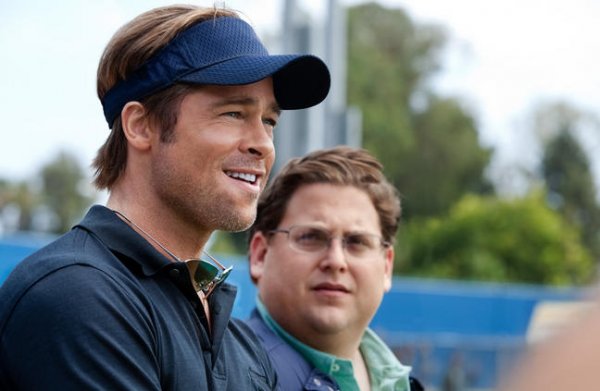
I don’t know about you but I don’t understand the whole deal about sports and the dollar. One thing I do know is that the mix of sports and money has sure changed professional sports in the last 40 years. It’s the reason why a franchise stays in a city or moves. It’s the reason why stadiums and arenas are now named after corporations. It secures broadcasting rights and merchandising marketing rights. It’s led to numerous league strikes; two of which either prevented a season from happening or ended a season prematurely. Most of all, it has the biggest bearing on how far up the league a team excels. Major League Baseball player-turned manager Billy Beane was the subject of the book Moneyball on his experience as a manager and introducing the use of sabermetrics in managing the Oakland Athletics team of 2002. It’s been made into a movie starring Brad Pitt, Jonah Hill and Philip Seymour Hoffman and it’s worth seeing.

The movie begins just after the Oakland Athletics were eliminated from World Series play in the 2001 American League Division Series by the New York Yankees; a team with three times the money as the A’s. After losing its three star players to teams with bigger money, general manager Billy Beane tries to assemble a winning team with Oakland’s limited budget but is irritated with his scouts’ decision making. Billy does have a personal issue with baseball scouts. When he was 18, he was scouted out as a phenomenal talent and was signed up with MLB, foregoing a promising college education. His career as an MLB player didn’t pan out and his promise was never realized. After retiring from baseball having played his last game with the A’s in 1989–ironically the last year the A’s won the World Series–Beane became GM of the team years later.

Upon visiting the Cleveland Indians, he meets Peter Brand, an economics grad from Yale with radical ideas in scouting baseball players but is very inexperienced with the business of Major League Baseball. Billy is so impressed with Pete’s thinking and choosing–including how Pete would draft Billy– he hires Pete as assistant GM. Pete’s assessment of players via sabermetrics, statistical analysis of players, and his ability of noticing qualities in players most MLB scouts overlook impresses Beane and helps him make some good player choices. However the scouts at the A’s and manager Art Howe are unimpressed with their use of sabermetrics and believe it’s effectiveness is trumpted by team play on the field. Despite it all, Beane has hope in Pete’s influence on his choices.

The beginning of the 2002 season does not look well. Oakland finds itself in the lower rankings at the early part of the season. Mostly it’s because Howe’s roster decisions conflict with that of Beane and Brand. Even as the A’s find themselves in last place in their Division, Brand still believes his prediction that the A’s will make a huge turnaround in July. This comes as a problem as Howe is still stubborn in his choices. This leads Beane to make tough trading choices for his more struggling players while Howe favors. Beane even gets Brand to tell a player he’s traded.

Now with the new set-up happening in Beane’s favor, we do see a turnaround. The A’s start winning, winning and winning. After winning their 19th straight game, they’re poised to break an MLB record for longest winning streak. One thing Beane notices is that whenever he’s at an A’s game, it’s bad luck for the team. This is the first game of the streak he attends. They have an 11-0 lead when suddenly things go wrong. Error after error happen and the game goes into extra innings. Nevertheless the miracle happens and the streak record is there’s. But it doesn’t stop there. The A’s find themselves back into the running for the World Series playing the Minnesota Twins in the ALDS. They hope it’s not a repeat of what happened to them against the Yankees the year earlier. This also appears critical since this could be whether Beane is kept on as the A’s GM. The game doesn’t go as expected and the aftermath doesn’t either as Beane rejects an offer from the Red Sox to stay with the A’s. I’ll wait for you all to see the movie to find out how much the BoSox offered Beane.

Without a doubt the biggest theme in the movie is money and how it’s changed the sport forever. It plays a role in how it makes certain teams excel further than others. It plays a role in how new players are selected and often enough it’s about their marketability instead of skill. When I saw that scene at the beginning when Oakland’s scouts are choosing players based on image, I asked: “Since when did playing sports become showbiz?” It plays a role in how players are hired, traded and terminated. It even tempts young players, like Billy himself back in 1979, into making an all-or-nothing decision where only time decides if it’s the right choice or not. Sometimes it pans out and sometimes, like in Billy’s case, it’s the deal with the devil. It even causes a power struggle between the managers and the coaches. Often the biggest team issues are more off the field than on the field.

As much as the mix of sports and money is the predominant theme of the movie, it’s also trying to introduce something new into Major League Baseball. Now Major League Baseball has to be the sports league most reluctant to change. While every other baseball league uses aluminum bats, MLB is still strictly wood-only. Drug testing was only introduced in recent years. Even decades ago, video relays and the lights at Wrigley Field caused huge debate. Now for Billy and Pete to introduce sabermetrics via computer into use on their team, even that comes into question with the men with traditional mindsets. I’m sure sabermetrics has attempted to make its way in before even without computers but it never really left much of an impact. Even after it helps the A’s break the winning streak record, it’s still debated after the A’s were eliminated from World Series play. Eventually it does become accepted by some, but not in a way expected.

Another theme that gets overlooked in this movie is about personal relations in such a cutthroat business. Billy has to be a cutthroat fiery worker if he’s to be a manager of a Major League Baseball team. Nevertheless in this fierce business, he’s able to befriend Pete. Interesting since Billy is fierce and cutthroat while Pete is shy and reserved. The movie is also about how Billy comes off as a father to his daughter. You can tell how much of a bond that means to him.

The best quality of the movie is how it’s able to make a story that’s very smart very winning on screen. It’s able to take a very intelligent and very popular topic and create a story about it that’s able to entertain audiences and keep them in suspense. It’s able to have an ending that’s different from your typical Hollywood ending and still come off well. Scriptwriters Steve Zaillan and Aaron Sorkin did an excellent adaptation to make a story thrilling with unexpected turns. Bennett Miller also did an excellent job of direction. Mychael Danna delivered and excellent accompaying score. However the movie’s best quality is its acting.  Brad Pitt did a very good job in paying a role that wasn’t your typical Brad Pitt role. Jonah Hill was also excellent in a role that was different from the ‘big goofball’ roles he’s been known for. Philip Seymour Hoffman again becomes the character in his latest role and again pulls it off excellently. It’s this type of work that has to make Moneyball the best baseball movie in years.

Moneyball is definitely this fall out-of-leftfield surprise winner. Even if you’re not a baseball fan, it will open your eyes about sports and actually get you hoping for the A’s. Even if you don’t like baseball, or movies about it, you’ll find something to like about it.

Move Review: The Help

I know what you’re going to say before I talk about The Help. There have already been a lot of movies about racism and segregation. Yes there have been. Nevertheless The Help is a well-made story about showing a black woman’s point of view on racism from a state most synonymous with segregation: Mississippi.

The movie revolves around three women in particular. The first is Abilene; an African American maid whose latest maid work comes right after the death of her son. The second is Milly; another African American maid who was recently fired from Hilly Hollbrook–Jackson’s white female ringleader–for using a toilet meant only for Hilly’s white family and is only rehired by a white ‘misfit’. The third is Skeeter; a white journalism grad from Ole Miss who is unmarried and wants to make a career for herself in writing but lacks a story.

The setting is Jackson, Mississippi. Segregation is alive and well but is facing abolishment. The black maids have had enough while the white upper class females want to see it kept. Hilly herself wants to enact a passage of a law to make it standard for separate bathrooms for white and colored people. Skeeter is tired of writing a housekeeping column and wants an actual story. She comes across it just after her former maid Constantine, who she always looked up to as a child, is mysteriously gone, Hilly speaks her pro-segregation mind at her ‘clique meetings’ and she encounters Aibilene and Minny. They have quite the story to tell and she learns a lot from what they have to say and what they’ve experienced. Even Milly’s story of her revenge on Hilly with ‘the pie’ makes for some colorful. Nevertheless a book publishing company wants to have the points of view from twelve maids, not two. It’s a struggle for Skeeter as she becomes more of a misfit in Hilly’s clique for being unmarried and being opposed to segregation and because of state law: Mississippi law can imprison writers and interviewees for cross-race writing. It isn’t until the shooting death of Civil Rights leader Medgar Evers that Skeeter finally gets her twelve to interview, however giving them pseudonyms to protect their identity. The result is the novel finally being made and boy does it stir up a lot of debate and reactions.

One thing about the ending is that a lot is accomplished and many good things come out of it. Despite positive changes, some bad things still remain and the movie doesn’t end on a completely positive note. The ending takes a turn for a different more negative ending. Nevertheless it did so on the right note. It reminds us that even after segregation was ended for real in the Southern States, some negative aspects of racism still remained and some changes didn’t go as far as it should have.

There have been movies about racism in the past and conquering racism but hardly has there ever been such where it’s on the basis of the black maids for white families. It touches on a common notion. The white children were raised and cared for by the African American maids and many of the children would look up to them as a mother figure. As most of those white children grew up as adults, they would then go on to the hiring and firing of them. They would adopt the cruelness to the maids their own parents had. The story is set in Jackson, Mississippi around the time of the civil rights movements and around the time Jackson, the capitol of Mississippi, is where segregation is possibly the most alive and well. The story features Skeeter, an aspiring writer who’s looking for a story and sees one. Remembering how Constantine was like a mother to her and wondering whatever happened to her, she hasn’t developed the hardness of heart her girlfriends had developed over the years. It is with her willingness to see the maids’ side and write about it that made her want to set the record straight. That helps to create the intrigue of the story.

One of the interesting themes in the movie is oddly enough its use of toilets. Many people including myself still look at toilets as something taboo but in recent decades, many people and many creative artists have defied this taboo and become more public about it and even incorporated it into art. In this film, it plays a significant role because as we remember, toilets were a part of the days segregation: separate ones for whites and colored. The Help presents toilets in many different references. It is Aibilene’s toilet teaching where she shows she’s a better mother to Mae Mobley Leefolt than Mrs. Leefolt is. It is where Minny uses a toilet for white people only in Hilly’s house that gets her fired. It’s where Hilly strongly believes in segregated bathrooms to the point to where she’s willing to take her plea to the surgeon general. It’s also the prank Skeeter uses to pull on Hilly for her lobbying. As taboo as it is, there’s no denying the significance of toilets in the movie.

One thing about the movie The Help is that it’s based on a novel that is complete fiction. That fact might make some question the triumphant moments in the movie. Question it all you want. One thing you can’t deny is that despite it being fiction, there are a lot of hard truths experienced by the African Americans in Mississippi that are portrayed very well and will make you think. Seeing how Hilly treats her maids meanly to the point of firing them instantly and even getting them arrested makes you think how many others were as mean as Hilly. That scene where Minny is with her eldest daughter in a maid’s uniform about to board the bus can also disturb you. Imagine a future that limited. Also that scene where Charlotte told how and why she fired Constantine. How many times do you think that has happened in the past? So the novel may not be based on a true story but possibly based on a thousand true stories.

The directing from Tate Taylor was top notch. He did an excellent job of directing the movie and writing the storyline well. The acting however is what made the movie most. The standout without a doubt was Viola Davis. Her performance of Aibilene was the glue of the movie and had the most to tell. Her acting was full of believability from start to finish. Octavia Spencer was the top scene-stealer as Minny. She was able to make for an excellent turn with adding elements of humor to her role. Emma Stone delivered possibly the best performance of her career. Already people are saying she’s the next big thing. Her performance of Skeeter demonstrates she can also make a good actress of herself. Also a standout is Bryce Dallas Howard. Her character acting was so excellent, she will easily make you hate Hilly.

Overall, The Help is a very excellent movie revealing a harsh reality of 60’s Southern racism. Some say it’s not as harsh of a depiction as it should be. Nevertheless we shouldn’t forget that even in racism situations that aren’t as harsh, the hurt can still be felt and the picture can have an ugliness of its own.

Movie Review: Harry Potter and the Deathly Hallows Part 2

DISCLAIMER: Okay, I’ve been saying that I have a lot of catching up with my summer movie reviews. This should be the last of my catching up.
 
What was expected was that the final novel of the Harry Potter series would be made into a feature-length film. What wasn’t expected was that the final novel would be divided into two parts. Obviously it was for the sake of more money for the Potter franchise. Nevertheless, Deathly Hallows Part 2 was a very good trilling movie in itself as well as a fitting end to the biggest movie franchise ever.
 
For the record, this is only the second Harry Potter movie I have seen. The only other I have seen is the very first: The Philosopher’s Stone. For my review, I will base it off what I have seen instead of comparing to the book or the other movies.
 
The dark mood of the Harry Potter movies starts right at the beginning. The movie starts as the fate of Hogwarts is in jeopardy.Dumbledore is dead and Lord Voldemort has retrieves his wand. Snape is now the head of Hogwarts. Dobby is dead and is now in the accompaniment of the goblin Griphook. Now Harry must destroy Lord Voldemort’s horcrux.The first place he suspects is a vault Gringott’s bank. The threesome along with Griphook go to the vault and learn that Horcrux is Helga Hufflepuff’s cup. After Harry takes the cup, Griphook steals the sword, leaving the three to face security. The three are able to escape after releasing the dragon guardian.
 
Harry has a vision tof Voldemork killing goblins including Griphook and learns that the Drak Lord knows of the theft. Harry also learns there is a horcrux related to Rowena Ravenclaw. The apparate into Hogsmeade which starts an alarm. They are rescued by Aberforth Dumbledore who instructs the paining of his sister Arianna to fetch Neville Longbottom and lead them through a secret path back to Hogwarts.
 
As Snape controls Hogwarts, it paves the way for the anticipated battles for the movie. The whole story is a maze in which Harry has to lead through and piece through in order to confront Snape in the final battle over Hogwarts. It’s a maze involving battles, dreaming, going through Voldemort’s thoughts and retracing Snape’s personal thoughts and Harry’s mother’s personal history. It even involved facing Snape and going through a temporary death in order to succeed in his battle. It’s bound to leave one who hasn’t read the novel or seen the other movies confused. Harry Potter fans however should be able to understand it all.
 
One note about the ending. The movie ended as was done in the novel in being correct with its facts. It had a mix of darkness and sweetness but I felt it ended on too sweet of a note. Nevertheless I’m happy it ended well instead of dragging on the way Lord Of The Rings: Return Of The King did. I know both are ends to a remarkable book series, but still.
 
Director David Yates did a very good job in directing the final chapter. For the record, he has directed the last four Potter movies and was best at making the characters mature and maintaining the darkness of each story. In this final movie, he’s excellent in keeping the intensity of the fate of Hogwarts and the battles that await the many including Harry. The acting was also very well done if lacking in being spectacular. Daniel Radcliffe has done an excellent job over the years making Harry grow in both age and character. The same can be said of the two co-stars Emma Watson and Rupert Grint. The chemistry between the threesome is still there after all these years.
 
The Harry Potter phenomenon is arguably the biggest entertainment phenomenon of the 21st Century. Although the first novel–The Philosopher’s Stone–was released in 1997, the phenomenon first made notice in 1999 and grew to what it is now. The big question is if this movie will mark the end of a phenomenon. I remember there was a picture at the London Premier of Hallows Pt. 2 saying “The End Of An Era: 1997-2011”. Whatever the situation, the Harry Potter franchise has left a permament mark in pop culture. It started as a book series that actually made kids start reading and made J.K. Rowling a celebrity. Then it went to a movie series that would attract many big-name British actors and would become the highest-grossing movie franchise ever. It has even made household names of the three main actors: Daniel Radcliffe, Emma Watson and Rupert Grint. Now that it’s over, it remains in question whether there will be another pop culture phenomenon the size of Harry Potter ever again.
 
Harry Potter and the Deathly Hallows Pt. 2 is a fitting end to a fitting book series and a fitting movie series. It took a risk in splitting the final novel in two movies. But in the end, it did everything right.

Movie Review: Pirates Of The Caribbean – On Stranger Tides

DISCLAIMER: Hi. This is my second-last summer movie review where I’m playing catch-up on my reviews. When I give my review of Harry Potter, I will finally be all caught up. In the meantime enjoy yet another late summer movie review.

Jack Sparrow.   

There should be a “Captain” in there somewhere.

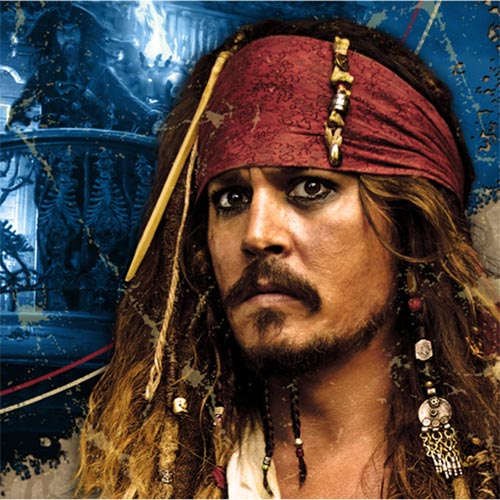
As I said before, the summer movie season is usually about the tried-and-true making big box office results. It’s at the box office where we learn if it’s tried-and-true or tried-and-tired. Up for this summer is the fourth installment of the Pirates of The Caribbean series: On Stranger Tides. Returning is Johnny Depp as Jack Sparrow, his most popular role of all-time. The big questions are does Jack still have the winning charm at the box office? Also does the latest Pirates adventure still have what it takes to thrill and charm and keep the Pirates phenomenon active?

This time Jack’s quest is the Fountain Of Youth. King George wants Jack to guide it to beat the Spanish. The one surprise is that his nemesis from the first movie, Hector Barbossa, is now a privateer in the British navy and now heading it. Already the intrigue would start for the die-hard POTC fans. Another interesting thing that he would be foiled by an imposter of himself: former lover Angelica who is Blackbeard’s daughter.

The part of the mission involving capturing a mermaid’s tear and a captive falling in love with a mermaid is probably the only thing in the movie that’s even close to fresh. The tear being collected by Blackbeard starts the rivalry scenario all over again. The main rivalry in the movie is different, if not unique. This time Jack Sparrow and Barbossa join forces to defeat Blackbeard. Barbossa has a grudge match of his own against Blackbeard for his amputated leg. Meanwhile the Spanish battle the Pirates for the sake of killing the fountain because they believe it’s cursed. Often rivalry upon rivalry upon rivalry gets too confusing unless it makes sense. Not here..

One glimpse at the storyline is that you could easily see it was hatched together in an instant. We see the typical formulas of the Pirates movies: Jack being his flamboyant cocky self, rival pirates, lands to conquer, new nemeses and new loves. This has been common ever since the first Pirates movie burst on. Its winning formula is now starting to become stale and predictable. Even the character of Jack Sparrow has lost his charm over the years. When he first arrived, he was arrogant, eccentric but charismatic and was able to charm the audience. If it weren’t for Jack’s personality, the first Pirates of The Caribbean movie could have been seen as a joke. Now Jack looks like a rehash that’s getting tired out and only tries to be entertaining. Penelope Cruz plays the typical lover of Jack. Villains are practically predictable. Often when an action scene or a battle comes on, I often question “Who didn’t expect that?” The only things close to being fresh was the mermaids and the surprise of Barbossa being an ally of Jack instead of a rival. Outside of that, it remains formulaic.

As for the business, it’s already showing signs of waning. The first movie, Dead Man’s Chest is the biggest grosser with almost $425 million. The follow-up, The Curse Of The Black Pearl had a record-setting opening weekend but its overall gross failed to top Chest. On Stranger Tides is the lowest-grossing of the Pirates movies with only $240 million. The future of the Pirates franchise should make a lot of Disney execs think whether the fifth movie is worth it or not.

Pirates Of The Caribbean: On Stranger Tides is a movie that will only excite Pirates fans at the most. It offers little freshness or anything unpredictable. So unless you’re a fan of Jack Sparrow, I believe it’s not worth it.

Oh yeah, just to let you know you’ll only have one more summer movie review after this. Then I’m finally caught up.

Movie Review: Thor

Once again, Marvel Comics had another superhero movie for release. This time it was Thor and it’s directed by Kenneth Branagh. The big question is does Thor stack up? And is Branagh able to direct sci-fi action?

Before I give my review, I have to confess that I’ve never read the Thor comic books so I am unable to compare the movie with the comics. I can just judge the movie for what it is.

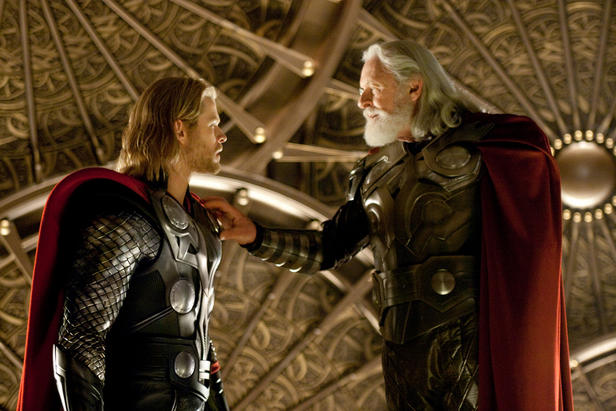
The movie takes place between two worlds. The first is in the supernatural world of Asgard in 965 A.D. The second is in present day New Mexico. Odin, king of Asgard is in a war against the Frost Giants in their quest to conquer the Nine Realms, including Earth. The Asgardian army wins and seizes the Casket of Ancient Winters. Just as Odin is about to crown Thor the new king, Frost Giants attempt to retrieve the Casket. Against Odin’s order, Thor battles Laufey and the Giants along with his brother Loki, childhood friend and the Warriors Three. The battle destroys the fragile truce between the two races and Thor is stripped of his godly power by Odin for his arrogance. He is banished via a Bifrost to present day Earth along with his hammer–the source of his power–protected by an enchantment only allowing the worthy to wield it.

Thor lands in present-day New Mexico where he is found by astrophysicist Jane Parker, her assistant Darcy Lewis and her mentor Dr. Selvig. However Thor and the hammer also caught the attention of a S.H.I.E.L.D. agent who soon commandeers the hammer area building a security-tight shield and and forcibly acquires Jane’s data about the wormhole that delivered Thor to earth. Thor learns of his hammer inside the S.H.I.E.L.D. area and breaks in to retrieve it. He’s unable to lift it and is captured by the S.H.I.E.L.D. team. Selvig is able to break him free and is left exiled on Earth clueless of his surroundings. He does develop a romance with Jane.

In the supernatural world, Loki learns he is the son of Laufey, the leader of the Frost Giants who the king adopted after the war ended. Loki is able to manipulate his way to becoming king when a stressed-out Odin falls into a deep recuperating ‘Odinsleep’. He offers Laufey the chance to kill Odin and retrieve the Casket. His rule does not sit well with the Warriors Three and try to find a way to enter the Bifrost but Loki soon learns of the plan and sends a warrior to Earth to kill Thor. The Warriors find Thor, but the Destroyer attacks and defeats them, which prompts Thor to offer himself instead. After he’s hit by the the Destroyer by a potentially fatal strike, his self-sacrifice now makes him worthy to wield the hammer. As he finally retrieves his hammer, his powers return to him and allows him to defeat the Destroyer. Before he leaves back to Asgard with his fellow Asgardians, he kisses Jane goodbye and vows to return.

As Thor and the Asgardians return to Asgard, Loki kills Laufey in an attempt to destroy the Frost Giants land with the Bifrost Bridge to appear worthy of the crown to Odin. Thor arrives and fights Loki while destroying the Bifrost Bridge to destroy Loki’s plan. Thor is left to battle Loki stranded on Asgard in danger of falling into the Abyss.  Odin awakes and prevents the brothers from falling into the abyss, but Loki does a suicide fall. Before Odin coronates Thor, Thor admits he’s not ready to be king while back on Earth, Jane and her colleagues seek for a way to open the portal to Asgard.

Overall the movie has the predictable thick drama one would come to expect from a superhero movie. The special effects were excellent and top notch. The set design of the world of Thor was excellent. The action scenes were scenes that can keep one thrilled. The acting was the type of thick and casual acting one would expect from a popcorn movie, so no really bravado performance from Natalie Portman here. There’s no doubt the role of Thor was intended to make Chris Hemsworth a star. The directing was done right. Kenneth Branagh did a good job. The writing was also well done but sometimes went over the top during some of the more comical scenes. Overall Thor is the type of movie that would impress people who like action hero movies or your expected summer blockbuster fare.

Thor was a very good start to the summer movie season. It has what it takes to charm audiences of action movies and superhero movies as well as get summer movie crowds excited.

Movie Review: Kung Fu Panda 2

Yes, I’m playing catch-up with my movie reviews of the summer. Hope you like this late review.

I’m sure you remember the first Kung Fu Panda. Po was the lumpy clumsy Panda who came from nowhere to become the Dragon Warrior. It charmed audiences, made people laugh and even rivaled Disney/Pixar in making 3D animated movies. Now Po’s back in Kung Fu Panda 2. But does this new version of Kung Fu Panda still have its kick?

We begin the movie learning of the clash between the peacock clan and their son Lord Shen stealing the power of the fireworks and using them as weapons. When Shen learned from a soothsayer that a warrior in black and white would defeat him, Shen exiled the pandas from the village. Shen’s parents exiled him soon after to which Shen swore revenge.

Flash forward 20 years, we see Po as the Dragon Warrior protecting the Valley Of Peace with the Furious Five who are now his friends and allies. Master Shifu senses Po lacks inner peace. At first Po doesn’t know what he meant until the five attack a band of wolf bandits. During the fight, Po is distracted by a symbol on the head wolf’s armor which causes a flashback to memories of his birthmother. He then learns from his father, the goose Mr. Ping, that he found him as a baby in a radish basket and adopted him since. Learning that truth leaves Po frustrated and upset.

Later Master Shifu learns that Master Thundering Rhino has been killed by Lord Shen with a cannon he build and plans to use to destroy kung fu tradition and conquer China. Po and the five go to Gongmen City to end Shen’s control. They come across two imprisoned council members and try to chase down Shen’s wofl pack, only to be captured. Upon being brought before Shen, Po and the Five break free and destroy Shen’s cannon. However Po is again distracted by the symbol that caused flashbacks of his mother which allows Shen to escape and destroy the tower with an arsenal of cannons. After escaping, a concerned Tigress confronts Po of his distraction. Po knows of Shen’s presence on the day he was separated from his parents and has to ask him about his past

Despite Tigress fearing for him, Po breaks into Shen’s cannon factory and confronts him. Shen tells Po his parents abandoned him before blasting him out of the factory and capturing the Five. Po finds himself rescued by an exiled Soothsayer in the city he was born in. The Soothsayer guides him to embrace his past where Po learns his village was raided at the time he was born as Shen’s forces killed every panda and burned the village. Po’s father was fighting the war and told Po’s mother to run and escape with their baby. Po’s mother ran throughout the snow and left him in a radish box at a place she knew he’d be safe, Mr. Ping’s place. It’s upon returning to his old home and finding his childhood toy that he learns he was given up out of love and raised out of love. Finally he attains inner peace.

Po then returns to Gongmen City to save the Five and stop Shen from conquering China. Po and the Five along with Ox and Croc block the gates to shop Shen but Shen’s cannon clears the way and lands them all in the ocean. While Shen attacks Po with his cannon, Po is able to use his inner peace to redirect Shen’s cannon fires to Shen’s cannon, destroying it. He then urges Shen to let go of his past, but Shen refuses and attacks Po. In the fight, Shen accidentally cuts the ropes to his own cannon and is crushed to death. Po achieves victory and freedom for Gongmen City. He returns to Mr. Ping and lovingly declares him as his father. The very end may hint to many that there may be a Kung Fu Panda 3.

While I’m not a big fan of most Holywood sequels, I have to say that I was impressed with Kung Fu Panda 2. It managed to have a story different from the first movie. Its fights and special effects were just as dazzling as the first. The characters still had their charm from the original and especially kept the appeal of Po. The movie had an excellent range of voice-over talent with renowned actors like Jack Black, Angelina Jolie, Dustin Hoffman, Jackie Chan, Michelle Yeoh and many others. The animation graphics were excellent and top notch to the slightest detail.

For the most part, I believe the movie would be fine for parents of children but not for most adults. It is a movie that doesn’t have the same level of adult appeal as a Disney/Pixar animated movie would. Some things that may appeal to parents is the actors doing the voiceovers. Overall, the movie, storyline and humor are more tailor made for families of young children.

 Overall Kung Fu Panda 2 makes for an enjoyable night out at the movies for families of young children. Even some older children or teenage fans of the first movie will enjoy it.