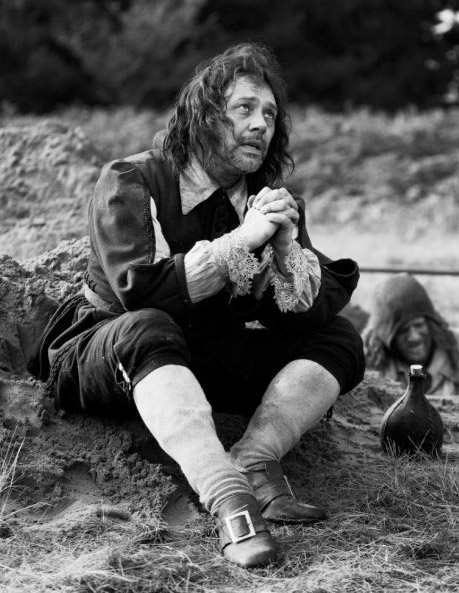
A Field In England is intended to be a historical drama/dark comedy. This makes for a unique and daring combination but does it work?
The story is set in the British Civil war of the 1600’s. Whitehead, an alchemist’s assistant, flees from his strict commander and meets a deserter from his own side and two other deserters from “the enemy’s” side. They all try to leave the war behind in search of an alehouse. Meanwhile they have a stew made with the mushrooms they found along the ground. Along the way they meet with an Irishman whom Whitehead had been sent to hunt down for stealing his master’s documents.
The Irishman however tries to get control over the group by letting them know of a treasure in the ground underneath. Whitehead is able to locate the area while the other three are digging or supervising. The exhaustion if digging takes its toll on the two diggers as they get into a fight and one is shot by the one supervising. After all the others run off, the one who did the supervising must now do the digging himself where he learns there’s nothing more than a skull. The Irishman then shoots him and then goes after Whitehead and the one surviving deserter. The two manage to escape and head back to the camp. However one of the deserters originally thought to be dead returns only to get embroiled in a shooting with the Irishman. After an ensuing shootout between the others, Whitehead is the one left standing and he buries the four. After burial, he returns to the hedgerow he originally deserted and finds the three soldiers still standing.
The thing about this movie is that it often appears clueless. All too often I’m sitting there in the theatre wondering what the point of the movie is or what the point of certain scenes were. Was his point about the British Civil War? Was his point about the warring factions: the Royalists and the Roundheads? Was it about the attitude the deserters shared? Was it to be experimental as noted by the many bizarre images? Was it another case of Ben Wheatley getting into his violence obsession? I was left very confused. The violence and even the alleged sodomy part really had me questioning. Even the special visual effects like the exploding sun and the strobe images had me wondering if Wheatley was trying to be experimental in his work.
I will admit that this is just my judgment from watching as I am unfamiliar with Ben Wheatley’s work. He has established a reputation in England with seven years of film making and video making under his belt. He is also primed and ready for the mainstream as he has already been slated to make an American-made film Freakshift and a sci-fi series for HBO in the future. Nevertheless I’ve been left assuming that A Field In England, which is directed by Wheatley and written by his wife Amy Jump, is an experimental picture for Wheatley. I saw nothing in the storyline involving any facts or factoids about the British Civil War and more of a focus on torture, violence and hallucinations. Even the language used in there didn’t sound like talk that would be used from the 17th Century but contemporary times.
The film has already received some acclaim. It has already won a Special Jury Prize at the Karlovy Vary Film Festival and was a Crystal Globe nominee at that festival. It has also made its round of film festivals and has already been released on DVD.
A Field In England appears to be more of a trip of psychedelia and violence than historical documentation or historical fiction. The best I myself can classify this film is an experimental work.
Daily life around the Tonle Sap River in Cambodia and potential changes is the subject in the documentary A River Changes Course.
A River Changes Course is one of the many documentaries being shown at the VIFF. It has its own message to say and it says it by the way a family lives.
The film focuses on three families that live on the Tonle Sap River: the Math family, the Moh family and the Sabourn family. The Math family is a fishing family who rely on fishing for their income. The Mok family works the rice farms but it’s hard considering the mother has a big family to raise. The Samourn family is an indigenous family living in an agricultural area that help to keep their family with a decent income.
Things have not been easy for either family. Sari Math must quit school to help the family but the fishing population of the river is dwindling. Khieu Mok, the eldest daughter of the Mok family, leaves the family farm for the capital Phnom Penh for a factory job to help pay her family’s debts. And Sav Samourn notices the land she’s always known as home being bulldozed for the sake of factories and farms for export. It hurts her as she always called the area ‘home’ whether through good or bad times.
The object of the film was to get the people to tell their stories. There’s no narrator. There’s just the camera showing the family through their everyday lives. Whether it be fishing from a boat, reaping harvest or working in the factory, or selling what they’ve made, it shows the difficulties they go through to make a living. It even shows the children of the family working in the farms, from the boat or even near the fish market. That shows childhood ends early and one makes a worker of themselves at an early age. It also shows conversations with those in jobs associated with the subjects being filmed. Just as Khieu talks of her difficulties in making a livable wage at the factories, two of her other co-workers talk of their own difficulties. Basically this documentary about the lives of three families in Cambodia showcase the lives of millions.
Even outside of the images of the people working and struggling, other scenes also send a message too. One is of a young boy singing a song with lyrics; “Marry me and I will make you rich.” Many times in the film, you will hear people sing songs in which they composed themselves. Another is seeing the small children in school learning how to read. Another is where the family gathers in a town area to watch television: one television per village. Another is even when it’s raining in the area but the young boys see it as swim time in the river. That’s a reminder that despite the hardships, childhood does exist. Actually all the images that don’t deal directly with the main plot say something.
One thing about the film is that it’s not just a showcase of daily life in Cambodia but it also shows glimpses of hope for the nation. We shouldn’t forget that Cambodia has a troubled past. There’s the dictatorship of the Khmer Rouge under Pol Pot in the late 1970’s where 2 million Cambodians were slaughtered. Cambodia has struggled to rebuild but it hasn’t been easy especially since the country is under a fixed democracy. Agriculture and fishing have always been ways of life in Cambodia but it’s always been conditional depending on the crop year or fish catch. The factory work offer some hope, albeit limited. Just as land is cleared for factory land or cropland for China, Khieu talks about the potential for better chances closer to home. Khieu’s mother talks of her son being a migrant worker in China. Even the images of the young children in school show an image of hope. Especially while Sari is talking in the background of quitting at Grade 7 and lucky to get that far. I believe that’s why it’s titled A River Changes Course as it shows potential changes for Cambodia.
However despite the images of hope for the future, it does come at a price for others. Sav is completely unhappy with the deforestation as this has been a land she has always called home, being indigenous. What’s seen as hope or a future for others can be seen as a big loss for someone like Sav. She even says: “We’ve worked so hard on this land and now they’ve come to destroy it all. Sooner or later it will all be gone.” It also shows that the title A River Changes Course does not completely have a positive meaning.
This documentary is not just a showcase of life in Cambodia but also a ‘homecoming’ for director Kalyanee Mam. She was born in Cambodia and emigrated with her family of nine to the USA in 1980 as refugees of the Khmer Rouge regime. She is a law graduate of Yale and UCLA Law School and has worked as a legal consultant in Syria and Iraq. Mam has also done film work along the way. She completed her first documentary Between The Earth And Sky in 2009. She also worked in the cinematography in the Oscar-winning documentary Inside Job. Mam is now working on another documentary Power of Pearl, due for release in 2015.
Mam also took time at the VIFF showing of A River Changes Course where she told her story of her family escaping Cambodia for the United States and living as refugees. She told about why she did the documentary and also about some of the raw deals Cambodia is getting in terms of creating crops for China, like none of the harvested crop going to Cambodians: all straight to China for ethanol. I myself asked her a question about politics in Cambodia: if it’s a democracy or dictatorship. She told of how fixed a democracy it is right now. Nevertheless she and other Cambodians believe in a hope for the future. In fact Mam made mention that when Khieu casted her ballot, she said it was for a livable wage. A River Changes Course is a chance for her to tell the story of her homeland across the world in hopes for a better tomorrow. In fact you’ll learn more about it at the film’s official website and how you can help too.
A River Changes Course has already received a lot of acclaim. It’s already received the Grand Jury prize for documentaries at this year’s Sundance. It has also won top documentary prizes at the Green Film Festival in Seoul and the San Francisco Film Festival. It has also received other awards such as Best Feature at the Atlanta Film Festival, a Human Rights Award at the River Run Film Festival, a Best Feature award at the Yale Environmental Film Festival, and a Grand Jury Conscience award at the Docville International Documentary Film Festival. I’m sure there’s more to come.
A River Changes Course is Kalyanee Mam’s most acclaimed work yet. It is an accomplishment too as it helps open people’s eyes towards what is happening in her land of origin and raise awareness and help. I believe that art can make for a better future. Much the same way The Killing Fields opened people’s eyes over what happened during the Khmer Rouge, this documentary can shed a big light to its aftermath many decades later.
One thing about the Vancouver Film Fest is that they show a lot of films and shorts from upcoming filmmakers. They also show films made by youth or young filmmakers too. The Reel Youth Film Festival–which is a festival all it own and had its premiere at the VIFF on Sunday–showcases films from young filmmakers.
Most of the time whenever there’s a shorts segment show I see, I review all the shorts one by one. Now rather than review the shorts, I will just describe what I saw. Besides I wouldn’t consider it to be fair to critique student films.
The twenty-five films were chosen out of three-hundred entries. The films are from Canada and seven other countries and range from one minute to nine minutes. They consist of animation or live-action. They are filmed on typical motion picture format or typical run-of-the-mill video camera. They range from a played-out stories to music videos to animation exhibits to social messages. Some of the films appeared amateurish in quality, some appeared quite professional in quality. Most can be classified as G-rated works but two films in the festival were rated PG with one even including nudity and masturbation (non-explicit, of course). Three videos included were also part of the United Way’s contest to create a one-minute anti-bullying film. Two videos were from the UNIS student program including one of two girls growing up in a rural area of Vietnam.
The films show a lot through their eyes. A lot of it is often about school life, home life and even the work life they anticipate to have in the coming years. Sometimes they focus on other people such as gypsies, two sisters in Vietnam, a graffiti artist or an elderly man in the town. Sometimes they focus on social issues like bullying, corporate greed, homelessness or drugs. Sometimes they focus on fun aspects like dating, school irritations, social media and even the city they’re proud to call home. Sometimes they even focus on nonsense subjects like the death of a sandwich, being scared by a ghost, an office dork or a certain secret about Barbie we never knew.
The thing is that most of the students doing the filming may or may not want to take filmmaking to further directions in their life. Some–like the directors of Crack, Hank and Light Switch–appear to want to take filmmaking seriously in the future. Many others look like they prefer the direction of animation. Some are just amateurs doing it for fun. I guess that’s what the focus of the Reel Youth Film Festival is: more concerned about getting out their voice or creativity rather than the seriousness or professionalism of the craft.
The screening I saw Sunday evening was actually the World Premiere of the annual Reel Youth Film Festival. There will be one more showing at the VIFF on a Wednesday morning open for student groups. It will be showing at more locations to come and the Festival can act as a fundraiser for your community centre. If you’re interested in screenings or interested in showing it at a place you know, or even if you know a young filmmaker with dreams, just go to: http://www.reelyouth.ca/
One last thing. That evening I went had a ballot for all to fill out. The ballot was asking the voter of their three favorite films and their favorite local film. I don’t know if they will be doing it again in their next showings but I had a chance to pick my favorites:
More
Crack
Being Ernest
Fav Local: Too Old For Fairy Tales
The Reel Youth Film Festival is a good attraction at the VIFF. Who knows? Maybe one of the directors can make it big one day.
The couple of Jim and Kelly get the fright of their lives in their vacation to Willow Creek.
I saw Willow Creek at the Vancouver International Film Festival just for the heck of it. What I got was something familiar but just as thrilling and had its own uniqueness.
The film appears to be videos of a couple, Jim and Kelly, as they are about to search for the mystery of Bigfoot. The legend of bigfoot started in Willow Creek, California one 1967 day when two men names Roger Patterson and Robert Gimlin claimed they sawe him and even provided a picture. The stories have kept on popping as the years went by.
Jim and Kelly head to Willow Creek to camp out in the Rockies and get their own piece of the action. Jim especially is a huge bigfoot enthusiast. Kelly doesn’t seem too into it but is cooperative with Jim nonetheless. They come to the town that’s full of Bigfoot landmark and businesses named Bigfoot. They even go to a Bigfoot diner where they have a Bigfoot burger with the buns shaped like a big foot. They interview residents, visit a Bigfoot museum and even have fun with the Bigfoot statues. They even show a singer who wrote the song Bob and Roger about the legendary discovery. It’s not to say that all has been fun before their camp-out. They did see one person who didn’t like how they were having a mock interview with a Bigfoot statue. They also met another man with an aggressively rude attitude while driving their Humvee down the valley.
That doesn’t stop them from finding another path to set up camp. They set up and then leave temporarily. Once they return they find their tent down and their stuff thrown about. Jim even finds his sock up in a tree. That doesn’t stop them from setting up again. They even sleep in the valley overnight leaving the camera running in hopes of getting a piece of the Bigfoot action. The night is a special bonus for Jim as it’s his chance to finally propose to Kelly. Kelly gives an unexpected answer but Jim’s cool with it.
Overnight they hear a lot of noises. First sounds like banging of rocks. Then sounds like loud growling. Then comes forceful actions outside their tent like their tent body being pushed. Jim and Kelly decide to leave the following morning. As they go to return to their car, Jim still tries to capture some stuff related to Bigfoot like hair from a tree or footprints near the creek. The fun ends when the two learn they’re lost without a map. The two are left stranded in the night where the unexpected happen.
Some of you may say this film sounds very familiar to The Blair Witch Project or Paranormal Activity. That’s definitely what I thought. It may be another spin off that formula but it does have elements of its own. First is of a mysterious phenomenon that’s already hugely popular and the place that made it popular. For those that don’t know, the town of Willow Creek, California is dubbed the Bigfoot Capital Of The World. They not only have all these Bigfoot places as shown in the film but also a Bigfoot festival. Back to the subject of the film, I’m sure one could see themselves doing such a film with other phenomenon like say going to Roswell for the alien phenomenon or Kelowna, BC for the Ogopogo.
Even separate from the subject of the search for Bigfoot was the story is also about the couple too. Blair Witch was of a group of friends together. Paranormal Activity had a couple but there wasn’t much focus on the relationship of the two. Willow Creek had a lot of focus on the relationship of Jim and Kelly first during their moments of fun together then on moments of great fear. Alexie Gilmore and Bryce Johnson gave a great performance as the couple. They made it work with their believable performance.
Bobcat Goldthwait also did a good job of directing and writing the story. Many of you may remember Goldthwait from the 80’s and 90’s with his comedic acting and his stand-up comedy where he had this irritatingly growling voice which people really liked. Filmmaking is something you would not normally associate with Goldthwait but he does make films of his own. This was a good film put together as it had a lot of people in suspense. Also he was at the showing for both the intro and the Q & A. Shows he still has it in terms of stand-up.
Willow Creek may remind you of certain other movies of the past but it’s a good story of its own and is worth watching. However I don’t think it may want you to check out the Bigfoot mystery anytime soon.
Blue Is The Warmest Color is a French lesbian love story that tells more than just a story.
One of the biggest attractions at this year’s Vancouver Film Festival is the French film Blue Is The Warmest Color. The win at the Palme d’Or at the Cannes Film festival will make it an attraction, no doubt. There are some that already know what it’s about and others that don’t. The question is will the crowds be satisfied?
The story starts with Adèle, a young high school student from Paris nearing adulthood and trying to decide what she wants to do with her life especially in times when Europe is going through economic troubles. She’s very involved with her job at day care, but lost in thought during school and unhappy in her relationship with Thomas. She soon leans of her lesbian attractions and starts trying to get as better understanding of it. She even breaks up with Thomas in the process.
Her gay friends from high school introduce her to Paris’ gay scene. She’s exposed to gay culture at one gay bar then visits a lesbian bar for the first time where she meet a tomboy woman with blue hair named Emma. Emma not only introduces Adèle to the lesbian scene but also to her work as an artist. Adèle’s high school friends are surprised with her relationship with Emma but over time the relationship goes from being simply Adèle being the subject of Emma’s art to a full intimate relationship. They share everything. Both are also good with each other’s parents. Both are also supportive as Emma helps with Adèle’s 18th birthday and Adèle cooks for Emma’s art party.
Things mark a turning point at Emma’s art party as Adèle senses something between Emma and Lise, her artistic colleague. Adèle also senses the advances of her boss from the daycare she works at. Eventually she does engage with her boss only for Emma to find out. Emma breaks up with Adèle in a rage leaving Adele frustrated and heartbroken. Months pass and Adèle is now a first grade schoolteacher. Emma is soon to have her first art exhibit opening. They meet again in a café to try and resolve what they can only for Adèle to learn a hard new truth. Adèle goes to the exhibit opening only to leave heartbroken but older and wiser.
The surprising thing about this is how this film tries to portray a relationship between two young girls. Its biggest quality was its truthfulness. It showed a girl-meets-girl scenario that’s often the common way two meet. It shows the relationship and how the two share so much with each other that almost mirrors other relationships. It also shows the friction in relationships with being attracted to another person, infidelity, break-up and aftermath that you will notice in other relationships. I believe that’s the biggest thing about this film. This is not a film that aims for heavy intense dramatic story but rather a film of a lesbian relationship between two young girls that mirrors most relationships people have or have had, possibly even one of your own.
It’s not only about the relationship in the film but also as much about the two main characters too. Adèle is turning 18 and in the midst of deciding what she wants to do with the rest of her life, eventually setting on teaching elementary school. Emma is an older art student and she’s disinterested in conforming to the expectations of the world nor to the art business. Adèle has just recently learned of her same-sex attraction. She slowly tries to learn about it and welcomes it when Emma comes into her life, but questions if she still has attractions and feeling to men. Emma on the other hand knew of her lesbian attraction at 14 and became very comfortable with it. The personality traits of both adds to the story of the relationship as it shows that opposites can attract. It also shows how the two personalities cause friction as Adèle has the common immaturities with an 18 year-old and Emma is a free person but with a fierce attitude.
One of the things of the movie is that it also brings up certain forms of thought. It should not be surprising because Adèle is a student just learning and it’s the student years where one tries to expand their mind. Emma makes mention of Sartre and him creating a intellectual revolution in saying we are ‘condemned to be free.’ Another time we’re in one of Adèle’s science classes seeing a lesson in gravity and one student talks of unavoidable vices and how the Catholic Church tells us that vices should be avoided. There’s also the division of the arts world and the business world that’s also present in the film. Adèle embraces the arts greatly in her own way but wants a career that’s stable especially since the future of the young of France looks uncertain and chooses teaching. Emma on the other hand wants to do what she wants to do and paint what she wants to paint and resists offers to ‘market’ her talent. That pressure of the dilemma of doing what one is born to do vs. doing what pays the rent is a common pressure in the minds of a lot of young people during those years. I remember it was even a pressure for me when I was a college student.
Without a doubt, the biggest thing that got me thinking were the graphic lesbian sex scenes. I know that sex scenes are choreographed but I was still surprised in seeing it’s explicitness. Even though I learned just now that fake genitalia were used, there’s no question that there will be many who will label it ‘pornography.’ In fact the producers refused to edit the film for release in the US and that got it an NC-17 rating.
In all frankness, I did find this a very revealing and intimate look at a lesbian couple but nevertheless I found this film to be too long. I believe if a film is going to be 3 hours long, it should justify its purpose. I really question whether 179 minutes is really necessary for that film because it didn’t appear to justify its length of time. I’m sure the film could’ve done as good a job of telling the story of the relationship if it was even two hours. There are even times when I question if that heavy-duty sexual activity, especially the impulsive activity in the café near the end, really added to the story or was included for shock value. That’s the problem with over-the-top sex scenes in movies: it may be intended for the story but could be taken the wrong way with the public. In fact there were times my ‘inner teenager’ felt like saying: “Owww! Get down!”
The best quality was the acting. Adèle Exarchopoulos did a very good job not just of portraying a young lesbian but also of a young teenage girl on the verge of womanhood. Her mix of a character who’s on the verge of adulthood trying to be more responsible but also dealing with her own immaturities, both behavioral and sexual, made Adèle very believable as a young woman. Lea Seydoux did a great job of playing Emma, the older freer one who’s in control. For those who didn’t notice, Lea is the one who won Owen Wilson’s heart in Midnight In Paris. It’s surprising how she’s completely unrecognizable here. She did a very good job of character transformation. Director/writer Abdelatif Kechiche was really daring in his subject matter and his adaptation of the story. I checked his Wikipedia profile and there’s no mention of himself being gay. Nevertheless He did an excellent job of taking the relationship and making it look so relatable.
The question will remain will Blue Is The Warmest Color go well with the movie-going public? Marketing gay-themes movies to the general public is not an easy task especially with the predominantly heterosexual crowd. Yes there have been films of gay characters and gay relationships that have scored well like Philadelphia, The Hours, Brokeback Mountain and Milk, but it’s still a chancy thing that’s still hit-and-miss with no proven consistent results. Even this being a French-language film may cause some difficulties. I even question if a film like this will score well with the LGBT populations in North America. We should also take in mind that living as a gay man or lesbian in Europe is a lot different that living as a gay man or lesbian in North America. Two different continents with two different social attitudes. Something I question.
Blue Is The Warmest Color is a unique film in its portrayal of a lesbian couple. It has a lot of good qualities that make it worth watching for some but not for others. It all boils down to the individual audient and their tastes and tolerances to decide if this is the right film for them or not.
Yes, it’s leading up to the Vancouver International Film Festival. It’s to start Thursday September 25th and runs until Friday October 11th. There are a lot of similar expectations from last year that carry over to this year, but there’s one big new expectation for this year.
As noted in my summary of last year’s VIFF, 2012 was the last year it was to be held at the Granville 7 Cinema. The Cinema would continue for another three weeks until it was too close for good and be built into a condominium strata. All the volunteers and supporters of VIFF received a summary email where we were told that there would be a new main facility decided by the spring. The months of waiting would keep us guessing and the changes in the Vancouver movie theatre scene would have many of us nervous. First was the closure of the Ridge Theatre at the beginning of February of this year. The second would happen later that month as Festival Cinemas–the independent cinema group that ran The Ridge, The Park and Fifth Avenue cinemas–ceased existence upon the president’s retirement and left the two remaining cinemas in the hands of bigwig Cineplex Odeon. The question of which main theatre would be in charge of the VIFF left followers further in the dark.
Eventually the news came. The Vancouver Film Festival will be shown on nine screens at seven different locations:
International Village Cinema (three screens)
Vancity Theatre
Cinematheque
Centre For Performing Arts
Vancouver Playhouse
Rio Theatre
SFU Woodwards Theatre
So there’s no one central location for this year’s VIFF. This will take some getting used to in its post-Granville 7 era. It’s a shame because the Granville 7 was very instrumental in its growth. In fact I was at the volunteer orientation yesterday and the volunteer leaders mentioned that even they are having to try to get used to the new theatres. So this year’s VIFF will be a challenge but it also promises to show a lot. The fact sheet states that 341 films are slated to be screened: over 200 are feature length and 92 are Canadian. Also those of you who attend the festival will notice the Cineplex logo on our volunteer shirts. That’s our new sponsor. So that’s a plus. Hey, having most of the showings at the International Village Cinema helps.
I’m back to volunteering again this year. This makes it my sixth year in volunteering. I’m looking forward to it. I’m able to get four days off from work to be able to volunteer during the daytime. So I hope to have a good time. I also hope for this to be a record-breaking year. I know it may be too much to expect for a film festival getting used to a new theatre system. Nevertheless it’s possible. Remember that 2011 is the record-setting year.
Wow. Sixteen days over three-hundred films from over 75 countries! The Vancouver Film Festival is back. So get ready to VIFF again!
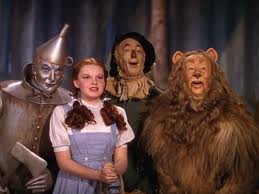
The Wizard Of Oz gets the 3D treatment and the IMAX treatment for one week only.
It’s interesting how many films have been re-released in 3D. However this week marked an opportunity to see a classic movie re-released in 3D for the first time ever, and in IMAX to boot. It seems appropriate that the first classic movie to receive a 3D re-release is The Wizard Of Oz. The big question is does The Wizard Of Oz work in 3D?
Just like my review of the 3D re-release of Titanic, I will focus my review in the 3D aspect of the film as well as other technical aspects. The most I will mention about the film itself is that it still qualifies as a masterpiece. The acting, singing and dancing are top notch and the movie is perfectly edited. The visual effects are very cheap and chintzy by today’s standards but they didn’t have today’s visual effects technologies 75 years ago. Nevertheless the movie continues to entertain families even to this day. It’s no wonder why it’s stood the test of time. In fact I declare: “If you haven’t seen The Wizard Of Oz, you didn’t have much of a childhood.” The film has received a load of acclaim including a #10 ranking on the AFI’s 2007 list of the Top 100 Films of all time, a #3 ranking on their list of the Best Musicals, a #1 on the Top Fantasy Films and a #43 rank on the Top Thrillers List. Three of its lines made the AFI’s list of the Top 100 Movie Quotes with “Toto, I’ve a feeling we’re not in Kansas anymore.” being #4. Three of its songs made the AFI’s list of the Top 100 Movie Songs with Over The Rainbow naturally being #1.
Another interesting note to add is that it was directed by Victor Fleming. Fleming also directed another masterpiece released in 1939: Gone With The Wind. Both would become two of the greatest films ever made. 1939 would be considered one of the greatest movie years ever and you could bet it was because of those two movies. No doubt they established Fleming as one of the biggest directors ever.
As for the 3D IMAX re-release, I often questioned in the days before seeing it whether it was a good idea to re-release it in 3D? Technology’s changed a lot in the many decades since. The special effects would be seen as cheap by today’s movie goers. Would the 3D work? Would the IMAX theater format work?
I saw it Saturday night. Hey, this is a one-week only limited time thing. The film started on an impressive note. I noticed the 3D work with the MGM roaring lion and the opening credits with the clouds in the background. As for the story, I didn’t notice how the 3D addition made too much effect on the movie. The debris from the cyclone didn’t really surprise us. The bedroom window images Dorothy was looking at in mid-air was made too obvious this was film-on-film work. The pyrotechnics used didn’t appear 3D. The flying monkeys didn’t appear like they were coming for me as I was hoping they would.
I don’t think the 3D effect really added too much too the movie. Showing it on an IMAX screen did. It wasn’t necessarily the special effects that were enhanced by the IMAX screen but it was the viewing of the whole movie. I’ve seen it on television many times but just to experience it on an IMAX screen was definitely something. I think I would have been impressed even if I saw it on a regular movie screen. Nevertheless it was a delight to see. The movie must have been remastered because the colorful images of Oz were incredible. The ruby slippers shined, the makeup on the tin man looked fresh, the green face of the witch looked scary, Glinda’s gown looked majestic, the yellow brick road looked freshly painted, Emerald City glowed…I think I could go on forever. Even the sound appeared remastered as the movie score and the musical numbers from everyone, especially Judy singing Over The Rainbow, sounded completely fresh.
Funny thing is that it has me wondering if there will be any other classic movies that would receive a 3D re-release. I will admit that The Wizard Of Oz is the one classic movie that most deserves a 3D re-release but will others follow? I’m sure there are some, like say King Kong or Ben-Hur or the Ten Commandments. I’m tempted to think some of those sci-fi B-movies from the 50’s would be great to re-release in 3D. So would Star Wars. Actually does Star Wars now qualify as a classic movie?
Oh yeah. For those curious about the box office biz, it made roughly $3.1 million this weekend. Ironically it made $3 million back during its original release in 1939. Actually $3 million would be lots in 1939. I’m sure if you adjusted 1939’s total with inflation and added in the grosses of the various re-releases, it would be in the hundreds of millions.
I’ll admit that I find 3D releases of movies cash-grabs, including 3D re-releases. The 3D of the 3D IMAX re-release of The Wizard Of Oz didn’t add too much. However the IMAX format and the remastering of both the images and the sound made it an excellent viewing pleasure. Reminds you that it’s so right and proper that it be re-released on the big screen whatever format it’s given.
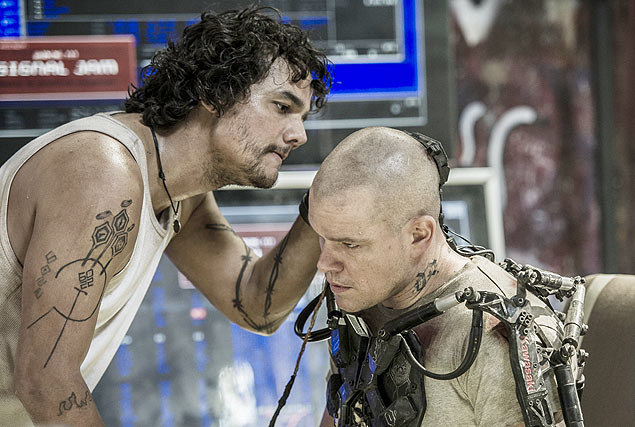
A computer hacker (Wagner Moura) gives Matt Damon the right stuff to help overtake Elysium.
Okay, you remember how I mentioned a while back about the struggle of big budget action movies this summer? Elysium has been out for a while. Does it have what it takes to get things moving again? Or will it be another casualty?
Before I get into the plot, I have to give you a picture of the two worlds. It’s 2154 and Earth is a poor polluted overpopulated planet under anarchaic conditions. Out in space is the satellite Elysium: a luxurious satellite full of sun, life and full cure from disease in the comfort of your own home. Earth isn’t even ruled by humans. Just ruthless androids programmed by computers. Elysium however has robots in their favor, as servants to them.
Max da Costa has developed into a rebel on planet Earth. He grew up an orphan and has lived in prison most of his life. Out on parole, he now works an assembly line of robot parts for Elysium in a wrecked-out Los Angeles. Max has a dispute with a robot that turns violent and lands him in the hospital with a broken arm.
In the hospital, he meets with a nurse named Frey. Frey was actually his childhood love in the orphanage. Despite his hard times growing up in the orphanage, he had the comforts of the love of Frey and a nun who served as a spiritual mentor to him and always believed he was meant to do something great one day. Frey is not only a nurse now but a mother of a daughter dying of leukemia.
Elysium is under a power struggle. It’s run by President Patel but Secretary of Defence Jessica Delacourt has power desires of her own. She orders the shooting down of a spaceship full of civilians from Earth which earns her a reprimand from Patel and her top security agent Kruger fired. That only fuels Delacourt’s desire for power as she connives a plan to have CEO billionaire John Carlyle design a computerized cybercoup to make her president which allows Carlyle’s company to override security for the next two centuries. Carlyle has the program implanted in his brain for safekeeping until his return to Elysium.
Max however is exposed to radiation at the plant one day and is given only five days to live. He desired to head to Elysium to cure himself and through the help of Spider: a computer hacker who builds illegal space caravans to Elysium. Spider agrees to send Max up there as long as he agrees to steal vital information. Max agrees and Spider gives him weapons, a fake Elysium ID, a bionic exoskeleton that can help him withstand force from android sentinels, and a cerebral data upload that can allow Max to steal data implanted in Carlyle’s mind.
However Carlyle and Delacourt know what’s going on and try to end Spider’s plan by shutting down the system. In the ensuing fight, Carlyle is killed along with most of Spider’s men. Max’s friend Julio sacrifices himself so that Max can get away. He does but only after being stabbed. Max goes to Frey for help but she wants to come along to get her daughter cured. Max tells her to stay out of it as this might be a suicide mission. Meanwhile Delacourt is in pursuit of Max as he holds Carlyle’s data implanted in his head. Spider wants to extract the data to make all people citizens of Elysium but can’t as long as the power is shut off in his place. The power outage can’t even get Max to Elysium just before he dies.
They are able to get a ship to Elysium through Max exchanging the program with Kruger but only to disguise Frey and her daughter as hostages and hold a grenade to his own head. Kruger agrees and Spider is able to sneak more people on board. During the trip, Kruger’s head is severely damaged by the grenade explosion and the plane crash lands in Elysium causing Delacourt to set off a state-of-emergency and fire Patel.
Right when Delacourt plans to get the program from Max and ‘bring him to justice’ Kruger’s head is reconstructed and he has mutiny plans of his own which includes assassinating Delacourt and making Elysium his own private playground. This allows Max and Frey to escape and get her daughter cured. However the ‘cure booths’ on Elysium only work on Elysians which her daughter is not made officially. It’s all up to Max to work with Spider to make everyone a citizen of Elysium and defeat Kruger from his regime in what little time Max has left. The ending is somewhat predictable but it works well for the movie.
The film seems to focus on the division of the rich and poor. It’s not an uncommon theme. Those who studied classic literature must have read A Tale Of Two Cities. Now we have Elysium where Earth is a hellhole for the 99% who can’t afford to live on Elysium while the rich 1% have it. It’s interesting that Neill Blomkamp is tackling such a common theme of the ‘other 99%.’. If you’ve seen his first big movie District 9, you’d notice how the transporting of aliens from one area of land to another echoes of apartheid. Now we see the separation of classes in Elysium. It’s unique to see Blomkamp make sci-fi movies that can get people thinking. It’s a welcome relief from most of this summer’s sci-fi with is mostly mindless. One unique twist from District 9 is that District 9 shows an outsider succumbing to the apartheid he’s participating in. Elysium is the opposite as it shows the lesser people trying to make the unfair fair. Good change of twist that works here.
This is another great sci-fi effort from director Neill Blomkamp. It’s not as well-written or well-directed as District 9 but it does make for a more intelligent sci-fi film than most of what’s been released this summer. The acting however was not that much of a standout. Matt Damon came across as a cardboard hero and Jodie Foster looked like she was trying to be a robot. Alice Braga wasn’t much of a scene stealer. Sharlto Copley however was quite good at playing the villain and Wagner Moura was a scene-stealer as Spider. The visual effects were very good and the satellite of Elysium was done excellently without flaw. It almost looked like a satellite capable of acting the same way earth does, with plant and sunshine, is actually a possiblility even in this century.
Checking out the box office, things don’t look so good. Elysium opened two weekends ago at the top of the box office with $29.8 million. Pretty somber since it cost $115 million to make. Last weekend also gave some bad news with only $13.6 million and this past weekend was more bad news as it didn’t even muster $7 million and ended the weekend at #7. I don’t know. Do you think it’s a victim of timing?
Elysium seems to be the right sci-fi thriller out at the wrong time. It is intelligent and does get you thinking unlike most of the sci-fi movies this summer but it suffers because of the current audience weariness of sci-fi movies. I think if it was released earlier this summer or even last year, it would have had more impressive box office results.
The release of Monsters University shows Pixar putting more emphasis on commercialism and less in remarkable writing.
Remember how for many years Pixar animated movies would be some of the best made of the year? Monsters University showed signs of Pixar heading in a more commercial direction with more emphasis on profit than on script quality. The question is will Pixar return to the greatness it had for many years?
Pixar started off as a small animation studio that made computer animated shorts. Actually shorts was as far computer animation got as far back as 20 years ago. That all changed when they received a phone call from Disney. There they teamed up to make the first ever animated feature. The end result, Toy Story, was history in the making. Released in the fall of 1995, it won over the critics and was a big hit at the box office. Director John Lasseter even received a special honorary Oscar for his achievement.
Eventually over the years the success of Toy Story would pave the way for successes of other 3D animated features over the years. Much of which was done by Pixar itself with the successes and critical renown of A Bug’s Life in 1998 and Toy Story 2 in 1999. In fact in teaming up with Disney/Buena Vista, it became clear that 3D would be the next big thing in animation as it would even fare better with the critics and outgross 2D animated movies from Disney like Mulan in 1998 and Tarzan in 1999.
However it would soon be clear that Pixar would soon get some rivalry in terms of 3D pictures. DreamWorks animation would release Antz just weeks before A Bug’s Life. Then they’d release Shrek in 2001 which did even better critically and financially than Pixar’s Monster’s Inc. that year. The rivalry would eventually lead to the eventual domination of 3D animation in shelling out animated features.
Pixar teamed up with Disney would have continued success and critical renown with other pictures like Finding Nemo in 2003 and The Incredibles in 2004. The movies were not your typical Disney movies in terms of marketing characters in toys but they did continue to score well with the public with both grossing over $250 million and score excellently with the critics. However 2006 gave a sign that Pixar was leaning into commercial directions with Cars. The movie scored 74% on Rotten Tomatoes—the lowest for a Pixar feature at the time—but the movie succeeded in toy merchandise. Its gross was also an impressive $244 million.
2007 to 2010 saw continued success and critical renown with Pixar’s features like Ratatouille in 2007, Wall-E in 2008 and Up in 2009. The big bang came in 2010 with the release of Toy Story 3, the finale to the Toy Story series. Like most of Pixar’s previous movies, it scored excellently with the critics. Its box office result was also excellent as it grossed $415 million: the most ever for a Pixar feature.
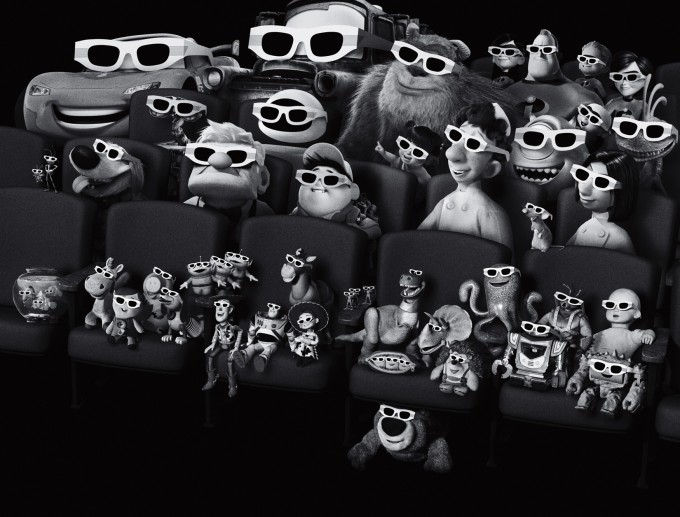
Vanity Fair saluted Pixar for its fifteen years of remarkable entertainment with this picture in its 2011 Oscar issue.
I still remember right after Toy Story 3 came there was countless mention of the success Pixar has made both financially and critically over the years. Entertainment webpages around that time made note of the successes they gave over the years. Rotten Tomatoes even pointed out that except for Cars, each Pixar movie up to then scored 90% or higher on its Tomatometer. Even Vanity Fair had a picture during the time of the Oscars of all the characters of Pixar movies. It was almost like around that Oscar time there was a big salute to Pixar for the 15 years of entertainment they gave. 15 years of excellent quality entertainment. 15 years of entertaining families and charming critics. A total of almost $3 billion gross. Forty-one Oscar nominations and eleven Oscar wins including seven wins in the Best Animated Feature category. In fact you could give credit for movies like Toy Story or Toy Story 2 for why the Best Animated Feature category was added by the Academy back in 2001.
Then it seems like right after Toy Story 3 and the glory that followed, things went downhill for Pixar. First came Cars 2 in 2011 with a lot of hype and merchandise. The film grossed a humble $191 million at the box office. However it was the Rotten Tomatoes result that was the big shocker. 39%: the first Pixar feature ever to be certified a Rotten Tomato. It even became the first Pixar feature to fail to receive a Best Animated Feature Oscar nomination ever since the category’s inception. As for the merchandise…
2012 gave a bit of hope that Pixar would be back into the swing of things with Brave. Brave was also a milestone as this would be the first Pixar feature with a female protagonist and would include two female co-writers and a female co-director. Unfortunately Brave received 78% at Rotten Tomatoes: falling short of Pixar’s finest efforts. The film did gross $237 million at the box office but still something was missing.
2013 seemed like another year where Pixar was aiming for quantity instead of quality. Monsters University, the prequel to Monsters Inc., was the only Pixar feature released in 2013. That hit a 78% on Rotten Tomatoes but still grossed an impressive $260 million. In terms of merchandise…
This weekend came Planes,a movie that was going along the same line as the Cars movies. It’s not necessarily a Pixar movie but it did have John Lasseter create the story for it. It scored only 24% on Rotten Tomatoes and opened the weekend with a paltry $22.2 million. That could be bad news about Lasseter’s creative juices.
It’s a question to what happened to Pixar as they always aimed for quality not just in terms of animation but also in the story and script. In fact seven of Pixar’s features have also been nominated in the screenplay categories and it’s those that have stood out as Pixar’s finest achievements. However as seen in the past, the desire to go more commercial does make the quality take a backseat. The animation is still top-of-the-line however the lack of inventiveness in its writing is making itself more evident.
It’s not to say that this is the end of Pixar’s legacy. 2014 will have The Good Dinosaur coming out. This was made from a concept of John Lasseter and will introduce a new scriptwriter to Pixar’s dream team. 2015 also shows Pixar keeping its creativity active with The Inside Out and also giving another commercial try with Finding Dory. How these movies will do both commercially and critically is something only time will tell.
Pixar has left a legacy of animated movies over the past twenty years. However it has been right after the release of Toy Story 3 that they appeared to be taking their legacy for granted. Their upcoming releases should send the message if they’ll return to it or not.
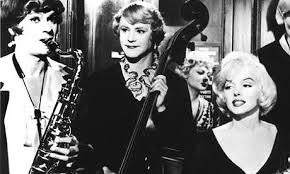
Tony Curtis, Jack Lemmon and Marilyn Monroe put on an unforgettable show in Some Like It Hot.
The AFI (American Film Institute) ranks Some Like It Hot as the best comedy of the 20th Century. No doubt it’s one of the most legendary comedies ever made. The question is does it still have what it takes to entertain people today?
Here’s a brief synopsis for those who’ve never seen it. It’s 1929 in Chicago. Joe and Jerry are musicians by day, bootlegging gangsters by night. They face themselves in a lot of trouble first with a rival mob for being in the crossfire of the St. Valentine’s massacre and secondly for the money Joe owes thanks to losing it on gambling. Their talent agent finds them a job to help them get away from the mob racket and make the money. There’s one catch. It’s with an all-girls band–Sweet Sue and her Society Syncopators—and they’re heading to Miami. They accept and agree to pose as women: Josephine and Daphne.
The beginning is not the best. As they board the train to Miami, they meet Bienstock, their manager who is one to give band members a cheap feel. However they do meet band member Sugar Kane who likes to take a drink every now and then and takes a liking to the two women-in-disguise. They soon start a good friendship after Sugar accidentally drops her liquor flask and the two try to cover it up to bandleader Sweet Sue.
Sugar confesses to the two on the train trip how she’s interested in millionaires. However they can’t make passes at her because they know they have to keep their disguises as women. Once in Miami, Joe disguises himself as a millionaire named Junior to woo Sugar: heir to Shell Oil who has a problem with his ‘disinterest’ in women. However Jerry faces a pursuit of his own as an aging millionaire Osgood Fielding III takes an interest in Daphne.
One night Osgood invites Daphne for dinner on his yacht. Joe convinces Daphne to keep Osgood occupied onshore so that he can take Sugar to the yacht as Junior and pass it off as his. Once on the yacht, Junior tries to convince Sugar that he is impotent because of psychological traumas. He does say he’ll marry anyone who changes that. Sugar tries to arouse him and it’s after some amount of effort that she succeeds. Meanwhile Daphne’s very good at charming Osgood as the two tango all night.
It’s right as Jerry tells the good news to Joe– that Osgood has proposed to him and a divorce upon the truth will result in a huge cash settlement–that they learn the charade has to end. Spats and his gang of mobsters from Chicago are in the hotel for a ‘Friends of The Italian Opera’ conference and they have to quit the band and escape the hotel. This also means that Joe has to disguise himself as Junior again and break off the engagement to Sugar. He succeeds by telling her he has to marry a woman of his father’s choosing but it breaks her heart.
But it doesn’t end there. The two finds themselves in pursuit of the mobsters from the Valentine’s Day killings. It’s right after a revenge shooting at the conference that the two find themselves in pursuit again by Spats and his gang. Even their disguises as dames won’t help them get away for long. They face an additional problem as Joe notices on stage how brokenhearted Sugar is. It’s there that Joe has to tell Sugar the truth and kisses her in his Josephine guise.
Soon Sugar, Joe and Jerry have to leave in a getaway boat for Osgood’s yacht. They all find the boat in time but not before a drunken Osgood runs out. It’s right in the end with all four in the motorboat that all the truths come out, but with unexpected results.
As I pointed out at the beginning, Some Like It Hot has received renown since its release and over the years as both a film and as a comedy. There’s always the question of whether today’s moviegoers will understand the films significance or its comedic value. There’s no question that people of today would still find men dressing as women funny. Heck, the ‘S*** Girls Say’ videos are a hit partially because of it. However we’re at a time where we’re not that unfamiliar with drag queen shows and men dressing up as women. We may not be blasé but we wouldn’t be as shocked as say a crowd from back in 1959 would be upon seeing this. Even the sight of two women kissing would be less shocking to us. Humorous but not so shocking.
We shouldn’t forget that this was released during a different time. A Streetcar Named Desire caused some controversy because of its depiction of promiscuity and a failing marriage. Rebel Without A Cause raised eyebrows with its portrayal of teenage crime. And Blackboard Jungle was being labeled as ‘outrageously violent.’ All these movies would be considered tame by today’s standards. It just goes to show how far we’ve come.
Even Marilyn Monroe’s sex appeal comes into question. By now we’ve had all sorts of screen actresses who have had their own shots at achieving sex appeal with male moviegoers. By now the top screen queens would be Kristen Stewart, Jennifer Lawrence and Megan Fox. Most males who are charmed by them would probably have a look at Marilyn and probably think she’s not as ‘babe-like.’ They may also think she “doesn’t show enough skin.” Heck some might even think she’s ‘fat.’ It wouldn’t surprise me, knowing today’s casting standards in Hollywood. Anyways those who know the screen goddesses of the past would know Marilyn was about more than her looks. She was also about her charm and charisma. That’s something today’s top screen queens lack.
The one thing that surprises me about Some Like It Hot is that it has cross-dressing during a time when Hollywood movies were still subject to the Hays Code. For those of you who don’t know or are too lazy to click on the link, the Hays Code was a rigid code used on movies and television up until 1966. It allowed for certain things to be in the movies but disallowed a lot of things too like an image of a toilet bowl or negative depictions or religious figures or certain things about sexuality. Even while watching it, I was thinking of the Code that was used at the time and wondered about certain scenes—the kiss between Sugar and Josephine and the “Well nobody’s perfect” scene—that left me wondering how they were able to get away with it at the time. Actually back then it did receive some flack from the Catholic Legion Of Decency who gave it a C (Condemnatory) rating. They’d also give Psycho a C rating the following year. Soon after other later films followed with a C-rating, it would lead to an overhaul and eventual end to the Hays Code in the 60’s. You have to give credit to some of these movies of the 50’s for pushing envelopes at the time and eliminating a lot of censorship in Hollywood in future decades. Mind you I don’t see why ‘decency committees’ should have a problem with cross-dressing. Besides we shouldn’t forget that Milton Berle dressed up as a woman on TV frequently during that time.
This is another winning movie for Billy Wilder. Billy is sometimes known for darker movies but rarely for comedies. This is probably his best comedic effort. Not his first but his best. He really took some challenges in making this film but he pulled it off well. This was also very good acting from both Jack Lemmon and Tony Curtis. Their performances were very humorous and it was amazing to see Jack, or should I say Jerry, instantly get into character as Daphne. Marilyn was also good but we shouldn’t forget that in this, like most movies, she was encouraged to play the movie sex goddess we all know her for. She pulled off her part very well. It’s still surprising how Marilyn is the biggest actress never to have even received as much as an Oscar nomination. Character acting from the supporting actors was also very good and added to the movie. The big surprise is that costuming was done by Orry-Kelly. Usually in the movies at the time, especially in Billy Wilder’s movies, it would be Edith Head who would do the costuming back then. Yeah, there were two types of costumers back in Hollywood back then. There was Edith Head and then there was everybody else.
Also interesting to see all the accolades this movie has received over the years. Besides being ranked the #1 Comedy by the AFI, the movie has been ranked #14 on their list of the Top 100 movies of all time back in 1998, then changed to #22 in their 10th Anniversary list in 2007. The line of “Well nobody’s perfect” ranks as the 48th-best movie line in their 100 Years…100 Lines list. In fact “nobody’s perfect” is even on Wilder’s epitaph. However it was not as lucky back at the year-end Oscars. That year the big toast of Hollywood was Ben Hur which would receive 12 nominations and 11 wins including Best Picture. The big surprise is that Some Like It Hot was not even nominated for Best Picture. Nominations did go to Wilder for Best Director and Best Adapted Screenplay and Lemmon was the only nominated actor with his Best Actor nomination. The only Oscar win was for Orry-Kelly for Best Costuming – Black and White who even beat out Edith Head. Some Like It Hot did fare better at the Golden Globes for wins for Lemmon, Monroe and Best Picture – Musical Or Comedy.
Some Like It Hot is a cutting edge comedy of its time in which most of today’s film goers who go to see it might not understand why it’s labeled the “Best Hollywood Comedy Of All Time,” especially since they’ve seen more shocking and more outrageous stuff. People who appreciate old movies and know the history of Hollywood film making will understand why and appreciate for such. For me, it was my first time seeing it and I was entertained.