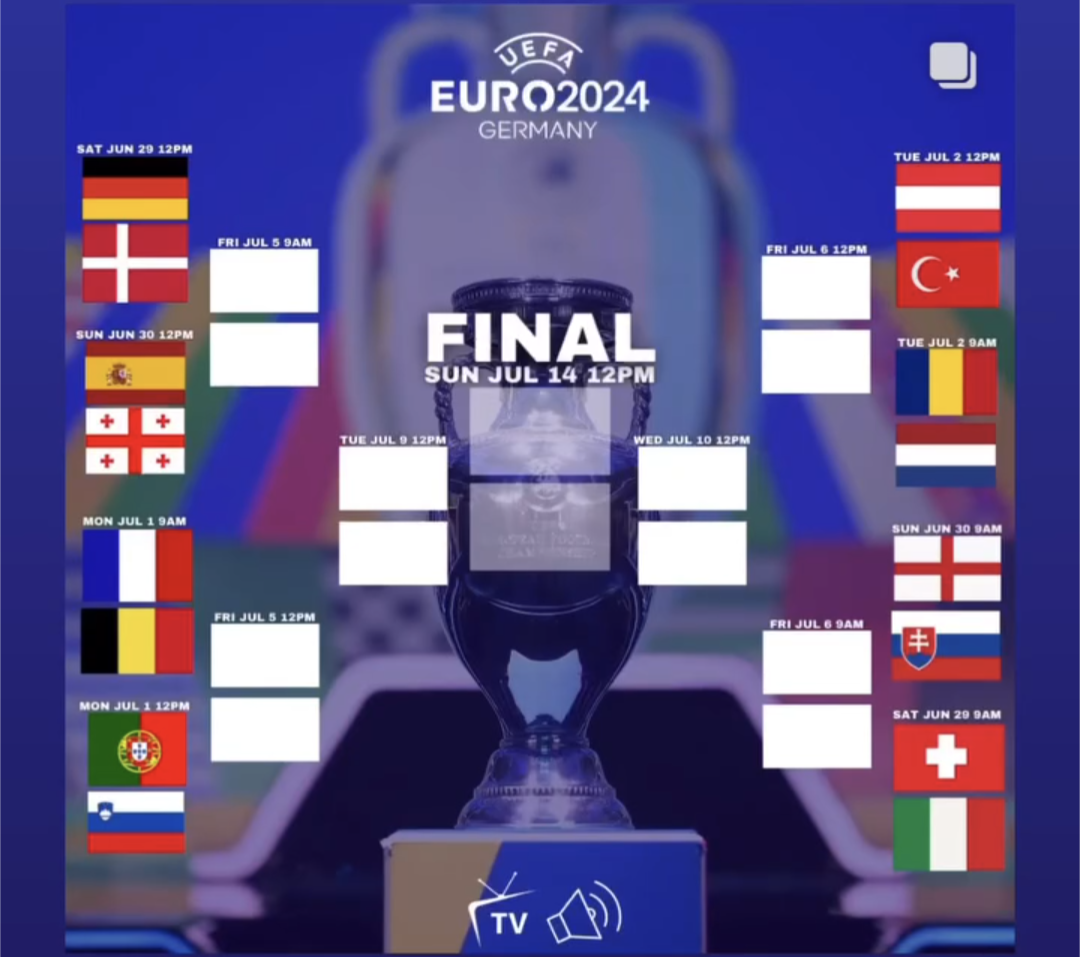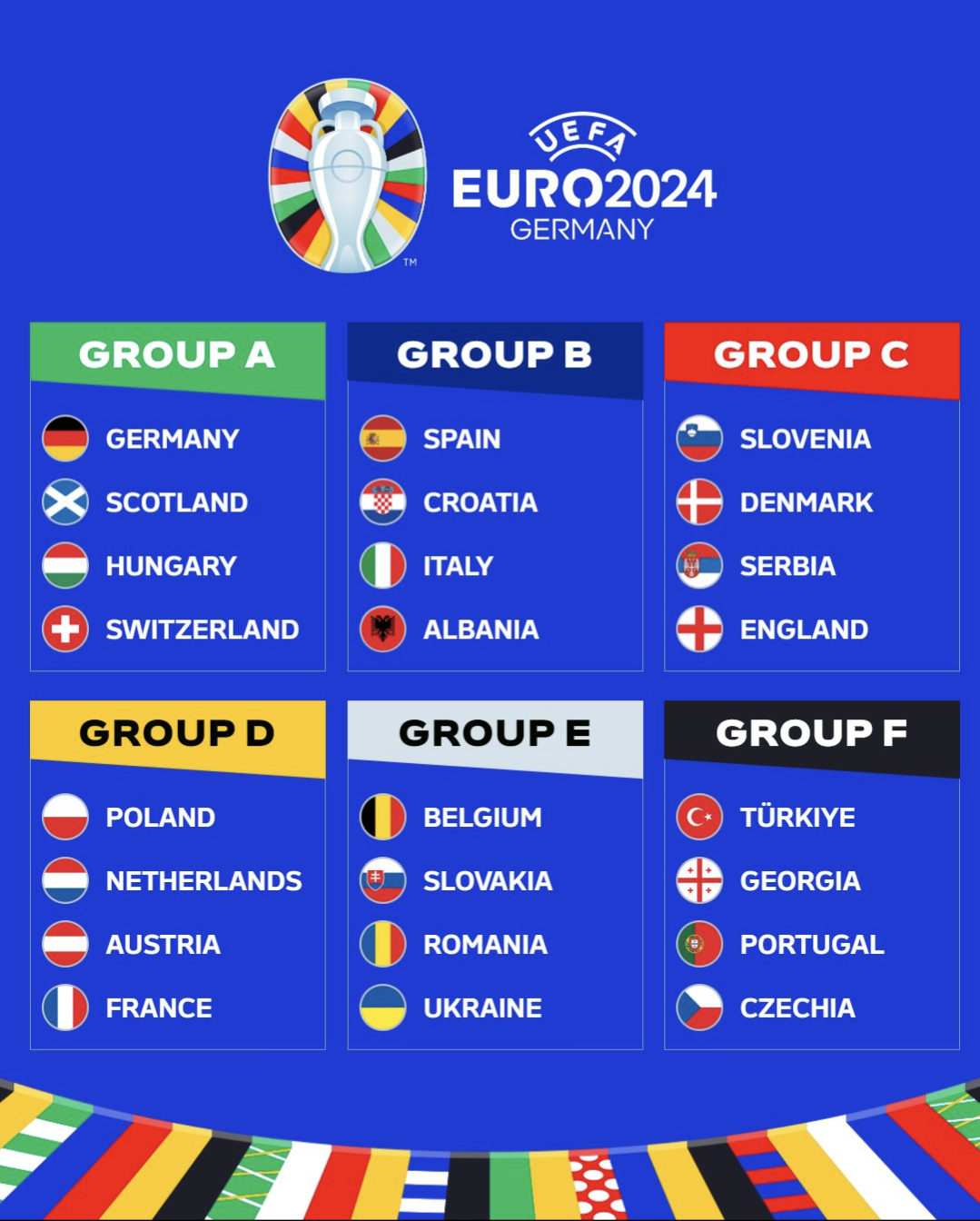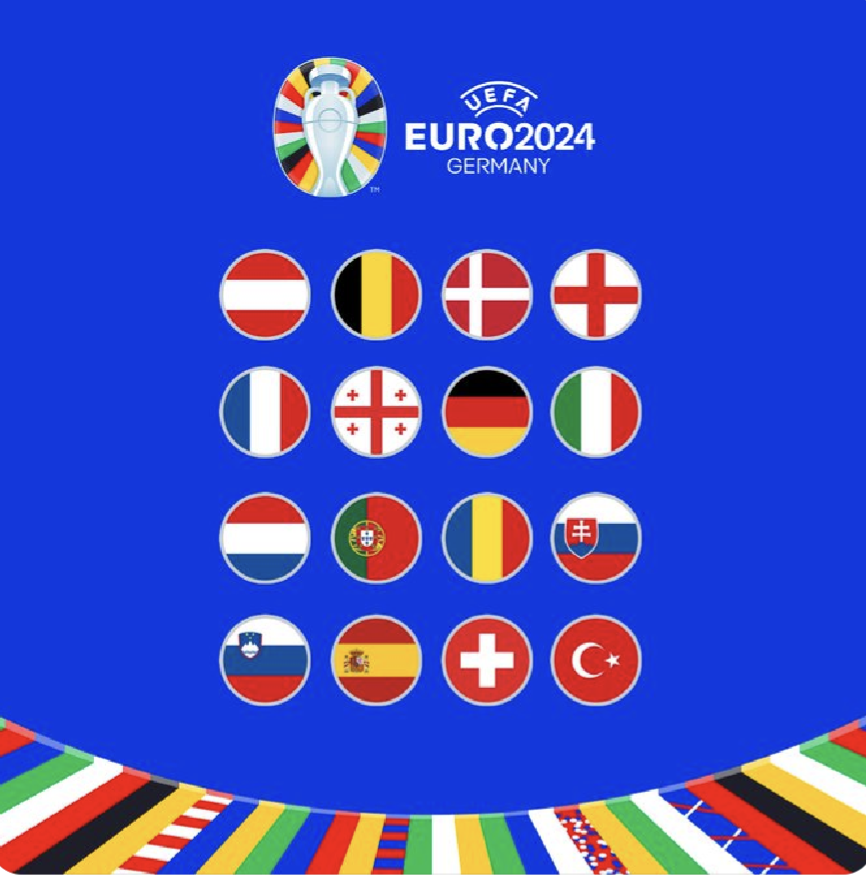
UEFA Euro 2024: Group Stage With One Game To Go

How about that? All 24 teams have completed their second game, or Matchday 2. There’s only one last group game to play and that will finalize the Group Stage standings and determine the qualifiers for the knockout rounds.

This year, there is an interesting allotment of the types of teams playing, but there are certain types of teams here in Germany that have stood out the most. We have teams who appeared to have lost their greatness before now playing hard to get it back. We have teams demonstrating their known consistency. We have underdogs surprising fans with wins over big guns. We also have teams that had a “Golden Generation” for many years that looks like their luster is running out and the younger players haven’t been well-trained to keep their team’s prowess active.

Now there’s only one game remaining in the Group Stage. That’s commonly referred to as ‘Matchday 3.’ Three teams right now have already guaranteed qualification by winning their first two games. With more than two groups having at least one draw game, two wins are a guarantee for qualification at this stage. Two of those teams have also already guaranteed a first-place finish in their group because of their win over the team in second place. Here at Euro, head-to-head results supersede goal differentials which the World Cup uses to to be the top tie-breaker in group rankings. In addition, only one team is guaranteed elimination already. Right now, the fates of twenty teams are still unknown and they will all need Matchday 3 to decide everything.

With one game to go, here’s my look at the teams in each of the Euro 2024 groups and what they need to qualify. Teams that have already qualified will be bolded. Group titles will contain links to my original group blogs:

Group A:

Some could say Germany did it in the very opening game. That remains to be seen. What is a fact is Germany won both their opening games and the hosts have guaranteed themselves qualification to the knockout round! A 5-1 against Scotland in the opener and their 2-0 win over Hungary did it. Second in the standings is Switzerland with their 3-1 win over Hungary and a 1-1 draw against Scotland. Germany and Switzerland meet for their last game. Switzerland can guarantee qualification with a draw. Even if they lose, the are still assured a top-three finish and are in conformable standings to qualify, though it’s not guaranteed. Their play against Germany will decide it all.

Of the teams in Group A that have not won a match, Scotland is third with a 5-1 loss to Germany and a 1-1 draw to Switzerland. At the bottom is Hungary with a 3-1 loss to Switzerland and a 2-0 loss to Germany. Both teams will face each other Sunday. No doubt that in order to have qualifying chances for the knockout round, either team must win. Despite the advantage of a draw to Switzerland, a draw against Hungary will not be enough for Scotland to qualify with two draws and a big loss. Even if Hungary wins over Scotland, it’s game results and goal differentials that will decide if their among the four wildcard teams that advance.

Group B:

Spain did it! They opened with a 3-0 win over Croatia and a 1-0 win against Italy thanks to an own goal from Riccardo Calafiore. Their two wins guarantee them qualification no matter what happens in Game 3. Their win over Italy guarantees them first place in Group B! Although Italy’s qualification is not guaranteed, the Azzurri are second with their 2-1 win over Albania. A draw against Croatia is all they need to qualify.

For the two teams at the bottom, Albania and Croatia, they still have qualification chances with both having a loss and a draw but for both teams, they need nothing less than a win to qualify. That will be a nail biter especially because both teams will face a highly touted opponent on Matchday 3; Albania will face Spain and Croatia will face Italy. After that 2-2 draw, Albania has an advantage because they have less of a goal differential. Nevertheless it’s down to the wire for both teams in a must-win situation. I don’t call Group B the Group Of Death for nothing!

Group C:

Sometimes in group play, you can get some groups that are quite decisive in who are the biggest and best in the group. Other times, the play in the group will be hard to decipher who are the powers of the group. Group C is that group as it’s hard to tell who are the better teams. Four games have been played and three of them were 1-1 draws. The only game where a winner was declared was England’s 1-0 win over Serbia. That lone win puts England at the top of the group and with very comfortable chances to qualify. I’ve been calling Group B the “Group Of Death” because of the caliber of the teams but it looks like with the closeness of play at Euro 2024, Group C should be called the “Group Of Death.”

Actually right now, none of the teams have enough points to qualify, but none of the teams are out. All four are still eligible. Despite England having it best, both Slovenia and Denmark have it good with two tie games each. A win from either will solidify qualifying. At the very least, a draw could help either of them for a wildcard berth as three draws is three game points and even goal differentials. Serbia still has qualifying chances but being the one team in Group C to take a loss, they will need nothing less than a win to qualify. Two draws and a loss won’t cut it in the wildcard third-place runoff.

Group D:

Group D has a unique situation. None of the teams have guaranteed qualification and one team is out of contention. The three teams that still have chances will need Matchday 3 to decide anything and everything. Leading the group are the Netherlands and France with a win and a draw each. The Netherlands opened well with a 2-1 win over Poland while France won over Austria 1-0 thanks to an own-goal by Maximilian Wober. The two teams played each other on Friday but it ended a scoreless draw. If you ask me, there are a lot of big name teams that are not playing like they want it. A simple draw can guarantee qualification for either team.

Austria opened up with the hard luck of a 1-0 loss to France thanks to Wober’s own goal. When they faced Poland, it was a surprise 3-1 win for Austria. That win is crucial for Austria’s qualifying chances, but their match against the Netherlands will decide things. As for Poland, they’re out. They lost 2-1 to the Netherlands and 3-1 to Austria. Even if they win their game against France and Austria loses, Austria will still have the advantage for their win over Poland. The head-to-head factor.

Group E:

Sigh. That subject about the ‘Group Of Death’ again! Group E is another group worthy of being labeled the Group Of Death because of the play so far. Talk about tight play! All four teams of Group E are even. All four had a win and a loss. Teams most people thought would not be among contenders delivered surprise wins at the start and keep their qualifying chances healthy. I’m not sure if there are any specific head-to-head rules that explain the current rankings, but the goal differentials look to be what’s deciding the current rankings. Despite losing to Belgium 2-0, Romania leads thanks to their 3-0 win over Ukraine while Belgium takes second due to their 1-0 loss to Slovakia. Slovakia is third because of even goal differentials after their 2-1 loss to Ukraine and Ukraine is at the bottom as the one nation with negative goal differentials thanks to their 3-0 loss to Romania.

Any of the four can qualify. Thanks to all four having a win and a loss, none have guaranteed qualification and none are out and it will take Matchday 3 to decide everything. Slovakia will play Romania and Ukraine will play Belgium. If both games are draws, only then would the current standings factor in qualification. It will have to be a case of either both games having a winner and a loser or the case of one game having a winner and the other drawing in order to decide the qualifiers to the next round.

Group F:

There must be something about being a team from the Iberian Peninsula this year because Portugal not only qualified but like Spain, they too guaranteed top of their group! It took a 2-1 win over Czechia and a 3-0 win over Turkey to solidify it! Even if they lose to Georgia on Wednesday and Turkey wins, Portugal will still finish first because of their win over Turkey.

Despite the loss, Turkey is second in the group and has good chances to qualify. Turkey can still qualify if they draw, even if Georgia wins. For both Czechia and Georgia, both teams will need nothing less than a win to qualify. Their 1-1 draw against each other keeps them in contention but a win needs to happen for either to qualify. Especially for the third-place wildcard berths because the two third-place teams with the lowest game results will join the fourth-place teams from each group packing for home sooner than they hoped!

And there you have it! That’s my summary for the Euro 2024 groups with Matchday 3 being all that’s left for all 24 teams. It will be interesting to learn of the other thirteen that advance and the seven others that get an earlier-than-hoped return home!

UEFA Euro 2024: Group D Focus

I’ll admit some of my talk outside the team talk in my last blog was pretty boring. For this blog, I will try something new. After my focus on the teams, I will give a focus on the ten venues that will be used to contest the games of this Euro. To save space and time, I will just talk about the venues with ‘fast facts.’

Anyways to start my blog off, here now is my look at the teams of Group D. Crazy thing is two teams in Group D played each other in the same qualifying group! Crazy that they meet again here! Who does these draws?:

– Poland (28): Poland is a team with a good reputation. The Orly or Biało-czerwon have finished third at two World Cups and weer Olympic champions in 1972. At Euro 2016, they made it to the quarterfinals for the first time. One of the problems with Poland is that the current team is big on talent but has a reputation of underperforming at big tournaments. They ended in the group stage at the last Euro and at the last two World Cups, they were out in group play in 2018 and out in the Round Of 16 in 2022.

Since World Cup 2022, the team has dropped Fernando Santos as coach and has gone back to a coach from their own nation: Michal Probierz. Robert Lewandowski, the most capped Polish player ever, is back, but Lewandowski can’t do it alone. The team has a lot of young talent 25 and under, but they also have some other established veterans like midfielders Kamil Grosicki and Piotr Zielinski and goalkeeper Wojciech Szczesny. In play since the World Cup, they’ve had wins to Germany, Ukraine, Estonia, Turkey and Latvia. They’ve had a win and a loss to Albania and two cases of a draw and a loss to Moldova and Czechia. Here in Germany, it’s a chance to write another chapter for the Polish team.

-Netherlands (7): The Oranje are considered to be the best team in the world to never have won a World Cup. At the Euro, they won in 1988 and have finished third four times. Since 2020, they’ve been underperforming. Euro 2020 saw them lose their Round of 16 match to Czechia 2-0, and after winning all three of their group play games! The last World Cup saw them lose to eventual champions Argentina on penalty kicks in the quarterfinals. Even losses in their recent play are quite telling.

Since the 2022 World Cup, they’ve dropped Louis Van Gaal as coach and are now back to being headed by Ronald Koeman who has played in two World Cups and was a key part of Oranje’s win of Euro 1988! The team’s stars include defender Daley Blind, midfielder Georginio Wijnaldum and forward Memphis Depay. Since World Cup 2022, they’ve had wins against Scotland, Greece, Canada and Ireland. They’ve also had losses to France, Croatia, Germany and Italy. Anything can happen at Euro. Germany offers the stage for a possible second win.

-Austria (25): There was a time The Burschen were one of the top teams in the world. They made the semifinals of World Cup 1934. World Cup 1954 saw them finish third. They last qualified for a World Cup in 1998. Austria only competed in their first Euro in 2008 when they hosted. Since then, they’ve worked to come back as a stronger team. At the last Euro, they made it to the Round of 16 for the first time ever.

Austria is coached by Germany’s Ralf Rangnick who was hired in April 2022. The team members mostly play in clubs with Germany’s Bundesliga or Austria’s own Bundesliga. Star players include goalkeeper Heinz Lindner, midfielder Marcel Sabitzer and forward Marko Amautovic, who is Austria’s most capped player. Since World Cup 2022 ended, they’ve had wins to Turkey, Slovakia, Sweden, Estonia and Serbia. They’ve also had a draw to Switzerland and a draw and a loss to Belgium. Anything can happen this month in June and Austria has the opportunity to prove themselves again.

-France (2): One thing about the lats ten years has been about the rebounding of Les Bleus. Sure, they’ve won the Euro before in 1984 and 2000, but their excitement these last ten years have ben remarkable. Finalists in Euro 2016 which they hosted, World Cup winners in 2018 and World Cup finalists in 2022. Their play in the final of the 2022 World Cup should be admired since many members were recovering from food poisoning.

The team is coached by Didier Deschamps, a former player for the 1998 World Cup winning team, who has coached since Euro 2012. His coaching has a lot to do with France regaining their form as the best in the world. Star players include defender Benjamin Pavard, midfielder N’Golo Kante and forwards Antoine Griezmann, Olivier Giroud and Kylian Mbappe. Since the World Cup final, they’ve had wins over Ireland, Scotland and the Netherlands. They’ve also endured a win and a draw to Greece, a draw to Canada, and losses to Germany. It’s very possible France could win their third Euro here in 2024. It’s all about the team being all together.

My Predictions: That’s often it. Four great teams, but they will have to be ranked in the end. I think the qualifiers here will be France and The Netherlands with Poland being the wildcard qualifier.

VENUES OF EURO 2024

It should be no surprise that Germany should have the venues to host a twenty-four nation major football tournament on its own. A nation who Bundesliga could be a challenge to the Premier League can do it. Germany has ten venues. They range in age from a few years old to 101 years old! Of course some of the older venues have had renovations, even one completely demolished to rebuild, but they still stand strong. Four are in the North Rhine-Westphalia region (with very little travel time between them), one is in the former East Germany and one hosted an Olympic Games. For this Euro, all of them will have group play games and at least one knockout match as well. For most of them, their Euro capacity is smaller than their respective team’s game capacity because standing areas are not allowed in the Euro.

This focus here is a brief focus. My focus is only giving a brief telling of the venues and its main facts like which city, year first completed, capacity and tenant team. I’ll be starting with venues that will only go as far as the Round Of 16 progressing to venues playing additional knockout matches to the Grand Venue which is to hold the final for the cup:

Venues Up To Round Of 16

  • Cologne Stadium: City – Cologne (Koln)
    Year Opened: 1923
    Euro Capacity: 46,922
    Current Tenant: Viktoria Koln
  • Leipzig Stadium: City – Leipzig
    Year Opened: 2004
    Euro Capacity: 46,635
    Current Tenant: RB Leipzig
  • Frankfurt Arena: City – Frankfurt
    Year Opened: 1925
    Euro Capacity: 48,057
    Current Tenant: Eintracht Frankfurt
  • Arena AufSchalke: City – Gelsenkirchen
    Year Opened: 2001
    Euro Capacity: 49,471
    Current Tenant: FC Schalke 04

Venues For Further Matches

  • Dusseldorf Arena: City – Dusseldorf
    Year Opened: 2004
    Euro Capacity: 46,264
    Current Tenant: Fortuna Dusseldorf
  • Volksparkstadion: City – Hamburg
    Year Opened: 1953
    Euro Capacity: 50,215
    Current Tenant: Hamburger SV
  • Stuttgart Arena: City – Stuttgart
    Year Opened: 1933
    Euro Capacity: 50,998
    Current Tenant: V1B Stuttgart
  • Westfalenstadion: City – Dortmund
    Year Opened: 1974
    Euro Capacity: 61,524
    Current Tenant: Borussia Dortmund
  • Fussball Arena Munchen: City – Munich (Munchen)
    Year Opened: 2005
    Euro Capacity: 66,026
    Current Tenant: Bayern Munich

GRAND VENUE

  • Olympiastadion Berlin: City – Berlin
    Year Opened: 1936
    Capacity: 70,023
    Current Tenant: Hertha BSC

And there you go. This is my look at the teams of Group D as well as a look at the ten venues for Germany 2024. Only two more groups left to review.

WORK CITED:

WIKIPEDIA: UEFA Euro 2024. Wikipedia.com. 2024. Wikimedia Foundation Inc. <https://en.wikipedia.org/wiki/UEFA_Euro_2024>

VIFF 2023 Review: Do Not Expect Too Much From The End Of The World (Nu astepta prea mult de la sfârsitul lumii)

Ilinca Manolache stars as Angela: a Romanian business executive who represents capitalism in Romania well in all its strengths and flaws in Do Not Expect Too Much From The End Of The World.

My VIFF experience for 2023 ended with the Romanian film Do Not Expect Too Much From The End Of The World. It was a good choice to end the film festival with, but not a really great choice. It has a point to deliver, but makes it in a way many will miss it.

The film begins with Angela, a young woman in Bucharest. Angela has a good-status job as an entertainment executive. Actually her job works her long hours and pays her not enough. Her job also interferes with her chances in getting a stable love life. She gets an income enhancement with her social media side gig. Angela is also a TikTok influencer named Bobita: a misogynist “alpha-male” type that Angela creates with a smartphone filter. Right into the beginning, Angela is part of the latest production job. It’s for a work safety video where they’re to have a victim tell their story. The decision of which story to use and the shooting of the video will have to be completed in two days. In addition, the head of the production company from Austria will be flying in tonight for this project and Angela is to pick her up.

Angela’s own life somewhat mirrors the life of another Angela. A fictional Angela from a 1981 Romanian film called Angela Moves On. In that film, the Angela is a cab driver in the era of Communism with Romania being part of the Eastern Bloc. Angela gets flack from her male co-workers of what a woman’s job should be. Her drives down the streets of Bucharest are relatively easy compared to the packed traffic present-day Angela gets. Angela presses on and hopes to find love on the job. She saw a chance in a man she picked up from the airport.

These two days come by with Angela at full force. The company has to pick and choose the person and family to do the video with. The story of the person’s accident has to fit the film’s narrative and the person needs to have a likeable personality. Meanwhile Angela tries to juggle work, a conference call with the video director Austrian Doris Goethe, meeting with her family, meeting with the actress who played Angela in Angela Moves On, shooting more Bobita videos (where Bobita’s phoniness is slowly given away video by video), entertaining Uwe Boll (and even shooting a Bobita video with him), dating a man and losing out, and driving Goethe after she arrives from Vienna. During the drive, Angela gives Goethe a good history lesson of Romania with its Communist past and present problems like the single-lane highway of death.

Then finally the safety video is being shot. They chose a family man who was left wheelchair bound and film him with his family posed in front of the area where it happened. The video goes through many takes and many style changes. In that time, Angela is there looking after things. She does her Bobita videos during the breaks and everyone can hear her. During shooting, a sudden fact is discovered but they continue on. The producers deal with it so they can get the story to fit the film’s narrative, much to the discomfort of the man and his family. The producers have it ‘stylized’ with the man telling his story with message cards.

Sometimes when watching this film, you think director/writer Radu Jude has a lot to say not simply about capitalism in Romania, but of Romania as a whole. On this film, we see pieces of Angela Moves On where it unintentionally showcases the hardships of Romanian life under the Communist Ceaucescu regime. Even how one of the male leads had his Hungarian name “Romanianized” may send a message. Now we have the Angela in Post-Revolution capitalist Romania. She works 16-hour days, she takes a side-hustle where she does this misogynist character on TikTok, the agency she works for tries to stylize the safety video. Romania has a sharp divide between the wealthy and the impoverished; the biggest in the EU. You can’t help but think that’s the statement Jude intends to have made in the film. To show that Romania had it the worst during the days of the Iron Curtain, but made to look nice, and now has it among the worst in the capitalist era of Eastern Europe.

The thing about this film is that it has a lot to say, but it doesn’t appear to have a consistent beginning, middle and end. Sure the film shows two days in the work life of present Angela, but it often appears there’s a story about to hatch. Yes, it shows her doing her Bobita videos and it shows scenes of the truth that can be given away any minute, but it doesn’t, leaving the viewer to wonder what’s next. Even the two long scenes — of most of the memorials of crash victims on that “highway of death” and of the 40-minute scene of the shooting of the safety video at the end — can leave one confused about the whole story. I’ve seen films before where it appears to be a magnifying glass on a person’s life, but even others I saw had a consistent flow from start to finish where everything connects solidly. This appears not to come together as solidly and fluidly. Either that or this film was not meant to be the film most of us expect. I’m sure Jude had his intentions for what the film is supposed to be.

This is actually the very first work I’ve seen from Radu Jude. His works have earned him a reputation as one of Romania’s best modern-day directors. It all started with the 2007 short The Happiest Girl In The World and it paved his reputation in his works to come. His breakthrough in feature-length films came in 2015 with Aferim! which became his first film Romania would enter in the Oscar category of Best International Feature Film. His past films have focused on a lot of themes in Romania’s history and Romania’s present. Even a film like his previous one — Bad Luck Banging Or Loony Porn — have elements of Romania’s past history despite the situation not intended to be political.

This film is the fourth Jude film Romania has entered into this Oscar category. This film has something in common with his two previous films: a very long title. Another thing it has in common is elements to do about Romania. The unique thing is how it does Romania past and Romania present. We have Angela the taxi driver in 1981 under Ceaucescu-era Communism and in color. We have modern-day Angela in the days of democracy, capitalism and the EU, but shown in black and white. We have Angela from 1981 dealing with male chauvinism in her job and trying to find the right man. We have modern-day Angela in a business that has a mix of men and women, but is overworked and gets her misogyny from the male drivers on the busy streets. It’s possible she uses the misogyny she gets for her Bobita videos. It’s a film that has a lot to say. Even if the film doesn’t make complete sense, it still leaves you with a lot to think about and definitely things Romania can identify with.

I feel the best thing about the film is the acting from Ilinca Manolache. If you’ve seen this film, this film seems less like a dramatic film and more like a documentary or a reality show. Manolache is successful in making this look like a natural situation instead of something acted out. She’s successful in making the actions and moments of Angela low key and happening in front of us as if this is real life. She’s also good in doing the Bobita parts in the humorous nature it’s intended to be and showing the irony of Bobita’s misogynist talk.

This film has garnered additional acclaim besides its Oscar submission status. It won the Best Film award at the Gijon Film Festival and at the Locarno Film Festival, it won the Special Jury Prize for international film and was also nominated in the Best Film category. Other nominations for this film include the Fiction Feature category for the Montclair Film Festival and the Gold Hugo award for Best Feature at the Chicago Film Festival.

Do Not Expect Too Much From The End Of The World is the type of film where you anticipate it to end a certain way, but it ends in a way different than one would expect. It’s a film that has a statement to make, but doesn’t do a good job of making its statement made well or clear. Despite its flaws, it is a film that will get you thinking.

And there you go! That is my look at the films of the 2023 Vancouver International Film Festival. I know it was later than usual but I figured that with these films bound to come out at a later time, reviews for them all are still worth posting. Even my wrap-up blog will come very soon.

VIFF 2023 Review: Last Summer (L’Été Dernier)

Samuel Kircher and Lea Drucker play stepson and stepmother that goes too far in the French film Last Summer.

For those that attend film festivals, there are many patrons who hope to catch a film with a bizarre storyline that looks good. One film that attempts to do it is the France film Last Summer. It’s a bizarre story that comes with unexpected twists.

Anne is an attorney in family law. She knows the system well and what works and what doesn’t in the Corts, but she will fight for her clients. Especially children. Anne is well-respected with how she works with rape cases, especially those involving minors. Anne is married to Pierre and has two adopted daughters from China. She does a very good job of balancing family life with her career.

Things change when Theo enters the picture. Theo is the 17 year-old son of Pierre’s from his first marriage. Theo is a troubled boy frequently getting in and out of trouble. Pierre is hoping a summer stay at his house will help improve him and improve his relationship with his son. In fact Pierre picks Theo up after his release from a detention centre. Anne is hoping to have this time to establish a mother-son relationship with her stepson.

Over time, Theo has no problem with being one of the family. He comes to family occasions well. He’s able to be a fun brother to his step-sisters. Anne has also found Theo to be a lot of fun to be around. It seems like they’ve developed a good relationship…or it’s something more. Anne is attracted to Theo and lets him know it. Theo is attracted to Anne in turn. Their closeness becomes more. A lot more.

Only problem is secrets don’t stay secret for long. The first exposure comes at a family birthday party. Anne’s sister catches them too close. She is disgusted and hurls an insult. Soon Pierre hears the news from Theo. Anne insists it’s all a lie. Whenever Pierre tries to bring it up, Anne knows of the right thing to say. When Theo confronts her in her office, she levels with him. She reminds him of his bad reputation and that no one will believe him. As time passes, Anne has successfully convinced Pierre and her sister that what they thought all along isn’t true. Soon Anne has one last encounter with Theo, which shocks everyone in the end.

Now this film is something. Very rarely do we have a film about incest created. And rightly so. Incest is a topic that almost all of us find disturbing and still churns a lot of people’s stomachs. This is a bizarre case. Theo is the stepson of Anne. Even if you get yourself questioning your morality as he’s not a blood relative of hers, he’s still the son of Pierre. Theo is a boy Anne is not to be attracted to in more ways than one. Seeing how the romance that is not to be unravel itself is enough to shock the pants out of the audients.

The funny thing about this film is that this film appears be about an incident of incest but if you look closer, you’ll see the film looks to be about Anne. Anne is a lawyer and an advocate: a respected woman who appears to champion the causes of exploited children. Soon she finds herself in a ‘tangle’ with Theo — a tangle that would lead anyone in the hottest of hot water — but she’s able to state her innocence and successfully convince those closest to her that it’s all a lie. We often forget that is the profession of lawyers and politicians: the power of the talk. Talk that wins cases, talk that wins minds, talk that can even trump proven truths. Anne has that ability to deliver that type of talk power and we see it throughout. She has the talk to win cases for young girls in family court, talk that can convince her husband and even her sister who catches her in the act that there’s no incest, and talk to convince Theo he won’t win his case against her. Usually a film about such an incident would be a film consisting of the incident, arrest, trial, conviction and any aftermath. I think that theme of Anne and the power of her talk may be the reason why the film ended in the way it did.

This is an incredible film by Catherine Breillat. Breillat is not well known outside of France. Her films in France have been known for decades to do about sexuality and family conflict. Her most notable works are 2001’s Fat Girl and 2007’s The Last Mistress. This film which she directed and co-wrote with Pascal Bonitzer is her first release in ten years and is actually an adaptation of a 2019’s Danish film Queen Of Hearts. Breillat does a great job in capturing the intensities of moments and having only us the viewer knowing the truth of the story. She knows how to capture what’s at stake should Anne be found guilty and expose a power play between the accuser and the accused.

The thing to make a film like this work is the acting. Lea Drucker was excellent as Anne, the one calling the shots. She knew how to make Anne the imposing figure that she is with the ability to be convincing to everyone even if we know it’s all a lie. Olivier Rabourdin was great as the husband who’s struggling to make sense of the whole situation of whether this really happened, what type of father he is. He was excellent at playing the man caught in the middle. Also great is newcomer Samuel Kircher. He gives Theo his recklessness, his innocence and his vulnerability without missing a beat. Very well done for a first performance.

Let’s just say Last Summer is a film of intrigue. It’s a film that features of an unspeakable happening and it comes with a lot of surprises including an ending nobody anticipated to happen. It’s a film that will get you thinking of what you saw over and over again!

VIFF 2023 Review: Apolonia, Apolonia

French painter Apolonia Sokol and her attempt to make a career as an artist is the subject of the documentary Apolonia, Apolonia.

Those of you who are into the new artists may or may not know who French painter Apolonia Sokol is. The documentary Apolonia, Apolonia appears to be a documentary about Sokol, but becomes a lot more.

The film starts in 2013 as Apolonia gets herself ready for her art exhibit. The film then flashes back to 2009 when Danish film maker Lea Glob first meet the young Apolonia after just graduating from the Ecole National Superior de Beaux-Arts de Paris. She talks of her childhood of just growing up, the daughter of two actors, with her mother in an artist’s flat owned by a Parisian theatre company. She also reveals she had cancer as a child and was not expected to survive but the nuns prayed over her and she made it. As Apolonia has graduated, she decides she wants to be a professional artist. She feels it’s in her. She’s grown up her whole life around the artistic friends. Her artistic influence throughout her life is inseparable from her. Though it comes right after her professor tells her that her paintings are less interesting than her personality.

Undaunted, she starts her first works in Paris. She decides with her first paintings what her art will be about. They won’t simply be portraits of people, mostly women. She aims to get to know the subjects she paints more intimately and wants that reflected in her paintings. For painting women, she has a goal of redefining the modern woman through her paintings. She sets up her works in her flat which she continues to hold parties with many artistic types. Soon the theatre building she’s lived in her whole life is repossessed and her mother has to find a new apartment. One woman she meets from a party, a Ukrainian woman named Oksana, soon becomes Apolonia’s girlfriend and she starts living in her apartment with the mother. Oksana, who formed a feminist activist group at her college called Femen, is very understanding of Apolonia’s artistic goals, unlike Apolonia’s recent ex-boyfriend. Early in her pursuits, she has many art exhibitions in Paris and various cities in France. Apolonia continues her works just as both Oksana and her mother are living in the apartment and it makes things cramped.

It’s only a matter of time until Apolonia captures the eye of someone big in the arts world. His name is Stefan Simchowitz and he is famous for being a renowned art collector. Simchowitz sees promise in Apolonia’s works and he offers her a ‘big break’ where she can have her art viewed in Los Angeles by some of the biggest names in the art world. There is one catch; the deal includes a minimum number of paintings to create. This becomes a case of both ambition and frustration for Apolonia. She struggles with that demand with the number of paintings she tries to do simultaneously, with the expense of her flat in Los Angeles, with the expense of her painting materials, and her loved ones being thousands of miles away. When the works are finally launched on display, her works get a lot of good reviews. She also gets some critiques including one critic saying that her works look more forced than inspired.

Over time, Apolonia continues to paint and continues to showcase her works around the world in France, Denmark, other American cities, Argentina and Turkey. As her exposure grows, things become more difficult for her. She questions her artistry and if it should even submit to commercial pressures. Things also stand in the way with the relations with people closest to her. The relationship with Oksana ends and her new love is a man. She’s still insistent on not being a mother, and even has an abortion. Then in 2018 while doing an exhibit in another country, Oksana commits suicide. It breaks Apolonia’s heart, but she paints her memory in her next paintings. Then suddenly, the filmmaker herself becomes hospitalized after giving birth. Lea, the director, is not supposed to make it, but she recovers. Flashing forward to the 2020’s, Apolonia has been honored for her works by the artistic board of the French government. She reflects on all it took for her to make it to this level.

This is a telling documentary. It is very rare for a documentary to showcase an artist and their attempt to make it in the arts work from their very start to when they finally make it. As we follow the artist’s path, we can easily see why Apolonia would want to be an artist. She was surrounded by the arts and artistic people throughout her life. It eventually becomes her turn to express herself. We get a look at all the works she creates and why she paints she does. We see all the difficulties Apolonia goes through to achieve her renown such as her first exhibitions, her first contract, the cost of creating the many works expected of her, the critics she has to deal with, the sexism in the arts world, the loss of her former girlfriend. Even family situations as her father wants her to become a mother but her grandmother is fine if she doesn’t have children. It’s a long 13 year struggle that comes with the triumph in the end. Anyone who’s interested in making it as an artist should see this. It will show them a lot and remind others familiar with the arts world it’s still hard to make it as an artist. Always was.

Those who watch this documentary will also see it’s not just about Apolonia Sokol. The film is also about the documentarian herself. As she continues to film Apolonia and her life, she grows as a human. Apolonia’s emergence as a great in the world of art coincides with Lea’s emergence as a documentarian and also as she grows as a person. In a bizarre twist of fate, Lea also cheats death as she was given a low chance of surviving after her child’s birth. Just like Apolonia was given a low chance of surviving her childhood bout with cancer. Sometimes it seems the two were fated to be together.

This documentary is unique that it mixes three different stories into one and somehow pieces it together well. It first comes as a film that follows a young emerging artist as she works to establish herself. It shows the works she does, her inspiration, her free personality and the sexist hurdles she tries to overcome. It also shows her in her personal life. It shows her as she tries to establish herself as an adult and faces the pressures from family and others to find someone she can commit herself to or even the pressure to become a mother. It also shows her relationships: first with a Ukrainian woman named Oksana, then with a French man. There’s also dealing with Oksana’s suicide which hurts Apolonia to this day. Finally there’s the filmmaker herself Lea Glob. Just as Lea helps make Apolonia in her film, it becomes a case where Apolonia makes Lea. Definitely a documentary that goes beyond its original mission.

Top accolades belong to Lea Glob. From first meeting Apolonia in 2009 to constantly coming back to her to tracing her career’s biggest moments, she captures an artist in the making. She captures an artist’s soul with a fierce feminist attitude that she includes in her works. She captures the difficulties Apolonia faces to make it as an artist, especially sexism and capitalism. She captures Apolonia’s relationships with the people around her and some of the heartbreak she experiences. She also captures her own unity with Apolonia as she is also an against-all-odds survivor story too. One could joke the two may be long lost sisters!

This film has already won many a documentary award at film festivals. Among them, wins in documentary categories at the Amsterdam International Documentary Festival, Hong Kong Film Festival, the CPH: DOX Festival, the Goteberg Film Fest and the One World International Human Rights film Festival

Apolonia, Apolonia is a documentary intended to track the growth and progress of a rising artist, but it also tracks the growth and progress of the film maker herself. It’s rare to see and it captures your intrigue too.

2023 Women’s World Cup – Group F Focus

As we’re getting closer to the start of the Women’s World Cup, FIFA already has it as its main feature on its website. There’s a lot of talk of new talent, but there’s also talk that this will be the last WWC for Megan Rapinoe, Christine Sinclair and Marta. That’s normally how it is in sport. Greats eventually retire and new legends are made. Nevertheless it’s exciting to see them play one last time.

Up next is Group F. This is a rarity as there are two CONCACAF teams in this group. This became the case as one CONCACAF team, Jamaica, was drawn while the inter-confederation berth was drawn months before the matches were to be played. This seems to be a new thing with World Cups. Drawing before certain berths are decided. The inter-confederation playoff was played in New Zealand in February and it was between four teams from four confederations. In the end, Panama won! Without further ado, here’s my look at Group F:

-France (5): France is one team that has struggled to show how great of a team they are. They made their first WWC in 2003 and achieved a fourth-place finish in 2011. Since then, they’ve been out in the quarterfinals at the last two Women’s World Cups and their best Olympic finish was fourth in 2012. Even hosting the Women’s World Cup in 2019 didn’t give them they breakthrough they sought. Last year, however, they achieved their first-ever Top 3 finish at the Women’s Euro.

The team is currently managed by Herve Renard who assumed his position in March after coaching the Saudi Arabia team during the men’s World Cup and taking the job after their original manager was dropped. Most of the team plays for teams part of France’s Division 1 Feminine. Top players include forward Eugenie Le Sommer and defender and captain Wendie Renard. The team has not had a loss yet in 2023. In the past 12 months, they’ve achieved wins against Canada, Denmark, Norway and the Netherlands. They’ve also had a draw to Norway as well as Iceland. Losses in the last 12 months have been to Germany and Sweden. Nevertheless Australia/New Zealand 2023 could write a new chapter for Les Bleues.

-Jamaica (43): Jamaica is one women’s team that was late to start its progress. Lately they’ve shown great improvements as they made it to the last Women’s World Cup in 2019 and they’ve finished third at the last two CONCACAF Women’s Championships. As of now, the last 12 months have seen the Reggae Girlz with their best-ever FIFA World Rankings.

The team is coached by Jamaican Lorne Donaldson who coached the team two months before they officially qualified. The team play for teams for various leagues in the US and in Europe. Interestingly, Jamaica’s ten most capped players are part of the current national team as well as seven of their eight best scorers! Leading the team is Khadija “Bunny” Shaw with 38 caps and 56 goals. These last 12 months have been difficult. The only national teams they had wins against are Paraguay and Costa Rica. They recently achieved a draw against Costa Rica. Their losses have come from Canada, South Korea, Australia and Mexico, This Women’s World Cup is a great chance for Jamaica to prove to the world they’re better than most people think.

-Brazil (9): The Brazilian men have the reputation as one of the most legendary football teams in history. The Brazilian women, or As Canarinhas, hope to achieve the same excellence the men have achieved. Like the men, they’ve competed in every Women’s World Cup. Unlike the men, they’ve never had a major win on the world stage. They’ve only made it to the WWC final once, back in 2007, and won Olympic silver twice. They’ve finished in the Round of 16 in the last to WWC’s and only made it to the quarterfinals in the last Olympics.

Since the 2019 Women’s World Cup, the head coach is Sweden’s Pia Sundhage who has coached the US women’s team to two Olympic golds. The current team consists of legends like forwards Marta, Debinha, and Bia Zaneratto along with defenders and defenders Rafaelle and Tamires. The team also has some young rising talents like forward Geyse, midfielders Kerolin and Ary Borges and young defender Lauren. In the past twelve months, they’ve achieved notable wins against Germany, Italy, Norway and Japan. At the UEFA-CONMEBOL Finalissma, they drew against England 1-1falling on penalty kicks. They played Canada three times, Brazil winning once and Canada winning the other two times. Their only other loss came to the US. The 2023 Women’s World Cup is a chance for Brazil’s women to get back their reputation as one of the best in the World and hopefully go to new heights.

-Panama (52): Panama is one women’s team that was slow to start. Their first-ever international game was in 2002. They were a team slow to start but their first sign of promise was at the fourth-place finish at the 2018 CONCACAF Women’s Championship. They followed it up with a quarterfinal finish at the 2019 Pan Am Games. It received its breakthrough at the 2022 CONCACAF championships after a win against Trinidad and Tobago granted them their berth to the inter-confederation playoffs which they won and gave the Canal Girls their first-ever Women’s World Cup trip! Right now their 52nd World ranking is its best ever.

The team has been coached by Mexico’s Ignacio Quintana who has not only coached to team since 2021 but successfully lobbied to have the women receive equal pay with the men’s team. The team’s players play mostly in teams belonging to women’s leagues throughout the Americas. Despite having a team with players having less than 20 caps, the team has played well in the last twelve months. They have achieved wins against Paraguay, and the Dominican Republic. They’ve had a win and a draw against Ecuador. They’ve also had a loss and a draw against Colombia, a win and a loss to Chile and a loss to Spain. This Women’s World Cup is an opportunity for Panama’s team to achieve bigger feats and take the team to greater heights.

My Prediction: Once again, a case of two clear favorites, which I normally hate going with. Nevertheless I predict the qualifiers from Group F to be France and Brazil.

And there you go. Those are my predictions for Group F of the 2023 Women’s World Cup. We shouldn’t forget that this Cup’s slogan “Beyond Greatness” isn’t just about winning. I’ll focus more on it in my next blog.

World Cup 2022: My Prediction For The Final, And Third-Place Playoff Too

I always say about the World Cup after month of play, there’s only one nation still smiling in the end! It’s been unusual to see World Cup matches as winter has been approaching. The time zones didn’t help too much. Nevertheless I made every opportunity to enjoy games at cafes and other viewing places. I also had my share of entertainment with the 442oons videos.

It’s crazy that World Cup 2022 already felt like a circus. I think every World Cup becomes a bit of a circus. Throughout this World Cup, talks of endless corruption, the corruption of the nation of Qatar, questions about matches being fixed or some referees having prejudices. Possibly one of the best things about the match for the Cup is not just to reward the winner, but the fact that all this will end. I remember before the start of one World Cup final, I thought to myself that all the craziness is over. What happened, happened. What didn’t happen, didn’t happen. And now all that should matter is who will win the Cup.

Onto the World Cup finals, it’s interesting that the two teams playing have a few notable things in common. Both have won the World Cup twice before. In both cases, their first World Cup win was when they were host nation. Both played in the very first World Cup in 1930, and one of the teams was even a finalist. Both teams have a striker who has amassed a total of five goals this World Cup, and both teams lost a group stage match here in Qatar. Without further ado, here are my reviews of the last two matches of World Cup 2022:

THIRD-PLACE PLAYOFF REVIEW:

The third-place match will take place on Saturday December 17th in Khalifa International Stadium in Al-Rayyan: a suburb of Doha. One team is looking to make this its third Top 3 finish. The other is looking to make it their first Top 3 result ever. Both teams didn’t get a defeat until their semifinal match. Both teams are also the same two Group F teams that rivaled each other in their first group play match. This is the second consecutive World Cup in which the bronze-medal match is between two group play rivals!

Past Head-To-Head Results:

Croatia and Morocco have met only twice before. Besides the scoreless group play match here in Qatar, the only other time was back in 1996. That too ended in a draw. The score was 2-2.

CROATIA

They’ve only existed as an independent nation since 1991 and they’ve gotten as far as the World Cup semifinal or further a total of three times. It’s no wonder why I call Croatia “The little nation that can.” Since their independence, they’ve qualified for the World Cup six times out of seven attempts. Three of those times they’ve made it to the semifinals or further. The first was in 1998:their very first World Cup. Last World Cup, they made it to the final. Sometimes you wonder what’s the secret to The Blazers? Me, I can’t answer. One thing I have to say is that Croatia is one team low on arrogance, big on play!

Croatia has been getting a lot of attention for the overall play of Luka Modric, the scoring of Ivan Perisic, and the eye-catching fashion of Ivana Knoll! At the last World Cup, Croatia was known for great play as well as good luck. They opened with three wins in group play and then followed with penalty kicks in both their Round of 16 match and quarterfinal. Their semifinal was a win against England, but France ended their dream in the final 4-2.

At thins World Cup, the Croatian team has changed, but it’s also kept some similarities. In group play, they had two scoreless draws and a 4-1 win over Canada. In their Round of 16 match and their quarterfinal, history repeated itself and they bagged wins on penalty kicks. It was in their semifinal against Argentina where their luck finally ran out.

Croatia has shown a lot with their play from midfielder Luka Modric and from striker Ivan Perisic. Worthy of credit to the team’s success is goalkeeper Dominik Livakovic. He’s one of the younger goaltenders of the tournament at 27, but he has done an excellent job in keeping Croatia alive, having only allowed in three goals before their match with Argentina. They could just be the team that has what it takes to clinch another Top 3 finish.

MOROCCO

It happens every World Cup. There’s always one team that has modest expectations before the competition but ends up going further than expected. Last World Cup, it was a case where Croatia and Belgium achieved their best-ever results. This year, it’s a case where Morocco is the “Cinderella story” of Qatar 2022. Nevertheless it’s wrong to dismiss Morocco’s success as a complete “Cinderella story.”

Morocco has to be one of the top African nations to adopt a football culture. They competed in their first World Cup in 1970. When they returned in 1986, they became the first African team in World Cup history to advance past the opening round. Returning to that success or taking it further has been a struggle. They qualified for the 1994 and 1998 World Cups, but went out in the group stage. Despite claiming a second-place in the African Cup of Nations in 2004, they had to wait until 2018 for their return to a World Cup. Even then, they were ousted with a draw and two losses.

When they arrived in Qatar, nobody knew what to expect of the Atlas Lions, but they delivered. They started with a scoreless draw against Croatia and then delivered a surprise 2-0 win over Belgium. A 2-1 win over Canada placed them at the top of Group F. Their Round of 16 match against Spain went goalless, but penalty kicks were the trick as they sunk three while Spain couldn’t sink one! The quarterfinals paved the way for a 1-0 win over Portugal. Their win made history as they became the first African nation to qualify for the World Cup semifinals. It was France that ended their quest for the Cup at 2-0.

Having Morocco in the semifinals was a big boost for African teams. Especially since none of the African teams of 2018 qualified for the knockout round. It’s hard to pinpoint how Morocco became so successful this tournament. I made the claim it could be since they’re a Sahara nation, they have better knowledge of how to play in a desert climate. Recently I’ve credited it to manager Walid Reguagui. Since he was hired four months ago, their semifinal loss to France is Morocco’s first loss since he was hired. Maybe that’s the secret. Others give credit to the great defensive play and the goalkeeping of Yassine Bounou. Bounou has only conceded three goals and a penalty kick this Cup. Whatever the situation, they had what they needed and they could just do it again on Saturday.

My Final Verdict: This is hard to tell. Both teams have played well. Both have been able to deliver when they needed to. Croatia has scored six while Morocco has scored five. Croatia however has conceded a total of six goals while Morocco has conceded a total of three. Both teams have a star player that may be absent. From Croatia, Mario Mandzukic because of his red card while assistant coach. From Morocco, Romain Saiss because of an injury sustained in the tournament. I think it will be a tight game but I expect Croatia to win 1-0 in added extra time.

THE FINAL

Can you believe it? After 28 days and 63 matches, there will be only one match left! This is the moment for a team to claim to their nation the world’s biggest bragging right! The final will be held in Lusail Stadium. One team aims to be the first South American team to win the World Cup in 20 years. The other team aims to be the first team in 60 years to successfully defend the World Cup.

Past Head-To-Head Results: France and Argentina have dueled each other a total of twelve times. Argentina have won six times including during the 1978 World Cup. France have won three times. Their last match was in the 2018 World Cup Round of 16 where France won 4-3.

ARGENTINA:

La Albiceleste knows about World Cup finals. This is Argentina’s sixth time to the World Cup final. Only three other nations have achieved six of more appearances. Argentina was even a finalist in the very first World Cup in 1930. Getting back to the finals was a real struggle. They didn’t return to the finals until 1978, which they hosted and won. Then in the 1980’s emerged a great player by the name of Diego Maradona. He helped captain Argentina to their second win in 1986. He retuned in 1990 to try and make it two in a row, but the team lost to Germany 1-0. From 1990 onwards, it was a struggle for the team to get back to the final. Early in this century, a young player named Lionel Messi was dazzling the world with his club play. Whenever the World Cup happened, he and the team would fall short. Then in 2014, they made the finals for the first time in 24 years. Unfortunately like in 1990, they lost to Germany 1-0.

Trying to get back to the finals has not been easy. In 2018, they had a disastrous run. They finished second in their group with a win, a draw and a loss, and then went out in the Round of 16. After the 2018, they hired Lionel Scaloni, who played for Argentina at the 2006 World Cup, as their new manager. Since his hiring the Argentine team has shown a lot of positive changes. Its most notable change was when they won the 2021 Copa America..

Here at the World Cup, Argentina got off to a rough start. The 2-1 loss to Saudi Arabia isn’t the first shocking opener Argentina’s delivered at the World Cup, but they knew they had to get themselves in order if they wanted to advance well. They succeeded with 2-0 wins over Poland and Mexico. In their Round Of 16 match against Australia, they dominated play as they won 2-1. In their quarterfinal against the Netherlands, they endured a game marred with frequent carding from a referee to a 2-2 draw. Penalty kicks kept them alive. In their semifinal match against Croatia, they dominated to win 3-0.

Throughout this World Cup, people have been constantly talking about “This is Messi’s last chance.” or “This will finally be Messi’s” No kidding there’s a lot of attention on Messi. In fact winning the Cup will make the difference between Messi being remembered as The Best Ever or The Best Never. Nevertheless we should remember the success of Argentina isn’t just Messi. There’s also the goaltending of Emiliano Martinez and young player Julian Alvarez rising to the occasion. Argentina has the right mix of youth and experience for the team and it just might pay off in winning the Cup on Sunday.

FRANCE:

Success for Les Bleus has been like a yo-yo. Like Argentina, France has been there at the very start back in 1930. They themselves would have difficulty establishing themselves as a football power. Even when they hosted in 1938, the team was out in the quarterfinals. It wasn’t until 1958 that they finished in the Top 3 for the first time. During the 60’s and 70’s, it was a case of either failing to qualify or out in group play. It was in the 1980’s when France saw a spark of improvement. Led by Michel Platini, the team finished fourth in 1982 and third in 1986. Just after, they followed with two failures to qualify. Then in 1998, France hosted and the team performed brilliantly en route to winning their first-ever World Cup.

It hasn’t been easy for France to return. At the 2002 World Cup, they were out in the group stage without even scoring a single goal. In 2006, they were runner-up to Italy. In 2010, the team revolted against the coaches and their federation and they went out in the group stage. Then in 2014, there emerged a new French team coached by 1998 player Didier Deschamps. The team featured a lot of young promising talents and they finished in the quarterfinals. That was just the warm-up as they’d go on to make the finals of Euro 2016 and win France’s second World Cup in 2018. Staying on top wouldn’t be easy. France was reminded of that when they bowed out of Euro 2020 in the Round of 16.

France was often reminded of the alleged curse of the defending champion. At the beginning of 2022, it was still in question how France would do after they endured three losses in Nations League play. Any questions France were given, they were answered in Qatar. They won their first two games of group play 4-1 against Australia and 2-1 against Denmark.The win against Denmark was a boost as they lost to them earlier this year. The 1-0 loss to Tunisia didn’t set their confidence back much, if any. After group play, it’s been nothing but wins for France as the won their Round of 16 match against Poland 3-1, their quarterfinal match against England 2-1 and their semifinal against Morocco 2-0.

The success of the French team has proven this “Curse of The World Cup Winner” is a myth. Mind you it was uncertain at first. And now they appear poised to repeat as World Cup champions. Only twice before has the reigning World Cup champion successfully defended its title: Italy in 1938 and Brazil in 1962. The World Cup team had a lot of notable players from 2018 like Paul Pogba and Samuel Umtiti left off and Karim Benzema benched because of injury. Nevertheless the team has delivered excellently with the striking of Kylian Mbappe and Olivier Giroud and the goaltending of Hugo Lloris. They’ve shown they won’t give up their World Cup title easily.

My Final Verdict: A lot to think about. Argentina’s group play loss came in the opener. France’s came after they were guaranteed qualification. Argentina has scored twelve goals while France has scored thirteen. Argentina has conceded five goals and so has France. This will be an extremely tight match. I think this is a match where it would go to a 1-1 draw and Argentina winning on penalty kicks. I’m sure it will be that tight!

And there you have it. My review and predictions for the third-place match and the World Cup final. This will definitely be one World Cup we will never forget.

World Cup 2022: Semifinals Predictions

The funny thing about this World Cup tournament is that with FIFA’s app, I’ve been making predictions for each game’s final score. Only three have I got the score absolutely bang on. Of course there are many I wrongly predicted would win. It’s interesting how this whole World Cup is a big circus both inside the field and outside the field. Not just the play but the politics, disputes and even brawls. In short, this World Cup is completely unpredictable. I find it weird because I’ve been quite good at making predictions on this blog and it’s come at mixed results. I successfully predicted all the Round of 16 winners, but I only got one quarterfinal winner right.

What can I say about this Cup’s semifinal teams. Before I talk about them, it’s interesting many teams that delivered some of the biggest wins in the Round of 16 lost their quarterfinal match! As for the semifinalists, two are from Group F. Two are from different groups. Only one team has won their knockout matches without even needing added extra time. While one team qualified with nothing but matches that went to penalty kicks. Two teams are renowned for their goal scorers, while the two others owe most of their credit to their goalkeepers. Two are finalists from the last World Cup. Two have won the World Cup in the past. One has made it to the semis for the first time ever. Two teams have lost one group play game while the two Group F teams have not had a defeat. This is only the second World Cup where the semifinal teams come from three different continents.

Without further ado, here is the look at the four teams that qualified for the two semifinals and my prediction for each one:

SEMIFINAL #1: ARGENTINA vs. CROATIA

Head-To-Head Stuff: Croatia and Argentina have played each other five times in the past; two of those games in the World Cup. Croatia has won twice and Argentina have won twice. For World Cup play, their first meeting was in 1998 group play. Argentina won 1-0. The second was group play of the last World Cup. Croatia won 3-0.

Team-By-Team Analysis:

ARGENTINA

For almost fifteen years when you think of Argentina, one name comes to mind: Lionel Messi. No doubt about it Messi has shone over the sport like no other player. Despite his accolades in club play, he has consistently been denied major international prizes like the Copa America and the World Cup. A common reminder that one player does not make the whole team. Argentina has a lot of talented players, but it’s always been a struggle to get them all together and win one of the biggest tournaments. They qualified for the final of the 2014 World Cup, but lost to Germany. In the two years after that, they qualified for the final of the Copa America both years and lost finals on penalty kicks. The failure of falling 4-3 to eventual champions France in the 2018 Round Of 16 added further insult to the injury.

Since the pandemic, Argentina has shown a change of play. Last year they won the Copa America and it became Messi’s first major international trophy ever. On to World Cup action, Argentina had the misfortune of losing 2-1 to Saudi Arabia. La Albiceleste knew they needed nothing but wins to qualify and they delivered with 2-0 wins in both games. They topped Group C and were one of five teams to top a group in Qatar with two wins and a loss. They won their Round Of 16 match against Australia 2-1 and won their quarterfinal against the Netherlands on penalty kicks after a 2-2 draw and a load of yellow cards. One highlight of the match was Lionel Messi scored the tenth World Cup goal of his career.

CROATIA

Croatia should be seen as the little team that can. They’re a nation of under 5 million that competed in six World Cups since their debut in 1998. They’ve made the Top 4 for the third time this very tournament! Returning back to the World Cup semifinals wasn’t easy. Shortly after play resumed after the pandemic, Croatia endured a lot of UEFA Nations League losses. They only made it as far as the Round Of 16 at Euro 2020, and they even struggled to resume winning during World Cup qualifying.

Things made a big improvement after their early Euro exit. Since then, they’ve only lost a single Nations League match and more than made up for things in World Cup qualification. In their play here in Qatar, the group stage was a case where they had scoreless draws against Morocco and Belgium and a 4-1 win over Canada. That big win was what they needed to qualify second in Group F. In their Round of 16 match against Japan, they drew 1-1 but won on penalty kicks. Their quarterfinal against Brazil also ended in 1-1 and again penalty kicks gave them the win. Top play has come from striker Ivan Perisic, midfielder Luka Modric and goalkeeper Dominik Livakovic.

My Final Verdict: This is hard to judge. Sure, Croatia won against Argentina in 2018 group play, but both teams were different teams in 2018. Back then Croatia won all three of their group stage games while Argentina had a win, a draw and a loss. Looking at the World Cup 2022 stats, Argentina has scored a total of nine goals while Croatia has only scored six. Croatia however have only conceded three goals while Argentina has conceded five. Croatia has never lost here in Qatar while Argentina had their shock loss to Saudi Arabia. On top of it, Argentina have picked up a lot of yellow cards from their card-crazy quarterfinal against the Netherlands and they might not want to risk their best players. Looking at all the facts, I have to say I predict Argentina to win 1-0 in added extra time.

SEMIFINAL #2: FRANCE vs. MOROCCO

Head-To-Head Stuff: France and Morocco have faced off against each other 11 times in the past, but never played each other at the World Cup before. Morocco’s only win came in 1963. France won seven times.

Team-By-Team Analysis:

FRANCE

Many of you remember my story of France’s long road of recovery from their embarrassing collapse in 2010 to winning theWorld Cup in 2018. It’s one thing to get to the top but it’s another to stay on top. After the World Cup win, France was still very skillful for the rest of 2018 and 2019, winning eleven of their sixteen games and only losing two. Things changed after the pandemic. They still managed to win many games but they showed sings of weakness. Especially during Euro 2020 when they topped their group with a win and two draws, but went out to Switzerland in the Round of 16 on a penalty shootout. 2022 also showed weakness in France as they lost three Nations League games including one match to Croatia: their opponent in the 2018 World Cup final. Many were suspecting France would become yet another casualty of the ‘curse of the defending World Cup champion.’

Here in Qatar, France had a lot to prove and they proved it. They were the first team to qualify for the knockout stage after a 4-1 win over Australia and a 2-1 win over Denmark. With that, they could afford to lose 1-0 to Tunisia and still top Group D. In their Round of 16 match against Poland, they won in convincing fashion 3-1. In their quarterfinal against England, the game was a controversial one with France winning 2-1. In addition, Kylian Mbappe is the World Cup 2022 scoring leader with five goals.

MOROCCO

Morocco is a team that deserves more respect than you know. Although they’re not the first African nation to compete in the World Cup, they’re the first team to qualify via a direct African berth back in 1970. They didn’t qualify again until 1986 and when they competed, they became the first African nation to qualify past the preliminary group stage. Their Round of 16 finish from 1986 would remain Morocco’s best result ever for a long time. They would return to the World Cup in 1994, 1998 and 2018, but would go out in group play. Over the next four years, Morocco would continue to have frustrations with team play and their coaches. French coach Herve Renard who coached the 2018 World Cup team would resign after the team’s Round of 16 exit at the 2019 African Cup of Nations. Bosnian coach Vahid Halilhodzic would step in his place right after. Morocco’s ouster in the quarterfinals of the 2021 African Cup of Nations and Vahid’s fallout with star player Hakim Ziyech would cause him to be fired in August 2022. More than three months before the World Cup!

Placed in Halilhodzic’s place was Walid Reguagui. Reguagui would be the first Moroccan since 2016 to coach the team. Things looked promising as Morocco won two for their friendlies before the World Cup and tied the third. Here in the World Cup, it’s nothing but up. Morocco opened with a scoreless draw against Croatia, but would go on to a surprise 2-0 win over Belgium and a 2-1 win over Canada. In their Round Of 16 match, they would have to go against Spain: one of their Group B rivals from World Cup 2018. The match went scoreless, but Morocco won the penalty kick match 3-0. Their win made them the fourth African team to play in the World Cup quarterfinals. In their quarterfinal, they were up against Portugal: another Group B rival from 2018! The goal from Youssuf En-Nesyri was fluky, but it was enough for Morocco to win 1-0. The win made Morocco the first African team to qualify for a World Cup semifinal!

My Final Verdict: This is tough to call. Morocco hasn’t lost a World Cup game yet while France had a surprise loss to Tunisia. France has scored a total of eleven goals compared to the five Morocco has scored. However, Morocco has only conceded one goal in World Cup play while France has conceded one goal per game. You can thank Montreal-born Yassine Bonnou for that record. Also worth keeping in mind Morocco will play one man down thanks to a double-yellow card on Walid Cheddira during their match against Portugal. I’d predict the win to France 2-0.

And there you have it. Those are my predictions for the two semifinals. It should make for some interesting play. This whole World Cup has been a case of surprises and upsets so expect the unexpected here too.

World Cup 2022 Preview: Group D

Group D is one of three groups in World Cup 2022 that has all four teams that were present in the previous World Cup. Twenty-four nations that competed at the World Cup 2018 are making a return appearance here in Qatar. Surprisingly, three of the teams in Group D were part of Group C in Russia 2018! In Group D, we have the defending champion from 2018, one who made it to the Round of 16, and two group stagers!

Some may guess that the two advancers from Group D will end up being the two European teams, especially since they’re both in FIFA’s Top 10 right now, but don’t be so fast to dismiss. Here’s my rundown of Group D:

-France (4): At the last World Cup, France did it! They won their second World Cup just 20 years after their first. And with a coach that was a player for the 1998 team! However France hasn’t been completely on top since. Back at Euro 2020, they only made it to the Round of 16. Also as I’ve pointed out before, being defending World Cup champion has put them in a spot of bad luck that has happened to defending champions this century.

Didier Deschamps has been their coach since 2012. Although the World Cup team has not been declared yet, half of the team that played in the 2018 World Cup have played for the national team in recent matches. The team plays in various leagues throughout Europe with most playing for France’s Ligue 1. They’ve recently acquired wins against Austria, South Africa and the Ivory Coast. They’ve had notable draws against Croatia and Austria, and they’ve endured notable losses to Denmark and Croatia in Nations Cup play. 2022 gives an opportunity for France to prove that the bad luck of being defending champion may just all be a myth.

-Australia (38): It seems like the magic of the Socceroos we witnessed back in 2006 was a memory. They’ve been able to qualify for every World Cup since after switching from the OFC to the AFC, but it appears to have worked against them. They may have qualified for each World Cup since, but they’ve ended in the group stage each time with their last win being in 2010. Even after switching to the AFC, they’ve won the Asian Cup in 2015, but lost in the quarterfinals in 2019.

Since the 2018 World Cup, they’ve adopted a predominantly Australian coaching staff with Graham Arnold leading. The team consists of six A-League players and the rest playing mainly for European clubs; most in Scotland. Their recent wins have all been against Asian teams. They’ve had draws against China and Peru, as well as a win and a loss to Saudi Arabia and Japan. They come with low expectations in Qatar, but football is a domain where even the least-favored can excel if the seize the moment.

-Denmark (10): De Rød-Hvide have often seen as a team who have their greatest moment waiting for them. However their greatest World Cup moment still seems to be a bit of a wait. They’ve made the semifinals of four Euros and won in 1992. However they’ve only qualified for five previous World Cups and their best finish is the quarterfinals in 1998.

The team has a predominantly Danish coaching staff with Kasper Hjulmand as head coach. Despite the cardiac arrest during their first Euro 2020, Christian Eriksen is still playing pro-football as part of Manchester United and he’s on the Danish team. The most capped player is Simon Kjaer who plays for AC Milan. In recent play, they’ve had wins against Austria, France and Serbia, but they’ve had recent losses to the Netherlands and Croatia. The Danish team could just arrive in Qatar as their best team yet. They’ll just have this coming month’s time to prove it.

-Tunisia (30): Tunisia is one of many African teams waiting for their big moment at the World Cup. They’ve played in five previous World Cups and always gone home after the group stage. Recently the team accomplished making it to the final of the 2021 FIFA Arab Cup, hosted in Qatar. They also won the Kirin Cup this year.

The team’s coaching staff is completely Tunisian with Jalel Kadri becoming head coach this year. The team’s players play for a mix of clubs in Europe and Arabic nations. In recent play, they’ve had notable wins against Chile and Japan, draws against Mali and Botswana, and notable losses to Brazil and Algeria. Whatever you do, don’t rule out Tunisia for 2022. Plus they could have an advantage since they are familiar with playing in desert climate.

My Prediction: It’s always the case. After a group review, predictions for the qualifiers are expected. I am going to join more of the common predictions and say France and Denmark. However I think Tunisia is the team that can most pull a surprise.

And there you go! That’s my prediction for World Cup Group D. Hard to believe I’m half-done! Hard to believe the World Cup starts in ten days! Better start doing my pub-planning fast!

VIFF 2021 Shorts Segment: MODES 2

With the Vancouver Film Fest comes segments of short films. That’s my second VIFF goal to see one of those segments. I achieved it when I saw the segment series MODES 2. Six films from six directors from six different nations. They all gave lots to see and hear.

-The Coast (India – dir. Sohrab Hura): The film shows people on the coast of a beach in south India as they swim around and throw themselves to the waves. The film also shows images of a religious ritual, which includes inflicting pain on one’s self. The film also shows images of a nearby carnival. Then ends again with people throwing themselves to the waves.

A video interview from the director says the images are of a religious festival where one begins by facing their personal demons and then ends as they wash their demons away. The images are seen in slow motion with disjointed music added into the score. It’s a very picturesque short film that gives us a fascinating look at people from a world away. It can even give you appreciation for such a festival as the waves form the Indian Ocean are as much of a storyteller as people.

-Happiness Is A Journey (USA/Estonia – dirs. Ivete Lucas & Patrick Bresnan): It’s very early morning of Christmas Eve 2019 at a newspaper deport in Austin, Texas. People gather at 1:30am to pick up newspapers to people’s homes. People gather them in big numbers and know they’ll need a good amount of gas. One of the delivery people is Eddie ‘Bear’ Lopez, a 62-year resident of Austin, who’s been doing this since 1997 without ever taking a day off. The film then follows Bear on his trip. Bear even brings his little dog with him. As he delivers, his trip is long. Ever since people made the move to the online news site of the paper, actual newspaper customers are less and less which means deliveries are further an wider. The film goes along Bear’s long route, which he has completed by 6am.

This is a film, shown with two different simultaneous camera images and consists strictly of the sounds around. No musical score at all. It shows about people who we either take for granted or have shunned their skills away because of our use of technology. It gives respect for a person with a low-paying job who never takes a day off, but somehow finds fulfillment in it. One of the desks in the depot has a sign that says “Happiness is a journey, not a destination.” Maybe that’s the point the two directors wanted to show. That with a job that is low-pay, facing near-extinction, and something most of us would label a ‘loser job,’ Bear finds some kind of fulfilment. Even if he has to work on a holiday.

-Show Me Other Places (Sri Lanka – dir. Rajee Samarsinghe): This film shows all sort of images: what we see on our computer, the images of suburbia, a birds-eye view of a construction site, friends, common people, and luxurious items. The film shows the many ways we see them: on a computer screen, through a VR viewing mask, and on our iWatches. Many images are seen as is, while some are meshed with colors and even other images.

I believe the point the filmmaker was trying to make was to do about imagery. It was about how we see things and also how she sees them. She allows her creativity to take place and show new and creative ways to look at things we commonly look at. In a lot of way, we’re given a new enlightenment when we see her creative imagery. Really gets you thinking.

-Adversarial Infrastructure (Russia – dir. Anna Engelhardt): The film is about a bridge that is the subject of political controversy. The bridge is the Crimean Bridge which connects a southwest tip of Russia with the Crimean town of Kerch with the bridge’s main part located on Tuzla Island. This is a bridge of great controversy as Crimea has been a subject of huge political debate as Ukraine insists is theirs while Putin proclaims Crimea to be part of Russia. This has been like that since 2014 since the Russo-Ukrainian War started. There was even a phony news story concocted by Putin that the bridge was bombed by the Ukrainian army.

The director showcases news stories with a coarsely-drawn computer map of the area in question and a rough computer graphic of the bridge as it would looked bombed out. The director even showcases how bridges are to be the opposite of walls and connect peoples, while this bridge appears to do the opposite. Or at least the media and the Russian government try to make it do the opposite. Myself being Ukrainian-Canadian, this is something of interest to me. The director is very good at using the various images in presenting a story and getting her message across. A message I personally agree with.

-The Canyon (USA – dir. Zachary Epcar): The film begins showing mostly people living in a new residential development. They’re of people relaxing, doing housework, renovating, exercising, playing tennis, a vide variety of activities. The film then shows images of luxuries and then images of peoples and what they have to say. Then the film focuses on a whirlpool-like area of Lake Berryessa in the Napa Valley of California. They talk of how the areas will no longer appear.

I believe the point of this student film and its various images is trying to make is their believe that new residential areas that are cropping up and attracting people will be empty canyons in the future. The buildings and luxuries they’re enjoying now will be swallowed up into nothingness in the future. The man-made whirlpool in Lake Berryessa conjures up images of how that area will be swallowed up over time. I believe that’s the point where they let the images they show do the storytelling as the students prove their point.

-Corps Samples (France – dir. Astrid de la Chapelle): The film begins with the focus on the year 1924. It’s the year Vladimir Lenin, the founder and first leader of the USSR dies, and the year a British mountaineer fell to his death just off Mount Everest. The only thing in common they have in common: both their bodies are perfectly preserved. The film begins with fossils found on Mount Everest during that time. Then it goes on to various images of fossils, stones, metals, minerals and crystals. It shows natural racks and crystals, and it showcases the minerals and chemicals we use for our everyday needs. It showcases on the images of the body of the mountaineer found perfectly intact after all these years. It also showcases the body of Lenin, perfectly intact in his tomb and a tourist attraction.

The filmmaker is either getting us to focus on either the association of minerals and preservation, and how it mixes into our daily lives and the everyday world, or it could be on the focus on something else. Right at the end of the film, she shows an image of a stone and asks us “Are you looking at the stone or is the stone looking at you?” Hearing that, I think it’s a case where a lot of the film is trying to get you to ask yourself that. Are you looking at the stones, crystals, fossils, and minerals? Or are they looking at you? That question of the end really gets you to change what you think the focus of the film is about. Even see it through a different light.

The six films of MODES 2 are about images and sounds. Some make their points clear, while some aren’t as clear and require your imagination to assume what you think its about. The images may be relate to each or other, or not related at all. The music or sounds may be smooth music, disjointed sounds or raw music. I guess that was the whole point of the MODES 2 short films. It’s six short films on sights and sounds and they want to get your imagination involved, and possibly even share the filmmaker’s imaginations. The films also have a message to say, but they want to convey the message creatively, and they want you to embrace the creativity as much as the message.

Even though I was hoping to see a short segment of live-action stories being played out, I’m glad I saw MODES 2. The films were loaded with images and sounds and done in their very own way. Nevertheless they were very good in sending the messages they were trying to send in their own creative way.