VIFF 2025 Review: The Last One for the Road (Le città di pianura)

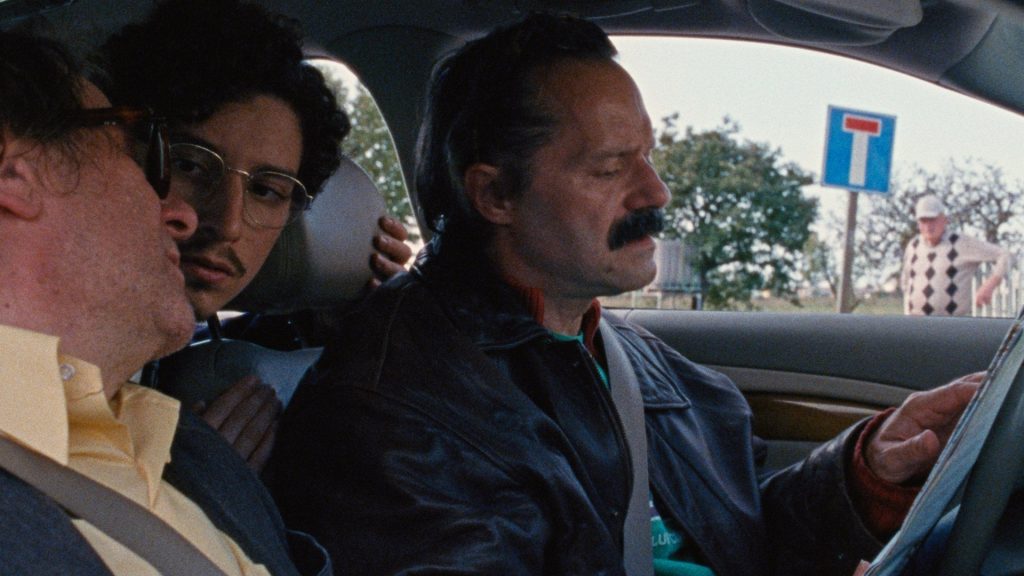
The Last One for the Road is a charming film of a road trip of two middle-aged friends and a young student they take along the way.

There is never a next time.

I find it quite intriguing that a film titled The Last One for the Road ended up being MY last film for my VIFF! Although I would rather have ended my VIFF with a film of a different genre in mind, I’m glad I ended with this one.

The film begins in the early-2000’s. A CEO of some company flies into a construction site. One of their veteran workers is retiring. He gives him a gold Rolex watch as a gift. Flash forward to the present. There are two fifty-something men at a bar in Veneto taking in what should be their last drink. The waitress tells them the bar is closing and they’re drinking non-alcoholic beer. Talk about a disappointment for a last drink! The two men, lifelong friends Doriano and Carlobianchi, decide to go on a trip to Venice and to a bar that serves a real beer!

They make a trip to the nearest town that will serve alcohol. They go over to a night club. It’s a country-western club. They have no problem taking in a real beer. They also notice something. There is a young male who looks unhappy. His name is Giulio, an architecture student. He has an exam on his mind and he is unhappy with how things are going for him right now. Especially after a woman he took interest in turned him down. Doriano and Carlobianchi talk to him and even offer to take him along for the ride for their ‘last drink.’ Giulio reluctantly accepts and is uncomfortable being part of this trip. Especially since he wants to return home to Mestre.

Now Doriano and Carlobianchi are a colorful bunch. Carlobianchi told Giulio the night before he holds the secret to the world. He also talks of always having one last drink because ‘it’s still yesterday for us.’ The two of them have drink after drink wherever they go. The two of them also talk about how the were construction workers who used to work on a highway in the to connect Lisbon through Treviso ending in Budapest. The two also talk about how they’re waiting for a friend named Genio whom they claim has money buried somewhere to fly in. At first, Giulio is uncomfortable with the two and can’t wait to take the train home.

Over time, Doriano and Carlobianchi are able to find temporary overnight shelters for themselves and for Giulio. They know how to create tabs and do clever talk to get it. As they go through various places, they talk about the glory times they used to have as partying young adults in the 1990’s and of their success in construction work before the 2008 financial crisis. The work they’re proudest of is the highway that links Lisbon through Treviso to Budapest. Since then, they had to swindle and scam their way into getting money whichever way they can. One job including stealing boxes of sunglasses and selling them. They even visit the house where they used to live in and come across one of the big boxes of unsold glasses. Giulio soon reluctantly warms up to the two men and starts liking them more.

Soon it becomes obvious to Giulio that this trip to anywhere will soon become a trip to somewhere. Within their talk of their ‘glory days,’ they also talk of Genio: a friend who helped them along with their scams. They mention that Genio was the lucky one as he managed to flee to Argentina before he could get caught. Genio is expected to fly in that day: the first-ever time since his ‘escape.’ Maybe Genio can give them some money. During the wait, they again make it to site after site where they either enjoy it or try to swindle something out of someone. Even a place the two used to stay at and there are still photos of them during their young days of the early 1990’s. Of course there are trips to bars for one last drink after last drink. At one bar, Doriano finds the retiree that received the watch that day. He’s at the slot machines hoping to get rich. Then they do meet up with Genio right at the airport. They pick him up and talk to him.

It’s not clear if they were able to get money out of Genio or not but it is made obvious that they now have the money. They are now able to pay some things off. Finally Giulio has his ticket for Verona. The two men help him along and see him off to his departure. Giulio tries to get a message the two men are trying to tell him but the train windows block all sound. As Giulio relaxes on the train, the two follow his train by car and give him well-wishes. Back to the regular daily life for Doriano and Carlobianchi, but just after having a cone of lemon gelato.

There have been numerous road trips films before. This is a unique story of two close broke friends who do a road trip just for the sake of taking in a drink and having a good time. When they meet a young adult who is bogged down with his cares, then it becomes a case of the trip being an actual destination and things to do. Over time, they reminisce over past memories: both good and bad. They expose secrets only they themselves know. While the young man doesn’t welcome this traveling around at first, he learns to relax and enjoy it. When he finally does board the train for Verona, it’s possible the two men left something behind with him. We hear near the beginning that Carlobianchi believes he holds the secret to the world. We never hear him tell the secret but I guess it may be in this story, Giulio’s time with these two men help him witness this secret for himself. That could be it that Giulio just sees or experiences the secret instead of hears it.

I don’t know if it’s been done before but it makes for a good story that feels more like an experience than a story. What also makes this story is that Doriano and Carlobianchi are not your typical pathetic slobbering drunks They’re drunks that are charming and they know how to get the best of life, no matter how dour it is for them. The likeability of the two is what makes this story not only watchable, but enjoyable as well. They also hint to things that are not made clear. Like is it possible the two are also secret boyfriends? Hey, a bit of mystery is an added perk to the story.

One thing you’ll notice as you watch is that the set places and towns they visit add to the atmosphere of the story. This being a road trip story, the film does a great job in telling its story around the locations and scenery of the region. The area of Northern Italy is on display from its old buildings to the Venetian coast to the landscape. The addition of the geography is another addition to the atmosphere of the film. Places that are part of the moments of the past that are significant to the two protagonists’ lives add to the story. Even some of the more run-down buildings look add to the story being played out.

If there’s one flaw about this film, it’s that you’re often left wondering what the point of the story is. You have two men who go from town after town for last drink after last drink, bring a young student along for the ride, pick up a colleague at an airport and go from place to place reminiscing of old times. The story can get confusing but it does reach an understandable ending as the two men see Guilio off at the train station and even follow his train. The middle may be disjointed but the beginning and end made the point of the film better to understand.

This is a great film for writer/director Francesco Sossai. Four years ago at VIFF 2021, he won the Vanguard Jury prize for his film Other Cannibals (Altri Cannibali). That film helped pave the way for Sossai to become assistant director for Mission Impossible: Dead Reckoning. This film is different than his other major films. The trip of two men wanting last drink after last drink and bring a young stranger along the way makes for a warm charming story. This film also gives a certain feel that will remind you of many of the more beloved Italian films of the past. I noticed that as I was watching and I sensed that’s what Sossai was aiming for. This film has been nominated for Un Certain Regard at Cannes and for the CineCoPro award at the Munich Film Festival.

The two leads, Sergio Romano and Pierpaolo Capovilla, have a great chemistry as two lifelong friends whom you will sense are lovers. The two of them and their ability to see the ability to celebrate the joys of life and laugh off the negative as they have drink after drink made the movie a joy to watch. They will succeed in making you like them. Filippo Scotti is also great as young Giulio. His performance was very believable as the young shy student who’s cynical of the zest for life of the two, but warms up later on. He made a great addition to the story. The cinematography of Massimiliano Kuveiller is another standout achievement. Showing off the places of the visit with great angles adds to the atmosphere of the film.

The Last One for the Road is more than just a road trip film. It’s about two men going through the good times and the bad times and the young stranger half their age they befriend. Although it may get confusing at times, it makes for a charming relaxing story.

And there you have it! That’s the last of the films of the Vancouver International Film Festival I have to review. My wrap-up blog is coming soon.
Oscars 2024 Best Pictures Reviews: Part Two

It does seem awkward for me to do five blogs of Best Picture contenders. It’s all about my writing. Last year my writing was so over the top, I had to post individual reviews instead of all ten within three blogs. This time as I was writing, I felt doing blogs consisting of two reviews each is a nice steady dose of my writing. Hope you like them. Now on with my next two reviews:

A Complete Unknown

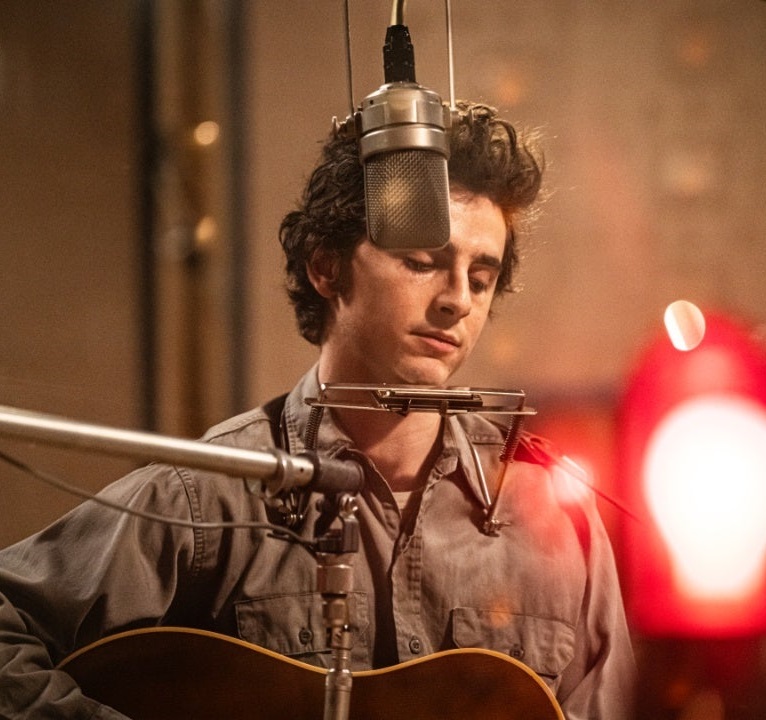
I’ve seen musicographies before. I’ve seen how they told the story of the musician or even show one part of the musician’s life. This film is a case of telling a part of Bob Dylan’s life. It tells of how he goes from an unknown folk singer in Greenwich Village to being part of the main folk scene of the time to branching out on his own. One thing we often forget about is that in the early-1960’s folk music was seen by many young people as the antidote to Rock ‘N Roll. Rock ‘N Roll music was seen by them as filled with scandals, fabricated acts, and music done for money’s sake. Folk was regarded by them as the opposite. It was regarded as self-composed music, honest feeling and even having a word to say to the powers that be. Bob, having a liking to Rock ‘N Roll, did not sit well with fans of folk music. To add, the Folk scene was becoming as much like showbiz as Rock ‘N Roll itself. You could easily see why folk fans would be outraged by his Rock ‘N Roll schtick. Looking back, it leaves me wondering after that moment did Rock ‘N Roll change Folk or did Folk change Rock ‘N Roll? Neither genres have been the same since.

The unique thing about this film is that it’s as much about the person as the musician. Most of us have known Dylan through his music. He always spoke his mind in his music. The film shows things most of us have overlooked. There’s the time Bob is torn between the love of Joan Baez and Suzy Rosso and finds it hard to hold a relationship with either. There’s Bob desire to expand and grow as a musician while the folk scene wanted to her him perform his more legendary hits. There’s how Bob found guidance from Johnny Cash and regarded Woody Guthrie as a musical father figure. There’s how the folk scene became just as much of a clique as even the most commercial music scene. We see that in how the folk scene was all about those connected to Pete Seeger and the shows he helped organize. You can understand why Bob would rebel and do his electric show. Bob always wanted to do his own thing. At the end of it all, he was still Bob.

This is quite possibly the best work from James Mangold. For so long he’s created films in which have received Oscar nominations and wins, but left him empty handed. Films like Girl, Interrupted, Walk The Line, 3:10 To Yuma, Logan and Ford vs. Ferrari. He did get a scriptwriting nomination for Logan but it’s this film he finally gets nominated for Direction. Having directed Walk The Line, Mangold knows how to direct a musicography. With the story he co-adapts with Jay Cocks, Mangold shows Dylan as a musician, artist, flawed lover and rebel. He also captures the essence of what folk music was to do about, the folk music scene of the 60’s and the times very well. It’s easy to see why he has received this acclaim.

The film also excels through the excellence of the performance of Timothee Chalamet. I’ll admit I first thought Chalamet playing Bob Dylan was a bad idea. I could not see him doing it. He accomplished it very well by making it a three-dimensional performance when it could have been wooden or cartoonish. I’m impressed with his work. Also really great is Edward Norton as Pete Seeger. I know Edward knows how to get into character. Here he makes a very convincing performance as Seeger. Newcomer Monica Barbaro is also excellent as Joan Baez. The film is, in a way, also showing us the Joan Baez we never knew. Very different from her on-stage persona we’re so familiar with. Elle Fanning was also great as Sylvie Russo who faces a hard time trying to love Bob as his fame was starting to take off. Boyd Holbrook was also very convincing as Johnny Cash and Scoot McNairy was also great as woody Guthrie. Even though both performances had a short amount of screen time, they were still both good and convincing.

A Complete Unknown is not your typical musicography. It presents a Bob Dylan we never knew, a Joan Baez we never knew and a folk scene different from what we thought it was. It’s as revealing as it is great.

Conclave

There has been a lot of unhappy talk from a lot of Catholic people about the film. One thing we need to talk in mind is that this story is a fictional story based on the adaptation of a book. Watching it, the cardinals did not act very priest-like. It made the whole conclave look like a joyless sect. Throughout the film, there’s hardly any focus on the spirituality of the cardinals. As the election of a new Pope is happening, it appears they are all rivals against each other with animosity. It almost makes the election of the Pope look like a political election where candidates look to expose the dirt of their rivals in order to win votes. Maybe that’s the point of the film. To make a papal election look similar to that of a political election. Although they do a good job of making that connection, I’m still unhappy about how the bishops and cardinals were portrayed.

Although I was unhappy of how the conclave is depicted, I am not angry as I am well aware this is a fictional story. Besides none of us knows what goes on behind the scenes of electing a new Pope. One thing the film does do well is that it shows the complications of being inside the Catholic Church. Although the film doesn’t know much about the faith of the bishops and cardinals and makes them look similar to dirty politicians, each of the bishops and cardinals represent ways of thinking most common among Catholic leaders. I myself have complained that the Catholic Church feels more like an institution than a church, but we forget how big the Church is. The Catholic Church is almost 2,000 years old and has 1.3 billion members and has churches on all the world’s continents. In some nations, Roman Catholicism is the religion of the majority. With a church that big, there is bound to be differing opinions on various issues. Some have Bible-based answers for various issues, some base their opinions on Church-based teachings, and some just give their own rational thought. You can understand why a church this big will have a lot of conflicting opinions among its members and leaders. The various debates among the College of Cardinals are reflective of that. Then there’s the powers that be. As you can see in the film, the electing of a new Pope is not an easy thing. There’s knowing that the Pope they elect with become the epitome of the image and the morality of the Catholic Church. You can understand why choosing the right bishop or cardinal to be Pope will be a difficult.

This film is good at making the election of a new Pope look like an intense drama. It succeeds in doing it by inventing a clever ‘behind the scenes’ story and making it into an intense drama that will keep you focused. It may overdo it in terms of the various conflicts between the bishops and cardinals but the conflicts reflect the common mixed beliefs held by Catholics. Sometimes the squabbles over certain bishops in the running are reflective of squabbles of the various beliefs of many Catholics. A Church of 1.3 billion is too big to have everyone believing the same thing on each issue. Also the film reflects on difficulties, scandals and controversies that the Church has left unfixed over the years. Even how secrets unraveled behind the Church walls are representing how the Church has a lot of hidden secrets. The film also succeeds how getting the problem of the Papal election solved is best assisted by two people least expected. It’s first done by Sister Agnes who, by being a nun, is to exist in the background but she can’t hide her silence anymore on all that has happened. The second is Cardinal Benitez who seems like the candidate least likely to win, but after he made his powerful speech, he appeared to be the best choice to be Pope, only for his secret to be revealed after his election. The film gives an ending that leaves us with questions of what will happen next. That’s what a film should do.

This film is an excellent work from Edward Berger. With the script Peter Straughan adapted from the novel, Berger directs a film that takes a world event and turns it into a behind-the-scenes drama that will keep you intrigued in the drama more than you thought you would be. Although it’s off in its depiction of priests and bishops, it’s still a great work.

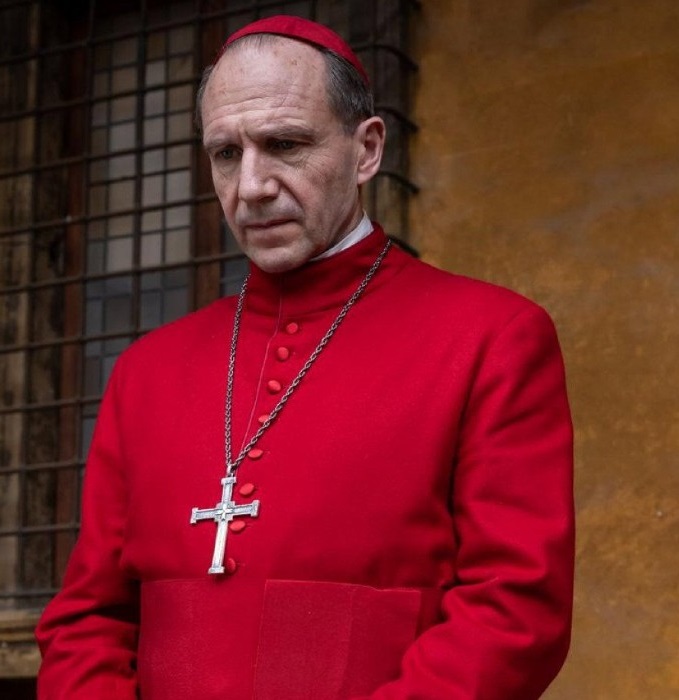
Also great is Ralph Fiennes as Cardinal Lawrence. He performs the role of a priest whose spirituality is clashing with his role of leading the College Of Cardinals. He makes the stress look obvious. The performances of the various bishops from John Lithgow, Stanley Tucci and others were very good, despite more focus on the Cardinals’ arrogances. Isabella Rossellini is the surprise of the film. Playing Sister Agnes who can’t hide her silence anymore, she really provides needed impact to the story and her silent moments are as good at storytelling as her talking parts. Carlos Diehz is also great as the Cardinal who’s the best most mortal choice for Pope, but has a hidden secret. The film also has a lot of great technical merits like set designers Suze Davies and Cynthia Sleiter for creating a set that looks very much like the Vatican, costuming Lisy Christl in making the clergy costuming look perfect and composer Volker Bertelmann delivering a score that adds to the intensity of the drama.

Conclave may be off in their depiction of cardinals and the Church itself but it succeed in bringing up hot topics surrounding the Church as it succeeds in making an intense drama of a Papal election.

And there you go. Those two films are my second look at the Best Picture contenders of this years. More reviews of Best Picture nominees to come.

VIFF 2024 Review: Balomania

Balomania is about balloon artistry in Brazil. An art that’s illegal in its country of origin.

Is setting a big artistic stylish balloon in the air a crime? Balomania is a documentary that focuses on the popularity of balloon art in Brazil that is illegal.

The film begins with Danish-Spanish filmmaker Sissel Morell Dargis detailing her move to Brazil at 19. She soon became a graffiti artist and became known popularly as ‘Simba.’ During her first years, she noticed what she thought were stars floating from the favelas of Sao Paulo. Her Brazilian friends told her they’re balloons and they were launched in the air by a secret society called the ‘baloeiros.’

That discovery started a fascination in her of that ‘balloon world’ that still continues to this day. The balloons are the hot air balloons launched without passengers. They come in all sorts of artistic designs. Some include a wide banner hanging from underneath it. Some include hundreds of small burning candles in colored cups whose arranged image adds to the balloon’s allure. Some even include fireworks. These balloons are very expensive to make but those involve with it believe it runs in the blood and is passed from generation to generation. This group of balloon launchers she meets with launches balloons once a week.

This balloon culture is also illegal in Brazil. In the past, it was common for Brazilians to release such artistic balloons in the sky. Then in 1999, the government felt it was happening more often than it should and they criminalized it. The government claims the reasons for these bans on balloons are because of public safety, air flight safety and for environmental issues. Dargis feels there’s something more underlying to it. Possibly classism of peoples.

She meets with the many men involved in this balloon culture and are part of these ‘balloon mafias.’ She meets the artists, the crafters, the launchers, and the catchers who catch the balloon in time so that no one is arrested and will eventually have to relaunch that balloon one day. She meets with those like Zulu, Tron, legend Sergio and young father Jaba. They talk of the balloon works they’ve done in the past. They talk of how expensive it is and how they don’t get paid anything for it. Just the thrill of dazzling people who view them. Jaba talks of how he wants to break the record of the biggest balloon ever launched.

Over the ten years, Sissel films this sub-culture, she showcases the balloons crafted and launched, the catchers who catch and relaunch, and the personal lives of many of those involved. She especially focuses on Jaba as he is a father to a six-year-old son and Jaba’s seen as the future of this balloon group. Sissel also films news stories of how the governments feel they’re not doing enough to stop this and feel the best solution is to toughen the jail sentences to 5-8 years. Sissel also gets opinions from people in Jaba’s favela who speak their mind about it. The favela has divided opinions. Some feel criminalizing this is just an excuse to distract form the real problems of the nation like defeating poverty, drug crime and corruption. Some people do favor the criminalization and see it as a safety threat. We even see one case where a balloon launched in the night burns up in a similar way the Hindenberg burned up. Jaba’s son tries to convince his grandmother that it’s art.

The COVID pandemic hits Brazil. Sissel is reminded her filmmaking of this balloon underworld was a distraction to her main purpose for life in Brazil, which was making video games. Sissel did however create a video game about balloon launchers called Cai Cai Balao. During those years that passed, Sissel wonders if Jaba achieved his goal. Balloon godfather Sergio has died. Jaba left creating and launching balloons for the sake of becoming a responsible father to his son. The project of the balloon of Jaba’s dreams, the biggest balloon ever with half a ton of fireworks, did not die and is carried on by his group. Although he’s not an active member anymore, he is still part of the group. The influence never leaves. We see it being launched in the air successfully with more than a hundred men involved..

I think it’s a common thing that can happen in any nation at any time. Even in the nations with the most freedom. A style of art that the nation’s government feels uneasy about or so much contempt for, they criminalize it. We’ve seen it before in the past with genres of music or literature. Paintings and statues have also come under government scrutiny for centuries. Here in the big cities of Brazil, we have balloon launching. The setting off of these eye-catching balloons. It was done commonly in the 80’s and 90’s but the government criminalized it because it was done too much and fear of safety both in the air and on the ground. If I was a Brazilian politician, I wouldn’t criminalize it, but I would have people who know how to do it properly licensed to do it.

Here in this documentary, it presents the art and those involved through a variety of angles. Since this is about the balloon art, there has to be a lot of scenes of the crafts they launch in the air. It’s part of Brazil’s culture. It’s eye-catching. There’s a set of people who are involved in this and it’s like a whole culture of these baloeiros. It’s an art that costs in the tens of thousands to make and they get paid nothing for it. It’s also the passion for it where you’re still a part of it even after you’re no longer active with it. It’s something these men do sometimes at the expense of family relations. It’s also a source of controversy among the public. Is launching an artistic balloon in the air a crime? Is it worth having these alleged criminals in prison for years? The film also uses news stories, talk from politicians and even debate from citizens about this. One scene I liked is the debate between Jaba’s son and his grandmother who thinks it should be criminalized. She asks him why he thinks it’s art and his response: “Because it’s very beautiful and if it’s beautiful, it’s art.” Smart way of thinking!

This documentary is an accomplishment for Sissel Morell Dargis. It’s natural for a creative person who takes an interest in some topic or some subject to want to do a film about it. This film is ten years of film footage from Dargis of those involved with the craft, those who watch and those who fear it. It succeeds in getting the audience interested in those involved with the craft as it succeeds in dazzling their eyes with the images of the balloons created and launched. It also succeeds in convincing one that the criminalization of this craft is foolish while also presenting the side of those who support the criminalization. Although it appears to side more with those that consider it art, it still tries to let you decide for yourself. It’s no surprise that due to the nature of touching on a craft that’s criminalized, Dargis has to do most of the filming on simple hand-held cameras. The documentary is as intriguing to watch as it is about the filmmaker making her point.

Balomania is an intriguing documentary that shows the art, the artists, the tricks of the trade and the opposition they face. It’s also about the director making the film and making friends along the way. It’s an art documentary that becomes a lot more.

World Cup 2014: My Prediction For The Final

Netherlands v Spain: 2010 FIFA World Cup FinalWhat can I say about the World Cup? All I can say is that it starts with 32 teams, takes a month and at the end, only one country’s left smiling. And so after 62 games and loads of surprises, they’ve weeded out the thirty pretenders and gave us the two contenders: Germany who has won the Cup three times before and Argentina who have won it twice before. The Maracana will be the stage for deciding the World Cup winners. Here I’ll do a rundown of the two teams and even make my prediction on who I think will win the Cup.

First an interesting note I came about. Isn’t it ironic that both the final for the Cup and the 3rd-place match are both like rematches of quarterfinals of the last World Cup? Anyways I’ll get on with it.

World Cup

Past Head-To-Head Results:

Germany and Argentina have squared off against each other 20 times. Argentina has won the most often with nine times. Germany has won six and five were draws. Both Germany and Argentina have scored 28 goals against each other. Germany and Argentina have crossed paths at seven World Cups starting in 1958. Surprisingly this is the third World Cup in a row they both challenge each other. The previous two were in quarterfinals. In 2006 when Germany hosted, they tied 1-1 and it took a round of penalty kicks to decide Germany the winner. Last World Cup it was Argentina that had their own version of the Mineirazo as Germany won 4-0. Also as surprisingly, this is the third World Cup Final they both face each other: the most World Cup finals pairings ever. The first was in 1986 when Maradona and the boys won 3-2. The following World Cup they met again and it was German revenge 1-0. In both cases, that was the last World Cup either team won.

Argentina FootballARGENTINA: One word that can best describe Argentina here at the World Cup is consistent. They won all three of their Group Stage games: 2-1 against Bosnia, 1-0 against Iran, and 3-2 against Nigeria. They also won their Round of 16 match against Switzerland in extra time 1-0, their quarterfinal against Belgium 1-0 and their semifinal against the Netherlands in a penalty shootout.

There’s another word to describe Argentina’s play at this World Cup: lackluster. The phenomenal big play that Argentina has been known for was missing. Instead it looked like they were focusing on the conservative.  Sure, the conservative style worked for France last world Cup but this is not what you’d expect from Argentina. Sure Lionel Messi has been one of the stars of the tournament and has lived up to his reputation during the World Cup but other Argentinians like Gonzalo Higuain and Angel di Maria have been playing rather modestly than what they’re reputed for. That scoreless draw should be cause for concern since it was mostly a contest of ball control and very little attacking. In fact I remember a scene near the end of regulation where it appeared Dutch players were lollygagging with the ball.

Whatever the situation, conservative play will not come in handy, especially against a team that annihilated the host country on Tuesday. That game has to be the biggest signal to Argentina that if they were to win the Cup, they will be pressed to pour it on like never before at this Cup. There’s no doubt Messi and Higuain have what it takes here. They have to be prepared for a similar attack like Germany gave Brazil on Tuesday. It’s evident that Germany can take full advantage of an opponent’s vulnerability and come down hard on them. They should know because Germany beat them in the quarterfinals at the last World Cup 4-0, just after winning every other previous game they played.

As for the team, I’m not worried about Messi. I think of him as Maradona without the ego. Especially since it’s evident he knows what he needs to do to deliver here and he’s done that. Sergio Romero has been an excellent goaltender as he has delivered each time and has only conceded three goals. The rest of the team will have to be prepared for anything from Germany whether it be conservative play or an all. And with Angel di Maria out, they will have to step up their midfield. Coach Sabella knows the job he has to deliver and I’m sure he’ll mean business, especially to bring Argentina back on top after 28 years.

Germany FootballGERMANY: What can I say? They are not called the Mannschaft for nothing. What we have is a team that is lacking in superstars and celebrity. Heck, Miroslav Klose has scored the most goals in World Cup history and he doesn’t have the star power as say Neymar, Messi or Cristiano Ronaldo. Instead we have a team full of players that are focused, know what they have to do and deliver. And they definitely know how to pour it on as evident in the Mineirazo and their opener of 4-0 against Portugal. You can bet Germany is a team that knows how to deliver.

Or do they? Sure, they had big wins against Portugal and Brazil but they have had their share of tight matches at the World Cup, like when they temporarily trailed Ghana before they tied 2-2. Or even going scoreless against Algeria in regulation before winning 2-1. It’s evident in those matches that Germany has weaknesses of their own and could be made vulnerable by Argentina. Argentina is a team very familiar with them and knows how to rival them. It’s also very possible Argentina will want to avenge Germany for the last two World Cup quarterfinals. Sure, Argentina has not been too spectacular but they could just pour it on when they have to. It’s happened before in major play.

One thing about Tuesday’s game, it’s that coach Joachim Löw doesn’t want that big win to make his team overconfident. Even Miro Klose stated that he doesn’t want the win to get to the team’s head. What they’ll have on Sunday is a new team and will need a new plan to win. It’s evident with each passing match, it’s all about knowing the rival, controlling them and monopolizing on your chances. And that’s what Germany will have to do on Sunday to win the Cup for the fourth time and for the first time ever as a unified nation.

MY PREDICTION: Okay. So here goes. My prediction for the winner of the 2014 World Cup. I believe it will be Germany 2-1 in extra time. Wow! I’ve been making a lot of predictions where the score is 2-1, haven’t I? But that’s what I believe it will be. Germany have that edge in terms of delivering goals and will continue to be the case if Argentina don’t step up their game. Argentina know how to defend and control opponents but they lack the ability to monopolize on their chances. So that’s why I give Germany the edge.

So there you go. It was fun making predictions for the World Cup. I hope to do football/soccer predicting again sometime soon. Maybe my next chance will be for next year’s Copa America. Provided if TSN or ESPN broadcast it.