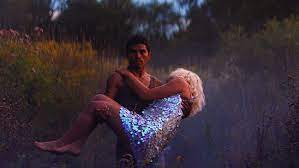
Drunken Birds is Canada’s official entry in the 2021 Academy Awards category of Best International Feature Film. It’s a film that meshes French with Spanish and Chinese to create a film that stands out.
The story begins with a Mexican family inside an apartment in Montreal. We learn of a man who’s searching for a woman named Marlena. Flash back many years ago. Workers for an arrested drug lord in Mexico chase down a car with a burning top. They then chase a worker for the cartel by the name of Willy down. They know what he’s been doing behind the drug lord’s back the whole time and they warn him at gunpoint.
Flask forward to the present to the Becotte farm near Montreal. The boss, Richard Becotte, is the latest to run a vegetable farm of his family going back many generations. He’s fair to the Mexican migrant workers who agree to work, but strict. Show up at 5:30am or no pay for the day. There are many who are returning, but there are some new men, including Willy. Willy does his work along with the other men, but he doesn’t really care about the pay. All that matters is he finds Marlena. In fact while the men communicate on Skype or Zoom with their wives, children and other family, Willy uses his time to search for Marlena, who has gone by a pseudonym. He has a feeling Marena lives in Montreal.
Flash back to many years ago. A Chinese art studio is given orders to either make replicas of legendary paintings of painting versions of photos. One of the photos is the picture of the Mexican mob boss. Flash to months later but still in the past, police visit the house of the drug lord some time after it was raided and the boss arrested. They talk of admiration of how they brought this tyrant with many riches down. They also notice a letter from his young wife Marlena that appears to be a suicide note. Instead it was a letter Marlena concocted with the help of Willy to plan her escape. Turns out before the raid, Willy was the ‘other man’ of Marlena. Marlena’s true love. A love that had to be kept complete secret. Four years ago, the two decided to escape together, but go their separate ways after that. Willy has been searching for Marlena for four years. He’s tried places in Mexico, knowing her pseudonym. Now hes here in Montreal hoping he’ll be able to find her here once and for all.
However the Becotte family have friction of their own. Last year in their cornfield, Julie had an affair with one of the workers. Daughter Lea knows about this and she confronts her mother about this, even mentioning Richard knows about it. This is hard to deal with as now Julie is starting to take a liking to Willy as she drives him off to a place. Meanwhile Lea is becoming an adult and she rebels against her parents. She’s trying to fit in with her friends and even try her way into the Montreal night club scene. She’s willing to try anything, including drugs and prostitution. Actually racers for the Montreal Grand Prix are in town from around the world. Lea is hoping to hook up with one of the racers and make some money. Her pimp gives her a pager and puts a drug in her mouth. She does win a driver and gets taken into his hotel room, but she leaves him, and the pimp’s phone, behind. She’s on the streets and dreams of being met up with the racer in his car, but awakens to find herself beaten up by the pimp.
Willy notices a beaten Lea in tears. He takes her in his arms and tends to her. However Richard comes in and mistakes Willy as the man who beat Lea up. Willy is in pursuit and tries to run off. However in a rainy night as he is chased in by a truck back to the Becotte farm, Richard has his men and he’s ready to square off with Willy. Richard shouts spiteful things to Willy and the Mexicans, blaming them for what happens to Lea. As the men try to beat Willy up, the Mexicans defend Willy and start charging at Richard’s men. Willy is able to find his way out and hide in a cornfield. Richard tries to search, expecting Willy to come out, but to no avail. Richard soon learns he has to make peace with his family. In the end, willy didn’t stop running. He made it to Montreal for his main goal: to find Marlena. The film ends in an expected but unexpected way.
This is a unique story. It’s a story of two worlds. The world of the past in Mexico and the world of the present as part of a farm. It’s a story of a man in search of the woman he loves and the story of a family that appears falling apart. It’s a story that deals with the issue of migrant workers and how they’re treated by their bosses in Canada. At the same time, it’s a story that blends in a colorful romance. It’s like two films in one in many ways. It’s not easy to mix the two, but it’s done successfully here.
In a lot of ways, this film shows a lot of similarities between both scenarios. Here we have Willy who’s the object of the kingpin wife’s desire. It’s a desire they have to keep well-hidden or else Willy will be killed. Both have to move on after the kingpin is arrested and his mansion raided. In Canada, we have the farm-leader’s wife who falls for the migrant workers. Willy becomes one of the men she falls for. It’s a case for Willy that both world’s collide with him. He has to cope with the aftermath of the raid and the immense possibility of never seeing Marlena again. He also comes across the possible danger of Richard crossing his path if he knows that he’s one of the workers Julie falls for.
Even though Willy is the centrepiece of the story, it’s not just about Willy. It’s about the Becotte family. Julie has her affairs with some of the migrant workers. Lea is upset with what she sees and claims Richard knows. Meanwhile Lea appears she wants to establish herself as an adult and she feels that means choosing her own direction, even if it is dangerous. When you see Richard and his men attempt to square off against Willy, blaming him for what happened to Lea, you can easily get the feeling Richard knows of Julie’s affairs and feels he has to take it out on at least one Mexican worker. Before he takes it out, you could notice by the look on his face he most likely blames himself for his family’s failures.
This is an impressive work from Serbian-born Canadian director Ivan Grbovic. His films like La Chute and Romeo Onze have won acclaim at past film festivals. This film hasn’t won as much acclaim outside of it’s Oscar entry. It did however earn a Platform Prize at the TIFF (Toronto International Film Festival). This is an impressive film that blends in modern storytelling with imagery of classic films and common Mexican dramas. What we have here is an excellent film that’s as much a joy to watch as it being a story that will keep you intrigued.
Jorge Antonio Guerrero is excellent as Willy. His performance as a man caught between his passion and always having to be on the run keeps you on the edge of your seat and hoping he succeeds in finding Marlena. Claude Legault is also very good as Richard. He does a good job of playing a man that’s supposed to be tough on the outside, but is hurting on the inside. Helene Florent is also good as the flirtatious Julie who later has to confront her wrongs. Also excellent is Marine Johnson as Lea. She does a great job of playing a teenager angry with her home life and wanting to break free, only to find herself more entrapped by her choices.
Drunken Birds is more than just a film with a story. It mixes modern drama with a social message and traditional Mexican drama to give the viewer a story that’s a delight to experience.






 ITALY: It’s hard to believe a team with one of the biggest football legacies of four World Cups has only won a single Euro. It was all the way back in 1968, and after both semifinals consisted of major controversies. In fact Italy’s case was they played a scoreless draw against the Soviet and there wasn’t a penalty kick system like we have now. So a coin-toss was used to decide Italy’s win! Since 1968, they have made it to the final twice: in 2000 and 2012. The Forza Azzurri have always been one of the most dazzling teams in the world, but they can also end up being one of the most unpredictable teams too. There have been many times in tournaments when even if they didn’t win, they would go further than expected. However there are times when Italy has delivered below pre-event expectations. That has especially been the case after they won the World Cup in 2006. However it was right after their failure to qualify for the 2018 World Cup that it was aware there had to be changes not only in the team, but the Italian football system.
 ENGLAND: Hard to believe this is the first-ever Euro final England has made it to! It’s just as surprising as their one World Cup, which was won in 1966 in old Wembley Stadium. Euro 2020 would be poetic if they won their first Euro in the new Wembley Stadium. Yes, it does seem like England’s win of the 1966 World Cup has made them a one-hit-wonder in football. England has almost always fielded the national team with the most talent and the most skill combined. However its inability to go far on the international stage has almost always seems to be the team not being able to come together and play as a team unit. That often seems to be the case. Ever since their World Cup win, the best England has done at the World Cup was two fourth places. Also the best they ever did at Euro was a third place.
 Jon The Blogcentric