
VIFF 2024 Review: The Thinking Game

The Thinking Game is a documentary that makes understanding A.I. pioneer Demis Hassabis to be as much about trying to understand how A. I. came to be and how it evolved to what we have now.

The topic of A.I. is something to provoke a lot of discussion. Some will regard it as a revolutionary breakthrough in technology. Others see it as a threat that devalues human abilities. The documentary The Thinking Game gives an insight into A.I. as navigated by one of its biggest pioneers.

The film begins with a look at Demis Hassabis: the British CEO of the technology company AlphaGo. It shows of his current working with A.I. and also his intrigue of developing AGI: Artificial General Intelligence. As we learn more about attempts to develop AGI, which is like A.I. but appears closer in developing the feelings similar to that of humans, we are introduced to Hassabis and his intrigue with the human mind. Hassabis was born to a Greek-Cypriot father and a Singaporean-Chinese mother in 1976. He grew up in East London and his above-average intelligence was noticed as he developed a love for chess. Soon he became the second-ranked chess player in the world for his age range and a chess master at 13.

Everything changed one day during a chess tournament he played in. It was a game when he was thirteen that he lost and he was out of the tournament. He was sad about it, but did not leave the playing area. While sitting, it got him thinking of all these people around him still playing and all the brain power going on. It got him thinking of a human’s brain power. Are there any limits to what human thinking can solve? Soon Hassabis bought a computer with his chess winnings and learned programming from books. One day, he won a contest to win a job at a video game company: Bullfrog Productions. Soon he helped with Bullfrog’s work and invented a game of his own: Theme park.

Theme Park became a hit and helped him make enough money to attend Queen’s College at Cambridge. College was difficult because he wanted to study artificial intelligence and he was chastised by the professors about it. He did graduate from Queens College with a Computer Science Tripos. He also went to the University College London where he achieved a PhD in Neuroscience. In between and after his stints at college, he continued his work in video games and programming going from Lionhead Studios to founding his own game studios Elixir. His fascination with the human mind never left him. He felt that through computers, he can create something with artificial intelligence that can even tap into human emotions. Something commonly referred to as Artificial General Intelligence, or AGI.

In 2010, Hassabis and his colleagues Shane Legg and Mustafa Suleyman created the artificial intelligence laboratory DeepMind. The activity on artificial intelligence at DeepMind started when Hassabis worked ways to get a computer to play old video games from the 1970’s and 1980’s. The AI system was taught nothing of the game and would have to learn by constant play. Over time, the A.I.’s learning system worked and they would master the games. Interest in DeepMind grew and it attracted investors like Elon Musk and would be owned by Google from 2013 to 2014. Then in late-2015, they created AlphaGo: a computerized version of the game Go with A.I. as the opponent. They would soon challenge the world’s highest-ranked Go players to matches and win.

For DeepMind, it was enough to declare victory. For someone like Demis Hassabis, it wasn’t enough. Hassabis has a lot of ambitions on his mind. One of which was protein folding. Solving the problem can help with solving Alzheimer’s, dementia and developing new drugs. Hassabis and his colleagues would create the program AlphaFold to perform the predictions of protein structures. For years, it was all trial and error. As one of the colleagues put it, they were the best in the world at it but they were awful. Then during the pandemic while everyone had to isolate and work at home, the code was cracked. It doesn’t end there for Hassabis as it appears he wants to crack every uncracked code that’s out there.

A.I. and A.G.I. are two things that are admired for what they do and despised for what they do. Through computer technology, they’re able to solve a lot of problems human’s either can’t solve or can’t solve fast enough. Because of that, many people see this as a threat to humanity, especially in terms of employment and the constant automating of jobs. Even Hassabis himself has been both praised for his discoveries and achievements and vilified by some in aiding something that many feel devalues human abilities. There are many people from his co-workers to journalists to his former professors that ask the big question when will it stop? Yet Hassabis comes across as the type who doesn’t want to stop until everything’s all solved.

This film actually spends more time focusing on Hassabis and his accomplishments than on the subjects of A.I. and A.G.I. The film showcases Hassabis as someone who many feel deserves the praise equal to that of other computer technology pioneers like Bill Gates and Mark Zuckerberg. Sometimes the film shows Hassabis as having acclaim ‘unsung’ compared to the two. The film also shows Hassabis as one of those child geniuses who was able to find a way to make better use of his brain than winning chess tournaments. It does show Hassabis to display a lot of genius traits both in action and personality but it doesn’t show him to be as much of an eccentric like many other famous geniuses.

The film is able to mesh Hassabis’ life story of how he went from a chess prodigy to being on the forefront of A.I. development with the current developments of A.G.I. his current lab. It chronicles his achievements while it also shows how workers in his lab are working to perfect his A.G.I. technologies to match human feelings and emotions. It doesn’t spend a lot of time on the news stories involving his lab and of A.I. research. It also spends a small amount of time on people who feel threatened by the latest wave of A.I. technologies. Especially the actors who went on strike last year. The film does leave out the times Hassabis has focused on the topic of existential risk from A.I. which Hassabis has spoken out and warned against. Hassabis has even stated the risk from extinction from A.I. is as much worthy of concern as nuclear war or another pandemic, but there’s no mention of it in the film here.

It’s interesting that this documentary comes out in the very year Hassabis and his AlphaFold partner John Jumper were awarded the Nobel Prize in Chemistry for the very protein structure prediction they were experimenting on in this documentary. The documentary does make it interesting how meshing games with work appears to be Demis’ life. He calls chess a good thinking game as a child, does game development as a teenager and young adult, uses A.I. to challenge people at chess, then using A. I. to challenge the world’s best Go players, to using A.I. to work protein structures. It seems like everything Demis has worked on in his lifetime appears to be another ‘thinking game.’ Leaving the film, maybe the film shows that science itself in all of its trials, errors and experimentations has always been a ‘thinking game.’

Director Greg Kohs delivers a documentary some could find intriguing or some could find to be missing information. It does a good job in getting us to see Demis’ achievements in a topic that has many people intrigued in. It can also lead people to scratch their head about what this film is about. Is it about Demis? Is it about A.I. or A.G.I.? Is it about his inventions and contributions? Is it about a person we’re to blame for what threatens us now? Is it even the world through Demis’ eyes? Or even is it about science as a whole with all the many failures before the successes?

The Thinking Game is an ambiguous documentary that is as much about A. I. evolving over the decades as it’s a biographical film of Demis Hassabis. It doesn’t focus too much on the controversies of A.I. Instead it focuses on Demis’ intrigue into A.I. and how it would greatly pave the way to what we have now. Whether it rightly or wrongly glorifies Hassabis, that’s up for the viewer to decide.
Oscars 2018 Best Picture Review: Bohemian Rhapsody

Rhapsody
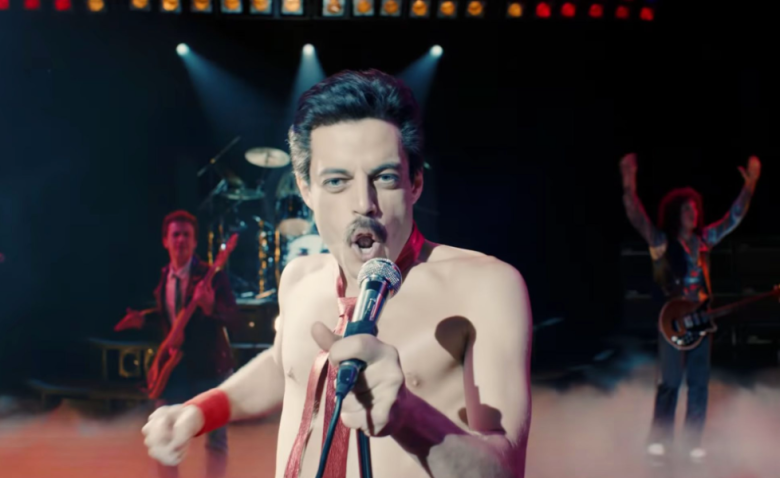
In Bohemian Rhapsody, Rami Malek captures the essence of Freddie Mercury to a tee.

The musical biopic Bohemian Rhapsody came out in movie theatres this year. We’ve seen music biographies before. The big question is does this film simply chronicle Freddy Mercury’s life? Or does it do much more?

The film begins just as Queen is about to step to the stage to perform in the 1985 Live Aid Concert. The film then flashes back to 1970 when Smile is an English band consisting of Brian May, Roger Taylor and singer Tim Staffell. Faroukh ‘Freddie’ Bulsara is a Farsi immigrant who studies and also works as a baggage handler at Heathrow airport. Freddie faces a lot of discrimination for the color of his skin and mockery because of his hyperdontia which makes him look like he has a mega-overbite. However Freddie does lose himself in rock and roll.

One night, Staffell quits Smile in disappointment. Freddie was there attending the show. When he sees what happened, he asks to join the band. The band gets a rocky start as they play at small college gigs, but it looks promising and Freddie fully believes in them all. The rock singer gig does not go well with his family who feels he should earn his living more ‘honestly.’ Freddie also wins the attraction of college student Mary Austin during a clothes shopping trip. They start dating and romancing.

Over time, Queen gets bigger and they soon have to record an EP. It will cost a lot of money and Freddie agrees to sell the van for money. The EP is a success and it attracts major music producers including one from EMI Records interested in the band. The band changes their name to Queen and Freddie even legally changes his name to Freddie Mercury. The band is acquired by John Reid, Elton John’s manager, and assistant manager Paul Prenter. They bring the band to a gig on BBC’s Top Of The Pops where the band lip syncs Killer Queen. As success grows, including success in the US, Mary and Freddie get engaged. However soon after Freddie learns of his bisexuality.

The band try to record their album A Night At The Opera and the song Bohemian Rhapsody, but the song is too long and hard to perform. On top of that, producer Ray Foster is antagonistic on the band for both the song and the music for the whole album. After Foster refuses it as a single, Freddie gets a local DJ to play Bohemian Rhapsody. The song opens to a lot of negative reviews, but also scores big on the charts worldwide. However Freddie starts an affair with Prenter and has to call off the engagement with Mary. Mary is devastated, but agrees to remain friends.

In the film, the band has continued success in the early 1980’s with We Will Rock You. However the band experience tension both by Freddie’s lavish partying lifestyle and the increasing controlling ways of Prenter. Freddie even cheats on Paul with a waiter, but the waiter tells Freddie to find him after he finds himself. The friction between Freddie and the band grows to the point Freddie leaves the band to record a solo album upon the direction of Prenter. However it becomes obvious how much Prenter wants a piece of the action and Freddie both breaks up with him and fires him.

Soon Freddie learns he has HIV right when the devastating AIDS epidemic was at its most troubling times. He returns to the band confessing it was wrong for them to leave. They’re offered an appearance at the 1985 Live Aid Concert which will be broadcast worldwide to raise money for food supplies during the famine in Africa. This will be the band’s comeback concert, but it will take a lot of effort to bring the band back to their level of performance.

Just before the concert, Freddie confronts his parents to make peace with them. Freddie is also supported backstage by a pregnant Mary along with her husband David. Bob Geldof is hoping for a lot of call-in donations through this concert. Then Queen get on stage and it’s like they never missed a step. The crowd is blown away, television crowds are dazzled, and the donations accelerate like nobody’s business. Queen was back and alive!

There have been musical biographies in films done many times before. In order to make a winning story about a musician, the film will definitely have to include the music. That’s what made the musician great. The film will also have to include key events of the person’s life: the artistic moments, the triumphant moments and the struggles, even any tragedies. It’s all a matter of deciding the right moments for the right beginning, middle and end of the film.

The film does a smart move in making the Live Aid Concert the pivotal moment for Freddie Mercury both as the scene where the movie starts before flashing back in time and ultimately ending. The film also does a good job in picking out moments such as when Freddie joins the band Smile, changes it to Queen, first hits it big with Killer Queen releases their iconic Bohemian Rhapsody, faces friction as well as declining fame in the early 80’s, Freddie’s HIV diagnosis, and their return to winning the public at Live Aid.

However the film also risks disappointing a lot of Queen fans because of how inaccurate the story is. Despite Jim ‘Miami’ Beach being the film’s co-producer and May and Taylor being music consultants, The five biggest inaccuracies Queen fans are most likely to notice are, firstly, Freddie was actually introduced to Brian May and Roger Taylor of Smile by singer Tim Staffell when Staffell wanted to pursue further studies. Secondly, We Will Rock You was written and recorded in the late-70’s rather than the early-80’s. Thirdly, John Deacon was actually Queen’s fourth bassist rather than the original bassist. Fourthly, Queen never split up nor did they get back together at Live Aid. Freddie may have had solo work — the most famous being Barcelona: the duet with Montserrat Caballet — but Roger Taylor also had a solo album too. Fifthly, Freddie learned he was HIV-positive in 1987: after Live Aid. Those that know the true Queen story will know that a lot of these moments in the film were mostly common music-movie cliches rather than the truth about Queen.

Despite failing a lot of Queen fans with some of the inaccuracies and cliches, the film does succeed in a lot of ways and even presents some truths even Queen fans knew. Freddie did credit his extra teeth for his singing, he adored his cats, he held outlandish parties, the song Bohemian Rhapsody was considered too long and too ridiculous at first, Freddie did keep his ordeal with HIV and AIDS private as he did not want to be an object of pity, and finally his friendship with Mary Austin lasted until his death and she did live next door to him even while married to David. The film does stick to the truth in a lot of areas, including that of how Paul Prenter was a controlling person in Freddie’s life. However another added quality is that the film does an excellent job of capturing the essence and feel of Queen’s music. Those that haven’t heard much of Queen’s music will experience songs they never heard before. Those that are fans of the band will fall in love with the songs again. Also those that want to be rock musicians themselves will be inspired to pursue their dreams after watching the film. You not only hear the music, but you can also get the feel of a rock performer too.

The film has already grossed $844.4 million worldwide at press-time with $210.6 million coming from North America. However the film has also faced a ton of heat during the awards season. The cause for all of this was for director Bryan Singer. As you know, Singer has faced criminal charges of being a sex offender. How it happened that Dexter Fletcher stepped into directing the remainder of the film upon the departure of Bryan Singer is that Singer was fired after having violent clashes with Rami Malek. Singer, and not Fletcher, was credited as the film’s director. The awards season has seen the film win many accolades which many have voiced their displeasure about. Possibly due to hostility during the #MeToo movement, many are speaking their mind as if they’re saying a win for Bohemian Rhapsody is a win for a sex offender.  I personally feel that Fletcher should have been credited as director. However despite the fact that Singer was fired, people are still unhappy. Makes you wonder what will satisfy them all? Denying the film a release and trashing it altogether? This is a reflection on how toxic and bullying the free speech of social media can be.

Anthony McCarten in cooperation with Peter Morgan may have written a story that was more cliched than truth, but it did capture a lot of the essence of Queen and a lot of the essence of Freddie Mercury. As for the ending, I can understand why they went for the heavy drama by ending with the Live Aid Concert. I’d rather they went with the moment Freddie records The Show Must Go On. Those who know the story behind that will recognize it as one of the biggest triumphs of Mercury’s career and a testament of his mental toughness.

The film also captured the essence of Brian, John and Roger well too. Co-director Dexter Fletcher did a very good job of picking up where Singer left off and creates an exciting experience for the audience. However the biggest triumph is the performance of Rami Malek. Until Bohemian Rhapsody, he was facing the common difficulty of actors of Middle Eastern descent with limited opportunities. It almost seemed like the biggest thing he would ever be known for is playing the Pharaoh in the Night At The Museum movies. This also was not an easy task because Malek was not originally a fan of Queen. However that all changed when he was given the role. Malek was excellent in his performance and will blow away anyone who sees this film.

The actors portraying Brian, Roger and John — Gwilym Lee, Ben hardy and Joseph Mazzello, respectively — also added to the film. Lucy Boynton was also excellent as the friend Mary Austin. Even minor performances like Tom Hollander as Jim Beach, Mike Myers as Ray Foster, and Allen Leech as Paul Prenter did very well with the roles they were given. Julian Day did a very good job with the costuming, Aaron Haye did an excellent job with the set design, and the producers did a very good job in choosing the right songs for the film.

Bohemian Rhapsody has some noticeable errors in the film. However the film succeeds in capturing the spirit of Freddie Mercury, capturing the music of Queen and capturing the experience of a rock star. No wonder it dazzles those that see it.