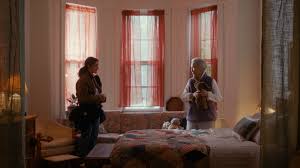
The Scout is about a film location scout names Sofia played by Mimi Davila (left) who discovers more than film locations.
With the Vancouver Film Festival, you can get a wide variety of styles of film showing throughout the Festival. One unique film is the American film The Scout. It’s unique in its own way, even if it is confusing.
Sofia is a location scout in New York City for a film company. Most of the day, she drops flyers into the mailboxes of surrounding houses or apartment suites saying she’s interested in having the inside of their places as set pieces with her phone number listed. After sending out a set of flyers, she makes a trip to an apartment of an older woman as she listens to her voicemail responses. The voicemail range from people interested to those thinking it’s stalking to some unhappy she hasn’t come to her place yet. As she photographs the suite of the older woman, she learns more about her life. She learns the mother has two grown children who have moved out and never returned to see her.
Her second trip is to another apartment. At the house is a man who works from home and often spends time looking after his infant daughter Sophia. Sofia takes a special liking as they’re names are similar. As she photographs the house, she learns more about him and has a sense from the talk that his marriage is falling apart. Her third trip is to another apartment, but that will require crew from the film company to also review. This will be busy for Sofia, the crew and the suite holders. The resident is quite welcoming. The talk from the film crew makes obvious a lot of thought is to go into selecting. Some like it, some are critical of it. Sofia is hoping it will work out.
The day continues as Sofia goes to another apartment of one who accepted. She finds out it’s her friend from her college days. Both of them are shocked. They reminisce about the good times of the past and they talk about what’s happening in the present. Not all of it is pleasant, especially in terms of their relationships. Sofia’s last appointment is to be with a pet store. She’s a half-hour late and the owner is unhappy with it as he’s locking his store. Despite his anger, she’s able to convince him for the appointment. The appointment goes so well, they even have dinner together going into the night. As great as that was, Sofia finds out it took so long, the traffic police clamped her car and she’ll have to pay a fine of more than $400!
The next morning, she attends a meeting at her company’s office. There they talk about certain locations for a scene. Judging by the discussion, it looks like one of Sofia’s discoveries won’t be considered for this scene. After the meeting, she spends the rest of the day over at an urban beach. She just goes there onto the sand holding a coffee and stands there looking out. You can tell on her face something is wrong.
The thing about this film is that it has a good beginning and a good end, but an unsolid middle. In seeing the film, it’s hard to understand what it’s all about. It does show a lot about what it’s like to be a location scout for a New York City film company, but it doesn’t fully make clear what it’s about. You don’t know if it’s intended to be a day-in-the-life film. You don’t know if it’s about the loneliness Sofia’s going through. You also don’t know if it’s to do about the frustration of working a film job in New York. The film could be a case that the director wants us to decide for ourselves what the story is, but I wish it was clearer.
If this film is intended to be one of those day-in-the-life films, it’s not an easy genre to accomplish as the day could present itself as a story to tell or just a portrait of daily life. The film does have a lot to say as Sofia goes from place to place and either meets with her crew or has an ordeal to deal with. It doesn’t make it too clear about what it’s trying to say. One can think of many themes this film could be about like the demandingness of a filming job, life inside different from what we see on the outside, or the story of a successful but lonely young woman. Scenes like when Sofia goes into her parents’ house and call out for her mother make you question if loneliness is the theme. You may have to watch it a second time to make up your own mind what this film is about.
This is the directorial debut of Paula Gonzales-Nasser and the first feature-length script she wrote. Paula has been in the New York film industry for eight years and has made a jack-of-all-trades of herself in doing set design, cinematography, art direction, location managing and producing. The first six years she spent being a location scout so it becomes pretty clear she’s basing this story on her own experiences. The story she writes and directs is a telling story of a location scout trying to make it, but it’s not the clearest in telling its story or making its main point of focus. Despite the lack of overall theme, the performance of Mimi Davila is great. Davila has had an acting career of over 15 years in various roles. In this film, she keeps her performance low-key but she can send a lot of messages even in her moment of silence. She makes for a very believable performance. The supporting performances from the people Sofia visits to the crew she works with also add to the film and make like you’re watching a real situation instead of seeing them act.
The Scout is a unique drama. It could easily be dismissed as a ‘boring movie,’ but you have to look closer. One thing is that the message or theme are not the clearest to understand.
Oppenheimer will get you questioning whether J. Robert Oppenheimer (played by Cillian Murphy) deserves to seen as a hero or villain, or neither.
Would a film about J. Robert Oppenheimer attract crowds to the cinema this summer? Oppenheimer proved to have the right stuff to make it happen.
When the film first arrived, there was the big question. Would a film about the inventor of the atomic bomb fly or would it flop? Would today’s audience care about a story of the inventor of the atomic bomb? Especially with this being a film with a budget of almost $100 million. Would it be a box office hit during the summer? In addition, does the film justify its three-hour running time? Oppenheimer surprised all naysayers by answering “yes” in all cases. It even succeeded in being a hit right while the Barbie phenomenon was in full-swing. No wonder 2023 will be remembered as the summer of “Barbenheimer!”
This film succeeds in justifying it’s importance. It’s easy to develop a fascination for the man who pioneered the “Nuclear Age.” Hiroshima and Nagasaki are still as intriguing and haunting today as they were when the bombs were dropped in August 1945. Even how this would pave the way for the introduction of the nuclear bomb and how it would cause the most intense moments of the Cold War of the past can make people intrigued in the man that started it all. Even though the most intense days are gone, it doesn’t mean the threat is no longer. There’s still Communist China, North Korea and even Putin taunting the world with threats. As long as nuclear bombs exist and are ready to use, J. Robert Oppenheimer will remain a man of intrigue.
The film can’t just be about building the nuclear bomb. The film is about the man himself. Oppenheimer himself started his career off as an aggressively ambition physics professor who had a clever and creative way of describing complicated things. It’s after he learns of nuclear fission in 1938 that he senses that it’s something that can be weaponized. The timing of this comes just as World War II dawns. The Manhattan Project is commissioned in 1942 to create such a weapon. J. Robert, who was Jewish himself, knew of the importance of stopping the Nazis. J. Robert didn’t simply agree to create such a bomb for the sake of having one created. He created one because he sensed the Germans themselves could learn of this and create one of their own. The war ends in Germany without a single use of such a weapon, but as its relevance is questioned, J. Robert suggests it could end the war in the Pacific. The bomb is tested successfully and that prompts President Truman to order them used in the war.
Then Hiroshima and Nagasaki happen. Everything changes for Oppenheimer. He is now ridden with guilt, feeling responsible for all the deaths that happened. The American people, on the other hand, see him as a hero for ending the war. President Truman, full of excitement with winning the war, taunts J. Robert’s empathy and rejects his wish to end further atomic development. It’s at the 1954 hearings that J. Robert, his legacy and his ties to communists are put under question and he has to confront himself on who he is. Eventually his arrogance and competitiveness would take his toll on him in the end. He’d have to face the music of the new world order he helped pioneer.
It’s also about the personal side of the man. J. Robert was a man of ambition in his early days of studies. He was also a man who thrived on knowledge and frequently consulted with Albert Einstein many times, relying on his knowledge. He was a man who liked difficult things and took an interest in the mystical and the cryptic. He was also the husband of Kitty Puening, but the marriage was rocky and riddled with J. Robert’s infidelity. His ties to communists in the intellectual community, and even with wife Kitty being a former writer for a communist newspaper, is something that could easily cause the suspicion in the 1950’s communist crackdown. J. Robert Oppenheimer was as much a complicated person as he was an important part of history.
This film should be seen as the crowning achievement of writer/director Christopher Nolan. His career has spanned over half a century starting in 1998 with Following, making his North American breakthrough with 2001’s Memento. His career would be full of landmark films like The Prestige, The Dark Knight, Inception, Interstellar, and Dunkirk. Until this film, only the latter has earned him an Oscar nomination in directing. He’s frequently delivered remarkable storytelling and has often found big box-office success, but many feel he’s missing the big renown he deserves. This film, which is an adaptation of the 2005 book American Prometheus, not only makes us take interest in the man who pioneered the nuclear age, but take us into the times and in the person Oppenheimer was. He succeeds greatly in creating a film that keeps out intrigue in the man himself as our intrigue into the creation of his bomb. Definitely the best film in an illustrious career he’s created.
We should also give many top accolades to Cillian Murphy. As much as this is Nolan’s masterpiece, we should also admire Cillian for making the film work for his portrayal of J. Robert. He does a great job in portraying the man and his genius, his weaknesses, his arrogance, and his hidden frailties. Definitely one of the film’s biggest highlights. Also excellent is the performance of Emily Blunt as Kitty Oppenheimer. Not only does she show her struggles with J. Robert’s infidelity and the potentially-destructive work he’s carrying out, but she’s able to tell J. Robert bluntly some awful truths about him, the world and all he caused. Also excellent is Robert Downey Jr. playing Lewis Strauss, the former colleague who turns against him and vilifies him in the end. Additional excellent performances come from Matt Damon as Ge. Leslie Groves who’s cynical and fearful of J. Robert’s work, Florence Pugh as J. Robert’s “other woman,” and Tom Conti as Albert Einstein, whom J. Robert often confides in and confesses to.
The technical feats of Oppenheimer are also excellent. There’s the cinematography of Hoyte van Hoytema, a frequent collaborator of Nolan’s, who did a great job of using the black-and-white and color imagery to showcase the two sides of the story. There’s the excellent editing from Jennifer Lame which showcased the story well and justified the film’s three-hour length. There’s also the costuming, hairstylists and makeup personnel that did a great job in recreating the looks of the past. The production design team also did a great job in their recreation of past buildings and the empty town meant to test the bomb’s effects. There’s also the great musical score from composer Ludwig Goransson that adds to the suspense and eeriness of the film and the sound team that delivers the right sound mixing needed for the story.
Oppenheimer is a deserving summer movie hit, an accomplishment for Christopher Nolan, and one of the best films of 2023. It’s a film that can get you feeling sorry for a historical person we should really hate and also show how important the story of his invention is for our times.
Maestro is a dead-on portrayal of Leonard Bernstein (played by Bradley Cooper) and his wife Felicia (played by Carey Mulligan)
Would a film about Leonard Bernstein be worth seeing? The film Maestro succeeds in making anyone who likes music worth seeing.
There are a lot of musical geniuses we know of for their music, but few we know of for themselves and the lives they led. Leonard Bernstein is one. Many of us are familiar with the conducting he performed or the music he’s written. What most of us are unaware of is his eccentricities as someone in the arts, his past of marrying a woman despite being gay, and his extramarital affairs. Despite it all, despite Bernstein’s failings as a person outside of his music, he still found Felicia to be his soul mate. That one person in the world who knew him inside out and understood him. There’s no doubt if Bernstein was out now, he’d have no problem pursuing a man openly. It was the times where loving his own was a criminal offense that could lead to his downfall. His liaisons with men had to be as secretive to the world as they had to be secretive to Felicia. The thing is had he lived in a time when it was okay to love your own, he wouldn’t have love Felicia: the one person meant for him. It does leave you thinking what would have happened if Leonard was free?
Even though it does a lot of focus on his marriage to Felicia and his infidelity during the time, it doesn’t forget it’s a musicography. It shows Leonard’s career from its start coming from a lucky break of the guest conductor falling ill to opening doors for him and his music to be heard in symphony halls and on the stages of Broadway musicals and on the silver screen, and even intricate choral pieces. It’s known that geniuses are known for their eccentricities. Leonard’s eccentricity was music singing inside of him and his need to create. If there’s one scene that stands out how much music was a part of Bernstein, it was him conducting his musical Mass. His body movements as he conducts sends that message of how into the music he was. Even as he was no longer the grand composer, he still spent the last years of his life teaching music students. He gave back as much as he created.
Though this is without a doubt a musicography of Leonard Bernstein, this is also about Felicia Montealegre. An actress herself, she was a free spirit of the arts like Leonard. She was understanding of his homosexuality, but was willing to take the risk of loving him and even marrying him. She herself was an actress and she also embraced the free-spirited feelings of the artist. Her love for him as well of her support for his work is as undying as his support for her and her work. She fends of rumors of his liaisons with men by reminding people and insists she holds reign over him as his wife. Even though she does, it’s obvious there will come a testing point in this. Especially as rumors are heard by his daughter Jamie and alcoholism controls his life. Even though the marriage does break down in the late-60’s she still remains with him and it’s as she’s dying of breast cancer that brings them back together. It seems as though despite the hurt, Felicia still believed Leonard was the one for him just like she appeared to be the only one for Leonard. The scenes of her death and as Leonard tries to live his last years without her sends that message.
Excellent work from Bradley Cooper. This is not the first time he acts, co-writes and directs in a film. A Star Is Born was the first. In this, his second effort, he does a great three-dimensional job in recreating Leonard Bernstein with the character he creates and the story he co-wrote with Josh Singer. He takes Bernstein inside out and showcases aspects we hardly knew of a person we’re familiar with. The film is also a great showcase of Cooper over the years. How many of you remember 2009’s The Hangover, Cooper’s breakthrough film, and still carry that image around of him over the years? This film is quite possibly the best film to rid one of that image of Bradley Cooper that’s lived rent free in your head for years and showcase his maturity of an actor over the years. Even seeing how you hardly sense a drop of Cooper in the role and see Bernstein will give you some new-found respect for him.
Also worthy of admiration is Carey Mulligan. Just like you see Leonard instead of Bradley in this film, you will also see Felicia instead of Carey in the film. Her performance of Felicia is something completely different from what you’ve seen Carey perform before. It will even get you thinking at times the film may be more about Felicia than Leonard. She does a great job who loves Leonard and embraces the freeness of the artist, but will have it tested throughout her marriage. Also great is Sarah Silverman as the sister Shirley. Those who only know Silverman through her comedy will be surprised to see she can pull drama off well too. She’s great as the one who knows Leonard inside out and serves one to warn Felicia of him. Also great is the performance of Matt Bomer as David Oppenheim: the man caught in the middle of this love triangle. For technical efforts, Matthew Libatique does a great job in doing the cinematic images and angles. The makeup team does a standout job in creating Cooper’s face to look like Bernstein from the age spots to the nose. The sound department is also great. They know that this film is about Bernstein’s music and they do an excellent job in working the sound right for the film.
Maestro is a three-dimensional biographical film that succeeds in getting one to get even closer and more personal with Leonard Bernstein. It’s also about the love of his life that would never die.
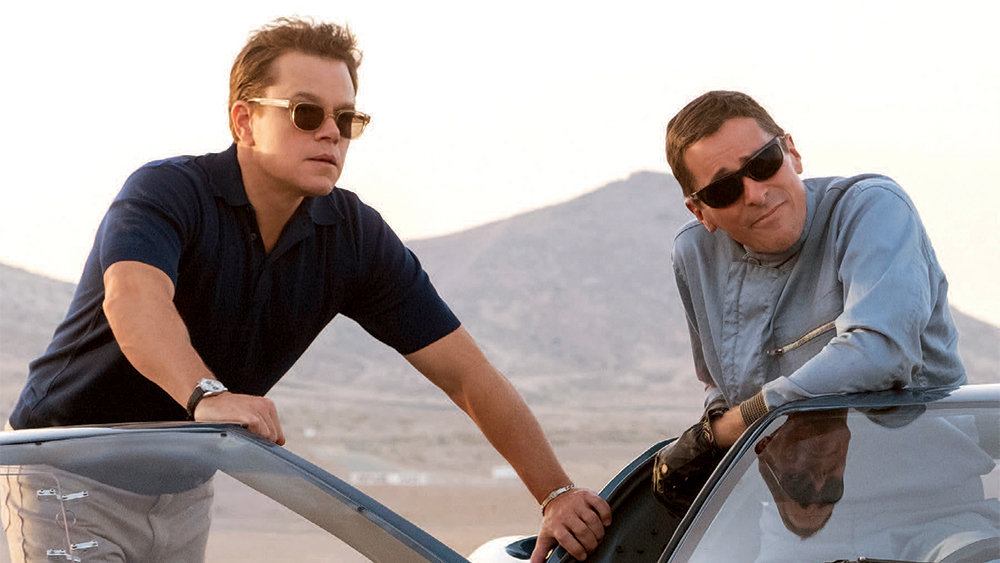
Matt Damon (left) is Carroll Shelby and Christian Bale (right) is Ken Miles in the racing drama Ford v Ferrari.
At first you’ll think Ford v Ferrari is about cars. It is, and about car racing. However, you’ll be surprised how much more it’s about.
The Ford Motor Company is going through an image issue in the mid-1960’s. For decades starting at the very beginning of the 20th Century, Ford under the genius of Henry Ford manufactured cars that completely redid the way Americans travel. Ford is still on top and currently led by Henry Ford’s grandson Henry Ford II, but it’s trying to win over younger buyers of their cars. It’s a bit harder because young people have recently developed an interest in racing cars and see Fords as their ‘parents cars.’ In 1963, Vice-President Lee Iacocca recommends to Ford they strike a merger with the cash-strapped Italian company Ferrari. It seems like a good choice as Ferrari has been a big winner in racing. In fact Ferrari cars have won the most recent 24-hours of Le Mans races since 1960.
However over at the meeting at the Ferrari office, the meeting does not go well. Enzo Ferrari tells Ford that he accepted a deal with Fiat that’s more lucrative and allows him to keep the Scuderia Ferrari racing division. In the meeting, Ferrari insults the Ford cars and Henry II as ‘not Henry Ford but the grandson of Henry Ford.’ That infuriates Henry Ford and he plans a revenge on Ferrari. The revenge is actually one to take the Ford Car company into the future. He plans to have a Ford car designed to win auto races. He hires Carroll Shelby who won the Le Mans in 1959 but had to retire because of heart problems: a problem he consistently takes pills straight out of the bottle. Since retiring racing, Shelby devoted his time to developing cars for auto racing through his company Shelby American. Carroll Shelby is close friends with 47 year-old Ken Miles: a British auto racer who is infamous for his bad temper and struggles as a mechanic with owning his garage in Los Angeles. This is a burden not only to him, but his wife Mollie and young son Peter. Especially since the IRS is on his case.
Miles is Shelby’s first pick in his Cobra team to test out his cars. Miles’ racing style and car know-how allows Shelby to make good decisions. He is always very honest with Shelby whenever he notices something that needs an improvement or when something’s a weakness. However, the choice of Ken Miles does not go well with Henry Ford, especially since he feels Miles’ personality and notorious temper doesn’t fit the Ford image. Ford elects to send Phil Hill and Bruce McLaren to the 1964 Le Mans instead. Miles predicts none of the Ford participants will win the race, and he ends up right. Once again, the race is won by a Ferrari driver.
Despite the big loss at Le Mans 1964, Shelby tries to reassure Ford that one of the Ford drivers hit 218 mph on the Ford GT40 and that made Ferrari nervous. Meanwhile it’s back to the drawing board. Shelby continues development on the Ford GT40 Mk II and he has Miles test the cars with Peter watching frequently and Ford unhappy about the arrangement. On one practice run, the brakes fail and cause the car to crash in fiery manner, which Miles is lucky to escape.
In 1966, Ford takes an extra step in the efforts of their racing cards by creating a racing division of their company and has Ford’s Senior Vice-President Leon Beebe run it. Beebe wants the program a case where Miles is not a part of any of it, not even the testing. Shelby meets up with Ford on an opportunity and offers to take him into his car. Ford accepts, and Shelby drives like a racer on the track which scares Ford almost to death. It’s right there he convinces Ford that Miles is the best man to win Le Mans. Ford agrees, but with a compromise; Miles needs to win the 24-hours At Daytona first before he can race at Le Mans. Shelby visits Miles at a street corner near his house after he’s finished grocery shopping to tell him the news. That infuriates Miles so much, he has a fist-fight with Shelby at the corner, which wife Mollie watches entertainingly.
Shelby and Miles continue with the racing and testing as Peter continues to watch and Phil Remington is the mechanic doing the fixing. Beebe is hoping Miles doesn’t win as he has puts in a second Ford entry in Daytona with NASCAR team Holdman-Moody supporting it. The Holdman-Moody team is faster at pit stops, but Shelby allows Miles to push his car to 7000 RPM. The result: Miles wins Daytona. It’s Miles’ first win in five years. Miles also has continued success later by winning the 12 Hours Of Sebring. Le Mans will be Miles’ chance to win the rare Triple Crown of endurance races.
At the 24 Hours of Le Mans in 1966, Miles is there as is Shelby, but so is Ford and Beebe. So is Enzo Ferrari in hopes of this being victory #7 for the Ferrari car. Ferrari has just released his latest racing prototype, 330 P3, and his best hopes in repeating rest with Italian driver Lorenzo Bandini. Mollie and Peter are listening to the race on the radio as Peter will be going through the race on the Le Mans racetrack he drew.
The race starts and Miles has problems on the first lap as the passenger door won’t close; he has to steer with his right hand and hold the door with his left. At the first lap, Miles alerts of the problem, which Remington fixes with a sledgehammer. Miles gets back to driving and has a lot of ground to make up. With each lap, he breaks the track record and passes numerous Ferraris as he gains ground on the leaders. However, as he’s pursuing Bandini, brake problems occur. At the pit stop, the team replaces the brake system, which infuriates Enzo Ferrari. He feels it’s against the rules, but Shelby is able to successfully convince race officials that the brake replacement is within the rules. As the race continues, Bandini is in hot pursuit by Miles, but Bandini is the last Ferrari driver in the race. As they duel again on the Mulsanne Straight, Bandini blows is engine and is out, making this the first Le Mans since 1959 Ferrari won’t win!
There’s still one more act of the drama. Three Ford cars lead the race nearing the finish with Miles leading them all. What should be a normal racing situation actually becomes a publicity opportunity for Henry Ford. He envisions all three Ford crossing the finish line simultaneously and even Beebe gets Shelby to tell Miles to slow down and set up for the opportunity. Miles is furious about this as this could put his Triple Crown in jeopardy and responds by setting more lap records, but eventually agrees with it. Miles does slow down and the three cross the finish simultaneously. However, it’s not a shared win as Ford driver McLaren is declared the winner. Shelby is mad that it ends all chances of Miles’ Triple Crown, but Miles is not down. Miles is just grateful for driving at Le Mans and giving the crowd a show.
That race would be Ken Miles’ last ever race. One day while testing a J-car, and with Shelby and Peter around, Ken crashed near a turn. It was a ball of fire and he didn’t get out. The fatal crash happened in Peter’s view. Some time later, Shelby goes to visit Mollie and Peter. He sees Peter still hurt but gives him words of comfort about his father and gives him a wrench Ken threw at Carroll years ago. As for Mollie, he just waves back from a distance after she waved to him. Then he drives off like a racer.
The film is unique as it is more than just a story about racing. It’s also how one race depended on taking a solid American business and a business legendary in making automobile travel the new norm for the USA into the future. Because of it, or maybe not exactly because of it, people still drive Fords today. Ferraris are still the most expensive sports cars today but Ford is still one of the biggest auto manufacturers in the World. The film also gave us some reminders about sports business. Businesses don’t simply look for sportspeople who win all the time. They also look for those with a marketable image. Michael Jordan may be a case where one of the best sportsmen ever becomes the most marketable ever, but it’s not always a guarantee. Seeing how a great racer like Ken Miles was shunned by everybody except by his family and those involved with Shelby American is one example. Also how Henry Ford looked at him was also unpleasant to see. I remember one person said that Henry Ford simply not liking you was enough for him to fire you. Goes to show he was cruel to whoever as he was to Ken Miles.
The story isn’t only about racing or even about a remarkable race. It’s about an auto racer whom at an age most would retire from the sport at was having the most successful year of his life. It was his love for his family. He wanted to win for them. And he especially wanted to be seen by his son as someone to be proud of. It was also of a friendship between Ken Miles and Carroll Shelby. Miles was the one person Shelby can best trust for an honest opinion about his cars, or should I say Ford’s cars. Shelby saw a lot of qualities in Miles most others overlooked. The friendship was strong, but it wasn’t without its friction as both men were temperamental and fighters. But the friendship was still very strong.
One thing about this film is that it doesn’t compromise in being an auto racing film. Being such, it knows that it has to make the audience feel like they are part of the race or they are in the driver’s seat. The camera angles as well as many of the scene shots helped greatly in creating the experience and intensity and leaving the audience at the edge of their seat. The film also does a great job of putting the audience in the races too. Despite the intimate story, the story does not forget what it’s about and makes the audience feel the moments too.
The film marks another great success for director James Mangold. This is his sixth film to earn Oscar nominations and his first ever to be nominated for Best Picture. Although he missed a Best Director nomination, he creates a great film that delivers just as good a story as it delivers in racing excitement. The story by brothers Jez and John-Henry Butterworth along with Jason Keller becomes more than a racing story with a simple plot. It’s a deep plot with three-dimensional characters and reminds the audience that the story is as much about the man, the friend, the husband and the father as it is about the racer.
The film marks another great performance for Christian Bale. Again he succeeds in getting into character and delivering a deep role. Not a false note about the character nor the father-son relationship. Matt Damon was also great as Carroll Shelby. His role may not have been as deep as Ken Miles’ but he added dimension and character to the role. The other standout of the film was Noah Jupe as Peter Miles. Noah made the father-son relationship work as well as Christian did. Other standout efforts include the cinematography from Phedon Papamichael. He knew the shots he needed for this racing film and he delivered, especially in some of the most intense scenes. The visual effects were also excellent and perfect for the film. Also the score by Marco Beltrami and Buck Sanders added to the excitement of the film.
Ford v Ferrari is the remarkable story how a driver and a race depended on the future of the Ford auto company. It’s also a story about a friendship between two racers few of us knew of. And a reminder of an overlooked great in the sport.
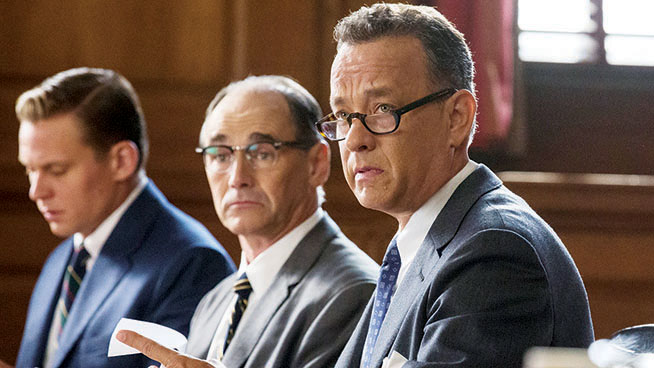
Tom Hanks plays James Donovan, a lawyer in the middle of the height of the Cold War, in Bridge Of Spies. Mark Rylance (centre) steals the show as his subject.
Bridge Of Spies is a Spielberg drama I missed out on seeing during its original theatrical release. I only saw it once it was a choice on a flight I took heading home. It was a good choice.
The film begins in 1957 with Rudolf Abel arrested by CIA agents as he’s trying to read a secret message. He is taken away but is able to keep the message. As Abel awaits trial, American lawyer James Donovan is assigned to defend him. The US government believes him to be a KGB spy but Donovan wants to have a fair trial because an unfair trial may be used as propaganda in the USSR. Donovan meets Abel whom is very welcoming to Donovan but will not cooperate with the US Government for any revelations in the intelligence world.
Donovan knows he has a heavy task in defending Abel. He’s serious about it but no one, not even his closest family, expects him to make a strong defense for Abel. Nevertheless Donovan is persistent and continues to seek acquittal for Abel despite an angry American public, persistent hate mail and threats on the lives of him and his family. Abel is found guilty on all charges. Before sentencing, Donovan asks the judge that Abel receive a prison sentence of 30 years instead of the death penalty because he feels Abel may become a bargaining chip with the Soviet Union. Further difficulties continue as Donovan is unable to win a Supreme Court case where evidence against Abel was tainted by an invalid search warrant.
Meanwhile two innocent Americans find themselves in the hands of Communists. One is US air force pilot Francis Powers whose plane is just shot down between the USSR-Turkish border. He’s able to escape his doomed plane and tries to steer his parachute into Turkey but fails and becomes captive. The other is Frederic Pryor, an American economics student studying in Germany just as the Berlin Wall is being built. He studies in West Berlin but has a girlfriend in East Berlin. He tried to bring her with him to the West but is arrested as a spy.
News gets to Donovan of the two men arrests. He’s even offered a deal from the USSR of the exchange of Abel for Powers. Donovan is insisting in a 2-for-1 deal of exchanging Abel for both Powers and Pryor. However he has the challenge of dealing with Soviet agents and a CIA that’s interested in only getting Powers back. The whole deal puts the governments of three nations– East Germany, the USA and the USSR– in a heated debate with Donovan make the outcome work out right. The end result is historic.
This is yet another film about war Steven Spielberg does focus on. There have been many films of the theme of war he’s done in his career. The wars he have depicted on screen have spanned time from World War II in Empire Of The Sun and Saving Private Ryan to World War I in The War Horse to the Civil War in Lincoln to even revenge missions in Munich.
Here he tackles a war that’s less about brutality but more about ideology and had victims of their own: the Cold War. Although there wasn’t as much blood shed, the Cold War did put a sense of paralyzing fear in the world, especially in the United States, with a possibility of nuclear war and armageddon. Thus the ‘duck and cover’ scene. Ask anyone over the age of 60 about doing all those ‘duck and cover’ practices at school. People were constantly being suspected as spies on both sides and there were reactions of hysteria to those accused of spying or treason. The construction of the Berlin Wall at a time when Germany was divided between the capitalist West and the Communist East is an example of the war.
The story takes us back to the 1950’s at a time when Cold War hysteria was at its highest. Neither side could be trusted if one from the other country came in to visit. That explains why even innocent visitors could be seen with suspicion. People arrested as spies for the other side were huge headline news. Most of the public wanted them dead with Julius and Ethel Rosenberg still fresh in their minds. It’s easy to see why someone like James Donovan would be so easily vilified by the American public and even face a possible shooting. The film shows why James’ efforts in the prisoner trade were necessary in the Cold War. It was something that was able to ease some tension on both sides.
Spielberg does a very good job of showing what the Cold War was like. Instead of showing fighting that’s common in the wars, he focuses on the more tense moments of the Cold War and captures its tense feel most people of that time felt. The screenwriting by Matt Charman and the Coen brothers was very good in providing insight to the moments in history and keeping the key elements of the situation. It didn’t focus too much on Jim’s personal life but it did focus on his efforts and even on the prisoners themselves. It may lack some historical accuracy but it does provide knowledge and keep the audience intrigued. Its one glitch is that it had too sweet of an ending. I don’t think it ended on the right note.
Tom Hanks was very good as Jim Donovan but it’s not at the same level as his most stellar roles. The biggest scene-stealer of the film was Mark Rylance as Rudolf Abel. He not only matched Abel physically but also gave him character with his love for art and his ability to say persuasive things. Other good supporting performances came from Amy Ryan as Jim’s wife and Alan Alda as Thomas Watters. Janusz Kaminski did a very good job of cinematography, the production designers did a very good job of recreating the 1950’s and 1960’s with their sets and Thomas Newman delivered a very good score to the film.
Bridge Of Spies is very much a story about a lawyer and his pursuits but also the times he had to deal with. Reminds you of some of the political tensions and paranoia that’s currently happening now. Spielberg does a good job of capturing the feel of the intensity as well as the political climate of the story.
Matt Damon plays an astronaut stranded on Mars but determined to live in The Martian.
Hard to believe I saw The Martian just two months after it hit theatres. What took me so long? What took me so long to write this review? Anyways I’m glad I finally had the chance.
I’m sure by now most of you have seen the story of how Mark Watney got left behind on Mars. The sandstorm on Mars and the debris that hit him left everyone escaping mistaking him for dead. Mark would then have to survive by growing his own food and creating his own habitat. It would work to his advantage but NASA would eventually get the message he needed to be brought back home. It would take a connection with a mission, sheer determination and camaraderie with his fellow astronauts to bring him back to earth successfully.
The movie is based off the book by Andy Weir. I can’t judge for myself on how the film compares to the book. However I will say this is a very good adaptation of a story of a man and his fight to survive on a strange planet. One thing I will have to say is that even though this is a sci-fi fantasy, the film would still have to be true to fact in a lot of areas. It would have to know Mars’ oxygen levels or lack thereof, temperature levels, climates and terrain and even know how long transportation and even communication between Mars and Earth would take. Today’s audiences aren’t as welcoming towards cheap hypotheses of space like they used to be decades ago. Not only would they need those facts but they would have to be incorporated into the script and made to work into a story that was suspenseful but also entertaining. The Martian succeeds in doing just that and doesn’t lose its comedic edge in the process.
The Martian is a reminder of why films about space travel still fascinate us today. They remind us of why we like to imagine trips to outer space including domains humans have never set foot on. They even capture our intrigue when a mission fails and the astronaut’s lives are at threat. They get us wondering “Do they make it or don’t they?” You may remember how Gravity caught our imaginations just a couple of years ago. Now it’s The Martian with its story of an astronaut trying to stay alive yet eventually return back to earth.
Some may question the mix of humor into the story if it was a smart choice, especially with the inclusion of disco songs Mark hates but keeps him alive. No doubt it was an entertaining choice as it entertained crowds. Comedy is all hit and miss and I feel it made the right choices in terms of adding in the comedic elements. In terms of drama, it didn’t make the more tense moments of life-or-death too tense for the audience. It kept us wondering and brought our hopes up with each positive moment but the intensity was not all that thick and that’s what made it win with the crowds.
No doubt it took the direction of Ridley Scott and the writing of Drew Goddard to make this film work. Ridley knows how to bring out the best in unique stories and make them win with movie crowds. The story however rested on the shoulders of Matt Damon. His performance where he mixes humor with the will to survive helped the film achieve the charm it needed. Despite Damon owning the movie, it’s not to say supporting performances from Jessica Chastain, Kristen Wiig, Jeff Daniels Michael Pena and Kate Mara didn’t have their importance. They helped too. Other top elements of the film included the music from Harry Gregson-Williams and the special effects team who were able to re-create life on Mars to a tee.
The Martian is a sci-fi comedy of the best caliber and has the best elements of a ‘popcorn movie.’ This is something only a director like Ridley Scott can pull off well. Very entertaining.
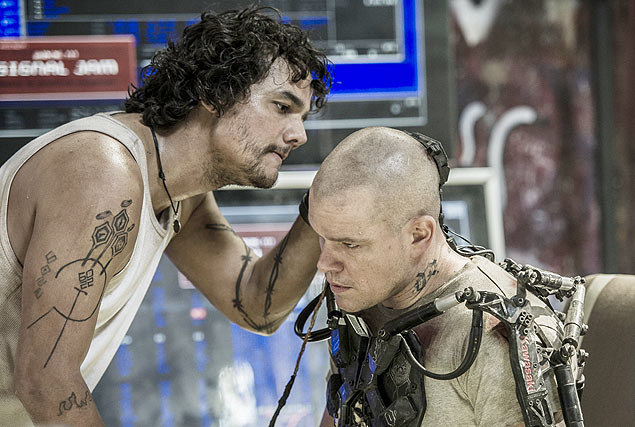
A computer hacker (Wagner Moura) gives Matt Damon the right stuff to help overtake Elysium.
Okay, you remember how I mentioned a while back about the struggle of big budget action movies this summer? Elysium has been out for a while. Does it have what it takes to get things moving again? Or will it be another casualty?
Before I get into the plot, I have to give you a picture of the two worlds. It’s 2154 and Earth is a poor polluted overpopulated planet under anarchaic conditions. Out in space is the satellite Elysium: a luxurious satellite full of sun, life and full cure from disease in the comfort of your own home. Earth isn’t even ruled by humans. Just ruthless androids programmed by computers. Elysium however has robots in their favor, as servants to them.
Max da Costa has developed into a rebel on planet Earth. He grew up an orphan and has lived in prison most of his life. Out on parole, he now works an assembly line of robot parts for Elysium in a wrecked-out Los Angeles. Max has a dispute with a robot that turns violent and lands him in the hospital with a broken arm.
In the hospital, he meets with a nurse named Frey. Frey was actually his childhood love in the orphanage. Despite his hard times growing up in the orphanage, he had the comforts of the love of Frey and a nun who served as a spiritual mentor to him and always believed he was meant to do something great one day. Frey is not only a nurse now but a mother of a daughter dying of leukemia.
Elysium is under a power struggle. It’s run by President Patel but Secretary of Defence Jessica Delacourt has power desires of her own. She orders the shooting down of a spaceship full of civilians from Earth which earns her a reprimand from Patel and her top security agent Kruger fired. That only fuels Delacourt’s desire for power as she connives a plan to have CEO billionaire John Carlyle design a computerized cybercoup to make her president which allows Carlyle’s company to override security for the next two centuries. Carlyle has the program implanted in his brain for safekeeping until his return to Elysium.
Max however is exposed to radiation at the plant one day and is given only five days to live. He desired to head to Elysium to cure himself and through the help of Spider: a computer hacker who builds illegal space caravans to Elysium. Spider agrees to send Max up there as long as he agrees to steal vital information. Max agrees and Spider gives him weapons, a fake Elysium ID, a bionic exoskeleton that can help him withstand force from android sentinels, and a cerebral data upload that can allow Max to steal data implanted in Carlyle’s mind.
However Carlyle and Delacourt know what’s going on and try to end Spider’s plan by shutting down the system. In the ensuing fight, Carlyle is killed along with most of Spider’s men. Max’s friend Julio sacrifices himself so that Max can get away. He does but only after being stabbed. Max goes to Frey for help but she wants to come along to get her daughter cured. Max tells her to stay out of it as this might be a suicide mission. Meanwhile Delacourt is in pursuit of Max as he holds Carlyle’s data implanted in his head. Spider wants to extract the data to make all people citizens of Elysium but can’t as long as the power is shut off in his place. The power outage can’t even get Max to Elysium just before he dies.
They are able to get a ship to Elysium through Max exchanging the program with Kruger but only to disguise Frey and her daughter as hostages and hold a grenade to his own head. Kruger agrees and Spider is able to sneak more people on board. During the trip, Kruger’s head is severely damaged by the grenade explosion and the plane crash lands in Elysium causing Delacourt to set off a state-of-emergency and fire Patel.
Right when Delacourt plans to get the program from Max and ‘bring him to justice’ Kruger’s head is reconstructed and he has mutiny plans of his own which includes assassinating Delacourt and making Elysium his own private playground. This allows Max and Frey to escape and get her daughter cured. However the ‘cure booths’ on Elysium only work on Elysians which her daughter is not made officially. It’s all up to Max to work with Spider to make everyone a citizen of Elysium and defeat Kruger from his regime in what little time Max has left. The ending is somewhat predictable but it works well for the movie.
The film seems to focus on the division of the rich and poor. It’s not an uncommon theme. Those who studied classic literature must have read A Tale Of Two Cities. Now we have Elysium where Earth is a hellhole for the 99% who can’t afford to live on Elysium while the rich 1% have it. It’s interesting that Neill Blomkamp is tackling such a common theme of the ‘other 99%.’. If you’ve seen his first big movie District 9, you’d notice how the transporting of aliens from one area of land to another echoes of apartheid. Now we see the separation of classes in Elysium. It’s unique to see Blomkamp make sci-fi movies that can get people thinking. It’s a welcome relief from most of this summer’s sci-fi with is mostly mindless. One unique twist from District 9 is that District 9 shows an outsider succumbing to the apartheid he’s participating in. Elysium is the opposite as it shows the lesser people trying to make the unfair fair. Good change of twist that works here.
This is another great sci-fi effort from director Neill Blomkamp. It’s not as well-written or well-directed as District 9 but it does make for a more intelligent sci-fi film than most of what’s been released this summer. The acting however was not that much of a standout. Matt Damon came across as a cardboard hero and Jodie Foster looked like she was trying to be a robot. Alice Braga wasn’t much of a scene stealer. Sharlto Copley however was quite good at playing the villain and Wagner Moura was a scene-stealer as Spider. The visual effects were very good and the satellite of Elysium was done excellently without flaw. It almost looked like a satellite capable of acting the same way earth does, with plant and sunshine, is actually a possiblility even in this century.
Checking out the box office, things don’t look so good. Elysium opened two weekends ago at the top of the box office with $29.8 million. Pretty somber since it cost $115 million to make. Last weekend also gave some bad news with only $13.6 million and this past weekend was more bad news as it didn’t even muster $7 million and ended the weekend at #7. I don’t know. Do you think it’s a victim of timing?
Elysium seems to be the right sci-fi thriller out at the wrong time. It is intelligent and does get you thinking unlike most of the sci-fi movies this summer but it suffers because of the current audience weariness of sci-fi movies. I think if it was released earlier this summer or even last year, it would have had more impressive box office results.



 Jon The Blogcentric