Shorts, shorts, shorts. Lots of them worth seeing at the VIFF. The next segment I saw this year Space And Time which consisted of nine shorts filmed by Canadian directors. They were all different but all shared something in common:
-24:24:24 dir. Daniel Dietzel- This is a film shot on a Montreal street corner facing the CCSE Maisonneuve over a 24-hour time period. What makes it amusing is that it shows the same corner with images of various hours at once. Sometimes all 24 simultaneously. The splitting of the various footage images in its sections along with the sounds mixed in will definitely make you curious during the whole thirteen minutes. The images of time and seeing the images of the Maisonneuve and the tower of the Olympic Stadium add to its charm. It’s surprisingly pleasant and enjoyable to watch. Quite the kaleidoscope.
-By The Pool dir. Karine Belanger- The film begins at an outdoor pool as a worker cleans the pool out in the spring just before it opens. He finds a small fish. Throughout the film, there are images of people doing aquarobics, swimming laps, swimming and playing, going off the diving board, late-night lifeguard parties and even a pool emergency. As summer ends, the diving board gets taken down and the pool gets drained. The man cleaning the drained pool finds a big fish! Funny how a film simply showing the summer of an outdoor pool can be amusing.
-Ranger dir. Sandra Ignagni- It’s a boat trip from a town in Labrador to an Arctic town. The long trip on the M. V. Norther Ranger is documented from boarding for deoarture to arrival. It focuses on everything from passengers to the captain directing to crewmen working to the waters it travels to passengers sleeping overnight to its arrival. It makes for a good simple unnarrated documentary film that tells a lot.
-Last Night dir. Joel Salaysay- Sarah is woken up by a phone call by her friend Jamie and tells her to come over. However the calls become more frightening over time as Jamie calls her back and doesn’t know where she is. Jamoe sounds like she’s lost or has lost her memory. As Sarah tries to get help, she tries to keep connection with Jamie. This is a good short as it keeps the audience intrigued not knowing what will happen next and hoping for the best for Jamie and Sarah.
-Late Night Drama dir. Patrice Laliberte- A young thug is in pursuit with a man he’s at odds with. He finds him at a night club and picks a fight with him. As he’s booted out, his girlfriend is angry at him and they get into a squabble in the car. After he throws a fit, she leaves him to drive off by himself.
This was all in French with the subtitles absent. Despite it, I could get a good sense of what’s happening. This is your typical night club drama you see all the time. What makes this film intriguing is its method of ‘follow-around’ cinrmatography. The audient follows the story wherever the young jerk goes keeping one in the thick of the drama
-Oh What A Wonderful Feeling dir. Francois Jaros- A woman deals with a truck-stop that’s normally a meeting place for those working their job, a spot for young people biking around and even a place of ill repute. She tries to make sense of the situation while also trying to solve a problem of her own. Even the paranormal comes into play. It doesn’t make for a lot of sense but it does tell the story well.
-Seven Stars dir. Sofia Banzhaf- A Vancouver woman visits Tokyo but struggles with her feelings of anxiety and alienation there. It’s a four-minute film that tells its situation. It’s more about the person in the place and their feelings rather than what happens.
-Stone Makers dir. Jean-Marc E. Roy- It’s just a four-minute film of a work day in a granite quarry but it’s more if you look close enough. The machines move around in almost a fluid motion like they’re dancing and the granite slabs look like works of art. It makes for an ‘oddly-satisfying’ film.
-Einst dir. Jessica Johnson- It starts with a view of a lone section of the Lower Seymour Conservation Reserve. Then a young woman comes to take off her clothes with nothing but a swimsuit on and swim in the Seymour River. As she goes under, she doesn’t re-emerge, leaving us to wonder. The quality of this short is its mix of natural beauty added with the mystery of the story. That’s what makes the film intriguing.
The nine shorts shown in this segment were all impressive. It was good to see them. There were some with stories to tell while some were more about focusing in on the scenery and the area around them. There were a few that turned out to be just footage and filmage of as-is situations. They remind you a lot of these ‘oddly satisfying’ videos on YouTube of everyday things that are somehow picturesque to look at and even tell its own story. Now you know why these ‘oddly satisfying’ videos are a hit.
Space And Time was an impressive selection of Canadian films. It was an hour and a half well-spent and was very enjoyable.
Mommy is an impressive story about a troubled son, a mother’s iron will and a friend willing to help them all out.
I was hoping to see Mommy at this year’s VIFF. It was one of those films I really wanted to see. Unfortunately there was only one showing–I think it was the only film that had a single showing– and this was not open to volunteers and tickets sold out days before. Fortunately I was able to see it when it came out in theatres shortly after. I’m very glad I did.
The film begins telling us it’s 2105 and Canada is under a newly elected administration that has passed a controversial new law. The law states that government agencies can now decide the fate of a minor with mental conditions and the parent has no control over it which includes transporting them to hospitals and facilities.
Diane ‘Die’ Despres, a 46 year-old widow of three years has been given the news. Her 16 year-old son Steve, an ADHD child with a history of violent behavior, has been sent to a long list of list of juvenile institutions over the years. His violent behavior has gotten him constantly kicked out and transferred to the next. However his actions at his most recent institution– setting fire to the cafeteria which left one boy badly burned– led to the final straw: transfer to a more restrictive detention centre where she knows he’ll never be rehabilitated. She goes against all judgment and takes Steve into her own hands.
Die has to be a toughy with Steve if she wants to make this work all on her own. She’s even willing to risk losing her job to keep Steve from the alternative, which does happen. She knows it will be very hard to keep Steve because of his behavior and it’s his first violent outburst since taking him on that’s her first test. She stops him by throwing a bookcase on him and that leads to Steve having a gash. She can’t take him to a hospital but she finds help from Kyla, a neighbor from across the street who’s always been so private and only seen with her husband and children. She gives Steve the stitches.
Die is impressed with Kyla’s nursing skills. The three form a friendship that’s very close as they do many things together. Kyla is especially beneficial as she’s a nurse who knows how to handle the behavior of people with ADHD like Steve. The three of them share many good times together. Die is finally smiling and happy, Steve is able to show off his enthusiasm and a passion for life, and Kyla is able to come out of her shell. Die is even impressed with how she knows how to handle Steve. She doesn’t have to do this alone. However all three know that they have to keep this top secret. Die even meets with a lawyer to work on their case against the institution. It appears to look good until Steve is mocked at a bar during karaoke night. he becomes violent and threatens the heckler with a broken beer bottle. Steve even gives a further outburst towards the lawyer which causes the lawyer to drop the two.
Despite it all, the three continue on even after Die is served. She is given the warning to give Steve up or she will be charged. The three hope to keep things hidden and things continue to go well until Steve tries to slit his wrist in a store. That was the final straw. Die can’t take it anymore and has to take Steve to the institution. Changes also come for Kyla as her husband has a job in Toronto. The film does end not how one would expect.
Once again this is another entertaining film from Dolan. Like many of his films, it gives a lot of focus on the madness of his protagonist’s minds. However this is not just simply that. This is also a focus on the protagonist’s behavior problems associated with the mental condition. It gives some good focus on the ‘wild imagination’ associated with people with ADHD, especially in scenes with Steve having fun in the parking lot and skateboarding feeling free. However it also focuses on behavior problems where Steve gets dangerously violent with his mother, verbally abusive with the lawyer who’s supposed to help the two out, impulsively suicidal in the store and even shows the lack of sexual restraint when Steve tries to come on to Kyla. The character of Steve does a good display of showing the positive side of ADHD but also its weaknesses, especially how many young people act like they don’t know their boundaries. We’re already made aware of the fire Steve set which left another teen badly burned at the beginning. However it’s in the film we get a better sense of the condition and a young person’s behavior patterns from sweet and loving to ruthless and nasty.
The film is also about a mother’s love for such a child and how it’s tested. I remember reading a book on parenting teenagers and it said a sentence that really stuck in my head: “If you can handle a teen with ADHD, you can handle any kid.” We know how much Die loves Steve to the point she’s willing to break the law to keep him. That opening scene when she unapologetically barges into Steve’s bedroom to wake him up even while she catches him masturbating already showed that she’s a tough-as-nails mother. However there’s no doubt that her love for him will be put to the test big time. The story shows the trials Die has to go to in order to keep Steve from his violent outbursts to the point of even throwing a bookcase on him. The story also shows how much sacrifice Die has to deal with to keep Steve such as losing her job and losing the lawyer that can help the two win the case. The story even shows how even the toughest of mothers like Die can just have enough of it all and turn Steve in.
It’s not even strictly about ADHD and a mother’s love. It’s also about the trio of a friendship. Kyla’s presence is also very vital as she is one of the few adults who know how to deal with Steve and she becomes Die’s first friend since the death. And to think Kyla was simply a loner wife and mother before the two met her. The film makes for a fascinating friendship between the three.
Interesting thing about this is that the story is in the near future but by a single year and talks of a law passed by the newly elected administration. The funny thing is that most Canadians, especially British Columbians, would expect a law like that to be passed by our current administration. Okay, enough of that. Back to focusing on the film, the one weakness about the film is that it gets us wrapped up in the story to the point we forget about this law that threatens to tear the two apart. And we’re only reminded of it near the end. I’m sure the law has a lot to do with Die keeping Steve to herself and Kyla keeping things hidden but the story makes it so easy to forget.
Once again, this is another triumph for Quebec wunderkind Xavier Dolan. I still remember five years ago when he burst on the scene as a 20 year-old with I Killed My Mother and caught loads of attention at that year’s Cannes. I saw it. Excellent film. Dolan has since proved he’s no one-trick-pony as he has delivered other consistent films like 2010’s Heartbeats, last year’s Tom At The Farm and this film. It’s no wonder he’s become all the buzz at Cannes these past few years and has even caught the attention of Brad Pitt. However this is something unique as this is the first Dolan film where Xavier does not act at all in it. It’s a very good film and another accomplishment from Xavier.
The funny thing about this film is that there have been times I wanted to compare it to his breakthrough film I Killed My Mother. It’s not an easy thing to do as both have a lot of things in common. I do admit that I Killed my Mother is still my favorite film from Dolan. Also looking back, I’ve been trying to see if Mommy shows a filmmaking maturity in Dolan in the five years since. It was very hard to pinpoint out in all the retrospective thinking I’ve been doing. Mind you for those who saw I Killed My Mother, I’m sure you were all surprised how well-directed it was. It easy makes you forget it was done by a 20 year-old.
Actually there were some differences and even some challenges between the two. And not simply because Xavier doesn’t act here. First was creating a story involving a character with a common mental condition. Dolan had to know it inside out and deliver a character that displayed those traits but didn’t come across as insulting to those that had it. Another difference was the focus of a teen boy’s heterosexual feelings. Most of Dolan’s films have focused on homosexuality. And another trait of the movie was Dolan trying to portray the essence of being a teenager even as Dolan was 24 at the time of making the film. Dolan shows she still hasn’t forgotten that essence five years later.
Antoine-Olivier Pilon did an excellent performance with a character very complex. It’s good to see someone that young do a great acting job. However Anne Dorval was the standout of the film. She also delivered well as a mother who is easily tested despite her rebel side. Suzanne Clement is also excellent as the friend who comes out of her shell. The three of them together had the right chemistry to make the film work. Even the minor characters added to the movie. Like Kyla’s husband added to it as one who could say a lot without speaking a word. The mix of music in the film was an excellent mix of common hits and neo-classical compositions and it fit the film well.
Mommy has already won some good accolades. It was nominated for the Palme d’Or at the Cannes Film Festival and won the Prix du Jury. It even won awards at a Francophone film festival in Namur, Belgium and has made almost $3 million at box offices around the world. It’s also Canada’s official entry in the Best Foreign language Film Category for this year’s Oscars.
Mommy also further confirms my belief about the Canadian motion picture system. For those who don’t know my belief about it, my belief is there are two different types of movies coming from Canada: the films from Quebec and the films from English Canada. The films from Quebec have their own distinct style and consistently display creativity and professionalism. The directors themselves have gained universal recognition and even won awards including an Oscar. The films from English Canada are also professional lack the eye-catching ability of Quebec and have to do lots of effort in order to win attention even in Canada. There isn’t even much of a legacy for the films of English Canada. I believe Mommy further adds to the legacy of Quebec filmmaking and further proves the films of English Canada have a lot of catching up to do.
Mommy is another accomplishment for Xavier Dolan. It quite possibly even makes him the biggest ‘young gun’ director in the world right now. Twenty-five years old and this is his fifth critically-renowned film. I can’t think of another young gun with as much accomplishments right now.
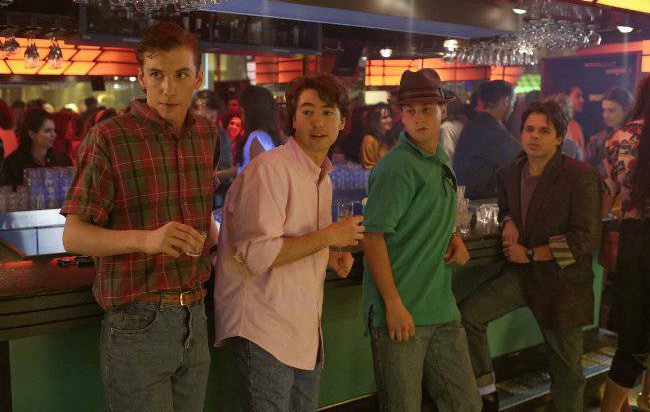
1987 is an autobiographical movie about director Ricardo Trogi in his teen years played by Jean-Carl Boucher (extreme right).
Remember last year when I talked about movies from other countries as much as I talked about films? Well I had the good luck of catching my first movie at the VIFF just recently. It’s a movie from Quebec called 1987 and it’s very entertaining.
The film begins with 17 year-old Ricardo Trogi breaking up an organizational meeting where the ‘powers that be’ organize that a teen should decide at 17 what he wants to do with the rest of his life. Ricardo breaks it up because he knows it won’t work. He’s 17 and he can’t decide.
Flash forward to the plot. Ricardo is about to graduate from high school and he has four big goals for this year: lose his virginity to his girlfriend Marie-Josee, get into night clubs, get a car and strike it rich with his big plan. Sound like big dreams but it’s not going to come true easily. His parents want him to get a job to learn responsibility. All the attempts from him and his three friends to get into Quebec’s top club fail. Marie-Josee is reluctant to go all the way. And his big goal is to open a night club for teens. That takes some doing since he has a $50 bill from Columbia House after falling for their 10 tapes for a penny ‘deal.’ Yeah, I fell for that too.
Things start pretty bumpy. He does get his first car but it’s a shabby Lada. He has a chance to lose his virginity but it’s postponed as he starts work on the one day Marie’s parents are away. His moneymaking chance flops with his first job as a valet. Hey, totaling a BMW will get you out in a record-short two hours. Then it’s by chance with his friends that they notice an expensive car stereo. Fortunately for them, no one’s around to see them steal it. That gives Ricardo an idea of being a stereo peddler to get the money for his night club. It starts to pay off. The more stereos he and his buds get, the more they can sell. Once he reaches 18, he can get into night clubs with his friends and be ‘the man.’ He even gets the notice over there of a Sara, female classmate he liked but the other boys called ‘STD’ behind her back.
However things don’t work as planned. First he finds out Marie-Josee kissed another man. He hears it right on prom night. He leaves her and then goes to the night club where he’s able to win over Sara. However he finds out that ‘STD’ is actually a virgin and confused with life. To make things worse, he finds out his friend and ‘partner in crime’ spends too much time with Marie-Josee. Then comes the Waterloo for him as the police know of his stereo theft. It all ends there. Nevertheless it ends with the director giving a final reflection at the end.
The thing that grabbed me most was that this movie was possibly the most truthful about the 1980’s of all 80’s-themed movies. You know how sometimes when you see a retro movie they don’t entirely get it exactly retro? They include some modern stuff but try to make it look classic? Like those 70’s-like hairstyles worn by the teens of Happy Days? Not in 1987. It grabbed me that this was the 80’s retro film that had to be the most exact when it came to 80’s style from multitude of armbands to plastic glasses on women and aviator glasses on men to girls in big hair to guys in tight jeans. I noticed very little present styles in this. And I’m an 80’s teen! Also that talk of opening a night club for teens. That was a unique 80’s thing. I even remember a teen night club in Winnipeg in the 80’s called Changes.
It’s not just the clothes and teen clubs that made it very precise in depicting the 80’s but also the entertainment they talked about and music played in the soundtrack. They played a lot of signature 80’s songs like Forever Young and Cum On Feel The Noize and there was talk about a U2 song affecting Marie-Josee’s mood. Having the Pet Shop Boys’ It’s A Sin fit the chase scene perfectly and even reminded me that I liked it. There were also a lot of lesser known 80’s gems in there too like Flock of Seagulls’ Space Age Love Song (which I prefer over ‘I Ran’), Run DMC’s It’s Like That and even uniquely Canadian 80’s gems like Luba’s Every Time I See Your Picture and even a Quebec 80’s gem from Martine St.Claire. Another such is the movie poster of The Untouchables which Ricardo thinks it’s about Al Capone being tough. The poster actually is a symbol of Ricardo’s teenage delusion as The Untouchables was about Al Capone getting caught. Eventually the Quebec police would become Ricardo’s Eliot Ness.
Another thing about it is that it was able to make light about a lot of teenager difficulties. Especially the age of 17 when you’re expected to decide what you want to do with your life and a lot of unexpected changes happen. Sure, you graduate high school but often your friends and even your high school sweetheart move on to pursue other things. First off the movie was able to make light of the shitty attitudes in both Nadia’s reclusiveness and Ricardo’s frustrations. It was also to make light of the romantic confusions of Marie-Josee and Sara. It was also able to showcase a lot of the typical teenage stupidities in a funny way. Especially Ricardo’s stupidity of thinking he’s ready to take on the world with his idea and that he can make it big on stealing car radios. The radio heist was especially amusing because he was acting like he was Don Corleone but he was a complete amateur. 16 year-olds in the ‘hood are better at playing the game than Ricardo. Nevertheless it’s funny to watch as most of us have passed the age of 18 and can even see their own past in it. We laugh because all Ricardo and his teen friends go through, even the toughest stuff, are all a case of ‘you live and you learn.’ Even cruel stuff like Sara being nicknamed ‘STD’ can be laughed off as the stupidity we once had.
I didn’t know until recently that 1987 was actually a sequel to 1981, another autobiographical film by Ricardo Trogi in which Jean-Carl Boucher also played Ricardo. I’ve never seen it so I can’t compare 1987 to 1981 at all. I will say it’s a very entertaining film in its own right and Trogi should be very proud of the movie he delivered. Like I say, any 80’s teen can identify with this and laugh along to it. It’s almost like they’re laughing at themselves. Jean-Carl Boucher was very good in his role as Ricardo. He was naturally comedic in the role without coming across as too stockish of a character. He made the comedic side of teen awkwardness look 3D. Actually all the teen actors were very good in their roles as they came off very believable especially in terms of showing teenage confusion and frustration in both comedic and serious lights. The adult actors were also good but it was Sandrine Bisson as the mother who was the best scene stealer. She reminds you of every mother and the crazy frustrated attitude they have. Yeah, juts when you though your mom was weird, it becomes apparent it’s a mom thing.
1987 is a funny movie that can appeal to all sorts of people like teens and grown adults or even people who just like 80’s stuff. It will bring back memories of the time. And of you.
Every VIFF I have a goal of seeing at least one Canadian film. On Friday I chose to see Whitewash, a Quebec production. I didn’t get too big of an accomplishment of a movie but it was suspenseful.
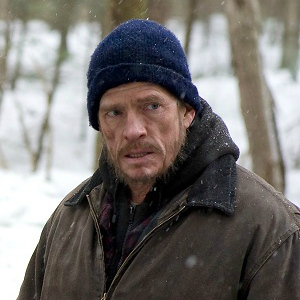
The movie starts with a man walking down a street and a snowplow driving down the road. Then the shocker: the snowplow hits the man. The driver is shocked to see he’s dead. The driver then drives far north to drop the body off into a ditch and cover it with snow. Then the driver travels as far north as he can only to find him stuck in a forested area. The most he can do is make the plow his home and his shelter.
Soon we learn that collision was not a collision between strangers. It was his neighbor Paul. We also learn of the driver’s name: Bruce. Bruce does the first thing he can with whatever money Paul has. Go to a diner to eat. Unfortunately he learns that both he and Paul are in the news as missing people. It becomes apparent Bruce would have to use his stuck plow as a hideout. Over time, Bruce would use other places too like a store to buy all sorts of supplies and a house of a snowmobiling family whom he accidentally scares the daughter and pisses the father off.
It’s in flashbacks that we learn a dark secret of Paul. Paul has a gambling problem and he lost $15,000. He can’t tell his wife. Bruce has problems of his own. He lost his wife to cancer. He also lost his job as a plowman as he drove his plow into a building one night while drunk. He spent time in jail and was suspended from driving anything for one year, His only chance for making money right now are from wholeselling a set of decorations he owns.
It’s after Bruce steals a snowmobile that he accidentally spots a body of a woman frozen to death. Another body to hide, underneath a lake of breaking ice. Then we learn through a flashback of what Paul was doing inside Bruce’s house the night of the accident. This paves way to an ending that is surprising and gets a lot of people guessing their own end to Bruce’s situation.
I don’t think there’s any real social point to make in this film. All it does is tell the story from the protagonist’s point of view of how he’s hiding out and what events led to the fatal collision. Over time there becomes more that meets the eye. The film is mostly about Bruce but it’s also about Paul too. Sometimes it gets one questioning if that was an accident at all or an accident waiting to happen. Did Paul mean to avoid Bruce’s plow or did he think this was his chance for his suicide? The film has us asking.
Another thing to say about the ending is that it is unpredictable. Subtly humorous but unpredictable. We’re all expecting it to end either one way or the other. Instead it ends on a different note. Some will accept the ending for what it is but some will try to draw their own conclusions of what will happen later on. The unpredictable ending is one of the top highlights of the movie. Actually I believe that the unconventionality is the biggest quality of the movie. We all expect that this is one thing but it’s not. We think that the fatal collision was random but it was between two neighbors. We think that it was accidental but it’s possible Paul had a death wish. We all expect Bruce to face some sort of consequence in the end but it ends on a different note.
One thing about the Canadian film industry is that its in a confusing state: a state that’s been like that for decades. There’s the films of Quebec that have been able to chart its own territory and create its own legacy. Then there’s the films of English Canada which has a long way to catch up to Quebec’s level. English Canada knows how to hold its own in music and in television but it’d not able to do as well in film. All too often if they want to create a movie to get attention, they’d have to hire a big name even if it’s American or British. They do hire Canadian name actors but many who had their time in Hollywood that’s past. This is a unique situation where a Quebec director creates an English-language drama/comedy. He hires an American who’s made a name for himself–Thomas Haden Church: most famous for playing a villain in SpiderMan 3 and his Oscar-nominated performance in Sideways– as the protagonist. The rest of the cast are Quebec actors. Even the director and his brother play minor roles.
I don’t know how this will help cinema for English Canada. This may take things forward or this may be a repeat of what’s happening now. I will say it is a very good film in its own part. Emanuel Hoss-Desmarais does a very good job of directing this film. The script he co-wrote with Marc Tulin was very good, very honest and full of moments through both present moments and flashbacks that help make the film very good. In fact Hoss-Desmarais won an award at the Tribeca Film Fest for Best New Narrative Director for his effort. Thomas Haden Church gave a very good performance as Bruce that was very honest. Marc Labreche’s performance as Paul was also very good and honest but the writers could have made more of it. Supporting performances were also good too.
Whitewash is a very good film that may not do anything too new for film from English Canada but it’s a good story all of its own and will keep the audience intrigued from start to finish.
Even though it is a good thing, Canada is not normally famous for its disasters. Yes we’ve had the Halifax Explosion, Hurricane Hazel and the Winnipeg Flood of 1950 but they don’t come that often. These past few weeks were a rare exception as Canada had three sudden disasters to deal with.
The Alberta Floods
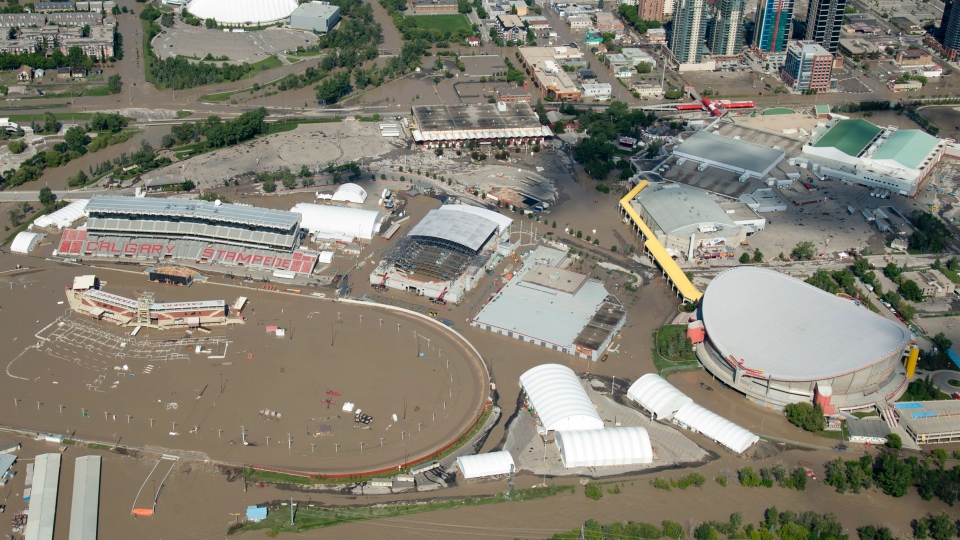
Much of Calgary’s downtown including the Stampede racetrack and saddledome was flooded out in the worst flooding in Alberta’s history.
Alberta’s rivers are not known for their floods. However heavy rainfall throughout the province of Alberta from June 19th to 22nd led to the worst flooding in the province’s history. Seven major Alberta rivers including the Bow and Elbow Rivers were filled hard and were over flooded to the point they caused huge damage to surrounding cities. The damage done to the city of Calgary received the most coverage especially since the flooding damage hit the downtown core bad. That and the fact that the annual Calgary Stampede was about to start. The stampede grounds endured considerable damage. Even venues like the Scotiabank Saddledome reported flooding up to the tenth row. In fact 26 surrounding neighborhoods around the Calgary area were placed under a mandatory evacuation order for three straight days. The 75,000 evacuees made it the largest evacuation in the city’s history.
It wasn’t just Calgary. The town of High River had to evacuate. The Siksika First Nation east of Calgary had to declare evacuation. Even towns of Banff and Canmore had to be cut off after floods and mudslides cut off much of the Trans-Canada Highway. Even cities like Lethbridge, Red Deer and High River had to declare their states of emergency. The flooding resulted in four fatalities in total.
The towns and cities continue their clean-up in the aftermath. One thing that did happen is that the Calgary Stampede went on as planned. Events planned for the Saddledome however were either cancelled or relocated to other locations in the city.
Toronto Flash Flood
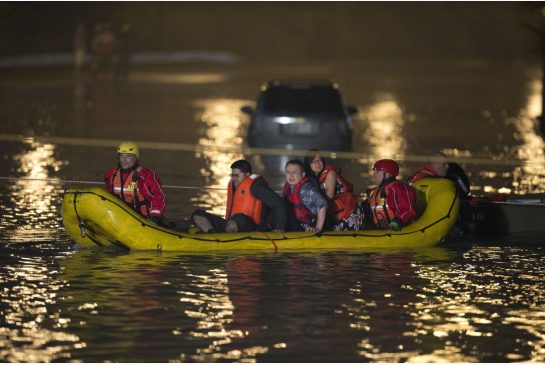
Soaking wet Go Train passengers are rafted to safety during a surprise flash flood in Metro Toronto.
Monday July 8, 2013 was expected to be like any other day in Toronto. If there was to be a thunderstorm, it was expected to be brief and pass by. However the afternoon provided some of the most serious thunderstorm activity faced by Toronto. Rain was delirious. Rainfalls ranging from 97mm in downtown Toronto to 126mm at Pearson Airport caused major flooding in many areas including the freeways and the subway stations. In fact news images showed a GO train with 1400 people that was caught in the floods. Power outages were rampant as 80% of Mississauga was without power as was 300,000 other people who received Toronto Hydro. A big surprise for a city that normally gets an average of 74mm of rain in the whole of July. Fortunately the floods have subsided and fortunately there were no fatalities.
Train Derailment In Quebec
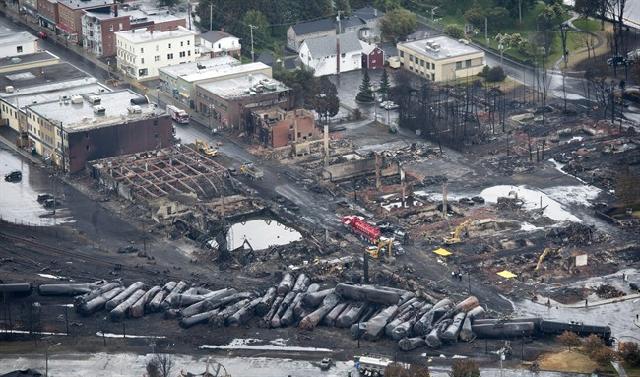
I saved to worst for last. Until a week ago, Lac-Megantic was a simple small town in Quebec close to the Canada/U.S. border. Since the early morning of Saturday July 6th, it’s the centre of possibly the biggest train accident of the year and continues to make more bad news with each day.
It was a simple train trip done many times before: a trip transporting oil from the United States to New Brunswick. Lac Megantic was just simply a town where the train was to pass through without disturbance or incident of any kind. The train set consisted of 72 tanks each filled with 113,000 litres of crude oil and had been transferred from train system to train system.
Burned out buildings and burned out oil tankers lay in the aftermath of a train derailment in the downtown of Lac-Megantic, Quebec.
Two hours before the incident while the train was parked in Nantes, the engineer left the train as he was done his shift. He felt however that it was unsafe since it was spitting oil and thick black smoke and wanted to call an American official about directives for the situation. Actually drivers who were driving along the train 40 minutes earlier complained of thick black smoke coming from the train. The Nantes Fire Department put out the blaze at 11:30pm and the train company employees confirmed the train was safe. However one failed to notice that the locomotive was tampered with. The train tanks, detached from the locomotive, started moving downhill at witnesses considered a dangerous speed. Then the unmanned train derailed in an area of downtown Lac Megantic, the tanks collapsed spilling crude oil on the ground and cause a huge fire 91 to 121 meters in diameter. Between four to six explosions were heard and heat from the fire could be felt as far as two kilometers away. Over 1000 of the town’s 6000 residents had to be evacuated. People in the third floor of burning buildings jumped to avoid being caught in the blaze.
Even as of now, there are no final statistics and new information is being gathered every day. 35 people have been confirmed dead but 15 remain missing. Thirty buildings in the downtown of Lac Megantic have been destroyed by the blaze. Information has surfaced that the locomotive is believed to have been tampered with. I’m sure more clues will come up in the future.
The Aftermath
With every disaster comes action. Not just action from emergency crews but action from all those involved including officials from the various industries affected. Here’s some of the action that has been taken so far. Remember these incidents happened three weeks ago at the most so there is still more action to come:
-The province of Alberta has started to create new flood-mapping standards such as categorizing high-risk flood areas. Some homeowners in high-risk areas are offered to move from their current location with financial assistance from the province or risk being ineligible for any future Disaster Recovery Fund assistance. Homeowners will be given new regulations in the future such as notating homes for sale being in a possible flood-risk zone. Even developers will be made aware of high risk areas.
-The City of Toronto will have to do some rethinking and reassessing certain aspects of the city. Especially the drainage system. Also Toronto transit will have to organize a better system of escape from its trains and subways to avoid a worse scenario. One thing is train riders who had to travel on the still-wet trains the following day were given a $100 credit to cover whatever dry cleaning costs. Hydro One had most of its equipment underground. It will soon review its standards and practices in the aftermath including bringing some equipment above ground.
-Once the clean-up and other activities from the Lac Megantic derailment are completed, you can be sure there will be a full inquiry on this incident. Even without the death count being finalized, this has already become the deadliest train accident in Canada since 1864. Montreal, Maine and Atlantic Railway (MMA) will definitely face the biggest heat from this as well as Transport Canada. Already the Transport Safety Board of Canada has started an investigation on this. The Red Cross has started emergency efforts in the town. Lac Megantic will have to make efforts to rebuild and have makeshift locations for businesses that used to exist before the disaster. You can be sure that certain people will be prosecuted for criminal negligence and the government agencies will set new regulations for dealing with petroleum-filled tanks.
It is a shock to see all of this happening in Canada in the span of one month’s time but it was possible. Nevertheless it is Canadian nature to take immediate action towards something like this. In fact a roof collapse in an Ontario shopping mall last year that caused the deaths of two people made national news and brought fast action. In some countries, you’d need a bigger fatality result to get major action happening. Only time will tell what the end results are and what actions come of these incidents.
This is the third year in a row a film representing Canada has been nominated for the Best Foreign Language Film Oscar. The film’s title is Rebelle (English title: War Witch) and it’s a surprisingly good film.
The film is set in Southern Africa: possibly the Congo. Komona is a young pregnant girl at fourteen telling her life story to her unborn baby. It all starts at 12 where she is captured by the rebel army and ordered to become a child soldier. The first order she’s given is to kill her parents. Since then she’s now the war lord’s. She’s constantly on the battlefront with the rebel squad’s killing missions. Her killing prowess wins her praise from the rebel leader Commandant-Rebelle and he even names her ‘War Witch’. However she’s haunted by the ghosts of those she killed. Including her parents.
At 13, she meets Magicien: a boy with albinism who will change her life forever. The two fall in love and agree to escape. Magicien wants to marry her but she insists on the promise she made to her uncle; if a man is to marry her, he must give her a white rooster. It almost appears to be an impossible task until Magicien comes across a community of people with albinism. There he finds a man willing to give him a white rooster. There’s just one catch. The rooster has to be let free and he has to catch it. Magicien accepts the challenge with the villagers watching. After a lengthy try, he does catch it. Komoma is his.
Soon the solitude and hope for a better future is under threat. She still has images of the ghosts of her parents. And the warlords capture Magicien and Komona. They order her to kill Magicien but she can’t bring herself to do so. Magicien is then killed by the war lords and she is kept captive. She knows she would have to kill her way out. She succeeds so just after the ‘rape trap’ she created works on the soldier who almost raped her. She escapes after killing him to the help of her uncle and aunt. It’s after the birth of her child she has to find a way to make peace with the past and rid herself of her parents’ ghosts for herself and her child.
A common theme shown in films and movies is seeing the images of beauty and hope in the midst of ugliness. This film features a modern ugliness in the world: child soldiers in African countries participating in fighting. It may be a civil war or a rebel mission but it’s ugly. Many like Komona are ordered to kill their parents and are a permanent part of the army. It’s a childhood stolen. Even some of the girl soldiers end up being victims of rape amongst the leaders. This film does show the ugliness that Komona experiences but it also shows moments of hope that she can break free from her captivity. We see it in her romance with Magicien. It’s a unique moment when two children ordered to be killers drop their guns and fall in love. We see it in the birth of her baby. We see it in the end as she’s on a truck full of people cradling her baby. Moments of beauty in the ugliest of time is the film’s biggest quality. We see it and feel it.
Another accomplishment of the film is its ability to make what’s normally unwatchable watchable. No one wants to see a child soldier who’s forced to kill her won parents. No one wants to see a child being raped, even though the actual act of intercourse is hidden. Nobody wants to see a young girl giving birth in the middle of nowhere. It’s realities but the type of realities that we don’t want to know about. What redeems it is the images of hope I just talked about. It’s those qualities in the movie that makes a movie full of unwatchable realities be watchable.
The direction and writing of Kim Nguyen is the best quality of the film. Born of a Vietnamese father and a Quebecois mother, this is only his fourth feature film but this looks to be the one he’s able to make a name for himself. This film shows all the right moments and presents the story excellently to the point that the images of the ghosts are seen as an important part of the film instead of something ridiculous. Also good is the acting of actress Rachel Mwanza. Interestingly is that she herself was abandoned by her parts and was a street child in the Congo. She did an excellent acting job here with no phoniness. The acting of Alain Lino Mic El Bastien and Serge Kanyinda was also very good. The inclusion of both a score and African folk music also added to the atmosphere of the film.
Rebelle has already generated a lot of buzz outside of its Oscar nomination. It was in competition for the Golden Bear award at last year’s Berlin Film Festival and Rachel Mwanza won a Silver Bear for her acting performance as well as a Best Actress award at the Tribeca Film Festival. Other accolades it has received are Best Film from the Cambridge Film Festival, ranked in the Top 5 foreign language films for the National Board of Review awards and nominated for five Canadian Screen Awards; Canada’s own Oscars formerly known as the Genies.
Seeing how a movie situated in Africa makes for some interesting discussion how it can become an official entry in the Best Foreign Language Film category for Canada. It is because director Kim Nguyen is from Quebec. If you have seen the film, you’d notice that none of it is situated in Canada nor is there any mention of Canada in the screenplay. There’s some dialogue in French with the rest being in Lingala but that’s it. The Best Foreign Language Film category is a category that is always under frequent debate. First there’s the imposed limit of one film for every country submitting an entry into that category. Then there’s the language question. I guess it will continue to be a topic of discussion over the years.
Rebelle is an excellent story of finding hope and the survival of the human spirit in one of the darkest situations in the world around right now. Its story of love and hope is its best quality and makes it all that more memorable.
Quebec premier-designater Pauline Marois avoided being shot by a crazed gunman on Sept. 4th. One man was killed and another critically wounded.
The news shocked all of Canada. On September 4, 2012, Parti Quebecois leader Pauline Marois won the Quebec provincial election. She was to give her victory speech at the Metropolis in downtown Montreal when a masked gunman opened fire, killing a stage technician and injuring another. Marois was unharmed. It has not been determined whether this was meant to be an assassination attempt on Marois or not. Even if it was, politically-motivated assassination attempts in Canada are extremely rare. Nevertheless the shooting did remind us that such a catastrophe is very possible here in Canada.
Throughout the beginning of time, being a political leader has always been a position to put one’s life in jeopardy. The King of a country would be seen as the prime target for warring armies in the quest to conquer. A leader could even be assassinated by a person within their circle as Julius Caesar was. Even in modern day dictatorships or dictatorships of the recent past, a head of state would be prey for assassination attempts like Fidel Castro, Saddam Hussein, Salvador Allende or Anwar Sadat. The assassin would either be an person of opposition or a militarized coup.
Even in democracies assassination attempts are still common as was the failed attempt on UK Prime Minister Margaret Thatcher in 1984 and the successful attempts on India’s Indira and Rajiv Gandhi in 1984 and 1991 respectively. Even countries with a reputation of being peaceful like Sweden are not immune to assassination attempts as was the case when Prime Minister Olaf Palme was shot and killed in 1986. The most famous assassination attempts in a democracy have come from the United States. Four presidents including legendary presidents like Abraham Lincoln and John F. Kennedy have been assassinated while in office. In 1981, President Ronald Reagan was shot while in office but survived. The most recent assassination attempt on an American politician was on January 8, 2011 on Arizona US Representative Gabrielle Giffords. She survived but six others, including US District Court Judge John Roll, were killed.
Here in Canada, we’re lucky not to have a prime minister assassinated while in office. Even infamous prime ministers like Brian Mulroney lived to see his last day in office and even Stephen Harper is still alive and active during a time of Harperphobia that’s heavily promoted through the gab of liberal Canadians. The closest call was on Jean Chretien back in November 5, 1995 when a man armed with a knife broke into his home residence to stab him. Neither Jean nor his wife were hurt.
There have only been two successful assassinations in Canadian politics. The first is Thomas D’Arcy McGee. He was both an Irish nationalist and a father of Canadian Federation. He would attack the Orange Order in his writings in the 1850’s and defended the Irish Catholic right to representation in the assembly. He was elected to the Legislative assembly of the Province Of Canada in 1858 and played a significant role in the creation of the Dominion Of Canada. Less than a year after the independence of Canada, McGee was shot to death by Patrick Whelan, an Irish Catholic and a sympathizer of the Fenians: a group of Irish Americans who wanted to take over Canada to prevent British occupancy. Whelan was hanged. McGee remains the only Canadian politician at the federal level to be assassinated.
The second successful assassination was at a provincial level and an act of terrorism. Pierre Laporte was Vice-Premier and Minister of Labour of Quebec in 1970 as Robert Bourassa was the Premier. On October 10, 1970, Laporte was kidnapped outside his home by a cell of the FLQ: A Quebec independence terrorist group. The FLQ was already regarded as a dangerous group for it had already committed seven murders, multiple mail bombings in the 60’s and bombed the Montreal Stock Exchange one year earlier. A British diplomat had been kidnapped days earlier and was still hostage. Laporte’s abduction was part of a ‘political protest’ to have ‘political prisoners’ freed. The Government of Canada under Pierre Trudeau responded with the enactment of Canada’s War Measures Act and Trudeau’s promise to punish whoever harms the two men. On October 17th, seven days after the abduction, Laporte’s body was found. The incident is remembered in Canadian history as the October Crisis. The British Diplomat was released in December and the FLQ eventually declined due to heavy police crackdown and declining public support after the assassination. Nowadays the biggest lobby for Quebec independence is through peaceful political lobbying like the Parti Quebecois.
Despite current politics in Canada being mostly peaceful, there is a chance for violence either by a cowardly person or a person with opposing viewpoints. We shouldn’t forget that Canadians have often reacted angrily to political situations in the past. We’ve had rebellions in both Lower Canada and Upper Canada before the Dominion was created. We’ve had rebellions in Manitoba in the 19th Century like the Riel Rebellion. We’ve had labor riots in various cities with the Winnipeg Riot of 1919 being the most famous.
Political violence became less admired and more looked down upon since World War II but it’s not to say it’s completely gone away. Back in the 60’s there were attacks on air force bases to protest the war. In the 80’s and 90’s, there were protests and blockades from First nations groups. Even in my city of Vancouver, there have been political riots like the G7 riot back in 1997 and various anti-Olympic protests before Vancouver 2010. There was also the G8 riot in Toronto from anarchist groups. So there’s no doubt that there’s political anger here in Canada that can turn violent.
I won’t say that the Montreal shooting was politically motivated as that has yet to be proved but I will state the facts I’ve read and know as of now. On the night of September 4th, 2012, the Parti Quebecois won the provincial election with a minority government. Party leader Pauline Marois delivered her victory speech when partway through, a masked gunman opened fire with what many thought was an AK-47. One stage technician was killed and another was injured. Marois was taken away by her bodyguards and was unharmed in the shooting. The gunman then attempted to set fire to the building with a Molotov cocktail. The shooter was quickly tackled and arrested by the police.
The victim was 48 year-old stagehand Denis Blanchette. Witnesses including Marois herself believe his actions taken that night could have prevented more fatalities. His funeral was held in a Roman Catholic church and was attended by hundreds including Marois and other political dignitaries. Police were present throughout the church. Dave Courage, the 27 year-old man who was also shot, was originally in critical condition and continues to recover in hospital. The suspect is 62 year-old Richard Henry Bain of La Conception, QC, a small town 90 miles northwest of Montreal. He faces 16 charges including first-degree murder, one count of attempted murder as well as possession of explosive material and prohibited weapons. While being placed in a police cruiser, he yelled in French “Anglos are waking up.” then in English: “It’s f***ing payback time.” Crown Prosecutor said Bain has 27 guns, all but one had been registered.
Bain is expected to reappear in court on October 11th. Despite the statement, it’s unknown whether Bain’s actions were politically motivated or the actions of a crazed man. Court trials and public reaction will define the events yet to come and could even affect the political climate in Quebec. One thing about the shooting is that it reminded Canada that political assassinations in Canada are quite possible. An extremely rare chance of happening but still likely.
If a Canadian movie has a Best Foreign Language Film nomination, do you think I’m going to go see it? Of course I’m going to go see it. For the second year in a row and for the sixth time ever, a Canadian film was nominated for an Oscar in that category. This year’s nominee is titled Monsieur Lazhar.
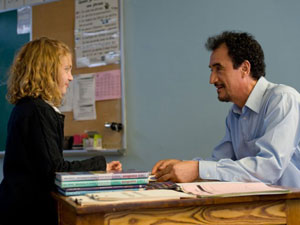
The film starts with what is to be a typical day at a Catholic elementary school. A boy named Simon is getting the milk for the day. As he walks into his classroom alone, he discovers his teacher Martine hanging. This is very hard for the students and the school. One of the difficulties is finding a new teacher for the students of the deceased teacher’s class. In walks Bachir Lazhar, an Algerian immigrant. They are hesitant at first but they agree to hire him.
Known to few is that Bachir’s immigration status is in question by the courts. A package he receives comes into question. The immigration court asks him why he won’t return since ‘Algeria is back to normal’ but he replies “Nothing is ever really normal in Algeria.” The interrogations eventually get frustrating to the point Bachir admits of the fire in Algiers that killed his wife and children back in the 90’s. That fire was no accident.
The class tries to move on as usual. For some students, it goes fine. For others like Simon and Alice, who witnessed their teacher hanging, it’s difficult and painful. Alice is more vocal about her difficulties. She makes a speech in class about violence and how the hanging has an effect. She also has a softer side and develops a liking for Monsieur Lazhar, even learning about his home city of Algiers. Simon is more reserved and difficult. He’s not the same since the hanging and appears like he has something to let out but can’t. He even resorts to fights with other students. Home life isn’t easy for him because his parents are rarely there. However something has to be done as it’s discovered he has a picture of Martine which he drew angel wings and a noose on.
Dealing with the students is not an easy task to do either. The elementary school is worried about the suicide being brought out into the open. Plus teachers are now under strict limits over what to deal with students’ issue and how to deal with them. The new laws set twenty years ago changed lots to how a teacher can function towards a student. This is hard for Bachir as he wants the students to heal from this trauma. Especially Simon, whom the teachers are considering expelling. We learn shortly before Martine hung herself, Simon was hugged by Martine while he was crying but told his parents she kissed him. The parents came down hard on her.
What happens in the end is one scenario ends on a bright note and another scenario ends on a low note for Bachir. In the end we get a turnaround that’s more valuable than Bachir keeping his job as a teacher. Something that the school board could never give the children.
The role of Monsieur Lazhar was that of a man who would help bring help when it was needed unexpectedly. Right at the beginning of his teaching he would tell the meaning of his name: “Lucky” and “Tell the good news,” In the end, he was the lucky one who would give the good news to the children. The students in turn would be the lucky ones as he would help the most troubled of the students heal from the trauma. He would succeed where the school board and the counselor would fail. Even in the end, his impulsive helping of the students would be too much for the school to handle. The ending would show the common belief that no good deed goes unpunished but it’s not without its rewards. Bachir Lazhar would give to the students and he would receive from them as well. His teaching of the students would also help him in terms of his own healing from the loss of his own family.
The best quality of the movie was in its gentle storytelling. We have a situation of a troubled school being taught by a teacher with a troubled past of his own. He faces two pressures of keeping his new-found job, keeping the peace of his classroom since the suicide, maintaining the peace of the school and being able to stay in Canada to avoid persecution back home in Algeria. All of this was told in a gentle manner that would keep the audience intrigued and hoping for the best for Bachir Lazhar and for Simon and Alice. That was its best quality.
The acting overall was excellent and stuck to their parts well without coming across as showy or phony. Mohammed Fellag was excellent playing a teacher with a troubled past thousands of miles away. The children were also good as they played genuine child roles instead of the typical cutesy acting Hollywood normally gives them. Their feelings, traumas and actions were not over-the-top either. The directing and scriptwriting of Phillippe Falardeau was also well-written, although not a standout. Known to few, Monsieur Lazhar is actually an adaptation of a one-man monologue. Falardeau did a very good job in creating and directing a script with a multitude of actors. He did a very smart job in making the story very real.
Intersting how Monsieur Lazhar gives Canadian film a unique achievement. This is the first time Canadian entries in the Best Foreign Language Film category has been nominated for two years in a row. Last year was Incendies. Interestingly two of the three producers of Monsieur Lazhar also produced Incendies. The Oscar nomination isn’t the only acclaim Monsieur Lazhar has received. The film also won the Viewers Choice Award for Best Canadian Film at the Toronto Film Festival, Best Film award at the Valladolid Film Festival and has been nominated for nine Genie Awards, Canada’s national award for filmmaking excellence. Surprisingly, it was not shown at the Vancouver Film Festival. It’s a shame because I would have liked to have seen it if it was out then.
Monsieur Lazhar is a film that starts out on a dark subject but it ends on a bittersweet positive note. The warmth of Monsieur Lazhar reminds us how people can succeed where the system fails. We need more people like Monsieur Lazhar out there.
 Shorts, shorts, shorts. Lots of them worth seeing at the VIFF. The next segment I saw this year Space And Time which consisted of nine shorts filmed by Canadian directors. They were all different but all shared something in common:


 Jon The Blogcentric