Summer Movie Summary: Superhero Movies

If there is one genre of movie that stands out during the summer movie season, it’s the superhero movies. Every year they win crowds and give them their enjoyment for the most part. For this summary, I will review two such movies: Captain America: Civil War and The Suicide Squad. Both are two different types of superhero movies in the way the people try to be heroes and with the comic franchises: Marvel vs. DC once again.

Captain America: Civil War

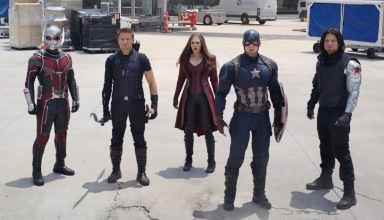
captain-americaWhile DC Comics has the two biggest superheroes, Marvel’s edge is its multitude of different superheroes: take your pick. This time around in Captain America: Civil War, the focus is on Captain America. Or is it?
Watching the film, I was expecting it to be a story about Captain America. You can imagine my surprise to see all the other Avengers characters. I was cool with it at first. However things started getting uncomfortable for me when I saw them take up so much screen time. They all took up so much time, I even questioned whether Captain America was even the lead role in the film. I even thought if it was to have one hero as the lead role, it should probably be Iron Man.

Nevertheless the film does have a lot of excellent qualities. The first is a story that is thought-provoking. There’s a situation where international rules are imposed on the Avengers. Right when an incident happens, it causes friction within the team and even division. The question remains of what is the right thing to do? The movie attempts to give you the answer. Virtues and morals are an uncompromisable ingredient in superhero movies no matter how much action is involved. Even top directors will say that the values of humanity are necessary for a winning superhero movie. Here we have a movie that gets one questioning what is the right thing to do considering the situation. That adds to the film as it gets the audience thinking.

Of course high-tech special effects and action battles are a must in superhero movies. The crowds come to get blown away. Captain America: Civil War delivers on such action just like most of the Marvel comic movies before it. It has moments that will leave you on the edge of your seat. In addition, it adds some comedy too as it gives us a young Peter Parker, played by Tom Holland, as a preview for the new upcoming Spider-Man installment. Here Peter comes across as your typical young idiotic yuts. Gives anticipation of what to expect when Spider-Man comes out.

The Russo brothers return to direct the movie. They directed the last Captain America movie. They did a very good job of delivering another great superhero movie. Christopher Markus and Stephen McFeely return with the Russos to write the latest installment. They did a good job despite the push of some actors to have more screen time. Of course, Robert Downey Jr. stole the movie and Chris Evans appeared to have a supporting role this time. The other actors did their parts well and didn’t appear to get into too much of the mix-up. The special effects delivered and Henry Jackson’s music added to the film.

For all intents and purposes, Captain America: Civil War is an Avengers movie in disguise. Don’t be fooled. However the quality of the story is maintained as it gives a thought-provoking story with the superhero action to deliver.

Suicide Squad

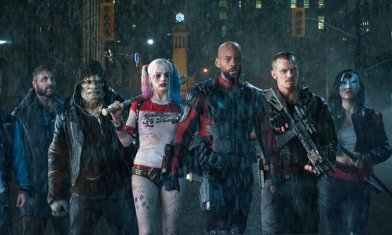
suicide-squadThere’s something about the knack to do an anti-hero movie. We saw that with Marvel when they released Deadpool. Now we see DC Comics making the attempt with the Suicide Squad. Do they succeed?

You’d think after Sausage Party, I’d start again on how this movie of a bad-guy superhero squad is trying to ‘bring back the 90’s’ but you’re wrong. A story where it takes bad guys and makes heroes out of them is actually a very common theme. It’s even been done in film as far back as the 1930’s as I once saw 1939’s Stagecoach take the outcasts of society and turn them into heroes. It’s a theme that has been done decade after decade. We see it done here again with the Suicide Squad. The people recruited to be part of the Squad are criminals and crazies that look like they deserved to be shunned away from society but an intelligence operative sees them as the right people for the job. They even make clear that they’re bad, not evil.

The ‘bad vs. evil’ theme is what makes this movie unique among the superhero movies of this year. Even from Deadpool. While Marvel’s Deadpool is about a selfish man who’s disinterested in being the superhero bestowed upon him, Suicide Squad is about a conscience present in even the baddest of badasses. A reminder that bad and evil are two completely different things. Don’t forget we’re dealing with a world where Superman is deceased, as exhibited in Batman vs. Superman: Dawn Of Justice months earlier.

Now the Suicide Squad is not a team of badass superheroes created in vain after Deadpool: an attempt at having ‘anti-Avengers.’ It’s a team that actually debuted in DC Comics in 1959 in their monthly Brave And The Bold series and made a return in 1987 in their Legends series back then. The comic would be a monthly series that would issue for some months, end temporarily for a year or two and then make a comeback from time to time. Now seems like the right time to bring them to the screen. I must say their craziness and eccentricities were big time scene-stealers. While Deadpool mostly relied on the idiotic actions and lines from its lead characters, the characters of the Suicide Squad were more about their crazy and even eccentric personalities. That was their edge and I’m sure that’s what won the crowds to them this year. It’s no wonder it’s the 4th highest grossing movie of the summer.

This is David Ayer’s first attempt at directing and writing a superhero movie. He has a resume for writing and directing a lot of good police dramas and action movies in the past. However his experience doesn’t completely translate the best. Imperfections are easy to notice and it seems the movie does get a bit disjointed at times. Even in terms of the characters, there’s not that much depth to their roles and it often appears like the actors are trying to play characters more than acting out roles. I’ve noticed that DC Comics movies this year are lacking in terms of writing. It’s noticeable in Batman vs. Superman too.

Nevertheless the actors do deliver on character acting and that’s one quality I feel made the movie. In addition the actors succeeded in making characters you want to hate at first and then surprise you as they become heroes and then return as bad guys. Margot Robbie was the standout as Harley Quinn. Her character was the one that knew how to grab your attention, even upstaging Will Smith.  Others standouts include Jared Leto as the Joker, Jay Hernandez as El Diablo and  Jai Courtney as Captain Boomerang. Visual effects were top notch and loaded with bright color that’s eye catching and very rare to see in most other movies, especially superhero movies. The mix of music was also an added quality. It seems like after Guardians Of The Galaxy, filmmakers are playing around and even experimenting with use of songs in the movies. Here they mix in music spanning five decades and it produces an entertainingly winning result.

Suicide Squad may be lacking in the script and in the editing but it’s the on-fire character acting, colorful visual effects and the eclectic music track that make the movie entertaining and a winner for the summer.

Sure, I only have two superhero movies in my summary of the genre but both do shed some light on the presence of the superhero movies of the summer and why they continue to win us over. They have spectacular action but they also test our conscience as well. I saw that in Batman vs. Superman earlier in the role of a superhero even after they cause destruction to do good. I see it again in Captain America as the Avengers question whether it’s right to break the law to do what’s right. I also see it in the Suicide Squad as outcasts get a shot at redemption and even remind themselves as well as others that they do possess a conscience and can even do what’s right despite their criminal minds.

Once again, the superhero genre remains one of the most winning movie genres of the summer. Even with the surprise success of Deadpool, families still come to the movies to see the good guys win. Some even like to get their ‘bad boy/bad girl’ kicks. All deliver in terms of action and a message.

Election 2015: Canada Votes

ElectionsCanadaToday on October 19th, all of Canada will vote for who will lead the country over the next four years. For over ten years and three terms, Conservative leader Stephen Harper has led Canada. He seeks a fourth term but faces tough opposition from Liberal leader Justin Trudeau and NDP Leader Tom Mulcair. Possible challenges come from the Bloc Quebecois and Gilles Duceppe and the Green Party under Elizabeth May. One thing about this election is that it has proved that anything can happen and no one is guaranteed the label of ‘winner.’ It’s been that close and full of yo-yo statistics. Here’s my rundown:

-Conservative Party: Stephen Harper – You can’t go anywhere without people talking about Stephen Harper. He ran for Prime Minister for the first time in 2004 and was seen as the one to help put conservative muscle back into Canadian politics. Even though he didn’t win, he did succeed in bringing the conservative side back into politics. The Conservative party had 99 seats, up from 72 in 2000, and the victorious Liberals under Paul Martin were left with a minority government after three terms as a majority under Jean Chretien.

Then in January 2006, a new election was held at the sudden revelation of the corruption of Liberal leader Paul Martin and after Governor General Michaelle Jean dissolved parliament. This worked for the benefit of Stephen Harper as the Liberal Party lost enough seats to give Harper’s Conservatives victory. Sure it was a minority with 124 seats but it was enough to give the Liberal party their first loss on the national level since 1988. This meant new changes for Canada with a Conservative government having most of the power albeit only with a minority.

There were many varied opinions about the first term of Stephen Harper. There were many on the left who felt he was too right-wing or making a lot of decisions they felt were wrong. There were others who admired him simply because ‘he says he’s gonna do some thing and he does it.’ I think that’s what wins people: a politician that actually delivers on their claims. This was enough for Harper to be able to win the next election in 2008. He increased the number of seats from 127 to 143 but it was still a minority.

Over time, people across Canada, especially in BC, were expressing their disappointment with his policies. I especially remember the arts community unhappy about the cuts in funding they were dealt in 2008. Then in March of 2011, the Conservative Party was found to be in contempt of parliament. The Government General, like in 2005, again dissolved parliament. This time things went the reverse. Harper’s Conservatives won a third term, this time with a majority of 166 seats.

The time since has been loaded with corruption and complains to Harper and the Conservatives. They run the gamut from political overspending on advertising to reducing door-to-door delivery of mail to the point there will only be mail boxes by 2019, to denying funding for science to promoting the controversial Keystone pipeline for boosting the export of crude oil to the controversial bill C-51 which appears to threaten Canadian’s privacy freedoms the same way the Patriot Act threatened Americans’ privacy rights. A lot of his misdoings appear to make good things he did like provide tax breaks to families and transit users.

-Liberal Party: Justin Trudeau – The Liberal party is one party that has had its biggest struggles ever these past ten years. It started with the Paul Martin fiasco leading the Liberals to their first ever election loss after winning the previous four. It continued with Stephan Dion in 2008 as their seat total declined from 95 to 77. However it was at the 2011 election under Michael Ignatieff where the Liberal party hit what appeared to be rock bottom by winning only 34 seats. They weren’t even the official opposition. After Ignatieff’s resignation just days later, they looked for a leader who could fill the spot. They found it in Justin Trudeau, the 43 year-old son of Prime Minister Pierre Elliot Trudeau. In fact, Justin was born while his father was Prime Minister.

The buzz around him grew but it hasn’t been without controversy. Justin has been faced with accusation that he’s riding off the coattails of his father’s legend. His only jobs before have either been a raft guide or a school teacher. This was especially noteworthy in Stephen Harper’s ads attacking Trudeau with the claim he’s “Just not ready.” It included the comment, ‘Nice hair, though.’ I myself even felt he didn’t deserve my vote because “He hasn’t proven himself politically. He’s all image and no real cred.” Even some of his campaign claims like his promise to legalize marijuana or prostitution have caught the disgust of many. Last poll had him in the lead. Whatever the situation if he wins, he will have to prove he deserves it.

-New Democratic Party: Tom Mulcair – The 2011 election was a landmark for the NDP. Actually it started months after the 2008 election when the NDP led by Jack Layton teamed up with the Liberals for a coalition takeover of parliament in order to reduce Harper. It didn’t work but it did catch the eye of the nation and it caused Canadians to look more favorably to the NDP party: a national party who were often lucky enough to just finish third in national elections.

The 2011 was a landmark for the party as they won 103 seats, up from 36 and the most they’ve ever won. Leader Jack Layton became the head of the official opposition. He only had months to enjoy his victory as he would die of cancer later that year. It would take time to find a new leader of the party and they found it in Tom Mulcair. Since he assumed power, he has been seen as Harper’s toughest political rival most able to put pressure on the Conservatives. He has hoped to take that with him to the election. It worked in August when the campaign trail began. However the NDP have been in a struggle since to win back the approval ratings they had back then and sit third. Only tonight’s election will tell the tale.

-Bloc Quebecois: Gilles Duceppe – If any party has had it harder than the Liberals since 2011, it’s the Bloc Quebecois. It’s not even just because of slipping to two seats. It’s of going through three different leaders after Duceppe resigned from incumbents to leaders voted in. After all the frustration, Duceppe is back in. He’s hoping to bring the Bloc’s power back into Canadian parliament and push for Quebec independence.

-Green Party: Elizabeth May – One party on the grow is the Green Party. They’ve been around for decades but it’s only in this century that they’ve been able to see their political power grow. I know. I’m from BC where the Green Party appears to have possibly its biggest support. Elizabeth May has done a lot to boost this party which holds left-wing policies and ideas noticeably different from the other two leading liberal parties: Liberal and NDP. In fact the Greens won their first ever seat in Parliament back in 2011 but it was not May.

The Green Party may have a candidate in almost every riding and their policies may appear to be the best for the country but they still have to develop more political muscle before they can be considered a serious contender. However May has done nothing wrong as a leader and should keep doing what she’s doing and take it further.

Since the start, the election has been called anyone’s game and hard to predict. The NDP had a lead at the start but it appeared to deteriorate over time and they hang at third in the polls. Harper and the Conservatives only had a brief lead in September for a week or two but found themselves soon slipping and now find themselves at second. Right now the Liberals lead at 37% at the last polls. Anything can happen on Election Day. In fact in BC, Christy Clark’s Liberals were expected to lose according to the polls but they won. The biggest shocker is the advance polls held during the long weekend of October 9-12. Voter turnout was way higher than expected. An increase of 16%. The increase resulted in a lot of long line ups. I myself had to wait almost a full hour to vote. nevertheless this is an optimistic sign as it shows more Canadians are willing to vote in this year’s election as compared to 2011.

Whatever the situation, it will be decided by 8pm Pacific Time who will be the Prime Minister of Canada. It could be decided earlier upon final results in Ontario but you never know. Anyways history will be decided tonight.

Funny thing but if the US presidential election can best be described as “two five year-olds fighting over the same toy,” what should the Canadian national election be described as?

Movie Review: Into The Woods


Meryl Streep plays a witch in control of the fates of fairy tales in the film adaptation of Into The Woods.

Into The Woods is the latest Broadway musical to hit the big screen. The question is does it entertain and charm well enough for moviegoers?

The film begins just as the fairy tales do so: Little Red Riding Hood is about to go to grandma’s with her basket, Jack has to sell the cow as she’s getting old, Cinderella is being mistreated by her stepmother and stepsisters, a lonely couple want a child, and Rapunzel is imprisoned in a castle by the Witch. The Witch puts a request on the couple. You first thing it’s just Rapunzel’s hair but she also asks for a red cape, a white cow and a golden slipper.

As they search the stories proceed: Riding Hood is lured off the path by a wolf, Jack goers to market but will only accept an offer that would mean the return of his cow, Cinderella arrives at the ball. However the couple find their way into the story or pass by it: Jack receives magic beans from the husband, the wife tries to swipe Cinderella’s slipper off her feet after running from the ball, the husband passes the tower Rapunzel is kept captive in, and both notice Riding Hood’s cape.

After a series of misadventures, the couple has all the items needed to produce the spell to receive their baby, all the fairy tale characters have their expected happy endings and the witch is able to regain her beauty with the potion. However the ‘Happily ever after’ endings don’t end up being so happy after all. The Baker worries he might end up being a poor father to his son just like his own father, Cinderella loses her charm for prince charming and the lavish life with it, Rapunzel is scared by the outside world, the witch loses her powers with her returned youth and Jack is pursued by the giant’s wife –ahem, widow– who came down to earth via a second beanstalk and demands Jack or she will destroy the village and its inhabitants.

Soon everything goes opposite to what’s planned. Casualties include the Baker’s wife who fell for Prince Charming before her accidental death, Rapunzel as she ran off forever with her prince, Riding Hood’s mother and grandmother, and Jack’s mother. The latter three killed in the Giant’s Wife’s rampage. On top of it, Cinderella and Prince Charming part ways. At first those still standing–the Baker, Cinderella, Jack and Red Riding Hood– think that Jack should be offered back only for them to blame each other. Nevertheless they do work things out, defend against the Giant and there’s the genesis of a new fairy tale the Baker reads to his son.

I have to say as a musical, Into The Woods was probably not the first time fairy tales have been mixed together to surround a main plot. It’s not even the first in motion pictures. Remember Shrek? What it needed to do was stay true to the fables while mixing the story of the baker and his wife as well as the haunting of the Witch during the first half and then allow for a believable twist to the fables we all know to occur in the second half. Even though the twist occurred starting with the giant’s wife appearing, all the twists of the stories had to appear sensible and pertinent to the original story. Some of the twists were very surprising and even tragic but it did come together in the end. That’s how the stage musical of Into The Woods worked.

The next trick was to bring Sondheim’s musical to the screen. Putting a stage musical to screen is a very difficult thing. There’s a lot of decision-making on what from the stage play to leave in and what to leave out. That would fall into the hands of director Rob Marshall and scriptwriter James Lapine who wrote the original Broadway version. However when it’s Disney that buys the rights, you think it would be a big break but there was an added challenge. Naturally with this being a musical about a mish mash of fairy tales, Disney would want to make this a family film and that could be intrusive to the control Sondheim and Lapine have over the play. This was not the case as both Sondheim and Lapine insisted to Disney that any changes would have to be approved by them. Even then, they would have to work within time constraints and keep it to a respectable running length.

In the end, Sondheim, Marshall, Lapine and the production company were able to create a finished adaptation 125 minutes in length that brings the musical to a big screen audience with big-name stars and additional musical talents. I myself cannot compare the film to the stage version since I’ve never seen the stage version. I will start by saying it doesn’t surprise me that Disney acquired the rights to adapting the musical to film as Disney is world famous for bringing fairy tales to life. I will say that one can do a good job differentiating the actors who know how to do musical acting and those who don’t. You just know it. There were some like Chris Pine and Mackenzie Mauzy who struggled, there were some like Billy Magnussen and James Corden who could have done a better job, there are some like Daniel Huttlestone, Lilla Crawford and Tracey Ullman who know how to deliver both singing and acting and then there are actors like Emily Blunt and Meryl Streep who are able to deliver a performance in a musical. Meryl was especially excellent as she had the role that would hold the film all together. Musical film is another genre she can add to her list of accomplishments.

I will say that the film adaptation did very well in terms of special effects and set design to give the fell like there really was one terrain in the world where all the original stories happen at once. Colleen Atwood once again knows how to create the right costumes for the movie. The music was not a problem at all as the songs were well-sung and fit the scenes well. The film also did a good job of handling the story where all the fables get their twist in the end. However the film does leave some noticeable things out. There are some times where it felt the story had key scenes left out like the big bad wolf living in the tree about to eat Red or Jack in the giant’s house or Cinderella’s fairy godmother creating her clothes for the ball. There were even some times when one could easily forget that this is a musical and it would take a song some time later to remind you. There were even a couple of scenes that made you wonder if it should have been kept in. I can’t think of a better way to do it but I’m sure there are areas that could have been done better. Rob Marshall did a very good job of directing. It’s fair to say this is his best work since Chicago but there are some areas I feel he could have been better, like not having us forget this is a musical in some areas. It may not completely be his fault as the script was written by James Lepine. Lepine may be an accomplished scriptwriter and director in musical theatre and this may be Lepine’s best musical ever but somehow he could have done a better job at a stage-to-screen adaptation.

The film adaptation of Into The Woods has been long awaited. Now that it’s here, it’s imperfect but very enjoyable and entertaining.

Oscars 2014 Best Picture Review: The Theory Of Everything

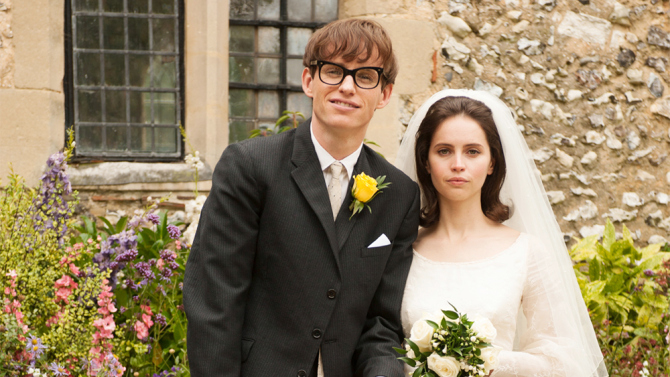
The Theory Of Everything is as much about Jane Hawking (played by Felicity Jones) as it is about Stephen (played by Eddie Redmayne).

When you hear about The Theory of Everything being about Stephen Hawking, you’d probably assume it’s about his scientific conclusions. You will actually be quite surprised.

Stephen Hawking is an astrophysics student at Cambridge in 1963. Stephen is awkward-looking, rather clumsy and already his imaginative thinking is being noticed by students and professors with varying reactions. One night, he meets Jane Wilde, a literature student. They form an unlikely couple with Jane actually taking an interest and liking in Stephen’s imagination.

The following year, there are two incidents that will change Stephen’s life: the first being a lecture on black holes which inspires him to write a thesis about time; the second being when he learns he has ALS–Lou Gehrig’s disease– and is given two years to live. Stephen becomes a recluse upon hearing the news but Jane tells him he loves him and will marry him. The two marry and they have a son Robert.

Stephen continues giving lectures as his condition deteriorates from using crutches to needing a motorized wheelchair and even talking with great difficulty. Jane is always there to help him but it’s becoming very hard on her. Nevertheless he continues to give lectures about black holes, evolution and time to top professors. Some professors find it erroneous while others praise it and give him an honorary doctorate.

Over time Hawking continues to win more acclaim in the science world including becoming a world-renowned physicist. Nevertheless the fame and his physical condition is making it hard for Jane both as a wife and as an educator. Upon her mother’s advice, she joins the church choir where she meets conductor Jonathan Hellyer Jones. Jonathan becomes a friend of the family but the birth of her third child causes suspicion from her mother if Jonathan is simply a friend. Jonathan senses the suspicion and leaves the family for a bit but Stephen tells Jonathan himself she needs him.

While Stephen’s in Bordeaux, Jane has a camping trip with Jonathan and the children and it’s obvious their feeling for each other are shown. The trip ends as Jane learns Stephen contracted pneumonia and needs a tracheotomy in order to fight this. Jane agrees. However Jane finds dealing with Stephen too difficult and hires a helper named Elaine. Elaine works well with him on the letter board. Then computerized technology comes in play and Stephen is able to communicate with a talking machine. He’s able to speak better with the machine than he did when he still had his own voice. It enables him to write a book where he dictates and Jane and Elaine type. The book, A Brief History Of Time, becomes a best-seller and wins Stephen worldwide renown. However it does mark the end of the marriage as he plans to accept an award in the US with Elaine instead of Jane. Nevertheless the film ends on a positive note leaving one to believe Jane and Stephen are still soul mates despite no longer being married.

The remarkable thing about the film is that it shows Stephen Hawking in a light we don’t normally notice. Yes, it shows Stephen and his scientific thoughts. Yes, it shows Stephen in his wild imagination. In fact there are times when it makes Stephen look like the Albert Einstein of our times. However it also shows other aspects of Stephen like how ALS can paralyze his body but not his mind. It’s safe to assume ALS made him a stronger person and the movie shows him acquiring his personal strength over time. He was expected to live only two years when he was first diagnosed and he’s still alive today. It shows how he won’t even let ALS stop him from getting a Penthouse subscription. It also shows him as a father and a husband but also a man with some personal weaknesses such as being sucked into his new-found fame and falling for his assistant Elaine.

But somehow it often appears the movie is not about Stephen. It appears more like it’s about Jane. We shouldn’t forget the film is based off of Jane’s memoirs of being Stephen’s wife. It shows Jane as she’s first attracted to Stephen despite being nerdy and having an eccentric mind. It shows her as the one who got Stephen out and living right after he learns he has ALS and even marries him. It shows her as the one that stood behind Stephen every time he gave a lecture on his Black Holes Theory even when top professors would dismiss it as rubbish. It also shows her as the one who helped Stephen write his legendary book with his talking machine. It almost appears like she was his arms and legs.

The film however does make Jane out to be a saint. It does show Jane’s struggle of being both a wife to a man with a disability. In fact it was the scene when Stephen is playing croquet just after his diagnosis and Jane sees how much it’s deteriorated him that sent me the message this movie could be about Jane. Despite Jane doing her best to be a supporting wife, there are times she can’t hide the frustration and it upsets her. Her frustration is a common frustration people who are spouses with disabilities go through. The film also shows Jane in another flawed light when she falls in love with Jonathan and has a long affair. This film highlights Jane’s own flaws as it highlights Stephen’s.

Without a doubt, the highlight of the film has to be the performances of the two leads. Eddie Redmayne was beyond dead-on as Stephen. In fact it’s the scene of the divorce where Eddie playing Stephen said more with  his face than his talking machine did that caught my attention. There were many times in the film Eddie was able to say more in silence as Stephen than when he was talking. From beginning to end he was excellent and embodied the ALS flawlessly. It wasn’t just the ALS. Eddie also gave us an inside look into Stephen’s imagination which adds to the character. Imaginative minds must be something for a topic for film this year. First Alan Turing and now Stephen Hawking. Felicity Jones was not only excellent but also did a great job of stealing the show. Her embodiment of Jane Hawking helps you get to know Jane better as well as have a new found respect for her. In terms of acting, this is mostly a two-person film. Nevertheless there were some good supporting performances from Charlie Cox as Jonathan and Maxine Peake as Elaine that added color to the story. Even the minor appearances of Stephen’s college mates and Stephen’s family added to the story too.

James Marsh did a very good job in directing, especially since he’s more of a documentarian (Man On Wire). This is his second feature-length film that isn’t a documentary and he does a great job of directing the story and bringing out the characters. Anthony McCarten did a great job of adapting Jane Hawking’s memoirs into a good story with great character depth. However it did often come across as a two-actor screenplay and could have added more depth to the other actors. The film had other great efforts too such as Benoit Delhomme’s cinematography, the score from Johan Johannson and added visual effects that dazzled.

The Theory Of Everything isn’t a perfect depiction of Stephen Hawking and his marriage to Jane but it is entertaining. We get to know the two better and feel for them both.

Oscars 2013 Best Picture Review: Philomena

Judi Dench plays Philomena Lee, an Irish woman looking for he long lost son, in Philomena.
Judi Dench plays Philomena Lee, an Irish woman looking for her long lost son, in Philomena.

The premise of Philomena may make many people nervous about seeing it. The questions before watching it will be “Will it be too disturbing?” or “Will the Catholic Church get knocked on screen again?” There’s only one way to find out.

The film begins in 1951 with a teenage Philomena Lee. She meets a young boy at a town fair whom she completely falls for that one day. Fast forward to 2004. Martin Sixsmith is an unemployed journalist since the Labour Party, the party he works as a government advisor, is beset by scandal. He goes to a party and meets the daughter of Philomena Lee who encourages him to write a story about her mother who was forced to give up her baby boy Anthony more than 50 years ago. Martin is uninterested in writing a human interest story and is more intent on writing a book on Russian history. However it’s after he meets Philomena and hears her story about how it all happened that he changes his mind and investigates further.

Once she was pregnant, she was sent by her father to Sean Ross Abbey, a mother-and-baby home that young unwed pregnant girls were sent to. It was terrible to live there while under the orders of the strict Sister Hildegarde, especially if she was assigned to do the laundries for four year to cover her stay. Nevertheless she was able to see her baby Anthony whom grew attached to her friend’s girl Mary. Then one day Philomena saw Mary and Anthony adopted out of the house. All Philomena could do was watch in heartbreak 30 feet away as her infant son was taken away.

Philomena had tried for years to find out what happened to her son by visiting the convent to no avail. Martin goes with Philomena to the convent only to hear from the nuns the records were lost in a fire years earlier. It’s over at the pub they hear from locals that the records were purposely destroyed in a fire and the children were sold to rich Americans. It’s after Martin’s searches in Ireland coming to a dead end that he decides on an arduous task. He decides to get the answers by visiting the United States and having Philomena accompany him.

Upon arrival in the United States, he learns through various search sites that Anthony and Mary were adopted by Doc and Marge Hess who renamed him Michael. Michael grew up to be a lawyer and a senior official to the Republic Party during the administrations of Ronald Reagan and George Bush Sr. He also learns news of heartbreak. Michael died in 1995 at the age of 43. The news naturally breaks Philomena’s heart but soon she wants to meet with people who knew Michael.

She meets one colleague and learns Michael was gay and died of AIDS. She meets up with Mary who grew up with Michael and eventually became a mother. Mary reveals Michael had a boyfriend named Pete Olsson. Pete is unwilling to cooperate despite Martin’s please but it’s not until Philomena pleads face to face with Pete that he complies. The visit with Pete is warm as he tells her of Michael’s childhood and even shows home videos. It’s when Philomena sees a video of Michael at the Sean Ross Abbey that she learns Michael tried looking for her while he was dying. She also learns he was buried over at the Abbey.

It’s then when Martin and Philomena return to the Abbey where it all started. It’s there where Martin can confront Sister Hildegard for being strict on the girls and being deceptive to both Philomena and Michael, whom she told Michael he was abandoned and they lost contact with the mother. Hildegard is unrepentant but surprisingly Philomena approaches her and forgives her. It’s right at Michael’s grave that she can finally meet the son she’s always looked for and finally make peace with her past.

The best quality of the movie is its unpredictability for those who’ve never learned the story. There may be some who have already learned the story of Philomena Lee but most who haven’t. If you don’t, then this movie will surprise you in many areas. It’s not just about Philomena’s search but learning of her son and what happened in the end. The film is full of moments. Moments of happiness, moments of tension, moments of relief, moments of surprise, moments of sadness and moments of humor. The film shows that the trip Philomena went on was not just about leaning about what came of her son but also her own personal journey of healing. A healing that needed to happen and occurred in unexpected ways.

Another great quality is the portrayal of the characters themselves. Philomena comes across as a very likeable and charming woman. Nevertheless one would question how smart she is at times and even question her faith if it’s just routine or even strong. Philomena is seen as simple and sometimes blames herself for a lot of wrongs in her life. However she comes across at the end as a stronger person than one would originally think. The biggest surprise is it would be Martin who most seems to have problems and issues while Philomena, who is the one who actually endured trauma, who still smiles at life in the end despite the harshness she went through.

Martin himself comes across as your typical egotistical journalist who appears to want to destroy the Catholic Church with his pen but somehow has a softening of heart once Philomena comes into his life. He will first make one wonder what his true intentions of helping Philomena learn of her son is: to really help Philomena or to get a great story published. In the end, he comes off as rather likeable for a journalist. Proof that even a journalist can have a heart!

I know there may be some Catholic readers that may be hesitant about seeing this film and the way the Catholic Church is portrayed. Yes, it’s surprising that Catholics would be more concerned about their depiction of the Church in a film that’s not by Martin Scorsese than whether Scorsese’s latest has another slamming of the Catholic Church in his latest. Even I myself was a bit concerned about seeing this as I saw The Magdalene Sisters ten years ago and it really was a nasty depiction of nuns and priests as well as a harsh but true look at the abuse the girls received. Philomena doesn’t show the girls in the laundries suffering abuse. It shows then doing the laundry but it does show the heartbreak of a teenage Philomena as she sees Anthony taken away from a distant window. It also shows Sister Hildegard to be unapologetic for all she’s done, not even for the girls that died during childbirth.

Actually in retrospect, I think it makes the Catholic Church look like the bad guy while the Catholic faith comes across as a positive thing in the end. One will first think of Philomena’s Catholic faith as something too ritualistic or forced upon her and even prone to break at one point but one will see in the end that it’s her faith that helps her through her hard times. In fact Philomena’s response to why she forgives Sister Hildegard in from of Martin will astonish the audience and will surprise many about how forgiveness is actually a form of personal strength.  As for The Wolf Of Wall Street, Catholics should relax as the most there is in it is a joke about nuns which is the tamest taunting of the Catholic church I’ve seen is a Scorsese movie in years. I feel Philomena’s story of her search is an uplifting story of hurt and eventual healing.

Without a doubt, the standout of the film is the performance of Judi Dench. Judi is one of those actresses who really knows how to excel with age. I may have seen better acting performances from her but her portrayal of Philomena was excellent in showing the many dimensions of Philomena Lee as well as adding a charm to her. Steve Coogan was also very good in what I feel to be the best acting I’ve seen from him. His role as Martin didn’t have the same dimension as Philomena but it was a very good performance. Coogan also did a very good job of scriptwriting with Jeff Pope. The story keeps one interested especially for those who don’t know the story of Philomena Lee. Stephen Frears may not as done as spectacular job in directing as Judi did in acting and as Jeff and Steve did in writing but it is worthy of respect. It may not be as great as his Oscar-nominated directing in The Queen but it’s still a very good job. Finally, Alexandre Desplat does it again in making the film with his score composition.

Philomena may first appear like a harsh movie about a woman hurt by her past and finally looking for answers. In the end it turns out to be more bittersweet than harsh and will leave one feeling Philomena did win in the end.

Movie Review: Django Unchained

Django Unchained movie still

If you’ve seen Lincoln already, you’ve already seen one man’s approach to slavery. Now Django Unchained is another man’s approach to slavery that’s more what Quentin Tarantino had in mind and not what you’d expect.

The film starts with the Speck brothers walking a group of male slaves down across Texas in 1858, three years before the Civil War. Their journey is interrupted by Dr. King Schultz who appears to be a traveling dentist. He offers to buy one of the slaves, Django Freemen. Before the Specks can refuse Schultz shoots one of the Speck brothers to death, shoots the other leaving him in pain and frees the other slaves to let them kill the wounded Speck.

Schultz confesses to Django he’s no longer a dentist but a bounty hunter who kills fugitives for reward money whenever the opportunity arises. He especially chose Django because he can help identify his next targets, the three ruthless Brittle brothers. Schultz admits he hates slavery and offers Django to help with freedom, $75 and a horse as a reward. Django assists successfully in helping Schultz shoot down the Brittles.

Not only does Django get his promised rewards but Schultz hires him as his bounty hunting associate. This comes as Schultz learns that Django has a wife: Broomhilda ‘Hildy’ von Shaft who is also a slave now owned by a separate owner. Schultz is hoping making Django his associate will reunite him with Hildy. Schultz does a good job in training him and Django is fully ready with the shooting skills and the desire for blood. His first operation on Smitty Bacall is a success from hundreds of feet above off a cliff. Django and Schultz are successful in other bounty shootings too and soon learn Hildy is owned by plantation owner Calvin Candie. Once arriving as his plantation, Candyland, we learn Calvin is a charming but brutal man who has his male ‘mandingo’ slaves fight to the death for his entertainment pleasure.

The two try to pose as ‘mandingo’ purchasers to Candie however the purchase turns real when they witness a slave mauled to death by angry dogs. They then ask for Hildy as an addition. Candie agrees to the sale but it raises the suspicion of Candie’s staunch slave Stephen who suspects Django knows Hildy and is up to something with this sale. Upon the advise of Stephen, a drunken ruthless Candie gives Schultz a deal: Hildy for $12,000 or death. Schultz agrees and shoots Candie after the offer. A shootout occurs with Schultz shot and Django shooting many of and many of Candie’s men dead only to end when Stephen threatens to kill Hildy is he doesn’t surrender.

Django is sent to punishment by Stephen and Candie’s sister working as a coal miner worked to his death. That’s what Stephen thinks as Django is able to outsmart the slave drivers, kill them and take their dynamite. This comes for the set up at the end for Django’s revenge on Stephen and all those at the plantation. Even though most people know what the ending will be, it’s the style that it’s done in that’s the treat of the movie.

One thing about this movie is that it’s not supposed to be the answer to slavery. It’s not supposed to be even a version of how slavery should have been solved all along. What this movie is basically is Quentin doing what he does best: a revenge movie done in his style. I’ve been an admirer of him since Pulp Fiction. I remember when I first saw it near the end of 1994. I was a college student of the time and Pulp Fiction was a movie that impressed people of my generation. I came from a generation that was strongly anti-censorship and looked at commercialism in movies as a downgrade in creativity and an attempt to soften the authentic. When Pulp Fiction came out, we were impressed. Finally a movie where the director/writer has complete creative control and it excels. Finally a movie that takes filmmaking to new levels as filmmaking should. Finally a film that pushes envelopes as us Generation Xers in college felt all art should. Finally a movie that makes original pay off at the box office. Finally an independent movie that could make the Hollywood fare at the time look like a laughing stock. Finally a film that doesn’t censor itself and doesn’t bow down to pressures of ratings boards or family values groups and it excels. In the end, Pulp Fiction has been hailed by most as the best film of the 1990’s.

Eighteen years have passed since Pulp Fiction has been released. While most directors have had a flare last for a number of years only to flare out over time, Tarantino never did. He still delivers movies that know how to charm and even enchant. Also while it appears that there’s a lack of taking film in new directions right now and more interest in creating a box office winner, Tarantino is still one who dares to stand out, take risks and do things his way. One thing I’ve come to know of Quentin Tarantino’s movies over the years is that he aims to deliver a film in style. It’s seen very clear in the films he shows that he attempts to tell a story via film noir or blaxploitation or spaghetti western style. He wants to deliver a stylized story as he’s done in his past movies and he does it again here.

Another thing Quentin does in his films that he does again here is deliver a movie with stylized characters with eerily charming personalities and deliver their acting with style. We see it with the characters of Django Freeman, Dr. Schultz, Calvin Candie, Hildy and Stephen. All of them have their personalities in their likeable traits and their hateable traits. All also deliver in their stylized acting without coming off as ridiculous. Few times can an actor get away with doing such a showy stylized character in movie performances without looking ridiculous or over-the-top. It’s here in Quentin Tarantino movies where it works the best. It’s funny because when I learned Django was about a slave getting revenge, I was expecting the actors to play characters with mannerisms from the 1850’s. Not in a Tarantino movie.

Also noticeable is how Quentin works to avoid the sentimental and touching in his films and it’s seen again here. The two where I got the biggest sense of this was firstly the scene where Django shot Smitty Bacall from a cliff and we see Smitty’s son coming to him on the ground. There’s no scene of the son’s reaction. The second was the scene where Hildy saw Django after being away from him for so long. I was expecting Hildy to be in tears and embrace him. Instead she faints at the sight of him. Not what I expected but should’ve in a Tarantino movie.

If there’s one glitch to comment about the movie, it’s that it’s yet another revenge flick from Tarantino. Back in the 90’s his films had the focus of the criminal mind. I was good with that. In the 21st Century, his movies have been focused on the theme of revenge, from the Kill Bill series to the Death Proof part of the Grindhouse movie to Inglourious Basterds. I didn’t have a problem with that because it was done entertainingly and even enchantingly at times in some scenes. Here it was a case where I went with the feel “Not another revenge story from Quentin Tarantino.” I’ll admit that it was a very stylishly done movie that delivers in entertainment value but seeing Tarantino toy around with the theme of revenge once again gives me the impression he’s masturbating to that theme a little too gratuitously.

Don’t get me wrong. I’m not trying to say in my review that this is the movie that is the turning point for my respect for Tarantino. In fact I still consider him one of the best filmmakers out right now. I would however like to see him work with other themes too. Like many people, I feel one trait that makes for a great director is one that can do many genres well. Steven Spielberg is an example of a director that can do a multitude of film genres. Martin Scorsese may be famous for gangster films but he showed he can do other styles of film well too, even family movies. Ang Lee is another filmmaker that has demonstrated versatility. I would like to see Tarantino become more versatile in the films he delivers. This may sound odd coming from a fan of his movies but I’d like to see him try it.

Okay, enough of me both praising and sacking Quentin. The film’s acting consists of character acting that knows how to be stylish without coming across as ridiculously showy. Jamie Foxx was impressive as Django Freeman. The only problem is that he was constantly upstaged by the supporting players. Christoph Waltz delivered excellently as King Schultz with all of his charming arrogance who somehow had a heart. Leonardo DiCaprio also was phenomenal as the charmingly hateable Calvin Candie. Samuel L. Jackson was excellent as the hateable Stephen: the former slave who now owns and beats his own. He makes you want his payback in the end. Kerry Washington was also good as Hildy but her character lacked the depth and style the leading male characters had. The sets were perfect in fitting the time. Even the springy tooth on Dr. Schultz’s coach looked less ridiculous over time. The music mix was also excellent. Another trait of Tarantino’s movies is the inclusion of music that enhances, stylizes and even enchants in the movie’s story and Quentin delivered again. It was a mix of original music and of songs from decades past that blend like magic into the film.

One would assume a movie like this would be one to cause controversy. And they’re right. This movie has had people speaking out against it on the subject of either the violence or the subject of slavery or the use of racial slurs. The most outspoken critic has been director Spike Lee. Spike has been critical of Quentin Tarantino in the past for the use of a certain racial slur in Pulp Fiction. Spike hasn’t really spoken about the use of that slur in Django but he has spoken about the movie itself and has declared it: “an insult to my ancestors.” This is particularly questionable since there are African American actors in leading roles. If they felt it was an insult to their ancestors, they would have refused to be in the movie. Besides I’ve always gotten the impression Spike Lee wants the world to think he’s the voice of all of black America simply because of Do The Right Thing. Fortunately the controversy hasn’t generated too much news overload.

It’s interesting while Lincoln showcased justice given to slavery, Django Unchained is about one slave’s revenge. Ironic how both are released in the same year and both have expectations to win the Best Picture Oscar. As for Django, it’s starting to feel redundant to see another Tarantino revenge flick but his stylized filmmaking compensates for that and delivers a winner of a movie for the most part. Not for all to see but it will entertain those that do see it.

Election 2011: Canada Votes

Okay, some of you who don’t live in Canada have heard that we have a National Election—the 41st Canadian General Election– in which we will be voting on May 2nd, but don’t know all the details of what’s going on. Here are the details about what’s been happening and what to anticipate.

For those unfamiliar with how Canadian elections work compared to American elections, Canadian elections are held on any given date instead of the first Tuesday of November. A Prime Minister’s term can be any length of time instead of the solid four years of an American President’s term, even though most Prime Minister terms are between three to five years. While Presidential Elections are decided by electoral votes based on which Party wins the most votes per state, Canadian Prime Ministers are decided by the most won seats with each voting district or region deciding its own winning Member of Parliament per Seat. In other words, while citizens vote for electors in the Presidential election and the winning Party in the state wins all the state’s electors, Canadians vote for MP seats in the Prime Minister election. While an American President is decided by the most electoral votes, even if he doesn’t have the highest total of votes, A Canadian Prime Minister can be declared upon winning the most seats even if they don’t have the highest total of votes. So there are some similarities between Canadian elections and American elections but a lot of differences.

Now for the current political scenario in Canada. Politics in Canada has gone through a lot of chaos over the past few years; so chaotic this is the FOURTH National Election in seven years. The most recent National Election was declared in the aftermath of a political scandal. Stephen Harper’s Conservative party was long considered to be in contempt of parliament at the beginning of March upon refusing to meet Opposition requests for details of proposed bills and their cost estimates. The Liberal Party responded by declaring a motion of non-confidence against the Government and on March 25, 2011, the House voted agreeing 156-145 to the motion. This marked the first time in the history of Canada or any nation in the Commonwealth of Nations that a cabinet has been found in contempt of Parliament. Following a meeting with Stephen Harper, Governor-General David Johnston agrees to dissolve the 40th Canadian Parliament and a Federal Election was declared.

Even before the most recent election was declared, Canadian politics has already been known for its chaos in the last seven years. Back in 2005, the Liberal Party under then-Prime Minister Paul Martin faced a sponsorship scandal of what would be documented in the Gomery Report. Even though Paul Martin had been Prime Minister for less than a year, an election was declared and in January 2006 Conservative Party Leader Stephen Harper won the election with a minority of seats. The Conservative Party victory was considered an arrival for political conservatives in Canada who struggled during the 90’s after the eventual decline of the Progressive Conservative party upon the resignation of Brian Mulroney.

 Another national election was held less than three years later in October 2008 and Harper’s Conservatives again won the election with a minority with Liberals, Bloc Quebecois and NDP making up most of the remaining seats. Shortly after the 2008 Federal Election, the Liberals and NDPs banded together for an overthrow of the Conservative government through a unified vote of non-confidence. Some may call it the right thing, others political mutiny. Whatever the situation, the coalition didn’t succeed and the Harper-led Conservatives remained the leading party of Canada. Since then, many Liberals have tried to distance themselves from the coalition.

Now it’s Stephen Harper’s try for a third term as Prime Minister. He comes in the election with the scandal creating baggage for him, but not a lot. Before the scandal, the Conservatives were tops in the polls and they still remain on top. One thing Stephen Harper is hoping for is a Conservative majority, especially with the 2008 attempted coalition still in his Party’s memory. The most surprising fact of the polls is that the Liberal Party is not the party with the second-highest ratings but the NDP. The Jack Layton-led NDP surpassed the Liberals in the April 20th poll and the most recent polls have the NDPs at an average of 31.4% in comparison with 3% for the Conservatives and the Liberals at 20%. This has many believing that the NDP could be setting up for a possible upset for Monday’s election; maybe even a Prime Minister Layton. Mind you the polls only represent popular voting patterns. It will all be decided when the ridings vote for the MP’s and their parties.

Win or lose, Jack Layton appears poised to have the biggest National Election result for the NDP party ever. The biggest ever result for the NDP Party is 43 seats in the 1988 election while the Party was led by Ed Broadbent. Even its founder, Tommy Douglas, never experienced the success Ed received. One difficulty of Layton’s, especially after the coalition, is for the NDP to distinguish its political platform from that of the Liberal Party. Too many voters label the NDP to be like the Liberals since they are on the same left stance. This may be seen good for liberal-siding voters but not so good for the NDP’s own identity. Whether Jack Layton wins or loses, he will have to prove the NDP’s distinction from the Liberals politically. Otherwise voters will continue to believe the NDP and Liberals are two choices of the same stance.

Then there’s the Bloc Quebecois. The Bloc was started in response to a resurgence of Quebec nationalism felt after the decline of the Parti Quebecois and after the Meech Lake Accord, which was intended to grant Quebec distinct constitutional status, was overturned in 1990. The party has attracted Quebec nationalists and even prompted a second referendum in 1995 in which Quebec nationalism lost again. Despite Quebec nationalism being voted down, the party has always won at least 50% of the Seats open to Quebec. The Bloc had 49 Seats in the last election–47 are still current– with 10% of the popular vote in Canada and 38.1% of the vote in Quebec. However recent polls have them at 7%. Could this mark a decline of the Bloc?

Party aspects aside, One thing about the election is that the parties are hoping for a better voter turnout than what happened during the 2008 election. Then, the voter turnout was 58.8%, the lowest turnout percentage ever for a National Election. Parties have been making the effort to urge voters out. Even campuses have had young people out to drum out support. Interesting how around the time I first became an adult, MTV started a ‘Rock The Vote’ campaign around the time of the 1992 Presidential election and MuchMusic started ‘Vote With A Vengeance’ for the 1993 Federal Election. This election, there’s no ‘Vote With A Vengeance’ campaign. Funny. Doesn’t Much care anymore?

The big day is May 2nd, tomorrow to be exact. Canadian history will be decided by the people. The election results and its aftermath will further shape Canadian democracy in the years to come. Stay tuned. As for Canadians, get out and vote!

WORKS CITED:

WIKIPEDIA: Canadian Federal Election, 2011.Wikipedia.com. 2011. Wikimedia Foundation Inc. <http://en.wikipedia.org/wiki/Canadian_federal_election_2011>

WIKIPEDIA: New Democratic Party.Wikipedia.com. 2011. Wikimedia Foundation Inc. <http://en.wikipedia.org/wiki/New_Democratic_Party>

 WIKIPEDIA:Opinion Polling in the Canadian Federal Election, 2011.Wikipedia.com. 2011. Wikimedia Foundation Inc. <http://en.wikipedia.org/wiki/Opinion_polling_in_the_Canadian_federal_election,_2011>

WIKIPEDIA: Bloc Quebecois. Wikipedia.com. 2011. Wikimedia Foundation Inc. <http://en.wikipedia.org/wiki/Bloc_Qu%C3%A9b%C3%A9cois>