VIFF 2021 Review: Kicking Blood

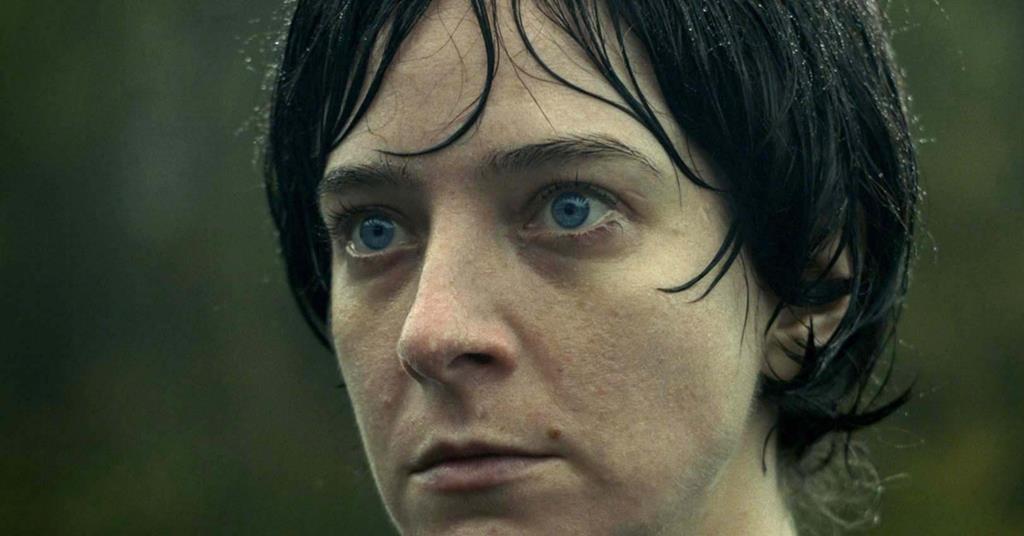
Alanna Bale plays a modern world vampire who faces a life-or-death decision in the Canadian thriller Kicking Blood.

Right during the first week of the Vancouver International Film Festival, I fulfilled my first VIFF goal of seeing a Canadian feature when I saw Kicking Blood. It also became my first Altered States film of the VIFF. It’s a vampire story that’s something.

Anna celebrates her birthday with a slice of cake and with Bernice and Gus: two of her co-workers at the library. During the shift, Bernice is upset Gus is leaving her for another woman. That night, Gus is about to make love to Anna. He thinks he’s the one in control. What he doesn’t know is that anna is a vampire. She delivers him the fatal bite!

Somewhere else in the city, Robbie is an alcoholic who’s being booted out of the house of a young woman who’s been looking after him. She caught him making out with her fiance! Robbie finds himself out on the streets. Anna walks by him. She sees him with a bottle in his hands. However she notices something about him. Somehow she’s willing to take him in. She’s able to let him live in her place and feed him well. He is expected to recover from his alcoholism, if he says he’s willing to change. Anna conducts business as usual at the library. She has her friendly conversations with Bernice. She then comes home to Robbie. She learns she has feelings toward him. Feelings of love. But she doesn’t know how to deal with it.

One night in a nightclub, two men named Boris and Ben are having fun and drinking. There they meet what appears to be a woman alone named Nina. Ben is attracted to her. He tries to get closer to her, but Nina knows he’s married and trying to hide it. Soon it’s the three of them with Ben doing cocaine. They’re having good conversation. Anna joins the conversation. However it’s apparent Ben will become Nina’s latest victim. She does eventually bite the life out of him.

It becomes apparent there is a trio of vampires in the town: Anna, Nina and Boris. They bite people out of their lives and then live off their possessions. Anna is very good from hiding it from Bernice and Robbie: two people who mean a lot to her, but how can she keep it a secret? It shows in her restraint as she wants to make love to Robbie, but she can’t get any closer. How is Robbie going to find out? That also hits her as she learns from Bernice she won’t take her pills and will rely on her inner strength and her mentality on her physical condition. A vampire like Anna can’t have connection to humans. How can Anna make this work?

The trio’s next victim is an artist who lives alone. They visit her in her apartment as she’s making a sculpture. They first ask her questions about her art, but then they shift the focus on how her art may be remembered after her death. The questions of her art seen after her death continue, which the artist kindly answers them. Then Nina bites the life out of her. Instead of enjoying this, it’s a turning point for Anna as she shows huge concern.

The last incident of vampirism affects Anna. She knows as a vampire, she can’t connect with humans emotionally. Problem is she has been connecting with humans as she watches Robbie go through his alcoholic withdrawal and as she visits Bernice in the hospital as she’s dying. She is reminded she has human sensitivity. She can’t have that as a vampire If she does, she would have to identify with mortal humans. She reveals her identity to Robbie, but he is shocked and leaves her. While at a bar, he meets Vanessa: an old flame from his college days. The two start heating up.

However the time is coming for Anna. This is the time she will have to choose between life as a vampire or human mortality. First she confronts Vanessa with Robbie. The two face off right in the middle of the road as Nina and Boris arrive. Vanessa is the latest victim. Then the two remind Anna that Robbie is her last chance. One bite of him will keep her immortality active. Refusing to bite will lead to her death. The ending is slow and more about intensity than effects, but dramatic and unconventional.

I’m sure we’ve all seen our fair share of vampire stories. From the classic stories of the legendary Count Dracula to the teen craze of the Twilight series, vampires still intrigue us and captivate us. This is a unique story of a young female vampire who’s part of a trio of vampires. As they welcome themselves in other peoples’ lives, they kill them with one bite and take material things of theirs. Anna is a vampire who works a librarian job, but pursues her victims. Often you’ll understand why a librarian like Anna has so many luxuries. However it’s an odd twist when she takes in a homeless alcoholic like Robbie. Often you wonder why would she? He has nothing to take from. Would he still be one of her eventual victims? More on that later.

The thoughts continue when you learn of the vampire trio she’s a part of. It’s after she meets and tends to Robbie that she starts to reconsider her life as a vampire. She has feelings for Robbie and doesn’t want to kill him, but her vampirism is her immortality. Should she continue to be a vampire and have Robbie as one of her victims? Or will she choose the life of mortality? That she’d rather die than kill Robbie? Even with the presence of Boris and Nina, it gets you wondering. Does she like being a vampire? Or is she controlled by the other two?

The film has Robbie as the surprising secondary character. Anna meets Robbie on the streets right after his previous ‘keeper’ booted him out and with a bottle in his hand. You’re left wondering why would a vampire like Anna take in a man like Robbie who has nothing? Would he be her next victim? Even later as she houses him instead of giving him a fatal bite like all the others, you wonder why is she keeping him alive? Is it something in herself that she sees and only Robbie can bring that out in her? Is it Robbie that gives her the change of heart? Boris and Nina remind her that her biting is her key to immortality and that a vampire is not to connect or empathize with humans. But Robbie is the human that does exactly that. Even though her best friend Bernice is the first human to get her to connect as a human instead of maintain her vampire separation from humans, it’s Robbie who best conveys Anna’s human feelings. It’s also Robbie, as he goes through alcoholic withdrawal, who sends the message to Anna of the vampirism withdrawal, a fatal withdrawal, she could face. Is it worth it?

This is a film full of a lot of twists and surprises. The vampire legend is always full of various elements of the legend. I’m sure many stories play with the legend. One thing that caught my attention is how these vampires are perfectly unaffected by the sunlight. Most vampires are either affected by sunlight or the light is fatal to them. The trio of vampires are unharmed by the sunlight, but it’s the nighttime where their vampirism comes to life. Maybe that’s the trick. They act like everyday humans by day, but their vampire side comes out at night. Even the story of how another woman tries to steal Robbie from Anna adds into the drama. For the most part, the story makes sense. If it’s a jigsaw puzzle, the pieces fit well. The story however carry itself out in a slower-than-usual pace. It settles more for the intensity of the situation, rather than the sensational images of bites of the flesh. Also I feel we learn the fact that Anna is part of a trio of vampires later in the film than we should. However those who come to a film about vampires and are huge fans of seeing ‘vampires in action’ may be disappointed. The ending works, but there were even small bits where it had some flat moments, or could have been better. Like Nina’s last line.

I give top marks to director Blaine Thurier. He does a very good job in directing the play he co-wrote with Leonard Farlinger. I like how he plays along with the legend and creates a unique story of vampires in the modern world. It even gives you the feeling of a vampires-next-door story! Also very good is the acting from Alanna Bale. Playing a character that goes from an everyday girl to a vampire at night to a vampire with human feelings is not an easy task. She does a very good job of it and keeps her focus well. She makes it work. Luke Bilyk is also very good as the recovering alcoholic Robbie. He does more than just play a recovering alcoholic. His role is also that of human feelings and feelings of love to Anna. He does a very good job of showing the importance of Robbie in the story.

The film also has a lot of great supporting performances too. Rosemary Dunsmore was great as Bernice, the librarian who gives Anna her human feelings. Vinessa Antoine was also very good as Vanessa, the woman who tries to win Robbie away from Anna. Ella Jonas Farlinger (daughter of scriptwriter Leonard Farlinger) and Benjamin Sutherland were good as the two other vampires, but their roles lacked dimension.

Kicking Blood is not your typical vampire story. It does offer a twist in the common vampire story that delivers the unexpected. Despite it’s small but noticeable glitches, it will still keep you at the edge of your seat.
VIFF 2021 Shorts Segment: MODES 2

With the Vancouver Film Fest comes segments of short films. That’s my second VIFF goal to see one of those segments. I achieved it when I saw the segment series MODES 2. Six films from six directors from six different nations. They all gave lots to see and hear.

-The Coast (India – dir. Sohrab Hura): The film shows people on the coast of a beach in south India as they swim around and throw themselves to the waves. The film also shows images of a religious ritual, which includes inflicting pain on one’s self. The film also shows images of a nearby carnival. Then ends again with people throwing themselves to the waves.

A video interview from the director says the images are of a religious festival where one begins by facing their personal demons and then ends as they wash their demons away. The images are seen in slow motion with disjointed music added into the score. It’s a very picturesque short film that gives us a fascinating look at people from a world away. It can even give you appreciation for such a festival as the waves form the Indian Ocean are as much of a storyteller as people.

-Happiness Is A Journey (USA/Estonia – dirs. Ivete Lucas & Patrick Bresnan): It’s very early morning of Christmas Eve 2019 at a newspaper deport in Austin, Texas. People gather at 1:30am to pick up newspapers to people’s homes. People gather them in big numbers and know they’ll need a good amount of gas. One of the delivery people is Eddie ‘Bear’ Lopez, a 62-year resident of Austin, who’s been doing this since 1997 without ever taking a day off. The film then follows Bear on his trip. Bear even brings his little dog with him. As he delivers, his trip is long. Ever since people made the move to the online news site of the paper, actual newspaper customers are less and less which means deliveries are further an wider. The film goes along Bear’s long route, which he has completed by 6am.

This is a film, shown with two different simultaneous camera images and consists strictly of the sounds around. No musical score at all. It shows about people who we either take for granted or have shunned their skills away because of our use of technology. It gives respect for a person with a low-paying job who never takes a day off, but somehow finds fulfillment in it. One of the desks in the depot has a sign that says “Happiness is a journey, not a destination.” Maybe that’s the point the two directors wanted to show. That with a job that is low-pay, facing near-extinction, and something most of us would label a ‘loser job,’ Bear finds some kind of fulfilment. Even if he has to work on a holiday.

-Show Me Other Places (Sri Lanka – dir. Rajee Samarsinghe): This film shows all sort of images: what we see on our computer, the images of suburbia, a birds-eye view of a construction site, friends, common people, and luxurious items. The film shows the many ways we see them: on a computer screen, through a VR viewing mask, and on our iWatches. Many images are seen as is, while some are meshed with colors and even other images.

I believe the point the filmmaker was trying to make was to do about imagery. It was about how we see things and also how she sees them. She allows her creativity to take place and show new and creative ways to look at things we commonly look at. In a lot of way, we’re given a new enlightenment when we see her creative imagery. Really gets you thinking.

-Adversarial Infrastructure (Russia – dir. Anna Engelhardt): The film is about a bridge that is the subject of political controversy. The bridge is the Crimean Bridge which connects a southwest tip of Russia with the Crimean town of Kerch with the bridge’s main part located on Tuzla Island. This is a bridge of great controversy as Crimea has been a subject of huge political debate as Ukraine insists is theirs while Putin proclaims Crimea to be part of Russia. This has been like that since 2014 since the Russo-Ukrainian War started. There was even a phony news story concocted by Putin that the bridge was bombed by the Ukrainian army.

The director showcases news stories with a coarsely-drawn computer map of the area in question and a rough computer graphic of the bridge as it would looked bombed out. The director even showcases how bridges are to be the opposite of walls and connect peoples, while this bridge appears to do the opposite. Or at least the media and the Russian government try to make it do the opposite. Myself being Ukrainian-Canadian, this is something of interest to me. The director is very good at using the various images in presenting a story and getting her message across. A message I personally agree with.

-The Canyon (USA – dir. Zachary Epcar): The film begins showing mostly people living in a new residential development. They’re of people relaxing, doing housework, renovating, exercising, playing tennis, a vide variety of activities. The film then shows images of luxuries and then images of peoples and what they have to say. Then the film focuses on a whirlpool-like area of Lake Berryessa in the Napa Valley of California. They talk of how the areas will no longer appear.

I believe the point of this student film and its various images is trying to make is their believe that new residential areas that are cropping up and attracting people will be empty canyons in the future. The buildings and luxuries they’re enjoying now will be swallowed up into nothingness in the future. The man-made whirlpool in Lake Berryessa conjures up images of how that area will be swallowed up over time. I believe that’s the point where they let the images they show do the storytelling as the students prove their point.

-Corps Samples (France – dir. Astrid de la Chapelle): The film begins with the focus on the year 1924. It’s the year Vladimir Lenin, the founder and first leader of the USSR dies, and the year a British mountaineer fell to his death just off Mount Everest. The only thing in common they have in common: both their bodies are perfectly preserved. The film begins with fossils found on Mount Everest during that time. Then it goes on to various images of fossils, stones, metals, minerals and crystals. It shows natural racks and crystals, and it showcases the minerals and chemicals we use for our everyday needs. It showcases on the images of the body of the mountaineer found perfectly intact after all these years. It also showcases the body of Lenin, perfectly intact in his tomb and a tourist attraction.

The filmmaker is either getting us to focus on either the association of minerals and preservation, and how it mixes into our daily lives and the everyday world, or it could be on the focus on something else. Right at the end of the film, she shows an image of a stone and asks us “Are you looking at the stone or is the stone looking at you?” Hearing that, I think it’s a case where a lot of the film is trying to get you to ask yourself that. Are you looking at the stones, crystals, fossils, and minerals? Or are they looking at you? That question of the end really gets you to change what you think the focus of the film is about. Even see it through a different light.

The six films of MODES 2 are about images and sounds. Some make their points clear, while some aren’t as clear and require your imagination to assume what you think its about. The images may be relate to each or other, or not related at all. The music or sounds may be smooth music, disjointed sounds or raw music. I guess that was the whole point of the MODES 2 short films. It’s six short films on sights and sounds and they want to get your imagination involved, and possibly even share the filmmaker’s imaginations. The films also have a message to say, but they want to convey the message creatively, and they want you to embrace the creativity as much as the message.

Even though I was hoping to see a short segment of live-action stories being played out, I’m glad I saw MODES 2. The films were loaded with images and sounds and done in their very own way. Nevertheless they were very good in sending the messages they were trying to send in their own creative way.

VIFF 2021: Mix Of Online And Live Theatre

VIFF 2021 will increase it’s cinema capacity, but restrictions will apply.

It’s a fall tradition of mine. The Vancouver International Film Festival (VIFF) comes back and I end up volunteering for it. It’s a tradition that was broken last year. You can’t blame me. The COVID pandemic severely limited seating capacities and the number of films they could show on screens, not to mention theatre attendance. Last’s year’s VIFF was a case where few shows were shown in theatres and most were screened online. This year, the VIFF makes a big return back to the theatres, if not a complete return.

The International Village which used to allow three of its theatres to show VIFF films during fourteen of its sixteen days isn’t doing it this year. The Centre for the Performing Arts isn’t giving itself to the VIFF this year either. There are five theatres from past years that are VIFF venues again this year: Cinematheque, Vancouver Playhouse, Rio Theatre, SFU Goldcorp Theatre and the VanCity Theatre at the VIFF Centre. The VIFF also acquired four new venues to facilitate for the fest:

  • Annex Theatre – It’s called the Annex because it’s the annex to the Orpheum theatre. It’s a nice cabaret-style theatre that served the VIFF before as a lecture hall or conference room. This time, it will be showing films throughout most of the VIFF.
  • Hollywood Theatre – Those that remember my blogging from bygone days will know the Hollywood is a theatre in the West Broadway area build back in the 1930’s. Although it’s no longer owned by the original members, it has reopened to become a multi-event stage with mostly theatrical shows and music concerts. During the VIFF, it will return to its original purpose as a movie theatre.
  • Studio Theatre: VIFF Centre – Even before the pandemic hit, there was a fundraising initiative underway at the VanCity Theatre of creating a studio theatre meant for screening local films and give more local filmmakers opportunity. It was finally opened this summer and this is the first VIFF in which it will serve as a venue! Just to the left of the main studio theatre at the VanCity, it’s smaller in capacity but can serve its purpose well.
  • Kay Meek Arts Centre – I think this is the first VIFF venue outside of the city of Vancouver ever. Located in West Vancouver Secondary School, this local theatre is also a major centre for arts in West Vancouver.

This year, I’m back to volunteering. I will be at the Playhouse Theatre and working as part of a ‘skeleton crew,’ which is the minimum number of volunteers a facility can have at one time. This is one of the precautions as part of the pandemic. The second is that theatres will only be at 50% capacity. The third precaution is that people are to have their BC Vaccine Card or Vaccine Passport to get into theatres. For those who don’t know what a Vaccine Card or Vaccine Passport is, it’s a scanner code the certifies that one has been vaccinated twice.

For those that are still too nervous about going into a theatre, there are many of the VIFF films that can be streamed online. Many of you may remember that the majority of VIFF films from last year can be streamed from wherever they wanted whenever they wanted. Not the case this year as the online screenings can be screened during select times and there are many that have a limit to the number of online customers of that screening.

The VIFF will be starting today and running until Monday October 11th, which is Canadian Thanksgiving. Returning back to the Festival are VIFF Immersed technology exhibits, VIFF Totally Indie Day, VIFF Talks and Masterclasses and VIFF AMP music conferences. For film lineups, there will be 185 films. 73 of them will get a cinema run. Of the sixteen expected to stand out:

  • The Electrical Life of Louis Wain – The Opening Gala film. It’s an eccentric biographical film of artist Louis Wain who is played by Benedict Cumberbatch and directed by Will Sharpe.
  • Petite Maman – The Closing Gala film. The latest feature from Portrait Of A Lady On Fire director Celine Sciamma. It’s a unique story of the mysterious bond between mother and daughter.
  • All My Puny Sorrows – Michael McGowan directs this film adaptation of the novel by Miriam Toews. Alison Pill stars as a young woman hugely concerned for her talented sister.
  • Belfast – A film loaded with potential Oscar buzz. Kenneth Branagh directs this story of the spark of civilian unrest in 1969 Northern Ireland as seen through the eyes of a child.
  • Benediction – Directed by Terence Davies, It’s a portrait of World War I poet Siegfried Sassoon. It stars Jack Lowden and Peter Capaldi.
  • Bergman Island – Directed Mia Hansen-Love. As the village Ingmar Bergman grew up in has been turned into a theme park , two filmmakers, played by Vicky Krieps and Tim Roth, ponder their relationship.
  • Drive My Car – A three-hour film by Ryusuke Hamaguchi. A recently-widowed theatre director tries to live life again as he puts together a new production, and casts his late wife’s lover as the lead.
  • Everything Went Fine – Directed by Francois Ozon and stars Sophie Marceau and Charlotte Rampling, it’s the story of an 85 year-old man who wants his daughter to end his life, while she tries to change his mind.
  • Memoria – Directed by Uncle Boonmee director Apichatpong Weerasethakul, it’s the story of an orchid grower in Colombia, played by Tilda Swinton, who experiences a booming noise only she can hear.
  • Mothering Sunday – Directed by Eva Husson, it’s about a maid in 1924 who spends time with her lover before he is about to marry a younger woman. Can she change his mind?
  • Night Raiders – Directed by Danis Goulet, this is a futuristic film set in 2043 and Canada plans to return to past colonial ways of treating Indigenous children.
  • Official Competition – The film is about a Spanish female film directer trying to direct two male movie stars with big egos. It’s co-directed by Mariano Cohn and Gaston Duprat and it stars Antonio Banderas and Penelope Cruz.
  • One Second – Directed by Zhang Yimou, It’s a story of a man during China’s Cultural Revolution who escapes China’s labor camps to see his actress daughter on screen. It’s no easy task.
  • Red Rocket – Directed by Florida Project director Sean Baker, this film is of a washed-up porn star returning to his hometown trying to reconcile with his wife, but also promoting a young teenaged girl to stardom.
  • The Sanctity Of Space – A documentary directed by Renan Ozturk and Freddie Wilkinson. It’s of the mission to meet with famed cartographer Bradford Washburn whose worked opened up a new world for mountain climbers pursuing Alaska and Yukon.
  • The Worst Person In The World – Directed by Joachim Trier, it’s a coming of age story of a young woman about a young woman who leaves a trail of destruction in her wake.

And there you go. That’s just a brief preview of the highlights at this year’s VIFF. But the VIFF has more films to offer. Way more. It’s worth checking out over these next eleven days.

VIFF 2020 Wraps Up Its First Online Fest

It does seem awkward to do a wrap-up for the Vancouver International Film Festival. Not just because it’s way into December, but because most of the film festival was online! Plus all my VIFF activity for 2020 was online! Nevertheless I feel it’s worth it.

2020 was an interesting festival as it had to resort to mostly online viewing of films. There were airings of films at theatres like the VanCity and Cinematheque, but they were very few and had limited capacity. Despite all this, the online system did give the opportunity to watch many of the films that were part of this year’s Film Festival. There were 102 feature films, 98 short films and 19 talks and events at this year’s VIFF. The number of VIFF Gold passes sold out. Despite the lower number of films, viewership was still good as it totaled over 50,000 online views.

For me, this was a unique experience to view a film festival all all online. I first had a goal of seeing ten films online. There was some time where I thought I had a lot of catching up to do as there were days I didn’t watch. Then it was like the last five days I did a lot of cramming. Like two films a day each day. In all honesty, I prefer watching films in the theatre. Having them in the theatre is better for demanding my attention. If I watch it on a computer, I will easily be distracted by other things online or want to sneak a websearch in. If I’m in the theatre, it’s nothing but that film.

Nevertheless I was successful in seeing fifteen feature films and two shorts segments. I saw six Canadian films or film segments, one multinational set of shorts, four American films, four European films, and two Asian films.Those who know me know my film goals for the VIFF consist of three main goals: one Canadian feature-length film, one shorts segment, and one contenders of the Best International Feature Film Oscar. The goal of a Canadian film was accomplished with Monkey Beach: the first VIFF film I saw this year. The shorts segments I did twice with Programme 2 and Reel Youth. The International Feature contender I was not able to do. During VIFF, there weren’t even ten countries that gave their official submissions to the AMPAS Academy. At the time, none of them were shown at the VIFF. The reason why so few is because the 2020 Oscars will be held on the last Sunday of April 2021 and the other countries were in no rush. During that time, I went with films I felt would best contend: Undine, Father and There Is No Evil. As time passed, it would eventually be revealed none of those films became their nation’s official submission in the category. Looks like this was one goal I had to put on hold this year.

One thing that was not absent from this year’s VIFF was their award winners. Awards were still given out. I’m happy to say that three of the films I saw won awards. One thing about this year’s awards was that because of the nature of the festival, most of the people’s choice or audience award categories could not happen. Thus only one audience award. Included for this year are VIFF Immersed awards for virtual reality that is sponsored by VeeR VR network. Here’s a list of the award winners from this year’s VIFF:

BC Spotlight Awards

Sea To Sky Award
Presented by Telus
WINNER: Nuxalk Radio (dir. Banchi Hanuse)
Special Mention: Cosmic (dir. Meredith Hama-Brown)

Best BC Film Award
Presented by CreativeBC, Encore by Deluxe
WINNER: The Curse of Willow Song (dir. Karen Lam)

BC Emerging Filmmaker Award
Presented by UBCP/ACTRA, AFBS & William F. White
WINNER: Jessie Anthony for Brother, I Cry

Best BC Short Film
Presented by Telus Storyhive
WINNER: Cake Day (dir. Philip Thomas)
Special Mention: Sunken Cave And A Migrating Bird (dir. Qiuli Wu)

Canadian Film Awards

Best Canadian Film
Presented by Directors’ Guild of Canada
WINNER: Beans (dir. Tracey Deer)
Special Mention: Nadia, Butterfly  (dir. Pascal Plante)

Emerging Canadian Director
Presented by Directors’ Guild of Canada
WINNER: Violation (dirs. Madeleine Sims-Fewer and Dusty Macinelli)

Best Canadian Documentary
Presented by the Rogers Documentary Fund
WINNER: Call Me Human (dir. Kim O’Bomsawin)
Special Mention: Prayer For A Lost Mitten (dir. Jean-Francois Lesage)

Best Canadian Short Film
Presented by Side Street Post
WINNER: Bad Omen (dir. Salar Pashtoonyar)
Special Mention: Moon (dir. Zoe Pelchat)

Most Promising Director of a Canadian Short Film
Presented by Delta Air Lines
WINNER: Acadiana (dirs. Guillaume Fournier, Samuel Matteau and Yannick Nolin)
Special Mention: Labour/Leisure (dirs. Jessica Johnson, Ryan Ermacora)

VIFF Impact Award
Presented by The Lochmaddy Foundation
WINNER: The Reason I Jump (dir. Jerry Rothwell)

Rob Stewart Eco Warrior Award
Presented by RBC and Cineplex
WINNER: The Hidden Life Of Trees (dir. Peter Wohlleben)

VIFF Immersed Awards

Best Cinematic Live Action
WINNER: Kowloon Forest (dir. Alexei Marfin)

Best In Documentary
WINNER: By The Waters Of Babylon (dirs. Kristin Lauth Schaeffer and Andrew Halasz)

Best In Animation
WINNER: The Book Of Distance (dir. Randall Okita)

Honorable Mention In Animation
In The Land Of Flabby Schnook (dir. Francis Gelinas)

Audience Award
WINNER: Ecosphere: Raja Ampat (dir. Joseph Purdam)

VIFF Immersed Volumetric Market Awards
Sponsored by VeeR

  • Uninterrupted (dirs. Nettie Wild and Rae Hull)
  • A Vocal Landscape (dirs. Omid Zarai and Anne Jeppesen)

Before I wrap up my blog, I’ll give you the other films in which I saw at the fest. All films listed below are Canadian unless otherwise noted:

And there you have it. That’s my wrap-up of the film festival. I know it took me a long time to finish it all up, but I finally mustered the energy after all my work and courses. As for next year, we’ll see how the VIFF is carried out. Will they do more online films? Will they reduce the number of theatres or keep the same number they had in 2019? All I can say is I hope to see the VIFF films back in theatres. I like volunteering and being part of events. Only time will tell how VIFF 2021 is played out.

VIFF 2020 Review: Jumbo

A carnival ride is the object of desire of Jeanne (played by Noemie Merlant) in Jumbo.

I ended my VIFF with the French film Jumbo. It was part of the Altered States slate. I agree the film was something else!

The film begins in an amusement park in a French city. Jeanne Tantois is the park custodian. Her job over there is just her labor. She has a fascination with many of the rides there, but she doesn’t get along well with too many of the men that she works with. She’s a young girl who lives with her parents. Her mother Margarette wonders when she will find the right boy. At home, she creates things like celestial ceiling images or mobiles consisting of a lot of LED lights. There in her room, she lets her imagination run free. She even has a belief that objects have souls, even moving motorized objects.

One day, a new ride comes to the amusement park. It’s a 25-foot tall ride set to accommodate 32 at a time. Jeanne cleans the light bulbs, but soon notices the ride, named ‘Jumbo,’ is communicating with her. She’s surprised by it all. Jumbo offers her a ride. She accepts with her riding alone, and she appears to enjoy it in an erotic sense. Over time, she has gotten to have a closer liking to Jumbo. Jumbo communicates with her: green lights for yes, red for no. Soon her liking for Jumbo isn’t just simple. It’s intimate.

Not everybody is accepting upon hearing Jeanne’s love for this carnival ride. The other teens from her school including a group of boys poke fun at her. Her boss and the head custodian look at her with huge suspicion or something’s wrong with her. Margarette meets Jumbo, rides him, and is shocked that she could be attracted to an object. However it takes a lot of convincing to her mother that her attraction to Jumbo is real and is her everything.

The relationship between her and Jumbo grows. One night she lays down on Jumbo and his oils enter into her almost as if a sexual pleasure. Then the workers at the amusement park are given awards for the best services. Jeanne is given an award for her services with the bullying boys watching from the back. Then the shocking news. Jumbo will no longer be at the amusement park. Jeanne is devastated. Even more so when she learns Jumbo will be transported to an amusement park in Belgium. Her boss makes it clear it’s her attraction to Jumbo that caused their decision. That leaves Jeanne no other choice. She must marry Jumbo before he’s taken away. Margarette and her stepfather are willing to assist her in the marriage. The two perform the rites as both Jumbo and Jeanne accept. All three go for one last ride and get off in time before the bullying boys from her school can get them.

Now there have been films about people having feelings of love to objects in the past. However this is something unique as it’s of a young female with an attraction to a carnival ride. This could have come across as a dumb story. However there is such a thing as objectophilia. Writer Zoe Wittock learned of a story of a Florida woman who was in so love with a carnival ride, she tried to marry it. Even then, to make it believable, it required that from a believable character. Jeanne is that character. She herself is a dreamer who likes to draw and is fascinated by lights and stars. She even mentions at the beginning of her belief that objects have souls of their own. It was necessary for her to say something like that for her objectophilia to be believable.

Even with the imagination, the film had to make Jumbo come alive as well. If Jeanne sees the soul inside Jumbo, we the audience have to see it too. It works as we see Jumbo come to life whenever Jeanne is around and when Jeanne conveys her emotions and feelings. Plus right at the end, Jeanne’s mother and stepfather have to see Jumbo’s soul for themselves in order for Jeanne to marry it. As bizarrely erotic this story is, it needs to have the scenes to make us believe it and the characters to make it work. And it does.

Top credit goes to writer/director Zoe Wittock. Before Jumbo, she wrote and directed four short films. Jumbo is her first feature-length film. It’s also marks her return to film work after a five-year hiatus. A woman sexually attracted to a carnival ride looks like the premise for a bad movie or something completely freakish. Zoe, however, is able to make it work with the story and making the story of Jeanne’s love believable and also giving character to the ride. Additional credit should go to Noemie Merlant. It’s also the believability of Noemie’s performance that keeps Jumbo from being dismissed as a stupid movie. She made the objectophilia believable and not look as freaky as one would anticipate. It’s very surprising to see her play a completely different character than Marianne from Portrait Of A Lady On Fire as well as a different time period. There’s also excellent acting from Emmanuelle Bercot as the mother who has to struggle to accept her daughter’s objectophilia and in the end be encouraging to Jeanne in marrying Jumbo.

Jumbo appears like a film that would not win too many awards on the film festival circuit, but it has won one and has received nominations. It won Best Feature Film at the Chattanooga Film Festival, nominated for a New Direction award at the Cleveland Film Festival, nominated for a Best First Feature Award at the Philadelphia Film Festival, a New Visions Award nominee at the Sitges – Catalonian Film Festival and Best International Film at the Jeongju Film Festival.

Jumbo has what would first be dismissed as a ridiculous story. What made it work was the actors making the story and the bizarreness believable as we watch.

And there you have it! That’s the last of my film reviews of this year’s VIFF! my wrap-up of this year’s Festival is coming soon!

VIFF 2020 Review: Violation

Violation is a revenge fantasy co-written, co-directed and starring Madeleine Sims-Fewer.

DISCLAIMER: I know we’re well into December and the VIFF ended almost three months ago, but I have been too busy with work and my part-time courses. They all left me with no time for me to finish my blogging. Now I have the time and I aim to finish my last five VIFF blogs over this next week.

Violation is another Canadian-made feature I took an interest in. Especially since it’s part of the Altered States slate of the VIFF. That film is definitely something else!

The film begins with a woman and a man alone in a cabin. They appear to be ready to engage in something sexual. Even something kinky and involving bondage. The woman ties the man’s hands up and he is excited for what he thinks he’s going to get. He’s waiting for it, but instead she hits him hard across the head and he’s unconscious.

The film then flashes back to the beginning. Miriam is a woman on the edge of a divorce and with a new boyfriend, Caleb. She goes on a getaway with her younger sister, Greta, whom she hasn’t seen in years. The getaway is in a cabin by the lake just outside the woods and joining Greta is her fiance Dylan. The getaway looks to be a good time to relax and reunite with family members.

However all that changes one day. Miriam decides to sleep for awhile during the daytime, but Dylan enters in for more than just a visit. You can tell that Dylan violates her by the mere image of her eye and her look of horrific shock.

Returning back to after Miriam hit Dylan, Miriam has a lot of cleaning detergents and tarps. It’s clear she wants todo more than just kill Dylan. She assumes Dylan is already dead after she first hit him across the head, but even with Dylan’s face covered, Dylan regains consciousness. She has to kill him, and she strikes his head again and continues until he’s sure he’s dead.

It doesn’t end there. Miriam now has to dispose of Dylan’s body. Trying to do that is very hard as she will have to decapitate him and saw off his body… and clean everything up so it’s all unnoticeable. She even has to have his body drain of blood above the bathtub. She does that with immense difficulty. She then saws off his head and legs and wraps his whole body in a tarp. After all that, she takes his bagged body and burns it to the point it’s nothing but ashes blowing in the wind by the lake. It may be over but Miriam is not the same. You can tell as a Russian couple are arguing nearby a shore and she interferes to tell the man to leave his wife alone. The look on her face at the end says it all.

The film then flashes back to before the whole murder and disposal happened. Miriam and Greta are out for a carefree swim on the beach. They get into good conversation about memories, but Miriam has to tell Greta the truth about Dylan. Miriam tell her but Greta does not believe her. In fact, Greta gives her a reaction of betrayal. The film ends with the look on Miriam’s face just before she’s about to commit the murder.

Right before the film was about to begin, one of the VIFF emcees said that the directors are known for making films of uncomfortable viewing. This film has a lot of uncomfortable things about it. First off being a rape, then a murder during a sex act, then a dismemberment. It does give you the impression that these filmmakers want to do some unwatchable elements Lars von Trier may have not tapped into. The rape wasn’t graphic, but we get a sense of what’s happening by the sex sounds of Dylan and the wide-eye of Miriam. The dismemberment was very graphic. I wondered how on earth they were able to get a realistic-looking fake body to do the scene. The first attempt at murder was graphic as well as the successful second attempt.

Actually the scene where Dylan thinks he’s about to have sex with Miriam was quite graphic. When I saw the erection, I wondered if it was real or not? I’m no prude, but I’ve always considered an erection on film to be the stuff of porn. So when I saw that scene, I was thinking “I hope that’s a dildo!”

The film attempts to tell a story of a woman who’s a victim of misogyny and plots her revenge. The film shows how the whole incident changed her. You can tell as she reacts when she comes across a Russian couple arguing after she finished with the murder. I’m sure misogyny and men who act as sex predators is a major message of the film. However I think the film mixes things up in the storytelling. You’ll notice it’s not chronological from start to finish. It’s a lot like Pulp Fiction where it goes from one time period of a story to the next and mixes it up in various scene. This film does the same thing too. However the arrangement of the story seems like it didn’t make sense to have one scene one place and another scene one place and to have the image of Miriam before she commits the murder at the very end. I don’t think the placements were well-placed. I get the ending, where they show the look on Miriam’s face and it showed a person irreversibly changed, but I think placement of sequences could have been better.

Despite its flaws, one of the film’s best storytelling qualities are the various filmshots. The rape scene is only scene through the eye of Miriam. That image and the sounds accompanying are all you need to know to get the message. The overhead shots of the lake area aren’t just picturesque scene shots. They’re also shots sending the message that anything can happen in the remote outdoors. The scene of Dylan’s ashes all in the air and around the lake area send the message that Miriam is leaving it all behind. And by leaving it all behind, it’s everything: Dylan, sister Greta, Caleb, and especially the life Miriam once led.

This film is a very good work for directors Dusty Mancinelli and Madeleine Sims-Fewer. They have written and directed many short films before and some shorts together. This is the first feature length film for both as writers and as directors. It’s flaws are noticeable, but it definitely succeeds as an ambitious work. I strongly believe I will see better from both of them in the near future. Madeleine also does an excellent job in embodying the character with both the emotional and psychological transitions throughout the story. This is a story she co-wrote so it makes sense that she knows the character inside out. Outside of the role of Miriam, there weren’t too many other roles that were well-developed. Anna Maguire’s role as Greta was the only supporting role that showed any depth. Jesse LaVercombe’s role as Dylan was too two-dimensional as the predator who appears charming at first. The additions of the music of Andrea Boccadoro and the cinematography of Adam Crosby add to the film.

Violation has won awards and earned nominations at many Canadian film festivals. Directors Sims-Fewer and Mancinelli have received the most acclaim with the Emerging Canadian Artists award at the Calgary Film Festival, a Rising Stars award at the Toronto Film Festival, a Best Canadian Film nomination at Toronto, a Best Canadian Feature Nomination at the Montreal Film Festival and a Discovery Award nominee at the Directors Guild of Canada Awards.

Violation is a story about being violated by a predator and getting revenge. However it’s a story that’s not put together the best and ends on a confusing note. Hard to make sense what the film was trying to be.

VIFF 2020 Review: Father (OTAC)

The Serbian film Father is about a Serbian father (played by Goran Bodgan) who will fight to get his children back.

The Serbian film Father is not one of the more featured films of the Festival. However it is a unique film that’s worth seeing.

The film begins with a woman taking her two children to a construction plant. Her name is Biljana and she has a gasoline tank in her hand. She shouts out that she threatens to burn herself and her children unless she receives her husband’s overdue wages. The men there try to stop her, but she sets herself ablaze. The men are able to put her out in time and take her to the hospital.

Word not only gets to her husband Nikola. Word has also gotten to the child and family services in his region. The leader, Vasiljevic, is very suspicious of what type of father Nikola is and conducts people to investigate both the children and the house. Those who investigate the children ‘notice’ some flaws in them. Those who investigate the house point out how lacking it is in modern functions or how out of date it is.

Vasiljevic has made it clear that if Nikola modernizes the house, he could have his children back. This is frustrating enough as he has had no income for two years and he is constantly seeing his wife as she’s in the hospital. He does everything he can in the period of a few days, but Vasiljevic is still disapproving. His children are in foster care indefinitely and he’s not allowed to even see them. Before Nikola leaves, he is told by one man about how corrupt Vasiljevic is and how he has close associates of his in every village. Vasiljevic takes the children and puts them in the foster care of friends of his and skimming government money for this. Nikola’s made aware what Vasiljevic did is a common thing he does.

Although it’s difficult, especially as he wants to be by the hospital bedside of his wife, Nikola decides to make a 300 km trip to Belgrade and meet with social services to get his children back. Nikola has a friend with a computer draft him with a letter to the minister, pack fruit and stale bread, and set out on foot to Belgrade.

The trip is long and Nikola witnesses poverty and barren wasteland as he walks on. He comes across buildings that have decayed over time. He comes across stores that have been abandoned. He witnesses the best of people and the worst of people along the way. Some help him out while some steal or fight with him. He also develops a temporary friendship with a dog he met at an abandoned gas station he slept at. He also gets some help from truck drivers and ‘good samaritans’ who drive him.

When he arrives in Belgrade, he is brought to the very government office he needs to visit. He tries to meet with the minister, but is told he can only meet with him tomorrow. He has nowhere to sleep or to eat and leaves himself to sleep outside right by the entrance. As he is sitting out, a media team notices him and his story and will interview him for an evening news story. One person who saw the news and saw his story drives over to see him and gives him food.

The next day, he meets face to face with the minister. He heard his plea, he learned his story from the news. The minister tells him of the guidelines he will direct in order for Nikola to get his children back. A man drives him back to his town and to his home. However Nikola comes across an uncooperative Vasiljevic. Vasiljevic tries to act like Belgrade has no control over him and even demeans him of the story in the news. However Nikola has had enough. He demands to see his children, if not have them returned to him.

His wish is granted and he hugs his daughter with no problem, but the son is embarrassed of him. Nikola pleads to him, but the son finally hears his word. As the children are led away Nikola, tries to stop them from hurting his children, and is able to hug his son, as he looks onto the foster family with mistrusting eyes. Nikola returns to his house, only to learn everything is stolen by the neighbors. He goes over, gets everything, and has everything ready for the start of his goal.

It’s a story that has a lot to say. I’ve never lived in Serbia so I don’t know what the laws are in terms of family. However this does have a lot to tell about corruption in Serbia the filmmaker knows about. Interestingly the corruption of the social services does seem to resemble how the US government has been like under the Trump administration. We see it as a case of an honest man being messed around by a dishonest system. Even how Vasiljevic tries to act like Belgrade has no control over him and he can do what he wants does remind us of Trump as well; a leader’s false sense of invincibility and how they think they can abuse power all they want.

The 300km trip to Belgrade is a telling story. Nikola sees poverty all around him. We see Belgrade as a city that’s been working to modernize itself, but the film makes it appear like the rural lands have been neglected or overlooked and people like Nikola caught in the middle. One notable scene is that scene of Nikola seeing a group of villagers, just as impoverished as him, engaging in a folk dance and holding a Serbian flag. It looks like it’s sending a message how people in even the poorest of areas seem to still have the sense of Serbian pride. They may hate the government or the system, but they love Serbia. Even that scene of Nikola being driven by a man with many Orthodox religious artifacts sends a message of the Serbian people.

SPOILER WARNING: Do Not Read This Paragraph If You Don’t Want To Know The Ending. The ending scene is also very key. Right after Nikola is done seeing his children for that brief reuniting, a woman who works for Vasiljevic is willing to give him some associates who could help. I think that sends a message that even people who work for the system are forced in their job to do things they don’t want to do, but have to because it’s their job. That ending scene where Nikola learns his house has been robbed by the villagers, but retrieves all his belongings by going to all the houses and taking them without a single one resisting also sends a message that his struggle is their struggle too. That scene at the end where he is sitting at the dinner table with no food, but the plates for all four set up, also sends a message of his next goal of bringing back his whole family and he will stop at nothing to achieve it. Just like he did on that trip to Belgrade.

This film is another great work for Srdan Golubovic. He first achieved international renown in 2001 with his 2001 film Apsolutnih sto. Two of his films, 2007’s The Trap and 2013’s Circles, were Serbia’s submission for the Academy Award for Best Foreign Language Film. This film which he directed and co-wrote the screenplay with Srdjan Koljevic and Ognjen Svilicic is a good work as it tells a story of a man and also sends a message too. It comes across as a story telling of the Serbia Belgrade forgot over time while at the same time telling of a father’s love and his willingness to do what it takes to get his family back. The acting of the main protagonist Goran Bodgan is excellent. Most North Americans will notice the Bosnian actor as Yuri Gulka from the Fargo series. Bodgan does an excellent job of speaking volumes of his character and his story without saying a lot. The supporting actors, both young and old, also did a very good job in the roles they had. The cinematography of Aleksandar Ilic is also excellent and is all critical to the storytelling.

Father has had a good run in the film festival circuit. It won Best International Narrative at the Calgary Film Festival and was a Best Film nominee at the FEST International Film Festival and the Minsk Film Festival. It was also a nominee for Best Balkan Film at the Sofia Film Festival.

Father is a film with the common motif of a long trip and people met along the way. Nevertheless it is a good story that has a lot to tell about Serbia, and even mirror the world as a whole.

VIFF 2020 Review: Undine

Paula Beer plays a Modern-day undine in Christian Petzold’s latest film Undine.

Undine was the first live-action foreign-language film I saw at the VIFF. It’s a very unique story.

The film begins with a man names Johannes breaking up with his girlfriend. She is distraught and even says she’ll have to kill him. Her name is Undine Wibeau. Undine tries to go about her daily life as she works as a historian at the Berlin City Museum. There she shows people a model of the city and tells of the history of Berlin. Undine has a unique ability to focus in on places and areas. She has an area of the Spree River in focus.

At a remote area of the Spree River, a man named Christoph works in the water to weld or to search out treasures found in the ocean floor. That is his profession. Undine returns to the cafe where she and Johannes used to drink at. That’s where she meets Christoph for the first time. The conversation gets friendly, but an accident happens. The accident causes them to bump into the cafe’s fish tank, causing it to break and spill all over. Both Undine and Christoph fall to the floor in love. However the owner is furious and bans the two from the cafe forever.

Over time the relationship between Christoph and Undine grows. They even move in together. One time during his job, Christoph offers to show Undine what he’s seen. Undine goes down, but without the scuba gear and she later floats off. He senses something peculiar about her. His sense of peculiarity grows right during his job he comes across a sunken ship with the name Undine on it.

Even though the relationship between Undine and Christoph grows, Undine still can’t help but think of Johannes. It strikes her as she goes about her job but when she looks at a part in the module that resembles the location of the cafe, she gets the sense that Johannes is there. Even while she’s walking romantically with Christoph in a park, she noticed Johannes with his new girlfriend. She turns her head, but returns back to Christoph. However Christoph sensed something. It wasn’t just the turn of the head but the the change of her heartbeat. It infuriates him, but Undine confesses the truth. That it was her ex.

Heartbroken, Undine goes to the cafe where Johannes is. Despite the owner being infuriated by Undine’s presence, she meets with Johannes and says he wants her back. The next day, an emergency happens at Christoph’s job site. The oxygen has been cut from his scuba outfit and he’s removed from the river unconscious. Undine is distraught to learn the news. She goes over to the hospital to see Christoph, but there’s a woman by his bedside. Christoph is unconscious and comatose. The woman tells Undine he’s brain-dead and she unleashes her anger on her. Undine leaves, going to Johannes’ place later that night. Johannes is in the pool while his girlfriend goes in the house to get a drink. Undine enters the pool. While Johannes is happy to see her, Undine drowns him. The then leaves and walks into the Spree River naked.

Two years pass. Christoph is alive and well. He recovered from his coma. The woman from the hospital, Monika, is his girlfriend and they are expecting their first child together. However Christoph is sensing something back to the Spree River. He returns one night alone, and there he sees her: Undine. She is alive and well and she belongs in the water. It becomes clear who is truly in Christoph’s heart.

One thing about this film is that it gets into the myth of the undine. For those who don’t know, the undine is a lot like the mermaid most us are familiar with. However the mermaid is just one of the images of the undine. The mythical undine is a lot darker than the mermaid who wants to please the man she meets. In fact one aspect of the undine is if the man is unfaithful to her, he is doomed to die.

What this film does is try to get to the common image of the undine in both its positive qualities and its negative qualities too. In a sense, the film is more of a reminder of the undine myth. The film also tries to set the myth of the undine in the modern world. In modern-day Berlin to be exact. Undine Wibeau is the undine in the modern world who lives along the humans, but gets to the true sense of who she is when she’s in the water.

One unique thing about the film is how they use Berlin as part of the telling of the story. Undine works as a historian with an urban development team. She knows a lot of Berlin’s history form centuries back to the days of division with the Berlin was to the present and its developments. The history also provides clues to Undine’s own past and own identity. One would be surprised how a story of an undine in modern Berlin would come to be.

This is another good film by Christian Petzold. Petzold has become one of Germany’s most heralded directors in recent years with films like Barbara, Jerichow and Phoenix. Here he delivers another good film. It’s very well-done, but it does have its flaws. The energy level does seem to get lost somewhere near the end. Nevertheless it is mostly well-written and well-acted. Paula Beer is also excellent as the mythical Undine. Her role may have lacked dimension, but she was very good in capturing the mythical figure of the undine well. The two leading men, Franz Rogowski and Jacob Matschenz, were good in their roles, but I felt their roles were underdeveloped. Hans Fromm did an excellent job with delivering the cinematography for the film.

Undine has done quite well on the film festival circuit. At the Berlin Film Festival in won the FIPRESI Prize and was nominated for the Golden Bear for Best Film. Beer herself won the Silver Bear Prize at that Festival for Best Actress. It’s also been a nominee for Best Film at the Denver Film Festival, Beijing Film Festival, Seville European Film Festival and a Best Narrative nominee at the Montclair Film Festival.

Undine is a good attempt at telling a modern-day story of the undine myth. It doesn’t keep the energy or the vibe consistent throughout the film, but it is picturesque and has a good sense of the characters.

VIFF 2020 Review: Beauty Water (성형수)

Beauty Water is a Korean animated film about an attempt to become beautiful gone wrong.

It’s interesting that the first foreign-language film I see at the VIFF is an animated film. The Korean film Beauty Water is definitely something else.

The film begins in a production studio for a television network. It starts with a conversation between the actors and actresses and conflict arises. In the background is Yaeji, the make-up artist. She’s overweight and has average looks. She doesn’t get involved in any arguments. She’s just there listening in. The actors and actresses then come to her when they get their make-up done. Even if the prima donna actress berates her looks, she carries on as if nothing is happening. After work, she goes home to live with her parents. The parents have always been there for Yaeji from her days pursuing ballet as a child to her present career.

One day the producers of an advertising show think Yaeji is perfect for an advertising campaign. It’s to do about a cooking gadget. In that advertisement, they will show Yaeji eating. She agrees, but she is completely embarrassed when she later learns of all the mocking internet memes on social media. Embarrassed to tears with her body, she decides to fix things for her. She saw an ad for a product called Beauty Water. You wash your face in the water for 20 minutes and you peel away the old skin for a new beautiful face. But it’s not simply peeling away the skin. It’s peeling away the thick excessive flesh.

Yaeji orders a bottle and uses it on her face. The result leaves Yaeji happy that she’s now beautiful, but it’s not enough. She wants enough Beauty Water to change her whole body. She begs to her parents for financial assistance, but would be the equivalent of four months of their income. Yaeji begs to them, believing she’ll be nothing without that Water. They agree and the bottles of Beauty Water come in time to change her whole body.

The end result is both a face and a body of a beauty perfect to get noticed by television producers and the rich and famous. She rushes out and buys expensive stylish clothes from Seoul’s Gangnam District. She attends a party for the rich and famous over in Gangnam. She wins the notice of a production company of Jihoon. She also wins the attraction of a certain handsome man she noticed at the party.

However she is insecure. She’s afraid the effects of the Beauty Water won’t last. She also still has images of her past self she wants to forget, but reappear out of nowhere. With the money she made in her new modelling career, she’s able to afford more Water and soaks in a bath of it. Unfortunately, the phone dies before the alarm is to go off at the 20-minute mark and the Water goes deeper into her flesh leaving her almost depleted. She begs to her parents for them to give her some of their flesh. They agree by bathing in the water and giving their removed flesh to Yaeji.

Despite her new flesh, Yaeji’s body looks hideous. Nevertheless she still plans to meet up with the man she met. She tries to hide the effects from the man while she’s over at his place. She even goes to a woman who helps her return the form of her body, or at least make it human-like. However when she returns back to his place, she makes a shocking discovery. She sees identifications of other women. Did they also use the water? Did he kill them? She tries to escape him, but it’s of no avail. She learns the awful truth of him. I won’t give away the ending, but I will say she’s still alive in a way you won’t expect.

This film is a film that’s a good example of the common style of Korean animation. Most of you may already familiar with the style of anime from Japan and a lot of the grim and even bizarre stories and images it showcases. Korean animation is also similar in its way of showcasing bizarre and grotesque imagery and bizarre storylines. This film is good in showcasing the bizarre style of Korean animation that could just rival anime. However it’s not just for shock and gore. It has a story to say.

The main message of the story is to show the nations obsession with beauty and youth and how it’s actually quite damaging. If you’ve noticed in the last twenty years, South Korea has emerged in the world’s eyes with its entertainment industry being seen as a force to be reckoned with. We already have K-pop phenomenons like BTS, 2ne1 and BigBang. All of them are young with picture-perfect looks, clothes and bodies. The television and film industry in South Korea is also obsessed with youthful beauty.

You can tell director Cho Kyung-hun has something to say about this film. South Korean society in recent decades as it has worked to become a world power has become a nation that values beauty, wealth and prestige. There’s a lot of plastic surgery young women in South Korea undergo. There’s also news of many women in South Korea having eating disorders. This film has even been advertised with a tagline: “In a society as obsessed with physical appearance as modern South Korea, ugliness is a fate worse than death.” I think that’s the point Cho is trying to make. He’s trying to show how damaging the obsession with physical beauty is in Korea, but doing it with the bizarre style that is Korean animation. Very rarely is there a film that tries to both freak you out and get you thinking.

The story itself is creative. It aims to get one thinking while at the same time aiming for the thrills and shocks. Already the first shock is near the beginning when you see this Beauty Water make one not simply peel off skin but flesh! That’s what the Water does and that’s why Yaeji uses it on her whole body, even though it’s intended for just the face. It’s hard to notice a flaw in the story. I admit I don’t understand Asian animation styles. There are times I wonder if it did get the message across or did it rely too much on the shock imagery.

Beauty Water does more than just show an animation style that’s common in Korea. It also has a message to tell about beauty and how a society values it almost dangerously. It conveys the message in a very bizarre style.

VIFF 2020 Review: The Curse Of Willow Song

The Curse Of Willow Song is about a troubled orphaned girl (played by Valerie Tian) who possesses a curse that haunts her, but could just save her.

Most of the familiar VIFF categories from past years are back for the online festival for this year, including Altered States. The first Altered States film I saw was the locally-filmed The Curse Of Willow Song. It was something else.

Willow Song is a troubled girl. The daughter of Chinese immigrants who both passed away, she was addicted to drugs and followed in her older brother Mission’s footsteps to live a life of crime to survive. Manual labor wasn’t enough for her. Only the arson she committed landed her a prison sentence. She’s done her time, but she spends her time in a detention centre in Vancouver as she works to build her life. Her one friend is Flea, another girl at the detention centre. Flea appears to be the only one she can trust right now. Willow is not allowed to see any close family, especially her brother, for fear she will return to her addiction and criminal ways.

It is very hard for Willow to reintegrate back into society. One labor job that appeared to have steady work ended as the boss accepted an opportunity in Edmonton. The detention centre doesn’t seem to be working well to help her get back on her feet. The society she’s around has a contemptuous look at young Asian-American females. On top of that Wolf, the pusher from the place she burns down, keeps harassing her how much she owes him.

She gets relief when she least expects it from Dani: a figure from her past. Dani has found a place for Willow to live all the way out in Surrey in an abandoned warehouse area that has common housing amenities. There, Willow is able to have a set-up similar to that of a comfortable home. There’s just one thing. When Willow sleeps at night, there appears to be something dark and mysterious growing on the walls.

Despite her new shelter, Willow knows she still has issues to deal with. She still has to reintegrate herself back into society. Also she has to avoid any contact with Mission or Wolf. That’s not an easy thing to do as she tries to get a labor job, but the boss just pays attention to her physical and racial features. He hires her, but drops her after the first day. Obvious sexual harassment. Walking down the streets of East Van, she does bump into Wolf. He hasn’t forgotten her. He still wants the money from her and won’t stop until she does. In addition, she meets up with Flea, but Flea appears to have turned her back on her. The growth on the walls continues to get bigger and bigger.

Soon, Willow’s secret shelter doesn’t stay secret for long. First to know is Mission and his gang where they go to conduct some activities. It’s only after an altercation with others that they go. Flea finds Willow’s whereabouts and they appear to have made peace. Only it turns out Flea gave Wolf the info about her secret place. Wolf and Flea then go over to her place. Wolf is ready to chase her down and kill her. Willow tries to run and hide herself wherever she can, but Wolf is determined. Willow tries to hide herself in a room full of chairs. Wolf is determined to get to her, but something happens to Willow as she’s hiding. When Wolf gets to where she is, Willow has become this monster of black smoke. She can attack Wolf and there’s nothing he can do. Flea tries to search for Wolf, but Willow has a surprise for her.

This is definitely a horror-thriller movie. However it does a lot more. It sends a message about some Asian-Canadians who slip through the cracks of the system. This is in the focus of Willow: a young Asian-Canadian female. She’s orphaned, best at skilled labor, a recovered drug addict, and has been with her brother’s crime ring. Seeing how Willow wants to get back on her feet but the system either failing or falling short does send a message about problems that are out there. What happens to Willow often happens to many other girls too. I guess that’s why it’s shown in black and white. Because of the black and white world Willow lives in.

Another unique element is the thriller aspect of the film. The ending where Willow turns into this bizarre deadly spirit is bizarre to see. I actually read in an interview with director Karen Lam that she mentions of “psychokinesis (PK), where people can create an energy when under extreme stress that resembles a poltergeist.” That’s something unique. This is also the first time I’ve ever seen something like PK in a film, especially used by the protagonist. It was evident that Willow had her PK growing over time as it grew on the walls before her big confrontation with Wolf when it really came out.

This is a great work from writer/director Karen Lam. It’s a film that does keep you intrigued with the protagonist and what will happen next. The film was nominated for ten Leo Awards (BC’s equal to the Oscars) and it won two including Best Director for Lam. It’s well-deserved as this is a film that really succeeds in telling its story and keeping the audience intrigued. Also excellent is the acting of Valerie Tian. She does a good job of playing the protagonist with a troubled past and something supernatural she doesn’t know what to make sense of. Ingrid Nilson is also excellent as the traitorous Flea. She’s good at playing a lot of street girls that will befriend you one minute, then take what you have the next.

This film is part of the VIFF series Altered States. Many of you know that I’ve been seeing a lot of Altered States films for many VIFFs of the past. Those we the thriller/horror films that were shown at the Rio Theatre during their 11:30 weekend shows until they dropped them after 2018. Altered States are back this year and they’re mostly all online.

The Curse Of Willow Song is more than just a film of a young woman with a supernatural gift. It’s also a film with messages about our society and discrimination. It definitely knows how to end in unexpected manner.