I had already fulfilled one of my VIFF goals of seeing a segment of short films when I saw MODES 2. However I was hoping that for short films, I would see something less experimental and more in the lines of either documentaries or live-action storytelling. I had my opportunity when I saw the shorts segment entitled Programme 3. They were seven films by Canadian directors that were all unique in their films and their messages.
-Flower Boy (Canada – dir. Anya Chirkova): It’s summer. Nav is a musical dreamer. He plays music from piano to guitar to his analog synthesizer at parties. His girlfriend Sarah is a painter who has artistic dreams of her own. She even painted a portrait of Nav with a flower instead of a head. For summer income, Nav works at a laser tag ground where he does the typical duties and the co-workers talk of how much they hate the job and the boss. As the months pass, Nav grows further in love with Sarah, but knows summer will end and he will be heading to college in another province. Also during the job, the 60 year-old boss shows Nav that he had music dreams too, as a rock ‘n roll drummer. The boss shares with him his passion. As summer ends, he makes a decision that a surprise to all.
This is a nice picturesque story. The images do as much of the storytelling as the dialogue. The story is pretty much a celebration to any and all artistic dreamers. Even for those who eventually went on to pursue real jobs. Those who’ve had artistic dreams of their own when they were young can identify with this story of see themselves in some way somehow. This also works well for me because I had dreams of being an actor when I was younger and, well, I turn 50 next September. It’s a reminder of no matter how old you get or even how successful you are at your real job, the dream never dies. Even if it’s in an against-all-odds profession, it’s still worth it to chase the dream and never stop dreaming!
-Things We Feel But Do Not Say (Canada – dir. Lauren Grant): Genevieve is hurting, but does not make it obvious. Later we learn what’s been hurting her. The pregnancy that’s supposed to be, isn’t. It’s a miscarriage. She tries to keep it inside, even to her husband, but you know it’s going to come out. She goes with him to the doctor’s appointment and tries to keep a poker face about it, but you know it will come out. Then it does. She then returns back to her work, greeted warmly by her friend, and carries on with her day.
This isn’t just a story about a miscarriage and the hurt one feels. It’s also about trying to hide emotions and go about daily life, even though one is hurting inside. The body language actually does more telling about the story and Genevieve’s feelings than the dialogue. That’s what the film is for the most part. About unspoken feelings we hold deep inside.
-Tla-o-qui-aht Dugout Canoe (Canada – dir. Steven Davies): Joe martin is a 66 year-old man from the Tofino First Nation. His profession is making dugout canoes: canoes made from trees that are dug out from the trunk. He is skilled from teachings from his late father. The skills he uses to make the canoes, like the hand-carving and painting, are centuries-old traditions passed on from his people. The skills and canoes were scorned upon by the Canadian government decades ago who had a system to assimilate the Indigenous people, robbing them of their culture and language and sending them to Residential Schools where they were abused and neglected mercilessly. Joe is now free to make his canoes. His daughter Tsimka uses the canoes he made to take visitors on tours of Clayoquot Sound.
This is one of two documentaries that’s part of ‘indigiDOCS.’ This allows the canoe maker to tell his story of his craft and how it’s important to him and his people. At a time when Indigenous peoples are going through Truth And Reconciliation and working to take back what was stolen from them in the past, like their languages and cultural rites, this is an important documentary. You learn of the skill of how it’s important for the maker and his people and why it’s worth keeping alive and worth passing on to generations.
-News From Home (Canada – dir. Sara Wylie): It’s March 2020. A daughter makes a phone call to her mother. She has anxiety and she’s scared. She doesn’t know what to do. She wants to fly back to be with her mother, but her mother advises it’s not a smart idea. This breaks the daughter’s heart. She’s scared and frustrated to tears. She just doesn’t know what to do. Another phone call some days later. The daughter again calls the mother. The daughter doesn’t have the same frustration she had during the first phone call. She reassures her mother she’s calmed down, if imperfectly. The mother says things of reassurance. It ends with a friendly goodbye.
This is a film that consists of recorded phone calls, home movies, and the images of the rooms inside the hose where the calls took place. No actors or people present. One thing we should not forget is it’s in March 2020 when the COVID pandemic hit Canada and all these social restrictions and isolations started taking place. There was a lot of fear among people about what would be next. I too anticipated this could be the next Influenza. This film captures the moment. Even reminds us of our own first moments of dread when this all started. However it also shows the moment of relief and reassurance over time. It even shows the close bond of family. It’s that bond with someone who reminds us things will be fine that we all need.
-Indigenous Dads (Canada – dir. Peter Brass): The film is a documentary. It’s an interview of four Indigenous fathers from across Canada and of various Indigenous Nations including Brass himself. Two are fathers of two, one is a father of four, and one is a father of one. All of them share their feelings of what it was like when they became a father for the first time, both positive and negative. All four talk about how fatherhood made them grow and change as men. All talk of their love for their children. They also all talk of how they teach their children of what it is to be Indigenous and how they even remind them of the racism they can face. They also all talk about their hopes and dreams for their futures and what they want their children to grow us to be.
This is an important documentary short. It’s very inciteful. This shows a side of being both a father and being Indigenous that we rarely see. It’s an eye opener to this subject. It reminds you of the immense responsibilities these men have to face and are willing to face head-on, despite how hard it is. They speak their hopes, their joys and their fears. There are times of great emotion as well. I’m really glad I saw this.
-Srikandi (Indonesia/Canada – dir. Andrea Nirmala Widjajanto): Anjani, a young girl in Indonesia, is about to start college. This comes in the aftermath of the death of her father and as her mother is about to sell the house. Something her daughter is out protesting over. Soon, her daughter discovers something. She comes across her father’s puppet studio. Her father’s profession was the traditional Indonesian puppetry of Srikandi. She discovers she has been taught the skills of Srikandi by her father, even though Srikandi is traditionally forbidden o females. Anjani makes a decision about her career path to her mother. Her mother is not happy with it as it won’t guarantee a steady income, but Anjani is firm in her decision as he is days from leaving for Jakarta.
This is a student film from a Vancouver Film School student. Andrea Widjajanto is born and raised in Indonesia and came to Vancouver to study film. This is another film about artistic passions burning inside one’s self. This is also as she faces the heartache of the death of her father and the time in one’s life where she’s reached the college age and now preparing for a path she is to pursue for the rest of her life. This is a good film as it involves an artistic puppetry few people from outside Indonesia know about. It also reminds you that this desire to pursue your dream with the pressure from others to pursue something more bankable and steady is universal. It transcends cultures and borders. The dream to pursue one’s dream is universal. Despite the story taking place half a world away, one can relate to the story.
-Together (South Korea/Canada – dir. Albert Shin): It’s a seaside motel in South Korea. Two strangers who met online with fake names, a young-adult female who goes by the name Happy Virus and a middle-aged male who goes by Rabbit Doll X, are there. They are here for one reason: a suicide pact. Both have a cooking element and chemicals ready to do the job. During the time there, they talk about their lives and what they’ve been through. They take an interest in each other and even laugh and have a mini-party of just the two of them. It gets to the point the woman feels she can’t go through with this.
This is a story by Korean-Canadian director Albert Shin that treads on a serious subject matter. It’s of a common thing in South Korea of the type of suicide pact where two strangers with suicidal feelings meet online to commit their suicide together. Shin taps into human feelings as well as ethics and morals. In the end, he delivers a story that goes from potentially tragic to life-affirming in the end.
Overall these seven shorts have their differences, but they share a lot in common. All are from either Canadian directors or students in Canada. Some are documentaries or docudramas, while some are live-action. Most are in English while two are in different languages. All speak a message about the human spirit and human feeling.
Each of the seven films of the VIFF Shorts Segment Programme 3 either contain an aspect of life that we can all relate to or they will open our eyes. All of them are valuable to watch. I’m glad I had the chance.




 ITALY: It’s hard to believe a team with one of the biggest football legacies of four World Cups has only won a single Euro. It was all the way back in 1968, and after both semifinals consisted of major controversies. In fact Italy’s case was they played a scoreless draw against the Soviet and there wasn’t a penalty kick system like we have now. So a coin-toss was used to decide Italy’s win! Since 1968, they have made it to the final twice: in 2000 and 2012. The Forza Azzurri have always been one of the most dazzling teams in the world, but they can also end up being one of the most unpredictable teams too. There have been many times in tournaments when even if they didn’t win, they would go further than expected. However there are times when Italy has delivered below pre-event expectations. That has especially been the case after they won the World Cup in 2006. However it was right after their failure to qualify for the 2018 World Cup that it was aware there had to be changes not only in the team, but the Italian football system.
 ENGLAND: Hard to believe this is the first-ever Euro final England has made it to! It’s just as surprising as their one World Cup, which was won in 1966 in old Wembley Stadium. Euro 2020 would be poetic if they won their first Euro in the new Wembley Stadium. Yes, it does seem like England’s win of the 1966 World Cup has made them a one-hit-wonder in football. England has almost always fielded the national team with the most talent and the most skill combined. However its inability to go far on the international stage has almost always seems to be the team not being able to come together and play as a team unit. That often seems to be the case. Ever since their World Cup win, the best England has done at the World Cup was two fourth places. Also the best they ever did at Euro was a third place.

 Argentina: The South American team with the second-biggest legacy in football is undoubtedly Argentina. We’re talking about a nation that has won the World Cup twice, made the World Cup finals a total of five times, and won the Copa America fourteen times. A notion that has had their share of legends on the international scene like Guillermo Stabile, Daniel Passarella, Mario Kempes, Diego Maradona, Gabriel Batistuta, Claudio Cannigia, and the latest being Lionel Messi. Messi is often seen as the tour-de-force of the Albiceleste, but playing football is not a one-man job. In fact even at this tournament, Argentina has had other top scorers like Lautaro Martinez and Alejandro Gomez.
  Brazil: And now onto the nation with not just the biggest football legacy of South American teams but of all teams worldwide! Brazil has won the World Cup five times in the seven finals they’ve played in and have won nine Copas. If you started a list of the legendary Brazilian players in history, you’ll end up writing forever. However Brazil is not perfect. In fact the last fifteen years have been very good at exploiting Brazil’s weaknesses. Three of the past four World Cups, they’ve been out in the quarterfinals and talk about the humiliating semifinal against Germany at the 2014 World Cup which they hosted. And if there are any teams that are best at exploiting Brazil’s weaknesses, it’s the South American teams. In fact their 2019 win was their first Copa win since 2007. In between, there were three Copas and they were out either in the quarterfinal or group play.
 ITALY: Italy is a team that went from a national embarrassment to success in most recent years. We’re talking about a nation with one of the world’s biggest football legacies with three World Cup and winning Euro 1968. However recent years after their most recent World Cup win in 2006 would soon expose some of Italy’s weaknesses. They failed to win a game at the 2010 which they were defending World Cup champions and found themselves out in the Group Stage. Another out in the Group Stage happened at the 2014 World Cup. 2016 failed to redeem them as they were out in the quarterfinals of the Euro that year. And them World Cup qualifying. Italy was in Group G which was won by Spain. With Italy being second in the group, they were given a playoff chance where they were drawn against Sweden. The first game, that was played in Sweden, the Swedes won 1-0. The second game was to be in Italy, which seemed to assure they would take it. The whole game went scoreless and Sweden was the team going to the World Cup. World Cup 2018 was only the third World Cup without the Italian team present!
 SPAIN: Spain is a team that for a long time has been commonly known as ‘football’s greatest underachievers.’ They have always been a team loaded with talent, but couldn’t seem to deliver during the biggest events. Then something changed around the late-2000’s. Spain won their second Euro in 2008. Could it be that Spain could win the World Cup in the near future? The World Cup in 2010 answered that with a big “Yes!” It started off with a loss on their first game, but game after game was win after win up to winning the Cup. Spain continued their success with a win of the 2012 Euro and runners-up at the 2013 Confederations Cup. Then the downfall. At the 2014 World Cup, Spain became the latest defending champion to be out in the Group Stage. Further humiliation came when Spain was out in the Round of 16 at Euro 2016 and the Round Of 16 at the 2018 World Cup.
 DENMARK: Normally you don’t think of Denmark as a football superpower. I mean they only competed in their first World Cup in 1986 and their best World Cup finish has been the quarterfinals all the way back in 1998. However Euro tells of bigger success. This is Denmark’s fourth time ever in the Top 4. Past success includes a third-place in 1984 and a win in 1992. Denmark did have a downturn in their success as they failed to qualify for the 2014 World Cup and 2016 Euro. Things changed after they were taken on by Norwegian manager Age Hareide. In qualifying for the World Cup, Denmark finished second in their group against Poland, was pitted against the Republic of Ireland in their playoff matches and won 5-1. Denmark would then go on to finish in the Round of 16. After that was the switch to a Danish manager, Kasper Hjulmand, who has helped make the improvements in the team.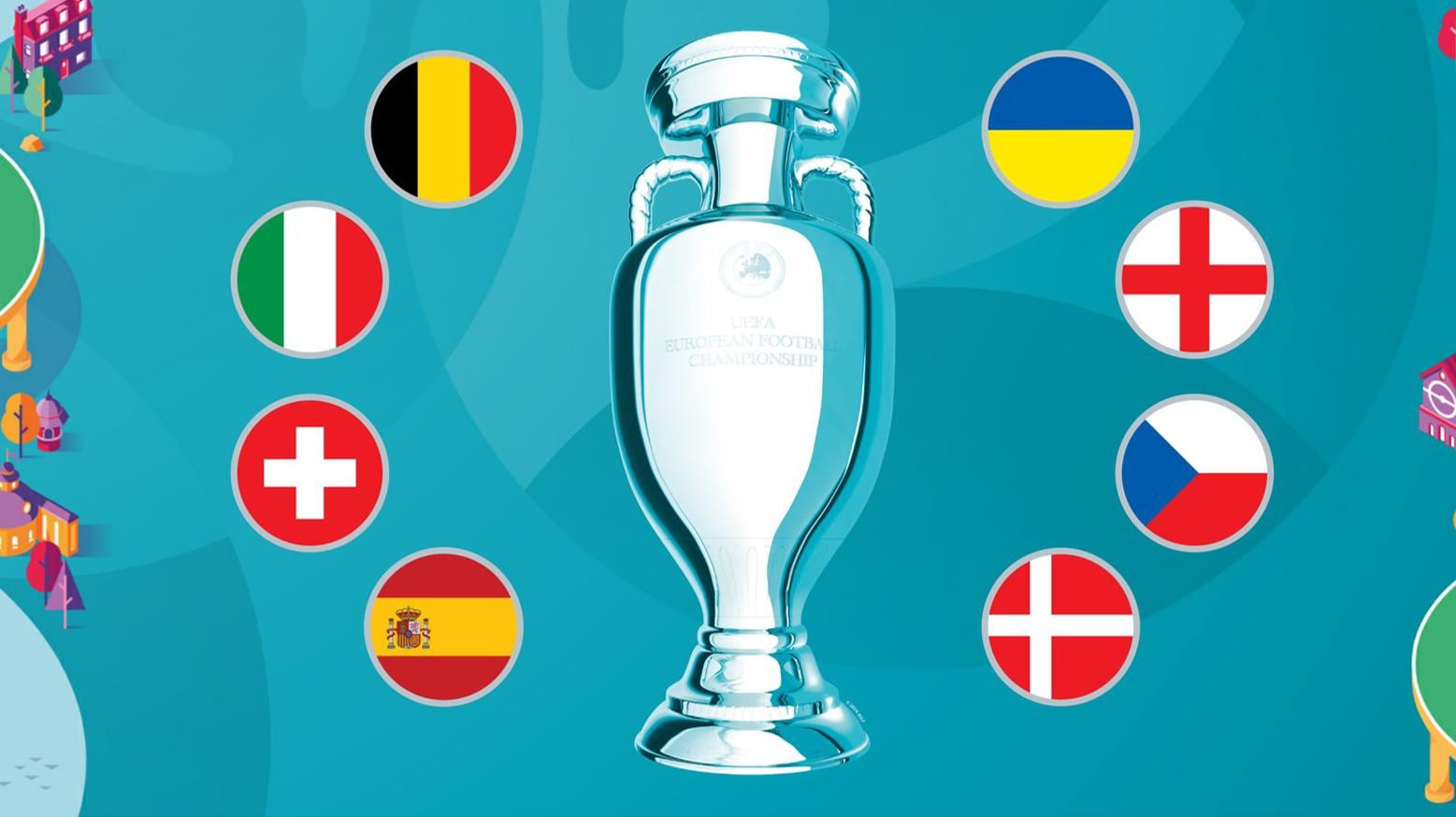
 Switzerland vs.
  Spain – Here is the big irony. Switzerland beat out reigning World Cup holders France on penalty kicks to qualify, and Spain beat out World Cup 2018 finalists Croatia in added extra time to qualify! Additional irony is both teams here had Round of 16 matches that ended with 3-3 after regulation time! Interesting!
  Belgium vs.
  Italy – Two different teams. One is the result of years of teamwork and perfecting that has taken them to the rank of #1 in FIFA’s World rankings. The other is a fresh team with a history of a legacy that’s making a comeback after failing to qualify for the most recent World Cup. Both teams have one thing in common. They both all have straight wins in this Euro tournament.
 Czech Republic vs.
  Denmark – Another quarterfinal of teams that surprised in their Round of 16 match. Most people would have touted the Netherlands over the Czech Republic. However the Czechs delivered a surprise win of two goals. Also many would have predicted Wales to beat Denmark as they have the more lauded players. Denmark surprised them with four goals!
 England vs.
  Ukraine – Tuesday was a case where the eventual winners were not the favorites going into their Round of 16 matches. England has been known in recent decades of losing to Germany. How easy we forgot they beat Germany to win the 1966 World Cup. And in the old Wembley Stadium. However it was a case of one of the best English teams ever against a struggling German team and it resulted in a 2-0 win! And in the new Wembley Stadium. Their first win of a knockout game since Euro 1996, which England hosted! And current coach Garreth Southgate was a player for the team back then!