
2023 Oscars Short Films Review: Animation

It’s interesting with seeing the reels of the shorts films, the Animation nominees are often the ones with the least total running time. They go by so fast, the shorts.tv reel add in a couple of other shortlisted films that got their honorable mention.

Anyways without further chit-chat, here are my reviews of the nominated animated shorts:

Letter To A Pig (dir. Tai Kantor) – The story begins telling of a boy hiding in a pig sty from Nazis who seek to put him in a concentration camp. The Nazis can’t find him. Fast-forward many decades later. The man tells his story to school students on Holocaust Memorial Day. He tells of how he credits the pigs in the pig sty for saving his life. He even wrote a letter to the pig. As he reads it aloud, one boy gives a taunting “oink,” while a female student listens intensely. As she engages herself in the story, she imagines herself and her classmates coming across a giant almost monstrous pig and them holding him prisoner in a trap. As they hold the pig prisoner, she can feel her nose metamorphose into a pig snout. Soon she feels sympathy for the pig and lets the pig go. As the pig is set free, he shrinks into a piglet and she hugs him.

This is an impressive story. It’s a story of a man who tells how a sty of pigs — animals he had been taught his whole life to regard as filthy and disgusting — helped spare him from dying in the Holocaust. As the young girl hears the story, she reflects on her own feelings of human hatred directed towards a pig in her mind and how she develops sympathy soon after and learns to love the pig. The story has its themes of collective trauma, fear and identity. It’s done in an impressive style that consists of a mix of 2D pencil drawings with minor colorization and mixing it with live-action images. The film is as much about the imagery as it is about the story. That’s why I give it my Will Win pick.

Ninety-Five Senses (dirs. Jared and Jerusha Hess) – The story begins with a man telling his views of human senses and colorful images about from the words he tells. At first you get the impression, this man is friendly. Then you hear his story. This man is on death row having his last meal. The capital offence he committed was arson of a repair shop he was fired from. He loved the jobs, but couldn’t handle being fired. He responded by setting it ablaze, forgetting the shop was also a house where the family lived above. As he anticipates his last meal, he looks over his past with regret, but also a sign of hope in the afterlife. He even has an outlook of how all once a person died, each of the five senses fade in their own way one by one. After a life of only five senses, he looks forward to the 95 senses in the afterlife.

It’s very rare you hear a story of a man awaiting execution to be told with a light-hearted spirit or even with some optimism. Never mind including humor. The man, voiced by Tim Blake Nelson, does a great job in telling his story without it becoming a common “Sob Story” you’d expect from a Death Row inmate. The story comes with some surprises for those who watch, like you wonder how a man that sounds so friendly would end up on Death Row. The film even ends on a humorous note. The story not only tells of the incident and of his observations and hope, but it does so in including in all five of the human senses. The story is told through six different animation styles and a multitude of colors that’s a delight to watch, despite the dark subject matter.

Our Uniform (dir. Yegane Moghaddam) – This film is where Yegane tells her story of growing up as a girl in Iran right after the Islamic Revolution. She talks of how the female teachers taught the girls to shout anti-American, anti-Israel and anti-UK messages on a daily basis. She talks of the uniform she was required to wear at school and of how the women there were firm in how all girls should wear their clothes in a proper manner and have all their hair hidden in a hijab. She talks of the difficulty she had in the hijab covering her hair that was longer than the hijab cloth, which got on the women’s nerves. She reflects on how growing up, she was taught under the new revolution to feel like she was inferior to men or below men.

No question this is a film of how a girl was indoctrinated with sexism not simply at a school, but from a system implemented by the ruling regime. The theme of the story is to do about clothing and the strict religious regulations of how girls should wear their clothing according to the new regime. The story is told with stop-motion imagery using clothes or fabrics of the clothes she wore as a child. The images drawn or painted on the clothes as well as the stop-motion movements of the clothes do a great job of telling her story. The use of clothing in the animation of telling the story is vital since clothing has a lot to do with what life was like under the regime. It makes the images as vital to the story as Yegane’s retelling. Hiding all your hair in a hijab and wearing a dress that covered everything was the new law in Iran and the film shows it in a unique way.

Pachyderme (dir. Stephanie Clement) – A woman retells her story of how as a young girl, she would often stay at the cabin of her grandparents. Her grandfather’s stern manner leaves her with a feel of fear and discomfort. The cabin was located by a lake. The cabin bedroom she sleeps in has a displayed elephant tusk the grandfather names “Pachyderme,” pointing in its direction in the hall. The room would give the girl and eerie sense about it through the wood imagery and the creaking of the boards. Even though the grandparents would say there’s nothing to fear, she felt there were monsters to take her. She goes to a lake where a woman had drowned some time earlier and feels spirits drawing her to its depths. Some time later, the grandfather dies and Pachyderme is split in two. As she returns to the cabin following her grandmother’s death, she takes both pieces of Pachyderme to the lake to bury it in the water. One of the two pieces is not completely immersed.

This film has to be the darkest of the five. In reading articles about it, it deals with the subject of incest. Incest itself is disturbing enough for audiences so it makes sense that it’s told through subtle imagery and storytelling that hides the actual facts. The theme of how she regards her grandfather as a monster and how it’s represented in Pachyderme adds to the storytelling, including the burial at sea. The ending where she attempts to bury the two pieces of Pachyderme in the water remind us she can bury a horrific memory like her grandfather’s terrible ways, but the small piece sticking out reminds us the bad memory can’t completely be buried. The imagery of the story is told through 2D images that appear as common images one would remember from storybooks they read. Possibly the monster that is her grandfather is epitomized through the common images of monsters we read in our children’s books of the past. It’s charming in its imagery as it is disturbing to see and listen to the harrowing story.

War Is Over! Inspired By The Music Of John And Yoko (dir. Dave Mullins) – The film starts in a battlefield of war. One soldier has a chess set where he appears to play by himself. After he makes his move, he writes his move on a piece of paper and attaches it to the leg of a messenger bird. The bird flies to “enemy territory” and gives the message to an “enemy” soldier who also has a chessboard and looks like he’s playing by himself. After he makes his move, he writes his move to a message for the messenger bird to deliver. Over time, the intrigue grows with the soldiers on both camps. As the bird delivers message after message, the anticipation on what the next move will be or who will win appears to quell the enmity between both sides. Then checkmate! But the sergeant is disgusted by what he sees. He reminds the camp they’re enemies and the battle must begin now. The soldiers on both sides line up with bayonets and all ready to do battle against the “enemy.” The battle begins and bloodshed ensues. On the field one soldier notices the messenger bird is shot dead. Just as the two soldiers from the chess game confront each other, it’s there from a message that slips out that one realizes the other is his chess rival. They drop their guns. All drop their guns when they see the written message “War Is Over.”

This is a creative story Dave Mullins directs and co-wrote with Sean Ono Lennon and Brad Booker produces through the inspiration of John Lennon’s legendary Christmas song and the message “War is over if you want it.” The one 3D-computer animated film nominated in this category this year, this is a film with a montage appearing to have a World War I setting and sends a message that still matters today. There may be a winner in a chess game but there are no winners in war. The scene where all the soldiers are intrigued and excited by a chess game against a player from the “enemy” side sends the message that enmity is something war creates and provokes, and is often unnecessary. The ending where the bloody battle is instantly ended with the written message “War Is Over” also sends a message of how many battles are in vain. The story first seems to be a story that’s either cute or “fluffy,” but the ending of the bloody battle with “Merry Christmas (War Is Over)” sends a significant message that is as important today as it was when John and Yoko recorded it back then. That’s why I give it my Should Win pick.

And there you have it. That’s my review of the five films nominated for Best Animated Short Film. Interesting that in a time where animated features appear to be dominated by 3D computer animation, only one of the five nominated films is such. That’s what I like best about this category. It opens itself up to various styles of animation, rather than going with one that’s all the rage.
Oscars 2016 Shorts Reviews: Animation and Live-Action

Cinema

I’m lucky to be living in Vancouver. It’s one of the few cities one can be able to see the nominated shorts in a big-screen theatre. Gives me a chance to review them myself and even make a should-win pick for myself. This year is quite an array of nominees in both animation and live-action. So without further ado, here are my thoughts on the nominated shorts:

ANIMATED:

-Blind Vaysha (Canada/France): dir. Theodore Ushev- This is a unique 2D animation story of a Bulgarian folk-tale. A story of a girl with one eye that can see the past and one eye that can see the future and cannot live in the present. The story also shows the attempts of others to fix Vaysha’s blindness. The linocut-style animation, however, was unique and had a lot of style and flare to it.

The story doesn’t really end. Instead the film ends asking the audience their perspective. It has a unique narrative point and I get why it’s done that way, but I often wonder if the film ended on the right note.

-Borrowed Time (USA): dirs. Andrew Coats and Lou Hamou-Lhadj – At first you’ll think this is a family-friendly story at the beginning but soon learn it’s not such as you move on. It’s a dark Western story of a man returning to the spot of a family tragedy from his childhood. The hurt comes back from it and he decides to do something drastic but something happens.

I have to admire Pixar animators Coats and Hamou-Lhadj for making a brief departure from their traditional family fare and doing something more mature under Quorum Films. No, it’s not R-rated like Pear Cider And Cigarettes but it’s dark enough to be adult. I think this short is most likely to upset my pick for the winner.

-Pear Cider and Cigarettes (Canada): dirs. Robert Valley and Cara Speller- Now this is a refreshing R-rated alternative. It sometimes reminds you of a Grand Theft Auto video game or the film Waltz With Bashir. However it is a personal story from director Valley. It’s a story that makes you wonder how far would you go for a friend? Especially if that friend is selfish, conniving, irresponsible and manipulative?

It’s a story that entertains and charms and even gets you to hate Techno too. Sometimes I wonder why was he friends with that jerk? I don’t know if it’s because it was set in Vancouver or because it was an R-rated alternative but it won me over and I make it my Should Win pick.

-Pearl (USA): dir. Patrick Osborne- This is the first VR short to be nominated for an Academy Award. A musician and his daughter travel in a hatchback with a song as a bond between the two. We see the two age, the daughter mature into a musician of her own and have her own version of the song. The viewer gets a 360 degree view of the whole 5-minute story.

Looks like something Richard Linklater would do. Actually it might remind you of Waking Life. An excellent short that’s entertaining and will touch you too. Might even make you go to iTunes and download No Wrong Way Home.

-Piper (USA): dirs. Alan Barillaro and Marc Sondheimer- This is the short shown before Finding Dory. A baby bird looking for food on the beach with her mother looking on and guiding her. Pixar does it again by delivering a clever, charming, and entertaining short with the dialogue absent and the animation as detailed to a tee as it gets. It’s excellent, but it’s something we’ve come to expect from Pixar even with their shorts. Nevertheless this is my Will Win prediction.

And those are my thoughts for the Animated Shorts up for the Oscar. A lot of styles of animation between Canadian and American companies. All five were very entertaining. We’ll see who wins.

LIVE-ACTION SHORT FILMS

This year there are no films with English as the language of the majority. All five are from European countries. Here’s the rundown:

-Ennemis interieurs (France): dir. Selim Azzazi – A man from Algeria seeks to be a French citizen but the interrogator at immigration has big questions for him about meeting with a group of Algerian men back some years ago which led to him being arrested and imprisoned for two years. The interrogator keeps insisting he answers but he’s very reluctant to do so. Even to the point of neglecting his chances of French Citizenship. Why? What will make the man give his answers?

It’s a story that appears boring at first but grows with intrigue with each minute and with each new detail. The interest builds over time. It even makes you wonder why is he withholding the names of the other men? Feelings of brotherhood? Fear of retaliation from them? Also this may be about an incident in the past but it’s very relevant, especially with the Paris bombings happening in November 2015. This is my Will Win pick.

-La Femme et le TGV (Switzerland): dirs. Timo von Gunten and Giacun Caduff – Elise is a woman who wave her Swiss flag at the passing TGV train to Zurich every time it passes her house at 6 in the morning and 6 in the evening . After that she bicycles to her job at the town patisserie. It’s her daily routine for 30 years; a routine she doesn’t want to change. One day, she comes across a letter that was thrown to her by a man who goes on that daily TGV. He’s a man from France looking for work. The two develop a friendship only by mail and packages. Over time she hopes to meet this man. Then one day the train stops coming. It’s changed route? How will she deal with the change? Will she ever see the man?

It’s a charming comedy that has you engaged with the character (based on a person who has existed and did wave her Swiss flag at passing TGV trains). Gets you thinking about the woman. Is she an eccentric? Is she naive? Lonely? Unpredictable ending but a happy one.

-Silent Nights (Denmark): dirs. Aske Bang and Kim Magnusson – Inger is a young Danish woman who helps at the Salvation Army during the day and looks after her ailing mother at night. Kwame is a Ghanian immigrant who came to Denmark for a better future and to support his wife and children at home. However he’s been left homeless and makes money from recycling.

They both meet as Kwame agrees to help. The two develop a mutual friendship and even progress into something more. However it’s put to the test when Kwame steals money from the charity to pay for his daughter’s malaria treatments. Even though Kwame is banned for life, Inger forgives him and still loves him. Then Inger’s mother dies and she learns about Kwame’s family in Ghana just as she learns she is pregnant. It’s over between the two. However Inger sees Kwame one last time where she gives him advice, and something else.

It’s obvious that this story is about the immigrant situation in Denmark and the difficultly of the times for all. It presents both Inger’s side and Kwame’s side. However it’s more. It’s about a love that’s true. Inger loves Kwame so much, she’s willing to forgive him for all the terrible things he did. It makes the choice she makes for her and her baby look like the right thing. This is my Should Win pick.

-Sing (Hungary) dirs. Kristof Deak and Anna Udvardy – Zsofi is the new girl at a school. She most looks forward to singing in the choir. However on her first rehearsal, the instructor talks of a choir competition where the prize is a performance in Sweden. She also tells Zsofi her voice is not ready for the choir and tells her to lip sync. Along the way, Zsofi finds a friend in star singer Liza. The two become good friends. However Liza notices Zsofi not singing but others. When she brings this up with the instructor, she not only admits it but tries to convince the children it’s the right thing for the competition. All of which leads to a surprise ending and the ending you think is right.

Often I question what the point of this film is. Is it about competitiveness to the point the ‘lesser’ singers are not allowed to sing for the sake of the big prize? Or is it a reminder of Hungary’s past communist regime; of how those that fit in are allowed to and those that don’t aren’t, but make like everything’s okay?  Even the choir director could remind you of a communist dictator on retrospect. Whatever the point, the story was entertaining and sweet. Reminds you of the joys of childhood and the right thing paying off in the end.

-Timecode (Spain) dir. Juanjo Gimenez – It starts as a check for a woman on a security job during the day. One day she learns of a broken car light. Upon viewing the video of what happened, she sees the worker before her dancing before hitting the car. She decides to give him a dancing video of her own. Video after video follows. Then on their last day, magic happens.

At first you think the man is something eccentric but this story builds into something that ends on a bizarre note. A very good film.

And there are my thoughts on this year’s nominated shorts. Now remember both categories are the hardest to predict the winner. For example, last year the consensus of critics ranked Stutterer the least likely to win Best Live Action Short and it won. Even Annie wins for Piper and Pear Cider and Cigarettes are not a guarantee that either will win.

With my shorts predictions out of the way, I just have my main predictions for all the categories to deliver. But not before my last Best Picture summary. Coming up tomorrow morning.


VIFF 2012 Review: Hunky Dory

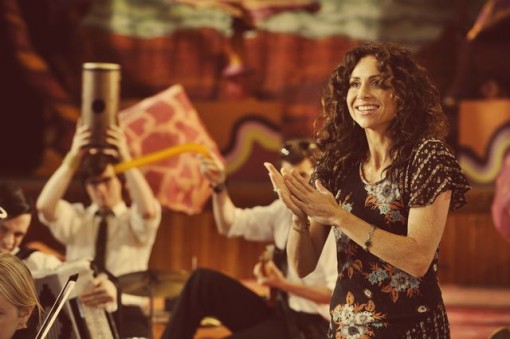
Minnie Driver urges her students on in Hunky Dory.

How often has a movie about a high school musical been done before? Now that Hunky Dory is out, does it add anything new or is it the same old schtick?

It’s the summer of 1976 in a small Welsh town. A young teacher, Vivienne, gets together with her drama group students to arrange to put on a play. As anticipated, it’s a Shakespeare play: The Tempest. Not as anticipated, she wants to put a twist on it by adapting the popular music of the time to it.

It’s difficult enough to arrange as it is but Vivienne and the students face other difficulties along the way. First Vivienne puts the students under a demanding rehearsal schedule that demands much of their time and in sweltering heat. Secondly the students have problems of their own: Stella is undecided between loving Davey or the boy at the disco; Evan is struggling to accept his homosexuality while he currently has a girlfriend; Kenny is pressured by his brother to join a gang of skinheads; the band face tensions of their own; and Davey, the central teen, faces the lures of Stella and Vivienne while dealing with the pressures of a broken home. Thirdly Vivienne faces a lot of dissent from many people in the school, especially Mrs. Valentine and Mr. Cafferty. She does find relief with the volunteering of the headmaster. Fourthly a fire happens and all the play’s props are burned to a crisp. The movie leads to a somewhat predictable ending but it also gives an epilogue detailing what has happened to the students since. It left me wondering “Did this really happen?” I’ve been known to question movies that are ‘based on a true story’ or ‘inspired by true events.’

I’ll have to admit this is not original stuff. This is a common scenario of a music teacher putting on a new twist to a play, people in the school unhappy and even offended with it and teenage conflicts during and between rehearsals along the way. How often have we seen that before? One quality that the story has is that the problems the students went through along the way were very common and realistic to the problems teenagers go through and continue to go through today. Romantic love triangles, the pressures of joining a gang, learning of one’s homosexuality, starting a band and tensions happening along the way, those are all common teenage problems that occur decade after decade. The young cast did a very good job of making them look real and relatable.

Another thing the film did very well is remind us of the charm of 70’s music. Yes the film gave you the feel you were watching a Glee episode but seeing the young people sing and perform songs from David Bowie, Roxy Music, 10cc, ELO, The Byrds this movie brings the charm back and reminds you why those songs charmed the teens then and continue to charm today. In fact the film’s title is the title of a 1971 album by David Bowie and one of the songs from it, Life On Mars, is the first song in the film where the students are performing or rehearsing.

Minnie Driver did a good performance where she was able to display her singing skills along with her acting, but I’ve seen better overall acting from her in the past. This movie actually belonged to supporting ensemble of actors playing the teenagers in the movie. The movie was about them growing up and dealing with their own personal issues while rehearsing for the musical and they did a very good job of it. They also did a good job of acting like Welsh teens from the 70’s. The one of the teens that stood out was Aneurin Barnard as Davey, the one caught in the middle of the play, family tensions and a possible liaison with Vivienne. The only adult actor to steal the movie away from the teens had to be Robert Pugh who goes from your typical stodgy headmaster to siding with Vivienne in the end. Marc Evans is not too experienced with directing features as he is with television and documentaries but he does a good effort in this movie, if unspectacular. Scriptwriter Laurence Coriat brings in some depth in what could have been another run-of-the-mill high school musical script. The music was very good and very professional. Overall all actors did a good combined job of acting and singing.

I didn’t originally plan to see Hunky Dory that day: the Sunday before Canadian Thanksgiving. I meant to see Late Quartet but tickets for volunteers were finished and I had to wait in the Rush Line as my last chance. I did secure a ticket for Hunky Dory just in case I was out of luck. Sure enough, I was out of luck for Late Quartet. Despite missing Last Quartet, I’m quite content in seeing Hunky Dory that Sunday night.

Hunky Dory has done the film festival circuit and is due for big screen release anytime soon. IMDB shows the movie listed as released on March 2, 2012 in the UK and Ireland. Wikipedia says that it will be released by Universal Pictures in the US and 20th Century Fox around the rest of the world. This would make it the first British independent film secured by a major studio. I thought Billy Elliot was. Whatever the stats, the purchase by those two companies should boost the box office outcome of Hunky Dory in the future.

Basically Hunky Dory is not meant to take film making or music making in any new directions. It’s the same story redone and made to look different. Nevertheless its purpose it appears is to entertain the crowd and it does just that. Fans of musical movies or shows like Glee or High School Musical will like it.