VIFF 2024 Review: Luther – Never Too Much

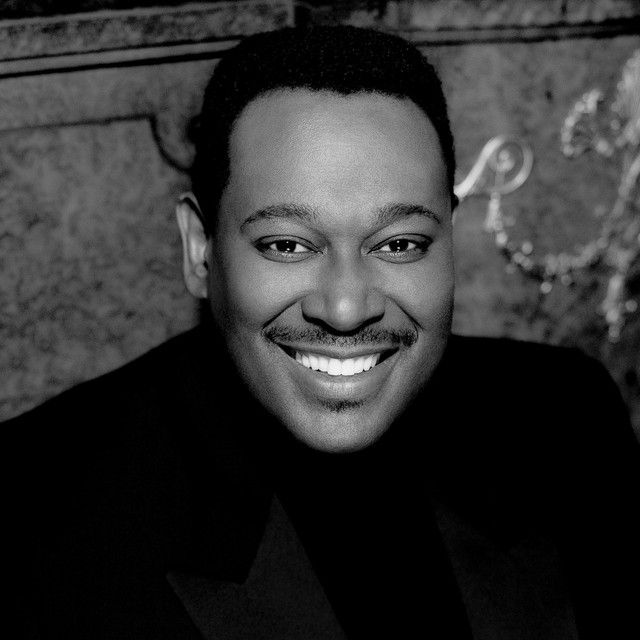
Luther: Never Too Much is an intriguing documentary of Luther Vandross whose music we remember, but we didn’t know the whole story.

I’m sure most of us who were teens from the 80’s or 90’s will remember the music of Luther Vandross. The documentary Luther: Never Too Much is a documentary that showcases the R&B legend’s career but also tell us of personal sides of the singer we never knew.

The film starts by showing Luther performing on stage and then focuses on his childhood. Luther comes across as the type of child which music was born in him. He was born in a housing project in Manhattan to a father who was a former singer and mother who was a nurse. At three, he taught himself how to play piano by ear thanks to having his own record player. At 9 and shortly after the death of his father, the family moved to a rough area of the Bronx. His older sister Patricia sang for the group The Crests, most famous for the hit 16 Candles. His sisters took him to the Apollo theatre to see acts perform for free. For Luther, that was his way of escaping the threat of street life. There, he not only got to see legends perform on stage but he studied the performers, their movements and their singing.

As an adult, music was so much a passion for Luther, he dropped out of college to pursue it. Despite trying to make it in the music business being very tough, Luther was very driven. He led a Patti LaBelle fan club, finally got on stage at the Apollo as part of the group Shades Of Jade, and then formed his own vocal group Listen My Brother. Listen My Brother got to perform on some of the very first Sesame Street episodes! Vandross tried other routes in music such as writing songs for Patti Labelle and the Blue Belles, Roberta Flack, Bette Midler, Diana Ross, Donny Hathaway and Chaka Khan. He also sang back-up for artists like Gary Glitter, David Bowie, Carly Simon, Donna Summer, Sister Sledge and Flack. He would also create jingles for many commercials, including many fast food franchises.

The whole time, many felt Vandross had what it took to make it as a solo singer with his singing and his drive. There were some critics who felt his weight is what kept him from having star potential. The turning point was when in 1980, he was ‘fired’ by Roberta Flack as he was a back-up singer on his album. Flack told him he was too good to be a back-up singer. He deserved better. It’s that move that finally started his drive to make it as a solo singer. The first crack as his singing career started in the summer of 1981 with his album Never Too Much. It went double platinum and the title song hit #1 on Billboard’s R&B chart and #33 on the Hot 100. That would be the situation through the first years of his solo career. His songs would become big hits on the R&B chart but would very rarely hit the Top 40 on the pop chart. The album also helped him achieve his first two Grammy nominations.

Vandross would get more notice in the public eye as he continued to release music over the years. Becoming known as the ‘Velvet Voice,’ his Grammy nominations made him one to watch. His jingle singing would be made fun of by Eddie Murphy in his comedic monologue of singers. Of which, Vandross responded by singing his KFC jingle while Murphy was in the audience. Vandross would also get nasty flack about his weight. His concerts drew huge attendance and his hits started getting bigger on the pop chart despite not making the Top 10. On the negative side, he would get more Grammy nominations and wouldn’t win. His weight was a constant struggle throughout his life and it appeared in the mid-80’s he was finally losing weight. Then in 1986, he drove recklessly with Jimmy Salvemini, a singer he was working with, and his manager brother Larry. The car spun out of control and crashed, killing Larry. Vandross was badly injured, was sued by the Salvemini family, and returned to overeating.

In late-1989, his fortune made a turn for the better. He released a Greatest Hits album co-titled ‘The Best of Love.’ The compilation went triple-platinum and it gave the hit Here And Now that became his first-ever US pop Top 10 hit, peaking at #6. The hit also helped Luther win his first Grammy after nine previous nominations. Further pop success continued with the album Power Of Love in 1991. The album peaked at #7 on pop albums, certified double-platinum, spawned two more Top 10 hits on the pop chart and won two more Grammies. Additional pop success came over the years with two more Top 10 duets with Janet Jackson and Mariah Carey.

Despite all the success, Vandross was still going through a lot of personal problems. He had health problems, continuing struggles with his weight and difficulty confronting his sexuality. The early-90’s saw the rise of hip hop and its eventual revolution with the African American music scene. Vandross’ career soon faded and he would be dropped from Epic records. In the early 2000’s, Vandross made less public appearances and was quietly teaming up with Richard Marx to create what would be his last album: Dance with My Father. The album went double-platinum and the title song went platinum and would win the Grammy for Song Of The Year. Unfortunately a year earlier, he had a stroke that left him bound to a wheelchair and unable to sing. Vandross’ mother accepted the award on his behalf. After two years of struggling with the effects of his stroke and diabetes, he died in 2005 at the age of 53. His funeral was well-attended by legends of R & B like Aretha Franklin, Patti LaBelle, Dionne Warwick and Stevie Wonder.

This documentary is more than just a common biographical film of a musician. It’s also a good focus at a lot of garbage musicians face in the music business. Luther was an excellent singer, musician and songwriter, but making it in the business was hard. The music business always gives its performers commercial expectations or else they will dropped in favor of a rising star with better selling potential. All too often, talented people get overlooked by singers or performers with better looks. All too often when a record label looks to hire a solo male singer, they expect him to look like a “Prince Charming” or a “Mr. Hot Stuff.”

Luther was the case of person who loved music so much, he was determined to make it whatever way we could. Even as he was frequently shunned because of his weight n the 70’s, his musical work, back-up singing and songwriting ability is what made him be active in the business. Even after he made it, he still faced the difficulty of racism in the music business, pressures from his record label and personal setbacks. His biggest problems were about his weight and his closeted sexuality. In the 80’s and 90’s, he was in the public eye and judged. If he was overweight, he was ridiculed in the press. When he lost weight in the mid-80’s, he was rumored to have AIDS. He would admit in talk shows that food would be his drug or source of solace. As for his sexuality, it was a case back in the 80’s and 90’s that a male singer with a romantic voice couldn’t come out. He had to keep it hidden throughout his life. It’s only after his death it came to light.

The film is as good at showing some of the problems Vandross faced in his music career as it is about his music. It was good at showcasing his many achievements. Many of which, some of his biggest fans wouldn’t have known about. The film is also very good at getting even some of the most personal information about Luther from some of the people Vandross was closest to from musical colleagues to family members. As a musical documentary, it doesn’t offer too much in terms of a new and different way of presenting its story. There are times it feels like the common formula in music documentaries. Also in terms of chronology, I noticed there were times in which some of the musical events in his career weren’t shown in fluid chronology. Whenever the film focused on a particular year, some songs were shown years before their release.

This film is a good achievement from Dawn Porter. Porter is known as a documentarian whose works primarily focus on African American subject matter. It started in 2013 with Gideon’s Army and still continues well. She also has in plans a documentary of the Mandela’s coming up. Here in this documentary, she does an excellent job of presenting a life of a man who loved music and had to make a profession of it however he could and was lucky enough to be a famous singer. She also presents well the personal troubles and difficulties Vandross went through. The documentary of Vandross’ life and career also makes a good lesson to wannabe musicians who want to make a career. The obstacles he went through are common big names in the music business go through and have to overcome. It’s easy to see how so many either don’t make it or get swallowed alive even if they do.

Luther: Never Too Much is an intriguing look at an R&B great that shows the singer’s drive, his fame, and his struggles, both physical and personal. His story is showcased in a format common in music documentaries but it presents its story very well.

2023 Oscars Short Films Review: Animation

It’s interesting with seeing the reels of the shorts films, the Animation nominees are often the ones with the least total running time. They go by so fast, the shorts.tv reel add in a couple of other shortlisted films that got their honorable mention.

Anyways without further chit-chat, here are my reviews of the nominated animated shorts:

Letter To A Pig (dir. Tai Kantor) – The story begins telling of a boy hiding in a pig sty from Nazis who seek to put him in a concentration camp. The Nazis can’t find him. Fast-forward many decades later. The man tells his story to school students on Holocaust Memorial Day. He tells of how he credits the pigs in the pig sty for saving his life. He even wrote a letter to the pig. As he reads it aloud, one boy gives a taunting “oink,” while a female student listens intensely. As she engages herself in the story, she imagines herself and her classmates coming across a giant almost monstrous pig and them holding him prisoner in a trap. As they hold the pig prisoner, she can feel her nose metamorphose into a pig snout. Soon she feels sympathy for the pig and lets the pig go. As the pig is set free, he shrinks into a piglet and she hugs him.

This is an impressive story. It’s a story of a man who tells how a sty of pigs — animals he had been taught his whole life to regard as filthy and disgusting — helped spare him from dying in the Holocaust. As the young girl hears the story, she reflects on her own feelings of human hatred directed towards a pig in her mind and how she develops sympathy soon after and learns to love the pig. The story has its themes of collective trauma, fear and identity. It’s done in an impressive style that consists of a mix of 2D pencil drawings with minor colorization and mixing it with live-action images. The film is as much about the imagery as it is about the story. That’s why I give it my Will Win pick.

Ninety-Five Senses (dirs. Jared and Jerusha Hess) – The story begins with a man telling his views of human senses and colorful images about from the words he tells. At first you get the impression, this man is friendly. Then you hear his story. This man is on death row having his last meal. The capital offence he committed was arson of a repair shop he was fired from. He loved the jobs, but couldn’t handle being fired. He responded by setting it ablaze, forgetting the shop was also a house where the family lived above. As he anticipates his last meal, he looks over his past with regret, but also a sign of hope in the afterlife. He even has an outlook of how all once a person died, each of the five senses fade in their own way one by one. After a life of only five senses, he looks forward to the 95 senses in the afterlife.

It’s very rare you hear a story of a man awaiting execution to be told with a light-hearted spirit or even with some optimism. Never mind including humor. The man, voiced by Tim Blake Nelson, does a great job in telling his story without it becoming a common “Sob Story” you’d expect from a Death Row inmate. The story comes with some surprises for those who watch, like you wonder how a man that sounds so friendly would end up on Death Row. The film even ends on a humorous note. The story not only tells of the incident and of his observations and hope, but it does so in including in all five of the human senses. The story is told through six different animation styles and a multitude of colors that’s a delight to watch, despite the dark subject matter.

Our Uniform (dir. Yegane Moghaddam) – This film is where Yegane tells her story of growing up as a girl in Iran right after the Islamic Revolution. She talks of how the female teachers taught the girls to shout anti-American, anti-Israel and anti-UK messages on a daily basis. She talks of the uniform she was required to wear at school and of how the women there were firm in how all girls should wear their clothes in a proper manner and have all their hair hidden in a hijab. She talks of the difficulty she had in the hijab covering her hair that was longer than the hijab cloth, which got on the women’s nerves. She reflects on how growing up, she was taught under the new revolution to feel like she was inferior to men or below men.

No question this is a film of how a girl was indoctrinated with sexism not simply at a school, but from a system implemented by the ruling regime. The theme of the story is to do about clothing and the strict religious regulations of how girls should wear their clothing according to the new regime. The story is told with stop-motion imagery using clothes or fabrics of the clothes she wore as a child. The images drawn or painted on the clothes as well as the stop-motion movements of the clothes do a great job of telling her story. The use of clothing in the animation of telling the story is vital since clothing has a lot to do with what life was like under the regime. It makes the images as vital to the story as Yegane’s retelling. Hiding all your hair in a hijab and wearing a dress that covered everything was the new law in Iran and the film shows it in a unique way.

Pachyderme (dir. Stephanie Clement) – A woman retells her story of how as a young girl, she would often stay at the cabin of her grandparents. Her grandfather’s stern manner leaves her with a feel of fear and discomfort. The cabin was located by a lake. The cabin bedroom she sleeps in has a displayed elephant tusk the grandfather names “Pachyderme,” pointing in its direction in the hall. The room would give the girl and eerie sense about it through the wood imagery and the creaking of the boards. Even though the grandparents would say there’s nothing to fear, she felt there were monsters to take her. She goes to a lake where a woman had drowned some time earlier and feels spirits drawing her to its depths. Some time later, the grandfather dies and Pachyderme is split in two. As she returns to the cabin following her grandmother’s death, she takes both pieces of Pachyderme to the lake to bury it in the water. One of the two pieces is not completely immersed.

This film has to be the darkest of the five. In reading articles about it, it deals with the subject of incest. Incest itself is disturbing enough for audiences so it makes sense that it’s told through subtle imagery and storytelling that hides the actual facts. The theme of how she regards her grandfather as a monster and how it’s represented in Pachyderme adds to the storytelling, including the burial at sea. The ending where she attempts to bury the two pieces of Pachyderme in the water remind us she can bury a horrific memory like her grandfather’s terrible ways, but the small piece sticking out reminds us the bad memory can’t completely be buried. The imagery of the story is told through 2D images that appear as common images one would remember from storybooks they read. Possibly the monster that is her grandfather is epitomized through the common images of monsters we read in our children’s books of the past. It’s charming in its imagery as it is disturbing to see and listen to the harrowing story.

War Is Over! Inspired By The Music Of John And Yoko (dir. Dave Mullins) – The film starts in a battlefield of war. One soldier has a chess set where he appears to play by himself. After he makes his move, he writes his move on a piece of paper and attaches it to the leg of a messenger bird. The bird flies to “enemy territory” and gives the message to an “enemy” soldier who also has a chessboard and looks like he’s playing by himself. After he makes his move, he writes his move to a message for the messenger bird to deliver. Over time, the intrigue grows with the soldiers on both camps. As the bird delivers message after message, the anticipation on what the next move will be or who will win appears to quell the enmity between both sides. Then checkmate! But the sergeant is disgusted by what he sees. He reminds the camp they’re enemies and the battle must begin now. The soldiers on both sides line up with bayonets and all ready to do battle against the “enemy.” The battle begins and bloodshed ensues. On the field one soldier notices the messenger bird is shot dead. Just as the two soldiers from the chess game confront each other, it’s there from a message that slips out that one realizes the other is his chess rival. They drop their guns. All drop their guns when they see the written message “War Is Over.”

This is a creative story Dave Mullins directs and co-wrote with Sean Ono Lennon and Brad Booker produces through the inspiration of John Lennon’s legendary Christmas song and the message “War is over if you want it.” The one 3D-computer animated film nominated in this category this year, this is a film with a montage appearing to have a World War I setting and sends a message that still matters today. There may be a winner in a chess game but there are no winners in war. The scene where all the soldiers are intrigued and excited by a chess game against a player from the “enemy” side sends the message that enmity is something war creates and provokes, and is often unnecessary. The ending where the bloody battle is instantly ended with the written message “War Is Over” also sends a message of how many battles are in vain. The story first seems to be a story that’s either cute or “fluffy,” but the ending of the bloody battle with “Merry Christmas (War Is Over)” sends a significant message that is as important today as it was when John and Yoko recorded it back then. That’s why I give it my Should Win pick.

And there you have it. That’s my review of the five films nominated for Best Animated Short Film. Interesting that in a time where animated features appear to be dominated by 3D computer animation, only one of the five nominated films is such. That’s what I like best about this category. It opens itself up to various styles of animation, rather than going with one that’s all the rage.

DVD Review: Sing Street

sing-street-banner-3
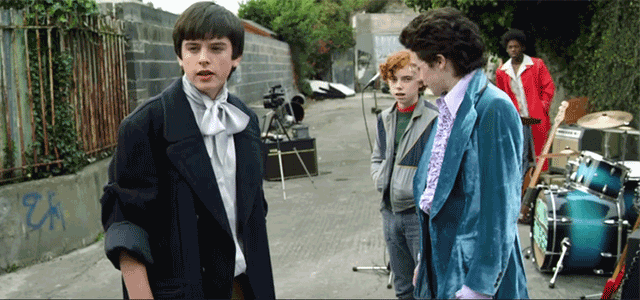
Sing Street is about a band in Dublin led by Conor (Ferdia Walsh-Peelo, left) , a boy with musical dreams.

2016 was seen as a weak year for comedies, unless they were animated. Possibly the most overlooked gem of 2016 was the Irish musical comedy Sing Street. I passed it up when it first came out, but I finally saw it recently. I’m glad I did.

We see Conor Lawlor strumming his guitar in his bedroom. Conor is a 15 year-old boy living in a shabby suburb of Dublin in 1985. Right now, Ireland is going through difficult times. It’s economy has been hit hard and many young people are fleeing to the UK, most notably London, for a future. His family is also going through difficulties as his father is struggling in his architecture practice and is struggling in his marriage and drinks excessively. Because of that, Conor is taken out of his high-class Catholic school and put into an all-boys free state school in Synge Street. A move older brother Brendan objects to, knowing how terrible the priests are there.

Things don’t go well for Conor on the first day. Being the new kid, he gets bullied. On top of it, he has the principal Br. Baxter giving him a hard time because he’s wearing brown shoes instead of black shoes in the dress code. Conor does end up with a bully name Barry but he makes a new friend in Darren who has big-time entrepreneur dreams. Conor also meets a 16 year-old girl named Raphina living at the orphanage nearby the school. He learns that Raphina is a budding model who’s headed to London. Conor impresses Raphina saying he’s in a band.

Now it’s up for Conor to create the band with the help of Darren. Darren is quick to act as Conor is introduced to Eamon: an awkward looking teen with a passion for music and can play many an instrument. Conor is able to meet a local black teen who is mostly shunned away from the others and two other awkward but musically-inclined students from his school. They start out pretty flat together and create a demo tape of popular 80’s songs. Conor gives it to Brandon but he’s unimpressed. He instructs Brandon not to be a cover band but do their own original stuff. That helps Conor to meet with Eamon to compose a song about his infatuation with Raphina: The Riddle Of The Model. The boys try on various costumes for filming a video and Raphina even volunteers to be their makeup artist and ingenue.

The song and video impress Brendan, feeling they’re off to a good start. However Conor’s rocker image of dyed hair and makeup gets on the nerves of Br. Baxter who insists in turning all boys into men at the school. Baxter even grabs Conor and washes the makeup off his face in a bathroom sink with hot water. But Conor and the band are undaunted. They continue making music and Raphina even advises that Conor be known as Cosmo. Conor develops the self-confidence to stand up to school bully Barry. The romance between Raphina and Conor heat up too, despite Raphina claiming an older man is her boyfriend. Conor even talks of sailing to London with Raphina.

However things soon take a turn for the worse. Conor’s parents are on the verge of separating with the mother moving in to her new lover’s place. Plus Raphina doesn’t show up when Sing Street are shooting a Back To The Future style video for their song Drive It Like You Stole It. Raphina later revealed she was set to leave for London, but her boyfriend abandoned her. A disheartened Conor breaks up with her. The breakup affects Conor in writing new songs for the band.

However it’s Brendan who encourages him to get back with Raphina and get back into playing. It’s through Brendan’s own personal feelings of past failures that drive him to give Conor the advise. Sing Street have a chance to perform a gig at school. Conor even offers Barry a chance to become a roadie for the band to escape his abusive household. The band performs their gig to the delight of the school and a condescending Br. Baxter looking on in disappointment, but they saved the best for last. The film ends not as one would expect but one that would leave the audience happy and hopeful.

I won’t deny this is a common story you’d expect to see in a film. I’m sure the story of a person growing up in a trash-bin of a city starting a band has been done before. The thing with this story is that for a common story like this to work again, the characters have to connect with the audience. They have to make the audience want them to succeed. The film succeeds in making the audience want Conor, or should I say ‘Cosmo,’ and Sing Street to succeed. The film succeeds in making the audience want Conor win Raphina’s love. The film succeeds in making the audience want the bullying of Barry to Conor to end and for Conor to get even with Br. Baxter. The connection of Conor with the audience is one of the biggest elements of magic in this story.

It’s not just the connection of Conor with the audience. It’s the connection with Raphina too. You get a sense Raphina is the right one for Conor, despite being confused about her love to her older boyfriend. However you get a sense that Conor will win her love. Raphina believes in the band and believes in Conor. You can see it in her eyes. Also Raphina shares Conor’s dreams of leaving for London. Seeing how unpromising Ireland looked with its economic drabness back then and the people seeing the priests as ‘rapists’ leaves you sensing life would be better for the both over in London.

It’s also the connection with Brendan with the audience too. Brendan is the first character in the film outside of Conor that’s easy to like because Brendan believes in Conor’s talents. Brendan’s also the type of brother that would be honest about how Conor is doing. Even after he disses what Sing Street does at first, he will give Conor words of encouragement. He will give Conor music albums to give him a sense about what makes rock and roll. It’s Brendan’s embrace of music in both its past influences and future directions that become a huge boost for Conor. However it’s also Brendan’s past failures that we get a better understanding. We see why Brendan pushes Conor in that scene after the parents’ separation and he throws a violent fit over his past failures. Because Brendan views himself as a failure who doesn’t have a chance, so he wants Conor to chase his dreams and be the one that has what it takes to go to London. It’s easy to feel for Brendan. It’s also easy for a viewer to see their own feelings of failure and regret in Brendan too.

With this being a film about a rock and roll band, the music has to be as important as the story itself. Brendan’s embrace for music is a big quality of the film, but it has to rub off on Conor as he’s the one with the gift of music. The film gets focused on the themes of music like themes of love, themes of heartache, themes of frustration, themes of emptiness and themes of hope. We learn about the ‘happy-sad’ feeling that we all get, but may  not know it. The ‘happy-sad’ element is definitely influential in music. Now once all the themes and elements of music are put together, the film has to have catchy songs. The film succeeds in doing so with songs like Riddle Of The Model, Drive It Like You Stole It and Brown Shoes. Brown Shoes made the perfect end-number for the school show. Even music from other musicians like Duran Duran, The Cure, The Jam, and many others add to the theme of music in the film. The film is as much about music as it is about love and dreams.

Writer/director John Carney succeeds in delivering an enjoyable film to the big screen. Music has been a common theme in past films of his like Once and Begin Again. He succeeds here again in delivering a film that’s enjoyable and keeping you engaged in the story. The film featured a very good debut performance for Ferdia Walsh-Peelo who was 16 years old when this film debuted at Sundance 2016. Ferdia is actually a singer who has performed professionally as a child in Ireland for years. This is his first acting role and he does an excellent job. Lucy Boynton also did a very good job in playing Raphina. The best thing is she made Raphina appear older than she really was. Jack Reynor was also very good as Brendan. He made Brendan into a likeable character, but also made you feel for him too.

Sing Street is a musical comedy that delivers excellently. It delivers a story and characters that connect with the audience very well. It also delivers entertaining music, which is what a film about a rock and roll band should do.

No Real Controversies In Music Nowadays. Just Excuses.

I’ll admit these controversies happened months ago.  Nevertheless I feel it’s still worth pointing out since  both topics still stimulate excitement amongst the young and both songs are still in the US Top 40.

You may have remembered that over the past four or so months there was a load of controversy over two happenings in the music business. One was Robin Thicke’s “Blurred Lines” in terms of its lyrics. Another was the performance of Miley Cyrus at the MTV Video Music Awards. Both were good at causing controversy in its time. But both wouldn’t have raised an eyebrow say twenty or even ten years ago.

 THICKE AND THIN

Robin Thicke in the unrated video fir 'Blurred Lines.' Both the song and video raised eyebrows in 2013.
Robin Thicke in the video for ‘Blurred Lines’ featuring a model in a flesh-colored suit. Both the song and video raised eyebrows in 2013.

First up is some controversy actually caused by music. This was courtesy of Robin Thicke and his song ‘Blurred Lines.’ which featured rappers Pharrell and T.I. The biggest controversy came from the video. There were two videos shot: one with the three models topless (which were actually flesh-colored G-strings) and the other with them covered. The topless version was first banned from Youtube but then restored albeit flagged as inappropriate for minors. There were even lewd messages like: “Robin Thicke has a big dick.” in the unrated version. My own problem with the video was seeing all those annoying hashtags.

Robin later commented on the controversy of the video: “We tried to do everything that was taboo. Bestiality, drug injections, and everything that is completely derogatory towards women. Because all three of us are happily married with children, we were like, ‘We’re the perfect guys to make fun of this.'”  Once again, the sexist-or-satire debate came up. I’m sure all three wives, especially Paula Patton, would have their own things to say about it.

Then there were the lyrics of the song. One lyric–“I know you want it”– hinted to many of date rape, especially at many universities in the UK. The first shout came from the University Of Edinburgh and at least twelve other UK universities followed in the ban. Thicke would later defend the song, declaring the song was about his wife (actress Paula Patton), and that after 20 years together, he indeed knew she wanted it from him. Once again, the fact that the three of them were married came up in the debate.

This proved to be the most controversial song of the decade and the first in years to stir up debate. The song has hit #1 in eighteen countries including Canada, Germany, France and even the UK. In the United States, it spent twelve weeks at #1 on the Hot 100 and became the first song of the decade to do so. The song currently sits at #31 on the Hot 100.

Oh, the song has also sparked a lawsuit from Thicke after the surviving relatives accused the writers of copying the ‘sound’ and ‘feel’ of ‘Got To Give It Up.’ I find it funny because I thought it was trying to capture the ‘sound’ of ‘Stuck In The Middle With You.’

MILEY GONE VILEY

Miley Cyrus really took full advantage of the good-girl-gone-bad gimmick this year by first twerking with Robin Thicke at the VMAs...
Miley Cyrus really took full advantage of the good-girl-gone-bad gimmick this year by first twerking with Robin Thicke at the MTV VMAs…

Miley Cyrus has been a star in entertainment since 2006 when her Disney channel show Hannah Montana won over young girls nationwide and made Miley a star. The success of the show also helped start her music career. However it was later years when she tried getting records released as Miley Cyrus that she tried to disassociate herself from her former Hannah Montana label.

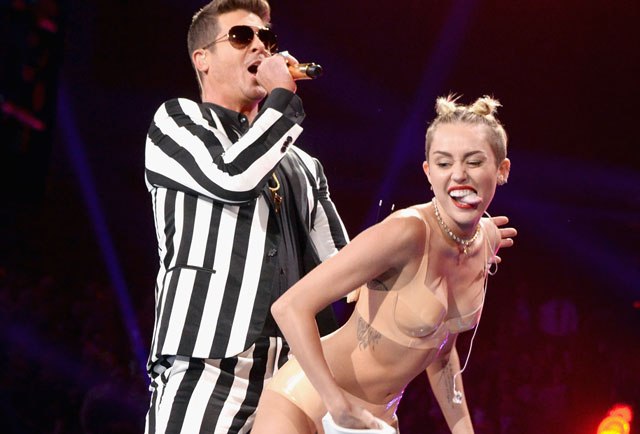
It wasn’t until this very year that she finally did away with her former Hannah Montana label. But in a way that made tons of news. Not surprisingly it was at the MTV Video Music Awards of this year. Surprisingly, it was along Robin Thicke with his performance of ‘Blurred Lines.’ But before Robin, Miley performed her song ‘We Can’t Stop’ in a teddy bear attire. Then once Robin performed ‘Blurred Lines,’ Miley stripped down to a skin-colored latex two-piece outfit, touched Thicke’s crotch with her foam finger and then twerked against his crotch. Twerking was already the sexually-charged dance fad of 2013 that was already getting a lot of talk but it’s there where it got it’s peak.

...and then by swinging naked on a wrecking ball in the video of 'Wrecking Ball.' It all paid off in giving her best record sales ever.
…and then by swinging naked on a wrecking ball in the video of ‘Wrecking Ball.’ It all paid off in giving her best record sales ever.

The reactions were angry and they came from all sides: viewers and musical guests. Many felt her actions were distasteful. The incident set a Twitter record as the ‘most Tweeted’ event in history with 360,000 tweets in a single minute. News and social media sites published articles to do about parental concern. The incident was even considered responsible for Australian actor Liam Hemsworth to break off his engagement to Miley. Even Gloria Steinem was questioned about it, asked if that incident is setting the women’s movement back. Miley responded to the flack: “They’re overthinking it. You’re thinking about it more than I thought about it when I did it.” My feelings were as I saw it: either sleaze-for-chart-topping’s-sake or cashing in on the good-girl-gone-bad image. Her response did little to quell the controversy. Cyrus even received a letter from Sinead O’Connor warning her about the music industry and what it could do to her. To which, Cyrus gave a bratty response where she even brought up O’Connor’s psychotherapy.

Whatever the situation, it did nothing to quell Cyrus’ record sales. “We Can’t Stop” hit #2 and her album Bangerz debuted at #1. Further Cyrus controversy came with the release of her second single ‘Wrecking Ball.’ The video consisted of images of her swinging naked on a wrecking ball and licking a sledge-hammer. Sure it was your typical sleaze-for-sales-sake–I dare anyone with half a brain in their head to describe how those images are ‘artistic qualities’– but it paid off as it became Miley’s first ever #1 hit in the US. Just when you thought sleaze-for-sales-sake eemed to be fading, we’re reminded that the good-girl-gone-bad image is still a hot chart-topper. For those that care, ‘Wrecking Ball’ is now at #20 on the Hot 100 with the follow up song ‘Adore You’ climbing up the charts and sitting at #30 right now.

MUCH ADO ABOUT LITTLE

As you can tell, the controversies have sparked a lot of news and a lot of talk. There’s just one problem. They both pale in comparison to musical controversies of the past. I know because I’ve seen decades of musical controversies come and go. In fact I even saw VH-1’s countdown of the 100 Most Shocking Moments In Rock ‘N Roll. Here’s a refresher of the Top 10 most shocking for those who forgot:

  1.  John Lennon Assassinated (1980)
  2. Michael Jackson Accused Of Child Molestation (1993)
  3. Altamont Concert Ends In Tragedy (1969)
  4. Kurt Cobain Commits Suicide (1994)
  5. Marvin Gaye Jr. Shot To Death By Father (1984)
  6. The Who’s Cincinnati Concert Marred By A Tragic Stampede (1979)
  7. Milli Vanilli: Girl You Know It’s Fake (1990)
  8. Woodstock 1999: Where There’s Smoke…There’s And End To Peace ‘N Love
  9. Sinead O’Connor Disses The Pope On SNL (1992)
  10. The Beatles: Bigger Than Jesus Boast (1966)

I don’t have the energy to list #11 to #100 but you would be able to see how legendary a lot of those shocking moments are. Even though the list was compiled back in 2001, you can be sure there are few controversies since that could be worthy of a spot on the list, should it be revamped. My best bets for replacements would be Metallica vs. Napster (2000-2002), Janet Jackson’s Super Bowl Exposure (2004), Lil Kim Big Liar (2004), Britney’s Divorce Outbursts (2007) and Phil Spector Guilty Of Murder. Outside of that, little else. Don’t forget the list came right after the 90’s when shocking moments were left, right and centre. We all remember how infamous acts from rappers like Snoop Dogg’s alleged gang-style murder participation that launched his stardom in 1993. Or Death Row manager Suge Knight’s menacing, even gang-style, methods of doing business. Or even the murders of Tupac Skakur and The Notorious B.I.G. that turned them from star rappers into rap legends. So it’s obvious that Miley’s incidents are not necessarily anything that will take shock to new levels nor are they anything too new. They’re just simply the shock of the moment that simply gets a lot of press. Nothing new or revolutionary. Just the stuff stealing the show and the headlines.

‘Blurred Lines’ isn’t much in terms of shock material as it happens. It’s not as controversial as say the lyrics on Enimem records back from 1999 to 2002: lyrics that causes censorship discussions and lawsuits from those people that felt slandered. Must I say they were lyrics that fueled Eminem’s superstardom and made him a hero to the young back then and a legend to his time.

Neither is ‘Blurred Lines’ as controversial as say the lyrics of rap group 2 Live Crew in their 1989 album ‘As Nasty As They Wanna Be.’ Those lyrics were nasty enough to be taken to a court in Broward County and judged obscene. The 2 Live Crew fought the obscene conviction and won. The court cases rewrote the book on record censorship and paved the way for more explicit and irresponsible lyrics from gangsta rap records to be released and sell like hotcakes for many years. If you want to dig deeper into lyrics controversy, ‘Blurred Lines’ doesn’t even contain the same shock elements as many disco records like the simulated orgasms heard in Donna Summer’s ‘Love To Love You Baby’ or Sylvester’s ‘You Make Me Feel Mighty Real.’ Nor does ‘Blurred Lines’ cause the same controversy as say the ‘Filthy Fifteen’: fifteen explicit songs labeled ‘filthy’ by the Tipper Gore-led ASPCA back in 1985 and would pave the way for warning stickers on records. It doesn’t even have the same shock value as say the psychedelic songs of the late-60’s, early 70’s that reference drugs and illicit sex. And those songs came just as the counterculture was starting to happen and the older generation were frustrated of what to make of it. Just to put it plainly if you released ‘Blurred Lines’ as little as say ten years ago or even during the disco days of the 70’s, you’d have young people labeling the song as boring because of its lack of shock value and its video not full enough of scantily clad women. Just like Miley’s twerking, ‘Blurred Lines’ was a case of a controversy pale in comparison to music controversies past but was able to own the spotlight at the right time.

It’s no secret that controversy has made many a music career. Miley’s and Robin’s controversies were pretty tame compared to music controversies of the past. Nevertheless they were the right controversies at the right time to steal the show and make their records top the charts. As for me, all it does is make me glad to be old.