2023 Oscars Short Films Review: Live-Action

It’s interesting when the Academy deliver their nominations for feature-length films, they’re mostly for English-language films. Most of them being American films. Yet the nominees for the short films categories are often multilingual. For the films nominated for the live-action category, we have  films in French and Danish. We also have three English-language films, but two are from the UK. Not as much foreign language as the animated films but still it tells how these categories are among the most international of them all.

What’s interesting about the short films in the live-action is that many are from up-and-coming directors, as is the common case in this category, but we also have one British film directed by Wes Anderson! Also in the film are renowned star actors like Benedict Cumberbatch, Ben Kingsley, Dev Patel, Ralph Fiennes and Richard Ayoade. The other films also show actors of renown like Brittany Snow, Leif Andree and David Oyelowo. So there’s something about short films that make well-known actors want to pursue them.

Without further ado, here are my thoughts on the Live-Action short films nominated for the Oscars:

The After (dir. Misan Harriman) – Dayo is a successful businessman in London. One day, he drives his daughter to the top floor of a parkade to meet up with his wife. Suddenly a man wielding a knife commits a massacre all over the parkade. The man stabs his daughter to death. The wife, heartbroken, jumps to her death as Dayo fights to restrain him for the police. Time passes. Dayo is resigned from his position and makes his pay an Uber driver. He has cut off all contact from his friends and colleagues and won’t even meet with crisis management counselors. Although he keeps to himself, it’s obvious he’s still hurting on the inside. As he waits for his latest customers at the airport, he takes the picture of his family and sings “Happy Birthday.” The daughter of the family he’s to drive looks very much like his own late daughter. He tries to restrain his emotions at first as the parents make their way to the car. During the drive, the couple are consistently arguing in front of the child, but the daughter is sensing something is wrong with Dayo. Dayo still tries to keep his cool. As he gets out lets the family off at their house, the daughter goes to hug Dayo and Dayo just breaks down. The parents are shocked by what they see and leave him, but Dayo picks himself up.

How do you live again after you’ve lost it all? This is the type of question we don’t normally ask ourselves or don’t want to think about but unfortunately, there are some people who have to do exactly that? This is a story that does a great job of showing the before-and-after of a tragic incident that claims the lives of Dayo’s wife and daughter. Throughout the story, Dayo is the storyteller through his actions and his emotions. Even without dialogue, you can sense what Dayo is saying through his body language. He doesn’t know how to live again or deal with his emotions. It’s right after the breakdown he has after the daughter hugs him that Dayo knows he has to continue on, despite how hard it will be. This film which is the directorial debut film for Misan Harriman tells a gripping story with a profound message. David Oyelowo does an excellent job in his performance in both scenarios of the story. If they could give Oscar nominations for performances in short films, I’d say give one to David!

Invincible (dir. Vincent René-Lortie) – The film begins with a young boy in the driver’s seat in a car named Marc who telephones his mother, but doesn’t say a word. His mother tells him to come home, but police lights flash. Rather than surrender to the police, Marc drives the car off the cliff into the water. Going back weeks earlier, Marc is on a family vacation having fun with his family at the lake. He plays with his little sister but is embarrassed of how she chickens out with her finger over his lighter. This is the last set of fun Marc will spend with him before being sent to the youth detention centre. The first day, Marc can’t stand being in a sweltering room with no way to cool off. He ignites the sprinkler system which the officials put him on a stern warning. A councillor tries to deal with Marc and tells him how he has what it takes to be a smart positive influence on others and can’t understand why he’s always getting in trouble. One day, the official sees progress in Marc and how he helps others. The officials decide to take the boys to a nearby community pool. it appears Marc is having fun with all of them but when the councillor isn’t looking, Marc does his latest escape. Marc runs into a car but as the woman enters a store to call the ambulance, Marc steals it, attempting to take his escape further. As Marc stops, he calls his family. The mother, aware the police are pursuing Marc, pleads for him to return as the sister tests her pain with the candle.

This is a story inspired by a troubled 14 year-old boy from Quebec who killed himself as he drove into a lake in 2008. The story haunted the people in the area for many years. The boy, Marc-Antoine Bernier, was a friend to the director. Here, it appears the director is using his film to bring some respect back to Marc. Marc was an intelligent boy capable of a lot of good, but kept on getting into trouble. We all have known a kid like that in our childhood. Although this is a story inspired by a real-life person and based on true events, there may have been events or happening added to the story. Only Marc knows what really happened. Nevertheless Vincent makes a good effort to redeem Marc from the story he tells and even tries to get us to feel some empathy for him. We’ve all had those years when we were younger when we all felt we were trapped mentally, if not physically. If Vincent doesn’t make you feel empathy for Marc, he does make for an intriguing story. That’s why I make this film my Should Win pick.

Knight Of Fortune (dir. Lasse Lyskjær Noer) – Karl is at a multi-chapel funeral home where he comes to mourn his wife. Left alone, he can’t bring himself to open the casket. He tries to adjust a light but it breaks. Frustrated, he goes to a bathroom where he encounters another widower named Torben. Torben claims he can’t open the casket for his wife. Karl goes with Torben to the chapel and helps open the casket. As Torben attempts to say his “last words,” a family comes in. They’re the real family of the deceased woman including the real widower. They allow Torben and Karl to stay. When the widower is at a loss for words, Torben is able to say the right words as if the woman really was his wife. Karl leaves Torben angrily but he later learns from the funeral directors that Torben lost his wife in a boating accident three years ago and never had a real chance to say goodbye. Outside in a nearby bench, Karl notices Torben. Instead of anger, Karl laughs and invites Torben to the chapel where his wife is. Torben is able to open the casket and Karl is able to say his last goodbyes. As Karl gives his wife one last kiss Torben sings “Knights Of Fortune.”

Another story of loss and coping. Although this story deals with the subject of death in a gentler manner, and even includes humor, We all know that loss is never an easy thing to deal with, but it needs to be dealt with. This is a story of a widower struggling to properly say goodbye encountering an imposter who knows the right words to say goodbye to a woman he’s never really met, but makes like she was his wife. Once Karl learns about Torben that he’s not simply an imposter, but a hurting man who uses funerals of wives to say the goodbyes he always wanted to say to his own wife, could Torben be the very person to help Karl deal with his grief? This is a story of grieving, healing and saying goodbye that is greatly different from other stories. Nevertheless it does offer a message of healing and hope. It’s ironic how this imposter is exactly what Karl needs to properly deal with is loss and say goodbye, and a friendship that really shouldn’t be, happens.

Red, White and Blue (dir. Nazrin Choudhury) – Rachel, a waitress in a diner, looks at a pregnancy test and sees a positive result. Rachel is a single mother who has difficulty to support her two children. She also lives in Arkansas where abortion is illegal, thanks to the overturning of Roe v. Wade. She plans a trip for an abortion procedure in Illinois where it is legal, but it’s more than she can afford. One day, a woman customer who somehow knows what Rachel is dealing with leaves her a tip which makes up the remainder for her abortion trip. Soon, she leaves her son Jake with a friend as she takes her daughter Maddy on this trip. This is the first time out of Arkansas for both of them. Before they go to the clinic, they go to a carnival as it’s just before Maddy’s birthday. Maddy wants a merry-go-round ride, but it’s more than Rachel can afford. She agrees to one ride and Maddy chooses the elephant. At the clinic, Rachel learns she’s late for her appointment but through past recollections and as the receptionist learns the dirty facts, she tries to make it urgent.

No doubt this story is about abortion. Especially in post-Roe v. Wade United States. The thing is this story is more than that. You know the story is about the pursuit of an abortion, but it’s not what you originally think at first. You think it’s about an impoverished mother getting an abortion because she’s two-and-through, but things change as you learn more information. You wonder why on earth would a mother take her young daughter on an abortion trip? Soon you learn there’s more to the reality of unexpected pregnancy and abortion that meets the eye. Including a lot of upsetting truths. It’s also surprising how in a story that has a theme that hits close to home and presents a story that many would find upsetting, it is still able to have a heart-warming ending that works. That is something in film that is very tricky to do, but Choudhury accomplishes it!

The Wonderful Story Of Henry Sugar (dir. Wes Anderson) – Based on a short story written by Roald Dahl, Henry Sugar is the pseudonym of a wealthy bachelor who loves to gamble away his inherited riches. Thing is he never seems to have enough and wonders how can he get more money? He learns the legend of a man from India named Imdad Khan who learned the fine art of levitating and seeing with is eyes closed, thanks to the teachings of a Great Yogi. Thing is as the doctors were studying Imdad, Imdad tells his story and dies suddenly. Henry tries through great lengths to master this technique through all he can learn. Once he finally masters the sight trick, he goes out gambling and wins big! Problem is all this money isn’t making him any happier. At first he thinks the right way to give the money away is to throw it off a balcony. After it causes a riot, police recommend Henry develop a better method. Henry then spends the next twenty years traveling the world, gambling, and donating his winnings to hospitals and orphanages.

This is the last of the five shorts shown in the shorts.tv reel. After seeing four stories that were either depressing, too serious or had dark subject matter, it was refreshing to end the reel with a light-hearted comedy. The story succeeds in making the tale amusing. Already we have a major director directing it and four major actors — Cumberbatch, Kingsley, Fiennes and Patel — acting in it. Nevertheless the story telling, set changes, and the acting of all make it a delight to watch. It makes for a “guilt-free guilty pleasure” as I like to call such things. That’s why I make this film my Will Win pick!

And there you have it. Those are my reviews of the five films nominated in the Oscar category Best Live-Action Short Film for this year. That also completes all my reviews for the Oscar-nominated short films. Those short film categories are usually the hardest to pick a winner. You think you know what will win, but end up surprised in the end. We’ll see how it all goes on March 10th.

2022 Oscar Shorts Review: Animation and Live-Action

Did you think with this being an Oscar year I would miss my chance to see the films nominated in the short films categories? The chance was there and I took it again. All the films had a unique style about them and all appeared worthy of their nominations. So here I go. Here are my reviews for the nominated films in the Animation and Live-Action categories.

BEST ANIMATED SHORT FILM

The Boy, The Mole, The Fox And The Horse (dirs. Charles Mackesy and Matthew Freund) –

A boy is lost in the winter snows. A mole finds him. He hopes the mole will lead him home, a home he’s never had before, and wants to grow up to be kind. The two hope the river they find will lead them there, but they’re encountered by a fox. The fox wants to hunt them both down, but finds himself in a trap. The mole frees him and the fox runs away. The next day the mole falls into the river, but is saved by the fox. The fox joins the mole and the boy on the journey to the boy’s home. Along the journey, they encounter a white horse who is an outcast. The three welcome the horse along the journey. Soon they discover the horse has a special trait. He can fly like Pegasus! Soon they come to the village where the boy’s home is. The three animals say their good-byes, but the boy makes a surprising decision.

It seems like every year, there has to be at least one animated short from the UK that’s nominated. This is this year’s nomination. This is an adaptation o f a 2019 children’s book from Charlie Mackesy, who co-directs this short film. This is a 2D short that has been on Apple TV starting this Christmas. It has a quiet soft tone that’s more touching than sentimental. It makes the right moves and is able to be soft without getting too mushy or manipulative. This is one charmer that I give both my Should Win and Will Win pick.

The Flying Sailor (dirs. Wendy Tilby and Amanda Forbis) – It’s the morning of December 6, 1917 along the coast in Halifax. Two ships collide within each other with one catching on fire. A sailor thinks nothing of it and lights a cigarette. Only the burning ship soon explodes. The sailor goes flying naked in an out-of-body experience. His life flashes before his eyes from childhood to his life at sea as Halifax is engulfed by the blast. The blast sends him out of earth and even out of the galaxy. Then all of a sudden, he’s brought back down into the galaxy, then earth, then back into Halifax into a body of water. Miraculously he’s still alive. He even stares a shocked fish in the eyes.

As I was watching this, I asked myself “Is this about the Halifax Explosion?” Yes, it was. In fact the film makers dedicate the film to a sailor who flew 2 kilometers in the explosion and lived to tell! This film from the National Film Board of Canada is one of of two animated features from The New Yorker Screening Room to be nominated. It’s a clever story that doesn’t need any dialogue for us to get the message. It lets the images and the moments tell the story of a man who’s near a sudden death contemplate his existence. A fast film, but entertaining and even humorous from start to finish.

Ice Merchants (dirs. Joao Gonzalez and Bruno Caetano) – A widowed father and son run an ice selling business. The ice comes from a box they fill with water, let freeze overnight, and break up to sell the next day. They get their freezing temperature by being up on the very mountain they have their house upon. The house is thousands of feet above the ground hanging from ropes and requires a system of pulleys and ropes to get to. They have to skydive down together into the town to sell their wares. The flight always causes their hats to fall off. They use the money from sales to buy new hats. Then one day, the son notices the water in the box didn’t freeze. The temperature is above freezing. The high temperature of the snow is causing an avalanche and the house’s ropes are breaking. The parachute falls from the house. The father makes the decision to jump with his son. Fortunately a female skydiver finds the two in the air, grabs hold of them, and opens her parachute. The two survive, but in a surprising way!

This film from a Portuguese animation company is another film from The New Yorker Screening Room. It’s a good 2D film that is as much about its art as it is about telling its story. It uses only a few colors at a time for each of its scenes. It has the visuals and the music tell the story without having any dialogue. It also does a very good job in showing the drama of the climax. It also ends on a happy and humorous note that works well with the story.

My Year Of Dicks (dirs. Sara Gunnarsdottir and Pamela Ribon) – It’s 1991 in Houston and Pam seeks to lose her virginity as she is approaching womanhood. She, however, is undecided which boy she wants to lose her virginity with. She constantly trusts the opinions of her best friend Sam, who is male. The first boy she tries to lose it with is David, a skateboarder who thinks he’s a vampire. She’s attracted to his mystique, but soon learns what a jerk he is and of the little game he had with his guy friends. The second boy is Wally, who’s a theatre usher. They try to do it in a broom closet during work hours, but it doesn’t work out. Third boy is Robert, whom she finds as nice. She soon learns he’s gay and was interested in Sam. Pam tries a party hosted by her friend Karina. She meets a boy named Joey who appears to be orderly. The party comes to a sudden halt and Pam learns Joey is a Nazi! The story ends with a surprise that Pam learns what she was searching for was there all along.

It’s a story with both intrigue and humor. The rotoscope animation adds to the story and adds to the comedic elements of the story. Pam brings an intriguing story and Sara Gunnarsdottir does a great job of animating and directing it.

An Ostrich Told Me The World Is Fake And I Think I Believe It (dir. Lachlan Pendragon) – Neil is a telemarketer trying to sell toasters. His boss confronts him of his poor performance and threatens to fire him. As he continues working, he hallucinates and notices things missing from his cubicle. He wakes up and he sees an ostrich. The ostrich can speak and tells him this world is a ‘sham’ and advises him to get a better look at his surroundings. Neil soon finds his way out of the animation world and into a prop box full of his own mouths. The following day, Neil is shocked to see all the furniture removed. A co-worker named Gaven tells him it’s a corporate decision, but Neil rips his mouth off. The creator tries to intervene, but Neil falls off the set. With Neil’s body all broken up, the creator puts him back together and on the set. The next day, Neil is confronted by his boos, and quits.

This Australian short is an amusing stop-motion animated film. It goes from the animated story to the world of the production studio. It’s funny how the film knows it’s stop-motion and knows how to joke around about that fact. That adds to the humor of the story. It’s a funny film that goes from the animated story to the real world and back to the animated story. It seems odd at first, but it’s very likeable.

BEST LIVE-ACTION SHORT FILM

An Irish Goodbye (dirs. Tom Berkely and Ross White) – Two brothers from Belfast, Turlough and Lorcan, have lost their mother. The priest gives the sons the ashes and attempts to give them their mother’s ‘bucket list,’ but Turlough thinks its useless. Turlough, who works in London, wants to sell the farm and have Lorcan, who has Down’s Syndrome, live with his aunt. Lorcan wants nothing to do with it. Lorcan says he has the bucket list and still believes they can fulfill his mother’s wishes with her urn. The two agree to try all 100. However it’s the 99th, skydiving, that her urn smashes. Turlough soon finds out the truth about Lorcan’s bucket list the priest. That leads to even bigger friction, but a resolution does occur after they proceed with the 100th item.

This Irish short film is a well-acted film that’s mixes both tragedy and comedy with the intensity of family drama. It also deals with the issue of Down’s Syndrome in a humorous manner that doesn’t tread on being insulting or having mockery. It’s a story you anticipate to be sad, but instead turns out to be humorous, enjoyable, and even heart-warming. It’s worth seeing.

Ivalu (dirs. Anders Walter and Rebecca Pruzan) – It’s morning in Greenland. The Queen of Denmark is to visit. Pipaluk is looking for her older sister Ivalu. Her father, who acts like he doesn’t care, says she ran away. Pipaluk tries looking for Ivalu. She sees a raven and thinks Ivalu’s spirit is in the bird. As she continues the search, she remembers the conversations she had with Ivalu. It’s then she faces the facts of a lot of ugly secrets about Ivalu and how her father treated her. Pipaluk feels she has to confront the awful truth. In the end Pipaluk wears Ivalu’s dress for the Queen’s visit.

This is a story that touches on a taboo rarely discussed but is well-known among indigenous peoples. Child sexual abuse is also very common in the Inuit populations of Canada. Although this is touchy subject matter, it does a good job in adapting a short story into a watchable film. The film has visuals that are both mystic and disturbing. It’s a sad story that does come as life-affirming at the end. Its imagery is the film’s best quality.

Le Pupille (dirs. Alive Rohrwacher and Alfonso Cuaron) – The story revolves around a Roman Catholic boarding school in Italy during World War II. The central character of the story is a girl names Serafina. She’s an outcast at the school and the nuns are strict to all the girls, including Serafina. Mother Superior Fioralba is the strictest of them all. Christmas is fast approaching and the girls are to put on a Nativity play. The people in the town see the girls as darlings, but Fioralba always finds something to scold them about like singing a romantic song on the radio, which Fioralba describes as ‘filthy.’ She’s angry Serafina won’t admit to singing the lyrics and tells her what a bad girl she is. On Christmas, a rich socialite, who’s frustrated by her cheating boyfriend, gives the nuns a big red cake for the girls. Fiorabla thinks the cake is a bad thing as soldiers are starving. At the Christmas dinner, the girls are about to have dessert of the cake, but Fioralba tries to convince them not to have it. Serafina, shamed by her scolding, is able to get a slice. Fioralba hoped to use the cake for the Bishop’s visit. In the end a chimney sweep is given the cake which, thanks to him falling, is enough for everyone from the schoolgirls to his chimney sweep friends to the alley-way pets to have some of the cake.

It’s a charming story. I didn’t think Cuaron would be the type to do a short film for Disney. And in Italian. At first, you think with subject matter like this, it would be a dark story. Instead it turns out to be humorous and also turns out to be a good lesson in charity the girls and the chimney sweeps end up teaching a stern but dishonest nun like Fioralba. It’s also a story that shows how freeing yourself can even triumph over in a strict religious boarding school. And during World War II in Italy to boot! That’s why I give this film my Will Win pick.

Night Ride (dirs. Elrik Tveiten and Gaute Lid Larssen) – In a town in Norway, a woman with dwarfism named Ebba is waiting for a tram on a cold night. A tram arrives, but the driver is taking a half-hour’s break. Impatiently, Ebba sneaks her way on the tram as he’s in the washroom. She plays along with the buttons in conductor’s controls and is able to get the tram moving. The conductor leaves the washroom shocked to find the tram moving, but Ebba moves on wit the runaway tram. Two rude males board the train along with a woman named Ariel. One of the males hits on Ariel, only to learn she’s trans. The two males get confrontational with Ariel, even threatening, but Ebba stops the tram to face up the men to stop. Even as the men are rude to her about her height, she doesn’t back down. She then tells the men to lead the tram and Ebba and Ariel get off. It’s just Ebba and Ariel on the bus bench as they watch a police car chase the runaway tram. They both laugh together.

It’s very rare that a film can take the topic of transphobia and make a comical situation. Here we have a case of a woman with dwarfism who steals the train and the trans woman whom the woman prevents from being attacked. It’s almost as if the runaway tram was a miracle for Ariel as it prevented physical abuse from happening. Not to mention the eventual comeuppance of the transphobes as both Ebba and Ariel see the police car chasing the tram on a bench. Both are cold, but they’re both safe, unlike the transphobes. And an unlikely friendship to boot!

The Red Suitcase (dir. Cyrus Neshvad) – Ariane, a young woman from Iran, has just arrived at the Luxembourg airport. She looks fearful. She has her red suitcase but refuses to leave past security. This causes suspicion among the guards and they check her suitcase. All that’s inside is clothes, pencil drawings. and art supplies. Nothing threatening. The true threat is past security. A middle-aged man her father arranged for her to marry. Her father even instructs her to approach the man through text message. Ariane has to escape and try to avoid catching his eye. She tries to get her money exchanged for Euros. It doesn’t exchange to much. She then tries to go out to look for an escape. She sees an airport bus and boards it, using her exchanged money to get on. Meanwhile the man is impatient as he has a big wedding planned that day. He received a message from Ariane’s father that her flight has arrived. He notices her money envelope so he knows she is outside. He searches in the bus area. He boards the very bus Ariane is on. Ariane finds an escape. He sees her suitcase but can’t find her. Ariane hides herself in the baggage area of the bus and won’t leave until it’s safe. Even a text from her father promising if she returns home, she can have anything won’t calm her. Then the bus drives off with the man on board and Ariane still at the airport.

The theme over here has to be the subject of arranged marriages. This is especially an important film as the Iranian feminist movement has been fighting for their freedoms since October. Those scenes where Ariane takes off her hijab and one where she cuts her hair are definitely part of the message. Even though the film is important because of its subject matter, the way the film plays out as we see one side of the subject matter and we learn more as it goes along is a creative element. Even the scenes of near-misses add to the intensity. We all wants Ariane to avoid being with the husband she doesn’t want, but we fear for her safety. We get the relief at the very end. Ariane is alone at the airport with all her money spent and without her suitcase, but she is free. It’s because of this that I designate this film as my Should Win pick.

And there you have it. That sums it up for the Animated and Live-Action short films nominated for this year’s Oscars. Those that aren’t normally film buffs, watching these shorts are more worth it than you think!

Documentary Review: Red Army

The most famous winter Olympic legacy of Soviet athletes probably came from its hockey players with Vladislav Tretiak (bottom, third from right) considered the best goalie in history.
Red Army spotlights the Soviet hockey dynasty both on the ice and off the ice and reveals things we never knew.

If you like hockey, you may be interested in watching Red Army. It takes you back to a dynasty in sports history hockey fans will remember well.

The film focuses on the glory days of Soviet hockey. It doesn’t focus so much on its first exposure of Soviet hockey prowess back during its early days starting with the 1956 Winter Olympics and continuing in the 1960’s. Its prime focus however was during the 70’s and 80’s when Soviet hockey was at its best and most dominating. This was the era of Vladislav Tretiak who is widely considered to be the best goalie in the history of ice hockey. This was also the era of Vyacheslav ‘Slava’ Fetisov and the magic five that included him, Igor Larionov, Alex Kazatanov, Sergei Makarov and Vladimir Krutov. As Canadians, we saw them as invincible machines who we all thought we’d lose to big time or have to put in a hell of a fight to win, as we did at the 1972 Summit Series and the 1984 Canada Cup.

The film also focuses on the team being instrumental during the Cold War. As many may remember, there was the ‘free world’ led by the United States and the Communist world led by the U. S. S. R. or Soviet Union as we commonly called it. Both countries were bitter enemies and both sought to defeat the other. The people were left paralyzed with fear feeling a war between the two might strike any day especially as each country increased its nuclear warheads. As far as sport went, it was in that arena where the Cold War was a common scene of rivalry. The Soviet Union as well as the other Soviet-allied nations of the Eastern Bloc wanted to use sport as a showcase of Communism’s superiority. The USA/USSR rivalry was always the biggest rivalry at any Olympics. The US had their winning sprinters, decathletes, boxers, wrestlers, swimmers and figure skaters. The Soviets had their gymnasts, throwers, weightlifters, cross country skiers, pairs figure skaters and especially its hockey team. The USSR saw their athletes as soldiers in the sports arena.

However the film does more than remind us of the times and the USSR’s dominance. It also showed life in the USSR. Life under the rationing system may have been fine before World War II but it was hard after the war especially with the country being devastated at a massive level. It didn’t rebuild well but rationing among its citizen’s still existed. It made for a hard life for most as people lived in crowded houses which might not have included running water. Even Slava Fetisov remembers receiving fish on Thursday. It also showed how the athletes were the privileged ones in the Soviet system while regular citizens had to stand in line-ups for their daily rations. It even showed the weakening of this system to the citizens in the 1980’s which paved the way to the reforms known as Glasnost and Perestroika and the eventual collapse of the USSR in 1991.

Of all the hockey players, the film focuses mostly on Slava Fetisov. Fetisov was discovered by sporting scouts of the government who were hired to search out talent at a young age to train up to Olympic level. That was sport in the Soviet Union: children were scouted out, analyzed physically for future athletic potential, and taken to central training facilities to train eleven months a year up to Olympic level. As cruel and inhumane it was for the USSR to do that, it worked and the USSR often had the biggest Olympic medal haul during that time. However the USSR cherished winning in ice hockey the most. In fact there was one propaganda song sung by boys about hockey where they sang lyrics like: “Real men play hockey. Substandard men don’t play hockey.” It was in the hockey stage where they could best show the world Communism’s prowess. It succeeded with winning a massive number of World Championships and eight Olympic golds out of the team’s ten Olympic appearances.

The documentary shows another side of the Soviet hockey team. We all saw the Soviets to play hockey like machines. What we would learn in that documentary is that the Soviets were not only prepared to have the brawn for the game but they were also prepared to have the smarts for the game as they were taught strategies by chess players. They were even taught ballet by some of the top ballet instructors. It wasn’t just tough training they went through but smart training too. What came of it was a play that was not only powerful and effective for winning but a play of style and finesse. Hard to believe none of us Canadians noticed that. Maybe if we weren’t so charmed by all this hockey fighting in the NHL, we would’ve noticed.

The documentary showed another aspect of the Soviet players that we missed all along. Sure, we saw the team as machines but the team was like a family. Slava Fetisov, Tretiak, Larionov, Makarov, Krutov, Kazatonov, they all saw each other as brothers. Of course when your taken from your own home and trained at a location thousands of miles away eleven months of the year, it should be natural to do so. It not only helped in making them better players but it helped with the players knowing their playing style inside out and make them a winning combination on the ice. A reminder that team chemistry was as essential to the success to the Soviet team as it is in practically any team sport. That was one of the qualities coach Anatoliy Tarasov— USSR hockey coach from the 1964 to 1972 Olympics– invested into the Soviet hockey team.

However the film also shows some darker sides of the Soviet team. It begins however on a positive note with Fetisov’s first experiences being coached by Tarasov in the 70’s. Tarasov wasn’t just simply a strict coach but he also played the role as a father figure to the team. Tarasov also helped develop key qualities in the team–speed, grace, teamwork, and patriotism– that became the blueprint of Soviet hockey and helped create their dynasty. However after Tarasov was fired, Viktor Tikhonov was brought in as coach. The Miracle On Ice game of 1980 really hit the Soviets hard not only as a loss of a gold medal but also what appears to be a turning point for Tikhonov. Tikhonov became a lot more ruthless to the players and trained them harder. You can understand why the Soviet players have a disgusted look on their face whenever you mention the Miracle On Ice game and don’t want to talk about it. It was not only a defeat for them but that also marked the time when Tikhonov became more ruthless. He dominated control over the players’ lives. He even cut players from the Soviet team if he sensed they might defect. One example of Tikhonov’s control was when one player’s father was dying. Tikhonov wouldn’t allow him to see his dying father. Things even got so frustrating for Slava at one point, he ran away from the national team to spend time with Tarasov. Here in the documentary none of the players have a positive thing to say about Tikhonov.

The documentary showed that even though the Soviet team was highly acclaimed by the government for their prowess, they were also under heavy scrutiny by the government. Tikhonov wasn’t the only one nervous about possible defections because of the temptation of the NHL. We should remember it was commonly expected that athletes from communist countries were expected to be proud to compete for national glory and reject temptations of money. The team as well as other elite Soviet athletes were allowed to hold Soviet passports: something most Soviet citizens were denied. They were however only allowed to hold them for when they were to attend a competition. Once they arrived back in the USSR, they had to hand them back. Members of the KGB traveled with them in case one member planned to defect. There was a fear that one defection could set off a wave.  It reminds us for all their glory and special treatment from the government, they were puppets under a system with a huge eagle eye over them. In fact Tretiak may have been the greatest goalie ever but he was never once allowed to play for the NHL in his whole career.

The sudden arrival of Soviet players into the NHL was greeted with excitement but adjusting to NHL play didn't come without difficulties.
The sudden arrival of Soviet players into the NHL was greeted with excitement but players like Fetisov (right) found adjusting to NHL play came with difficulties.

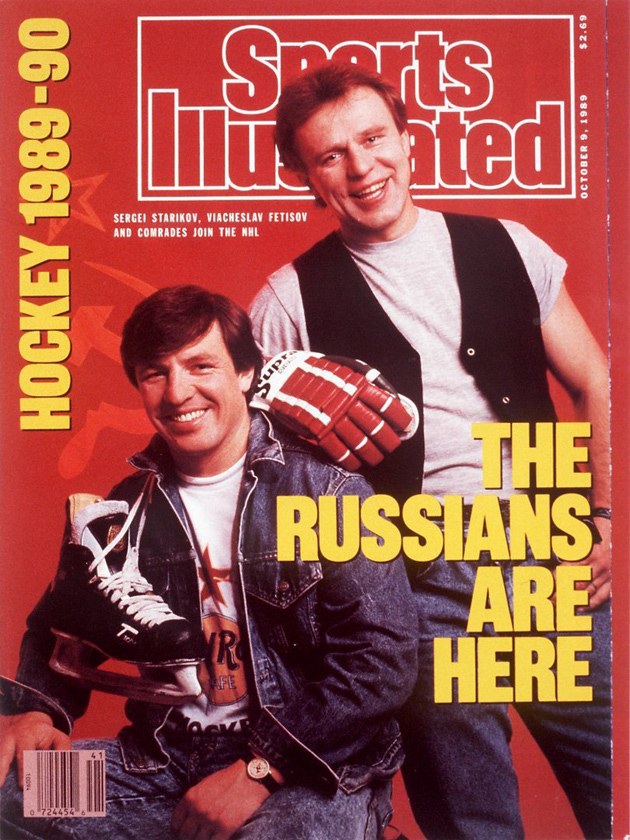
The documentary also shows when the bubble eventually did burst and Soviets eventually did find their way into the NHL. It all started when a junior player by the name of Alexander Mogilny decided to defect in May of 1989. Eight players including Fetisov soon followed. The arrival of such players was met with excitement for some NHL fans while others were more forbidding like Don Cherry who didn’t want any at all. However things weren’t easy. Even though Glasnost and Perestroika were starting to happen, Soviet athletes were still under scrutiny. Fetisov’s professional career in the NHL was monitored. As for play, Fetisov did not adjust too well to new life in the NHL. He learned right in his first game how the NHL was a different kind of play, especially when it came to fighting. His wife Ladlena had some challenges fitting in with the other wives of her husband’s NHL teammates. The struggle was common for a lot of Soviet players trying to adjust to NHL play. Nevertheless things eventually did pay off for Fetisov as he was with the Red Wings in 1997 the same time as Larionov and three other younger Russians. The team was able to get a chemistry of their own and they won the Stanley Cup. The team was able to bring the Stanley Cup to Moscow’s Red Square that year but not without challenges such as clearing things up after a post-victory limousine incident and negotiating with the Russian government.

The documentary ends with what has happened since. Fetisov has become a member of the Russian political party, a Minister of Sport in Russia and even part of Russia’s bidding team in 2007 for the Sochi Olympics in 2014. Tretiak is simultaneously the current President of the Russian Ice Hockey Federation and runs his own goalie school in Toronto which is considered physically punishing by most and very restrictive to whom is admitted. Tikhonov was given countless honors like the Orders of Honor and Merit in Russia and was even a nominee for the Olympic Order. The lives of all the hockey players living and deceased are also focused on at the end.

However the most notable end is the focus on the end of Soviet hockey. As you know the USSR collapsed in 1991. Surprisingly Tikhonov mellowed down in his coaching style afterward but it was still successful enough to bring the team of former Soviets under the name The Unified Team their last gold medal in 1992. The Soviet dynasty ended with as much of a bangs as it began with at the 1956 Olympics. Team Russia has been a different story. Russia continues to churn out top talents and top players. However Russia has never won Olympic gold. Silver in 1998 and bronze in 2002 but that’s it. They didn’t even have it together during Sochi when they lost their quarterfinal to Finland. Leaves you wondering when you remember that talk of the Soviet’s team chemistry if that’s what’s missing with the Russian team. The film ends showing Alexander Ovechkin, the current Russian phenomenon, playing a shootout game for a Washington TV station. A bit of trivia: Ovie was just two weeks short of his sixth birthday when the USSR collapsed. As he plays his game for the TV crew, we hear Slava saying something’s missing in Russian hockey. You’re left feeling that same way too.

One of the funny things of the documentary is that it will remind a lot of Canadians of the inferiority complex Canadians had to endure with in the 1980’s and maybe even the late 1970’s. Already Canadians were going through an inferiority complex of being made to feel second-fiddle to the Americans ever since the inclusion of cable TV bringing American entertainment into our living rooms. Adding to the feelings of inferiority to Canadians was seeing the Soviets excel in hockey. It was often a case of Olympic rules as the best Canadian players were professionals who were ineligible to compete in the Olympics. The best Soviet players however fit within the Olympic rules and were thus eligible to compete at the Olympics Games while the Canadian team at every Olympics during that era always fielded a diluted version of our very best. The Soviets almost always came on top while the Canadian team always fell short. Even when Canada got out its best pros for the Canada Cup, Canada would still face tough challenges from the Soviets as they were total machines and would almost always dominate over the Canadians. You can understand why Canadians cherish the memory of the victory at the 1972 Summit. You can also understand why the Americans hold the 1980 Miracle On Ice close to their hearts. Being second to the Soviets in what is ‘our game’ bit hard and left us down for a long time.

The film also brought back a lot of memories not just of the Soviet team but also how many of us remember the changes of Glasnost and Perestroika that were happening of the late-80’s and early 90’s. It even reminded us of the sports personalities at the time such as Brian Williams, Ron MacLean, Don Cherry, Don Wittman and Al Michaels. It also reminds us of many memorable moments in hockey. In fact it brought back the memories when I remember first hearing of Mogilny’s defection. Who would have thought that would be the beginning of the end?

Another unique thing is that it does something that was never done with the North American television stations before. It humanized the Soviet team. It reminded us behind the strong stoic Soviet team, they were human beings that went through a lot of difficulties. They had human heartbreak of their own. One example when Slava was in a car crash in 1985 that killed his 18 year-old brother. He went through a period of his live when e just didn’t want to live. Even Slava’s talk about his frustration with Tikhonov to the point he runs away to Tarasov showed that even these tough, stoic players had a breaking point of their own. To think all us North Americans saw in the Soviets were machines.

If there was one glitch in this documentary, it’s that Gabe Polsky sometimes does a bit of playing around with the interviews. In fact I remember seeing at the beginning him trying to ask Slava some questions while he’s on a phone call. It’s no wonder Slava flipped him the tweeter after the second question. We see Polsky do a few other stunts too. It’s a question if it was really worth it.

Another glitch is that the film was first released in the middle of 2014 and there was some information either missing or failed to update since. One missing piece of information is Tikhonov’s death in November of 2014. Another piece is of the Sochi Olympics where Fetisov was one of the Olympic flagbearers during the opening ceremony and Tretiak was the final torchbearer along with pairs figure skater Irina Rodnina whom herself is also a three-time Olympic champion and considered the best ever in an event known for Soviet dominance.

Red Army is an intriguing documentary that hockey fans will find worth watching. It takes you back to a stellar dynasty and a unique time. It will also show you a side of them you may have missed during their heyday.