Movie Review: Taxi Driver (1976)

Robert-De-Niro-Taxi-Driver
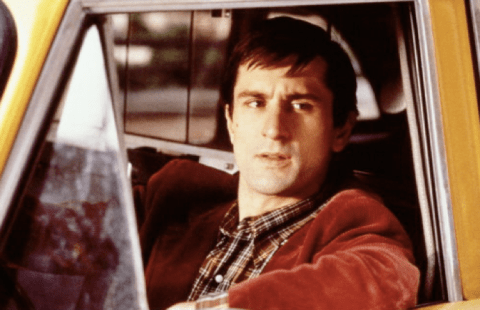
Seeing Taxi Driver in the theatre reminds you how Robert De Niro captivated you as Travis Bickle and why you can still see its greatness after all these years.

You talkin’ to me? You talkin’ to me? You talkin’ to me? Then who the hell else are you talking… you talking to me? Well I’m the only one here.

Every now and then, I like to check a classic movie that’s lucky enough to get shown on the big screen again. This summer I was lucky enough to catch Taxi Driver shown on the big screen. It’s one of my favorite Martin Scorsese films and it was a delight to see it on the big screen. It reminded me how much I missed the first time. Especially of its purpose at the time it was out.

The film is about Travis Bickle: a Vietnam marine honorably discharged who came to New York City from New Jersey to make a living for himself. He takes a job as a taxi driver and his job involves dealing with a lot of dirty work in the city as he’s often taken to the rubbish areas of the City.

He makes an attempt to win the love of a woman named Betsy who volunteers for presidential candidate Charles Palantine. His attempts are not that successful as he buys her a Kris Kristofferson album she already owns and takes her to a movie theatre showing a Swedish sex education film. She leaves the theatre immediately. Travis tries visiting the Palantine campaign office to win her back but is unsuccessful. Though he senses a hint she may still have feelings for him.

Two moments during his cabbie job change Bickle. One day he’s lucky enough to drive Charles Palantine when he comes to NYC. He tells Palantine he’s a supporter and wants him to clean up this town. Another case is when a child prostitute named Easy enters his car to evade her pimp Sport only to be taken away by him. Despite it being brief, he can’t forget her.

Throughout the time in NYC, Travis is lonely and disheartened to see how trashy of a city NYC has become. He’s completely disgusted and he feels he might snap any minute but his fellow cabbies believe he’ll be alright. However he goes out and purchases illegal guns from a dealer named Easy Andy, sets up some personal gun mechanisms and even rehearses what he’s about to say when confronted. On that day, he goes to a store where a robbery happens and he shoots the robber dead.

He has a chance meeting with Easy. He pays money for her but he’s not interested in sex with her despite Easy coming onto him. Instead he has a frank talk with her in a café during breakfast. He learns Easy is not simply some sleazy young teen girl but a young naïve teen runaway named Iris Steensma. He wants to take her out of the prostitution business but she is disinterest, or maybe afraid of Sport.

The following day, Travis has a letter for Iris with money in the envelope. He believes it will be a death wish. However Sport gets a hold of the letter and gives the money to Iris’ next customer. Travis attends a public rally led by Palantine telling the people of New York what he has planned. Travis appears with a Mohawk haircut and appears to attempt to assassinate Palantine but is able to run away.

Then he goes to the hotel where he knows is Sport’s brothel. He approaches Sport, asks one question, and shoots him. Sport survives but Travis is after the bouncer and Mafioso in Sport’s ring in order to free Iris. Travis shoots all three dead but is unable to shoot himself in the end like he intended to. Travis recovers from his coma of three months returning to his job. Iris is back home with her parents whom they consider Travis a hero. The film ends with Travis giving Betsy a ride, leaving us to question what will happen next.

The film rested mostly on the character of Travis Bickle. We have a Vietnam vet trying to reassimilate himself back into daily life. He possesses a set of values and beliefs but his uncoothed attitude causes a lot of social interference with those around him. On top of it, he’s disgusted with what he sees in New York City. He comes across a man who’s about to snap any minute and he knows it. However you wonder when he will snap. We think it will be an assassination the Palantine speech where he could have died a bad guy. Instead he takes a shot at redemption: one that he felt would cost him his life but didn’t. It almost made you feel like he was about to become a martyr figure but is given a second chance in life. It does seem like when Betsy quotes the lyrics from the Kris Kristofferson song The Pilgrim, she’s setting up for what Travis is about to become.

It’s the prostitute Easy/Iris whom changes him and is able to bring about a positive human side of him few notice, including himself. He knew his duty was to free Easy from Sport or whoever else got in his way and it might mean his life but he was willing to do it. He just needed the right motive to do it. He just asked Sport for Iris and he didn’t know who he was talking about. That was all the motive Bickle needed. You often wonder why he did it. For himself? For Iris?  To redeem himself in the eyes of Betsy?

Somehow I think Scorsese is trying to make a certain statement with this film. Throughout the movie we see images of Charles Palantine running for president and promising to clean up New York. However it was Bickle who did a small deed of ending crime involving a teenager in a single act. I believe Scorsese had something to say about politicians which he wanted to say through Bickle but it didn’t entirely make sense. We see Bickle dating Betsy who volunteers for Palantine’s campaign, Bickle having Palantine posters in his bedroom, Bickle driving Palantine and even speaking his support to him but we also see Bickle fake what appears to others as an assassination attempt. It’s obvious the message of politicians being cowards who are all talk was the message of that but it surprised me how Bickle would pull that on a candidate he appears to support. He’s even seen after his recovery with Palantine posters. Hard to understand.

Without a doubt, this is one of Scorsese’s best films. It still tells a story that captures people’s intrigue and lets people interpret their own version of the story. It still causes a lot of debate on what certain scenes mean and what the film is all about. One film expert claims the film is about the decline of New York coinciding with the decline of the male hero at the time. Good points. One person even stated how Bickle goes from human trash to almost like a saint-like figure.

No doubt the film was controversial in its time. It would still make people uncomfortable today. The violence however got a lot of people talking. However it’s nothing compared to the violence of movies throughout the 80’s and 90’s. Those movies went all out. Nevertheless the violence here does resonate with you. Even the theme of an act of vigilantism being made heroic in people’s eyes makes one question Scorsese’s feelings of vigilantes. Also that scene where Easy comes onto Bickle after he pays her the money would definitely anger people today. People have less of a tolerance to scenes like that today than they did back in the 70’s.

The film has you asking a lot of questions as you leave the theatre. You wonder was such a shootout necessary to free Iris from Sport? Or was it a case where Bickle was a person bound to explode any minute and it turns out this was the right minute? Also was the incident with Palatine a case where it almost happened instead of ‘faking it’ like I thought it was? Still gets you questioning once you leave the theatre.

One thing a lot of young people would not understand is how Travis Bickle would be disgusted by what he sees out in New York City. Most of us under the age of 50 have grown up accepting the trashy side of our cities as a fact of life and we’ve even seen it turned into a culture via hip-hop music and shown on videos on MTV. However this was the mid-70’s and this trashiness wasn’t as accepted. In fact, it was disheartening. I’m sure Travis represented the disgust seen by many people of how a great city can turn into a trashbin and how buildings that used to be lovely and elegant could turn into dirty places of sleaze. I’m sure that was a common feeling of many from the city. The thing is Bickle is a character who had just moved to the city. Often when I hear Bickle’s disgust of what happened to the city, I think I’m actually hearing Scorsese’s disgust. Scorsese was born and raised in the NYC area and I’m sure what Travis Bickle was seeing was stuff that was breaking Martin’s heart about the city he had always known and loved, until then.

The film is Martin’s. He does a good job of creating a melodrama that’s bound to reach a big climax any moment and you know it will come with a bang. He does an excellent job in capturing the dirt of New York and try to make a redeeming figure of a misfit like Travis Bickle. Days ago, I heard some young people talk about film. They talked how there are no longer any good directors that do film making for the love of it. All for top of the box office. And they talked about directors like Stanley Kubrick and Martin Scorsese who did it for the love it. I do agree with them. However I also believe that the 70’s was the heyday for visionary directors. Hollywood always was a case of top-of-the-box-office. Back in the 70’s, the counterculture crowd welcomed films that defied the rules of the Hays code and took new directions. That’s why Kubrick and Scorsese are considered legends. It’s not to say their spirit has been abandoned. I remember with the increase of film festivals in the 90’s, that spurned about directors of Quentin Tarantino and Lars von Trier who wanted to do their part in film making. Nowadays it doesn’t seem as present as most of the movie going public are more demanding in what they want. They don’t want to feel guilty about ignoring a unique talent or even liking a flavor-of-the month. We’ll see in time if more visionary directors come about.

The film’s excellence is also the result of scriptwriter Paul Schrader. He himself delivers a story that keeps us intrigued as well as allowing us to make our own assumptions of what the story is even after we leave the theatre. Also adding to the excellence of the film is Robert de Niro. He’s the one who has the best sense of who Travis Bickle is both inside and out and keeps us guessing. Also adding to the excellence is Jodie Foster. She plays a prostitute whom you know doesn’t belong on the streets and neither does Travis. Her role was an excellent performance for someone so young. Cybill Shepherd was also good as Betsy but her role was rather lightweight. Nevertheless she did give more to it. Finally a very fitting score from Bernard Herrmann. He already had an excellent resume in film compositions including Citizen Kane, The Day The Earth Stood Still and North By NorthwestTaxi Driver would be his last one before he died months later in 1975. The score is not the John Williams type of score you’d expect in a drama but it does capture the unhappy feeling of the film.

I’m sure Taxi Driver stands the test of time as one of the best thrillers ever. However I feel younger people may not get it. I do believe it’s a movie that still has a loyal following all these years and still maintains its original charm.

2015 Oscars: The Buzz And The Biz

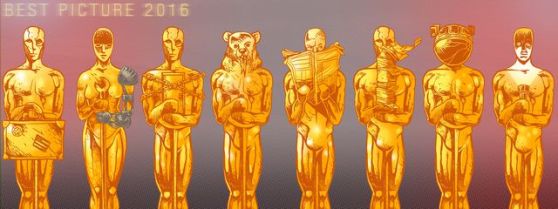
Best Picture 2015
This year’s Best Picture nominees brought in the most box office gold since 2012 but the winner…

Once again, it’s my annual look at this year’s top Academy Awards contenders and how they fared at the Box Office. This was something that once again had to wait until one month after the end of the Oscars to get the full picture. Boy did they have a lot to tell. Once again, all credits for my research to Box Office Mojo.

Before I get into explaining the box office results, I’ll let you all in that Awards Daily showed an interesting graph. It showed how not even $500,000 was spent on a For Your Consideration ad for a Golden Globe win but a win brought in megamillions. It also showed how millions are spent on For Your Consideration ads for the Oscar but the box office draw isn’t even half of what one gets from a Golden Globe win. Something to think about. Especially as we all read on.

When the nominations were announced, two of the eight Best Picture nominees–Mad Max:Fury Road and The Martian— had already grossed over $100 million. That wasn’t the case last year when none of them passed that mark on ‘Nomination Day.’ And that was the Thursday just before American Sniper had its wide release. Actually the eight-set of Best Picture nominees turned in an average of over $75 million. Very impressive.

The film that definitely had its biggest boost since its Best Picture nomination was The Revenant. Between Nomination Day and Awards day, it grossed $116.5 million. A significant boost also came to Room which only grossed $5.2 million before the nominations but $8.2 million between Nomination Day and Awards Day. Films like Spotlight, The Big Short and Brooklyn didn’t double their grosses after their nominations like The Revenant and Room did but their Oscar nominations did give them a good added boost. The Big Short received an additional 423.9 million: more than 50% more than before its nominations. Brooklyn also showed a bigger-than-50% increase in its box office results after their nominations. Spotlight also had an increase but it was just slightly over $10 million.

The only three movies that didn’t see a significant boost after their Oscar nominations were Mad Max: Fury Road, Bridge of Spies and The Martian because they had already neared completion of their box office run with their totals as impressive as they would get. Actually Mad Max: Fury Road wasn’t re-released after its Oscar nominations.

Now Awards Day came and three of the eight Best Picture winners had grossed over $100 million. However the Best Picture winner was a film that was one of the lowest-grossing of the eight nominees: Spotlight. It didn’t even have $40 million grossed by Awards Night. Ever since it’s only grossed an additional $5.2 million and it’s highly unlikely it will hit $50 million. This makes it the second year in a row the Best Picture winner failed to gross $50 million and the third year in a row it fails to gross $100 million. This is a bit of a surprise since I said to myself months earlier: “One more Best Picture winner that fails to gross $100 million and I’m done with Oscar tracking.”

Actually those were temporary feeling as despite Spotlight‘s low gross, it was a film that gave something to admire. However it does point some interesting stats. This will make it the fourth Best Picture winner of the 2010’s that didn’t gross $100 million and there’s still four more years left. The naughts, the decade before the 2010’s, only had three that failed to do so as did the 90’s. You’d figure that the title of Best Picture Winner’ would be a draw to the box office but now it appears less than ever. This shows an interesting detail about how the Academy is in terms of voting for Best Picture. In the past, it was almost always a Hollywood picture. Then things changed with the 1996 Oscars when Jerry Maguire was the only one of the five Best Picture nominees done by a major Hollywood studio to receive a Best Picture nomination. All of the other four nominees including winner The English Patient were independent films.

Since then, the independent films have been winning the Academy over. This has led to a bigger gap than ever between blockbuster films and critical darlings. It has definitely become evident over these last ten years. It’s a bit of a downer for me because I’d really like to see good cinema do well at the box office deep down inside. However it’s becoming more fact. I read an article from Awards Daily which talked about how independent films and films of critical renown don’t so well nowadays at the box office. In the past, you had the movie box office which gave a first run and second run of movies before it even hit video. Now we have such a wide variety of media methods like Netflix and Shomi. It seems like if you want to bring people to the movies, you have to have what it takes to do it. Moviegoers are now choosier as they can decide whether a movie is worth seeing in a cinema or worth waiting for it on Netflix. That would often mean big special effects and often theatre things like showing them in 3D or AVX or in D-Box seats. You mostly won’t get that with the films that win the biggest critical renown. That could have a lot to do with the Best Picture winner constantly grossing lower and lower. For the record, the last Best Picture winner that grossed $100 million+ is 2012’s Argo.

The box office may not have been friendly to Spotlight but it was friendly to the eight Best Picture winners as a whole. The eight have grossed a combined total of $803.8 million– just over $100 million per film for the first time since 2012– an all of them have grossed over $10 million. Spotlight wasn’t the only nominee to bag some extra money after the Oscars. The Revenant took an extra $11.4 million, The Big Short gained an extra $1.6 million, Brooklyn grossed an extra $1.5 million and Room grabbed an extra $1.2 million. Overall The Revenant and Room were the two with the biggest boosts from the Oscar buzz.

The box office results of this year’s nominees told a lot about moviegoers and their choices this year. The winner told lots about the Academy and how they’ve changed as far as voting for Best Picture. Next year should tell more.

Movie Review: Deadpool

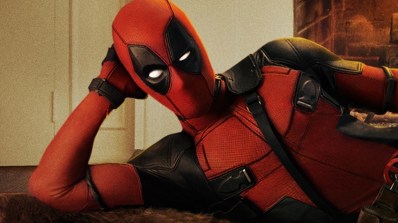
deadpool
Ryan Reynolds plays Wade Wilson who becomes Deadpool: your atypical superhero. Actually he’s not a superhero at all but very entertaining.

Surprise, this is a different kind of superhero story.

DISCLAIMER: I know this review is late. I’ll admit that this is a common thing of mine that right after the Oscars, I become too tired to do blogging for a while. So please excuse the lateness of my review.

Just before the Oscars were about to be awarded, I admit that I went to see Deadpool. All this buzz about an R-rated superhero movie and setting box office records for R-rated movies. I was tempted to see it. I’m glad I did.

Now I will admit that this was a big risk for Marvel to release an anti-hero movie especially since they’ve had many a comic book hero made legendary because of their movies. They have a reputation  of delivering entertaining movies that win big at the box office and even give children, as well as kids at heart, heroes with positive messages.

Deadpool is something else. Actually Deadpool is not a made-for-the-movies anti-hero. Deadpool was created by a Marvel comics cartoonist back in 1991 for another comic series as a supervillain.However Deadpool’s popularity evolved over the years since. Yeah, like I said in my review of Straight Outta Compton, anti-heroes and jerk characters were all the rage in the 90’s more than any other decade.

The surprisingly mammoth success of Deadpool came as a surprise. I think it was a big success because Deadpool reminded us of our like of anti-authority jerks back in the 90’s. Gangsta rap may have had a lot to do with it but but it was like our thirst for jerk character after jerk character was unquenchable back then. Mind you Deadpool had to come at the right time in order for us to be won over by him. I felt that releasing a movie like Deadpool in February was a smart idea. The summer time is the time for superhero characters that are family-friendly. The ones that are meant to win the biggest movie crowds of the season. A February release was better because there’s not as much competition at the box office. And it paid off big-time with the first-ever February opening weekend of $100 million or more.

It should be no surprise that Ryan Reynolds was back as Deadpool for his first-ever feature-length film. It should be a fact that Reynolds was cast as Deadpool since he was described in a 2004 Marvel cartoon as ‘Ryan Reynolds morphed with a shar-pei.’ Reynolds himself even played Deadpool in a 2009 X-Men movie. Here Reynolds was funny as one of those hateable characters whom you actually end up liking for some dumb reason. Morena Baccarin was also good as Vanessa, the one person that can actually keep Wade’s head on his shoulders. Actually Vanessa’s love for Deadpool and her ability to bring him to his senses is what keeps him from being completely hateable.

Ed Skrein was good as the villain but came across as basic as your typical villain in popcorn movies with nothing that really stood out. Tim Miller did very good as a first-time director. Giving such a film like Deadpool to a first-time director could have been seen as a gamble for Marvel but Tim did things right. Writers Rhett Reese and Paul Wernick were not first-timers. In fact Deadpool is their third feature-length script. They do a very good job in giving the film the needed humor and sass for such a character like Deadpool.

Possibly the most surprising thing about Deadpool has to be its surprisingly huge box-office success. The $132.4 million it made in its opening weekend shattered opening weekend records for the month of February, the winter season and for R-rated movies. It also became the first ever R-rated movie to have an opening weekend of $100 million. As of now its $346.9 million makes it the third-highest grossing R-rated movie ever. The record is held by The Passion Of The Christ with $370.8 million. It’s possible it could break the record as it held onto #5 this past weekend in its sixth week of release.

Now there’s already talk about a Deadpool sequel. I’m not surprised about that given the success of the movie. There’s also been talk of more R-rated superhero films in the future. I will say that the box office success of Deadpool may fuel the desire to shell more of them out but Deadpool’s success is not a guarantee toward a new phenomenon of R-rated superhero movies. Sure, I was entertained by a smart-aleck wise-cracking anti-hero but I’ll bet if another one was shelled out, I’d be tired of them. I will admit this film does kind of remind us how we still have a liking for anti-heroes although not unlimited like it was in the 90’s. It’s not the case like back then when the jerk phenoms won us over but made everyone else who weren’t like them either look like a joke or look forgettable. Sure we may like an anti-hero like Deadpool but I’m sure by now, we prefer our jerk-characters and anti-heroes in doses. We can only appreciate so much nowadays. Besides Deadpool only made it look good to be an anti-hero for those two hours.

Deadpool is the surprise hit of the winter and the surprise of movies this year. It made having an anti-hero character look refreshing and even charming. However I don’t think it will start another anti-hero revolution again. Deadpool charmed us for those two hours but time will tell how much further he can charm us.

My 2015 Academy Award Predictions

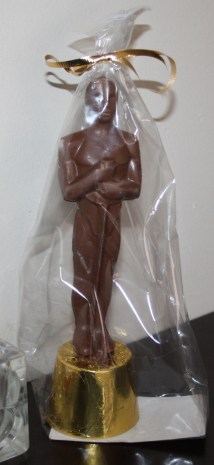
Chocolate Oscar

No kidding there was a lot of news about this year’s Oscar nominees from the lack of diversity and the boycotts and AMPAS reform that followed to how this being one of the most unpredictable years as far as Best Picture is concerned. Despite the protests, Chris Rock will still host the Oscars.

As for me, I’ve seen all the Best Picture nominees. This makes it the fifteenth year in a row I’ve seen them all before the awards night. It almost would have been my last as I was losing faith in the Academy as the last two Best Picture winners failed to gross $100 million both individually and combined. For the record, 2012’s Argo is the last Best Picture winner with a gross of higher than $100 million. However that could change with The Revenant being a strong favorite.

Collectively I have seen enough films and shorts to make up 86 of this year’s nominees. It’s a shame there won’t be any more members at large because I think I’d make a better Oscar voter. Anyways here are my predictions for this year’s Oscar winners. Note that the bigger categories will get the focus as well as my prediction. Only in few smaller categories will I elaborate. Also you will receive links to my reviews.

Best Picture 2015

BEST PICTURE SUMMARY

This year’s eight Best Picture nominees are quite different. Some have a lot of similarities but there are some surprises. Who would’ve though a Mad Max movie would be one of the nominees? Or even The Big Short would be a heavy favorite? Anyways here’s my summary with the titles hyperlinked to my review:

-The Big Short –  My favorite of the Best Picture nominees and my Should Win pick. I admire it for it being unconventional and making sense of something very technical. However I feel it may come up a bit short to my prediction for the winner.

-Bridge Of Spies –  I feel this is the most underrated movie of the whole Best Picture race. It did a great job in capturing the eerie feel of the Cold War and even the political tension behind it. Too bad it finds itself out of contention for the win because it is deserving of it.

-Brooklyn – It’s easy to think Brooklyn has all the bait of what would win the Academy over. However this was a tightly competitive year. Plus the Academy will always surprise you about what it thinks ids the best.

-Mad Max: Fury Road –  Very rarely does a science fiction movie have a chance at winning Best Picture. This film surprised everyone about how good a sci-fi story can go. A deserving winner, but the competition was tight and also I don’t think the Academy will make it Best Picture.

-The Martian –  Space stories have been winning over the Academy more often lately. Two years ago, it was Gravity.Now The Martian. A good choice for a nominee but I think there were too many parts that were a bit cornball.

-The Revenant –  It may have a lot of buzz but it doesn’t completely guarantee it will win Best Picture. The Revenant may have won the Golden Globe and BAFTA but Spotlight won the Critics Choice award and The Big Short won the Producers Guild. The buzz however is too hard to ignore and I feel that The Revenant Will Win Best Picture. Anyways I find it refreshing having a movie that made over $100 million win Best Picture, especially after Birdman’s poor gross.

-Room – One of two Canada/Ireland entries for Best Picture. Very well-acted and well-written but I don’t think a movie about two young people abducted makes for a Best Picture winner. It deserves respect for making this scenario watchable on screen but not enough to make it a winner.

-Spotlight –  This is this year’s critical darling. It has a lot to offer with a great ensemble of acting, an excellently-written story and well-directed. It has what it takes to win Best Picture. However I feel its November release has hurt its chances for the win. It still has some good chances to win but it faces rivalry against later releases like The Revenant and The Big Short.

BEST DIRECTOR:

-Should Win and Will Win – Alejandro Gonzalez Inarritu – The Revenant – This last while has been the emergence of Inarritu. He first burst onto the scene in 2000 with Amores Perros. He received his first Best Director nomination for Babel. Last year, he won for Birdman. This time around he directs an epic thriller and he succeeds excellently at it. Also it pays off at the box office this time.

BEST ACTOR:

-Should Win and Will Win – Leonardo DiCaprio – The Revenant – Everybody’s saying “Leo should win it.” It’s easy to see why. He’s done a lot of great performances. Plus winning the Oscar could be the case of career culmination for him. It’s too easy to declare career culmination for his anticipated Oscar win. However you have to see The Revenant for yourself to see why. It involved a lot of physical acting as well as a lot of acting moments involving no speaking at all. You can easily see why he’s a deserving winner.

BEST ACTRESS:

-Should Win and Will Win – Brie Larson – Room – Often enough winning an acting Oscar is often a case of career culmination. Other times it can be that case where you’re lucky to have that role of a lifetime. This is the case for Brie Larson. She was mostly unknown and her biggest work up to then was acting in Trainwreck. However her turn as Joy Newsome as a woman braking free from her kidnapping and struggling to live life in what should be freedom is that role of a lifetime.

BEST SUPPORTING ACTOR:

-Should Win – Mark Rylance – Bridge Of Spies – I’ll only base my decision on the supporting performances I’ve seen. Mark was excellent as he had to embody the character of a frail 50 year-old man from head to toe. Not only that but give him a unique charm that’s able to steal the show away from Tom Hanks.

-Will Win – Sylvester Stallone – Creed – I’m not a fan of Sylvester Stallone. In fact I can easily see why the Golden Raspberry awards like to give him accolades. However if there’s one role in which he knows how to do right, it’s Rocky Balboa. I believe with this being possibly the last movie of the Rocky saga, Stallone will win it.

BEST SUPPORTING ACTRESS:

-Should Win – Rooney Mara – Carol – I have to say of all the supporting actress performances I’ve seen, I’m most impressed with Rooney Mara. She played a young woman who was insecure with herself and just learning about herself until Carol helps her to understand herself and not be afraid to love.

-Will Win – Alicia Vikander – The Danish Girl – I admit I have not seen The Danish Girl. However Alicia’s performance has already generated a ton of buzz. It seems like a no-brainer she’ll win. Some are already touting her as the biggest thing out of Scandinavia since Liv Ullmann. We’ll see.

BEST ORIGINAL SCREENPLAY:

-Should Win – Matt Charman, Joel Coen and Ethan Coen – Bridge Of Spies – I liked Bridge Of Spies and how it captured the time of fear and paranoia of the Cold War. This was a unique collaboration of Spielberg and the Coen brothers. I thought Bridge Of Spies was one of the smartest films this year.

-Will Win – Tom McCarthy and Josh Singer – Spotlight – Spotlight is one film that has gotten a lot of renown for its story of trying to bring a story to the presses. It’s a deserving winner as it is a story that will keep you interested and intrigued from star to finish. At the same time, it makes a film about sexual abuse by the clergy actually watchable.

BEST ADAPTED SCREENPLAY:

-Should Win & Will Win- Adam McKay and Charles Randolph – The Big Short – All I can say is the script was full of energy. It defied convention and at the same time made sense out of a confusing topic which only those inside the banking world can fully understand. A deserving winner here.

BEST ANIMATED FEATURE:

-Should Win & Will Win- What can I say? Inside Out is the animated movie of the year. It’s very much the case that when Disney/Pixar releases an original film, it’s bound to be the class of the field in terms of animated films. Heck, the script was even nominated for Best Original Screenplay so how can you rival that?

Here are the rest of the categories. I will only predict who Will Win. As well as give some notes if I feel so.

BEST ART DIRECTION:

Colin Gibson & Lisa Thompson – Mad Max: Fury Road

BEST CINEMATOGRAPHY:

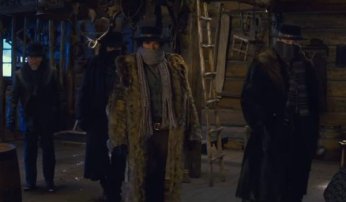
-Robert Richardson – The Hateful Eight

BEST COSTUME DESIGN:

-Jenny Beavan – Mad Max: Fury Road

BEST DOCUMENTARY FEATURE:

Amy

BEST FILM EDITING:

-Margaret Sixel – Mad Max: Fury Road

BEST FOREIGN LANGUAGE FILM:

-Son Of Saul – Hungary

BEST MAKEUP AND HAIRSTYLING:

-The Revenant

BEST ORIGINAL SCORE:

-Ennio Morricone – The Hateful Eight

BEST ORIGINAL SONG:

-“Til It Happens To You” – The Hunting Ground

As far as songs go, that’s the biggest talk about Til It Happens To You and Lady Gaga winning the Oscar. I’m cool with it. As long as she doesn’t wear a meat dress.

BEST SOUND MIXING:

The Revenant

BEST SOUND EDITING:

-Mad Max: Fury Road

Actually I will have my final prediction in this category Saturday evening as that’s when we’ll know the Motion Picture Sound Editors Guild winner.

BEST VISUAL EFFECTS:

-Star Wars: The Force Awakens

It seemed like a no-brainer to predict Star Wars to win that category. However it’s not to say it didn’t have it rivals. Accolades have also been given to the effects of The Revenant and Mad Max: Fury Road.

BEST LIVE-ACTION SHORT FILM:

Click here for reviews and predictions.

BEST ANIMATED SHORT FILM:

Click here for reviews and predictions.

BEST DOCUMENTARY SHORT SUBJECT:

-Chau: Beyond The Lines

JUST ONE MORE – TOP OSCAR UPSETS

This is something new for me. I’m picking the five most likely upsets of the evening, especially those that will go against my own predictions:

  • The Big Short to win Best Picture
  • Mark Rylance wins Best Supporting Actor for Bridge Of Spies
  • Mad Max: Fury Road win Best Visual Effects
  • Mustang (from France) wins Best Foreign Language Film
  • Sandy Powell wins Best Costume Design for Cinderella

And there you have it. My predictions for Hollywood’s night of nights. You might only care about who wears what but see who wins on Sunday the 28th. Even attend a party. You might win prizes.

Reviews Of Other Nominated Movies Viewed:

-Joy

-Ex Machina

-Straight Outta Compton

-Anomalisa

-Boy And The World

-Cinderella

Oscars And Diversity: The Struggle Continues

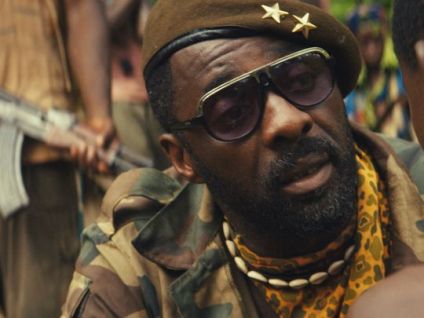
Elba
Idris Elba in his supporting performance in Beasts Of No Nation had the best chances for a non-white actor to receive an acting nomination for this year’s Oscars. Despite being heavily favored, it didn’t happen.

Remember last year I talked about the issue of Oscars and race that took over headlines? Yes, it’s nice to see people pay attention to something about the Oscars besides who wears what? However it did focus on a problem in which many people including myself hoped would only exist last year. Unfortunately it was not the case.

THIS YEAR’S HOPE

Last year was a big focus of the lack of diversity. I even did a focus on it myself and even explained how things worked in all my 15 years of ‘OscarWatching.’ Many including myself were hoping that this year would not have the same mistake this year. And this year had a performance by a black actor eligible for a nomination: Idris Elba in the Supporting Actor category for Beasts Of No Nation. It had all the eligible clout: a Golden Globe nomination, a Screen Actors Guild nomination and a BAFTA nomination. Although nothing is guaranteed or earned in showbiz, it had the right amount of juice to clinch the nomination in that category. Many wanted to see the nomination happen. I also wanted to see it happen. I know that if it didn’t happen, there would be a whole whack of controversy and outrage. I even thought the Academy wouldn’t deny him the nomination, not after the #OscarsSoWhite embarrassment from last year.

The nominations were announced on January 14th. Elba was not among the nominees in that category. There were the nominations of Christian Bale and Mark Rylance which were also nominated for the same awards previously mentioned, the was Golden Globe winner Sylvester Stallone. However there was Mark Ruffalo who had earned a SAG nomination and Critics Choice nomination and Tom Hardy who had amassed only a Critics Choice nomination. All the acting nominees were white. All eight Best Picture nominees consisted of a predominantly white cast and predominantly white crew. As for directing and writing, the only non-white nominee was Mexican Alejandro Gonzalez Inarritu.

The lack of diversity wasn’t just the black-and-white issue. Gay director Todd Haynes was heavily favored to be nominated for Best Director for Carol and even for Carol itself to be nominated for Best Picture but those didn’t happen either. If there’s one positive thing, there were four women who receive scriptwriting nominations: up from zero from last year.

THE BACKLASH

People were already speaking their outrage. A new Twitter hashtag– #OscarsStillSoWhite– came about. Civil Rights leader Al Sharpton, whom last year said he would set up a ‘diversity task force,’ was outspoken in his outrage and urged boycotts. Boycotts did happen from Spike Lee, Will Smith and Jada Pinkett Smith. Some actors who did not intend to boycott like George Clooney, Viola Davis and Lupita Nyong’o spoke their criticism. Host Chris Rock was under pressure to boycott the Oscars. He declined but he will be focusing on it during his opening routine at this year’s ceremony. Even Barack Obama spoke out about the controversy: “I think that when everyone’s story is told then that makes for better art, it makes for better entertainment it makes everybody feel part of one American family, so I think as a whole the industry should do what every other industry should do which is to look for talent, provide opportunity to everybody. And I think the Oscar debate is really just an expression of this broader issue. Are we making sure that everybody is getting a fair shot?”

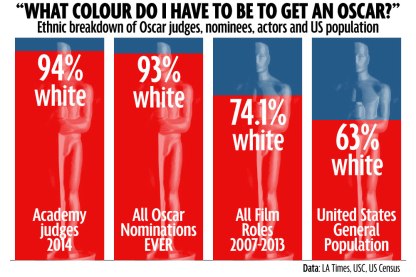
racist-oscarsThe Academy especially came under fire as they were scrutinized and analyzed and it was revealed that over 90% of the Academy were white in comparison to 65% of the population of the United States being white. In addition three out of every four Academy members were male. Despite the criticism and outrage, there were defenders coming from the likes of actress Penelope Ann Miller:  “I voted for a number of black performers, and I was sorry they weren’t nominated. To imply that this is because all of us are racists is extremely offensive. I don’t want to be lumped into a category of being a racist because I’m certainly not and because I support and benefit from the talent of black people in this business. It was just an incredibly competitive year.” Even black actors like Ice Cube and Whoopi Goldberg  dismissed the labeling of the Academy as racist. Ice Cube described the labeling of racism as “crying about not having enough icing on your cake.” Whoopi whom herself has won an Oscar and even host the Oscar ceremonies for many years stated: “Even if you fill the Academy with black and Latino and Asian members, if there’s no one on the screen to vote for, you’re not going to get the outcome that you want. I won once, so it can’t be that racist. I’ve been black the whole time.”
THE AMPAS PRESIDENT

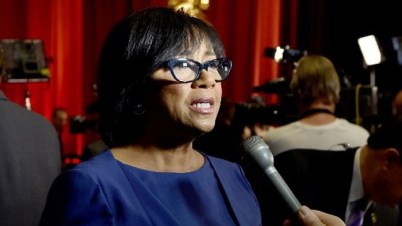
With all the criticism the Academy faced this year, the one person who had to do the responding was AMPAS president Cheryl Boone Isaacs. Born in Springfield, Massachusetts in 1949, Boone Isaacs grew up in a middle-class African-American family. She graduated from Springfield Central High School in 1967 and from Whittier College in 1971 with a degree in political science. Her studies in college included a program studying abroad in Denmark.

Her introduction to showbiz came at the age of 25 through her older brother Ashley Boone Jr. who worked as an executive in Hollywood. She started work in Hollywood as a publicist for Columbia Pictures. Her first job was being a publicist for Close Encounters Of The Third Kind. She would work for various film companies as a publicist. Her publicity work on films would eventually lead to higher stature such as Vice President, Worldwide Advertising and Publicity of Melvin Simon Productions and Director of Advertising and Publicity for The Ladd Company. Under Paramount Pictures starting in 1984, she would start as Director, Publicity and Promotion, West Coast and then eventually become the Worldwide Publicity Director. Some of her marketing campaigns included successful Oscar campaigns for Best Picture winners Forrest Gump and Braveheart.

Success continued for Boone Isaacs as she would become President of Theatrical Marketing for New Line Cinema, the first black woman to hold such a position. She even has her own promotion company, CBI Enterprises, Inc., where she has worked on successful promotion of Best Picture winners: The King’s Speech and The Artist.

Boone Isaacs has been a member of the Academy since 1988. In 2013, she was promoted to the position of AMPAS president in 2013and became the first African-American president of the Academy as well as only the third woman, after only Bette Davis and Fay Kanin. Since her inception as president, he achievements have included lifting the cap or restriction on the number of Academy members. she also initiated a drive to invite over 400 new members coming from many ages and backgrounds.

THE PRESIDENT AND THE ISSUE OF DIVERSITY

“It’s easier to be the president of the United States as a black person than to be the head of a studio.”

-Spike Lee

The issue of the Academy and diversity appeared to be making progress since the start of the new millennium. Actors of various races were earning nominations more than ever before as well as non-white directors. Even in the minor categories, minorities were getting an increasing number of nominations. However it’s almost always in the acting categories where the issue of the Academy and racial diversity gets the heaviest scrutiny. That was the case last year when the first hashtag #OscarsSoWhite came out.

Isaacs
AMPAS president Cheryl Boone Isaacs didn’t hesitate to make changes to the Academy in response to the backlack which included boycotts from Spike Lee and Will Smith.

Cheryl Boone Isaacs, an African-American woman herself, knew this was an issue that needed looking into and she made her efforts. This was especially noteworthy at the AMPAS’s annual Governor Awards  on Saturday November 14th. One of those awarded was Spike Lee where he was given an honorary Oscar. Before Boone Isaacs announced her plans, Lee talked about the lack of diversity even commenting that when he goes through Hollywood offices, he only sees white faces and the only non-white is the person checking his name at the door.

At those Awards, Boone Isaacs announced her plan which she called A2020: an initiative to age, gender, race, national origin and point-of-view, in Hollywood over the next five years.  Her A2020 initiative is a five-year plan to study practices at the Academy with the aim of improving the diversity of its own staff and governance while also bringing new voices into the organization. Outside of the Academy, the plan is also intended to encourage and to push the industry to examine its hiring practices and to begin to make changes. Boone Isaacs stated: “When it comes to fair and equal representation in our industry, words are not enough. We also have a responsibility to take action and we have an unique opportunity to do so now.” At those ceremonies, Lee thanked her and said: “she’s trying to do something that needs to be done.”

THE PRESIDENT RESPONDS TO THE CONTROVERSY

“The Academy is going to lead and not wait for the industry to catch up.”

-Cheryl Boone Isaacs

If there’s one thing most people would feel upon learning of this year’s nominees, it’s that Cheryl’s A2020 plan isn’t happening fast enough. Even though the set of 51 new members of the Academy was more diverse especially with 17 of them being women, the end result on nomination day was one of disappointment. Boone Isaacs herself came under fire by some for not doing enough. Even civil rights leader Al Sharpton ridiculed her by referring to her as a pawn in a predominantly white members-only club.

No doubt Boone Isaacs felt the heat. It was only a matter of a mere eight days after the nominations were announced that Boone Isaacs announced the sweeping changes to the membership rules for Academy members. This was published on the AMPAS website under the title ‘Academy Takes Historic Action To Increase Diversity.’ For those interested in the plans, click here to the official document.

The day before, the Board Of Governors approved through a unanimous vote a set of sweeping changes coming to the Academy’s membership. Its intent was to make the Academy members more diverse and open the door to more women and visible minorities. However one of the things they most wanted to get tough on was the membership of their older members. Examples of the proposed changes starting this year are:

  • New members lasting 10 years and renewed if that new member has been active in motion pictures during that decade.
  • Lifetime voting rights after three ten-year terms or if they’ve won or have been nominated for an Academy Award. Standards also applied retroactively to current members.
  • Current members that have not been active for 10 years can still qualify if they meet the other criteria.
  • Members not qualifying for active status will be moved to emeritus status and will be denied voting privileges.
  • An ambitious global campaign will be launched to identify and recruit qualified new members who represent greater diversity.
  • To increase diversity in its Board Of Governors, the Academy will establish three new governor seats that will be nominated by the president for three year terms and confirmed by the board.
  • New members who are not governors will be added to its executive and board committees where key decisions about membership and governance are made. This allows for new members to become more active in the Academy’s decision-making and help the Academy identify and nurture future leaders.

Most of the response has been good. Some of the biggest came from Selma director Ava DuVernay through Twitter: “One good step in a long, complicated journey for people of color + women artists. Shame is one helluva motivator.” Lee stood by his boycott but applauded Boone Isaacs and the Board of Governers for: “trying to do the right thing. It’s a start.” Steven Spielberg also reminded us: “I do think that what the Academy is doing, in a proactive way, to open up the membership to diversity, I think that’s very, very important. But it’s not just the Academy, and I think we have to stop pointing fingers and blaming the Academy. It’s people that hire, it’s people at the main gate of studios and independents. It’s the stories that are being told. It’s who’s writing diversity — it starts on the page. And we all have to be more proactive in getting out there and just seeking talent.”

I admire Cheryl Boone Isaacs for taking the initiative for making these needed changes. The Academy always was aboard with its own membership rules and needed reform back in the 1960’s because of its own issues then. Issues came again now and reform was needed. The changes proposed look great: less members for life.

However I do believe they are not a 100% guarantee of diversity happening on a consistent basis. No kidding diversity will be increasing at double the rate it’s been happening in past years. However it doesn’t mean that every year from next year onward will feature a diverse array of nominees. I’ve seen the various film seasons over the years and see how certain films excel more than others. I’ve seen years that have been very generous towards minority actor and have given them roles that can contend for glory at various awards shows including the Oscars. However I’ve also seen years which have been lackluster for them and they would lack parts that can propel them among the ‘elite of the year.’ I know it’s a start and there will be more to come but I’m still a bit cynical it’s a solve-all.

Also it also depends on the media too. I’ve seen them label some films long before the Oscars full of ‘Oscar buzz.’ And most of them are predominantly white. The media can’t just simply label a film ‘Oscar bait’ because it has characteristics that are common with what wins the Academy over. They should call it ‘Oscar bait’ because of top notch quality, and skin color should not matter.

Nevertheless next year is the first year when these changes are to come into effect. Hopefully over time we will see a more diverse Academy. And not just more blacks; more women, more Hispanics, more Asians, more of all minorities. As for 2016, potential is already showing as this year’s Sundance showed The Birth Of A Nation: a film with a predominantly African-American cast that had rave reviews and huge buzz. The release date to the box office has not been set but Fox Searchlight has bought the film’s rights at $17.5 million, the most ever for a Sundance film.

The outrage over the lack of diversity at this year’s Academy Award nominees was just the catalyst needed for the necessary changes to happen. The future will tell if these changes pay off or not. However the lack of diversity is still an ugly reminder of what happens when you turn art into a competition.

WORKS CITED:

WIKIPEDIA: 88th Academy Awards. Wikipedia.com. 2016. Wikimedia Foundation Inc. <https://en.wikipedia.org/wiki/88th_Academy_Awards>

WIKIPEDIA: Cheryl Boone Isaacs. Wikipedia.com. 2016. Wikimedia Foundation Inc.  <https://en.wikipedia.org/wiki/Cheryl_Boone_Isaacs>

Kilday, Gregg. “Spike Lee: Getting a Black President Is Easier Than a Black Studio Head” The Hollywood reporter. 14 November 2015 <http://www.hollywoodreporter.com/news/spike-lee-getting-a-black-840371>

Gray, Tim. “Governors Award Winner Spike Lee to Hollywood: ‘You Better Get Smart’” Variety. 15 November 2015 <http://variety.com/2015/film/news/governors-award-winner-spike-lee-to-hollywood-you-better-get-smart-1201640307/>

“ACADEMY TAKES HISTORIC ACTION TO INCREASE DIVERSITY” Oscars.org 22 January 2016 <http://www.oscars.org/news/academy-takes-historic-action-increase-diversity>


DVD Review: Straight Outta Compton

Straight-Outta-Compton
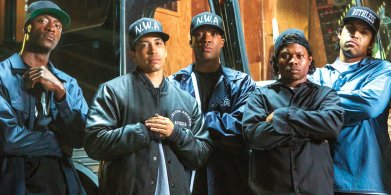
Straight Outta Compton tells the story of the rise and fall of N.W.A., and the unleashing of an eventual musical and sociocultural revolution.

DISCLAIMER: This was to be my movie review months ago. I will admit to procrastinating on this. There have been other movies I’ve been too lazy about writing a review on in the past. However I couldn’t avoid writing a movie review on this. Not after its screenplay was nominated for an Oscar. So here it is, finally!

The summer of 2015 was filled with anticipated blockbusters but every now and then, there’s a ‘sleeper hit’ that comes from nowhere to win the movie crowds. This summer’s such hit was Straight Outta Compton. You can easily see why it was a hit.

I don’t have to go into details about the plot since most of you have already seen it. Besides I’ve already elaborate how the album Straight Outta Compton created a revolution in rap, in R&B music, in music as a whole and in pop culture. Click here for the elaboration. Sure, the gangsta rap that N.W.A. seem to have invented may have become the new modern day version of blues but it was a lot more. Much more!

Now focusing to the movie, the film was trying to state a lot of points. The obvious as I’ve elaborated on is how N.W.A. was a game-changer not just in music but in pop culture as well. The film shows how they made it happen. However I think the film was trying to put out its own points for the whole N.W.A. story. I believe the biggest point the film is trying to push is that Eazy-E was the heart and soul of the group. Sure, Dre and Ice Cube have had the hugest post-breakup success of all the members but it was Eazy-E who helped get it off the ground and was the biggest benefactor in making N.W.A. N.W.A. Even after he breaks free from Heller, he’s seen as the one who was going to bring N.W.A. back and any hopes of N.W.A. coming back ended when he died. Ironically this film came out 20 years after Eazy’s death. You’re led to think that way right at the end of the film.

Another top point I feel the film is trying to promote is that the biggest adversary to N.W.A. was the music business. Sure they had a lot of adversaries in their time from family pressures to their run-ins with the law to getting records out when major record companies were afraid to touch them to pushy watchdog groups of parents trying to protect their children to the police forces. They overcame them all despite the tense moments they encountered with them but I believe the film is showing that the powers that be in the music industry as well as their own ambitions were the adversaries they could not overcome.

The first sign you get about this is during the interview where they get heat for their lyrics but one reporter asks Ice Cube what he spent his last cheque on. His response, ‘Raiders gear,” is already sending a message about the type of problems they will encounter with the music business in the time to come. Problems that would eventually lead to their own split and their own personal creative pursuits. It also ends on the same note at the end as Dr. Dre leaves Suge Knight to start his own label. I think the point they were getting across is that any music act is better off being their own boss and that ending was not just sending the message but also the turning point where Dr. Dre came into his own. That’s it. I think the music industry had to be one of the biggest focal points in the movie if not the biggest.

Also an afterthought. I know I elaborated a lot about how N.W.A. and Straight Outta Compton changed music and pop culture. The thing is it happened not just with the success of the album but also of Dr. Dre and Ice Cube going their own directions. Their own personal paths started on an abrupt note but it produced so much like Dre’s own raps and the various acts he shelled out and even Cube’s solo rap career and film career starting with Friday which would eventually pave the way for other rappers to secure acting roles. However I saw N.W.A. as a group of five friends. A friendship that was strong before Straight Outta Compton but fell apart once they hit the big time. It left me wondering if that tidal wave of pop culture I elaborated on would still happen had N.W.A. stuck together. It probably would have but not as big as Cube and Dre going separate directions. It leaves you with the dilemma which would have been better. One thing was certain. Any change of them getting back together ended with Eazy-E’s death.

F. Gary Gray does a great job in directing. It shouldn’t be that much of a surprise that the director who directed Friday would direct this. Gray has directed other movies since like The Italian Job and Law Abiding Citizen but I believe this is his best ever. Jonathan Herman and Andrea Berloff deliver a great script that very close to fact while including their own point of view on the story and keeps one intrigued from start to finish. O’Shea Jackson Jr. does a very good job as Ice Cube but I wouldn’t consider it too much of an effort to play your own father. The other actors playing the rappers like Corey Hawkins and Jason Mitchell were also good. None of the actors playing rappers really stood out which is probably a good thing because the film’s acting is an ensemble effort that doesn’t appear to compete against each other and delivers well as a group. Paul Giamatti was also good as Jerry Heller but I’ve seen him play conniving controlling svengali-like characters before and he doesn’t really deliver anything new in his role as Heller.

I myself wasn’t too surprised Straight Outta Compton would be a huge hit in the summer. However I was surprised to see how underhyped it was among the superhero movies set to be released. The one thing is that it delivered as a movie and rally stood out. I think that’s what paved its way to being a summer winner.

How Straight Outta Compton Created A Revolution

Straight-Outta-Compton-album
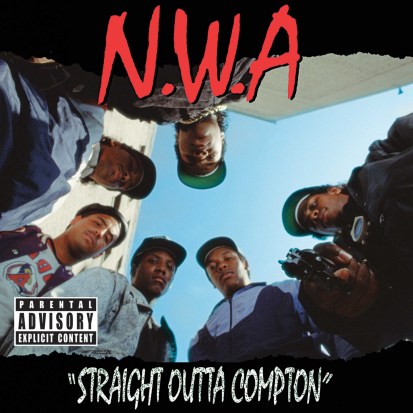
The 1988 album Straight Outta Compton was avoided at all costs by airplay and hunted down by censors. However it would sell triple-platinum and start a tidal wave in music and pop culture as well.

For so long I’ve been procrastinating with my review of the movie Straight Outta Compton. The biggest reason why it took so long is because I wanted to write up how the album created a tidal wave for music and pop culture and changed how things are done. The thing is my retrospect took way too long to write. Song it deserved its own blog. So here’s what I have to say about both the sociocultural changes and music changes made by N.W.A.’s Straight Outta Compton.

Basically I’m writing this based on my observations starting off in the late-80’s  growing up as a teen in Winnipeg and in the 90’s as a college student there and even my experiences living in Vancouver in the 21st century. For those who don’t know, there are a lot of areas in Winnipeg especially close to the inner city and and in Greater Vancouver, especially Surrey, that can qualify as some of Canada’s top ‘hoods.’

I still remember the music scene long before N.W.A. Gangsta rap didn’t exist before. There were reality raps  but they weren’t such a huge phenomenon. In fact it was party raps or celebration raps that were winning crowds slowly but surely. Reality rap was there but mostly through the group Public Enemy who used rap to speak out about racism and social injustice. Also there’s the 1982 rap song The Message which singlehandedly put to rest any claims about rap being a simple fad. Rap was not yet all the rage but it was already a growing phenomenon. In fact back then the R&B scene was dominated by soul singers. That was especially show in the movie as the group had to compete for stage time against a soul singer who looked and sang like every woman’s dream. That was the R&B phenomenon back then. The music scene back then was dominated by soul singers with strong and dramatic voices and big-haired heavy metal bands. In fact the biggest controversy back then came from heavy metal musicians for allegedly Satanic-themed music. And they were already provoking enough heat to have parental groups speak out against them and their lyrics.

Also back then, there wasn’t just the difficulty for N.W.A. to get their raps on stage and on record. There was the popular belief that rap and hip-hop completely belonged to the districts of New York City. We forget that rap grew out of the inner city of NYC. For years they owned it alone. Back then it was believed that any rap act outside of NYC would be seen as a diluted version of hip hop or just a bunch of wannabes.

N.W.A.’s Straight Outta Compton won big because it was the music my generation of teens was looking for. For one thing, it was raw music. I came from a generation that felt contempt to the major record labels for the music they were trying to get us to buy. It was processed and packaged for the sake of chart-topping and we didn’t want that. We wanted music that was real and uncensored. Most of believed: “Hit music is shit music!” We especially had a liking for any music or art form that took whatever most people, especially the status quo, would be disgusted with or look away from and shoved it in their face. Music that provoked our parents were bonus points, especially since it was coming around the time these parental groups were trying to be watchdogs and eventually created the ‘explicit lyrics’ sticker. It appeared like Straight Outta Compton was what we were looking for: untouched music promoted by an independent record label that went no holds barred on its lyrics. The outrage sparked by **** The Police made radio stations avoid it at all costs but made the young want to buy it more. Three times platinum without any radio airplay. And to think we thought we’d find what we were looking for in alternative rock from indie labels the whole time.

The tidal wave in music and in pop culture as a whole would come thanks to its success. Over time there were other rap acts who would record explicit albums. The biggest challenge came from the 2 Live Crew’s As Nasty As They Wanna Be which faced an obscenity conviction in a Florida court. Eventually the 2 Live Crew took their case to the Supreme Court and won. After that it would pave the way for other acts with more explicit and provocative albums. Dr. Dre as a solo act would face his own heat as he would shell out music that would garner complaints as ‘irresponsible.’ The response from Dre and other who recorded such music would send the record straight: “They’re not responsible. Where are the parents?” Even us young people supported the rappers side and saw these groups of parents trying to protect their children as both a censorship threat and selfish stupids. Why? Because we felt they though that just because they have kids, they could tell the entertainment industry what to do while they could go off and do whatever they want. Entertainment’s not a babysitter!

The thing is gangsta rap rewrote the book on how to do business. I will get to how much gangsta rap and hip-hop was like a drug for late-Generation X’ers and Millennials a bit later. However it became clear that if anyone wanted to make it in gangsta rap, they had to have street cred. Often it seemed like a biography was needed. I remember back in 1993, Snoop Dogg was facing a criminal charge of participation in a gang-style murder. His album Doggy Style was released months after he turned himself in and it sold big time. In the past, an act facing a murder charge would have his career killed. Not with Snoop Dogg as he became famous not in spite of his alleged murder charge but because of it.

This would lead to other rappers have their careers launched thanks to having a gang-style criminal charge. Even the gang-style tactics of Suge Knight and his way of ‘doing business’ on Death Row Records propelled gangsta rap even further and led to more chart-topping acts. Thanks to Straight Outta Compton, the West Coast rap scene came of age and rivaled that of NYC. Within years the rivalry became so intense there were turf wars which led to the deaths of both Tupac and Biggie. The gang style deaths of both of them accelerated their sales and cemented their post mortem immortality. Never before has there been a style of music the capitalized so much on its infamy and scandalous news. Mind you the gangsta intrigue of the public wasn’t anything new. Violence and the underworld has always charmed past generations. A century ago, people were intrigued and charmed by the ‘Hatfield vs. McCoy’ rivalry that’s still celebrated in country music scenes. Our parents and grandparents were charmed and intrigued by Al Capone and Chicago in the 20’s. Now our generation had gangsta rap and the tales of the streets.

As I mentioned earlier, gangsta rap and aggressive hip-hop was like a drug to the late-Generation X’ers and Millennials. It’s punk-ass anti-authority attitude sure won them over. One of the annoyances was that it cause many young people, especially middle and upper class white kids, to dress like gangstas and do ‘hood style’ finger gestures. Not to mention talk in a phony accent and walk in a phony swagger. Yes, my generation and the generation after me ate up whatever MTV gave us. Without a doubt, they ate up the hip-hop and rap scene big time. Instead of it fading away, it became the new norm. Instead of it being a look that belong to just a clique of people, it became the look to be. Big in terms of clothes to wear was sportswear, especially Chicago Bulls and Air Jordan stuff. I often consider hip-hop music to add to why the Air Jordan became ‘the shoe that changed the world.’ Stuff you wore on the street you could wear anywhere, even formal occasions. Oh yes, the baggy pants. That was the most noticeable thing that reigned supreme in hip-hop clothes. Starting in the early 90’s baggy pants went from the hip-hop look to the norm period. Back in schools, it was thought any boy who didn’t wear baggy jeans deserved all the bullying in the world. Sure, teenage and young adult society was always a case where ‘be yourself’ faced stiff competition from ‘be what wins’ but I think it got its toughest competition from ‘be gangsta’ during the gangsta heyday.

As for the girls and women, this was interesting. Back when gangsta rap burst on the scene, I went to a university that was very much into liberalism and very anti-sexism and anti-misogyny. The misogyny with the rappers calling women ‘hoes’ offended me. I was appreciative of the alternative rock at the time. They were looking at women way less objectively than the heavy metal acts of the past and I was hoping their efforts would change things. Not to be. The gangsta rappers stuck to their female-objectifying guns and won the young over. As far as they were concerned, rock wimped out. The crazy thing is the teen girls and young women also ate it up. The girls were charmed by the bad boy sex appeal of the rappers and reminded you all how bad boys have what it takes to turn girls on. And at the same time reminded you how nice guys have the sex appeal of Mr. Rogers. And you saw how they ate the music up as they were in night clubs dressed scantily clad and dancing sexually provocative and enjoying every minute of it as one of those songs are blaring. It was as if they were intoxicated by hip-hop’s beat completely oblivious to the misogyny of the song being spun. Yes, gangsta rap and hip-hop was that much of a drug back then!

Talking about it being like a drug, I remember seeing for such a long time and especially in Winnipeg how the younger generation after me would dress like them, blast their music at high volume from their cars trying to look tough and even chant their lyrics back as they were listening to it through their discmans or iPods religiously. It did seem like rap and hip-hop was a religion and the rappers were their gods. And to think it was Straight Outta Compton that started it all.

The craziest thing is not just how big it would become but also how long of a phenomenon it was. Even after ten or fifteen years, the gangsta phenomenon and hip-hop phenomenon reigned supreme. As long as they were churning out new gangsta phenoms, it acquired its endurance. No matter what they did, whether it be Puff Daddy and his crew ‘makin the money,’ Dre churning out Enimem or 50 Cent promoted on Shady Aftermath, hip-hop and rap kept going. The bad-boy phenomenon of gangsta had plenty to do with it. There were a lot of other rap acts that weren’t gangsta coming out like Coolio who said he wanted to lead the ‘post-gangsta era of rap back in his day or the Fugees consisting of Haitian descendants. However they along with other non-gangsta acts couldn’t have the wining power or endurance of gangsta rap. It’s almost like the young public would only throw gangsta rap and its bad-boy away once there was something else that could ‘outbad’ it. And there was nothing.

The phenomenon had been going on for so long, you thought it wouldn’t ever stop. However it did. For years, hip-hop and rap appeared to have unstoppable energy but there would be signs that it would eventually run out of gas. First example is 50 Cent. Remember how back in 2003 his ‘shot nine times’ story made him a new gangsta phenomenon with Get Rich Or Die Tryin’? He wasn’t just simply the next gangsta phenomenon but over time he’d eventually become the last gangsta phenomenon. Over time the repetitiveness of the music would eventually leave people bored. Hey the last rap song I liked was J-Kwon’s Tipsy. The last big rap song to top the charts was 2007’s Crank Dat from Soulja Boy. Even Eminem’s Slim Shady guise would lose its fire as the last song loaded with energy would be 2004’s Just Lose It.

You look at the charts now and rap and hip-hop aren’t as dominant as they were back then. Still popular but its dominance has faded. The rappers in the last 10 years like Lupe Fiasco and Macklemore haven’t been able to hold a stick to the ones of the Golden Era. Even current rap phenomenon Wiz Khalifa can’t compare. Many young people who like hip-hop are often listening to the music from the Golden Era. In fact I came across a Rolling Stone edition of the 100 Best Hip-Hop songs ever and only nine of the 100 songs were released in the past ten years. The seemingly unstoppable fire of hip-hop did eventually get tamed.  I myself refer to the fade by saying: “Hip-hop has lost so much fire in the last ten years, it’s no longer sissyish for a guy to wear skinny jeans.”

Nevertheless the popularity of the Golden Age of rap and hip-hop still has a following even with today’s young if not the rage it used to be. New trends have come, especially in the form of more electronic music but rap and hip hop still has a liking with them. It still wears big with the late-Generation X’ers and Millennials as many have not dropped their gangsta duds quite yet. Air Jordan is still a popular clothing line even if basketball shoes and basketball wear isn’t all the rage anymore. And people still like to rap to state their case. I remember one time I saw a man about to be arrested outside a bus stop. He stated his case by rapping!

The ads from the film Straight Outta Compton talk about how one group changed pop culture forever. That is very true. I was young enough to experience the pop culture scene before Straight Outta Compton burst on the stage. And I was able to see how it changed it all living in both Winnipeg and Vancouver. I don’t know if you can attribute it solely on N.W.A. and Straight Outta Compton but it makes a valid point. Oh yeah, click here for my movie review.

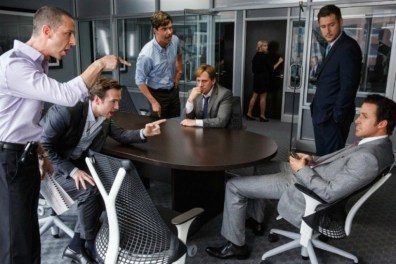
Oscars 2015 Best Picture Review: The Big Short

Big Short
The Big Short will make you lose all the respect you have in the banking system, if you’re even dumb enough to have any respect for it period.

We live in an era of fraud in America. Not just in banking, but in government, education, religion, food, even baseball… What bothers me isn’t that fraud is not nice. Or that fraud is mean. For fifteen thousand years, fraud and short sighted thinking have never, ever worked. Not once. Eventually you get caught, things go south. When the hell did we forget all that? I thought we were better than this, I really did.

The Big Short has been the surprise of this year’s awards season. It’s one of the Oscar entries with the least hype but is somehow coming out on top or pretty close. I decided to find out why.

The film begins in 2005 with Michael Burry, an eccentric hedge fund manager who’s socially flawed but very successful at what he does. He’s actually an M.D. but decided to go into the financial industry. One day he hears how housing prices have increased in Silicon Valley despite the decrease of jobs. He gets his answer. He finds out that the banks and financial industries are giving out subprime mortgages with big risk to underqualified people. The banks either don’t know about this or their too lazy to solve things.

Burry suspects this will lead to the collapse of the American economy within due time. However Burry is also creative. He knows how to ‘short’ the system by creating by creating a credit default swap market allowing him to bet against the housing market. He goes to the various banks offering megamillions to wager. The banks are willing to accept, feeling Burry will lose and the housing market is secure.

Burry’s deal catches the attention of Deutsche Bank trader Jared Vennett, whom the film is mostly scene through his point of view. Vennett hears about it from a banker he dealt with and investigates Burry’s claims for himself. Once he learns of the truth that the mortgages are high-risk, poorly-organized, sold-for-big-numbers and practically unsupervised by the banks and lending companies, he gets his own piece of the default swap action of his own.

An accidental phone call from Vennett to hedge fund manager Mark Baum catches Baum’s interest. Baum is a good businessman but is tough, cynical and isn’t afraid to let people know when something is going wrong. Heck, he was a Doubting Thomas since he was a child. Baum meets up with Vennett and is given a demonstration by Vennett and his assistant through a Jenga blocks set. Vennett demonstrates how the encroaching collapse is being further perpetuated by the sale of CDOs: Collateralized Debt Obligations. These poor loans are given incorrectly high loan ratings from A to AAA and B to BBB due to the dishonesty of the ratings agency. Baum is reluctant and this takes over his mind.

At the same time, Charlie Geller and Jamie Shipley are making their way into Wall Street. The two young Colorado men formed their own investment and trading business in Jamie’s garage where the two helped turn $100,000 into $40 million in four year. Now they want to take it to the next level by achieving on Wall Street but despite their promise, they lack the stuff to play with the big guns. At a bank where they failed to get assistance, Geller encountered a paper where he learns of Vennett’s attempt to short and they want a piece of the action. However they will need an IDSA and they lack the minimum capital to profit from this. They are able to get what they need from their friend and mentor Ben Rickert: a retired banker who now gardens for a living.

The time after is not business as usual. Burry’s story may have gotten a lot of notice but it’s also gotten to the ire of his clients. They feel the housing market is very secure and he’s wasting their money. Many demand he stop what he’s doing but he refuses. He even keeps the percentage increase in his ‘shorting’ in big red numbers on his whiteboard. Geller and Shipley consult with Rickert on making a future deal. Geller proposes a large amount of money despite Shipley’s reluctance.

Baum is frustrated by all this and he enlists two of his workers to check up on the housing situation by driving into neighborhoods. What they see is not pleasant: people with low incomes owning two-storied homes and one home rented out to a low income family by a landlord owing five months on his mortgage which he took out under his dog’s name! The landlord himself abandoned his own home to the point an alligator was able to crawl into the swimming pool. In addition, Baum learns of successful mortgage salesman who are going as far as selling mortgages to underqualified immigrants and even giving out NINJA mortgages (NINJA: NO Income No Job no Assests) as well as a banker for a major bank who’s willing to let it happen for fear clients will take their business to the competition and get their mortgage there.

Then comes the American Securitization Forum in Las Vegas. Burry isn’t there but Vennett and Baum are there together along with Geller, Shipley and Rickert to get their IDSA and their own piece of the default swap. Baum comes across a CDO manager who reveals much to Baum’s horror that he’s created synthetic CDOs: a chain of large bets on the faulty loans which actually total more money than the actual CDOs. It’s there where Baum’s business partners convince him to take this on. Geller and Shipley get their IDSA and they find their piece of the action in AA CDOs which have been overlooked by most of the bigwigs. They get their opportunity but they’re reminded by Rickert of the immense hurt that will happen to the American public once they win in their gamble. The celebration of the two ends right there.

Returning back to their business expecting the doomsday to happen any day soon, Baum wants to be the one settling the score as he himself tries to get the word out at public meetings. Geller and Shipley try to get the word out to the news but no one from a former college classmate who now works for the Wall Street Journal to Jamie’s brother’s ex-girlfriend who is a broker to even Charlie’s parents believe their doomsday claims. Burry’s investors still continue to refute his claims and want to pull out until Burry puts a moratorium on their withdrawals, much to their anger.

The stock market crash of 2008 eventually happens. Burry, Vennett and Baum were right all along. Businesses collapsed, the unemployment rate went up, the homelessness rate skyrocketed, trillions of dollars invested by the American people were lost. Not to mention many countries, especially in Europe, went through their economic crises that still exist today. In addition Burry’s investments increased fivefold from his original investment, Vennett made a nifty $77 million and Charlie and Jamie got the big financial break they sought. But no one’s smiling. Oh yeah, did I mention that there was no bank reform done and there was only one arrest from this whole mess?

This is a film that gets inside the world financial crisis of today. We should all be angry and outraged with the system for what it did with the people’s hard-earned money. We had a banking system that was too laxed and had next to no restrictions in giving out mortgages to people even if they weren’t qualified. We had people who saw the eventual doom but opted to get a piece of the action. We had bankers and mortgage dealers who were irresponsible enough to make salesmen of themselves and only care about getting big numbers for bonus checks. We had the bankers, investors and other financial professionals either negligent or ignorant to what’s happening. People’s hard-earned investments, funds and savings were treated like gambling money by these professionals. In the end, it led to the biggest collapse in the world’s economy since the stock market crash of 1928.

The film gives us what we should have to be angry with the system. However the film also does a good job in making a comedy out of it. I myself have come across a lot of situations that have been very nasty or very stressful but also very funny because of the stupidity behind it all. This is the magic of the film. It finds the humor of the stupidity that occurred in the system. While The Wolf Of Wall Street made Wall Street look like a jungle, this film made the banking and loan system look like they treated the system like it was a playground of people’s money. The film gives us many characters we find entertaining and funny but also types we just want to give the middle finger to. The film also makes us laugh at the stupidity that’s going on while having us leave the theatre infuriated in our afterthoughts.

In the end, the laughter ends and even those that profited big are disheartened. Burry’s not celebrating the big returns his investments got. Baum is left with a huge stomach ache and looks like his soul is crushed in the end. Geller and Shipley have possibly the biggest impact as you can see as they’re in the abandoned NYSE building and they’ve lost complete faith in the system.

Another quality of the film is that it helps the average person make sense of a complicated system. The story of how it all happened is a long and complicated story that consists of terms the average person hasn’t heard of and exists in a system only those inside can make sense of and understand why it happened. In making this film, they had to make a film that would help the average person make better sense of the banking system and the products and outside products that come with it. Who outside of banking or investing knows what a CDO is or how to ‘short’ the market when it’s doing business or even what an IDSA is? This film helps make sense of these complicated terms and showed how they worked in a business that is supposed to make things work. The vignettes from celebrities giving an explanation or a demonstration of how things worked added to the humor of the film as well as the quality. Even that flashback to the late 1970’s of how Lewis Ranieri changed the bank system, and our lives ‘more than Michael Jordan, the iPod and YouTube put together’ also added to the story and make more sense of the irresponsibility.

I have to say this is an accomplishment for director Adam McKay. Adam is not known for directing serious movies. For the most part, he’s most famous for writing and directing Will Ferrell comedies like Anchorman, Talladega Nights and Stepbrothers. This film is a completely different change of pace for him. However he succeeds in directing and co-writing with Charles Randolph an excellent film that’s as much a comedy as it is a tragedy.

It’s often a wonder why someone would take what is a terrible moment in American history and turn it into a comedy. I guess that’s what McKay and Randolph are doing is that they’re showing the bizarre stupidity that happened the whole time in a comedic way. They deliver a film that will have you laughing at the ridiculousness of it all and at the same time infuriate you for days or even weeks after leaving the theatre.

McKay and Randolph also succeed in delivering a film that defies convention which is all the better for it. The use of cameos from other people in an attempt to get the audience to understand banking methods and money-making methods adds to the movie. Most people would think something like this would subtract from the quality. Instead it adds. Additional tricks in the film that add to the quality are scenes and moments where the characters stop the drama in their scenes and face us explaining the real story.

Standout performance has to go to Christian Bale as an eccentric businessman whose socially flawed but smart enough to sense a danger and get rich off of it despite his anger. His social reclusiveness as well as his fixation on music adds to the character’s dimension. The other big standout from the film was Steve Carell. His character of a man who just can’t get the impending doom off his mind and is unapologetically frank but also troubled is another show-stealer. Actually there were a lot of eye catching characters including that from Ryan Gosling as Jared Vennett despite the role not being as complex as Bale’s Burry or Carell’s Baum. Additional scene stealers include John Magaro and Finn Wittrock as the two young and hungry businessmen who want a piece of the action but have a lot of learning to do. They first come off as the Tweedledee and Tweedledum of the film but it’s right at the end you see how much the realities have bit them.

The film doesn’t prove much in terms of outside things like a score or cinematography or effects. However the film put together unconventionally worked on so many levels. Besides other unconventional qualities I talked about previously, there’s also the added element of showing pictures and film clips of average Americans as they would be the ones paying the hardest price of it all. Even the addition of various news clips and music videos add to the film. The addition of a wide variety of music from hip-hop to rock is another added quality. I feel the film ending with Led Zeppelin’s When The Levee Breaks was the right choice because the levee broke here.

The Big Short is one film that will get a lot of people thinking. I may be Canadian but I was shocked at what I was seeing. I too was outraged at how irresponsible the American banking system was and how it appears to have learned nothing from this. I consider myself lucky to be Canadian after seeing this. For all its headaches, the Canadian banking system is a lot more responsible in terms of who it lends its products to and even declines if it feels it has to. However it does have some careless elements of its own. For my own experience, I signed up for a credit card the very first week I was in university while under NINJA status and I still got it. There was another time I was at my bank during company time but a credit card saleswoman wanted me to sign up for a Gold Visa card. Since she wouldn’t take no for an answer, I signed up for it hoping she would get off my case. I thought I wouldn’t get it since I didn’t have the minimum annual income for a Gold card. I got it to my surprise. I’m still unhappy about this. Makes you wonder how and why banks seem to have forgotten their standards. No wonder that British man in a pub said to Rickert: “$100 million? Are you a banker or a drug dealer? Because if you’re a banker, you can fuck right off!”

The Big Short will make you angry with the banking system but will also make you laugh at the stupidity as well. It’s part drama, part comedy, part history lesson and that is probably what makes it a winner.

Oh yes. Another year of watching all the Best Picture nominees. This makes it the fifteenth year in a row I’ve done so! Here’s to another Oscar year.

Movie Review: The Hateful Eight

hateful-eight
The Hateful Eight focuses on eight despicable people in the same building. It leaves the audience wondering who will still be alive at the end, if anyone at all.

Quentin Tarantino is possibly the most uncompromising director in Hollywood. Even when he’s not at his best, he can still make a statement. I gave The Hateful Eight a look. I have to say I found it had a lot to like.

It starts in post-Civil War America in the frontiers. It’s a cold day and there’ signs that there’s a blizzard coming soon. Major Warren, an African-American bounty hunter, has three bodies to take back to Red Rock. He hitches a ride with a stagecoach despite being told by driver O.B. Inside the current passenger wants to be alone. Warren does get the ride and meets his other passengers: another bounty hunter by the name of John Ruth who has his bounty, the ruthless Daisy Domergue, with him handcuffed to him also headed to Red Rock. The ride is not pleasant as Daisy should racial slurs at Warren. To which Ruth response with a punch in her face. However Warren and Ruth are able to bond as Warren reads him his letter from Abraham Lincoln.

Along the way, the coachman  comes across a Lost Causer by the name of Chris Mannix who claims he’s to be the new sheriff of Red Rock. Mannix is welcome but tension between him and Warren start over each other’s war records. However both Ruth and Warren make a pact to protect each other’s bounties.

The blizzard becomes so powerful, the four have to take refuge at the nearby Minnie’s Haberdashery, a stagecoach lodge. Minnie’s not there and the four are greeted by Bob, a Mexican who claims Minnie is visiting her mother and he’s in charge. Also at the Haberdashery are Red Rock hangman Oswaldo Mobray, cowboy Joe Gage who’s simply traveling to visit his mother, and former Confederate general Sanford Smithers. Ruth knows they will all be in the lodge overnight and trouble is bound to brew with all these differing and conflicting people. So he gets all but Warren to disarm.

They even try to get the eight to have a civilized dinner of stew at the same table. However Mannix points out to Warren that his letter from Abraham Lincoln is a forgery. Warren admits it, stating his letter gets him respect from white people that he’d otherwise be denied. Ruth is outraged when he hears this. Warren also has another confession, but to Smithers. He provokingly confesses to him that he tortured, sodomized and killed his son in lawful self-defense in revenge for his son executing black soldiers during the Civil War.

Another incident happens known only to Domergue, the coffee was poisoned. She alerts no one of this and allows for Ruth and O.B. to pour a mug. After drinking they both vomit and collapse. Mannix is fortunate enough not to drink the cup he poured after he saw what happened. Domergue is able to kill Ruth but through her own gun. Warren attempts to be the master of justice, determined to find out who poisoned the coffee. Only to uncover that Bob is possibly an impostor because Minnie’s haberdashery does not allow Mexicans. He suspects from the start that Minnie was killed and executes the Mexican. To the surprise of everyone, Warren is shot from below. Further shootouts follow leaving Mannix and Mobray wounded.

The film then flashes back to the beginning of the day when it was to be a typical day for Minnie’s Haberdashery. However a robbery happened where everyone including Minnie were killed. Only Smithers is still alive. The leader of the heist was Jody Domergue, Daisy’s brother, who plans to ambush Ruth knowing they’ll eventually stop here because of the anticipated blizzard and his gang will take Daisy away. Returning back to the current situation, the story goes into various confrontations and leads to an unpredictable ending.

Of all the films that are happening around this Oscar season, this appears to be the one film that shows no real intention of making a political statement or social statement of any kind. Actually what it is doing is telling a story that for the whole of it only takes place not even for a full day. It’s starts with a free African-American major wanting a stagecoach ride only to end up in the same coach as two others. Then another. All of which are polar opposites and you know a fight would start any minute. Then the four get to a shelter during the blizzard which happens to be a haberdashery place with four others, also a set of characters too with traits you know could add to the conflict.With eight spiteful people in the same place at the same time with a bone to pick with at least one of them, you know hell will break loose any minute and you wonder who will be the first to get killed. Even as you watch the whole film unravel, you will end up surprised to see anyone at the end of the movie alive.

Once again Quentin Tarantino delivers. He’s one of few directors that doesn’t have to succumb to the pressures of parental guidance groups, family values groups or even the pressures of Hollywood and be able to deliver his stuff his way. As I said at the beginning, he’s possibly the most uncompromising director in Hollywood. He is no holds barred in terms of the use of profanity and racial slurs in this film and uses no restraint. As is common in his movies, he divides his film into segments or even chapters as he does here. Also like his past films, he plays with the chronology of time as the incidents of what happened before the eight got together is shown as the fifth chapter rather than a simple flashback as most film makers would do.

Another thing Tarantino does here like he does in some of his other films is throw in some subtle humorous moments. One example is the case of a cowgirl from New Zealand. Another is getting all of the eight at a table to eat their dinner in a civilized manner, or as civilized as it can get. Another example of his dark humor is the gory effects of when one gets shot in the face or when one drinks the poisonous coffee. And an additional example is how he has items be a significant part of the film. The same way the watch, Kahuna Burger, suitcase and wallet fit the story of Pulp Fiction to a tee, we have Warren’s letter from Abraham Lincoln. He does the type of movie violence that can even make Martin Scorsese jealous. He always was a film maker who didn’t play by the rules. He always made his own rules.

I will admit being a longtime fan of his movies, I was wondering what The Hateful Eight would be like. His last two films weren’t exactly his best: Inglourious Basterds could dazzle at first but would later be seen as ridiculous in afterthoughts and Django Unchained look both ridiculous and redundant as revenge being rehashed. Here Tarantino takes a chance by having most of the situation happen in a single physical location. Most of the time you have that in the case of student films or feature-length films of rising directors. Here Tarantino uses his experience and his knowledge of directing and writing to create a full intense film that’s predominantly set in a single place. That was very creative of him as he does a good job in the story and directing and delivers a movie that gives you the sense anything can happen any minute.

However the film is awfully long and there are many scenes that seem like they are drawn out. Sometimes there are times you’re actually wondering why something hasn’t happened yet.I do give Tarantino credit for delivering a story that’s unpredictable but I still feel almost three hours is too long for such a film.

SPOILER ALERT: Ending Will Be Revealed In This Paragraph. Bypass This Paragraph If You Want The Ending To Be a Surprise. If there’s one surprise Tarantino gave me, it’s the ending. Usually Tarantino is one film maker that doesn’t usually have sentimentality in his films. I have never seen a sentimental moment in any of his previous films. However the ending as Mannix and Warren appear dying was possibly the most sentimental thing I’ve ever seen in a Tarantino film. Sure, that’s not saying much but it’s still atypical enough to notice. No, I didn’t shed a tear as didn’t anyone else in the theatre but it was still a surprise.

Tarantino may be the brains behind what’s all happening in the film but it’s the actors that make it come alive. All eight of the main actors had to deliver a character that was as likable as they were hateable. Basically the type of characters whom you wouldn’t shed a single tear over when they die. They succeed in doing so and even make you welcome their deaths at times. Samuel L. Jackson and Kurt Russell were the ones able to command the most attention. However the biggest scene stealer will have to be Jennifer Jason Leigh. Her performance as the uncoothed Daisy Domergue really caught everyone’s attention. Her character of Daisy could have been considered annoying or even a distraction but she made it work. Her turn will also surprise you how a woman can be as ruthless as the men. The second show stealer would have to be Walton Goggins as Sheriff Mannix. Goggins also had a character that could have easily been dismissed as annoying or over the top but he became more likable and oddly enough appreciable by the end. If there was one more scene stealer, it had to be Bruce Dern as the spiteful Confederate General. Even the minor roles such as Minnie and Six Horse Judy were played well.

The film also did well in terms of its technical aspects. Robert Richardson did a very good job of cinematography both among the outside shots and inside shots. The natural and created sets works well too. Once again, Tarantino delivers a film with an excellent mix of songs from the past that fit the film well. However it’s the addition of the score from Ennio Morricone that give the film an added boost.

The Hateful Eight is not Tarantino’s best film ever. In fact it’s imperfections are noticeable. Nevertheless the film rarely gets boring and will still please Tarantino fans.

Movie Review: Boy And The World (O Menino E O Mundo)

Boy And The World
A boy goes looking for his father and encounters a world both colorful and dark in Boy And The World.

I was lucky enough to see Boy And The World when it was in film theatres in Vancouver. I’m glad I had the chance to see it.

Cuca is a small boy who lives in a village of a distant world. Cuca has all the imagination of a child his age. One day his father leaves to find a better job. As he says goodbye, he gives him a reminder of him. Cuca buries it near a tree. Over time Cuca is impatient and then goes on a search for his father.

Cuca’s search takes him to various worlds. One of farmers, one of cotton pickers, one of construction workers. Each world is magical and musical and tells its own story. The villagers are often seen celebrating in the streets. However each world is threatened by the greyness of lifelessness. One day Cuca meets a man whom he believes to be his father. He keeps on following him to the jobs he pursues in the various worlds he visits. Then one day Cuca makes it to the big city and is disgusted with what he sees. The film doesn’t end on the happy note we hope for but it does end with a message of hope.

This is a very unique 2D animated film. The film is very colorful and very mesmerizing while keeping one focused on the main story at the same time. There isn’t much dialogue and the Portuguese doesn’t have subtitles added to them. However it’s not needed because all the visuals with their actions and patterns tell the story and send the message. Hard to describe the film’s best quality. All too often when I look back, I remember how the film dances and comes alive with colors and music. Almost every scene that tells a story or sends a message turns into a colorful musical splendor.

The film also has a lot to say about the negative elements of society depicted in the film. Even without saying much or without saying a word at all, you can tell the differences when you see the common people in the ‘world of color’ and the world of the city and of industrialization in ‘black, white and grey.’ That scene near the end where Abreu focuses on corporations and industrialization and its dehumanizing effects in Brazil is also set to music just like with the positive parts. The dreary music that comes with it also sets the mood. That was the key quality of the film: the use of music and colors to tell the story and deliver a message.

Top acclaim should go to writer/director Ale Abreu. He is an animator who has a short but merited list of animated films and shorts to his credit. Most of which have never been seen outside of Brazil. Boy And The world is probably his first film or short seen outside of Brazil. Actually the film’s first release outside of Brazil was at the Ottawa International Animation Festival. The film won an Honorable Mention for Best Animated Feature because according to the jury: “it was full of some of the most beautiful images we’ve ever seen.” If you’ve seen the film, you’d understand why. I believe Abreu created a masterpiece.

Since Ottawa, the film has done a very good job at creating an impression at film festivals over time. In Brazil, it won two Cinema Brasil awards for Best Animated Film and Best Children’s Film and the Best Brazilian Film at the Sao Paulo Film Festival. Further accolades include Official Selection feature at the Shanghai Film Festival, the One Future Prize for Abreu at the Munich Film Festival, Best Screenplay at the Cairo Film Festival and Best Feature at the Annecy Film Festival. Bigger acclaim just came months ago as it won the Annie Award for Best Independent Animated Feature.

Before the Oscar nominations were announced, the nominees for Best Animated Feature were expected to be given to films that fared better at the box office like The Good Dinosaur, The Minions Movie or The Peanuts Movie. Instead the animators branch of the Academy decided to show some favoring to some artsier films including Boy And The World. I will admit if it weren’t for its Oscar nod, I would not have seen it.

Boy And The World is a different type of animated film and for the better. It has its own style, its own feel and its own charm despite also delivering a socially-conscious message. A rare gem of a film.