Oscars 2024 Best Pictures Reviews: Part Two

It does seem awkward for me to do five blogs of Best Picture contenders. It’s all about my writing. Last year my writing was so over the top, I had to post individual reviews instead of all ten within three blogs. This time as I was writing, I felt doing blogs consisting of two reviews each is a nice steady dose of my writing. Hope you like them. Now on with my next two reviews:

A Complete Unknown

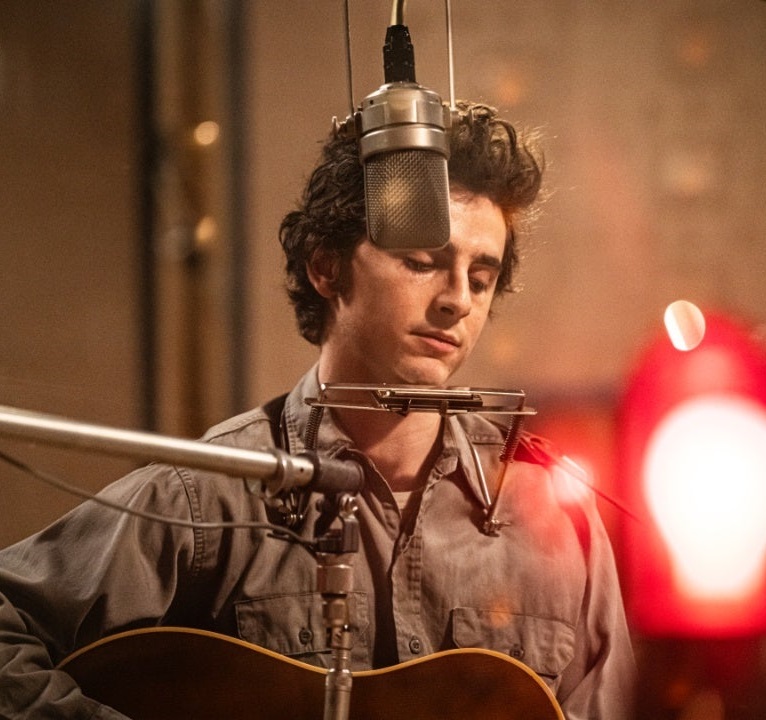
I’ve seen musicographies before. I’ve seen how they told the story of the musician or even show one part of the musician’s life. This film is a case of telling a part of Bob Dylan’s life. It tells of how he goes from an unknown folk singer in Greenwich Village to being part of the main folk scene of the time to branching out on his own. One thing we often forget about is that in the early-1960’s folk music was seen by many young people as the antidote to Rock ‘N Roll. Rock ‘N Roll music was seen by them as filled with scandals, fabricated acts, and music done for money’s sake. Folk was regarded by them as the opposite. It was regarded as self-composed music, honest feeling and even having a word to say to the powers that be. Bob, having a liking to Rock ‘N Roll, did not sit well with fans of folk music. To add, the Folk scene was becoming as much like showbiz as Rock ‘N Roll itself. You could easily see why folk fans would be outraged by his Rock ‘N Roll schtick. Looking back, it leaves me wondering after that moment did Rock ‘N Roll change Folk or did Folk change Rock ‘N Roll? Neither genres have been the same since.

The unique thing about this film is that it’s as much about the person as the musician. Most of us have known Dylan through his music. He always spoke his mind in his music. The film shows things most of us have overlooked. There’s the time Bob is torn between the love of Joan Baez and Suzy Rosso and finds it hard to hold a relationship with either. There’s Bob desire to expand and grow as a musician while the folk scene wanted to her him perform his more legendary hits. There’s how Bob found guidance from Johnny Cash and regarded Woody Guthrie as a musical father figure. There’s how the folk scene became just as much of a clique as even the most commercial music scene. We see that in how the folk scene was all about those connected to Pete Seeger and the shows he helped organize. You can understand why Bob would rebel and do his electric show. Bob always wanted to do his own thing. At the end of it all, he was still Bob.

This is quite possibly the best work from James Mangold. For so long he’s created films in which have received Oscar nominations and wins, but left him empty handed. Films like Girl, Interrupted, Walk The Line, 3:10 To Yuma, Logan and Ford vs. Ferrari. He did get a scriptwriting nomination for Logan but it’s this film he finally gets nominated for Direction. Having directed Walk The Line, Mangold knows how to direct a musicography. With the story he co-adapts with Jay Cocks, Mangold shows Dylan as a musician, artist, flawed lover and rebel. He also captures the essence of what folk music was to do about, the folk music scene of the 60’s and the times very well. It’s easy to see why he has received this acclaim.

The film also excels through the excellence of the performance of Timothee Chalamet. I’ll admit I first thought Chalamet playing Bob Dylan was a bad idea. I could not see him doing it. He accomplished it very well by making it a three-dimensional performance when it could have been wooden or cartoonish. I’m impressed with his work. Also really great is Edward Norton as Pete Seeger. I know Edward knows how to get into character. Here he makes a very convincing performance as Seeger. Newcomer Monica Barbaro is also excellent as Joan Baez. The film is, in a way, also showing us the Joan Baez we never knew. Very different from her on-stage persona we’re so familiar with. Elle Fanning was also great as Sylvie Russo who faces a hard time trying to love Bob as his fame was starting to take off. Boyd Holbrook was also very convincing as Johnny Cash and Scoot McNairy was also great as woody Guthrie. Even though both performances had a short amount of screen time, they were still both good and convincing.

A Complete Unknown is not your typical musicography. It presents a Bob Dylan we never knew, a Joan Baez we never knew and a folk scene different from what we thought it was. It’s as revealing as it is great.

Conclave

There has been a lot of unhappy talk from a lot of Catholic people about the film. One thing we need to talk in mind is that this story is a fictional story based on the adaptation of a book. Watching it, the cardinals did not act very priest-like. It made the whole conclave look like a joyless sect. Throughout the film, there’s hardly any focus on the spirituality of the cardinals. As the election of a new Pope is happening, it appears they are all rivals against each other with animosity. It almost makes the election of the Pope look like a political election where candidates look to expose the dirt of their rivals in order to win votes. Maybe that’s the point of the film. To make a papal election look similar to that of a political election. Although they do a good job of making that connection, I’m still unhappy about how the bishops and cardinals were portrayed.

Although I was unhappy of how the conclave is depicted, I am not angry as I am well aware this is a fictional story. Besides none of us knows what goes on behind the scenes of electing a new Pope. One thing the film does do well is that it shows the complications of being inside the Catholic Church. Although the film doesn’t know much about the faith of the bishops and cardinals and makes them look similar to dirty politicians, each of the bishops and cardinals represent ways of thinking most common among Catholic leaders. I myself have complained that the Catholic Church feels more like an institution than a church, but we forget how big the Church is. The Catholic Church is almost 2,000 years old and has 1.3 billion members and has churches on all the world’s continents. In some nations, Roman Catholicism is the religion of the majority. With a church that big, there is bound to be differing opinions on various issues. Some have Bible-based answers for various issues, some base their opinions on Church-based teachings, and some just give their own rational thought. You can understand why a church this big will have a lot of conflicting opinions among its members and leaders. The various debates among the College of Cardinals are reflective of that. Then there’s the powers that be. As you can see in the film, the electing of a new Pope is not an easy thing. There’s knowing that the Pope they elect with become the epitome of the image and the morality of the Catholic Church. You can understand why choosing the right bishop or cardinal to be Pope will be a difficult.

This film is good at making the election of a new Pope look like an intense drama. It succeeds in doing it by inventing a clever ‘behind the scenes’ story and making it into an intense drama that will keep you focused. It may overdo it in terms of the various conflicts between the bishops and cardinals but the conflicts reflect the common mixed beliefs held by Catholics. Sometimes the squabbles over certain bishops in the running are reflective of squabbles of the various beliefs of many Catholics. A Church of 1.3 billion is too big to have everyone believing the same thing on each issue. Also the film reflects on difficulties, scandals and controversies that the Church has left unfixed over the years. Even how secrets unraveled behind the Church walls are representing how the Church has a lot of hidden secrets. The film also succeeds how getting the problem of the Papal election solved is best assisted by two people least expected. It’s first done by Sister Agnes who, by being a nun, is to exist in the background but she can’t hide her silence anymore on all that has happened. The second is Cardinal Benitez who seems like the candidate least likely to win, but after he made his powerful speech, he appeared to be the best choice to be Pope, only for his secret to be revealed after his election. The film gives an ending that leaves us with questions of what will happen next. That’s what a film should do.

This film is an excellent work from Edward Berger. With the script Peter Straughan adapted from the novel, Berger directs a film that takes a world event and turns it into a behind-the-scenes drama that will keep you intrigued in the drama more than you thought you would be. Although it’s off in its depiction of priests and bishops, it’s still a great work.

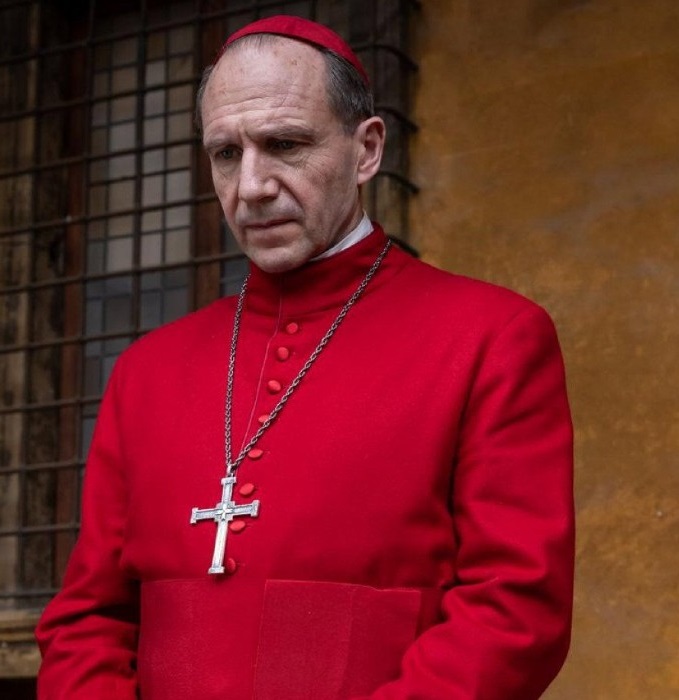
Also great is Ralph Fiennes as Cardinal Lawrence. He performs the role of a priest whose spirituality is clashing with his role of leading the College Of Cardinals. He makes the stress look obvious. The performances of the various bishops from John Lithgow, Stanley Tucci and others were very good, despite more focus on the Cardinals’ arrogances. Isabella Rossellini is the surprise of the film. Playing Sister Agnes who can’t hide her silence anymore, she really provides needed impact to the story and her silent moments are as good at storytelling as her talking parts. Carlos Diehz is also great as the Cardinal who’s the best most mortal choice for Pope, but has a hidden secret. The film also has a lot of great technical merits like set designers Suze Davies and Cynthia Sleiter for creating a set that looks very much like the Vatican, costuming Lisy Christl in making the clergy costuming look perfect and composer Volker Bertelmann delivering a score that adds to the intensity of the drama.

Conclave may be off in their depiction of cardinals and the Church itself but it succeed in bringing up hot topics surrounding the Church as it succeeds in making an intense drama of a Papal election.

And there you go. Those two films are my second look at the Best Picture contenders of this years. More reviews of Best Picture nominees to come.

Paris 2024: Fourteen To Watch

Paris will join London as the only two cities to host the Summer Olympics three times.

On Friday, July 26th, the Games Off The XXXIIIrd Olympiad will open in Paris, France. This will be the third time Paris will have hosted the Summer Olympics, having hosted in 1900 and 1924.

One thing about these Olympics Games is these will now be back to full crowds. You may remember the Tokyo Games were delayed by a year and had to be held without spectators. You may also remember the Beijing Winter Olympics were also quite limited in spectators. Now that the pandemic has been mostly tamed down, Paris can be a free-for-all and the crowds are back. Also I got back my ambition to do pre-Olympic blogging. Something I haven’t done since the 2018 Winter Games.

With every Olympics comes many an athlete or team that will be heavy favorites or athletes of curiosity. Here’s my look at fourteen athletes at the Paris Games who you should keep an eye on.

-Noah Lyles/USA – Athletics: The American sprinters have been struggling to get themselves back to the top for almost 20 years. First there was the setback of Usain Bolt and other Jamaicans. Then there was Italy’s Marcell Jacobs winning in Tokyo and the men’s really team failing to qualify for the final. Seeking to put the US back on top is 27 year-old Noah Lyles. Back at the Tokyo Games, promise was noticed as he won a bronze in the 200 metres. At last year’s World Championships, he won the 100m, 200m and was part of the winning American relay team.

This season, Lyles is ranked World #1 in both the 100m and 200m and even recently ran a personal best in the 100m of 9.81. Lyles will have rivals in Paris. In the 100m, he will be up against Jamaica’s Kishane Thompson and Kenya’s Ferdinand Omanyala who have posted faster times this year. Expecting to challenge Lyles in the 200 is Tokyo silver medalist Kenneth Bednarek who finished second to him at the US Olympic trials. Also rivaling him is Botswana’s Letsile Tebogo who finished second to him at the 2023 Worlds in the 100 and third in the 200. If all goes well for Lyles, he could be one of the stars of Paris.

-Sha’Carri Richardson/USA – Athletics: Many will remember before the Tokyo Olympics, there was a lot of news of Richardson being disqualified from the Olympic team for testing positive for marijuana. It was a shock to many. Sha’Carri was undoubtedly disappointed. Unnoticed at the time was the then 21 year-old sprinter was still young and her best years were still to come. At last year’s World Championships, her talent arrived when she won the 100m, finished third in the 200m and was part of the US’s winning relay team.

For most of this year, Sha’Carri has kept it low-key. She hasn’t been to too many competitions and bypassed the Diamond League this year. She did prove herself to be a force in the 100m in Paris after winning the US Olympic trials in 10.71. Her main rival Sherlock’s Jackson of Jamaica is injured but that won’t stop her from having rivals in Paris like Ivory Coast’s Marie-Josee Talou-Smith, St. Lucia’s Julien Alfred and Jamaican legend Shelly-Anne Fraser-Price looking for one last Olympic gold. Paris could be Sha’Carri’s moment and the possible start.of a long legendary career.

-Yaroslava Mahuchikh/Ukraine – Athletics: Back at the Tokyo Olympics, Yaroslava was 19 years old and seen as a rising talent with her bronze medal in the high jump. Then the war started months later. Many Ukrainian athletes had to find new ways to train or even leave Ukraine to seek refuge in another country. Mahuchikh first traveled by car to Belgrade to compete at the World Indoor Championships. Shortly after, she found refuge in Germany to resume training. Since her move, her career skyrocketed with silver at the 2022 World Outdoor Championships and then gold last year. Just last month, Mahuchikh broke the 37 year-old world record in the women’s high jump!

She is a heavy favorite to win the high jump in Paris, but she will have competition. She will face rivalry from Australia’s Nicola Olyslagers who beat her at this year’s World Indoor Championships as well as another Australian: 2022 World Champion Eleanor Patterson. Whatever happens, Mahuchikh’s triumphs are not limited to inside the athletics arena.

-Sydney McLaughlin-Levrone/USA and Karsten Warholm/Norway – Athletics: The biggest action in athletics at the Tokyo Olympics came in both the men’s and the women’s 400m hurdles. In both events, the winner broke the world record by a huge margin, the second-place finisher finished in a time faster than the pre-Olympic world record and the third-place finisher’s time was a small fraction short of that pre-Olympic world record!

It’s interesting to see what has happened since to both men’s winner Karsten Warholm and women’s winner Sydney McLaughlin. Both won their hurdles event at a World Championship since. Walholm has still continued his consistency with major victories, and won the 2023 World championships but finished 7th at the 2022 Worlds. McLaughlin has also won the 2022 Worlds and has even knocked almost a full second off the world record since Tokyo. She missed the 2023 Worlds due to a knee injury. Both runners will face rivalry here in Paris. For Warholm, the two other medalists from Tokyo — US’s Rai Benjamin and Brazil’s Allison dos Santos — will rival him in Paris.  McLauglin’s top rivalry will come from 2023 World Champion Femke Bol of the Netherlands and her own teammate Shamier Little. Only time will tell if both repeat as Olympic champion here in Paris, and if they break the world record again.

-Eliud Kipchode/Kenya – Athletics: One thing about social media these past ten years is that there are so many athletes being promoted as GOATs. One of which is Eliud Kipchode who’s commonly seen as the GOAT of marathon running. Personally I still want to think of Abebe Bikila as the GOAT but Kipchode’s feat of eleven major marathon victories, four Olympic medals including two marathon gold’s, and breaking the world record twice, it’s very tempting to call him the GOAT. Even his time-trial marathon run under two hours sparked buzz.

The crazy thing about marathon races, especially at the Olympics, is that it is the hardest to predict. Many favorites have succumbed to the course or the weather conditions and unknowns have often ended up the winners. Despite his illustrious career spanning almost two decades, Kipchode will face rivalries from 2023 World Champion Victor Kiplangat of Uganda and from his own teammate Benson Kipruto who has won the fastest marathon time this year. Whatever the result, Kipchode will add to his greatness here in Paris.

-Simone Biles/USA – Gymnastics: Simone Biles is an athlete loved by many, shunned by others. For many years, she was dominant in gymnastics having won a stack of World Championships and at the 2016 Rio Olympics, she was the queen winning four golds and a bronze. In between Rio and Tokyo was the revelation of the predator doctor Larry Nassar. Biles was one of his former patients who testified against him. Then at the Tokyo Olympics, she had a mental lapse called the ‘twisties’ and needed to bypass most of the competition. She did leave Tokyo with a silver and a bronze, but many people, most of whom don’t understand the dangers of gymnastics, labeled her a quitter or a loser. She would come back at the 2023 Worlds winning four golds and a silver.

Despite being the queen, she will face challenges from Brazil’s Rebecca Andrade and from her own American teammates in Jordan Chiles and defending Olympic all-around champion Sunisa Lee. Whatever happens in Paris, it will add to Simone’s greatness.

-Carlos Alcaraz/Spain – Tennis: One thing about tennis is right while there are a lot of greats, there are also young guns looking to dethrone them. One of which is Spain’s Carlos Alcaraz. Right at a time that seems dominated by Rafael Nadal and Novak Djokovic, Alcaraz appears poised to dethrone them.  The 21 year-old has already won singles titles in Wimbledon, the US Open and most recently his first French Open victory. The latter is an advantage as the Olympic tennis competition will also be in the Roland Garros arena.

One thing about Olympic tennis is that most favorites have not won the gold medal and many times, unknown players have become Olympic champion. In fact, Djokovic’s only Olympic medal is a silver from 2008. Djokovic is one of Alcaraz’s rivals here in Paris. Also in the tournament are challenges from Germany’s Alexander Zverev and Norway’s Casper Ruud. Paris should be another chance for Alcaraz to make a name for himself in the tennis world.

-Julien Alfred/St. Lucia – Athletics: One of the things I like to do each summer Olympics is keep an eye out for any athletes that just might win their nation’s first-ever medal. One with good chances is 23 year-old Julien Alfred from the Caribbean island of St. Lucia. Her talent was first noticed at the 2018 Youth Olympic Games when she won silver.in the 100m. When she enrolled at U of Texas and became part of the Longhorns track team, that’s when things improved. She won a silver medal at the 2022 Commonwealth Games and at last year’s World Championships, she finished fifth in the 100m and fourth in the 200m.

In the 100, her rivals include Sha’Carri, Shelly-Anne Fraser-Price and Marie-Josee Talon-Smith. In the 200, she will face challenges from Jamaica’s Shericka Jackson, the US’s Gabrielle Thomas and the UK’s Daryll Neita. The Olympics are known for upsets and Julien Alfred could prove to be one of the top upsetters in Paris.

-Spain Women’s National Football Team: When it comes to a nation like Spain, you figure they would greatly support their men’s football team but greatly overlook their women’s team. Over the last five years, the RFEF started taking their women more seriously. After the 2019 Women’s World Cup, Spain’s women’s team made huge improvements in the sport and even won the Women’s Works Cup last year. Despite the growing success of the team, the sexism the team has been facing has been greatly exposed. Before the WWC, players boycotted the team because of a lack of a tactical preparation and a controlling environment. After they won the WWC, there was the incident at the trophy ceremony where RFEF president Luis Rubiales kissed player Jenni Hermoso on the lips, unconsentually. The controversy sparked outrage in Spain which led Rubiales to resign and paved the way for better equality with Spain’s women’s team.

One thing about the reigning WWC champion is that they’ve never won the Olympic gold medal. Spain aims to end that bad luck curse. They could face tight rivalry from the WWC fourth-place team Australia and from the US and Germany who hope to improve greatly after their WWC disappointments. Even host-nation France could be a threat. Anything is possible at the 2024 Olympics and Spain’s team could just achieve another victory here.

Four From The Host Nation

France’s athletes have competed in every Summer Olympic games except 1904 and have won a total of 751 medals: 223 of them gold. That medal haul puts them 5th in the all-time total of Summer Olympic medals. The sports where they’ve won their most gold medals are in fencing, cycling (which they have the most total medals), judo, equestrian and sailing. Here in Paris, the French team look to greatly add to their legacy. Here are four athletes representing France to look out for:

-Leon Marchand/France – Swimming: France’s swimmers have won a total of 43 medals. Eight of them gold. So far no French swimmer has won two individual event gold medals. The possibility looks great for Leon Marchand. Back at the Tokyo Olympics, he was 19 at the time and didn’t win a medal. Since then, he has become the fastest all-around swimmer in the world. He has won the World Championships of both 2022 and 2023 in both individual medley events: 200m and 400m. 2023 had added bonuses as he broke Michael Phelps’ world record in the 400 from the 2008 Olympics and he also won a bonus gold in the 200m butterfly.

He will face rivalry here in Paris from the UK’s Duncan Scott and the US’s Carson Foster in the IM races. In the 200 fly, he will face rivalry from defending Olympic champion Krisztok Milak of Hungary and Tokyo silver medalist Tomoru Honda of Japan. If all goes well, Marchand should be able to delight the home-nation crowd.

-Joris Daudet, Sylvain André and Romain Mahieu/France – BMX Cycling: Usually when you think of France and cycling, you think road racing like the Tour De France. Even though France is still big in road racing, it has recently developed as a force in BMX racing! Franch riders have won a medal at every World Championships since 2016 and they’ve won the last two: Romain Mahieu winning last year and veteran Joris Daudet Winning this year. The caliber of talent of France’s BMX racers is so jam-packed, last year’s Worlds silver medalist Arthur Pilard didn’t make the Olympic team. Instead this year’s Worlds bronze medalist Sylvain André will be competing in Paris.

The most interesting thing is all three were finalists at the Tokyo Olympics. Despite the big predictions, it will all boil down to the races. In fact, Daudet has won World Championship medals since 2011 but has never won an Olympic medal. The anticipated sweep of the medals will face a challenge from defending Olympic champion Noel Kimmann and 2022 World Champion Simon Marquardt from Switzerland. Anything can happen in Paris and the French BMXers can deliver a performance for the ages.

And there you have it. There’s my look at foreign athletes to look out for at the upcoming Paris Olympics. My blog of Canadians to look out forl is coming soon.

VIFF 2019 Review: Joel

Joel
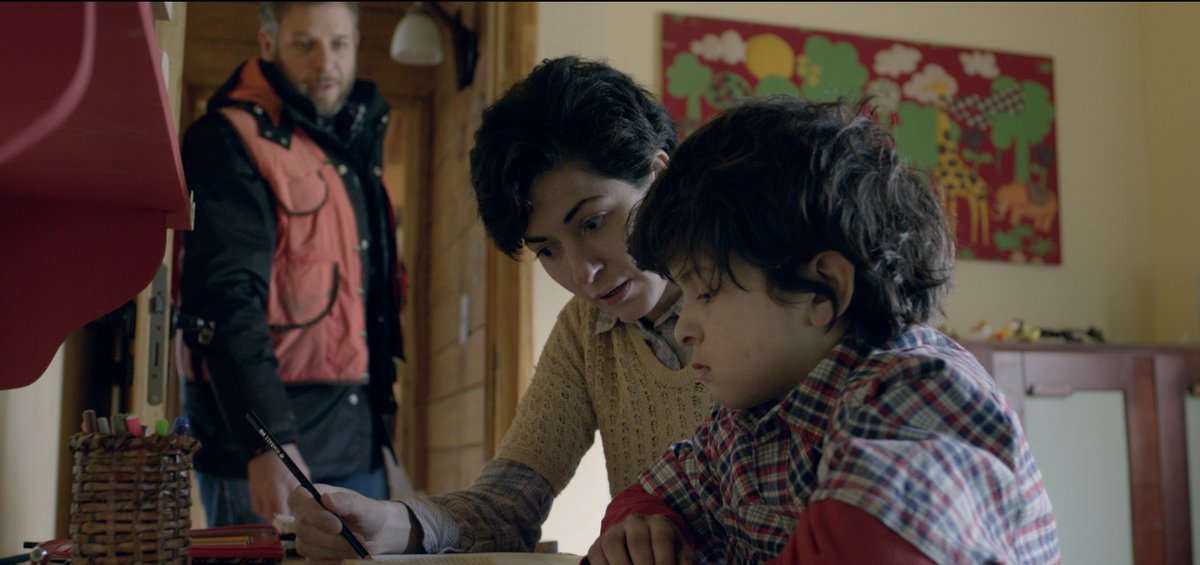
Joel is the story of an Argentinian family’s adoption of a boy, and the difficulties that come with it.

Joel is a family drama from Argentina. It’s based on an adoption scenario that tells more about the society than about the adoption process.

Cecilia and Diego are a couple in a small Argentinean mountain town of Tolhuin in the Patagonian forests. Cecilia is a music teacher and Diego is a successful forester. They’ve been hoping to start a family, but it hasn’t worked out. They decide to pursue the Argentinean adoption system. They’ve received news their request from the government has been granted. They also learn about a boy who is up for adoption. They’re told he’s eight years old and his name is Joel.

They are informed that Joel is actually nine years old. Joel comes from a troubling family background in Buenos Aires. His mother died and was soon looked after by his uncle and grandmother. His uncle soon ended up in prison and Joel had since been committed to institutions. Cecilia and Diego are both excited and nervous about taking on Joel. They look forward to being his parents, but are cautious about what they might have to deal with. The two meet Joel for the first time. The two are both excited and nervous while Joel is quiet and shy.

Cecilia and Diego make the efforts to be parents to Joel. They give him his own room and allow him to pick out his own clothes. There’s a party to introduce Joel to the family. Samuel and Virginia, a religious couple whom they are friends with, are pleased to meet Joel. Cecilia and Diego also enroll Joel into the town school. They have a lot of high hopes, but are nervous.

One day, they find a cellphone in Joel’s drawers that’s not his. They return it to the school but the people aren’t happy. Then Cecilia receives word that Joel will have to be given a teaching schedule different from the other students and separated from them. The reason why is made unclear to Cecilia at first. The teacher reveals that Joel has been telling the children stories about doing drugs.

This is alarming the parents. The outrage has gotten to the point that the parents do not want their children to be around Joel. This is having a strain on the relationship of Cecilia and Diego. Those close to them, including Samuel and Virginia, are distancing themselves from them. Even Diego’s boss weighs in about what is to be done with Joel. Cecelia is even told if she gives up on Joel, he could be sent back to the institutions where he eventually grows up to live a life of crime and die young.

There’s a school meeting about what is to be done with Joel’s educational setting. The meeting is fiery with many parents speaking out their hostility. One of the mothers confronts Cecilia and tells her that she was adopted too and the attitudes that are happening are similar to what she experienced. Then the teacher and school director finally meet with Cecilia to discuss their final decision. It’s a decision they’re optimistic with. They have decided to have Joel spend six months in a ‘special school’ up in the mountains where they believe he will be better-adjusted in time to have him brought back to the school. Cecilia is not happy with the result. Diego insists she goes along with it because his boss believes it’s the right thing. As Cecilia is about to drive Joel to his temporary school, she makes her own critical decision on the matter.

This film tells of an adoption story in Argentina. However the film does show a lot of elements that one anywhere in the world can identify with. There’s the legal process which is common in most countries; there’s the fact that Diego and Cecilia will be parenting for the first time ever; there’s the adoption of a boy from a troubling background from the big city; there’s trying to get the boy to fit into a smalltown setting. There’s even the mission of the Argentinian adoption system: “Our aim is to find parents for the children, not children for the parents”.

Here in North America today, adoption should be a non-issue. Some countries or cultures may have a negative stigma about adoption whether it be the adoption process or about the children adopted. I’m not knowledgeable at all about how most Argentinians view adoption. All I know is the laws stated in the film and nothing else. However I did see a theme that we commonly see even in towns or villages of developed countries like Canada and the US. A city kid is taken into a home in the countryside to be given a life and a family. What happens is ostracism not just of the kids, but of the parents too. Even a client of Diego’s weighs his own opinion on this. The film shows a common theme of smalltown narrow-mindedness where they can be hostile to outsiders. In this case, we have the children, parents and teachers that are mostly against Joel being in the town and schools. Lines like “Our children are pure and live in a lovely town. Why should they have to put up with him?” sound like they’re echoes from common-talk. That scene of the mother who was adopted and faced similar flack says a lot about these attitudes.

The quality of the story also gets the audience involved and gets them wondering who or what to side with. Joel appears harmless, but he comes from a troubled background in Buenos Aires. Cecilia and Diego took Joel away to give him a family life and to take him away from the inner city threats that could endanger him, including from his own blood-family. Joel acts harmless around the house, but the teachers, parents and students all tell a different story. You even see things that make you wonder like how Joel arrived with a packet containing a lighter, money and a toy, or even the cellphone he either found or stole. You never see Joel do any of the things those parents say he does, but even if Joel said those words or stole the phone, this is very common among children his age. Wrong, but common among boys his age. It’s the people’s overreactions that are causing the problem.

In the meantime, this causes problems with both Joel and the family. They’re undecided about what to do or what actions to take. It’s right at the end where Cecilia makes her decision. I think that’s the biggest quality of the film. The film is about a story that’s very down to earth and is something a lot of families can relate to. It’s about facing the difficulties of doing the right thing. It’s about trying to give love to a child with quite a backstory, but trying to be a parent and doing what’s right. It’s about trying to get acceptance in a place where the hidden narrow mindedness comes out. I don’t think the story is meant to defame Tolhuin in any which way, but it presents itself as a story that can happen in any Argentinian town. It’s a story the audience can easily put themselves in the shoes of Cecilia and Diego. What would they do? What’s the best thing for Joel? It even gets the audience asking what would you do?

This film is a very good film from writer/director Carlos Sorin. Sorin is one of the most renowned directors from Argentina. 2002’s Historias Minimas is his most renowned work to date having won him many film festival awards including the FIPRESCI Prize at the San Sebastian Film Festival. What he delivers in Joel is a film that lacks the envelope-pushing and artistic daringness that one expects to have as film festival fare. Not every film at the VIFF aims to be artistically daring or provocative or experimental. Sometimes the films at the VIFF are films that are among the best their country has to offer. Sorin is a director with a reputation. He places reality on the film screen and tries to make a statement with the story. He succeeds in doing so in Joel. He presents an example of a situation and gets one thinking of the attitudes that he sees in Argentina. There was a lot of good acting, but it’s Victoria Almeida that is the centerpiece of the film as Cecelia. She holds the story together as it mostly revolves around Cecelia and her desire to be a mother and to do what she needs to. Especially for Joel.

Joel is a family drama that tells of an adoption story in Argentina, but there are many elements of the story that one can see happening close to home. The story succeeds with messages that cross borders and cultural barriers.

Oscars 2018 Best Picture Review: Roma

Roma
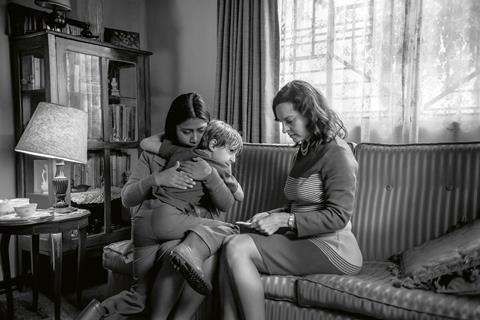
Cleo (Yalitza Aparicio; left) is the maid to the changing household of Sofia (Marina de Tavira; right) in Roma.

For the record, no foreign-language film has ever won the Oscar for Best Picture. They’ve been nominated before but never won. Roma could just be the first. It has the story and all the other ingredients to do it.

The story begins in late 1970 as the maid Cleo is cleaning the driveway to the garage of the house she tends to. The house she tends to belongs to a couple, Sofia and Antonio, the grandmother, and their four children in the affluent Colonia Roma district of Mexico City. Cleo and Adela, both indigenous, are the two live-in maids. The parents see Cleo as their maid while the children look up to her and talk to her often. The driveway and garage is the place where the dog is left to stay while the family is gone during the day.

The driveway and garage is too small for the big car Antonio drives, frequently bumping into the sides and driving over the dog droppings. That even comes in private conversation as Antonio angrily tells Sofia about all the dog droppings on the driveway. Cleo notices that, as normally Antonio is not that angry. Antonio, a doctor, mentions to all he’s going off to a brief trip to Quebec for a conference. He returns days later, but says he will be going to Quebec for a few weeks. The children believe it, but Cleo and Sofia sense something is wrong. Cleo knows it because she saw his wedding ring in the drawer.

Life for Cleo and Adela does not always revolve around the household. Both have boyfriends: Adela has Ramon and Cleo has Fermin. One night they all decide to go to the movies together, but Cleo and Fermin sneak away to rent a room. Before they make love in the bedroom, Fermin shows Cleo the martial arts skills he learned with a shower pole. Fermin tells Cleo that this is what gave him, an orphaned boy, his will to live.

Some time later, when Cleo and Fermin are watching a movie, Cleo tells Fermin she’s pregnant. Fermin says he has to be gone for a bit, but doesn’t return. Cleo tells Sofia that she thinks she’s pregnant. Sofia takes her to the hospital Antonio works at. While waiting in the maternity ward, an earthquake happens. Cleo learns from the doctor she is pregnant.

Cleo and Sofia try to carry on with their lives despite their difficulties. Sofia takes her children, Cleo and Adela on a New Year’s trip to a hacienda owned by her Norwegian-Mexican friends. Before the party, we hear a conversation about recent tensions over the land. The celebrations begin with festivities and fun for the children. However just before midnight, a fire erupts in the forest. As everyone is trying to put the fire out, a man counts down the seconds to New Years Day 1971 and sings a Norwegian lullaby.

Back in the city, Sofia organizes a movie night with the grandmother, the four children, Cleo and Adela. As they wait in line, Cleo notices Antonio. He hasn’t left for Quebec at all. In fact he’s holding the hand of another woman. Sofia has known this all along, but she wants to conceal it from the children until the time is right. Though one son, Paco, does notice it. Sometime later, Adela tells Cleo Ramon has been able to locate Fermin attending outdoor martial arts classes. Cleo watches the class, and is even willing to participate (and does the blind-balanced exercise better than the male students). As the class ends, she confronts Fermin, but Fermin refuses to acknowledge the baby. She tells her to leave or he’ll beat her and the unborn baby.

Time passes and the baby is almost due. The grandmother takes Cleo crib shopping one day. However a student protest takes place. The protests turn brutal as police respond with clubbings. Then violence erupts as a group of youth — strongly believed to be the paramilitary group The Hawks — start shooting the protesters. The grandmother and Cleo seek refuge in a department store, but the Hawks enter and shoot a protester dead. One of the gunmen aims the gun at Cleo, but when it turns out it’s Fermin, he drops his gun and runs off.

The incident gives Cleo so much stress, she has to go into labor. Teresa rushes Cleo to the hospital in a taxicab, but the chaos of the massacre makes it next-to-impossible to get there. Once there, Antonio reassures Cleo in the delivery room to stay calm but leaves her with Teresa and other doctors. The doctors hear no heartbeat in Cleo’s womb and decide to operate. The baby is born a stillborn girl. None of the attempts to resuscitate the baby succeed.

Cleo tries to carry on her usual work and tries to live life again. One day, Sofia drives a smaller car into the garage, and with ease this time. She says she found a job of her own and she’s able to tend to the children herself. She tells the children that they are going on a brief family vacation to the beaches of Tuxpan as one last trip with the old car. Sofia invites Cleo to come along to help her cope with the loss. As they arrive, the mother tells the truth to her children. Sofia and Antonio are getting a divorce and the purpose of the trip is so Antonio can collect his belongings from the home. Before the trip ends, Cleo looks after the children as they are swimming in the ocean. However Cleo notices the waves are getting dangerously bigger. Cleo, forgetting that she can’t swim, swims out to try to save them. She succeeds in saving them and Sofia and the children are thankful for her selfless act. However Cleo confesses right there that she did not want her child to be born. The mother, the children and Cleo return to the house with less furniture than before but with a new sense of unity between Sofia and Cleo. The film ends as a conversation between Cleo and Adela begins.

The film is unique because it is semi-autobiographical of Alfonso Cuaron’s childhood. This film happens from 1970 to 1971: a time when Alfonso was nine to ten. The film Marooned, which was the film in the family movie night scene, was a film Alfonso saw as a child and may have inspired him to become a film maker. The film does give a lot of reminders of what it was like to be a child in a middle-class family in Mexico City. There are posters of Mexico 70, the World Cup Mexico had just hosted, on the walls. There’s the brother making fantasy (American) football saves, which was a time Mexico was just discovering American football.

However Alfonso’s childhood isn’t the central story behind Roma. The story is about two women and their lives around a pivotal turning point in Mexico’s history. Mexico experienced a lot of changes for the better and for the worse during that period of time, but it’s the changes within the women that were noticed most in the film. We have Cleo, an Indigenous woman who is one of the two maids, who is the main protagonist. We also have Sofia, the matriarch of the family, as the secondary protagonist. Both have their common female roles at the beginning: Cleo as the maid; Sofia as the housewife. However things change as it becomes obvious the men in their lives are doing them wrong. Antonio leaves Sofia for another woman, and Fermin abandons Cleo upon her pregnancy. The cowardliness of both men are shown in later scene as Fermin is part of the rebel group shooting protesting students and Antonio just simply puts Cleo in the hands of doctors as he leaves her behind. However both women find their strength inside as Sofia learns she can manage things, even motherhood, on her own and Cleo is able to save Sofia’s children in a situation when she thought she couldn’t.

The film is not just about the unity of two women but of unity of two women from different classes. We have Cleo, an Indigenous woman possibly from an impoverished background, who is impregnated by her boyfriend and then leaves her. We have Sofia, a Caucasian woman from a more well-to-do background, who is losing her husband slowly but surely. Both appear lost, but they later find an inner strength they never knew they had. It happens as Sofia is able to get a job and own her own car. It happens with Cleo as she saves Sofia’s children and admits her feeling toward her stillborn baby. It’s at the end where Sofia tells Cleo how she will always consider her part of her family that we see the bond of two women coming together. United in their struggles despite their class.

One unique aspect of Roma is its use of metaphors. One is the use of airplanes in the imagery and in the various poignant scenes. Another is the use of the marching band in a couple of key scenes, including the end. Another is how it was right after Cleo saves the children from giant waves that she confesses. Another is how the size of the cars in the garage are symbolic of the marriage and divorce. Another is of various scenes involving movies that tell a lot about relationships. Even the time in which it’s set, from 1970 to 1971, is considered a turning point in Mexico’s history. The marginalized were going either get nastier or protest democratically. The government and their crackdowns would only expose the police or whoever else attacked as cowards. The rich would no longer have their peace and order as the poor would seek to destroy or steal for their own gain. On top of that, women would gain more, They would achieve more freedoms over time and a sense of independence. Mexico would not be the same.

This masterpiece belongs to Alfonso Cuaron. He is the writer, director, cinematographer and co-editor with Adam Gough of this film. The film is a lot like his childhood, as he said it would be, but it’s more. It’s about the two women who find a new sense of freedom in a Mexico that was changing. He creates a masterpiece that’s as telling as Mexico and himself as it is of the characters. The lead acting went to newcomer Yalitza Aparicio and she shines. This may be her first film role ever, but she does an excellent job with her role. Interesting to know in the scene where she swims out to rescue Sofia’s children, she couldn’t swim, just like her character! Also excellent is Marina de Tavira as Sofia. A veteran actress in Mexico, she did an excellent job playing a woman in a troubled marriage who comes out stronger. The child actors who played the chilren were also excellent. I think it was Carlos Peralta as Paco who was intended to be the representation of Cuaron.

The unique thing about Roma is that this is a film most shown on NetFlix. It was screen in theatres beforehand so it does qualify for Oscar eligibility. However with it being on NetFlix, very few theatres have shown it on the big screen and there are no official box office statistics as of yet. The VanCity theatre in Vancouver was the only theatre in Greater Vancouver that screened Roma on the big screen. I had the luxury of seeing it on the big screen just days after Christmas. Those who just see it on NetFlix are missing out on an amazing experience. It is 100 times better seeing it in a movie theatre. However the NetFlix factor is very unique for a film with this many Oscar nominations and a huge chance of winning Best Picture. That NetFlix factor could rewrite the game on how films, especially independent films, are shown.

Roma is nothing short of a masterpiece. It’s also a film with a poignant social message as well. However it’s very picturesque to watch and an excellent experience for those lucky to see it on the big screen.

Animated Movies Review

2016 was a stellar year for animated movies from Zootopia to Moana to Kubo And The Two Strings to Finding Dory. 2016’s line-up gave people lots of reason to come to the movie theatres. 2017 was very lackluster in comparison. We’re talking about a year when The Boss Baby was nominated for Best Animated Feature and even the mere existence of The Emoji Movie. 2017 almost made it look like if Sausage Party were released that year instead, it would be a Best Animated Feature nominee! However the best animated movies of 2017 slowly made its way on the screen in the latter months of 2017. I was lucky to see Ferdinand, Coco and Loving Vincent: three of the best of the year.

Ferdinand

Ferdinand

When I was about to see Ferdinand, I wondered how they would able to take the small story and turn it into a feature-length picture. I myself remember an animated short made by the Walt Disney studios made decades ago that was very humorous. However I wondered how would a feature-length adaptation play out?

The story starts out well with an entertaining look, but a bit of sadness at the beginning. As it progresses to adult Ferdinand, Ferdinand is funny and charming as a husky but flower-loving bull. John Cena adds to the characterization of full-grown Ferdinand. The characters of Lupe, Una and the other bulls add to the story.

There were times I wondered how will they get to where Ferdinand is scouted out by his accidental outburst? How will it be written out? Although it’s not true to the fable, the writers were able to create a way for Ferdinand to be discovered and sent to the bull rings to fight.

Another case that had me wondering was right in the middle of the story. It had me wondering how on earth the story would have a happy ending? Of course the film needed to have a kid-friendly happy ending, but in a situation where the bull either becomes a fighting bull who dies in the ring or to the slaughterhouse as meat? Nevertheless the writers were able to make the story work with good events to the plot and not just simply drag it out over the time. Even creating an ending where Ferdinand wins over the crowd and getting them to want him to live works for the film.

For the most part, Ferdinand is not all about the type of intricate story you’d expect to find in a Disney/Pixar film. Instead Ferdinand is about creating a charming modern adaptation of the short fable with charming and entertaining characters. It succeeds in charming the audience as well as entertaining the children. Despite the story being elongated into a feature-length picture, the film does not waste time. It succeeds in being entertaining. It also adds in some other elements that gets one nervous of what will happen to Ferdinand, even if they know the story. The story works in its feature-length and will not disappoint fans of the fable. It’s also good at winning crowds too as it made a good $282 million at the worldwide box office.

coco

Coco

Very often you know the Disney/Pixar collaboration will deliver something fresh and original in its arsenal that’s able to win us over. This year, they deliver Coco. Coco is unique because it’s of a Mexican family situated in Mexico. The question is will they make something original and unique entertaining to the public?

The team of writers and animators at Disney/Pixar are known for their innovations and their frequently-successful way of trying new concepts. First there was 1995’s Toy Story: the first-ever 3D animated feature. Then came A Bug’s Life which created an engaging story revolving around insects. Then Finding Nemo not only told a story about fish, but successfully took us to another world. The Incredibles was good at teaching morals in an entertaining way. Ratatouille made an entertaining story involving a rat. Wall-E magically gave us an engaging story about two robots in love with very little dialogue. It was Brave where they not only gave us their first female protagonist, but welcomed a female writer on their ‘dream team.’ And there was Inside Out which made character out of emotions.

Coco is not just a new movie from the Disney/Pixar collaboration, but a new chapter for them. They hired Mexican/American writer Adrian Molina as the scriptwriter along with Matthew Aldrich. Molina had already been part of Pixar as a 2D animator for Ratatouille, a storyboard artists for Toy Story 3 and Monsters University, and even wrote the script for Walt Disney Studios’ The Good Dinosaur. The voice cast is predominantly of Mexicans or Mexican Americans. Disney/Pixar even hired a ‘cultural consultant’ group of three Mexican-Americans including one former CEO of the Mexican Heritage Corp to make sure they were doing a film respectful of Mexican people.

The result is a film that has garnered praise even from both critics and even Mexican-American communities. The film even received excellent reviews from Latin American film critics. The film was also a top box office winner having grossed $730 million so far. Even in Mexico, it spent three weeks at #1 in the Mexican box office and grossed a total of $57.8 million in Mexico.

Now the film itself does what Disney/Pixar films have a reputation for: taking the audience to a new world. Here they give an excellent depiction of the Land Of The Dead that looks very intricate and maybe too big, but succeeds in making sense to the viewer. Once again the animation team does an excellent job in creating this new world and even the smallest detail is done with perfection. Once again Disney/Pixar is tops in animation quality.

However there was one time I was confused by the story. I’ll admit like most, I thought Ernesto was the great-great-grandfather. I was shocked when I learned that Ernesto killed Hector with poison. It left me wondering if Miguel’s great-great-grandfather was in fact a dirty killer. Even seeing Ernesto send Miguel to die in the cenote pit left me shocked. ‘Why would Ernesto do this to his own great-great-grandson?’ It’s in the pit with Hector that we learn that Hector is really the great-great-grandfather. That was a relief. It was there where it became better sense why Miguel needed to redeem the name of the family through the spirit of Hector. The story was very well-written and very entertaining. Also the song ‘Remember Me’ is an excellent song for the movie that makes for the perfect tearjerker moment you don’t feel manipulated by.

One again Disney/Pixar delivers a masterpiece in Coco. It is as top-quality as it is magical to watch.

kinopoisk.ru

Loving Vincent

Now the previous two films in which I just talked about are both the more family-friendly films. Loving Vincent is the polar opposite of both. It’s not cute, it’s less family-friendly, and it’s not even 3D computerized animation. It also didn’t even make $10 million at the box office. Nevertheless it is charming in its own ways.

The film is a plot where Armand Roulin is asked by his father Joseph to deliver a letter from Vincent Van Gogh who died a year earlier to his brother Theo. After learning Theo died, Armand looks to find the right person to give the letter to. Throughout the journey, Armand tries to get the answer to whether Vincent’s death was a suicide or not? He was released from a hospital after found to be in good mental capacity six weeks before.

Armand comes across many people in Vincent’s life. Some have positive things to say. Some negative things. All have something to say about the person of Vincent, the various people he met with or fought against, and his personal feelings before his death. This still leaves Armand confused and his question of Vincent’s death unanswered. It’s right after Dr. Gachet promises to give the letter to Theo’s widow that he learns van Gogh’s suicide wasn’t of mental agony, but to free himself and his brother. Later Armand receives a letter from Theo’s widow thanking him.

This animated film about Vincent Van Gogh couldn’t be a simple animated film. Instead this is a film in which the images were done by 100 painters trained to paint like Van Gogh. The object of the film was to create a story involving characters of people Van Gogh painted and was close to in his life across a backdrop that’s just like the paintings he painted. Basically an animated story about Van Gogh that captures the essence of Van Gogh’s art. The story may be fictional, but it succeeds in playing out like a Van Gogh painting. It even gets one that knows very little about Van Gogh’s works or his life intrigued. It even gets fans of Van Gogh’s art admiring the film for capturing the essence of the artist and his works. I also like how the film ended as “Vincent (Starry Starry Night)” was playing. It would make those who never understood what the song was all about understand it better.

So there’s my look at three of the best animated films of 2017. All three are nominated for an Oscar for Best Animated Feature. All three are enjoyable in their own way.