Oscars 2024 Best Picture Reviews: Part One

Ten is not a set number for the number of Best Pictures nominees. Nevertheless it’s still nice to have ten as the total of nominees.

This year, there are a wide variety of films nominated from science fiction to two musicals to a musicography to a dark comedy to a horror movie to many types of dramas. Here  are my first two reviews of the Best Pictures nominees:

Anora

This is quite the unexpected comedy that delivers an unexpected sad ending. A sad ending was anticipated but the sad ending we got was not the one anticipated. It seems odd to have a story about a stripper/hooker marrying a rich kid to be one of the best films of the year but Sean Baker has developed a reputation for directing films about people in the sex trade. This is quite the story itself. We have a stripper who plays a ‘love kitten’ day after day for lusting men, but craves real love. We have a billionaire’s son who’s too spoiled, immature and careless to get it about life and love. He thinks marrying Anora is easy like that and he can live the same irresponsible life again, but he has a lot to learn. We have Igor, the henchman hired by the Zacharovs to have the marriage annulled, but Igor becomes the first person to see Anora as a human being throughout this whole ordeal. We also have the Zacharovs who are so obsessed with their money and power, they think they can do whatever they want. This is the kind of story that brings a lot to the table to talk about.

It’s hard to pinpoint the exact theme of the story because there’s so many topics and themes this story presents a point about. One could be the theme of sex workers. As I mentioned, Baker’s films often deal with sex workers. Here we see the case of a sex worker who is treated like a piece of meat and there are times her true feelings are shown. There are moments we stop seeing Anora as ‘this thing’ and start seeing her as a person. There’s also the case of wealth and privilege. Not only do we see wealthy people having the best luxuries but we see them having a privileged son living a careless irresponsible life, we see how the rich devalue marriage both with Vanja’s eloping of Anora and the Zacharov’s own marriage, we see how being a henchman to the Zacharovs means having to leave a christening of your godchild because your boss demands so, and we also see how the rich Zacharovs know that their money gives them power and uses it against Anora. Especially when the mother insists the family doesn’t apologize to anyone just as Igor points out Vanya owes Anora an apology for the eloping. It’s quite the irony when a stripper or prostitute has a better sense of what marriage is all about than a billionaire’s son. Or even his parents.

Often overlooked, I feel one of the top themes in the film is love. We have Anora, a stripper who pretends to love the men she sleeps with, but she craves real love. We have Vanya, whom Anora thinks she found love with as she spends weeks with him and easily falls for his marriage proposal. Anora is oblivious Vanya wants to marry an American so he doesn’t have to return to Russia and work his father’s business. Even the scenes as Vanya’s playing video games after the two marry hinds at Vanya’s irresponsibility. We also have Anora’s delusion with the marriage. Even though Vanya continues to play video games after they marry, she still thinks she met her love. We have the Zacharovs who view their son marrying a sex worker to be a disgrace to the family. We also see scenes which make you question the Zacharov’s own marriage. Finally we have Igor who becomes the first person to see Anora as a human being instead of ‘that thing.’ It was made obvious in the scene where Igor says Vanya owes Anora an apology. That ending where he allows her to stay at the Zacharovs one last night to sleep, bathe and pack and the ending scene as he’s about to drop her off is also an irony. He’s first hired as a henchman to stop the marriage, even if it means brute force, and now he actually has feelings for Anora. A shock to us all, and to a disheartened Anora as well.

This is the big breakthrough film Sean Baker has been waiting for. The film world has known Baker for a long time as one knocking on the door. He’s delivered small breakthrough films before with 2015’s Tangerine and 2017’s The Florida Project. Here, he directs a story that’s intriguing and unpredictable. It first seems like a film that would give us a cartoonish story but as the film progresses, the story is a lot deeper and it’s not the story we thought it was. Also worthy of top acclaim is lead actress Mikey Madison. If you thought you’d never shed tears for the character of a stripper, you will be wrong. It’s remarkable we have a film where the character of a stripper is shown to have real three-dimensional feelings, but Mikey’s performance of Anora was deep and revealing and we actually start feelings for her. He go from seeing her as ‘that thing’ to seeing her as a frail hurt person. Also excellent is Yura Borisov. Nobody expects any of the henchmen to have feelings for Anora, but Yura catches us by surprise. It’s also he who makes the movie into something we didn’t expect. Also good is Mark Eydelshteyn in playing Vanya. His portrayal as an immature irresponsible spoiled rich son makes you want to hate him in the end. Both Aleksey Serebryakov and Darya Ekamasova are great at Vanya’s parents. They also succeed in making you hate them as much as you’ll hate Vanya. We can see why Vanya is a spoiled brat.

Anora is not your typical story of a prostitute or a stripper. It’s a story of a love gone wrong and ends with a love you don’t know if it should be. Those who see it won’t forget it.

The Brutalist

We’ve seen stories about the difficulties of achieving the American Dream before. Some are harder than others. This film takes a cynical look at an architect who achieved his American Dream. We have a Jewish architect who left post-Holocaust Hungary to find refuge in the United States and achieve his success there. We see how he has to fight his demons like his infidelity, family members that are petty, harrowing memories that cause him to take heroin, a difficult market for his Bauhaus style, rival architects, people that want to use him and above all, his own egotism. It’s not at all a pretty sight to see but it does tell a good story of a man hoping to pursue his greatness in the United States.

The thing that makes this film is not just the telling of Laszlo Toth’s story, but how it’s presented. The film begins as Laszlo’s ship sails past Ellis Island and he sees the Statue Of Liberty, but from his angle, he has to look at it upside down. He has to struggle to achieve his dream by eating at soup kitchens, living at the YMCA, embraced and then neglected by a family member who’s a successful business man, and having to prostitute himself at times. His breakthrough comes by fluke as it was the renovation unapproved by Harrison Van Buren where they first meet, and the meeting is bad. It’s after Harrison discovers who Laszlo is and of Laszlo’s pre-war success in Hungary that he’s willing to take him on. It’s not an easy task as it involves years of work and labor, supplies cancellations, dirty work form Harrison, his friendship with Gordon put to the test and Laszlo’s own ego coming to light. Then there’s how Laszlo’s attempt on success threatens his marriage to Erszebet as she has now arrived in the United States. She knows his secrets and she says she’s fine with it, but it will become obvious she’s not. His success threatens family unity with the niece as the daughter adopted after the Holocaust.

The crazy thing about the film having a half-hour intermission may have some question its purpose. We should remember many decades ago, it was common for long movies to have intermissions. This film’s intermission is very successful not only in dividing the movie properly, but give you the feeling you’re watching two different films. The first half focuses on Laszlo’s arrival, his attempt to make it in the United States, the dirty obstacles he has to face and his big break. And right while he’s writing to Erzsebet with the hopes of her coming to the United States. At the end of the intermission comes a new scenario. As Erzsebet finally arrives in the United States with niece Zsofia, there’s the added pressure of keeping a family together. Especially since Laszlo can’t keep his secrets to Erzsebet any more and she has a disability to deal with. Over time, she senses things like Laszlo’s ego and how Harrison wants to make a pet out of him. Despite being confined to a wheelchair, Erzsebet is able to muster the strength to use her walker to confront Harrison about his mistreatment of Laszlo. The ending epilogue is also something as Laszlo is saluted for his work, in Italy. It’s like he achieved his American Dream but had to achieve it at a harrowing cost and he had to get his honor from outside the US.

This is an accomplishment from Brady Corbet. Younger adults may remember his teen actor days in films like Thirteen and Thunderbirds. Like a lot of young actors, Corbet felt the need to make films of his own. This is Corbet’s fourth feature film. This film that he directs and co-wrote the story with wife Mona Fastvold is definitely something. It mixes some classic film styles while telling the story of a Holocaust survivor’s pursuit of the American Dream. There have been films where the American Dream has been achieved at a big cost before, but this film meshes Laszlo’s pursuit with the shaping of the United States and most notably Pennsylvania after World War II. As the US shapes itself after the war, Laszlo attempts to shape his success in the US, but at a huge price that comes at the cost of him, his dignity and his marriage. Right at the end as they have the tribute gala in the epilogue, you wonder if this should be a happy occasion or not with what Laszlo has gone through.

Excellent performance from Adrien Brody. Remember him from 2003’s The Pianist? He appears to have kept it low-key since. This year, he comes back with another performance of a lifetime where he shows Laszlo to be a creative man and a troubled man. He will make you hate him as much as he will break your heart. Also great is Felicity Jones as Erzsebet. It’s the appearance of Erzsebet that most turns this film into two films in one. With her arrival comes the change of environment. She appears to be one who will most interfere with Laszlo’s success and even a victim of his own selfishness but in the end, she’s the best person Laszlo needs during his most troubling time. Guy Pearce is also great as the deceptive Harrison. He’s excellent in portraying an all-American businessman who welcomes Laszlo and his talents, but as long as something’s in it for him and is willing to make a toy of Laszlo. Additional excellent acting comes from Raffey Cassidy, as the niece Zsofia who’s mute at first but soon develops her ability to talk, and from Isaach de Bankole as Gordon, Laszlo’s first friend and business associate who Laszlo later turns on in his success. Excellent technical merits are the cinematography of Lol Crawley, the production design of Judy Becker and the musical score from Daniel Blumberg.

It’s easy to see why The Brutalist is a heavy favorite to win Best Picture. It combines a graphic disturbing story of one man’s pursuit of the the American Dream and shows it in a stylish artistic fashion. Hard to outdo it.

And there’s my look at the first two Best Picture nominees for this year. If you’ve seen them, you can understand why they’ve won most of the Best Picture awards.

VIFF 2024 Shorts Segment Review: Forum 3

Once again, I achieved a VIFF goal when I attended Short Forum 3. This forum of eight shorts is more international and has a wide variety of styles and subject matter.

Jane’s In The Freezer (USA – dir: Caleb Joye): It’s a quiet day at the pier at the lake in Detroit. A woman who’s just gazing tried to develop conversation. Her name is Jane. The conversation doesn’t last long. She goes to the mall. At one store, she pretends she’s a worker and helps to assist with a customer’s purchases. While at the liquor store, she sees a man she claims is her son and tries to ide herself from him. After he’s gone, she sets up a dating profile on a website and goes to a nearby bar where she hopes to meet someone new. All the young men ignore her or reject her passes.

The main theme of this short film is about loneliness. It’s a common topic nowadays as it seems that it’s at an all-time high thanks to modern technology. In this story, we have a middle-aged woman trying to connect with someone. Anyone. No matter where she goes, she’s either ignored or shunned. She looks for constant opportunities to make some new friends or a new love time and time again and looks like she won’t stop. She also appears like she’s either trying to either hide or recover from a past where she estranged herself from her son. The film succeeds in getting the viewer to feel sorry for her and also wonder what her past was.

My Dog Is Dead (Japan – dirs: Tasuku Matsunaga and Takehiro Senda): Riko is a young woman in the big city of Tokyo who lives with her boyfriend Yoshiki. Just recently, she received a phone call from her mother that her dog Koppe died. She has to return back to her town. Yoshiki agrees to take her there but views the trip as tedious. She’s quiet but he treats it like a road trip and they frequently squabble over the choice of radio station. At the private memorial service with Riko, her mother and Yoshiki, Riko is in tears but Yoshiki gives her an odd look.

The film is as much about the boyfriend in the relationship as it is about the trip home. Things appear normal in the relationship but that appears to change after Koppe’s death. Riko wants to mourn Koppe one last time but it appears Yoshiki thinks it’s odd. Even that change of radio stations sends a message that maybe he’s not the right boyfriend for her and has an immature side about him. It’s a story that says as much from the images as it does from the dialogue.

Shoes And Hooves (Hungary – dir: Viktoria Traub): An animated story, pedicurist Paula has been in search for love but has always felt inferior because her upper body is human and her lower body is horse-like. She lives in a world full of full-humans, full-animals and those like her who are half-and-half. One day, she meets an alligator man named Arnold. On the first date, there’s a sense of chemistry between the two, mostly from Arnold, but Paula senses the relationship is doomed.

This is a unique story about self-image and self-acceptance. Paula needs to deal with her insecurities and her desires. With it being an animated film, it tells its story in an array of creative story telling mixed with unique imagery and metamorphosis that only animation can do. It’s as good of a creative story with a message as it is dazzling to watch for the visuals.

Nemo 1 (Canada – dir: Alberic Aurteneche): The only documentary of the eight films here. The film is shot around the Chittagong Ship Breaking Yards in Chittagong, Bangladesh along the Bay Of Bengal where ‘dead ships’ are scrapped for recycling metal. The film gives a good look as the Nemo 1 ship is the latest ship being scrapped from the various areas being broken to how high above the waters or ground they have to work. Then words from a Bangladeshi writer are shown as images of other older scrapped ships are shown. The film ends with ugly details of this yard.

There is no dialogue or spoken word here as far as the images of the ships. Only the spoken word parts are spoken. This documentary is about the images we see and the accompanying music. We see something so big and something we don’t know if we should find disturbing or not. The inclusion of the spoken word is a philosophical message of what happens if we do wrong. Unfortunately, wrong is happening as the work is deadly and the year cuts safety corners. This documentary has a lot to say and says it in its style.

Tayal Forest Club (Taiwan – dir: Laha Mebow): In a small Taiwanese town, a teenaged tribal boy named Yukan buys a bottle of wine at the store. He goes with his best friend Watan on a nature trek to the forest and to offer the wine to his ancestors. It’s a good escape from Yukan’s drunken father. They leave the town but not after passing the town drunk. As they go in the forest, they have fun until they learn their wine offering is missing. Within hours, the two find themselves lost in the night. What will happen? Soon a spirit man comes who looks like the town drunkard. Soon they are safe.

This is a good story of two young Taiwanese tribal teens. It’s also a reminder to us of how it’s not just in Canada and the Americas where Indigenous people or tribal peoples face discrimination. It’s a worldwide problem. There you see two teen friends who are misfits just like the other tribal peoples in their town. As they go out in their trek in the wilderness, they learned they forgot their wine offering and end up lost, but they get a connection to the nature that other Taiwanese wouldn’t know. Their tribal connection helps lead them home.

-Chuff Chuff Chuff (dir: Chao Koi Wang): A man from Hong Kong appears to be on a train asleep as the train passes through forest land. He wakes up and sees his home being like it’s inside a train car. He thinks it’s just a dream but the Cantonese-speaking woman reminds him it’s not. What he sees on the TV screen of the view from a train car is really happening.

This is a surprisingly fast film (six minutes). At first you will wonder what this film is about. I’m sure you can’t get the full message after watching a six-minute film. You will need to think about it more after watching. It appears the film is about a case of the common barrier of dreaming and reality and of how it’s not as far apart in this world. The addition of the turtle in the living room floor adds to the concept of the two wanting what’s out of reach.

-Nietzschean Suicide (Iran – dir: Payam Kurdistani): It’s in the 1930’s. The pharmacist, who is expecting his wife to give birth soon, is one who works strictly by the book and won’t play games. When he learns the town midwife is coming to him for a death wish requesting cyanide, he refutes her pleas, declining her fake prescription. Soon his son is born and he’s being sued by a client for agreeing to something ‘Nietzschean.’ He’s now ready to grant the midwife her wish in a unique way.

This is a unique drama as it does capture the cold feelings of the time. The silence adds to the intensity of the situation of the midwife’s death wish and the pharmacist caught between waiting for his son to be born and what he feels is the right thing to do. It keeps the viewer interested in what will happen next and will he give in?

-Darker (USA – dir: Matazi Weathers): Los Angeles is in a dystopian time. A pandemic has taken over and caused people to return to their homes. There’s word of a prison riot that is spiraling out of control. The riot grows to fire and unrest on the streets. At the same time, black insurgents and trans hackers along with their allies promote an uprising.

This film doesn’t exactly have a beginning, middle or end. It looks more like it captures a moment of when all hell breaks loose. Not just any hell. A hell fueled by the anger of racism and other types of discrimination. Images of the riots of 2020 and news stories talking of 1992 give the sense this film is sending a message. If we don’t solve the problem of racism and other forms of discrimination, all hell will break loose again and it will be worse than ever.

And there you go! That’s my look at the eight films as part of VIFF’s Short Forum 3. There was only one Canadian film. There were four Asian films, two American and one European. Most were dramas. There was one documentary and one animated film. All eight films are unique in their own ways and all are very creative.

UEFA Euro 2024: Group Stage With One Game To Go

How about that? All 24 teams have completed their second game, or Matchday 2. There’s only one last group game to play and that will finalize the Group Stage standings and determine the qualifiers for the knockout rounds.

This year, there is an interesting allotment of the types of teams playing, but there are certain types of teams here in Germany that have stood out the most. We have teams who appeared to have lost their greatness before now playing hard to get it back. We have teams demonstrating their known consistency. We have underdogs surprising fans with wins over big guns. We also have teams that had a “Golden Generation” for many years that looks like their luster is running out and the younger players haven’t been well-trained to keep their team’s prowess active.

Now there’s only one game remaining in the Group Stage. That’s commonly referred to as ‘Matchday 3.’ Three teams right now have already guaranteed qualification by winning their first two games. With more than two groups having at least one draw game, two wins are a guarantee for qualification at this stage. Two of those teams have also already guaranteed a first-place finish in their group because of their win over the team in second place. Here at Euro, head-to-head results supersede goal differentials which the World Cup uses to to be the top tie-breaker in group rankings. In addition, only one team is guaranteed elimination already. Right now, the fates of twenty teams are still unknown and they will all need Matchday 3 to decide everything.

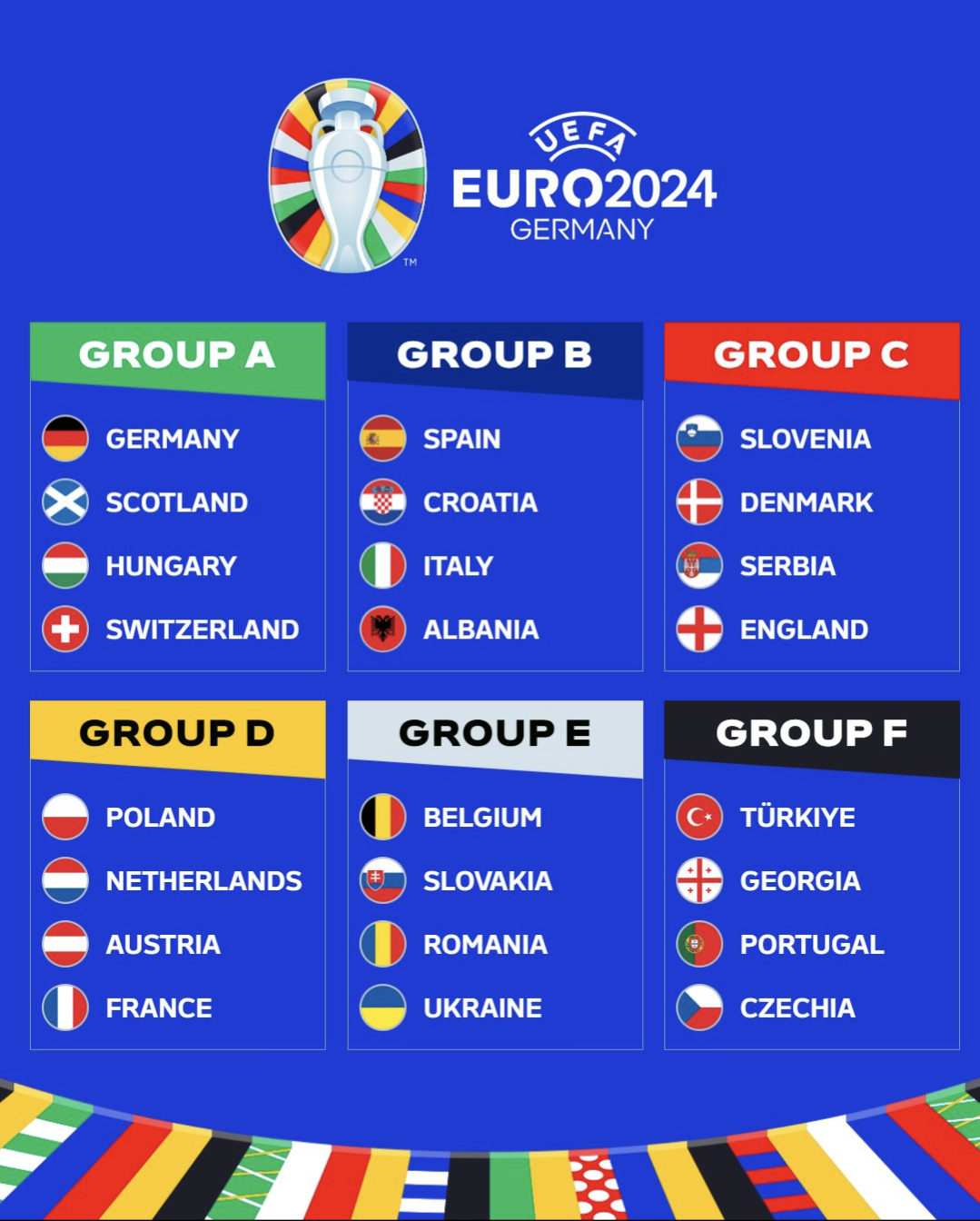
With one game to go, here’s my look at the teams in each of the Euro 2024 groups and what they need to qualify. Teams that have already qualified will be bolded. Group titles will contain links to my original group blogs:

Group A:

Some could say Germany did it in the very opening game. That remains to be seen. What is a fact is Germany won both their opening games and the hosts have guaranteed themselves qualification to the knockout round! A 5-1 against Scotland in the opener and their 2-0 win over Hungary did it. Second in the standings is Switzerland with their 3-1 win over Hungary and a 1-1 draw against Scotland. Germany and Switzerland meet for their last game. Switzerland can guarantee qualification with a draw. Even if they lose, the are still assured a top-three finish and are in conformable standings to qualify, though it’s not guaranteed. Their play against Germany will decide it all.

Of the teams in Group A that have not won a match, Scotland is third with a 5-1 loss to Germany and a 1-1 draw to Switzerland. At the bottom is Hungary with a 3-1 loss to Switzerland and a 2-0 loss to Germany. Both teams will face each other Sunday. No doubt that in order to have qualifying chances for the knockout round, either team must win. Despite the advantage of a draw to Switzerland, a draw against Hungary will not be enough for Scotland to qualify with two draws and a big loss. Even if Hungary wins over Scotland, it’s game results and goal differentials that will decide if their among the four wildcard teams that advance.

Group B:

Spain did it! They opened with a 3-0 win over Croatia and a 1-0 win against Italy thanks to an own goal from Riccardo Calafiore. Their two wins guarantee them qualification no matter what happens in Game 3. Their win over Italy guarantees them first place in Group B! Although Italy’s qualification is not guaranteed, the Azzurri are second with their 2-1 win over Albania. A draw against Croatia is all they need to qualify.

For the two teams at the bottom, Albania and Croatia, they still have qualification chances with both having a loss and a draw but for both teams, they need nothing less than a win to qualify. That will be a nail biter especially because both teams will face a highly touted opponent on Matchday 3; Albania will face Spain and Croatia will face Italy. After that 2-2 draw, Albania has an advantage because they have less of a goal differential. Nevertheless it’s down to the wire for both teams in a must-win situation. I don’t call Group B the Group Of Death for nothing!

Group C:

Sometimes in group play, you can get some groups that are quite decisive in who are the biggest and best in the group. Other times, the play in the group will be hard to decipher who are the powers of the group. Group C is that group as it’s hard to tell who are the better teams. Four games have been played and three of them were 1-1 draws. The only game where a winner was declared was England’s 1-0 win over Serbia. That lone win puts England at the top of the group and with very comfortable chances to qualify. I’ve been calling Group B the “Group Of Death” because of the caliber of the teams but it looks like with the closeness of play at Euro 2024, Group C should be called the “Group Of Death.”

Actually right now, none of the teams have enough points to qualify, but none of the teams are out. All four are still eligible. Despite England having it best, both Slovenia and Denmark have it good with two tie games each. A win from either will solidify qualifying. At the very least, a draw could help either of them for a wildcard berth as three draws is three game points and even goal differentials. Serbia still has qualifying chances but being the one team in Group C to take a loss, they will need nothing less than a win to qualify. Two draws and a loss won’t cut it in the wildcard third-place runoff.

Group D:

Group D has a unique situation. None of the teams have guaranteed qualification and one team is out of contention. The three teams that still have chances will need Matchday 3 to decide anything and everything. Leading the group are the Netherlands and France with a win and a draw each. The Netherlands opened well with a 2-1 win over Poland while France won over Austria 1-0 thanks to an own-goal by Maximilian Wober. The two teams played each other on Friday but it ended a scoreless draw. If you ask me, there are a lot of big name teams that are not playing like they want it. A simple draw can guarantee qualification for either team.

Austria opened up with the hard luck of a 1-0 loss to France thanks to Wober’s own goal. When they faced Poland, it was a surprise 3-1 win for Austria. That win is crucial for Austria’s qualifying chances, but their match against the Netherlands will decide things. As for Poland, they’re out. They lost 2-1 to the Netherlands and 3-1 to Austria. Even if they win their game against France and Austria loses, Austria will still have the advantage for their win over Poland. The head-to-head factor.

Group E:

Sigh. That subject about the ‘Group Of Death’ again! Group E is another group worthy of being labeled the Group Of Death because of the play so far. Talk about tight play! All four teams of Group E are even. All four had a win and a loss. Teams most people thought would not be among contenders delivered surprise wins at the start and keep their qualifying chances healthy. I’m not sure if there are any specific head-to-head rules that explain the current rankings, but the goal differentials look to be what’s deciding the current rankings. Despite losing to Belgium 2-0, Romania leads thanks to their 3-0 win over Ukraine while Belgium takes second due to their 1-0 loss to Slovakia. Slovakia is third because of even goal differentials after their 2-1 loss to Ukraine and Ukraine is at the bottom as the one nation with negative goal differentials thanks to their 3-0 loss to Romania.

Any of the four can qualify. Thanks to all four having a win and a loss, none have guaranteed qualification and none are out and it will take Matchday 3 to decide everything. Slovakia will play Romania and Ukraine will play Belgium. If both games are draws, only then would the current standings factor in qualification. It will have to be a case of either both games having a winner and a loser or the case of one game having a winner and the other drawing in order to decide the qualifiers to the next round.

Group F:

There must be something about being a team from the Iberian Peninsula this year because Portugal not only qualified but like Spain, they too guaranteed top of their group! It took a 2-1 win over Czechia and a 3-0 win over Turkey to solidify it! Even if they lose to Georgia on Wednesday and Turkey wins, Portugal will still finish first because of their win over Turkey.

Despite the loss, Turkey is second in the group and has good chances to qualify. Turkey can still qualify if they draw, even if Georgia wins. For both Czechia and Georgia, both teams will need nothing less than a win to qualify. Their 1-1 draw against each other keeps them in contention but a win needs to happen for either to qualify. Especially for the third-place wildcard berths because the two third-place teams with the lowest game results will join the fourth-place teams from each group packing for home sooner than they hoped!

And there you have it! That’s my summary for the Euro 2024 groups with Matchday 3 being all that’s left for all 24 teams. It will be interesting to learn of the other thirteen that advance and the seven others that get an earlier-than-hoped return home!

UEFA Euro 2024: Intro and Group A Focus

The 2024 UEFA European Football Championships, commonly referred to as Euro 2024, will be starting very soon! There will be a lot of differences from that of the previous Euro 2020. For starters, there will be no full-year delay because of a pandemic and there will be no regulated seating like it was in some stadiums. Secondly, it has returned to a single-nation hosting format. This year, Germany hosts and it will be held in ten different venues. All of the stadiums have been built long before but the Stuttgart Arena and Hamburg’s Volksparkstadion went through renovations or expansions in time for this tournament.

THE GROUPS OF EURO 2024

Qualifying for Euro 2024 was no easy feat as it would involve team’s play for almost a full year for some, starting in late-March 2023. Twenty of the teams would secure their berths by November of 2023 with twelve more nations needing to play in the playoffs in March of this year to secure the last three berths. Drawings of the groups were done through a system of UEFA”s Nations League rankings that don’t make too much sense. Russia was banned from the tournament because of their role in the Russo-Ukrainian War. Even the system of qualifying didn’t make too much sense. The top two of each of the ten groups would qualify; that made sense. Finishing third, however, didn’t guarantee qualifying for the repechage playoff round as Nations League points would supersede it in some cases. Some groups didn’t have any teams qualify for the playoff route, some teams that finished lower than third in their group would advance to the playoff round, and Group J had their 3rd, 4th and 5th place teams advance! The playoffs were the most straightforward as the twelve qualified teams were drawn into three groups of four and it was a knockout tournament with the last team standing in its group advancing and completing the last three berths.

GROUP A FOCUS

After all that, the twenty-four teams competing in Euro 2024 have been decided. Nineteen of the teams are returnees from Euro 2020, one team will be in its first Euro since 2000 and one team is making their Euro debut! Now to start with my look at each group’s teams and my prediction of who will most likely qualify form the groups. FIFA rankings are in brackets:

-Germany (16): They may be known as the DFB-Team or The Mannschaft, but Germany has one of the biggest legacies among European teams. It’s not just their World Cup success with four wins but at the Euro, they’ve won three times and qualified for an additional three finals! Nevertheless, it all feels like a distant memory as Germany have struggled these past six years. Disappointments include going out in the Group Stage at the 2018 World Cup, a lousy ranking in the Nations League and an ouster in the Round Of 16 at Euro 2020. This led them to drop longtime coach Joaquin Low and take on former Bayern Munich manager Hansi Flick. Troubles continued as Germany again was out in the Group Stage at World Cup 2022. After more lackluster results, Flick was dismissed in September 2023. To add further shock, it was announced this March the German team would switch their national kit supplier to Nike in 2027 from Adidas: a brand they’ve been with for seven decades.

Although Germany is going through tough times, this is not the lowest they’ve ranked on FIFA’s list. Their lowest ever is 22nd in March 2006, just three months before World Cup 2006 which Germany hosted. The team is now headed by former Bayern Munich manager Julian Nagelsmann. The only members of the 2014 World Cup winning team that are still there are goalkeeper Manuel Neuer, midfielder Toni Kroos and striker Thomas Muller. The rest of the team consists of a lot of young rising talent with other established members. 2023 was a bad year with losing six of their eleven friendlies. Ever since Nagelsmann was made head, they’ve had struggles with a 3-2 loss to Turkey and a 2-0 loss to Austria. They’ve also had some wins with 3-1 against the USA, 2-0 against France and 2-1 wins against both the Netherlands and Greece. This tournament will give Germany a chance to rebuild its reputation as a major world football force in the world’s eyes.

-Scotland (39): The Tartan Army is commonly seen as the hard luck team in major tournaments. Not only have they played in the most World Cups without advancing past the opening Group Stage, but they’ve also played the most Euros without ever advancing to the Group Stage: three in total! I remember one Scottish comedian saying they have the most creative ways in getting eliminated from major tournaments.

The team has been coached by Steve Clarke since 2019. His success in getting Scotland to Euro 2020, their first Euro in 24 years, helped keep him coach despite the team not qualifying for the 2022 World Cup. Most of the team’s players hail from either teams from the Premier League or the Scottish Premiership. They did an excellent job in their Euro qualifying play, winning all games except one to Spain. Play since has been troubling as they have drawn to Georgia, Finland and Norway and have lost to England, France, the Netherlands and Northern Ireland. Germany 2024 is another chance for Scotland to take its team to new heights and possibly their first-ever knockout round in a major tournament.

-Hungary (26): Sometimes it does seem like the days of the Magical Magyars are a thing of the past with being in two World Cup finals, winning three Olympic gold medals and finishing third at only the second Euro ever. As Hungary made the move from Communism to freedom in the late 80’s, it actually caused a decline in football as the fall of Communism caused financial problems for many Hungarian clubs including some of their bigger clubs declaring bankruptcy in the 90’s. The resurgence of Hungarian football started in the 2010’s with qualifying for the past three Euros starting in 2016.

The team has been coached by Italian Marco Rossi since 2018. The team has a wide variety of players that play for various leagues, but it has done a lot of promotion of its younger talent. In fact the team captain, midfielder Dominik Szoboszlai who plays for Liverpool, is only 23 years old. Since 2023 began, Hungary has had a great record, achieving wins against Turkey, Serbia (twice) and Lithuania, and its only loss coming from Ireland. Euro 2024 can be another opportunity to bring Hungary’s past magic back!

-Switzerland (19): Switzerland is often seen by many as a sleeping giant. La Nati have not had that much of a legacy but the team shows potential to achieve greatness at any time. They’ve qualified for the last five World Cup and have made it to the Round Of 16 in four of them. The first Euro where they qualified for the knockout round was in 2016 and in 2020, they made it to the quarterfinals.

Switzerland is coached by Yurat Makin, who became their coach in August 2021, shortly after Euro 2020. Veteran greats like Granit Xhaka and Xherdan Shaqiri will be returning, but the team will feature a mix of old and new talent. They were consistent in group play in Euro qualifying. They’ve managed wins against Israel, Belarus, Estonia and Ireland but they’ve also had losses to Romania and draws to Denmark, Austria and Kosovo. Germany could be the stage for the Swiss team to reach new heights.

My Predictions: And now is that hard part of the blog. Predicting the two or three teams that will qualify for the knockout round. I will say Germany and Hungary with Switzerland a wildcard.

And there you go! That’s my first blog for Euro 2024 where I do a group breakdown. More to come over the next two weeks.

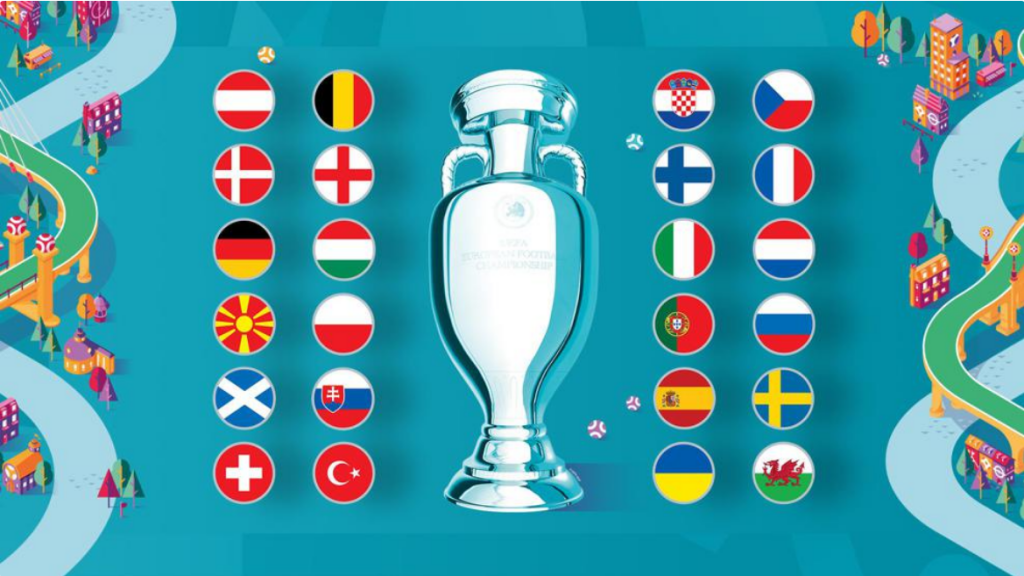
UEFA EURO 2020: Group Stage With One Game To Go

To be among the 16 to qualify, it takes two wins to guarantee. The only way it could ever be possible for a team with two wins not qualifying is if all six groups had three teams with two wins and a loss. And that’s extremely unlikely. Whatever the situation, all four teams of each of the six groups have played two games and there are a lot of telling stats. Three have qualified already while twenty others still have the last game as one last chance, and only one is officially out. Here’s how the groups look so far. Those who have already qualified are bolded:

GROUP A:

Italy came to Euro 2020 with the hope of redeeming their reputation in the football world. They delivered 3-0 wins against Turkey and Switzerland to guarantee themselves qualification for the Round of 16. Wales’ 2-0 win over Turkey and 1-1 draw against Switzerland put them in very good chances of qualifying.

For the next game, Italy could lose to Wales and they’d still qualify, but I’m sure they’d want to win or at least draw so that they can keep their #1 status. Wales’ chances of qualifying are healthy, but they would have to win to take the lead in Group A, draw to guarantee 2nd place, or rely on their game stats and goal differentials if they were to lose to Italy. Switzerland will have to win over Turkey if they want to qualify. A draw won’t cut it as game stats and goal differentials decide the four third-placers that qualify. And Turkey will need nothing less than a win for them to have a chance. They’ve lost to Italy and Wales. Only a win against Switzerland will do if they are to have any chance of qualifying.

GROUP B

Many touted Belgium as the team most likely to win Group B based on their third-place finish at the 2018 World Cup. With two wins, they’ve already guaranteed a qualification no matter how bad their game against Finland goes. They haven’t completely guaranteed the #1 spot. If Finland beats Belgium they will be the #1 team as a result of head-to-head play.

With Russia and Finland having a win under their belts, drawing can guarantee a 2nd place for Russia and a 3rd-place for Finland which would have to rely on their wildcard stats to qualify. However I’m sure Neither of the teams simply want to draw in their last matches on Monday. Denmark is in the uncomfortable position that they will need to win against Russia if they are to have any chance to qualify. It would not surprise me if the Danish team has been shaken since the collapse of Christian Eriksen. That’s a shocker he was dead for five minutes. It’s very good fortune that the first aid on the field did all the right stuff to resuscitate him and have him taken to a hospital. Actually since Eriksen’s cardiac arrest, it’s a reminder to us all that living is more important than winning.

GROUP C

Most groups would normally have a simple qualifier if they have two wins by now. Group C has an official first-place with the Netherlands! It was their two wins and big goal differential that did it! And I doubt if they will want to lose to North Macedonia in their last game!

The game of Ukraine vs. Austria will be the game for second-place in the group. If there’s a draw, Ukraine will have the advantage because of bigger scoring. Austria could qualify due to the combination of game results and goal differentials. If both qualify for the Round of 16, or either one, it will be their first time ever at the Euro that they do. As for North Macedonia, they have the misfortune of being the first team eliminated. Even if they win against the Netherlands and by a big margin, it won’t matter because of their head-to-head losses to Ukraine and Austria.

GROUP D

Interesting that Groups A to C already have a qualifier guaranteed while Groups D to F don’t have anything decided and it will take Matchday 3 to not just decide it all but decide anything. If if any team in those groups is guaranteed a Top 3 finish, that still doesn’t completely guarantee them qualification. Focusing on Group D, Both first-matches for the group’s teams resulted in wins, but both second-matches on Friday resulted in draws. That means with two teams having a win and a draw and two teams with a loss and a draw, none of the four have secured qualification and all four still have a chance in their third-matches on Tuesday.

In the match of the Czech Republic vs. England, the winner will naturally claim the #1 spot of Group D. If there’s a draw, the Czech Republic has the advantage with better goal differentials. However I’m sure both teams want to win. Croatia and Scotland both have a win and a draw. Croatia leads because of goal differentials and a draw would solidify Croatia to finish in third place, but that most likely won’t be enough to qualify. The six third-place teams will be ranked by game stats and goal differentials. Only the top four will qualify for the Round of 16, and two draws and a loss will most likely make Croatia one of the two third-place packing sooner than they hoped. So either Croatia or Scotland will have to win and nothing less if they want to secure qualification.

GROUP E

Like Group D, Group E has the difficulty of two draws causing the statistics to remain completely undecided for who will qualify. One thing that is certain is that all four still have chances to qualify and it’s up to Matchday 3 to decide it. Sweden has the best luck so far with a 1-0 win over Slovakia despite their scoreless draw against Spain. Despite the loss, Slovakia is second in ranks thanks to their 2-1 win over Poland. Spain, normally a powerhouse, has just two draws while Poland looks like their still waiting to deliver. They’re lucky they saved themselves against Spain 1-1.

Sweden has the luxury that they can qualify simply by drawing, but I doubt if they want a simple draw. Especially since Poland will be hungry for the win. The winner of Slovakia vs Spain will definitely qualify, but Slovakia will have better qualifying chances if they lose because of their win over Poland. You can be sure Spain want to win this. Attempting to qualify on a wildcard with three draws is pushing it. Possible, but pushing it. Also Poland requires nothing less than a win if they want to qualify. Two draws and a loss has very low chances of cutting it. Plus they’d have the added bonus that is they win over Sweden, they’d overtake Sweden in standings because of the head-to-head result!

GROUP F

Group F looked to be the Group Of Death. However a lot of lopsided play has turned a lot of things around unexpectedly. France is one team that has underperformed. One would usually expect a lot of big play from the team that are the reigning World Cup holders. However their 1-0 win over Germany came thanks to an own-goal from Germany’s Hummels and they drew 1-1 to Hungary. Drawing against Portugal will guarantee them qualification, but they will have to win if they want to prove themselves a worthy winner. Isn’t that something? A rematch of the Euro 2016 final happening in group play?

Germany has had it most interesting. They got a loss to France because of an own-goal, but a 4-2 win over Portugal thanks to two own-goals from the Portuguese! A draw against Hungary will guarantee them qualification, but Hungary won’t make it easy as they will want to win. Despite the loss, Portugal are still in good contention after their 3-0 win over Hungary. They can still qualify if they lose to France, but they would have to rely on goal differentials to see if their stats are good enough for the wildcard berth. Finally Hungary proved themselves strong players by drawing 1-1 against France, but they need nothing less than a win against Germany if they want to qualify. That’s how it is for them with just a loss and a draw.

And there you go. This is how things look right now with the teams of Euro 2020 with only one game to go. Matchday Three will finalize everything to decide the thirteen others who will advance and the seven others who will be packing for home sooner than they hoped. Looking forward to it!

UEFA EURO 2020: Group E and Group F Review

Interesting to note for this year’s qualifying teams, there are only two new teams competing this year: Finland and North Macedonia. Also this year are nine of the ten countries that have one at least one Euro title. Greece is the only former winner that didn’t qualify. The funny thing about football is that any team can win the Euro. There have been surprise victories before when the underdog came out the winner like Denmark in 1992 and Greece in 2004. It’s very possible a country that has never won a Euro before can win here.

Continuing on with my group reviews, I focus on Group E and Group F today.

GROUP E

For this group, this looks to be the most unpredictable. This group consists of two teams that are known for great play, but frequently fall short. It also has two teams that can go further than most people expect them to.

Spain (6) – La Furia Roja are an enigma. For so long they had been known as football’s greatest underachievers. However that all changed around the time of the late-noughts, early-2010’s. During that time, Spain won two straight Euros (2008 and 2012) and finally clinched the World Cup in 2010. After that, Spain lost their winning edge. They were stopped in the Group Stage of the 2014 World Cup and since then it’s been the Round of 16 at both Euro 2016 and the 2018 World Cup.

Spain have been in a struggle to get their winning ways back. The current team has an all-Spanish team of coaches. Most of the players play for La Liga with six playing in England’s Premier League teams. Since the start of 2020, they’ve only had a single loss, to Ukraine. They would also beat Ukraine in that time as well as Germany, Switzerland and Lithuania. They also had draws against Greece and Portugal. Chances are Euro 2020 could be the domain for Spain to redeem itself.

Sweden (18) – One thing about football is never underestimate the Blågult. After a disappointing Group Stage ouster at Euro 2016, they came back with a World Cup qualifying surprise against Italy in the playoff round and would then go on to finish in the quarterfinals of the Cup. And this is after superstar Zlatan Ibrahimovic retired from the national team!

You can thank coach Janne Andersson for the turnaround. Team Sweden’s players play for various leagues around Europe. They arrive at the Euro competition with a set of mixed results since the beginning of 2020. They’ve had losses to France, Portugal and Denmark, but they’ve also had wins against Russia, Croatia and Denmark. Whatever Sweden does here in Euro 2020, they have what it takes to deliver the unexpected.

Poland (21) – Making it to the quarterfinals of Euro 2016 has been Poland’s biggest Euro success ever. This is a team that has finished as high as third at two World Cups and three Olympic medals including gold in 1972. Unfortunately Poland didn’t get the breakthrough they were hoping for at the 2018 World Cup as they were out in the Group Stage. Robert Lewandowski didn’t even score a goal.

The current Polish team consists of players who mostly belong to teams in England’s Premier League and Italy’s Serie A. Poland has had mixed results in its play since the beginning of 2020. They’ve won against Bosnia, Finland and Ukraine, both also lost to England, Italy and the Netherlands. The Euro 2020 arena will be another chance for Poland to prove itself and what it’s made of.

Slovakia (36) – Slovakia is a team that is constantly under low expectations, but will surprise many of their naysayers. They’ve only qualified for a single World Cup back in 2010 and their first-ever Euro was the Euro 2016. In both cases, they progressed past the Group Stage into the Round of 16.

Here in Euro 2020, The Falcons hope to do much better. Their coaching staff is completely of Slovakian coaches and the players play for a wide variety of leagues throughout Europe. Slovakia have had a mixed set of results since the beginning of 2020. They’ve won over Russia, Scotland and Northern Ireland, drawn against Cyprus and R. O. Ireland, and lost to Israel and the Czech Republic. Anything can happen in Euro 2020 and the Slovaks have what it takes to pull a surprise.

My Prediction: For this group, I anticipate that Spain will top it and Sweden will come in second. I have a feeling Poland will come in third but may not have enough to earn the wildcard qualifying berth.

GROUP F

Of all the groups in Euro, this is the group most deserving of the title the Group Of Death. Two of them have won the World Cup in the past ten years, one is the defending Euro champion and the other is a former great looking to reclaim its greatness.

Hungary (37) – The Magyars have been hoping to regain the success their team used to have from the 1930’s to the 1960’s that carried them to two World Cup finals and three Olympic gold medals. For those that don’t know, the Euro began in 1960 and Hungary’s best-ever result is a third back in 1964. For a long time it seemed like their era was long over. However Euro 2016 showed signs of a comeback as the team qualified for the first time since 1972 and made the Round of 16.

The head coach is Italian Marco Rossi whose been hired since the 2018 World Cup. A majority of the players play for teams in the Hungarian league. Since 2020, they’ve only had a single loss to Russia, a single draw to Poland, and wins against Iceland, Serbia and Turkey. Not much is expected of Hungary here but they have what it takes to pull an upset in Euro 2020.

Portugal (5) – Portugal comes to Euro 2020 as the defending champions. They started the Group Stage with straight draws but came on in the knockout round winning all their games en route to the win. Unfortunately, they followed it up at the 2018 World Cup with an ouster in the Round of 16.

Fernando Santos, who coached them at Euro 2016 is still their head coach. Cristiano Ronaldo is their captain, but they also have a lot of other greats with the team like Pepe, Joao Moutinho and Rui Patricio. Since the start of 2020, they’ve only had a single loss, to France. They’ve had draws to Spain and Serbia, and wins against Croatia, Sweden and Israel. Portugal has made it as far as the semi-finals in four of the last five Euros. It’s highly likely the magic of the Navigators will be back in Euro 2020.

France (2) – France is a case of a success story that rose over time. They started after humiliation at the 2010 World Cup. Then became slow-and-steady progression with a quarterfinal finish at the 2014 World Cup to becoming runners-up at Euro 2016 to winning the World Cup in 2018.

Les Bleus is still coached by Didier DesChamps who has coached them since the 2012 Euro. Ironically there are more players on France’s team that play for Spain’s La Liga and England’s Premier League than in France’s Ligue 1! Goalkeeper Hugo Lloris, who is the team captain, plays for Tottenham Hotspur! For play, France has only had a single loss since the beginning of 2020, to Finland. They’ve won against Croatia, Sweden and Wales, but also had both a win and a draw against both Portugal and Ukraine. Euro 2020 could be the stage where France can claim their third title.

Germany (12) – The Mannschaft have always been known as a top contender in football, whether it be the World Cup or the Euro. Their win at the 2014 World Cup kept their reputation of consistency alive. However their reputation took a severe beating at the 2018 World Cup when they were ousted in the Group Stage. That made it the first World Cup in 80 years Germany failed to progress past the opening round. Some say it was because of a team that wasn’t together. Some even say it’s the ‘curse’ of the defending World Cup champion. Germany’s disappointment would continue as they struggled during the first year of the UEFA Nation’s League.

Despite the setbacks, Joachim Low is still the national coach. The current team features some of the 2014 World Cup alumni but mostly consists of a lot of new younger players. A majority of players play for Germany’s Bundesliga. Since the beginning of 2020, Germany have only had two losses: to Spain and North Macedonia. They’ve also drawn against Spain as well as Switzerland and Denmark and they’ve achieved wins over Ukraine, the Czech Republic and Iceland. A recent 7-1 win over Latvia shows the Mannschaft have something to prove. Euro 2020 could prove to be the domain for Germany to redeem themselves.

My Prediction: This is a tough one as even the best teams have shown some visible weaknesses. I predict Spain to top the group with Portugal second and Germany third, but with enough game stats to qualify as a wildcard.

And there you have it. That’s the last of my predictions for Euro 2020. Sure, a lot could be told. However we should remember that lots have changed since the pandemic and that could also mean the prowess of some teams. Those expected to fare well might now here. That’s why whenever I make my predictions, I tell people not to use them for gambling bets! Anyways this should be an exciting month with a lot of exciting play.

Oscars 2016 Shorts Reviews: Animation and Live-Action

Cinema

I’m lucky to be living in Vancouver. It’s one of the few cities one can be able to see the nominated shorts in a big-screen theatre. Gives me a chance to review them myself and even make a should-win pick for myself. This year is quite an array of nominees in both animation and live-action. So without further ado, here are my thoughts on the nominated shorts:

ANIMATED:

-Blind Vaysha (Canada/France): dir. Theodore Ushev- This is a unique 2D animation story of a Bulgarian folk-tale. A story of a girl with one eye that can see the past and one eye that can see the future and cannot live in the present. The story also shows the attempts of others to fix Vaysha’s blindness. The linocut-style animation, however, was unique and had a lot of style and flare to it.

The story doesn’t really end. Instead the film ends asking the audience their perspective. It has a unique narrative point and I get why it’s done that way, but I often wonder if the film ended on the right note.

-Borrowed Time (USA): dirs. Andrew Coats and Lou Hamou-Lhadj – At first you’ll think this is a family-friendly story at the beginning but soon learn it’s not such as you move on. It’s a dark Western story of a man returning to the spot of a family tragedy from his childhood. The hurt comes back from it and he decides to do something drastic but something happens.

I have to admire Pixar animators Coats and Hamou-Lhadj for making a brief departure from their traditional family fare and doing something more mature under Quorum Films. No, it’s not R-rated like Pear Cider And Cigarettes but it’s dark enough to be adult. I think this short is most likely to upset my pick for the winner.

-Pear Cider and Cigarettes (Canada): dirs. Robert Valley and Cara Speller- Now this is a refreshing R-rated alternative. It sometimes reminds you of a Grand Theft Auto video game or the film Waltz With Bashir. However it is a personal story from director Valley. It’s a story that makes you wonder how far would you go for a friend? Especially if that friend is selfish, conniving, irresponsible and manipulative?

It’s a story that entertains and charms and even gets you to hate Techno too. Sometimes I wonder why was he friends with that jerk? I don’t know if it’s because it was set in Vancouver or because it was an R-rated alternative but it won me over and I make it my Should Win pick.

-Pearl (USA): dir. Patrick Osborne- This is the first VR short to be nominated for an Academy Award. A musician and his daughter travel in a hatchback with a song as a bond between the two. We see the two age, the daughter mature into a musician of her own and have her own version of the song. The viewer gets a 360 degree view of the whole 5-minute story.

Looks like something Richard Linklater would do. Actually it might remind you of Waking Life. An excellent short that’s entertaining and will touch you too. Might even make you go to iTunes and download No Wrong Way Home.

-Piper (USA): dirs. Alan Barillaro and Marc Sondheimer- This is the short shown before Finding Dory. A baby bird looking for food on the beach with her mother looking on and guiding her. Pixar does it again by delivering a clever, charming, and entertaining short with the dialogue absent and the animation as detailed to a tee as it gets. It’s excellent, but it’s something we’ve come to expect from Pixar even with their shorts. Nevertheless this is my Will Win prediction.

And those are my thoughts for the Animated Shorts up for the Oscar. A lot of styles of animation between Canadian and American companies. All five were very entertaining. We’ll see who wins.

LIVE-ACTION SHORT FILMS

This year there are no films with English as the language of the majority. All five are from European countries. Here’s the rundown:

-Ennemis interieurs (France): dir. Selim Azzazi – A man from Algeria seeks to be a French citizen but the interrogator at immigration has big questions for him about meeting with a group of Algerian men back some years ago which led to him being arrested and imprisoned for two years. The interrogator keeps insisting he answers but he’s very reluctant to do so. Even to the point of neglecting his chances of French Citizenship. Why? What will make the man give his answers?

It’s a story that appears boring at first but grows with intrigue with each minute and with each new detail. The interest builds over time. It even makes you wonder why is he withholding the names of the other men? Feelings of brotherhood? Fear of retaliation from them? Also this may be about an incident in the past but it’s very relevant, especially with the Paris bombings happening in November 2015. This is my Will Win pick.

-La Femme et le TGV (Switzerland): dirs. Timo von Gunten and Giacun Caduff – Elise is a woman who wave her Swiss flag at the passing TGV train to Zurich every time it passes her house at 6 in the morning and 6 in the evening . After that she bicycles to her job at the town patisserie. It’s her daily routine for 30 years; a routine she doesn’t want to change. One day, she comes across a letter that was thrown to her by a man who goes on that daily TGV. He’s a man from France looking for work. The two develop a friendship only by mail and packages. Over time she hopes to meet this man. Then one day the train stops coming. It’s changed route? How will she deal with the change? Will she ever see the man?

It’s a charming comedy that has you engaged with the character (based on a person who has existed and did wave her Swiss flag at passing TGV trains). Gets you thinking about the woman. Is she an eccentric? Is she naive? Lonely? Unpredictable ending but a happy one.

-Silent Nights (Denmark): dirs. Aske Bang and Kim Magnusson – Inger is a young Danish woman who helps at the Salvation Army during the day and looks after her ailing mother at night. Kwame is a Ghanian immigrant who came to Denmark for a better future and to support his wife and children at home. However he’s been left homeless and makes money from recycling.

They both meet as Kwame agrees to help. The two develop a mutual friendship and even progress into something more. However it’s put to the test when Kwame steals money from the charity to pay for his daughter’s malaria treatments. Even though Kwame is banned for life, Inger forgives him and still loves him. Then Inger’s mother dies and she learns about Kwame’s family in Ghana just as she learns she is pregnant. It’s over between the two. However Inger sees Kwame one last time where she gives him advice, and something else.

It’s obvious that this story is about the immigrant situation in Denmark and the difficultly of the times for all. It presents both Inger’s side and Kwame’s side. However it’s more. It’s about a love that’s true. Inger loves Kwame so much, she’s willing to forgive him for all the terrible things he did. It makes the choice she makes for her and her baby look like the right thing. This is my Should Win pick.

-Sing (Hungary) dirs. Kristof Deak and Anna Udvardy – Zsofi is the new girl at a school. She most looks forward to singing in the choir. However on her first rehearsal, the instructor talks of a choir competition where the prize is a performance in Sweden. She also tells Zsofi her voice is not ready for the choir and tells her to lip sync. Along the way, Zsofi finds a friend in star singer Liza. The two become good friends. However Liza notices Zsofi not singing but others. When she brings this up with the instructor, she not only admits it but tries to convince the children it’s the right thing for the competition. All of which leads to a surprise ending and the ending you think is right.

Often I question what the point of this film is. Is it about competitiveness to the point the ‘lesser’ singers are not allowed to sing for the sake of the big prize? Or is it a reminder of Hungary’s past communist regime; of how those that fit in are allowed to and those that don’t aren’t, but make like everything’s okay?  Even the choir director could remind you of a communist dictator on retrospect. Whatever the point, the story was entertaining and sweet. Reminds you of the joys of childhood and the right thing paying off in the end.

-Timecode (Spain) dir. Juanjo Gimenez – It starts as a check for a woman on a security job during the day. One day she learns of a broken car light. Upon viewing the video of what happened, she sees the worker before her dancing before hitting the car. She decides to give him a dancing video of her own. Video after video follows. Then on their last day, magic happens.

At first you think the man is something eccentric but this story builds into something that ends on a bizarre note. A very good film.

And there are my thoughts on this year’s nominated shorts. Now remember both categories are the hardest to predict the winner. For example, last year the consensus of critics ranked Stutterer the least likely to win Best Live Action Short and it won. Even Annie wins for Piper and Pear Cider and Cigarettes are not a guarantee that either will win.

With my shorts predictions out of the way, I just have my main predictions for all the categories to deliver. But not before my last Best Picture summary. Coming up tomorrow morning.


VIFF 2016 Review: Tales Of Two Who Dreamt

tales-website
Tales Of Two Who Dreamt document the dreams of a Romani refugee family who dream of immigrating to Canada and hopefully doing a small film.

One thing about the VIFF is that it will show films done by Canadian directors or people close to home. In fact the VIFF credits itself as the film festival that shows the most Canadian films: shorts and feature-length. One example this year of a feature-length Canadian film shown at the VIFF was Tales Of Two Who Dreamt which was a unique documentary.

The film begins with a man, Sandor Laska, telling a story of a boy who turned into bird after a dream. Over time, we the director is planning to make a small film of this story. Even a makeup artists is seen putting a beak on the son Alexander.

What we get is something else. We hear the story of the father and the Laska family. They are refugees living in a tall apartment in Toronto specifically for refugees. They are Romani people from Hungary. They seek refuge in Canada because they are of an oppressed minority and often face discrimination.

As they live in the apartment awaiting approval of their status in Canada, we learn there are many Romani families also seeking refuge. Often they meet together and party together. The children play soccer on the apartment’s field together often with refugee kids from other countries.

Time passes as the family continues to pursue both dreams: the dream of doing the film and the dream of immigrating to Canada. In the end, neither happen. Their immigration case wasn’t approved and they have to return back to Hungary where they really have nothing to return to. The film that was to be made couldn’t be done. The family were deported back before it could be completed.

This film is a good eye opener to the Romani people that seek refuge. They are a people who number in the tens of millions spread across various countries of Europe. They are people whose lifestyle are considered questionable. They are a people who value their cultural roots in music and dance often to the point they neglect working a real job. They live their lives their own way; many of which are illiterate.

The Romanis are seen by the other people in the country as lazy, irresponsible or even the ‘scum of the earth.’ They are often referred to as ‘Bohemians’ or ‘gypsies’: the latter of which they consider to be a slur. They’ve had their discrimination over the decades and centuries. They were even one of the groups of people executed during the holocaust. Discrimination against them still continues today in various European countries. Some countries like Italy have passed anti-Romani laws. Some countries like Hungary let discrimination go freely. You can easily see why a family like the Laskas would try to seek refuge in Canada.

Sometimes when you see the struggle of the Laskas and other Romanis in the apartment as they seek their residency status, you sometimes think this film is about the refugee situation as a whole. What you see the Romanis struggling with is often what you see most refugees struggling with. That tall apartment with nets on the outside put on after the death of a six year-old boy who fell off his 19th floor balcony tells a lot about the place where refugees wait to hear their fates in Canada. At the end, you get thinking that the Laskas didn’t succeed in escaping what they attempted to escape. Sandor talks about how the interpreter didn’t state his case right to the judge and that had to be why his residency status was revoked. Sometimes it makes you sense could the interpreter have an anti-Romani attitude? Did he misinterpret purposefully so that the Laska did fail and then get sent back to Hungary to return to their discrimination? It does get you thinking.

Directors Nicolas Pareda and Andrea Bussmann turn the film into a docudrama. There are times when the film gets ready to film the ‘birdboy’ story, times when they focus on another family who are to be part of the skit, times when they focus on the apartment building as a whole, and times when they focus on the Laskas and their reality. It’s a mix of various shots from family struggles to kids playing to young adults holding a party. The two directors try to piece together the many stories. There are times when scenes are shown with a score of a Romani song sung a capella. There are even times when they include Timea’s scratchy violin-playing as score to a scene in the film. Sometimes it hits, sometimes it misses. There are times when the mixed organization appears to work and then there are times when the film feels disjointed. I think the film aimed to be creative in its documentation during times when it wasn’t supposed to be.

Despite the film’s noticeable imperfections, I would have to say the best thing about this film is that it gave a voice to a people. This was a chance for Romani refugees to tell their story of what they faced and why they came to Canada along with the hopes for their children. The adding in of the ‘birdboy’ story adds color to the film as it is a Romani tale. You can see why the film is called Tales Of Two Who Dreamt. The first dreamer was the ‘birdboy’ and the second dreamer was Sandor Laska. I’ll admit I was disappointed at the end to learn the ‘birdboy’ film was never finished. But it’s something that just happens and you saw why.

Tales Of Two Who Dreamt is a documentary that’s noticeably disjointed in a lot of areas. It is still very valuable as it gives an image of the refugee situation Canada is trying to deal with.

Rio 2016: Fourteen To Watch

London Flame

The Rio Olympics is coming our way. Of course the media being what it is, it chooses to focus on all the bad news with the bad construction problems and the Zika virus and the slow ticket sales. The story of the Russian track team being systematically doped added to the fire and has led to scrutiny of the whole Russian team in recent weeks. However there have been tales of woe before past Olympic Games and they’ve gone off excellently so it would be fair to give Rio a chance. So without further ado, here’s my focus on thirteen to watch–eight individual athletes, a duo, and four teams:

Rio 2016
The Rio 2016 logo features three characters in the Brazilian colors in a triple embrace resembling Sugarloaf mountain.

-Katie Ledecky/USA – Swimming: You all thought Michael Phelps would be the top swimmer of focus in my blog, right? Wrong. He will be looked into in a focus on another swimmer later in my blog but now the swimmer of top focus here is the US’s next big swimming sensation: Katie Ledecky. As a 15 year-old, she competed in London as the youngest member of the US Olympic team. She won gold in the 800m freestyle and broke the American record along the way. Since then, she has become a distance freestyle ace with world records in the 400, 800 and 1500m freestyles along with World Championship golds in those events as well as the 200 free. She is poised to win gold in the 200, 400 and 800 freestyles in Rio: a feat only achieved once before by American swimmer Debbie Meyer in 1968. Katie can even add a bonus gold with the 4*200m free relay. Her chances are good as her best time in the 800 this year is 12 seconds faster than the second-best and her top 2016 time in the 400 is 1.5 seconds faster than that of American teammate Leah Smith. However the 200 will be her toughest event to win as Sweden’s Sarah Sjostrom’s 2016 best is less than .1 faster than Katie and just .12 behind her is Italy’s Federica Pellegrini: 2008 Olympic champion who finished fifth in London. Nevertheless it will be a brave attempt from the 19 year-old.

-Simone Biles/USA – Gymnastics: Women’s gymnastics has become a complicated sport ever since it was revolutionized by ‘pixies’ like Olga Korbut and Nadia Comaneci. It seems a gymnast’s career at the top is very short. It’s very hard to develop consistency especially with time encroaching. However one gymnast who can beg to differ is 19 year-old Simone Biles. She has shown a consistency in World gymnastics not demonstrated since Ludmilla Tourischeva back in the 70’s. In the past three World Championships starting in 2013, Biles has won fourteen medals including ten gold. She has also won the last three World all-around titles. Biles appears invincible but she does face rivalry from her own teammates Gabby Douglas (defending champ from London) and Laurie Hernandez as well as Russia’s Angelina Melnikova. Rio could just be the arena to crown her greatness in the sport.

-Ashton Eaton/USA – Athletics: There have only been two decathletes who have won back-to-back Olympic gold medals: The US’s Bob Mathias and the UK’s Daley Thompson. Ashton Eaton looks poised to become the third. He first burst onto the scene at the 2011 Worlds as a 23 year-old when he finished second behind his American teammate Trey Hardee. Hey, the US is known for their decathletes as they have won a total of 28 medals including thirteen gold. The following year, Eaton beat Hardee at the US Olympic Trials with a world record points total. Eaton went on to win gold in London as well as the last two World Championships. Eaton appears invincible having the year’s best result at the US trials but he does have rivals in Germany’s Arthur Abele and Canada’s Damian Warner who finished behind Eaton in second at the Worlds. Rio could just be the arena for a great to deliver.

-Usain Bolt/Jamaica – Athletics: What can I say? The ‘Lightning Bolt’ has proven himself to be the biggest thing in athletics since Carl Lewis. He has an unmatched streak at dominating sprinting in major events. It all started when he won the 100, the 200 and the 4*100 relay in Beijing in 2008 all in world record time. Since then every Olympics or Worlds he entered, he’d leave with golds in all those events each time with the exception of the 100 in 2011 where he received a false-start disqualification. Already people are ruling Bolt to achieve the triple-triple here in Rio. However it’s not 100% guaranteed. Bolt had to pull out of the Jamaican Olympic trials because of a pulled hamstring injury. He has since recovered well and even won a major 200 in London a few weeks ago. However the 100m has three runners that have a faster year’s best than Usain. Topping the list is 2004 Olympic champion Justin Gatlin. The 200m features four runners who ran a faster time this year than Usain’s 2016 best. Topping that list is American LaShawn Merritt: 2008 Olympic 400m champion. Win or lose, chasing Olympic history will make for an exciting show from a legend.

-Mo Farah/Great Britain – Athletics: Seven male distance runners have won both the 5000m and 10000m runs in the same Olympics. However one–Finland’s Lasse Viren– has done it twice back in 1972 and 1976. Mo Farah, A Somali who moved to the UK when he was eight, appears poised to duplicate Viren’s feat. Farah’s last loss of a major 5000 or a 10000 came at the 2011 World Championships. Since then he has taken gold at the 2012 Olympics and both the 2013 and 2015 World Championships in both events. There will be rivals trying to block his path like Ethiopian Muktar Edris, American Galen Rupp, his Portland training partner, and Kenyans like Caleb Ndiku, Paul Tanui and Geoffrey Kanworor. Whatever the situation, Farah’s pursuit will be one to watch.

-Cate and Bronte Campbell/Australia – Swimming: Admit it. You get intrigued when you see a pair of sibling athletes either competing together or against each other. Enter the Campbell sisters from Australia who are at the top of the world in sprint freestyle. 24 year-old Cate is the one with Olympic medals–two bronze in 2008 and a relay gold in 2012–along with 100 free gold at the 2013 Worlds. 22 year-old Bronte won the 2015 World Championship in the 50 and 100 free with Cate winning silver in the 50 and bronze in the 100. However Cate that this year’s fastest times in the world in the 50 and 100. Bronte has the second-fastest in the 100 and fifth-fastest in the 50. Ah, don’t you wish sibling rivalry was this civil? However the Malawi-born Campbell sisters are not alone at the top. They will face challenges from Sweden’s Sarah Sjostrom who also made the 2015 Worlds podiums in both events and 2012 Olympic champion from both events Ranomi Kromowidjojo of the Netherlands. The Rio stage should provide for some fun drama. And after all that rivalry, the two could just team up for a gold in the 4*100 free relay!

-Laszlo Cseh/Hungary – Swimming: All eyes will be on Michael Phelps. He may have won it all with 22 medals over three Games including 18 gold but he’s making a comeback after a troubling time since London which included his second DUI arrest. Who’s also worth looking at is 30 year-old Hungarian Laszlo Cseh. When Phelps won six golds and two bronze in Athens, Cseh won 400 individual medley bronze. While Phelps won eight golds in Beijing, Cseh won three silvers. While Phelps won four golds and two silvers in London, Cseh won 200 IM bronze. In all cases, Phelps was the Olympic champion. Here in Rio, we have a different scenario. We have Phelps trying to get back his old form while Cseh appears to be in the best form of his life. Cseh has the world fastest times this year in both the 100 and 200 butterflies. Cseh is a heavy favorite for the 200 but he does face rivalry from Phelps, American Tom Shields and Poland’s Konrad Czerniak in the 100. Cseh has never been called ‘Phelps’ Shadow’ in his career but Rio could become the first Olympic arena to finally beat Phelps and win Olympic gold.

-Majlinda Kelmendi/Kosovo – Judo: 75 nations competing in Rio have never won an Olympic medal. Two nations–Kosovo and South Sudan– will be making their Olympic debut. Kosovo’s team will consist of eight athletes in five sports. Leading the team is 25 year-old judoka Majlinda Kelmendi. Back in 2012, Kosovo was not officially recognized by the IOC and Kelmendi opted to compete for Albania. Since then Kelmendi has won gold at the World Championships in the lightweight category in 2013 and 2014. She missed out on the 2015 season because of an injury but is poised for a comeback in time for Rio. She has already won this years’ European championship. She faces rivalry from Japan’s Misato Nakamura and Brazil’s Erica Miranda. Whatever the outcome, be sure she’ll do her country proud. She will also be the flagbearer during the opening ceremonies.

FROM THE HOST NATION:

Rio 2016
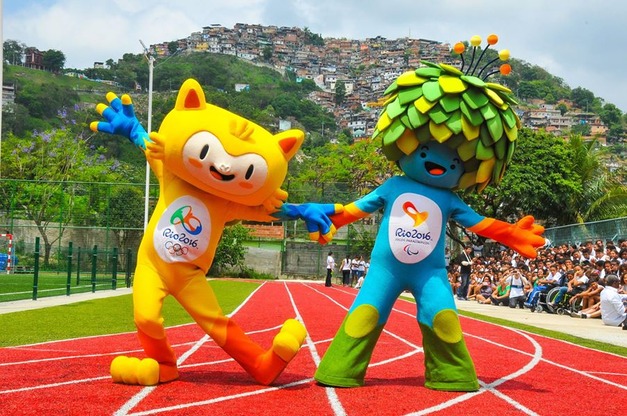
Vinicius, seen left with Rio Paralympic mascot Tom, is the 2016 Olympic mascot. Vinicius is a mix of Brazil’s mammals. Both mascots are to represent Brazil’s diverse people and culture.

Of course there is to be some focus on athletes of the host nation. I make it a priority as it makes some of my favorite Olympic moments with athletes winning gold or a medal in front of their home crowd. And in Rio, Sports Illustrated predicts Brazil to win 20 medals including six gold. The most medals Brazil has won in a single Olympics is 17 back in London. The most golds, five in Athens in 2004.

Focus on the two teams later. Here are the duo and individual of focus:

Isaquias Queiroz and Erlon Silva – Canoeing: Brazil has won Olympic medals in thirteen sports but canoeing isn’t one of them. In recent years, Brazil has fielded a canoeing duo who have emerged at the top of the world in the 1000m event. Isaquias won the Worlds in 2013 and 2014 in the individual 500m. Erlon was part of the bronze medal-winning 200m pair in 2014. However both were competing in events that won’t be contested in Rio. Leading to last year’s Worlds, the two were paired together and trained for the 1000m pairs event. They entered that event at the Worlds and won. They will face challenges from the duos of Hungary and Poland. They could just make Brazilian Olympic history here in Rio.

Fabiana Murer – Athletics: Brazil is not expected to win any medals in athletics, according to Sports Illustrated. Overlooked must be pole vaulter Fabiana Murer. She’s a 2011 world champion and she finished second at last year’s World but is known for Olympic choking. In 2008, she finished 10th. In 2012 she failed to qualify for the finals. 2016 looks to be a good year for Murer as she set a new South American record back in July. However she faces challenges from London Olympic champion Jennifer Suhr of the US, last year’s World champ Yarisley Silva of Cuba, last year’s World bronze medalist Nikoleta Kyriakopolou of Greece and American Sandi Morris who’s the only vaulter to have a higher 2016’s best than Murer as of now. Whatever the situation, the home country has her back.

TEAMS:

Refugee Olympic Athletes Team: In the past, you had to have some citizenship ties in order to compete at the Olympic Games. Refugees in the past have been overlooked as they were believed to have bigger problems than sports to deal with. Some would have to wait many years to represent the nation they’ve been adopted into. At the last Olympics in London, some refugees participated as Individual Olympic Athletes. IOC president Thomas Bach has taken note of the current worldwide refugee crisis by trying to break barrier for refugee athletes who want to compete at the Olympics. In March of this year, Bach announced his intention to create a team of refugees to compete in Rio taking into account the athletes’ sporting ability, personal circumstances and United Nations-verified refugee status. A $2 million fund created by the IOC was used to help train the athletes for Rio. At these Olympics, there will be ten athletes competing as Refugee Olympic Athletes. Five are runners from South Sudan who reside in Kenya. One is an Ethiopian marathoner who sought refuge in Luxembourg. Two are Congolese judokas living in Brazil and two are Syrian swimmers who have sought refuge in Belgium and Germany. They may not have much of a medal chance but they will already achieve victory by just competing at the Olympics.

United States Women’s Football Team: If there’s one team that one can call the class of the field, it’s the American women’s football (soccer) team. The US Women have won three of seven Women’s World Cups and four of the five Olympic gold medals. Those who saw last year’s Women’s World Cup know about how well the American women continue to play brilliantly. Here in Rio, fourteen women from last year’s WWC squad are part of the Olympic squad including stars Megan Rapinoe, Carli Lloyd and Hope Solo. There are also four newcomers including Mallory Pugh and Crystal Dunn. Since their WWC win, the team has won all but three of their matches since, losing only once to China 1-0 in a friendly back in December. WWC finalists Japan may not have qualified but it’s not to say the US won’t face some tough rivalry from China, France and even hosts Brazil. Nevertheless if they’re as brilliant together in Rio as they were in Canada last year, magic can happen again.

TRIVIA: Being WWC-holder is actually bad luck for the Olympics. In the previous five Olympics, no team that was the WWC-holder at the time has won Olympic gold. They’d make the Olympic podium, yes, but never the top step. Can the US break this bad-luck spell?

FROM THE HOST NATION:

Brazil’s Olympic Volleyball Teams: Football may be Brazil’s #1 sport. It’s safe to say volleyball is Brazil’s #2 sport. Ever since the men’s team won Brazil’s first ever court volleyball medal, Brazil has been on a roll winning a total of nine Olympic medals including four gold. They’ve also won 11 of the 30 Olympic medals awarded in Beach Volleyball including two gold medal-winning duos. Brazil is expected to dominate here. In beach volleyball, Brazil’s pairs won five of the six medals with only the men’s silver conceded to a Dutch pair. Brazil is not as dominant in court volleyball at the Worlds but the teams have what it takes to deliver as the women have won Olympic gold back in 2008 and 2012. Here in Rio, the women will face tough competition from the US and China who finished ahead of them at the 2014 Worlds. The men appear heavy favorites to win but they will face challenges from 2012 Olympic champs Russia and 2014 Worlds champs Poland. It could be possible the home crowd’s cheering could propel them both to win gold.

Brazil’s Olympic Football Teams: You’d figure Brazil, a country that has won a total of five World Cups, would have at least one Olympic gold in football, right? Wrong! It’s all because of eligibility rules in football over the years. Before 1984, footballers couldn’t even make a penny off their sport if they wanted to compete. That would allow the Eastern Bloc countries to field their best for the Olympics and propel them to the podium while World Cup-winning countries like Brazil, Argentina, Germany and Italy could only field ‘diluted’ teams to the Olympics which would finish in a shabby ranking or not make the Olympics at all. Brazil was able to qualify for six Olympics in that period but failed to win a medal.

In 1984, the Olympic door was open to professionals despite some restrictions or two. In 1992, professionals as long as they were 23 or under could compete. Since 1996, each squad had to have all but a maximum of three footballers under 23 with the other three being anyone they wanted. The opening of the floodgates to pros has boosted Brazil’s men’s team as they’ve qualified for six of the eight previous Olympic competitions and have stood on the podium five times. What they want here in Rio is to stand on the top step for the first time. In London, Brazil fielded a kit featuring a 20 year-old Neymar Jr. and won silver with Mexico taking the gold. Here in Rio, Neymar is back and the other 17 members of the Olympic squad are part of pro teams from Brazil, Spain, France and Italy. The Olympic squad may have finished third at the 2015 Pan Ams but the team has been consistent in friendly play over the last two years losing only to Nigeria back in March. Most of all, the team wants to return the football spirit to the country that left the nation broken-hearted at the 2014 World Cup and achieving shabby results at the last two Copa Americas. Whatever the situation, Brazil may just lift the spirits of their country.

Oh, did you think I’d forget the women’s football team? I didn’t. Women’s football isn’t as restrictive as the men’s competition. Every woman that competed at last year’s WWC is eligible to compete in the Olympics. As for Brazil’s women’s team, they have two Olympic silvers from 2004 and 2008. However they have had difficulties in the last major tournaments with losing in the quarterfinals at the 2012 Olympics and losing to Australia in the Round of 16 at the 2015 WWC. The team has since had their ups and downs with losses to the US, France, Canada and New Zealand they’ve trained hard under coach Vadao and have had mostly wins. Stars Marta, Formiga and Cristiane will be there. Hopefully the Brazilian women will be as victorious as their men and these Olympics here could be the arena for it.

And there you have it. Some of the athletes who to look out for at the Rio Games. Remember the gold medal does not go to the hardest worker, the most deserving, the most talented, the one with the most pre-Olympic accolades or even the best athlete. The gold goes to the one that’s the most there. And Rio will be the arena to decide the Olympic champions. These seventeen days will allow the athletes to “live their passion.” My review of Canadians to watch was printed the following day. Just click here.

UEFA Euro 2016: Group F Focus

Euro Logos

For my predictions for the previous groups, just click below on the links and you’re there:

Interesting how the next Euro won’t have a single host country. It was decided in 2014 for what will be the 60th anniversary of the Euro to have all the first round matches and knockout games in cities throughout the continent mainly for that celebration. The second reason why was because Europe was, and still is to a certain extent, struggling with an economic crisis. It makes sense as most cities that have agreed to stage part of the tournament will use the stadium already in existence. Only Brussels is planning a new stadium for Euro 2020 and Budapest is planning a new version of their old stadium in time for the tournament. This should prove interesting in how it works out. In the meantime, here are my predictions for Group F:

Portugal FixedPortugal (8): This isn’t simply the time for The Navigators. More like this is the century for them. Back in the 20th century, the team only qualified for two World Cup and two Euros. Now they’ve made every World Cup since 2002. Not to mention every Euro since 1996. The team features legends like Cristiano Ronaldo, Bruno Alves, Nani and Pepe. The team also shows promise for their youth as they were finalists in the under-21 Euro last year. They team will come to France in hopes of shaking off their embarrassment from the 2014 World Cup of being ousted in the Group Stage. The team brought back Fernando Santos whom coached Greece at the 2014 World Cup. The squad for Euro 2016 features a wealth of talent both old and young. Since Brazil, the team has had a lot of key wins against Argentina, Belgium, Serbia and Italy. They’ve also had some key losses against France, Bulgaria, Russia and England. The players playing their best strengths and the right team chemistry should take them far in Euro 2016, if not win.

IcelandIceland (35): Iceland amazes me. A nation of less than half a million people fielding a football team to be reckoned with. This is their first-ever Euro. They almost qualified for the 2014 World Cup going as far as the knockout stage against eventual qualifiers Croatia and even bringing them to a scoreless draw in the first match. They’ve even reached their highest FIFA ranking of 23rd for three months of last year. The team consist of members that play for a variety of teams throughout Europe across many different countries. Sweden’s Allsvenskan league is the national league with the most members of the national team. In the past two years, the team has had key wins against Turkey, Czech Republic, Greece and the Netherlands twice. However 2016 has shown the team struggle in Friendly play losing four of their seven matches including Norway, Denmark and the United States. France will be the first stage for them to prove themselves on an international level. Don’t count them out.

AustriaAustria (11): Austria is an enigma. The team had their best days in the 1930’s and 1950’s. Since the 1960’s the team’s prowess has declined with only qualifying for four World Cups and giving a dismal showing at Euro 2008 which they co-hosted. Since 2014, the team has shown a remarkable turnaround. In Euro qualifying, they finished top of the group by winning nine of their ten games and only drawing once, even overpowering Russia and Sweden. The current team is coached by Swiss coach Marcel Koller and features players that mostly play for Germany’s Bundesliga. In the past two years, the team has had additional wins against the Czech Republic and Albania. The team has also had losses against Turkey, Switzerland and the Netherlands. I’m sure they hope to show the World what they’re made of in France. Possibly their best team in decades.

HungaryHungary (18): I’m sure Hungary hates being known as a ‘blast from the past’ but it’s easy to dismiss them as that. It’s a long ways since their days of being the ‘Magical Magyars’ back in the 30’s and 50’s which include two World Cup finals appearances and Olympic gold in 1952. Their first signs of their prowess waning came in the 60’s. Despite finishing third in Euro 1964, they only went as far as the quarterfinals at both the 1962 and 1966 World Cups. Since 1966, the team has never made it past the Group Stage at the World Cup with their last appearance in 1986. Their last Euro appearance was in 1972. The demise of Communism led to less focus on Hungarian football talent and an eventual demise in world rankings including a worst-ever FIFA ranking of 86th in 1996. However Hungarian football is making a comeback as there is more funding for football and more development of players happening nationally. They’ve even hired a German, Bernd Storck, as their head coach. Most of the players play for Hungary’s OTP Bank Liga but there are four players that play for teams of Germany’s Bundesliga. They’ve had notable victories in the last two years against Finland, Norway and Albania and some notable draws against Croatia and Greece. They’ve also had some notable losses to Russia and Germany. France could be the stage for them to prove Hungary’s back.

Prediction: Okay, my final prediction for the final group. Predicting Portugal to top it is easy. Predicting the other two is heard because it could be any of the three. I’ll go with Austria second because of their consistency and Hungary third.

And this not only sums up my review of Group F but of all Euro 2016 first round groups. Some of you may wonder why I haven’t predicted the winner of the Euro yet. It’s simple. Because I’ve always had a case on my blog of predicting the groups first and then making predictions for the knockout rounds as the tournament moves on and then then predicting the final just days before it happens. It always was my case. Besides if I went with my group predictions, I’d have a raw idea on who would win the Euro as I mapped them out. I’ve basically mapped out that the winner of the Cup would end up being France. Yeah, that raw. So hang tight right now.

And that wraps it up for all my pre-tournament posting of Euro 2016.24 teams playing, only 16 will still stand after Wednesday the 22nd. It all remains to be decided over the next two weeks. More predictions and write-ups from me coming as the tournament progresses.