Oscars 2024 Best Picture Reviews: Part One

Ten is not a set number for the number of Best Pictures nominees. Nevertheless it’s still nice to have ten as the total of nominees.

This year, there are a wide variety of films nominated from science fiction to two musicals to a musicography to a dark comedy to a horror movie to many types of dramas. Here  are my first two reviews of the Best Pictures nominees:

Anora

This is quite the unexpected comedy that delivers an unexpected sad ending. A sad ending was anticipated but the sad ending we got was not the one anticipated. It seems odd to have a story about a stripper/hooker marrying a rich kid to be one of the best films of the year but Sean Baker has developed a reputation for directing films about people in the sex trade. This is quite the story itself. We have a stripper who plays a ‘love kitten’ day after day for lusting men, but craves real love. We have a billionaire’s son who’s too spoiled, immature and careless to get it about life and love. He thinks marrying Anora is easy like that and he can live the same irresponsible life again, but he has a lot to learn. We have Igor, the henchman hired by the Zacharovs to have the marriage annulled, but Igor becomes the first person to see Anora as a human being throughout this whole ordeal. We also have the Zacharovs who are so obsessed with their money and power, they think they can do whatever they want. This is the kind of story that brings a lot to the table to talk about.

It’s hard to pinpoint the exact theme of the story because there’s so many topics and themes this story presents a point about. One could be the theme of sex workers. As I mentioned, Baker’s films often deal with sex workers. Here we see the case of a sex worker who is treated like a piece of meat and there are times her true feelings are shown. There are moments we stop seeing Anora as ‘this thing’ and start seeing her as a person. There’s also the case of wealth and privilege. Not only do we see wealthy people having the best luxuries but we see them having a privileged son living a careless irresponsible life, we see how the rich devalue marriage both with Vanja’s eloping of Anora and the Zacharov’s own marriage, we see how being a henchman to the Zacharovs means having to leave a christening of your godchild because your boss demands so, and we also see how the rich Zacharovs know that their money gives them power and uses it against Anora. Especially when the mother insists the family doesn’t apologize to anyone just as Igor points out Vanya owes Anora an apology for the eloping. It’s quite the irony when a stripper or prostitute has a better sense of what marriage is all about than a billionaire’s son. Or even his parents.

Often overlooked, I feel one of the top themes in the film is love. We have Anora, a stripper who pretends to love the men she sleeps with, but she craves real love. We have Vanya, whom Anora thinks she found love with as she spends weeks with him and easily falls for his marriage proposal. Anora is oblivious Vanya wants to marry an American so he doesn’t have to return to Russia and work his father’s business. Even the scenes as Vanya’s playing video games after the two marry hinds at Vanya’s irresponsibility. We also have Anora’s delusion with the marriage. Even though Vanya continues to play video games after they marry, she still thinks she met her love. We have the Zacharovs who view their son marrying a sex worker to be a disgrace to the family. We also see scenes which make you question the Zacharov’s own marriage. Finally we have Igor who becomes the first person to see Anora as a human being instead of ‘that thing.’ It was made obvious in the scene where Igor says Vanya owes Anora an apology. That ending where he allows her to stay at the Zacharovs one last night to sleep, bathe and pack and the ending scene as he’s about to drop her off is also an irony. He’s first hired as a henchman to stop the marriage, even if it means brute force, and now he actually has feelings for Anora. A shock to us all, and to a disheartened Anora as well.

This is the big breakthrough film Sean Baker has been waiting for. The film world has known Baker for a long time as one knocking on the door. He’s delivered small breakthrough films before with 2015’s Tangerine and 2017’s The Florida Project. Here, he directs a story that’s intriguing and unpredictable. It first seems like a film that would give us a cartoonish story but as the film progresses, the story is a lot deeper and it’s not the story we thought it was. Also worthy of top acclaim is lead actress Mikey Madison. If you thought you’d never shed tears for the character of a stripper, you will be wrong. It’s remarkable we have a film where the character of a stripper is shown to have real three-dimensional feelings, but Mikey’s performance of Anora was deep and revealing and we actually start feelings for her. He go from seeing her as ‘that thing’ to seeing her as a frail hurt person. Also excellent is Yura Borisov. Nobody expects any of the henchmen to have feelings for Anora, but Yura catches us by surprise. It’s also he who makes the movie into something we didn’t expect. Also good is Mark Eydelshteyn in playing Vanya. His portrayal as an immature irresponsible spoiled rich son makes you want to hate him in the end. Both Aleksey Serebryakov and Darya Ekamasova are great at Vanya’s parents. They also succeed in making you hate them as much as you’ll hate Vanya. We can see why Vanya is a spoiled brat.

Anora is not your typical story of a prostitute or a stripper. It’s a story of a love gone wrong and ends with a love you don’t know if it should be. Those who see it won’t forget it.

The Brutalist

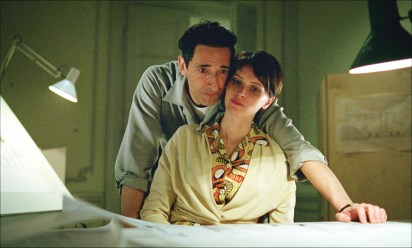
We’ve seen stories about the difficulties of achieving the American Dream before. Some are harder than others. This film takes a cynical look at an architect who achieved his American Dream. We have a Jewish architect who left post-Holocaust Hungary to find refuge in the United States and achieve his success there. We see how he has to fight his demons like his infidelity, family members that are petty, harrowing memories that cause him to take heroin, a difficult market for his Bauhaus style, rival architects, people that want to use him and above all, his own egotism. It’s not at all a pretty sight to see but it does tell a good story of a man hoping to pursue his greatness in the United States.

The thing that makes this film is not just the telling of Laszlo Toth’s story, but how it’s presented. The film begins as Laszlo’s ship sails past Ellis Island and he sees the Statue Of Liberty, but from his angle, he has to look at it upside down. He has to struggle to achieve his dream by eating at soup kitchens, living at the YMCA, embraced and then neglected by a family member who’s a successful business man, and having to prostitute himself at times. His breakthrough comes by fluke as it was the renovation unapproved by Harrison Van Buren where they first meet, and the meeting is bad. It’s after Harrison discovers who Laszlo is and of Laszlo’s pre-war success in Hungary that he’s willing to take him on. It’s not an easy task as it involves years of work and labor, supplies cancellations, dirty work form Harrison, his friendship with Gordon put to the test and Laszlo’s own ego coming to light. Then there’s how Laszlo’s attempt on success threatens his marriage to Erszebet as she has now arrived in the United States. She knows his secrets and she says she’s fine with it, but it will become obvious she’s not. His success threatens family unity with the niece as the daughter adopted after the Holocaust.

The crazy thing about the film having a half-hour intermission may have some question its purpose. We should remember many decades ago, it was common for long movies to have intermissions. This film’s intermission is very successful not only in dividing the movie properly, but give you the feeling you’re watching two different films. The first half focuses on Laszlo’s arrival, his attempt to make it in the United States, the dirty obstacles he has to face and his big break. And right while he’s writing to Erzsebet with the hopes of her coming to the United States. At the end of the intermission comes a new scenario. As Erzsebet finally arrives in the United States with niece Zsofia, there’s the added pressure of keeping a family together. Especially since Laszlo can’t keep his secrets to Erzsebet any more and she has a disability to deal with. Over time, she senses things like Laszlo’s ego and how Harrison wants to make a pet out of him. Despite being confined to a wheelchair, Erzsebet is able to muster the strength to use her walker to confront Harrison about his mistreatment of Laszlo. The ending epilogue is also something as Laszlo is saluted for his work, in Italy. It’s like he achieved his American Dream but had to achieve it at a harrowing cost and he had to get his honor from outside the US.

This is an accomplishment from Brady Corbet. Younger adults may remember his teen actor days in films like Thirteen and Thunderbirds. Like a lot of young actors, Corbet felt the need to make films of his own. This is Corbet’s fourth feature film. This film that he directs and co-wrote the story with wife Mona Fastvold is definitely something. It mixes some classic film styles while telling the story of a Holocaust survivor’s pursuit of the American Dream. There have been films where the American Dream has been achieved at a big cost before, but this film meshes Laszlo’s pursuit with the shaping of the United States and most notably Pennsylvania after World War II. As the US shapes itself after the war, Laszlo attempts to shape his success in the US, but at a huge price that comes at the cost of him, his dignity and his marriage. Right at the end as they have the tribute gala in the epilogue, you wonder if this should be a happy occasion or not with what Laszlo has gone through.

Excellent performance from Adrien Brody. Remember him from 2003’s The Pianist? He appears to have kept it low-key since. This year, he comes back with another performance of a lifetime where he shows Laszlo to be a creative man and a troubled man. He will make you hate him as much as he will break your heart. Also great is Felicity Jones as Erzsebet. It’s the appearance of Erzsebet that most turns this film into two films in one. With her arrival comes the change of environment. She appears to be one who will most interfere with Laszlo’s success and even a victim of his own selfishness but in the end, she’s the best person Laszlo needs during his most troubling time. Guy Pearce is also great as the deceptive Harrison. He’s excellent in portraying an all-American businessman who welcomes Laszlo and his talents, but as long as something’s in it for him and is willing to make a toy of Laszlo. Additional excellent acting comes from Raffey Cassidy, as the niece Zsofia who’s mute at first but soon develops her ability to talk, and from Isaach de Bankole as Gordon, Laszlo’s first friend and business associate who Laszlo later turns on in his success. Excellent technical merits are the cinematography of Lol Crawley, the production design of Judy Becker and the musical score from Daniel Blumberg.

It’s easy to see why The Brutalist is a heavy favorite to win Best Picture. It combines a graphic disturbing story of one man’s pursuit of the the American Dream and shows it in a stylish artistic fashion. Hard to outdo it.

And there’s my look at the first two Best Picture nominees for this year. If you’ve seen them, you can understand why they’ve won most of the Best Picture awards.

2023 Oscars Short Films Review: Animation

It’s interesting with seeing the reels of the shorts films, the Animation nominees are often the ones with the least total running time. They go by so fast, the shorts.tv reel add in a couple of other shortlisted films that got their honorable mention.

Anyways without further chit-chat, here are my reviews of the nominated animated shorts:

Letter To A Pig (dir. Tai Kantor) – The story begins telling of a boy hiding in a pig sty from Nazis who seek to put him in a concentration camp. The Nazis can’t find him. Fast-forward many decades later. The man tells his story to school students on Holocaust Memorial Day. He tells of how he credits the pigs in the pig sty for saving his life. He even wrote a letter to the pig. As he reads it aloud, one boy gives a taunting “oink,” while a female student listens intensely. As she engages herself in the story, she imagines herself and her classmates coming across a giant almost monstrous pig and them holding him prisoner in a trap. As they hold the pig prisoner, she can feel her nose metamorphose into a pig snout. Soon she feels sympathy for the pig and lets the pig go. As the pig is set free, he shrinks into a piglet and she hugs him.

This is an impressive story. It’s a story of a man who tells how a sty of pigs — animals he had been taught his whole life to regard as filthy and disgusting — helped spare him from dying in the Holocaust. As the young girl hears the story, she reflects on her own feelings of human hatred directed towards a pig in her mind and how she develops sympathy soon after and learns to love the pig. The story has its themes of collective trauma, fear and identity. It’s done in an impressive style that consists of a mix of 2D pencil drawings with minor colorization and mixing it with live-action images. The film is as much about the imagery as it is about the story. That’s why I give it my Will Win pick.

Ninety-Five Senses (dirs. Jared and Jerusha Hess) – The story begins with a man telling his views of human senses and colorful images about from the words he tells. At first you get the impression, this man is friendly. Then you hear his story. This man is on death row having his last meal. The capital offence he committed was arson of a repair shop he was fired from. He loved the jobs, but couldn’t handle being fired. He responded by setting it ablaze, forgetting the shop was also a house where the family lived above. As he anticipates his last meal, he looks over his past with regret, but also a sign of hope in the afterlife. He even has an outlook of how all once a person died, each of the five senses fade in their own way one by one. After a life of only five senses, he looks forward to the 95 senses in the afterlife.

It’s very rare you hear a story of a man awaiting execution to be told with a light-hearted spirit or even with some optimism. Never mind including humor. The man, voiced by Tim Blake Nelson, does a great job in telling his story without it becoming a common “Sob Story” you’d expect from a Death Row inmate. The story comes with some surprises for those who watch, like you wonder how a man that sounds so friendly would end up on Death Row. The film even ends on a humorous note. The story not only tells of the incident and of his observations and hope, but it does so in including in all five of the human senses. The story is told through six different animation styles and a multitude of colors that’s a delight to watch, despite the dark subject matter.

Our Uniform (dir. Yegane Moghaddam) – This film is where Yegane tells her story of growing up as a girl in Iran right after the Islamic Revolution. She talks of how the female teachers taught the girls to shout anti-American, anti-Israel and anti-UK messages on a daily basis. She talks of the uniform she was required to wear at school and of how the women there were firm in how all girls should wear their clothes in a proper manner and have all their hair hidden in a hijab. She talks of the difficulty she had in the hijab covering her hair that was longer than the hijab cloth, which got on the women’s nerves. She reflects on how growing up, she was taught under the new revolution to feel like she was inferior to men or below men.

No question this is a film of how a girl was indoctrinated with sexism not simply at a school, but from a system implemented by the ruling regime. The theme of the story is to do about clothing and the strict religious regulations of how girls should wear their clothing according to the new regime. The story is told with stop-motion imagery using clothes or fabrics of the clothes she wore as a child. The images drawn or painted on the clothes as well as the stop-motion movements of the clothes do a great job of telling her story. The use of clothing in the animation of telling the story is vital since clothing has a lot to do with what life was like under the regime. It makes the images as vital to the story as Yegane’s retelling. Hiding all your hair in a hijab and wearing a dress that covered everything was the new law in Iran and the film shows it in a unique way.

Pachyderme (dir. Stephanie Clement) – A woman retells her story of how as a young girl, she would often stay at the cabin of her grandparents. Her grandfather’s stern manner leaves her with a feel of fear and discomfort. The cabin was located by a lake. The cabin bedroom she sleeps in has a displayed elephant tusk the grandfather names “Pachyderme,” pointing in its direction in the hall. The room would give the girl and eerie sense about it through the wood imagery and the creaking of the boards. Even though the grandparents would say there’s nothing to fear, she felt there were monsters to take her. She goes to a lake where a woman had drowned some time earlier and feels spirits drawing her to its depths. Some time later, the grandfather dies and Pachyderme is split in two. As she returns to the cabin following her grandmother’s death, she takes both pieces of Pachyderme to the lake to bury it in the water. One of the two pieces is not completely immersed.

This film has to be the darkest of the five. In reading articles about it, it deals with the subject of incest. Incest itself is disturbing enough for audiences so it makes sense that it’s told through subtle imagery and storytelling that hides the actual facts. The theme of how she regards her grandfather as a monster and how it’s represented in Pachyderme adds to the storytelling, including the burial at sea. The ending where she attempts to bury the two pieces of Pachyderme in the water remind us she can bury a horrific memory like her grandfather’s terrible ways, but the small piece sticking out reminds us the bad memory can’t completely be buried. The imagery of the story is told through 2D images that appear as common images one would remember from storybooks they read. Possibly the monster that is her grandfather is epitomized through the common images of monsters we read in our children’s books of the past. It’s charming in its imagery as it is disturbing to see and listen to the harrowing story.

War Is Over! Inspired By The Music Of John And Yoko (dir. Dave Mullins) – The film starts in a battlefield of war. One soldier has a chess set where he appears to play by himself. After he makes his move, he writes his move on a piece of paper and attaches it to the leg of a messenger bird. The bird flies to “enemy territory” and gives the message to an “enemy” soldier who also has a chessboard and looks like he’s playing by himself. After he makes his move, he writes his move to a message for the messenger bird to deliver. Over time, the intrigue grows with the soldiers on both camps. As the bird delivers message after message, the anticipation on what the next move will be or who will win appears to quell the enmity between both sides. Then checkmate! But the sergeant is disgusted by what he sees. He reminds the camp they’re enemies and the battle must begin now. The soldiers on both sides line up with bayonets and all ready to do battle against the “enemy.” The battle begins and bloodshed ensues. On the field one soldier notices the messenger bird is shot dead. Just as the two soldiers from the chess game confront each other, it’s there from a message that slips out that one realizes the other is his chess rival. They drop their guns. All drop their guns when they see the written message “War Is Over.”

This is a creative story Dave Mullins directs and co-wrote with Sean Ono Lennon and Brad Booker produces through the inspiration of John Lennon’s legendary Christmas song and the message “War is over if you want it.” The one 3D-computer animated film nominated in this category this year, this is a film with a montage appearing to have a World War I setting and sends a message that still matters today. There may be a winner in a chess game but there are no winners in war. The scene where all the soldiers are intrigued and excited by a chess game against a player from the “enemy” side sends the message that enmity is something war creates and provokes, and is often unnecessary. The ending where the bloody battle is instantly ended with the written message “War Is Over” also sends a message of how many battles are in vain. The story first seems to be a story that’s either cute or “fluffy,” but the ending of the bloody battle with “Merry Christmas (War Is Over)” sends a significant message that is as important today as it was when John and Yoko recorded it back then. That’s why I give it my Should Win pick.

And there you have it. That’s my review of the five films nominated for Best Animated Short Film. Interesting that in a time where animated features appear to be dominated by 3D computer animation, only one of the five nominated films is such. That’s what I like best about this category. It opens itself up to various styles of animation, rather than going with one that’s all the rage.

2023 Oscars Short Films Review: Documentaries

Once again with the Academy Award nominations being awarded for the biggest feature-length films of the year, the AMPAS Academy also rewards the short films in three categories. I’m lucky to live in Vancouver where I can see the short films on the big screen.

The first set of films I will be focusing on is Documentaries. In each of my blogs about the short films, you will also get my predictions for which films Should Win and Will Win:

The ABC’s Of Book Banning (dirs. Sheila Nevins, Nazenet Habtezghi and Trish Adlesic) – This documentary focuses on recent regulations implemented in American school systems in the past ten years to ban certain children’s books. Most notably in Florida. There are three classifications: Restricted – disallowed to children unless permission from parent; Challenged – at risk of being banned from school libraries; and Banned – completely banned from school libraries. The books banned are mostly to do about the themes of racism and racial empowerment, sexism and female empowerment, and LGBT pride. The authors are unhappy and the children can’t fathom why they’re banned and are disappointed with the reading material they are allowed to read.

This is a smart documentary that highlights the problem from all angles. It doesn’t just show the classification system but also the books that have fallen prey to this system. We hear verses from the book and we sense why they’re banned, but still wonder what’s the problem? We hear from some of the authors of these banned books and what they have to say. We hear what the children have to say and how they can’t understand why they’re banned and what they’re left with are books with weak material. You’re left feeling for those children and the lack of knowledge they’ll be receiving. You’re also left wondering about how the USA — a nation that advertises itself as “the land of the free” — can allow for book banning to happen. I thought book banning and book burning were considered “Un-American!” Not anymore? That’s why I pick this as my Should Win and Will Win picks.

The Barber Of Little Rock (dirs. John Hoffman and Christine Turner) – In this documentary, we are introduced to Arlo Washington. He started as a barber in Little Rock, Arkansas to help raise and provide for his younger siblings after his mother died shortly after his graduation. Over time, he progressed to opening his own barber shop, then his own haircutting school, and then opening a loan company that gives loans to African Americans and other impoverished people the banks normally reject. The film not only showcases what Washington has accomplished but also interviews some of his loan customers from his bank and gets them to describe systemic racism.

The best thing about this documentary is its insightfulness. It touches on a topic we commonly hear about, but know very little of the stories of people who live it. We learn of the man who beat the odds, but he’s not hoarding all his wealth to himself. He’s a man who knows the problem and is willing to create things to empower people like never before and even fight a centuries-long problem like never before in the community. The film also reminds us that what he’s fighting is a nation-wide problem. The opinions from his interviewed clients about the topic of economic discrimination and systemic racism will open your eyes to the very people who have been hurt by this. Although Washington is doing a great job fighting it in Little Rock, he can’t fight it alone and there’s lots to be done nationwide. This documentary is very much an eye-opener.

Island In Between (dirs. S. Leo Chiang and Jean Tsien) – The film is about S. Leo Chiang, a Taiwanese-born American filmmaker, who returns to his nation of birth, but to an area he only knows from his family’s past military duties. The part of Taiwan he returns to is the Island of Kinmen. Kinmen is a set of Taiwanese islands that are closer to Mainland China than the main island of Taiwan. Actually the area of Kinmen he lives in has just a three-mile separation from the island city of Xiamen through the Tuyu Islet. As he sees this seemingly-short gap of water between the two islands and the rusty military guns that sit by the coast, he reflects how he was taught Taiwanese pride in his childhood and of anti-China propaganda he was taught. He talks of his confusion of his citizenship as he mentions of using his Taiwan passport to return to the US, but use his American passport to visit China. He talks of radio messages sending messages of freedom to the citizens of Xiamen and continue to be sent. He talks of the fear of war with Mainland China that could erupt and how tensions appeared to be easing in the last twenty years. One of the breakthroughs was a ferry system that could allow Taiwanese people to visit Mainland China that went well until the COVID pandemic hit.

This film serves as a reminder of the Cold War we forgot still exists. The Iron Curtain that was broken down in Eastern Europe in the early 1990’s overshadowed that hard-line Communism still exists in a few nations like the People’s Republic of China. Those unfamiliar with history will need to know China underwent a Cultural Revolution shortly after World War II which separated the Communist mainland from the capitalist Taiwan. The two nations have been bitter political enemies since the start. There was warfare between the two in the 1950’s. Despite the war ending many decades ago, the fear of another war still continues despite the guns rusting away on the coasts of the island. Chiang shows how all this has had a hard time for him establishing his identity. The national politics, the use of passports and the recent slow breakdown of political barriers leaving him wondering how should he identify himself? Chinese? Taiwanese? American? This is another documentary that’s insightful about a topic we so easily overlook.

The Last Repair Shop (dirs. Ben Proudfoot and Kris Bowers) – This film focuses on a shop in Los Angeles that repairs musical instruments. It’s not just any repair shop. This repair shop repairs musical instruments for the 80,000 school students in the Los Angeles Unified School District area free of charge. It’s the last shop of its kind left in LA. Featured are the repair people: Dana, who repairs stringed instruments; Paty, who repairs and cleans brass instruments; Duane, who takes care of woodwinds; and Steve, who repairs and tunes pianos. In the film we learn Dana is a gay man who had to be closeted in his early years, even as he did music in his prime. Paty, a single mother, first appeared to have a limited future as a music teacher until a chance to show her skills opened doors for her and a better income for her family. Duane used to be a banjo player who performed for the President of the United States. Steve learned music in his home nation of Armenia until a war in 1990 where his father was killed caused his family to flee to the US. The film also shows some of the students whom benefit from the repairs performed. Most are from underprivileged areas. The film ends with a final symphony with all.

This is one of the least heavy documentaries of the five nominated. This is a film that will remind you not to take things for granted. We learn of the students whom are benefiting from this. Students that value the music lessons and see ambition in their instruments and their lessons. Students that wouldn’t have much of a chance elsewhere, or would come at a cost. We learn of the people in charge of the shop. We learn of their backgrounds and how music either was always part of their life or changed their lives for the better. We learn of how some like Paty have this as an opportunity to beat the odds and have something better for herself and her family. As we watch the final symphony, we see how for all involved that music is not just music. It’s a crucial part of their lives and represents a future of promise for the young. This is not simply a documentary that’s light-hearted. It’s as much insightful as it is a delight to watch and enjoy.

Nǎi Nai & Wài Pó (dir. Sean Wang) – Two grandmothers. Both in-laws. One grandmother goes by the name Nǎi Nai. The other goes by the name Wài Pó. One is in her 80’s, but still feels young. The other is 94, but feels like she’s 100. They both live in the same house and sleep in the same bed. The two talk of their history and of how they first met. The two talk of how both of them, each different in their own way, manage aging and still do their best efforts to maintain a vital life. The two also talk about the fears of aging. Especially as one looks through an old personal phone list and notes how it has the numbers of those that are deceased.

This is a documentary that’s sweet, funny and sad at times. We see two grandmothers of the filmmaker who go by different names and live together. Their friendship is surprising since in-laws are known to be at odds with each other. They show how they continue to pursue vitality in their ages and will do it in their own way, whether by one doing cultural sword arts or one drinking shamelessly. They also show that they won’t shy away from some of the dark realities of aging. They know that despite the vitality they pursue and odds they aim to beat, there are some sad reminders of some realities around the corner. It’s a mix of bitter and sweet that is impressive to watch. Including the ending where one calls Sean a brat!

And there you have it. That’s my review of the five documentaries nominated in the category Best Documentary Short Film for this year’s Oscars. I know I described many of them as “insightful,” but all of them are eye-openers that will get you to see more about topics you may already be familiar with, topics you never know about or even topics you may have overlooked before.

VIFF 2023 Review: The Sacrifice Game

The Sacrifice Game is a super-bizarre story of a Christmas dinner two private school girls will never forget. Try as they might!

Can you mix the horror movie genre with the Christmas season and be able to create a good movie of the mix? The American film The Sacrifice Game makes that brave attempt.

The film begins with what appears to be four guests approaching a Christmas party three days before Christmas 1971. The hosts don’t recognize them, but that doesn’t matter because the four ‘guests’ kill the family in their home. One of them paints an image with a victim’s blood on the window. The following day is the last day before Christmas for a boarding school. All the girls leave the school and the dorms to be with their families for Christmas. All except Samantha, whose father can’t see her for Christmas this year, and Clara who appears not to have a family. Rose, one of the teachers, is willing to have a Christmas dinner with the two girls at the school. She even gets her fiance Doug to help.

That same day, the group of four, maned Jude, Maisie, Jimmy and Grant, go to a nearby church and claim the priest as their latest victims. Before they leave him behind, they take a piece of his skin that has like a bizarre tattoo on it. As the time gets closer to the ‘party’ at the girls’ school, Samantha tries to start conversation with Clara. Clara is reluctant. It may appear shyness, but more like Clara has a secret. A secret notable from the scars on her skin. Also the girls at the school hear the news of the killings. It makes them nervous, but they think it’s a distant problem.

The next day, two days before Christmas, Rose is helping to organize the dinner and Doug is helping along. The two girls go to the more closed-off areas of the school building. They come across a lot of secret things, including books they’re not to read. Meanwhile the four claim their latest victim. A policeman stops their car on the road. As he inspects the car, he comes across the pieces of marked skin from their victims. He becomes the latest victim of the four. The following day, Christmas Eve, Rose has everything ready for the two girls and Doug is heading over to the school. The group of four approach Doug and kill him. They then enter the school where the three are waiting for Doug and the group kidnaps them.

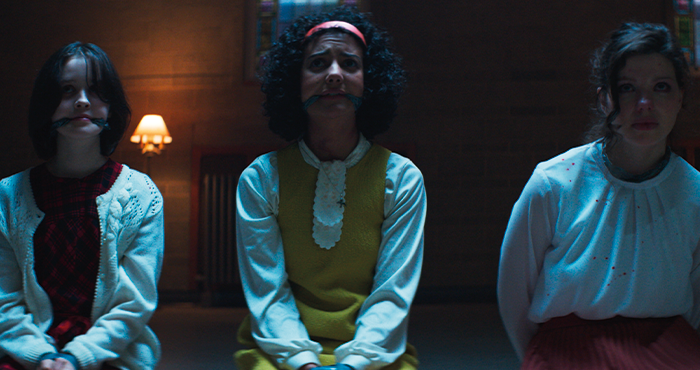
This is it. It’s Christmas Eve and the group of four are now terrorizing the three girls all tied up. Jude, the de facto leader, talks about how lovely the party is in a sinister way. He terrorizes them at the dinner table and in the gift area. Then Jude tells of a force that he read in a book and he believes to be coming to this very school on Christmas Day. Rose chastises him for it, but she gets killed. Now it’s just the four and the girls as the four wait for the force to come at midnight.

Midnight happens, but the force the four were hoping for doesn’t appear immediately. Jude, who appeared to be the one in control, is now angry and out of control. The three others go searching around the school. This allows the two girls to break free and hope to escape, but their secret is revealed to one of the members. Over time, the four are both trying to look for the spirit and chase the girls down. Samantha and Clara search things out but Samantha discovers secrets about Clara. To best describe the ending without giving it all away, it becomes a twist and turn of events in which leave the four of them dead and Samantha shocked for life!

Doing any horror movie is always a challenge. Humor is welcome, but to a limit. The best element of a horror movie is to give the audience a sense of fear. People come to horror movies to be scared for fun. Adding in the theme of Christmas does set up for a risk of balancing out being funny with the aim of scaring people. This film does a good job as it tells the story over four days. The four are in search of a demon. The people they kill before they go to the school are people with a skin print they believe will connect them to the spirit they search out. They sense it at the school but they can’t find it only for an unlikely girl to be the very spirit they were looking for.

The intriguing thing about this film is that it comes close to the time another film about kids left behind during Christmas, The Holdovers, is about to come out in theatres. Here we have two female Holdovers at an all-girls school in the 70’s. This is different as the teacher is very willing to befriend the girls. She even brings her boyfriend to the dinner. Little did any of them know of the mayhem of terror to come.

The film is mostly successful in piecing the story together, but its flaws are noticeable. The most noticeable is the middle of the story where the team of murderers wait for the moment to happen. Usually in horror films, the biggest clinic would come at the very end. It comes at the middle and it seems like.it’s trying to drag the climax throughout the rest of the movie. I’m sure there are a lot of people that felt the film either get too slow or too confusing. Also that twist when it becomes Christmas and the big force they expect to come doesn’t, I think that will leave a lot people scratching their heads and wondering what’s going on. I have no problem with surprise plot twists, but as long as they’re done well. Also the portrayal of insanity in some of the characters like Jude. That seemed too over the top.

Overall I consider this to be a good film by director Jenn Wexler. This film she directs and co-wrote with Sean Redlitz is a good take on using Christmas as the setting of a horror story. Wexler has already had experience in directing horror with 2018’s The Ranger. Here she takes a story that’s unpredictable and adds a few twists to it. Although it’s not as smooth and one might question the choices she makes, it actually turns out to be better than your average horror film and doesn’t cross into the stupidity traps most horror films fall into. As far as acting, the two girls, played by Madison Baines and Georgia Acken, were the best performers. They both played two scared lonely girls who felt like misfits in a boarding school well. Acken transitioned into her horror character well. That’s what makes for a believable horror story.

You’d think it’s highly unlikely that a horror film would win awards at film festivals but The Sacrifice Game has won awards. At the Fantasia Film Festival, it won the Audience Award for the Best Canadian Feature. Even though this is an American film, it qualifies as a Canadian film in some festivals because it was filmed in Quebec. The Nashville Film Festival awarded it the Best Graveyard Shift Feature award!

The Sacrifice Game is not the first horror movie to mix a horror plot with the Christmas season, nor is it the best. Nevertheless it does take full advantages of putting the Holiday season in its plot and even paves the way for an unlikely heroine!

VIFF 2015 Review: A Syrian Love Story

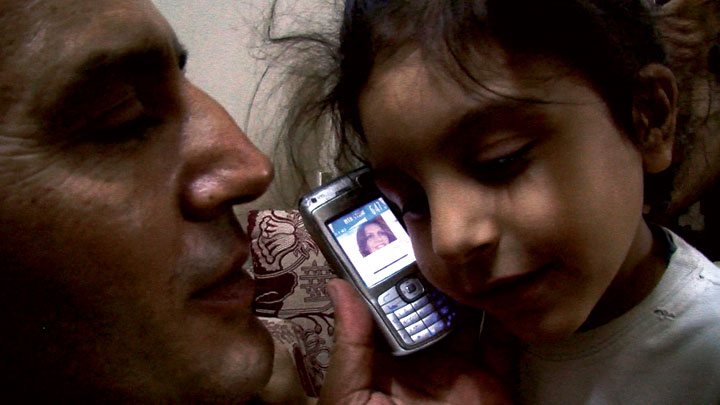
A Syrian Love Story focuses on a Syrian couple from the start of 2011's Arab Spring to the present.
A Syrian Love Story focuses on a Syrian couple from the start of 2011’s Arab Spring to the present.

I saw quite a few documentaries at this year’s VIFF. A Syrian Love Story was one documentary that gets one thinking.

This is a documentary filmed year by year over five years. It starts in 2010 while Syria is going through its start of political turmoil. It had been under turmoil since the 1970’s when Hafez Al-Assad took power and any reforms promised by his son Bashar, who succeeded Hafez in presidency after his death almost ten years earlier, doesn’t deliver in the reforms he promised. Images of protest met with a violent response from government forces are too common. Caught in the middle is a married couple of Amer Daoud and Raghda Hasan. They have four sons from 6 to 22. Amer is living in Damascus being a father to the children. Raghda is in a prison for publishing a book about their relationship of all things. Amer and Raghda are no strangers to political oppression in their home country. Raghda has face imprisonment because she’s a communist revolutionary and Amer was once imprisoned with his ties to the PLO. In face they both first met in prison and fell in love through communicating through a prison wall.

Sean McAllister is in Syria looking for something about Syria’s crisis to film but something out of the ordinary. He finds it in Amer and Raghda. McAllister also shows us their four sons. The first year he films Amer’s phone conversations with Raghda while she’s in prison. He gets her sons to talk with her as well. McAllister was even imprisoned for a few days for a journalism crime and was able to listen first-hand to the torture in Syria’s prisons. He even meets the older son who broke up with his girlfriend because she was pro-Assad. Despite all this, McAllister does show a case of hope for the future, for all.

In 2012, Raghda is finally free. She is reunited with her husband, sons and the rest of her family. But they can’t stay in Syria, not while there’s civil war that started once Syrian people revolted against Assad during 2011’s Arab Spring. The family move to a refugee area in Lebanon. They do it not simply for the sake of themselves but their sons too. McAllister is nervous for the couple’s future since he knows behaviors of prisoners after they’ve been freed. He hopes Raghda doesn’t exhibit behavior that will hurt their marriage.

In 2013, they find themselves in Paris, France. Things are definitely better for the two youngest children Kaka and Bob. Bob is in a good school and Kaka is able to become a disc jockey at his high school. Things appear to go well for Amer and Raghda as they’re able to make a living for themselves but there’s a sense that something’s wrong. The children sense it.

In 2014, we get a good sense of what’s wrong. Amer and Raghda’s marriage is crumbling. Amer feels distant from Raghda and has a French girlfriend of his own. It upsets Raghda to the point she changes the password on his laptop. She even attempts suicide by cutting her wrists. No doubt it upsets everyone. She them admits she never had the chance to find herself and she feels that despite her  political freedom in France, she still feels she can do more for Syria or for others hurt by war.

The film ends in 2015. They two youngest sons have a promising future in France. Their older son reveals his pro-Assad former girlfriend was killed. Asad runs a chicken farm in France and is without Raghda. He wishes her well in whatever she does. Raghda is now in Turkey in a city 20 miles from the Syrian border. She works with refugees and is happier with her life now.

This is a unique story of love that starts with one hoping for a happy ending. We know Syria won’t turn out for the better but we hope that Raghda will be free and will return to her family and they’ll live happily ever after. We all want that storybook ending. Unfortunately it doesn’t end up that way. McAllister knows the problems prisoners exhibit after they’re free and he lets Amer and all of us know it. Over time, it shows after the moves, after Syria’s continued strife and after one senses the love between the two fading over time. It was unfortunate. The moment of hope doesn’t end up being when Raghda is free but rather when Amer is still in France and Raghda is in Turkey. That’s where the true scene of hope for the better is present.

The story is not just about the couple. It’s also about the surrounding family. This is especially noteworthy of the two youngest sons, Kaka and Bob. Bob is six at the beginning and the youngest. He tried to be a carefree child but the hurt of knowing his mother’s in prison is evident. Kaka is ten at the start and familiar with the realities in Syria. He’s able to tell Sean in good enough English his feeling of the situation, and of how he’d either like to fight or kill Assad. As they grow, the changes are present. Bob is getting bigger but has difficulties fitting into his school in Paris because his long hair causes other boys to call him a girl. Kaka is getting a better education but can’t ignore what’s happening to his parents. He can sense what’s happening and has his own opinions on what he feels should happen. Although the two are not the main protagonists, their presence in this story is vital.

One thing about this documentary is that the story focuses more on the fading marriage than it does in the strife in Syria from civil oppression to public outcry to a civil war to the eventual crisis with ISIS. However it does focus on the couple as they were fighting their own war with each other. They go from loving each other and having a closeness while Raghda’s in prison to the love fading over time after Raghda is free and they’re together again. It’s sad that they were closer together when Raghda was in prison. It’s even hard to pinpoint who’s the bad guy. Is it Amer for his fading commitment? Or is it Raghda for her inner strife? Amer appears like a jerk not even willing to try when he says things like “Syrians love prisoners,” but Raghda’s suicide attempt gets you wondering was she thinking of her family at the time?

Watching this documentary, I believe that this isn’t the type of documentary meant for the big screen. With the camera quality, editing and McAllister’s voice over, it fares much better as something for television broadcast. I’m sure that’s what it intends to be. I have to give McAllister credit for having the ability to do all this filming over time and to present a unique story. I also give Amer and Raghda credit for McAllister willing to film them while their marriage was hitting rock bottom and they were showing terrible behavior such as Amer threatening to smash his laptop and Raghda slitting her wrists. It surprises me that they were willing to show things that personal on camera.

A Syrian Love Story may not be a documentary meant for the big screen but it’s a very revealing story that reminds us not all love story has the fairytale ending. despite the hardships they show, it does end on a hopeful, if not happy, note.

Oscars 2013 Best Picture Review: Philomena

Judi Dench plays Philomena Lee, an Irish woman looking for he long lost son, in Philomena.
Judi Dench plays Philomena Lee, an Irish woman looking for her long lost son, in Philomena.

The premise of Philomena may make many people nervous about seeing it. The questions before watching it will be “Will it be too disturbing?” or “Will the Catholic Church get knocked on screen again?” There’s only one way to find out.

The film begins in 1951 with a teenage Philomena Lee. She meets a young boy at a town fair whom she completely falls for that one day. Fast forward to 2004. Martin Sixsmith is an unemployed journalist since the Labour Party, the party he works as a government advisor, is beset by scandal. He goes to a party and meets the daughter of Philomena Lee who encourages him to write a story about her mother who was forced to give up her baby boy Anthony more than 50 years ago. Martin is uninterested in writing a human interest story and is more intent on writing a book on Russian history. However it’s after he meets Philomena and hears her story about how it all happened that he changes his mind and investigates further.

Once she was pregnant, she was sent by her father to Sean Ross Abbey, a mother-and-baby home that young unwed pregnant girls were sent to. It was terrible to live there while under the orders of the strict Sister Hildegarde, especially if she was assigned to do the laundries for four year to cover her stay. Nevertheless she was able to see her baby Anthony whom grew attached to her friend’s girl Mary. Then one day Philomena saw Mary and Anthony adopted out of the house. All Philomena could do was watch in heartbreak 30 feet away as her infant son was taken away.

Philomena had tried for years to find out what happened to her son by visiting the convent to no avail. Martin goes with Philomena to the convent only to hear from the nuns the records were lost in a fire years earlier. It’s over at the pub they hear from locals that the records were purposely destroyed in a fire and the children were sold to rich Americans. It’s after Martin’s searches in Ireland coming to a dead end that he decides on an arduous task. He decides to get the answers by visiting the United States and having Philomena accompany him.

Upon arrival in the United States, he learns through various search sites that Anthony and Mary were adopted by Doc and Marge Hess who renamed him Michael. Michael grew up to be a lawyer and a senior official to the Republic Party during the administrations of Ronald Reagan and George Bush Sr. He also learns news of heartbreak. Michael died in 1995 at the age of 43. The news naturally breaks Philomena’s heart but soon she wants to meet with people who knew Michael.

She meets one colleague and learns Michael was gay and died of AIDS. She meets up with Mary who grew up with Michael and eventually became a mother. Mary reveals Michael had a boyfriend named Pete Olsson. Pete is unwilling to cooperate despite Martin’s please but it’s not until Philomena pleads face to face with Pete that he complies. The visit with Pete is warm as he tells her of Michael’s childhood and even shows home videos. It’s when Philomena sees a video of Michael at the Sean Ross Abbey that she learns Michael tried looking for her while he was dying. She also learns he was buried over at the Abbey.

It’s then when Martin and Philomena return to the Abbey where it all started. It’s there where Martin can confront Sister Hildegard for being strict on the girls and being deceptive to both Philomena and Michael, whom she told Michael he was abandoned and they lost contact with the mother. Hildegard is unrepentant but surprisingly Philomena approaches her and forgives her. It’s right at Michael’s grave that she can finally meet the son she’s always looked for and finally make peace with her past.

The best quality of the movie is its unpredictability for those who’ve never learned the story. There may be some who have already learned the story of Philomena Lee but most who haven’t. If you don’t, then this movie will surprise you in many areas. It’s not just about Philomena’s search but learning of her son and what happened in the end. The film is full of moments. Moments of happiness, moments of tension, moments of relief, moments of surprise, moments of sadness and moments of humor. The film shows that the trip Philomena went on was not just about leaning about what came of her son but also her own personal journey of healing. A healing that needed to happen and occurred in unexpected ways.

Another great quality is the portrayal of the characters themselves. Philomena comes across as a very likeable and charming woman. Nevertheless one would question how smart she is at times and even question her faith if it’s just routine or even strong. Philomena is seen as simple and sometimes blames herself for a lot of wrongs in her life. However she comes across at the end as a stronger person than one would originally think. The biggest surprise is it would be Martin who most seems to have problems and issues while Philomena, who is the one who actually endured trauma, who still smiles at life in the end despite the harshness she went through.

Martin himself comes across as your typical egotistical journalist who appears to want to destroy the Catholic Church with his pen but somehow has a softening of heart once Philomena comes into his life. He will first make one wonder what his true intentions of helping Philomena learn of her son is: to really help Philomena or to get a great story published. In the end, he comes off as rather likeable for a journalist. Proof that even a journalist can have a heart!

I know there may be some Catholic readers that may be hesitant about seeing this film and the way the Catholic Church is portrayed. Yes, it’s surprising that Catholics would be more concerned about their depiction of the Church in a film that’s not by Martin Scorsese than whether Scorsese’s latest has another slamming of the Catholic Church in his latest. Even I myself was a bit concerned about seeing this as I saw The Magdalene Sisters ten years ago and it really was a nasty depiction of nuns and priests as well as a harsh but true look at the abuse the girls received. Philomena doesn’t show the girls in the laundries suffering abuse. It shows then doing the laundry but it does show the heartbreak of a teenage Philomena as she sees Anthony taken away from a distant window. It also shows Sister Hildegard to be unapologetic for all she’s done, not even for the girls that died during childbirth.

Actually in retrospect, I think it makes the Catholic Church look like the bad guy while the Catholic faith comes across as a positive thing in the end. One will first think of Philomena’s Catholic faith as something too ritualistic or forced upon her and even prone to break at one point but one will see in the end that it’s her faith that helps her through her hard times. In fact Philomena’s response to why she forgives Sister Hildegard in from of Martin will astonish the audience and will surprise many about how forgiveness is actually a form of personal strength.  As for The Wolf Of Wall Street, Catholics should relax as the most there is in it is a joke about nuns which is the tamest taunting of the Catholic church I’ve seen is a Scorsese movie in years. I feel Philomena’s story of her search is an uplifting story of hurt and eventual healing.

Without a doubt, the standout of the film is the performance of Judi Dench. Judi is one of those actresses who really knows how to excel with age. I may have seen better acting performances from her but her portrayal of Philomena was excellent in showing the many dimensions of Philomena Lee as well as adding a charm to her. Steve Coogan was also very good in what I feel to be the best acting I’ve seen from him. His role as Martin didn’t have the same dimension as Philomena but it was a very good performance. Coogan also did a very good job of scriptwriting with Jeff Pope. The story keeps one interested especially for those who don’t know the story of Philomena Lee. Stephen Frears may not as done as spectacular job in directing as Judi did in acting and as Jeff and Steve did in writing but it is worthy of respect. It may not be as great as his Oscar-nominated directing in The Queen but it’s still a very good job. Finally, Alexandre Desplat does it again in making the film with his score composition.

Philomena may first appear like a harsh movie about a woman hurt by her past and finally looking for answers. In the end it turns out to be more bittersweet than harsh and will leave one feeling Philomena did win in the end.

Film Review: Blood Pressure

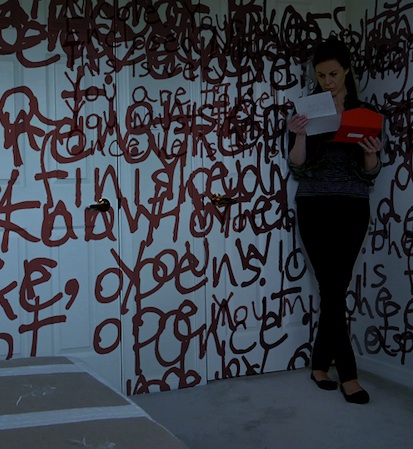
Michelle Giroux reads a letter from a secret 'friend' in the Canadian-made thriller Blood Pressure.
Michelle Giroux reads a letter from a secret ‘friend’ in the Canadian-made Blood Pressure.

Even though I’m excited about the summer fare in movies, I’m also interested in what the independent movies have to show. Blood Pressure is one. Shown at the VIFF Theatre in Vancouver, it’s Canadian-shot, Canadian-produced and Canadian-made. But is it one film for those who want to get off the beaten path?

The film begins with the reading of a letter addressed from ‘a friend.’ It’s to a woman named Nicole. The letter from this ‘friend’ appears to be one who knows a lot about her. The ‘friend’ knows she’s a pharmacist and married mother of two living in a Toronto suburb. The ‘friend’ even knows where she graduated from. The friend also knows she’s not too happy with her job and her family life. You’ll soon see the friend is right. She’s not happy with her marriage or her job at a pharmacy. The one person she can confide to is retiring from the pharmacy.

Interestingly the ‘friend’ knows what to give Nicole as this ‘friend’ gives her a card for a complimentary massage and a manicure. The friend even knows of her wishes as just days after talking to her husband about a vacation to Mexico, she follows a set of lights to a chair with a plane ticket to Mexico. And the friend gives her shooting range sessions and martial arts classes. The ‘friend’ then asks of her to do things to prove her loyalty such as set up a flyer in the mail a certain way. Then the requests get bigger as the ‘friend’ asks her to observe a young man with a cane in a cafe at a certain time. Then the requests become even more voyeuristic as the ‘friend’ asks Nicole to observe the man while talking on the phone without being noticed. It didn’t work and the friend asks her to view the man in his bed at a certain time and be very observant.

However this fixation of these letters starts to bear down on Nicole’s life. The shooting sessions and martial arts classes work for her and even improve her relationship with her daughter. However it’s leading to difficulties in her marriage and even disputes with her boss on the job. Then the moment when she can finally find out who the friend is: a request to give the man an envelope at the cafe. It’s there she finds out that he’s the friend but it’s at his hotel suite she finds out why. At the suite she learns of this man, Darryl Saunders, and of his debilitating physical handicap. He is impressed with her loyalty to him and gives her one last request: kill him.

Nicole doesn’t know how to take this request. She tried looking up his medical information only to learn of a Daria Saunders instead, who is Darryl’s deceased wife. Meanwhile she develops feelings for the man and has simultaneously won over the attraction of her pharmacy boss. This even has her husband suspecting an affair. This all leads to a surprise decision from Nicole which leads to finding out another surprising truth about Darryl. The end result is one that will surprise you and the movie ends on a note that can leave the audience deciding for themselves how it all ends.

This film is a very good example of a creative idea paying off. It all started with an idea from scriptwriter Bill Fugler from an idea while talking with writing friends at a café bookstore. Co-writer and director Sean Garrity added narrative elements to bring the story to the big screen. It was originally to be filmed in Winnipeg when a sudden career change with his wife led to shoot it in suburban Toronto: Richmond Hill to be exact. Jonas Chernick was cast to be Darryl. Michelle Giroux, a friend of Jonas Chernick, was a stage actor and originally only read with the male actors during pre-production. Garrity was so impressed by her reading, she was cast as the lead. It was an excellent choice as Giroux owned the film. She was given a very complex lead role that spoke volumes even when she wasn’t speaking at all and she delivered excellently. Jonas was also good as the hurting Darryl as was Jonah Katz as the struggling husband. Tatiana Maslany did an excellent job of portraying a teenage daughter despite being much older.

After seeing Before Midnight, I was tempted to think that Blood Pressure was about reaching middle age in today’s world and the emotions that run through people. Even though Nicole possessed a lot of feelings and frustrations one would have at middle age, it’s not what this movie’s about. It’s more of a psychological thriller that uses human emotions to keep the audience thrilled instead of special effects.

One thing unique about Blood Pressure is its surprise success. The film made its big screen debut at the Busan Film Festival. It was screened in Garrity’s home city of Winnipeg in February 2013 to sold out shows at Cinematheque cinema which led to a screening at the Grant Park Cinema weeks later. The film would soon have popular screenings in Toronto in March. Its success in Toronto and Winnipeg has led to other screening nationwide including Calgary screenings and a Vancouver debut on June 29th. I actually thought something like this would make its Vancouver debut at the VIFF. looks like its buzz made it happen faster.

Blood Pressure is a surprise for the summer but not on a large scale. Those interested in Canadian film will like this. This is an excellent triumph for Manitoba filmmakers.

Oscars 2011 Best Picture Nominee: The Tree Of Life

The Tree Of Life won the Palme d’Or at the 2011 Cannes Film Festival. The film isn’t the typical drama you’d come to expect. Instead it’s more introspective and delivers a message of a common theme of the human existence.

The movie’s story starts upon Mrs. O’Brien receiving the news of her son’s death. Mrs. O’Brien had always been taught everyone must choose between the path of grace or the path of nature. The son’s death would throw the family in turmoil. The movie then focuses on present-day Jack O’Brien, now an architect. When a tree is planted in front of his building, he reminisces about his life as a young boy during the 1950’s.

A pre-teen Jack is living with his family in suburban Waco, Texas and is now forced to choose the path for himself. His parents have equal bout opposite influences on him. His mother represents grace as she is gentle and nurturing but authoritative, presenting the world as a place of wonder. His father represents nature as he is loving but strict and authoritarian as he tries to make his boys tough for a world here perceives as corrupt and exploitative. He often questions giving up his passion of becoming a musician and instead became an engineer and hopes to achieve wealth through filing patents of his inventions.

Before Mr. O’Brien goes on a trip to market his inventions, a drowning death of a child at the town pool happens. Mr. O’Brien suddenly turns violent and unleashes an abusive rage on his boys and Mrs. O’Brien. While he’s away, Jack and the boys are raised exclusively by their mother and his feelings of rebelliousness start happening. Jack follows along with the other boys in his town and commits acts of vandalism and animal abuse, even theft of women’s underclothing from a neighbor’s house. It’s after that where Jack gets the first natural sense of his consequences and throws the stolen underwear in the river. Mr. O’Brien returns home having failed to sell his inventions. His plant closes and is given the option of staying with the company with an unpromising job or be terminated. He chooses the unpromising job which means the O’Brien family would have to move away from Waco. Upon leaving he asks Jack to forgive him for the harsh treatment of him.

What I just stated in the above synopsis was of the events that happened in the drama. That’s only half of it. The other half is what happens in the more sublime parts. The opening image of the movie is the mysterious flame that flickers in the darkness. We see it at the beginning of the film as it leads to the opening scene of Mrs. O’Brien receiving the news of her son’s death. Just as soon as an older Jack O’Brien reminisces of his childhood in the 50’s, the movie doesn’t shift back to Jack in the 50’s but of the very beginning of the universe. Galaxies are formed, planets are formed, volcanic activity and the existence of life begin on Earth, dinosaurs fight to survive and fight to conquer, an asteroid hits the Earth, and then the O’Briens marry and have Jack and his two brothers. This leads into the main drama of the story.

After Jack reconciles with his father the sublime returns as it fast forwards to an Earth five billion years later incinerated and shrunken by the sun and left completely devoid of any life. The movie returns to the present as Jack leaves work and encounters a vision of walking on rocks. As he walks through a lone wooden door frame, which is probably the door from the house in Waco which doesn’t exist, and is reunited with his family and all those who were in his life. Even those that died including his brother have been resurrected. The movie ends with the mysterious flame seen at the beginning continuing to flicker in the darkness.

For those who’ve seen the movie, there’s no question that the movie is very much thematic and gets you thinking. The biggest theme of the movie has to be the constant dilemma of the way of grace vs. the way of nature. It’s a constant choice everyone has to face in their life. It’s also made present in the movie that this dilemma has existed ever since there was life on Earth even before the human race. It’s a dilemma Jack is forced to confront as a child and witness his parents representing the two opposites. The way of grace is given additional support by the messages given by the priest. The way of nature is given additional support by all the rough, even destructive games the boys play. That theme and the various part of the film, both in terms of the plot and the sublime, focus on the theme of grace vs. nature being the universal pulse.

If there’s one weakness of the film that stands out, it’s that it tries too hard to be artistic and creative. I actually admire films that try to be original and take artistry to new levels. The only problem is all too often, many artistically inclined films look like they forget they are to be shown in front of an audience. When I critique movies, my attitude towards the more artsy films is: “Okay, I know you are trying to be artistic and creative but don’t forget you’ll be seen in front of an audience.” I also have a tough attitude towards commercial movies: “Okay, I know you want to make big money but give the audience their money’s worth.” Overall I feel a film doesn’t have to be entertainment but it should do something with the audience, like connect with them or get them thinking.

Enough about my critiquing guidelines. The problem with the Tree Of Life is that firstly it takes a subject matter that is common. It also tries to connect the dealings of loss and lost innocence with the existence of earth and the universe itself and even the spiritual world. Yes, it makes for some creative film crafting and original themes but it doesn’t succeed in grabbing the crowd or make them involved in the story line. Often the story tries too hard to let its sublime side get inside the audience that the story comes across as humorless and even unwatchable or confusing at times. That has to be the biggest glitch and that’s why I feel it doesn’t deserve to win Best Picture. Terrence Malick does his best to write and direct a watchable movie about lost innocence and reconciling with the past that tries to get inside the audience, but it misses in a lot of ways.

The best acting performance overall had to come from then-newcomer Jessica Chastain. It was her performance as Mrs. O’Brien, the struggling housewife, that was the most complex as she plays a character who struggles to keep the calm of the family despite the many fierce adversaries that come their way. Even though Chastain earned an Oscar nomination in The Help, I felt her supporting performance here was much scronger and deeper. Brad Pitt also did well but it was not his best acting performance. Actually his performance was more of a supporting performance as was that of Sean Penn. The leading performance of the movie actually comes from young Hunter McCracken. As young Jack O’Brien, he embodies the loss of innocence unraveling through its joy, anger and its heartbreak. Through young Jack, we see the embodiment of what being a young boy is all about in both a boy’s toughness and tenderness. Young Jack sees all that is happening and what would lead to the decline in relationship with his father that would pave the way for the reconciliation. The film’s best qualities are the cinematography by Emmanuel Lubezki and the musical score by Alexandre Desplat.

The Tree of Life tackles familiar themes of coming of age, loss of innocence and reconciling with the past. The problem with it is it tries too hard to connect it with the existence of the universe, all life on earth, the end times and even the spiritual world. Although it didn’t really appeal to me, I’ll just sum it up by saying it’s a love-it-or-hate-it film.