Movie Review: The Wild Robot

This year is one Oscar year where predicting the Best Animated Feature winner will be difficult. One of the favorites is The Wild Robot. Does it have what it takes to win?

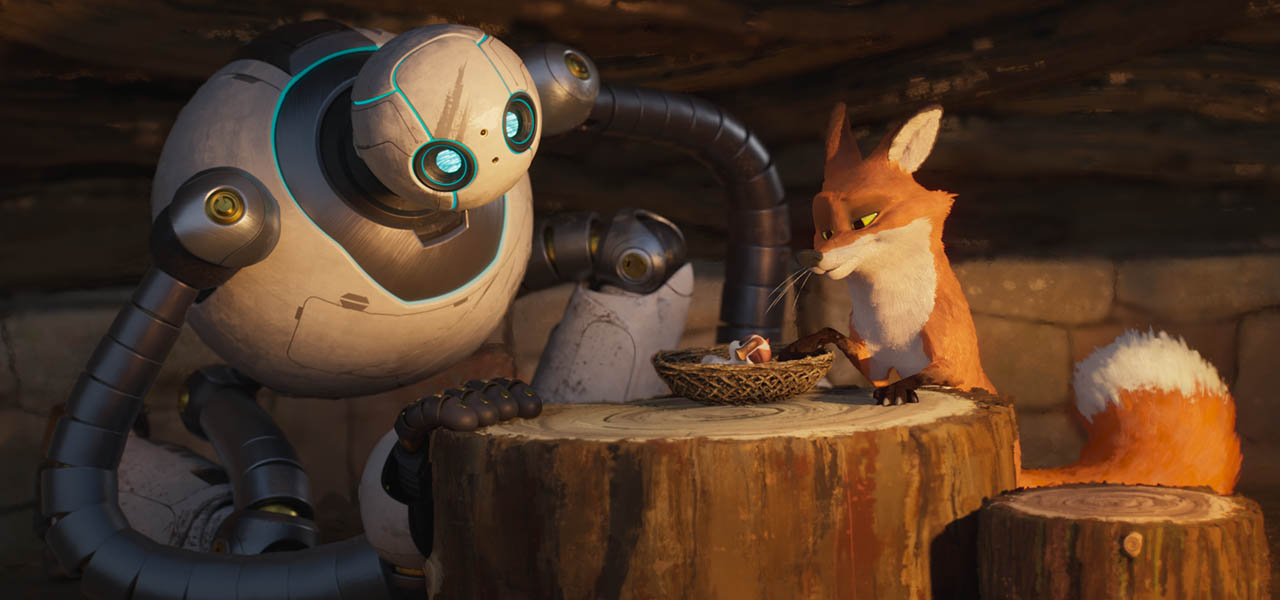
The film begins in a remote forest land on an uninhabited island unblemished by human intervention. The coast soon becomes an unintentional wash-up ground for Universal Dynamic’s ROZZUM robots coming from a capsized ship. Only one robot, Unit 7134, survives and running wildlife activate it. It’s obvious the robot has no place on the island as it can’t interact properly with animals. The robot is intended to be a customer service robot with a female voice. Nothing the robot does helps any of the animals and the animals respond in a hostile manner, chasing 7134. Upon falling from running away, 7134 crushed a mother goose to death and all but one of the nest eggs on its landing. The lone egg that was unharmed hatches the baby gosling. 7134 takes a fascination in it. Plus 7134 is programmed to continue with whatever mission she’s given until completion. She puts the egg inside her chest.

7134 finds a memory card in herself to make her communicate with animals better and inserts it. Soon after, she encounters Fink: a sly hungry fox who knows of the egg and wants to eat it. 7134 is able to prevent the theft. Soon the egg hatches and a male gosling is born and imprints himself on 7134. 7134 now has a mission to raise the gosling to adulthood, but how? 7134 first finds guidance from a mother opossum who’s currently mothering six babies. Fink returns but instead of eating the gosling, he makes a deal with 7134 to help raise the feller for a shelter in return. 7134 agrees and creates a hut for them all to live. In the naming of the gosling, 7134 gives the gosling number-names which annoys Fink. Fink gives 7134 naming tutelage and the gosling is given the name ‘Brightbill.’ 7134 even gets a new name of her own: Roz.

Over the months, Brightbill grows, albeit awkwardly. While the other goslings are goose-like and grow as naturally as geese do, Brightbill acts more like Roz than a goose. The other teen goslings taunt him for his awkwardness. Then one day, another flop day of goose training for Brightbill, one of the peers tells Brightbill that Roz killed his mother. It’s there Brightbill turns against Roz.  Even though Roz still wants to mother Brightbill, a ROZZUM unit she reconstructs tells her to return to Universal Dynamics. Roz is determined to reconcile with Brightbill and raise him. That sends a signal back to Universal Dynamics. Meanwhile Roz finds the right bird to teach Brightbill how to fly: a falcon named Thunderbolt. With help from goose master Longneck, Thuynderbolt succeeds in making Brightbill able to fly in time for migration.

The migration is not what it seems. The birds encounter a thunderstorm as they fly in San Francisco. They hope the greenhouse from Universal Dynamics they spot in San Francisco is the temporary shelter they need, but the Universal Dynamics technology detects the birds as contaminant and a multitude of reconnaissance, or RECO, robots that look exactly like Roz go shooting at the birds. The island which has the hibernating animals goes through a severe snowstorm and they fear they will freeze to death. Roz and Fink build a shelter for all animals but demand a truce of all of them not to harm each other.

As spring returns, Brightbill and the geese return, Roz repowers herself and the animals are free to roam the island. Unfortunately, Universal Dynamics has sent a robot to retrieve Roz named VONTRA and she’s troublesome, reckless and remorseless. VONTRA is not even afraid to start a forest fire on the island to get Roz. It’s then the animals group together to rescue Roz and battle VONTRA as their land is burning in a bright red fire. I won’t spoil the ending but the film then ends not with the battle but the aftermath, reminding us of the bond between Roz, Brightbill and all the animals.

This film is based upon the 2016 children’s novel The Wild Robot by Peter Brown. The story itself is a story about togetherness. In many ways, children who watch this film can learn about the importance of getting along and actually coming as one. If animals who attack eat other or treat each other as prey can get along, so can other kids. Same way as a robot, who has no qualities to bond with animals, learns to have those qualities and does bond. Even raise a baby gosling to goose. The film also has other themes too of the environment and how development threatens animal’s habitats. Even the threat of having technology run things and make decisions with no human feelings is another thematic element of the story. At the beginning, I didn’t think Roz would be of any help to the animals of the island. Just an interference that acts on her own programmed logic to do only the things she’s programmed to do. A change of things changes everything and Roz becomes an unlikely hero.

The film’s quality is in its story. It plays the story well. The animals act like animals and Roz acts with her programmed logic. Over time we see the story develop. Roz goes from being an interference on the island to becoming a big help. Fink goes from a sly conniver to being a big help to the animals too. Brightbill also goes from being a robot-like gosling to the goose he was meant to be. It succeeds in making moments you think won’t develop properly develop into the way it was meant to be. At the same time, the film also adds in the other threats like how robots are sent to the island as Roz is not doing her commanded duties and VONTRA threatens to get her even at the cost of the island’s destruction. Unexpected moments like these and the film ending in the manner you didn’t expect add to the story. Also since this film is an adaptation of the first book of a Wild Robot trilogy of books, it also sets up well for the sequel that will be adapted from The Wild Robot Escapes novel. The box office results of this film have opened the door for the development of a sequel, but filming details and release date have not yet been confirmed.

The biggest credit should go to director/writer Chris Sanders. Sanders has over 40 years of experience in animation having first worked as a scriptwriter for the Muppet Babies cartoons and then becoming story writer for five of Disney’s films in the 1990’s during the ‘Disney Renaissance.’ He then broke out into directing with 2002’s Lilo and Stitch which is the first film he directed, co-directing with Dean De Blois. Since then, he moved onto Dreamworks Animation and has co-directed How To Train Your Dragon with de Blois, The Croods with Kirk DeMicco and his first solo project The Call Of The Wild. In this film, he succeeds in delivering an excellent story mixed with dazzling effects. He does a great job in making a film that can easily make Disney and even Pixar jealous!

Also great voice acting from Lupita Nyong’o. She knows how to make Roz the unfeeling robot at times she needs to be and help her develop into having feelings. Kit Connor also does a great job in playing Brightbill from his awkwardness to his anger. Pedro Pascal is excellent as the sly Fink. Stephanie Hsu is also great as the villainous VONTRA. Actually the mix of vocal talent is great throughout the film. Adding to the film is the musical score by Kris Bowers and the work from the film’s sound team and the visual effects team.

In the Oscar category of Best Animated Feature, this film has been in a tight battle against Flow. To think, its biggest rival is an independent film from Latvia! In this category, Flow has won the National Board of Review award, the Golden Globe, and the Online Film Critics Society Award. The Wild Robot has won the Critics Choice Award and the Producers Guild Award in this category. At the Annie Awards for animated films, it achieved ten nominations in nine categories including Best Animated Feature and it won in all nine!

The Wild Robot delivers in what one would commonly expect in an animated film. Although it’s more oriented for children than it is for adults, the parents will have no problem being entertained by the story. Don’t be surprised if it wins the Oscar on Sunday!


2023 Oscars Short Films Review: Animation

It’s interesting with seeing the reels of the shorts films, the Animation nominees are often the ones with the least total running time. They go by so fast, the shorts.tv reel add in a couple of other shortlisted films that got their honorable mention.

Anyways without further chit-chat, here are my reviews of the nominated animated shorts:

Letter To A Pig (dir. Tai Kantor) – The story begins telling of a boy hiding in a pig sty from Nazis who seek to put him in a concentration camp. The Nazis can’t find him. Fast-forward many decades later. The man tells his story to school students on Holocaust Memorial Day. He tells of how he credits the pigs in the pig sty for saving his life. He even wrote a letter to the pig. As he reads it aloud, one boy gives a taunting “oink,” while a female student listens intensely. As she engages herself in the story, she imagines herself and her classmates coming across a giant almost monstrous pig and them holding him prisoner in a trap. As they hold the pig prisoner, she can feel her nose metamorphose into a pig snout. Soon she feels sympathy for the pig and lets the pig go. As the pig is set free, he shrinks into a piglet and she hugs him.

This is an impressive story. It’s a story of a man who tells how a sty of pigs — animals he had been taught his whole life to regard as filthy and disgusting — helped spare him from dying in the Holocaust. As the young girl hears the story, she reflects on her own feelings of human hatred directed towards a pig in her mind and how she develops sympathy soon after and learns to love the pig. The story has its themes of collective trauma, fear and identity. It’s done in an impressive style that consists of a mix of 2D pencil drawings with minor colorization and mixing it with live-action images. The film is as much about the imagery as it is about the story. That’s why I give it my Will Win pick.

Ninety-Five Senses (dirs. Jared and Jerusha Hess) – The story begins with a man telling his views of human senses and colorful images about from the words he tells. At first you get the impression, this man is friendly. Then you hear his story. This man is on death row having his last meal. The capital offence he committed was arson of a repair shop he was fired from. He loved the jobs, but couldn’t handle being fired. He responded by setting it ablaze, forgetting the shop was also a house where the family lived above. As he anticipates his last meal, he looks over his past with regret, but also a sign of hope in the afterlife. He even has an outlook of how all once a person died, each of the five senses fade in their own way one by one. After a life of only five senses, he looks forward to the 95 senses in the afterlife.

It’s very rare you hear a story of a man awaiting execution to be told with a light-hearted spirit or even with some optimism. Never mind including humor. The man, voiced by Tim Blake Nelson, does a great job in telling his story without it becoming a common “Sob Story” you’d expect from a Death Row inmate. The story comes with some surprises for those who watch, like you wonder how a man that sounds so friendly would end up on Death Row. The film even ends on a humorous note. The story not only tells of the incident and of his observations and hope, but it does so in including in all five of the human senses. The story is told through six different animation styles and a multitude of colors that’s a delight to watch, despite the dark subject matter.

Our Uniform (dir. Yegane Moghaddam) – This film is where Yegane tells her story of growing up as a girl in Iran right after the Islamic Revolution. She talks of how the female teachers taught the girls to shout anti-American, anti-Israel and anti-UK messages on a daily basis. She talks of the uniform she was required to wear at school and of how the women there were firm in how all girls should wear their clothes in a proper manner and have all their hair hidden in a hijab. She talks of the difficulty she had in the hijab covering her hair that was longer than the hijab cloth, which got on the women’s nerves. She reflects on how growing up, she was taught under the new revolution to feel like she was inferior to men or below men.

No question this is a film of how a girl was indoctrinated with sexism not simply at a school, but from a system implemented by the ruling regime. The theme of the story is to do about clothing and the strict religious regulations of how girls should wear their clothing according to the new regime. The story is told with stop-motion imagery using clothes or fabrics of the clothes she wore as a child. The images drawn or painted on the clothes as well as the stop-motion movements of the clothes do a great job of telling her story. The use of clothing in the animation of telling the story is vital since clothing has a lot to do with what life was like under the regime. It makes the images as vital to the story as Yegane’s retelling. Hiding all your hair in a hijab and wearing a dress that covered everything was the new law in Iran and the film shows it in a unique way.

Pachyderme (dir. Stephanie Clement) – A woman retells her story of how as a young girl, she would often stay at the cabin of her grandparents. Her grandfather’s stern manner leaves her with a feel of fear and discomfort. The cabin was located by a lake. The cabin bedroom she sleeps in has a displayed elephant tusk the grandfather names “Pachyderme,” pointing in its direction in the hall. The room would give the girl and eerie sense about it through the wood imagery and the creaking of the boards. Even though the grandparents would say there’s nothing to fear, she felt there were monsters to take her. She goes to a lake where a woman had drowned some time earlier and feels spirits drawing her to its depths. Some time later, the grandfather dies and Pachyderme is split in two. As she returns to the cabin following her grandmother’s death, she takes both pieces of Pachyderme to the lake to bury it in the water. One of the two pieces is not completely immersed.

This film has to be the darkest of the five. In reading articles about it, it deals with the subject of incest. Incest itself is disturbing enough for audiences so it makes sense that it’s told through subtle imagery and storytelling that hides the actual facts. The theme of how she regards her grandfather as a monster and how it’s represented in Pachyderme adds to the storytelling, including the burial at sea. The ending where she attempts to bury the two pieces of Pachyderme in the water remind us she can bury a horrific memory like her grandfather’s terrible ways, but the small piece sticking out reminds us the bad memory can’t completely be buried. The imagery of the story is told through 2D images that appear as common images one would remember from storybooks they read. Possibly the monster that is her grandfather is epitomized through the common images of monsters we read in our children’s books of the past. It’s charming in its imagery as it is disturbing to see and listen to the harrowing story.

War Is Over! Inspired By The Music Of John And Yoko (dir. Dave Mullins) – The film starts in a battlefield of war. One soldier has a chess set where he appears to play by himself. After he makes his move, he writes his move on a piece of paper and attaches it to the leg of a messenger bird. The bird flies to “enemy territory” and gives the message to an “enemy” soldier who also has a chessboard and looks like he’s playing by himself. After he makes his move, he writes his move to a message for the messenger bird to deliver. Over time, the intrigue grows with the soldiers on both camps. As the bird delivers message after message, the anticipation on what the next move will be or who will win appears to quell the enmity between both sides. Then checkmate! But the sergeant is disgusted by what he sees. He reminds the camp they’re enemies and the battle must begin now. The soldiers on both sides line up with bayonets and all ready to do battle against the “enemy.” The battle begins and bloodshed ensues. On the field one soldier notices the messenger bird is shot dead. Just as the two soldiers from the chess game confront each other, it’s there from a message that slips out that one realizes the other is his chess rival. They drop their guns. All drop their guns when they see the written message “War Is Over.”

This is a creative story Dave Mullins directs and co-wrote with Sean Ono Lennon and Brad Booker produces through the inspiration of John Lennon’s legendary Christmas song and the message “War is over if you want it.” The one 3D-computer animated film nominated in this category this year, this is a film with a montage appearing to have a World War I setting and sends a message that still matters today. There may be a winner in a chess game but there are no winners in war. The scene where all the soldiers are intrigued and excited by a chess game against a player from the “enemy” side sends the message that enmity is something war creates and provokes, and is often unnecessary. The ending where the bloody battle is instantly ended with the written message “War Is Over” also sends a message of how many battles are in vain. The story first seems to be a story that’s either cute or “fluffy,” but the ending of the bloody battle with “Merry Christmas (War Is Over)” sends a significant message that is as important today as it was when John and Yoko recorded it back then. That’s why I give it my Should Win pick.

And there you have it. That’s my review of the five films nominated for Best Animated Short Film. Interesting that in a time where animated features appear to be dominated by 3D computer animation, only one of the five nominated films is such. That’s what I like best about this category. It opens itself up to various styles of animation, rather than going with one that’s all the rage.

2022 Academy Awards: Best Picture Reviews – Part One

The 95th Academy Awards are coming soon. Once again, I saw all ten Best Picture nominees. For the first time in three years, I didn’t need a streaming service to see any one of them. Elvis was the only one I saw outside of a theatre; on an airplane divided by two flights. The other nine I was lucky to see in theatres. There is your mix of enjoyable and unenjoyable. A mix of common popcorn fare and serious topics.

This year’s batch have some notable details. For the second straight year, a film directed by Steven Spielberg is nominated. For the second straight year, a remake of a Best Picture winner is nominated. Two of the nominated films are sequels to legendary sci-fi or action films. Two of the nominated films have four acting nominations each. On the contrary, half the films have no acting nominations. Also interesting that comedies, which normally get the sort end of the stick at Oscar time, are this year’s toast as two of the heavy favorites are comedic films.

The purpose of my reviews are to give a summary of the Best Picture nominees. I will be saving my predictions for a separate prediction blog. In the meantime, here is the first of my reviews of the Best Picture nominees of the 2022 Academy Awards:

All Quiet On The Western Front – Just like the 1930 film, this is an angry film. This film makes it look like World War I was a vanity effort. Like all the war was where it was all about the egos of those in power. While the young men fought and many died, these leaders with the power only cared about themselves and the power they wanted to hold onto. Even those who worked in the military seemed to take the losses of life very lightly. Seemingly not caring that a generation of young men were being lost. The last 20 minutes of the film would especially enrage many. Armistice had been declared for November 11, 1918. Germany was the losing side, but the German leader wanted one last battle. Another bunch of young men dead, just shortly before the war finally ended. Will definitely have you leaving the theatre asking what was it all for?

I’m planning on doing a comparison of this film to the 1930 original for after the Oscars. So in looking at this film, I won’t compare it to the original. I won’t even call it a remake because even the original was adapted from a novel. It’s possible this film is a re-adaptation. I will say the film is an excellent work. The film does a good job in telling the story from the point of view from the young soldiers and the meetings with the leaders. It shows the two different worlds between the two very well. The battle scenes are also intense to look at. Of course, war is ugly. There’s no compromise in the story here. Most surprising is how they slowed down the last 24 hours of World War I over a period of just over twenty minutes. That paves the way for the final dramatic scenes that would make the viewer angry at the end.

Top credits go to director/writer Edward Berger. He brings back the horrors of World War I in grand style and delivers a film that has a big message to send even now as Ukraine is going through a war of its own. The acting from newcomer Felix Kammerer was also excellent, even if his part didn’t have that much depth. Albrecht Schuch was also very good at Kalczinsky. The film also had excellent technical elements like the music of Volker Bertelmann, the cinematography of James Friend and some of the best production design and visual effects of the year. The visual effects really did a good job for the battle scenes.

Avatar: The Way Of Water – Usually when a sequel comes out, the freshness of the original seems lost and the rehash seems to be too similar to the original. Nevertheless the story does aim to have some notable differences from the first. One of which is Jake’s new family on Pandora, including his relationship with his oldest son. The other is facing rivalries both from Earth and his world. The best thing about this film is that the first Avatar took the audience to a new world. This film is also successful in taking people to a new world. Although it feels there may be something missing in this film, it’s still very spectacular and gives the audience the escape they’re looking for. The new twists in the story will also give people the drama they’re looking for and the action scenes they all enjoy.

James Cameron does it again. Not only does he bring back the world of Pandora successfully, but he does it so in breaking box-office records! To think James Cameron films have knocked each other out in setting the record for the highest-grossing ever! First Titanic, then the first Avatar, and now this! However it’s not simply box-office numbers. Cameron succeeds in creating a world where people can escape and be enchanted by. Pandora dazzled people back in 2009 and 2010 and it does it again here. Cameron also wrote an excellent story with four other writers and compiled the official script with two of the writers. They had to make it a believable story, especially since this film is thirteen years since the first. It does a story that works for the film. There was very good acting from returning actors Sam Worthington and Zoe Saldana. Also excellent was newcomer Jamie Flatters in playing Jake’s oldest son. The film’s best qualities, nevertheless, are its visual effects. It’s these effects that give people the escape to Pandora they’re looking for and keep their attention on the drama as it unfolds. Simon Franglen also does a good job in composing a good score for the film.

The Banshees Of Inisherin – This is a film not everyone can understand at first. Even after one sees the film, they can only guess what the film is about. Some say it’s about human weaknesses, or about men and their inability to relate, or even about Irish pride as seen through the eyes of McDonagh. I’ve often felt the story is as much about the island town of Inisherin as it is about the central story. Inisherin is a town away from the mainland and lucky to be out of the range of fighting during the Irish civil war. However Inisherin comes across as a town where nothing really happens or nothing really improves. Anybody who wants to get anywhere have to be like Siobhan and leave the island. Sometimes it seems like the dead friendship of Padraic and Colm is symbolic of how dead the town of Inisherin is. In addition Inisherin being a small town, it’s often a case where word easily gets around about what’s happening. The feud between the two soon becomes the talk of the town.

This film is unique as it attempts to make a comedy out of something intense and dramatic. It’s a story of a drama that is slow, but the slowness is its quality. A story about a man deciding to end a friendship because his friend is ‘dull’ and spend the rest of his years composing music seems odd and pointless. Nevertheless the film allows for the intensity to build over time. It also has its ugly surprises, but the surprises become important to the drama. The different characters also add to the story. They help provide for the environment of the story almost as if the film is based on a classic Irish fable. In addition, the scenery adds to the story. The film is as much about the scenery and the landscapes as it is about the town and its drama. Its addition to the film help builds the story.

Top credit should go to director Martin McDonagh. McDonagh infrequently shells out works. It seems like almost once every four to five years. In fact his last film before Banshees, Three Billboards Outside Ebbing, Missouri, was five years ago! This is quite possibly his best work. It’s a story that gives you the unexpected and Martin did an excellent job with it. Also when you see the ending, you easily forget that this film is a comedy. Once again, a case of a film that mixes comedy with tragedy, and it does a memorable job here.

Additionally, the story came alive from the excellent acting. Colin Farrell did a great job making Padraic to be kind and loyal and always trying, but pushed to his limits near the end. Brendan Gleeson was also great as the stubborn Colm. He captured his hardness very well. Kerry Condon was also great as Siobhan, the sister who tries to find a way out. Also great was Barry Keoghan, the troubled son of the policeman Padraic and Siobhan try to help out. The supporting characters like the Garda, the banshee and the priest also added to the story. There were also additional technical feats with this film like the cinematography of Ben Davis and the score from Carter Burwell.

Elvis – It’s not easy doing a musical biography and making it into something different. On top of it, you can be sure there have been countless made-for-TV movies made about Elvis. So how can you make an Elvis movie for the big screen of 2023? One ingredient that makes it different is the story being told from the point of view of Colonel Tom Parker. Those of us who know a lot about Elvis may have overlooked his relationship with the Colonel, especially the rocky moments. Another is to add some creative flares. Those that remember Moulin Rouge will remember how that film has creative flares. Luhrmann applies similar creative flairs from Moulin Rouge here. Another ingredient is to have the best songs of a musician’s career as well as their career’s most significant moments. You can’t pack everything about Elvis into 159 minutes of story. This film does showcase the most famous moments of his career.

Another excellent work from Baz Luhrmann. Just when you thought you couldn’t bring Elvis back to the big screen, Luhrmann does it, and in a stylish winning way. He pulls the right moves to deliver an Elvis film people of today will want to see at the theatres. Of course it’s the performance of Austin Butler that has to be the biggest quality. A thirtysomething of today able to epitomize Elvis? The answer is Yes! Butler does an excellent job in playing The King in with a performance with dimension and doesn’t go cartoonish, as one can risk doing performing Elvis. Tom Hanks is also quite good as the colonel. It’s hard to picture him with a Dutch accent, and there were a few times when I questioned if it was off or not, but he did a good job with his role. The technical details also make the film excel. The cinematography, production design, makeup and costuming are all some of the best of this past year.

Everything Everywhere All At Once – Now there have been some absurdist films that have been nominated for Best Picture or other major categories. What makes this film-of-the-absurd is that this takes place in a multitude of worlds. Thanks to technology, Evelyn is able to make many trips of the mind to many different universes and assume many different personas: past, present and future. Even the persona of a rock somewhere in the desert is possible! Usually most people look at stories like these and ask “What the hell?” This is one absurd story that many people found enjoyable. The kung fu fighting scenes also helped a lot too. And to think this all started as Evelyn’s taxes were to be done and she was to get some bad news!

To think it’s the magic of the directing/writing team of the Daniels (Kwan and Scheinert) that delivered this gem. The two have not had a lot of directing experience. Until this film, they’ve only directed some short films together and their only feature was Swiss Army Man from back in 2016! Here they have the perfect breakthrough film for them, and boy is it unforgettable. It’s a fun, thrilling story that comes off as weird and bizarre at first, but starts making more sense as time goes on.

Also excellent is the combined acting. Michelle Yeoh shines as Evelyn. When I first saw her in Crouching Tiger, Hidden Dragon, I had a feeling she would go far. She had a lot of grace with her. Although this role is way more multidimensional, she still does excellently here and delivers one of the best performances of the year. Ke Huy Quan is also excellent as the meek Waymond. Quan is also this year’s former child actor comeback story. He is best remembered as Short Round from Indiana Jones and the Temple Of Doom and Data from The Goonies. Here he gets the adult actor breakthrough he was waiting for, and what a scene-stealing performance! Additional scene stealers are an unrecognizable Jamie Lee Curtis as the IRS agent and Stephanie Hsu as the daughter whose nihilism threatens the multiverse. All the aforementioned actors had a lot to do with their main role and their various roles in the many worlds of the multiverse. That’s a lot of work! Additional technical credits go to Shirley Kurata for the costuming and the band Son Lux for the score that fits the film well.

And there’s the first of it. This is the first half of my review of this year’s Best Picture nominees. Second half coming in a day or two.