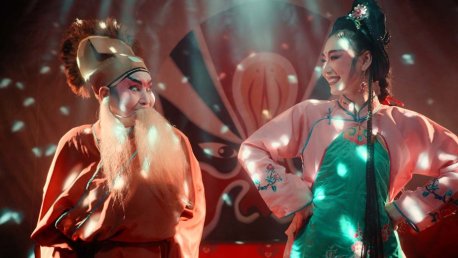
I accidentally came across To Live To Sing when the virtual reality show I wanted to see was in a venue with a low capacity. I’m glad I saw it.
The film begins with a show of local performers in a Chinese city. The show starts with a modern fan dance by schoolgirls. It’s then followed by the Jinli Sichuan Opera Troupe: a local troupe that performs traditional Chinese opera. Right after the show, the opera troupe goes back to their own end of the city where they put on their own daily show. They perform every day at the same time at the same small theatre and entertain the same local crowd they’ve charmed for years. They rehearse well and they get along mostly fine. They have their own disputes on how to do something artistically, but it doesn’t last long. The Troupe is led by Zhao Li whom oversees everything. Her niece Dan Dan, who was orphaned at a young age and raised by Zhao, is seen by Zhao as the future of the troupe as most are aging.
Things are changing in the area they live. A lot of old homes are being crushed under government orders in order to build new developments. The theatre is under threat. This will not only mean the end of the theatre but the end of the opera troupe too. Zhao is frustrated as her theatre doesn’t attract crowds big enough. The others are worried too, but they try to make plans fearing the worst. Dan Dan however sees this as a breakthrough moment as she always dreamt of being a pop star instead of being confined to an opera troupe where she only gets paid 10%. During the time of frustrations, Zhao notices a dwarf in Chinese opera wear. She tries to spot him out, but he runs away.
Zhao is trying to negotiate with the government about keeping her theatre. However she knows it will be uncertain due to the small crowds that come to her theatre. Zhao is very forbidding of any modernisms that come to the theatre. She is strict on tradition. Then one night when she’s out, she notices the dwarf. She tries to follow him but loses focus of him. She is by a night club and she is drawn to the music. Then the announcer announces a singer for her first performance. It’s Dan Dan, and in a showy dress. Dan Dan notices Zhao in the crowd and can’t sing. The two have a fight outside where Dan Dan walks off furiously. The following day, Zhao confessed to Dan Dan that she always saw her as her daughter. Dan Dan becomes more committed to the troupe.
Zhao has another encounter with the dwarf and the dwarf takes her to a restaurant. There she sees one of the men negotiate a future job deal. Feeling the threat harder, Zhao decides one day to break with tradition and do a show that fuses modern with traditional. The troupe is welcoming of it. They perform the show with the mix of modern and traditional. The crowd loved it, but Zhao notices the spirit of the dwarf as it takes her to a mysterious land of Chinese art and culture.
Despite the audience pleased with the performance, Zhao can’t lose focus as an official from the party will be attending a show to see whether to keep the theatre up or not. They get a chance! However it’s a very slim one as the areas nearby are being crushed. The night before, Zhao has the same fantasy of the dwarf taking her to that land. Then the day of the show. The audience is ready. The players are ready, but the official is not to be seen. There has to be a wait and it’s making the crowd impatient. Then the official finally arrives and they are able to put on their show. Just as the show is happening, Zhao is again taken away to that imaginary place. The show she’s in is a dazzling trip of the imagination, until the character played by Dan Dan is stabbed. It all falls apart.
We then learn that the official decided to have the theatre removed. The troupe is heartbroken, even though some talk about plans of what to do after. The next day where there’s no show, members of the local audience show up and wonder why know show? The film flashes five years later with Zhao and Dan Dan returning to the same spot and what’s become of it. They see the development and the ruins. However Zhao gets back onto the stage for one last performance.
The film is a common story about art attempting to stay alive. The film also touches on the subject of gentrification. We see it all around us; old buildings being crushed for new developments with big profits in mind. I see it a lot in Vancouver. Here it shows it happening in the People’s Republic of China. In most countries, they have the freedom where they can come bring this issue up to the government. Not all chances work out successfully, but they’re still given a fair chance. In China, you’re chances are very limited with a chance that’s slim to none. When the government says it will happen, it will happen. Zhao was lucky to have that one chance where she could prove to the government the importance of her opera. It was unsuccessful but she still had it.
The film also showed another aspect or battle. It also showcased the battle between traditional art and the more modern art or entertainment that’s the call of the day. Without a doubt, Zhao is a purist of the traditional Chinese opera and starts off as forbidding to the new ways and the new sounds. We should not be surprised that she would be furious if she saw Dan Dan become a contemporary pop star. Despite her belief in traditionalism, she does convince herself to welcome the modern sounds and even mesh it into the traditional opera. We see that a lot in many countries of mixing traditional or classical with the modern. It’s actually very successful in many countries. It proves to be a success here too. However the film sends a message that even with modernisms, the traditional should not be lost. It should still be admired and celebrated.
One thing the film tried to make clear with the story is of the spirits of art and how it exists inside Zhao. You may notice there are many times a dwarf in opera garb is in Zhao’s vision. The dwarf leads Zhao to many images all telling the story of what will happen. However the dwarf doesn’t always lead Zhao to images of a happy ending. That image where the opera comes alive in Zhao’s dreams but leads to the stabbing of Dan Dan is what would send the message of the bad fate of the opera troupe and its house. However it’s right at the end where when it appears all has been long lost at the end, it’s not. The spirit of art still remains even in the ruins.
This is the first film I’ve seen from Chinese-Canadian writer/director Johnny Ma. Living in Vancouver, he’s able to do Chinese stories that would not be the most welcome in the People’s Republic. His first feature from 2016 Lao Shi was about battling bureaucracy and legal manipulation in China. The film was shown at the Hong Kong film festival but not in Shanghai. This film was shown in both Shanghai and Hong Kong. It doesn’t depict the government that bad here. Instead the focus is on art and its attempt to survive. Johnny does a very good story and is good at sending a message, but it is a bit uneven in its storyline. The film also has a real opera troupe as its cast and they all play fictional versions of themselves. That’s another quality to the film. It does make you wonder how they’re doing in their home country. The actors all did well by being themselves when they had to, performers when they had to, and actors when they had to. Zhao Xiaoli and Gan Guidan stood out the most as the two did show a close chemistry in the film that made the aunt/niece relationship look real.
To Live To Sing is a story of artistic ambitions with a bittersweet ending. However it’s a good and colorful, albeit imperfect, reminder that art will triumph.







 England: Women’s football has really grown a lot since England finished third at the last Women’s World Cup. The team they fielded looked like one that could pose the best challenge to the United States. Unfortunately it was not to be as the US beat them 2-1. To add insult to the injury, the US’s Alex Morgan appeared to do a tea-sipping gesture after scoring the winning goal. Many have taken this to be an insult to the English.
 Sweden: Before the semifinal, I’m sure most of you predicted Sweden to beat the Netherlands. I mean Sweden had the clout. They’ve been to every Women’s World Cup since it began in 1991. They’ve finished in the Top 3 three times before. They’ve even beat the Netherlands way more often than they lost to them. However things did not go according to plan. Before the match, Fridolina Rolfö received a second yellow card during the match against Germany which meant she will miss the next match. The Netherlands turned out to be a more formidable opponent than they expected. Regulation play resulted in no score. Then there was the goal from Jackie Groenen in the 99th minute. Then there was the shocking injury to Kosovare Asllani where she was carried off on a stretcher.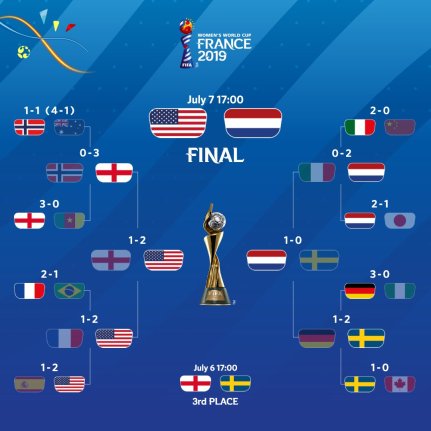
 United States: The United States is the team that is most expected to win this Women’s World Cup. They’re the defending champs from 2015. They’re ranked #1 in the World. They have some of the biggest stars in women’s football who are seen as trailblazers. However they have also earned naysayers too. It all started when they won 13-0 against Thailand and celebrated after each goal. Many thought it was disrespectful. Then Megan Rapinoe made headlines for taking a knee during the play of the Star-Spangled Banner. She followed that by saying she won’t be going to the White House to a reporter. Most recently, Alex Morgan made England fans mad when she celebrated her game-winning goal by doing a tea-sipping gesture. Despite the negative press, they’ve delivered each time. They’ve won all their games, scoring 24 goals and only conceding three.
 Netherlands: Before Women’s Euro 2017, people did not expect much of the Netherlands. Why should they after they finished in the Round of 16 in Canada 2015 and failed to qualify for the Olympics? However they surprised everybody by winning all their games and would win the final by beating Denmark 4-2. This made it the first Women’s Euro since 1993 that Germany didn’t win! Here at this Women’s World Cup, expectations were good but not that big. Canada was expected to top Group E, but the Netherlands did it by winning all their games, including beating Canada 2-1. Then in the Round of 16, they were pitted against Japan whom they lost to in Canada 2015. This time the Netherlands won. They were pitted against Italy in the quarterfinals and won 2-0. Then came Sweden who was more expected to win the game. It started with nil-nil after regulation, but a goal from Jackie Groenen in the 99th changed it all. Now it’s the Netherlands in the final.
