Oscars 2018 Best Picture Review: Vice

Vice
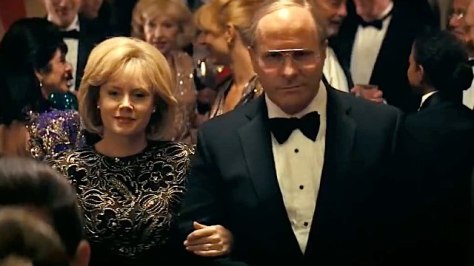
Amy Adams and Christian Bale play political power-couple Lynne and Dick Cheney in Vice.

As the world becomes more and more confusing, we tend to focus on the things that are right there in front of us. While ignoring the massive forces that actually change and shape our lives. With people working longer and longer hours, for less and less. When we do have free time, the last thing we want is complicated analysis of our government, lobbying, international trade agreements, and tax bills.

You would wonder would a film like Vice work at this time? A film about former US Vice-President Dick Cheney and his wife Lynne? A film about politics of the past? Turns out there’s more than meets the eye.

The film opens in the White House as the September 11th attacks happen. Instead of talking things out, Dick Cheney gives an immediate order. The film then flashes back to Wyoming in 1963. Dick Cheney and Lynne are married and living in Lynne’s parents’ house. Dick was originally a student at Yale University but his persistent alcoholism caused him to drop out. He takes work as an electrical lineman, but that doesn’t satisfy his in-laws at all. It’s after he gets busted by a cop for driving drunk, his second DUI, that Lynne tells Dick to clean up his life. All of this is narrated through a man named Kurt: a typical ‘middle-class’ American.

Fast forward to 1969; Republican president Richard Nixon is in the White House and Cheney has been hired as an intern. He meets a slimy scheister named Donald Rumsfeld who is Nixon’s policy advisor. Cheney works under Rumsfeld’s wing and tries to juggle family and political commitments. Cheney also overhears a conversation between Henry Kissinger and Richard Nixon about the bombing operation in Cambodia. There, Cheney learns about the true power of the executive branch. Rumsfeld’s abrasive attitude has an effect on Cheney as both distance themselves from Nixon. After Nixon resigns in the heat of the Watergate Scandal, both men are promoted: Cheney to Chief Of Staff to the new President Ford and Rumsfeld to Secretary Of Defense. Their jobs only last two years as a Democrat, Jimmy Carter, is elected president.

After leaving the Oval Office in 1977, Dick decides to pursue politics on a state level by running for the seat of House Representative for Wyoming; Wyoming is a state that has only one seat in Congress. Dick’s campaign starts on a lackluster note as he delivers an uncharismatic speech. However he soon suffers his first heart attack. While recovering in the hospital, Lynne decides to deliver speeches for him. Her speeches are more winning to the public and it succeeds in helping him to win his House seat.

Then Reagan becomes president in 1980. Cheney is able to provide influence to the agenda promoting conservative pro-business polices like promoting fossil fuels (which puts an end to Carter’s goal of more solar power) and also ending news media showing both sides of the issue, which paves the way for one-sided media like Fox News on the right and CNN on the left. In the meantime, Dick and Lynne are shocked to learn that their teenage daughter Mary is a lesbian. Nevertheless Dick agrees to be supportive to her, despite being a right-wing politician.

Dick is promoted to Secretary Of Defense during the tenure of George H. W. Bush and has a pivotal role in the Gulf War of 1991. Also during the time of the senior Bush, Dick meets his son George W. Bush, who’s a clumsy nimrod. Dick has desires to be President but after Bill Clinton is elected, he decides to retire from public life to spare the scrutiny for the sake of Mary. Cheney then becomes CEO of Haliburton while Lynne raises golden retrievers and writes books. Then starts an epilogue claiming Cheney lived the rest of his life happy and healthy with his family out of the public eye, then the credits roll.

But wait. That’s not really the end of the film. Dick is still CEO of Haliburton, but he meets with George W. Bush who’s the Governor of Texas. He wants to run for President for the 2000 Election not because he desires the power to himself, but to please his father. Cheney agrees to be his running mate provided Bush delegates ‘mundane’ executive responsibilities to him like foreign policy and energy. Things like family values issues, he doesn’t want to get involved with for the sake of Mary. Bush is elected president despite a hugely controversial election. On his first day as Vice-President, he learns Rumsfeld is back as Secretary Of Defense, and is still as slimy as he was when they first met. Added to the team of making foreign policy and defense decisions is legal counsel David Addington and Chief Of Staff Scooter Libby.

The film then returns to the 9/11 attacks and when Dick gave the immediate orders. After that, Cheney and Rumsfeld team up over initiating and presiding over the US attacks in Iraq and Afghanistan (which Kurt finds himself a soldier in both those wars). Cheney struggles with his heart attacks as the War Of Terror mounts. Nevertheless he continues through his vice-presidency which includes instituting the Unitary Executive Theory, his role in the Plame Affair, the accidental shooting of Harry Whittington (which he never apologized to him for). His actions are shown to cause thousands of deaths overseas, the rise of the Islamic State of Iraq and Syria, and record-low approval ratings upon leaving office. Rumsfeld is even forced to resign. Nobody likes him in Washington.

However it doesn’t end there. Cheney is about to die of heart failure while waiting for a new heart. Just as he says his teary goodbye to Lynne, Liz and Mary, Kurt is killed in an auto accident while jogging. Sure enough, Kurt’s heart is the perfect match for Dick’s transplant in March 2012. Then Liz runs for the House seat of Wyoming where she announces during a debate her opposition to same-sex marriage. This causes Mary to cease communication with Liz. Liz is now the Rep of Wyoming. At the end, Cheney says to us all he regrets nothing.

When you see one renowned film by a certain director, you are impressed, or interested, with what you see. When you see a second film by that director, you get a better sense of what their film making style is all about. I’ve seen The Big Short and I was very impressed with what I saw. However, when I saw Vice, I liked what I saw but throughout the film, I was thinking “Okay, I get Adam McKay’s filmmaking style.” I’ll admit throughout the film, I was seeing a lot of elements similar with what I saw in The Big Short. However I saw some new elements in Vice as well. Basically Vice told me more about Adam McKay than it did about the Cheneys. I noticed in both films, Adam likes to toy around with the story. He also likes to include references to the time of the story both in terms of the political landscape and of pop culture moments. Adam even admits that Vice is a ‘true story’ or as true as it gets since Dick is a private person.

The events in the film are events that are widely known, but are seen through the eyes and imagination of Adam McKay. The characters of the various politicians are also through McKay’s eyes, which may explain why they come off as cartoonish. It almost seems like the Cheneys are the only political figures that don’t come across as cartoon characters, despite also being portrayed as crazy and conniving. Like is Rumsfeld right? Is the top job of the Vice President to ‘wait for the president to die?’ The influence of Cheney’s decisions and politicking are shown to have a huge presence in American life and politics for many decades and have a huge influence now. Even the reason why Donald Trump became president.

However the biggest standout is having the story of Dick Cheney narrated by Kurt: a fictitious veteran of both the wars in Afghanistan and Iraq. Kurt even narrated while he’s dead and his heart is inside Cheney! I think the point of having Kurt, the average American, narrate the story is to show how much Dick’s decisions and political influence us Americans. It shows why we get such empty promises in terms of our economy, it shows why the middle-class is shrinking. It also even shows why we’re all so frustrated, we turn to dumbed-down entertainment to escape this frustration of American politics in our lives. No matter what serious issues we have to deal with in our lives, we’d rather tune out and watch another Fast And The Furious sequel. Adam demonstrates it all, through Kurt.

Kudos to Adam McKay for delivering another bizarrely-constructed but thought-provoking sad comedy. His direction and writing didn’t work as well as it did for The Big Short, but it worked well too and was very entertaining. Christian Bale was excellent as Dick Cheney. He did an excellent job in depicting both the young Dick and the older Dick Cheney too. Amy Adams also did an excellent job in depicting Lynne Cheney throughout the film and as she aged too. The film also showed how Lynne had an impact on some of Dick’s choices and how she acquired political influence of her own. Dick knew how to deliver policies and decisions, but didn’t know how to make speeches. Lynne knew how to deliver a speech. Amy did a very good job in demonstrating Lynne’s political savvy. The most surprising performance came from Sam Rockwell as George W. Bush. He was completely unrecognizable and dead-on! Steve Carell may not have delivered an accurate performance of Donald Rumsfeld but he was dead-on as the slimeball Rumsfeld as seen through McKay’s eyes. Also Jesse Plemons was an entertaining scene-stealer as Kurt. Instead of making Kurt look like something ridiculous, he made Kurt work.

Vice is a sad comedy about Dick Cheney and American politics. We both laugh and mourn how all this came to be.
Oscars 2018 Best Picture Review: Bohemian Rhapsody

Rhapsody
In Bohemian Rhapsody, Rami Malek captures the essence of Freddie Mercury to a tee.

The musical biopic Bohemian Rhapsody came out in movie theatres this year. We’ve seen music biographies before. The big question is does this film simply chronicle Freddy Mercury’s life? Or does it do much more?

The film begins just as Queen is about to step to the stage to perform in the 1985 Live Aid Concert. The film then flashes back to 1970 when Smile is an English band consisting of Brian May, Roger Taylor and singer Tim Staffell. Faroukh ‘Freddie’ Bulsara is a Farsi immigrant who studies and also works as a baggage handler at Heathrow airport. Freddie faces a lot of discrimination for the color of his skin and mockery because of his hyperdontia which makes him look like he has a mega-overbite. However Freddie does lose himself in rock and roll.

One night, Staffell quits Smile in disappointment. Freddie was there attending the show. When he sees what happened, he asks to join the band. The band gets a rocky start as they play at small college gigs, but it looks promising and Freddie fully believes in them all. The rock singer gig does not go well with his family who feels he should earn his living more ‘honestly.’ Freddie also wins the attraction of college student Mary Austin during a clothes shopping trip. They start dating and romancing.

Over time, Queen gets bigger and they soon have to record an EP. It will cost a lot of money and Freddie agrees to sell the van for money. The EP is a success and it attracts major music producers including one from EMI Records interested in the band. The band changes their name to Queen and Freddie even legally changes his name to Freddie Mercury. The band is acquired by John Reid, Elton John’s manager, and assistant manager Paul Prenter. They bring the band to a gig on BBC’s Top Of The Pops where the band lip syncs Killer Queen. As success grows, including success in the US, Mary and Freddie get engaged. However soon after Freddie learns of his bisexuality.

The band try to record their album A Night At The Opera and the song Bohemian Rhapsody, but the song is too long and hard to perform. On top of that, producer Ray Foster is antagonistic on the band for both the song and the music for the whole album. After Foster refuses it as a single, Freddie gets a local DJ to play Bohemian Rhapsody. The song opens to a lot of negative reviews, but also scores big on the charts worldwide. However Freddie starts an affair with Prenter and has to call off the engagement with Mary. Mary is devastated, but agrees to remain friends.

In the film, the band has continued success in the early 1980’s with We Will Rock You. However the band experience tension both by Freddie’s lavish partying lifestyle and the increasing controlling ways of Prenter. Freddie even cheats on Paul with a waiter, but the waiter tells Freddie to find him after he finds himself. The friction between Freddie and the band grows to the point Freddie leaves the band to record a solo album upon the direction of Prenter. However it becomes obvious how much Prenter wants a piece of the action and Freddie both breaks up with him and fires him.

Soon Freddie learns he has HIV right when the devastating AIDS epidemic was at its most troubling times. He returns to the band confessing it was wrong for them to leave. They’re offered an appearance at the 1985 Live Aid Concert which will be broadcast worldwide to raise money for food supplies during the famine in Africa. This will be the band’s comeback concert, but it will take a lot of effort to bring the band back to their level of performance.

Just before the concert, Freddie confronts his parents to make peace with them. Freddie is also supported backstage by a pregnant Mary along with her husband David. Bob Geldof is hoping for a lot of call-in donations through this concert. Then Queen get on stage and it’s like they never missed a step. The crowd is blown away, television crowds are dazzled, and the donations accelerate like nobody’s business. Queen was back and alive!

There have been musical biographies in films done many times before. In order to make a winning story about a musician, the film will definitely have to include the music. That’s what made the musician great. The film will also have to include key events of the person’s life: the artistic moments, the triumphant moments and the struggles, even any tragedies. It’s all a matter of deciding the right moments for the right beginning, middle and end of the film.

The film does a smart move in making the Live Aid Concert the pivotal moment for Freddie Mercury both as the scene where the movie starts before flashing back in time and ultimately ending. The film also does a good job in picking out moments such as when Freddie joins the band Smile, changes it to Queen, first hits it big with Killer Queen releases their iconic Bohemian Rhapsody, faces friction as well as declining fame in the early 80’s, Freddie’s HIV diagnosis, and their return to winning the public at Live Aid.

However the film also risks disappointing a lot of Queen fans because of how inaccurate the story is. Despite Jim ‘Miami’ Beach being the film’s co-producer and May and Taylor being music consultants, The five biggest inaccuracies Queen fans are most likely to notice are, firstly, Freddie was actually introduced to Brian May and Roger Taylor of Smile by singer Tim Staffell when Staffell wanted to pursue further studies. Secondly, We Will Rock You was written and recorded in the late-70’s rather than the early-80’s. Thirdly, John Deacon was actually Queen’s fourth bassist rather than the original bassist. Fourthly, Queen never split up nor did they get back together at Live Aid. Freddie may have had solo work — the most famous being Barcelona: the duet with Montserrat Caballet — but Roger Taylor also had a solo album too. Fifthly, Freddie learned he was HIV-positive in 1987: after Live Aid. Those that know the true Queen story will know that a lot of these moments in the film were mostly common music-movie cliches rather than the truth about Queen.

Despite failing a lot of Queen fans with some of the inaccuracies and cliches, the film does succeed in a lot of ways and even presents some truths even Queen fans knew. Freddie did credit his extra teeth for his singing, he adored his cats, he held outlandish parties, the song Bohemian Rhapsody was considered too long and too ridiculous at first, Freddie did keep his ordeal with HIV and AIDS private as he did not want to be an object of pity, and finally his friendship with Mary Austin lasted until his death and she did live next door to him even while married to David. The film does stick to the truth in a lot of areas, including that of how Paul Prenter was a controlling person in Freddie’s life. However another added quality is that the film does an excellent job of capturing the essence and feel of Queen’s music. Those that haven’t heard much of Queen’s music will experience songs they never heard before. Those that are fans of the band will fall in love with the songs again. Also those that want to be rock musicians themselves will be inspired to pursue their dreams after watching the film. You not only hear the music, but you can also get the feel of a rock performer too.

The film has already grossed $844.4 million worldwide at press-time with $210.6 million coming from North America. However the film has also faced a ton of heat during the awards season. The cause for all of this was for director Bryan Singer. As you know, Singer has faced criminal charges of being a sex offender. How it happened that Dexter Fletcher stepped into directing the remainder of the film upon the departure of Bryan Singer is that Singer was fired after having violent clashes with Rami Malek. Singer, and not Fletcher, was credited as the film’s director. The awards season has seen the film win many accolades which many have voiced their displeasure about. Possibly due to hostility during the #MeToo movement, many are speaking their mind as if they’re saying a win for Bohemian Rhapsody is a win for a sex offender.  I personally feel that Fletcher should have been credited as director. However despite the fact that Singer was fired, people are still unhappy. Makes you wonder what will satisfy them all? Denying the film a release and trashing it altogether? This is a reflection on how toxic and bullying the free speech of social media can be.

Anthony McCarten in cooperation with Peter Morgan may have written a story that was more cliched than truth, but it did capture a lot of the essence of Queen and a lot of the essence of Freddie Mercury. As for the ending, I can understand why they went for the heavy drama by ending with the Live Aid Concert. I’d rather they went with the moment Freddie records The Show Must Go On. Those who know the story behind that will recognize it as one of the biggest triumphs of Mercury’s career and a testament of his mental toughness.

The film also captured the essence of Brian, John and Roger well too. Co-director Dexter Fletcher did a very good job of picking up where Singer left off and creates an exciting experience for the audience. However the biggest triumph is the performance of Rami Malek. Until Bohemian Rhapsody, he was facing the common difficulty of actors of Middle Eastern descent with limited opportunities. It almost seemed like the biggest thing he would ever be known for is playing the Pharaoh in the Night At The Museum movies. This also was not an easy task because Malek was not originally a fan of Queen. However that all changed when he was given the role. Malek was excellent in his performance and will blow away anyone who sees this film.

The actors portraying Brian, Roger and John — Gwilym Lee, Ben hardy and Joseph Mazzello, respectively — also added to the film. Lucy Boynton was also excellent as the friend Mary Austin. Even minor performances like Tom Hollander as Jim Beach, Mike Myers as Ray Foster, and Allen Leech as Paul Prenter did very well with the roles they were given. Julian Day did a very good job with the costuming, Aaron Haye did an excellent job with the set design, and the producers did a very good job in choosing the right songs for the film.

Bohemian Rhapsody has some noticeable errors in the film. However the film succeeds in capturing the spirit of Freddie Mercury, capturing the music of Queen and capturing the experience of a rock star. No wonder it dazzles those that see it.

Oscars 2018 Best Picture Review: A Star Is Born

A Star Is Born
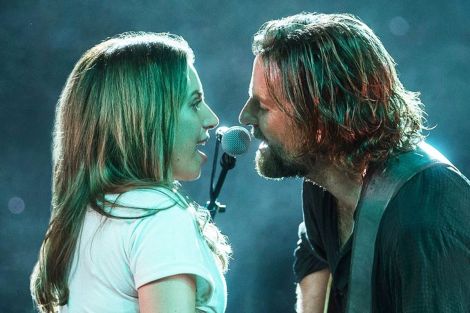
Lady Gaga and Bradley Cooper play two singers in love in A Star Is Born.

Right now we seem to have a lot of reboots in terms of entertainment. Reboots of TV series, reboots in music and reboots in movies too. A Star Is Born is a reboot of a film done three times before, but does it translate for the present?

I know I mentioned about a lot of reboots happening in my introduction. There are a lot of successful reboots right now, but there have also been some reboots that flopped too. What makes a successful reboot isn’t just rehashing something people loved in the past. It also involves making it relevant to the present and also have the ability to both please fans of the past materials and win over new fans. One of the best cinematic examples of a reboot is last year’s It. The cinematic version of It worked last year because of two smart choices. The first being it would divide 28 years earlier to the time of the plot in two separate films. The second being the childhood part of the story would be set in 1989 and the adulthood part of the story to be set in the present, unlike setting the childhood part in 1958 and the adulthood part in 1986 as in the novel and the miniseries.

Moving onto A Star Is Born, we’re dealing with a film that has been done three times before. The first being in 1937 starring Janet Gaynor and Fredric March, the second being in 1954 starring Judy Garland and James Mason, and the third being in 1976 starring Barbra Streisand and Kris Kristofferson. For Bradley Cooper to take on the project and turn it into something winning for the present, he had to make a lot of choices.

Some elements would be very similar to what was done in films past, while some elements would have to be new and relevant and believable for the present. There were a lot of elements of all three past editions that worked very well such as a singer struggling to make it, the wash-up who discovers her and promotes her to greatness and even loves her, and the man encountering a substance problem which hurts his marriage and ultimately takes his life.

There were some elements from the separate films that he had to include. For example 1937 and 1954 were about an actress trying to make it and a washed-up actor promoting her and loving here. 1976 was about singers for the first time. The choice to have singers and in the field of country music as in 1976 worked well for the film. I will focus more on that later. Also the tribute Ally gave to Judy Garland was a subtle reminder in the film of the most famous version of the story.

Then there were the more complicated choices. First off, Bradley Cooper may have proven himself as an actor, but not as a singer or a director in the past. Bradley had to give himself the practice and even have the duet scene done in front of a live crowd. Sometimes only the real thing can work. Secondly, there were two factors involving Lady gaga. One factor was she had limited acting experience with her biggest previous role being her minor role in Sin City: A Dame To Kill For. The other factor was to present Gaga as a country singer. We all know her as the modern flamboyant pop icon and most of us could not see her as a country star. Even seeing Gaga portray Ally as a common pop star later on was challenging because of her ‘grand diva’ image. However Gaga made it work and came off as a very believable country singer. Her songs from the film have also won her fans over too. Thirdly is the chemistry between the two. The two had to come across not just as two singers but as a couple in love. The chemistry between Jackson and Ally worked excellently and made for a believable story. Star power can only go so far. They have to make it work on screen and they did it. Fourthly is the music. In order to make this version of A Star Is Born about two contemporary singers, the reboot had to have original songs that fit the film and fit the genres of country of pop, whatever genre was needed in what scene. The songs fit the film to a tee and proved to be winners off the screen too as Shallow and I’ll Never Love Again have charted.

Top accolades go to Bradley Cooper. The reboot was originally intended in 2011 to be directed by Clint Eastwood and have Beyonce as the lead. Beyonce’s pregnancy interfered with the story and it lead to four years of chaos with both Beyonce and Eastwood eventually leaving the project. Cooper picked it up, joined co-writer Will Fetters, and saw it as his chance for his directorial debut. He was first trying to get Beyonce to agree to the project, but it was decided in 2016 that Lady Gaga would be the lead. This proves to be a success in acting, directing, co-writing with Fetters and Eric Roth, and co-producing. The story comes across as relevant and believable to the current times and winning with the public once again.

It’s not just Cooper. Lady Gaga comes off excellent in what is her first lead role. We all know how Lady Gaga can really go into a character as seen in her on-stage performances and her music videos. However this was her first major acting role and singers are a bit of a gamble in terms of casting them as actors in movies; they’re either sink or swim. Sure, she knows how to sing, but the challenge was for her to handle a lead role. She handled the role of Ally with believability from start to finish. Even with the singing, Gaga showed she can sing country very well and also make for a believable common pop star. The film is as much Gaga’s triumph as it is Cooper’s.

There’s also more winning performances than just Cooper and Gaga. There’s also veteran actor Sam Elliott not just coming across as a believable cowboy half-brother in Bobby, but also stealing each scene he was in. That’s what makes a winning supporting actor. Andrew Dice Clay is not only good as Ally’s father Lorenzo, but is unrecognizable! Rafi Gavron also comes across well as Ally’s manager who has an axe to grind with Jackson. He did a good job in making Rez hateable. Dave Chappelle and Anthony Ramos were also very good in their supporting roles, despite having roles that weren’t that challenging or lacked screen time.

A Star Is Born goes beyond being a simple reboot. The story is made relevant to the times, the actors deliver a believable story and a love with chemistry, and the music is winning. This is not just another reboot. This is a reboot that works big-time!

Oscars 2018 Best Picture Review: Black Panther

Black Panther
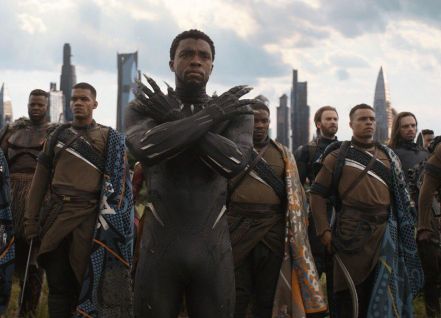
Chadwick Boseman plays The Black Panther who has to save the kingdom of Wakanda and his people.

People have been waiting for the longest time for a superhero movie to get nominated for Best Picture. If there’s a movie genre the 2010’s will most be remembered for, it will be for the heydays of the superhero movie. Deadpool and Wonder Woman were heavy favorites that ‘missed by that much.’ However it’s Black Panther that finally did it. And rightly so!

Now I’m not going to give a brief synopsis of the plot because most of you already know the story and saw the action. I will talk about superhero movies and how it lead to Black Panther’s most recent Oscar success. Now we’ve had superhero movies in previous decades and back in the 20th Century. I’m sure many of you can remember the old Superman and Batman movies from the 80’s and 90’s. The problem is around that time, the emphasis on popcorn movies back then was to be heavy on the action, and even heavy on the market hype, but comparatively minor attention to the characters and story-line. You couldn’t blame them; action movies blew people away and won big at the box office. However the flaws of a shotty script with minimal character development would soon become noticeable, especially by the critics. Around the 90’s as independent films were winning people over with storylines and well-developed characters, the stories and characters in action movies were starting to look either cardboard or idiotic. 1998’s Godzilla was possibly the best example of a film loaded with hype and action, but a ridiculous cookie-cutter story with foolish acting.

The 21st Century would mark a turning point for popcorn movies and especially for superhero movies for them to deliver better stories and better acting. Some say 9/11 became a turning point for movie watchers as they became less interested in cheering for villains and sleazes, but there’s more to that. The first sign was 2002’s SpiderMan. The producers were aware that despite the love for action in movies, the films story and acting could not be compromised. The film was loaded with action, as expected, but it did an excellent job in delivering a good story along with good acting as a result. That would not only open the doors for more superhero movies to come, but would also change the way superhero movies were done too. Marvel and their cooperating studios would become less focused on marketing hype — have you noticed there are less fast food chains plugging action movies lately? — and more focused on developing a well-written and well-acted story. It’s not to say that there were duds. There were a few SpiderMan sequels that were lousy and the 2015 rehash of the Fantastic Four was lame, but most superhero movies were very winning and easily demonstrated why they were winning crowds over.

Also on the subject of superheroes, I remember there were groups from religious organizations highly critical of the movies Hollywood was shelling out. They were complaining about all the ‘hazardous’ things in movies and how it threatened their values. Although no censorship occurred from their pleas, it did have an effect on the way superheroes are portrayed in the big-screen movies. One thing the studios were reminded of was that superheroes didn’t just simply do amazing things with their hands. They were characters that took a stand for values and were not afraid to do what’s right and be unafraid to deliver in their call of duty. In fact there have been many cases of some studios’ writing teams hiring Christian writers for the task. In most cases (obviously not for Deadpool), the superhero movies of the 21st Century were often praised by Christian critics of promoting values and dignity in a winning way. To think back in the 1990’s while gangsta rap and anti-hero entertainment were the call of the day, most people thought a story promoting values would come across being like a Mister Rogers. The 21st Century superhero movies proved that promoting values can be done in a winning way.

However it’s only been in recent years that superhero movies have the potential to do very well in the Oscar race. Most of the time, the best chances superhero movies had at scoring Oscars or Oscar nominations were in the technical categories like Best Visual Effects, Best Sound Mixing, Best Sound Editing. Sometimes they would win nominations in Best Costume Design, Best Production Design or Best Original Score despite nominations going mostly to ‘timepiece’ movies. The big turning point came in 2008 when The Dark Knight was a heavy favorite to get a Best Picture nomination. It didn’t happen, but Heath Ledger won an Oscar for his portrayal as The Joker. It was the biggest sign of how much better superhero movies, and even popcorn movies in general, became. In the past two years, there were two superhero movies, 2016’s Deadpool and 2017’s Wonder Woman, that were nominated for Best Motion Picture for the Producers Guild Awards. The Oscar nomination however did not happen: for Best Picture or any category!

It’s 2018; enter Black Panther. The Black Panther is a hero that actually made its debut in the Marvel universe in a Fantastic Four strip in 1966. The Black Panther has made many appearances in various Marvel comic stories. In film, the first appearance of the Black Panther was in 2016’s Captain America: Civil War where he was played by Chadwick Boseman. That of course was an Easter Egg of what was yet to come. The movie of The Black Panther was released in 2018. As expected, it was to tell the story of how the Black Panther came to be and how the Black Panther had to achieve their first defining moment of greatness. However it did a very good job in presenting a story of a moment in the distant past, to the ‘near-past’ of 1992 to the present. The story doesn’t just simply focus on T’Challa becoming the Black Panther, but also on his family and restoring the dignity of the Jabari Tribe and the wealth of the kingdom of Wakanda.

The film also does a good job in developing a story that’s entertaining for adults but also not too confusing for children. Another hard job of superhero movies is developing a story that works for both children and adults. It shows the conflicts abounding between T’Challa and Killmonger, as well as Killmonger’s pursuit of the throne of Wakanda with the intent to rule corruptly. It delivers the story in an excellent and entertaining manner with well-developed characters. Of course a superhero film needs to have its action moments, but the film does not compromise at all on the story or the characters.

The best efforts of the film come from director/co-writer Ryan Coogler and co-writer Joe Robert Cole. Coogler has had a steady progression in the film world. His first film was the 2013 independent arthouse film Fruitvale Station, then progressed to popcorn movies with 2015’s Creed, and now Black Panther. All have had winning results. Black Panther could have gone to another white director that was part of the Marvel team, but marvel made the right choice to have Coogler direct despite never directing a sci-fi movie. The result is winning. Cole has also been able to make his mark in this film. The most writing experience he had before the film was 2011’s Amber Lake and the TV series The People vs. O.J. Simpson. Here, he’s able to make a name for himself in a big way and should open bigger doors in the future.

With the great directing and the great story, the acting is also excellent. Chadwick Boseman delivers very well as the Black Panther and succeeds in delivering a three-dimensional role for the character. Michael B. Jordan (who also acted in Fruitvale Station and Creed) also does a great job portraying the villain. Lupita Nyong’o was possibly the biggest scene-stealer of the movie. She was enjoyable. The costuming by Ruth E. Cater worked excellently for the film as well as the sets for the film. It made Wakanda look very believable as a place. The music by Ludwig Goransson also fit the film excellently and the special effects were dazzling and entertaining.

It’s easy to see why Black Panther is a winning film. It’s a superhero story that delivers in all facets and manages to dazzle crowds too. It also succeeds in again taking a seldom-known Marvel superhero and turning him into a household name.

VIFF 2018 Review: Mega Time Squad

Mega Time Squad
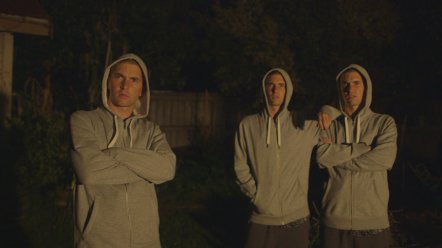
Anton Tennet plays a young man who uses multiplicity to form his own gang in Mega Time Squad.

Every year I do the Vancouver Film Festival, I make the effort to end my VIFF with the very last show. Once again, it was at 11:15pm at the Rio Theatre on Friday, October 12th. This year, it was the New Zealand thriller-comedy Mega Time Squad. It wasn’t the best film to end it with, but it wasn’t one of the worst.

John has a life that’s going nowhere. His parents are deceased. He lives in a garage in a town full of aged people. The only way he can make any kind of money is for working with a crime boss named Shelton who’s hired him with a lot of other dim bulbs.

Shelton gives John and another dim bulb named Gaz a mission. He wasn’t them to intercept a money drop at a Chinese antique store being dropped off by a rival Chinese gang led by a man named Wen. This turns out to be a bad idea as Gaz says he’s tired of being Shelton’s bitch. The heist is successful as they grab the money, but John gets a lot more. From the antique store, he grabs a Chinese bracelet. The store-owner tells him not to take the bracelet, claiming it has a mysticism that could be harmful. John ignores and takes it.

The crazy thing about the heist is that it has the Chinese gang and his own gang after John. John doesn’t know what to do until he discovers a time machine that can transport him back into time and avoid whatever trouble they’re facing. The machine also duplicates the user, so John uses it to get more than one John around. Eventually all the Johns meet up. The lead John declares his group of selves the ‘Mega Time Squad.’

The good thing is that John can accomplish what he misses the first time with his duplicate selves. The bad news is none are brighter than the original John. Plus with the charm bracelet, it could mean all the Johns would die off soon, including him. The various Johns are able to accomplish the heist, win a fight win over Wen, and fool people while the real John has won over the affection of Shelton’s younger sister Kelly. Eventually the actions of the various Johns catch up to the real one as Wen’s gang is after him and Shelton has a mission involving a bomb for him to do, which he eventually fails. Kelly learns of this and is turned off John.

However John has to do right. John is able to fix the curse so that all the other Johns are in a room. He reverses the curse of the bracelet and all the other Johns die with Kelly witnessing. Also Wen is able to get the bag of money John stole. Meanwhile an infuriated Shelton wants to see him. Shelton is about to shoot him for not doing his part right, but John confronts him and tells him he gives everyone the risky business while Shelton sits back and calls orders. Shelton tries to shoot john, but the bullet is shot in the reverse direction. RIP Shelton! All the gang members are free and John is free to love Kelly. As for Wen and the bag of money, that’s for you to see.

Here we go again where we see a New Zealand film that tries to be a thriller-comedy. I’ve seen it before many times at the VIFF with Housebound and Deathgasm. Housebound was the best-done of the three I’ve seen. Deathgasm was more focused on the humor and the gore than it was on the story, but still delivered on entertainment. Mega Time Squad gave me the feeling like I was watching the same thing over again. Also it didn’t compare to the other two as a story or in humor. There were a lot of times in which I felt the story was dumb or lacking in thrills. There was a lot missing.

One thing I will not do is declare this movie to be a disappointment. This film wasn’t the disappointment Housewife was. The acting was still good, if not great. The story was consistent and made sense. Even the foolishness or ridiculousness of the story or the idiocy of the characters didn’t come across as stupid or confusing. I will admit that this is the type of film that could simply be a made-for-TV film on a sci-fi network. However the film does deliver on a consistent story line that is fun, entertaining and humorous. It may be boring or lackluster in comparison, but it still entertains and will make you laugh.

I wouldn’t say this is an accomplishment for writer/director Tim Van Dammen, who ironically was an actor in Deathgasm. However I will say that it delivers in entertainment. Sure, some of it was idiotic, but it was able to pull itself together at the end and even deliver a humorous ending. Anton Tennet was funny as the loser-turned-winner John. Even some of his acting looked idiotic, but it was on for the most part. Hetty Gaskell-Hahn was the scene-stealer as Shayna. She was solid in her character and she helped make the film too. Yoson An was also good as a humorous villain who meets a surprise at the end.

Mega Time Squad offers nothing new for the thriller genre. I’ve seen it done before and done better. Nevertheless it will entertain you and get you laughing. It is a welcome relief after watching a lot of heavy, intense fare at the VIFF. And a good way to end the VIFF, if not end it with a bang.

And there you go! That sums it up for all the films I saw at the Vancouver Film Festival. I know it took longer than I should, but I saw a lot of movies and had little time to write. But I’m finally done now. My review of the Fest will be coming very shortly within a day or two.

VIFF 2018 Review: Winter Flies (Všechno bude)

Winter Flies
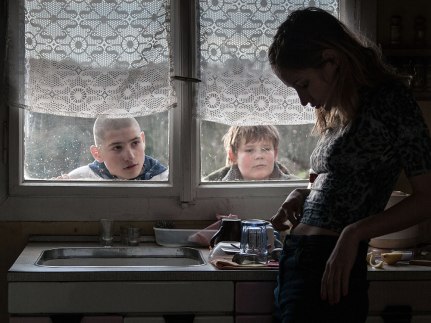
Winter Flies is the story of two Czech boys having fun braking the law.

“You’ve only got this time in your life to be young and stupid, so go for it!”

-my advise to young people

Winter Flies is the third of three entries in the Best Foreign Language Film category at the Oscars I saw at the VIFF. This Czech film is one that will surprise you.

The film starts on a winter’s day with a young boy carrying what appears to be a gun and wearing an outfit that makes him look like a bear. Turns out it’s a pellet gun. The boy’s name is Hedus. Soon an Audi arrives. It’s driven by a teenage boy with a shaved head named Mara. Despite the meeting together starting on a bad note, Mara decides to invite Hedus along.

The film then flashes to a police office. Mara has just been arrested for grand theft auto of that Audi. The female police officer, Officer Freiwaldova, is not impressed with Mara. He’s 15 and has a pregnant girlfriend back home, or at least he claims so. The film goes frequently from their ‘road trip’ to Mara being interrogated. They interrogate him about the trip and as well about the pink female sweater they found in the car.

Flashing back to the trip, Hedus drams of joining the French legion and asks Mara advise over girls. Mara acts like he knows it all, but soon they spot a girl on the road. She’s an older girl named Bara and looks like she’s abused. However she accepts a ride from the two as they don’t appear too threatening. During the trip, they stop at a park near a small lake. Hedus is having fun being up a tree and talking to Mara. Meanwhile a man is trying to sell them a dog. The boy laugh it off, only for the laughter to end when it appears the man is trying to drown the dog. They go to the rescue of the dog and Hedus even fires his pellet gun at the man. The dog is now theirs.

Back at the police office, Freiwaldova tries to get Mara to map out the trip, but he refuses and even hits on the Officer. Freiwaldova is frustrated with dealing with Mara. This is a long process as the Officer keeps on asking questions as she’s smoking cigarettes she puts in an ashtray with a fly in it. Continuing on the trip, the three come to a man who’s willing to give the three shelter for the night. They think it’s okay, and Bara sees no problem as long as she can protect herself. However things go wrong when they notice the man is about to rape her. That’s when Hedus and Mara act in and start acting violently to the man. They then take off again. However it’s soon where Hedus tries coming onto Bara. It’s there where she demands to be let out. So that’s all that’s left in the trip. The two boys, the dog and Bara’s pink perfume-scented sweater for them to masturbate over.

Overnight doesn’t seem to stop them. They learn they’re in a self-driving Audi as it can drive itself even while Mara is asleep at the wheel! In the morning, Mara learns they’re close to the town where his grandfather lives. However when they get to his house, Mara find his grandfather on the floor suffering from a heart attack. Mara, more concerned for anyone, gets his grandfather to a nearby hospital. Flashing back to the interrogation scenes, Freiwaldova is hoping to use this incident to find out more information about Mara. She calls the hospital to find out the name and tells Mara one of the men died last night. That makes Mara cry and confess information. It’s right after that where she admits she lied and says she did it to get any info out of him. No doubt Mara is pissed off.

Reflecting back to the trip, the Audi does eventually find itself caught by police in a small Czech town. It’s only a matter of time that the car is stopped and Mara is arrested. Hedus was nowhere to be seen. It’s the end of the road for Mara with him being at the police office, or is it? Hedus is outside the police office and the Audi is close outside. Hedus also found a ladder that reaches up to the office Mara is interrogated in. Hedus is sly enough to fire his pellet gun on all the police vehicles. That’s enough to distract all the officers and leave Mara alone in the office. Alone except for the fly in the ashtray coming back to life. Then Hedus climbs up the ladder and tries to get Hedus to escape. They’re back on the road again!

We should really hate those two jerks. One is stupid with an overactive imagination. The other is an irresponsible rebel with complete disrespect to just about everyone, including the police. We should also hate the two at the very end. However one critic made a point that I agreed with. They said the two make the rebellion and the irresponsibilities of adolescence look charming and even funny. I have to agree because that is the magic of art. It can take characters that we would look down on in the real world and make them look likable and even charming. We see that here as Mara does bring out the charm of the anti-authority jerk we really should hate. Hedus also brings out the charm of the weird boy with an over-the-top wild imagination. That was what the story is about in a nutshell: two adolescent misfits on a wild ride.

The film not only brings out the characters’ charms but may also remind us of our own adolescent ‘glory days.’ There are many scenes that were funny and hilarious, but would look terrible or disgusting in real life. Like when Mara is being a jerk to the officer, or when the two start hitting on Bara right after she was about to be raped the night before, or even when the two masturbate over Bara’s perfume-scented sweater. It’s a guilty pleasure to laugh at moments of stupidity like that because they will remind us of us and our own stupidities. I’m sure you remember the days you used to flip the tweeter to whoever you wanted! The film has other humorous moments as well like when the fly in the cigarette ashes appears to come back to life or when the two boys are able to sleep in the self-driving Audi with no problem. The latter should also be symbolic as it appears the two boys appear to be on a trip to nowhere. Maybe they don’t really care if they don’t have a destination, as long as they’re away. That’s another joy of being young: venturing into the unknown.

One thing to take note is that even though the two are characters of teens we should hate, Mara does show some vulnerability. One case is when a man is about to drown a dog. Mara gets Hedus to fire his pellet gun at the man while Mara goes to rescue the dog. Also that scene where Mara and Hedus are seen helping their grandfather who is having a heart attack. It sends you the message that Mara does have a heart, despite his rebellion and carelessness. Also that scene where Mara is crying when he thinks his grandfather has died shows he still has a child-like innocence in him that comes out when you least expect it. Those are scenes that bring out Mara’s redeeming qualities and make you actually like him and feel for him. He’s not the heartless jerk we’re first led to believe he is.

We should give a lot of respect to Slovenian-born director Olmo Omerzu and Petr Pycha. Who would’ve thought this was Pycha’s first ever feature-length script? Pycha’s story and Omerzu’s direction help make this film and its characters entertaining and charming in ways you least expect it. Tomas Mrvik was very good at the young protagonist Mara. This is Mrvik’s first film but he succeeds in making Mara hatable, but charming at the same time. Also acting for the first time is Jan Frantisek Uher. He did the idiocy of Hedus very well and surprised us all in showing Hedus is trickier than we thought. Lenka Vlasakova was excellent as Officer Freiwaldova. She did an excellent job in delivering the more dramatic parts and made them work for the film.

Winter Flies is the Czech Republic’s entry for this year’s Academy Awards for the Best Foreign Language Film category. The film was nominated for the Crystal Globe for Best Film at the Karlovy Vary Film Festival where Omerzu won Best Director. The film is also quite remarkable for including a lot of elements in a story of teenagers most teen films, especially those made by the Hollywood system, wouldn’t include. Stealing an Audi, allowing it to self-drive while asleep at the wheel, teen boys talking about getting ‘pussy,’ the two masturbating and climaxing in their pants, I doubt Hollywood would dare to make a teen-themed film with scenes like those!

Winter Flies is a humorous story. However the funniest thing about the film is that it makes likable characters out of two we should really hate!

VIFF 2018 Review: Edge Of The Knife (SG̲aawaay Ḵ’uuna)

Edge Knife
Tyler York plays a Haida man who’s inner monster overtakes him in Edge Of The Knife.

One of my goals each VIFF is to see a Canadian feature-length film. I had the good fortune when I went to see Edge Of The Knife. Not only is it a Canadian feature, but possibly the only feature-length film ever completely in the Haida language!

The film begins with the carving of a wooden mask and then burning it in a fire. The story begins with a meeting of two Haida families over at the Haida Gwaii in Northwestern BC in the 19th Century. It’s an annual fishing camp the families have together. Adiits’ii is the oldest son of and close to the family of Kwa and his son Gaas, who sees Adiits’ii as his mentor. Kwa’s wife Hlaaya finds his appetite for challenges to be too reckless for her son. However Adiits’ii often feels belittled by his own family. Sometimes Kwa makes him feel inferior.

In the evening, Adiits’ii decides to take Gaas onto the waters on boat. Overnight a storm hits the coast. The families fear the worst for Adiits’ii and Gaas. The next morning, the bad news. Gaas is found dead on the coast. Adiits’ii is missing and presumed dead. However Adiits’ii is still alive. He’s in a remote forested location and feels he can’t return because of the reactions from others he fears. Secluded, he becomes overtaken by a huge spirit. He transforms into a Gaagiid/Gaagiixiid — the legendary Haida Wildman  — and his behaviors become feral and even demonic. The whole family searches for Adiits’ii. Kwa and his wife are first to discover Adiits’ii, but lashes out at him wanting to kill him. The wife tries to stop him, but that leads Kwa to speak out his belief of who he thinks Gaas’ true father is. The families work to get Adiits’ii captured before they can free him from his possession. They set up a trap and they succeed. It’s at a ritualistic ceremony that involves prayer and piercing of the chest that they have to free Adiits’ii from the possession of the Gaagiixiid. The film ends with Adiits’ii carving out a mask out of wood, the very mask seen at the beginning, and burning it. At the end, we notice it’s in the image of how Adiits’ii was when possessed by the Gaagiixiid.

As far as film quality goes, this is a film I’d call great, but not excellent. The story is very good as it focuses on physical actions and unspoken feelings. However I have seen Canadian films with better dialogue and better story lines. Culturally, this is an excellent film as it captures the Haida culture and the Haida language without any interruption of the English language. Also it captures Haida mythology with excellence. It introduces us to the Gaagiixid. I am not familiar with Haida culture at all, but the film gives me a good understanding about the mythological belief of other beings. We should remember that Adiits’ii is a person with personal demons. He feels like the misfit and he feels like he’s belittled. Although he doesn’t say it, it’s obvious. After the accidental death of Gaas, it’s his guilt that gets the best of him and runs away. It’s there when he turns into the Gaagiixid. I believe the Gaagiixid is all about his personal demons and bad self-image. He had to conquer the Gaagiixid inside of him to truly come to peace with who he is and what he did.

SPOILER WARNING – Ending Revealed In This Paragraph: The film begins with the scene of a mask being carved of wood and then burned in a fire. At first one would wonder why would a person burn a mask that was just carved? Then it’s repeated at the end. At the end, you see that the mask is the image Adiits’ii had as he was fighting his inner demon. Then as you see it burn again, you see why. It’s like the final step in ending the demon inside. That scene is a good interpretation of Haida culture and Haida mythology.

This is an accomplishment of a film as far as culture goes. First off, this is a film done by not one, but two First Nations directors: Gwaii Edenshaw and Helen Haig-Brown. Secondly, this is a film done completely in the Haida language. This is a film that is essential for the language. At first, Haida was the only language the people spoke. However with the happenings of past history and with modernization, there are only twenty fluent Haida-speakers left. Even though there is educating young people inn the Haida language or even a resurgence of bringing back the language, the struggle is still there. This film does an excellent job in displaying the language and the culture of the Haida people. The idea of the film came back in 2011 by University professor Leonie Sandercock. In making the film, those involved received a Partnership Development Grant of $200,000 from the Social Sciences and Humanities Research Council, so even arts funds knew of the importance of this film to be made. Also to create a time before European settlers arrived really involved a lot of effort.

Also the film has been widely welcomed and celebrated by the Haida peoples and other First Nations peoples of BC. I remember a couple of times during the VIFF, I was waiting to see a film after Edge Of The Knife over at the theatre I was to attend. Each time I was in line, I was given the news that there would be a 30-40 minute delay of the start of my film. As Edge Of The Knife finished, I saw more than just people exiting. I saw some dressed in traditional First Nations costume. Some even brought drums and performed a song of celebration. When I saw that, I felt I had to see Edge Of The Knife when I had the chance. This was more than just something. I’m glad I did.

Gwaii Edenshaw and Helen Haig-Brown did an excellent job in directing and creating a world far back in the past and appear authentic. The script by Gwaai and Jaalen Edenshaw, Graham Richard and Sandercock was not too intense in terms of dialogue, but it does present a very good story that’s more about emotions and image-based. Tyler York did a very good job as Adiits’ii. His acting was more about what was inside of him rather than what he said. Willy Russ almost stole the show as Kwa. The actors involved are more of a Haida community rather than actors by profession. All did a very good job. The film was light on special effects, but the effects fit the film and the scenes right. It didn’t need more effects than necessary.

Edge Of The Knife may not be the best Canadian film I’ve seen or even the best of subject of First Nations peoples. However this is a very culturally-important film that deserves to be shown. It also tells its story in both an entertaining and mesmerizing way. Definitely worth seeing.

VIFF 2018 Review: The Guilty (Den skyldige)

Some of you are wondering when will I finish with my blogs about the VIFF? This is my fourth-last review. The end is coming very soon.

guilty
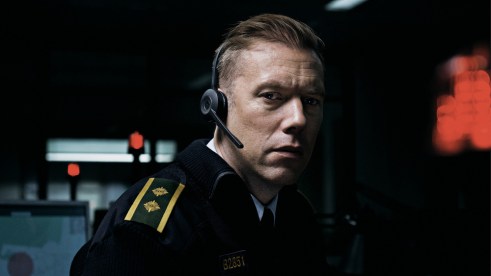
The Guilty is a unique drama which centres on the officer (played by Jakob Cedergren) and the voices he hears through his headset.

I usually like film that delivers the unexpected. That’s the best thing about the VIFF. The Guilty is a Danish film that delivers on surprises in the best way.

The film begins with Asger Holm operating the emergency call system at the Copenhagen police department. He has his call technology with him which includes the computerized phone system and a monitor consisting of a map mapping out the geographical range of the cellphone calls he receives. His calls are mostly mundane as it’s an evening and of situations that aren’t so violent and more cases of stupidity. Asger also receives the occasional phone calls from his lawyer. Cellphone calls on his personal line are not allowed during his job.

Soon there’s a call he receives that causes him concerned. It’s of a woman named Iben. She first tries to hit on Asger, but we soon learn she’s in the back of an SUV driven by Michael, her ex-husband. The monitor shows her travelling close to the Sjaeland area but there’s no knowledge what the car looks like or the license place. Asger tells police along the route to look out for a white van, which no one finds. Asger researches her ex-husband’s name and finds out he’s a convicted felon. On top of that, Iben has two small children she misses a lot.

We should keep in mind Asger is nearing the end of his shift, and must transfer whatever feedback to the next person who will be working the shifts. Nevertheless Asger sticks to it. Asger sends police to the house to tend to the small children while he tries to get police to chase the van. Asger receives a phone call from the police who visited the house. The police found the daughter with blood all over her but no wound. However they found the infant son dead with stab wounds all over him. Asger is convinced that Michael committed the murder. Asger learns the van has stopped and tells Iben to get something where she can hit Michael on the head  as part of an escape. She does so. When Michael calls in about being hit on the head, Asger lashes out at him and hangs up.

Now that Iben has escaped, it’s a matter of keeping her in a single location until the police arrive. Meanwhile Asger receives distracting phone calls from his lawyer about his trial for tomorrow. Asger will go on trial for the wrongful shooting death of a 19 year-old. Right while Asger is keeping Iben on the line, he learns a shocking result. Iben thought there were snakes inside her infant son. So she took a knife and stabbed him to cut them loose. Asger now has more to deal with. He first has to let his fellow police know of the shocking turn of events. He also has to deal with Michael and reassure him that he now accuses him of nothing and to stay calm. Also Iben now wants to jump into the coast water, now realizing the terrible thing she did. Asger reassures him and keeps her calm. Asger even tells her about the wrong he is about to face the music about. It works as Asger is able to keep Iben on the line and for police to come to her. The ordeal finally ended on the right note as Asger walks off.

This is more than just a detective story. This is a film that allows us to be the judge and jury of the whole action too. All we have is Asger on the phone, the police computer screens and those on the phone Asger converses with. The story is successful in giving us a scenario where we all think a common thing and make common assumptions: that Iben is abducted by her ex-husband, that Michael murdered his infant son, that Michael will murder Iben next. However it’s right in the middle that we are reminded that what we think we know is not the true story. I even remember hear gasps  or reactions of shock in the audience when it was made clear that Iben killed her infant son. That is the top quality of the story. With it being in one location and consisting of telephone conversations adding to the story, it allows us to confront what we thought we knew and shock us with the truth that we don’t see, but hear. Also the cellphone conversations to Asger along the side appear to be distractions to the story at first, but later prove vital in telling the story about Asger. It too gives us our own thoughts at the beginning, but later reveals a truth we didn’t know.

I have seen a lot of single-location films before. However I thought for the longest time that it would be next to impossible to do a single-location feature-length film. This film proved me wrong. It may have switched rooms on occasion, but it kept the story within the same building and was able to use it with the use of cellphones or computer terminals. The phone conversations that deliver the unseen drama work to the quality of the film and help make the story. I know I said the film’s gift is working with what we don’t know or what we assume at first. Everything in which the film did helped make the story work for us and kept us glued to our seat.

The story is not only about what happens through the phone conversations. The story is also about Asger Holm. When the film begins, we first think it’s about an officer assisting on an emergency line at the police station and that the story is mostly about Iben. Later on we learn the story is also about Asger.  We are led to believe that emergency operator is his assigned job. We often wonder why Asger won’t leave the crime situation to others, even after he’s told his shift is over. We wonder if he cares about being fired. It’s later we learn that Asger has a blemish too. The following day, Asger will need to go on trial for the shooting death of a 19 year-old. We soon understand his phone operations are not his job. It’s because he has been demoted since the shooting incident. As for continuing with dealing with Iben, it appears more than just sticking to it and doing the right thing despite the risks to his job. I think he knows this day will be his last day of any kind of police work and that may be the additional reason why he’s doing it. He know that his career will end with a blemish and I believe he wants his last act of police work to be a job of dignity. At the end of the film, he is not acknowledged at all by his co-workers and walks off. Nevertheless we in the audience know the excellent work he did. It is quite something how a policeman about to face trial becomes the one who prevents Iben from committing suicide and puts her in the right hands.

This film is an excellent work by Gustav Moller. This is actually Moller’s first-ever feature length film with only brief experience doing a short and two television episodes. This film he directs and co-writes with Emil Nygaard Albertsen who’s also mostly known for work in TV and shorts really delivers on the story and is excellent pieced together. The story becomes like a puzzle that needs to be pieced together piece-by-piece and it succeeds greatly in piecing it all together. Also excellent is the acting from Jakob Cedergren. The story is him, the computers and the phone calls he receives. Being the one who centres on the crime story as well as other stories that surround him through outside cellphone calls, he makes the story work and makes it interesting. He helps us focus on the situation and makes what could be a boring story interesting, thrilling and even thought-provoking. Also excellent was the acting of Jessica Dinnage. There’s no physical acting here. The only acting we have of Jessica is her voice through her cellphone calls. Nevertheless her voice-acting was perfect in both telling the story and in embodying the character. Her voice over the phone and the things Iben said really made the unexpected drama happen.

The Guilty is Denmark’s entry in the Academy Awards for Best Foreign-Language Film. The film won the Audience Awards at Sundance as well as a nominee for the Grand Jury Prize. The film has also won a wide variety of awards at other film festivals such as the Critics Choice Award at the Zurich Film Fest, the Special Circle Jury award at the Washington DC Film Fest, the IFFR Audience Award at the Rotterdam Film Fest and the World Cinema Winner at the Montclair Film Fest.

The Guilty is a remarkable film. Not just because of how it’s filmed on a single location, but also because of how it reminds us what we think is not what’s fact. Definitely an unforgettable eighty-five minutes.

******************

This blog is dedicated to Uncle Rick,

My Blog’s biggest fan.

1952-2018

VIFF 2018 Review: Burning (버닝)

Burning

One of my goals at the VIFF is to see at least one film which is a nation’s entry into the Academy Awards for the Best Foreign Language Film category. The first of three I saw during the VIFF was Burning from South Korea.

The film begins with Lee Jong-su performing odd jobs in Paju. One day he runs into a former neighbor and classmate from his childhood. Her name is Shin Mae-hi.  Mae-hi confesses to Jong-su that she always liked him but he always ignored her. Could it be because he was a farmer’s son and she was more urban? At the date later on, Mae-hi tells Jong-su that she has pursued an acting career. She’s disappointed to see that Jong-su hasn’t pursued a career in writing as he wanted to do in college.

The romance sparks up so high, they have sex in her apartment. She lets Jong-su know she will have an acting gig in Nairobi very soon and she wants him to feed her cat. He agrees. Jong-su never sees the cat, but always sees the food gone and the litterbox used. Also when he’s at her place, he masturbates in her bedroom. Mae-hi returns, but three days later than expected because of a terror warning. Mae-hi also returns with a Korean man named Ben: a man she bonded with during the crisis. The three have dinner together. Mae-hi recalls a sunset she saw during the trip. She cries, confessing she wanted to disappear. Ben doesn’t understand why people cry and admits he never cried himself.

Jong-su has things to take care of back home. He has to look after the family house and farm as his father is awaiting trial. Jong-su often watches the relationship with Mae-hi and Ben from afar with envy. However he’s suspicious of Ben. Ben is confident, but doesn’t mention what he does for a living. Jong-su pays a visit to Ben’s place and notices an area where there is a lot of women’s jewelry and decorations in the bathroom. Jong-su later joins the couple in a restaurant. There Mae-hi shows them the dance she learned in Nairobi. Jong-su likes what he sees, but he notices Ben is unamused.

The trio then go to Jong-su’s farm where they find themselves getting high and Hae-mi dancing topless. Hae-mi recalls a memory where Jong-su rescues her from a well. After Hae-mi falls asleep on a sofa, Ben makes a confession to Jong-su that he like to burn an abandoned greenhouse every two months. He notes his area is full of greenhouses. Ben claims the next burning will be close to Jong-su’s house. Ben also tells Jong-su that Hae-mi considers him her best friend. But as she awakens from her drunkenness, Jong-su calls her a whore as they leave.

Jong-su takes this to heart as he is careful over the neighborhood to spot out of any gas houses are burned down. None are, but he receives something even more disturbing. He received a phone call from Hae-mi one night that cut out after that cut off after a few seconds of ambiguous noises. The concern grows as Jong-su makes call after call to Hae-mi with no response. He goes to her apartment which is surprisingly clean and shows no sign of the cat. Jong-su contact’s Hae-mi’s family, but they say they haven’t heard from her in some time and she owes them a lot of money. Even Ben makes claim of Hae-mi not returning calls as Jong-su approaches him.

Suspicious of it all, Jong-su starts stalking Ben. Ben is unaware that Jong-su is stalking him, but treats Jong-su with friendliness. Ben even introduces Jung-su to his new girlfriend and even says they have a new cat. As Jong-su makes his way to the bathroom, he sees the watch he gave Hae-mi. Looks like the truth about Ben and what happened to Hae-mi came out. It’s just after Jong-su’s father has been sentenced that we get the final act of the drama.

The film is a quiet mystery. I call it quiet because there is little if any score. The film quietly lets the events unravel as they happen. It lets the facts quietly but surely become clearer over time. We learn more about what happened to Mae-hi. Mae-hi may be very free as is expected of an artistic person, but no sign of her for a long time does rise to suspicion. We soon learn more about Ben. He comes across cool and confident and the type of person who wouldn’t hurt anyone, but it’s Jong-su who sees Ben’s true colors. We also learn more about Jong-su. Jong-su comes off as an awkward son of a temperamental farmer undecided about his dreams. Jong-su comes as the type of person too awkward to do anything seriously violent, but as truths unfold, the monster inside him comes out. The story comes just as his father is sentenced for his violent actions, Jong-su becomes judge, jury, and executioner on Ben. Having all this happen in a film with no score or any other cinematic gimmicks works well for the film. I think something like a musical score may have hurt the drama.

In addition, the film answers more with what we don’t see than what we see. The value of the unseen is first given credit involving the scenes of tending to Hae-mi’s unseen cat. We never see the cat and neither does Jong-su, but the food is eaten and the litterbox is used. The unseen is key for resolving the mystery of Ben. The unseen is where Ben acquired all the female jewelry and decorations. He talks of his ‘hobby’ of burning gashouses down. However it becomes more obvious about what these burning are. And it took the piece of Hae-mi’s jewelry just after Hae-mi goes missing to get the sense that Ben is a killer, and the burnings is a secret word for murder. It’s at the end that the burnt gashouse ends up being Ben’s car with a fatally-wounded Ben inside.

Top credits go to Lee Chang-dong. Lee has had an impressive film making career in South Korea. However it was 2003’s Oasis where he won the Best Director award at the Venice Film festival that he first caught international notice as well as the Chief Dan George Humanitarian Award at VIFF 2003. Poetry took his career to a new height after he won the Best Director Award at the Cannes Film Festival in 2010. This film in which he directs and co-wrote the script with Oh Jung-mi is an excellent work of its own. It won the FIPRESCI Prize at this year’s Cannes Film Fest. Awards aside, the film does keep one intrigued. The story doesn’t make a lot of sense at first, but the drama slowly builds over time. Yoo Ah-In does a very good job as Jong-su. He does a great job of playing a character who first seems harmless, but has a monster inside of him. Steven Yeun, a Korean émigré to the United States, does a good job as playing a character cool and calm, but has a dark secret. Jeon Jong-seo is also very good as the free-spirited Hae-mi.

Burning is a suspense that starts quiet but slowly builds over time. Its quiet drama is its best asset and adds to the film.

VIFF 2018 Review: The Seen And Unseen (Sekala Niskala)

Seen Unseen
A young Indonesian girl uses myth and spirituality to deal with her dying twin brother in The Seen And The Unseen.

At film festivals, you often see a lot of cutting edge film. Very rarely do you see a film that’s family-friendly. The Seen And The Unseen is a film that should rightfully called family-friendly.

The film begins with a young Indonesian boy named Tantra being brought into a hospital bed. The mother is hurt. However the twin sister Tantri is naive and doesn’t know what’s really happening. You can tell by how she breaks the egg in her hand that it’s very serious. A flashback shows how the two were in more playful times.

The family live on a farm and the hospital Tantra is staying at is in the city. Unknown to her mother, Tantri takes trips to visit Tantra. She brings puppets, eggs, plants and a musical instrument. One day Tantra does a shadow-puppet show for Tantri where he tells of his illness. She returns to the hospital to play games, sing, dance and dress up in traditional costume. They even share time where they dress up as birds.

However the mother notices it and she’s not happy. Even though she understands, she advises Tantri not to do it anymore. Nevertheless Tantri feels the spirits of her brother in the farm fields. She even feels her own spirits in the animals and in the sky. Then the news comes. Tantra’s cancer is getting worse. She spends as much time as she can with him whether it’s in the hospital or in the dream world. In the dream world, he’s alive and well and active. Even as she goes with her parents with a temple crowded by monkeys, she can feel his spirit. Even as his death eventually comes.

The thing of the film is that it takes a stressful situation like a child sick and dying and it incorporates Balinese culture as a way to escape. Tantri is the twin of Tantra so of course she has a strong with him. The culture incorporated in the film is very much rooted in images of monkeys and birds. When he’s sick with a potentially fatal illness, she goes to elements of the Balinese culture to play with him and communicate with him. She even uses the elements to get into her own spirits. However for Tantra, the more serious and debilitating his illness gets, the more his imagination flies. It becomes evident that there’ something in the unseen. The mother doesn’t see it. I guess that was the point; a world seen only by the two children.

The culture in the film is also central in the relationship between two twins. It is there where in Tantri’s dreams, the two can act out their stories, or where they can become the spirits of animals. They share songs, dances, dress in animal costumes and play games. The two have a balance together. When Tantra is nearing death, Tantri senses something in his spirit. It’s this world of culture and animal imagery that help Tantri in dealing with her brother’s looming death.

If I have one complaint, it’s the ending. I felt like the ending was too brief. All the events led from his admission to the hospital up to his death. I was anticipating something post mortem whether it be Tantra’s spirit in the form of animals or imagery. It was not to be. I assume it was the director’s choice for the ending to be that way. However I felt it did take away from the film.

Top credits go to writer/director Kamila Andini. Childhood is an essential part of her filmmaking as she also wrote and directed The Mirror Never Lies. I know the subject of a child dying makes for something that would be tricky to make watchable, but Andini creates something beautiful. Through the imagery, the looming death of Tantra doesn’t look so harsh. The film even has spiritual elements and the focus of the soul living on. I admire Andini for having those elements in the film. In terms of acting, top credits go to Thaly Titi Kasih. She was the protagonist in the film and she did a very good job without getting manipulative or overbearing in emotions. Even though she’s the sister in between this, she’s not trying to be manipulative. Also goo din the film is Ida Mahijasena as the brother whose spirit comes alive at night when the body is fastly dying.

The film has won the Best Feature Award at the Adelaide Film Festival and won the Generation KPlus Award at the Berlin Festival. It was also a nominee for the Platform Prize at the Toronto Film Festival. The VIFF doesn’t have any special awards for family-related films. Here’s hoping in the future.

The Seen And The Unseen is a film that wouldn’t normally get children too interested, but it’s a beautiful film. One could even describe it as ‘spiritual.’ However it’s definitely cultural.