Copa America 2024: My Prediction For The Final

Will this be Argentina’s record-setting sixteenth win?
Or Colombia’s second?

Back on my talk about the Euro final, I talked about how people shouldn’t see continental tournaments as joke tournaments. Same with the Copa America. Especially knowing that all the teams of the CONMEBOL are as capable of losing to each other as they are winning. Argentina may be the World Cup holder but that doesn’t guarantee they’ll win every game in their wake. Most likely, they’ll face defeat at the hands of a South American team. In fact, Argentina’s only loss since their World Cup win was to Uruguay this past November!

Here in the Copa America, the final is down to two teams from the CONMEBOL, as I feel it should be. One team is tied with Uruguay for fifteen previous wins while one won it only once back in 2001. So the big question is which team will win the Copa America on Sunday? Here’s my look:

Head-To-Head Stats: The two teams have played each other 42 times before. Argentina has won 25 times before, Colombia has won nine times before, and eight games were draws.

Team-By-Team Analysis:

ARGENTINA: Coming to this tournament as the reigning World Cup holders, it’s easy to assume they would become the favorites to win. Added to the fact they are the reigning Copa holders from their 2021 win. Very often, many World Cup winning teams start feeling immediate changes after their win. That hasn’t been the case for the Albiceleste. Lionel Scaloni is still the team’s head manager as he’s been since after the 2018 World Cup. Many anticipated Lionel Messi would retire after the win in Qatar 2022 but he’s still part of the team and still captain. Also remaining with the team are star players like Angel di Maria, Julian Alvarez, Lautaro Martinez and goalkeeper Dibu Martinez. Their play in the US has been consistent with their reputation as they won all three of their Group Stage games and made it through both of their knockout matches.

Despite their great play, they have shown vulnerability. As anticipated, it’s come at the hands of South American teams. Recently it was in their quarterfinal against Ecuador that went to a 1-1 draw. It was after penalty kicks that they won. I know I talked about Argentina’s only loss since their World Cup win being to Uruguay. It’s possible Colombia could expose their vulnerability in the final. The last time they met back in February 2022, Argentina won 1-0. If Argentina is not overconfident and they take their rivalry against Colombia seriously, they can become repeat Copa winners.

COLOMBIA: It hasn’t been an easy time for Los Cafeteros. Right after they learned they would not qualify for the 2022 World Cup, they dropped their coach for Argentine coach Nestor Lorenzo. Since then, they have not lost a game. Actually their 1-0 loss to Argentina in February 2022 in a World Cup qualifier is their last loss. James Rodriguez is the captain with David Ospina being the head goalkeeper. Here at the Copa, Colombia delivered the best results in their group, delivered the only win in regulation time in their quarterfinal against Panama and delivered another win against Uruguay 1-0.

Other than Argentina, Colombia has delivered the best consistency in play. They’ve been scoring well and delivering strongly against their opponents. I know I talked about possible vulnerability of Argentina. Colombia can be just as vulnerable and Argentina could take full advantage of it. In the final, neither team can afford to give anything away. If Colombia want to upset the current World Cup Holder, they will have to be on the ball from the start and give nothing away.

My Final Verdict: We should remember that the Copa America and the World Cup are two different tournaments and both have their own challenges. Winning either trophy is not easy at all. My prediction is Argentina to take it 2-0.

And there you have it! That’s my look at the 2024 Copa America final and my prediction for the win. Interesting how both the Euro final and the Copa America final are happening on the same day! Aren’t you relieved of the time difference?

2023 Oscars Short Films Review: Live-Action

It’s interesting when the Academy deliver their nominations for feature-length films, they’re mostly for English-language films. Most of them being American films. Yet the nominees for the short films categories are often multilingual. For the films nominated for the live-action category, we have  films in French and Danish. We also have three English-language films, but two are from the UK. Not as much foreign language as the animated films but still it tells how these categories are among the most international of them all.

What’s interesting about the short films in the live-action is that many are from up-and-coming directors, as is the common case in this category, but we also have one British film directed by Wes Anderson! Also in the film are renowned star actors like Benedict Cumberbatch, Ben Kingsley, Dev Patel, Ralph Fiennes and Richard Ayoade. The other films also show actors of renown like Brittany Snow, Leif Andree and David Oyelowo. So there’s something about short films that make well-known actors want to pursue them.

Without further ado, here are my thoughts on the Live-Action short films nominated for the Oscars:

The After (dir. Misan Harriman) – Dayo is a successful businessman in London. One day, he drives his daughter to the top floor of a parkade to meet up with his wife. Suddenly a man wielding a knife commits a massacre all over the parkade. The man stabs his daughter to death. The wife, heartbroken, jumps to her death as Dayo fights to restrain him for the police. Time passes. Dayo is resigned from his position and makes his pay an Uber driver. He has cut off all contact from his friends and colleagues and won’t even meet with crisis management counselors. Although he keeps to himself, it’s obvious he’s still hurting on the inside. As he waits for his latest customers at the airport, he takes the picture of his family and sings “Happy Birthday.” The daughter of the family he’s to drive looks very much like his own late daughter. He tries to restrain his emotions at first as the parents make their way to the car. During the drive, the couple are consistently arguing in front of the child, but the daughter is sensing something is wrong with Dayo. Dayo still tries to keep his cool. As he gets out lets the family off at their house, the daughter goes to hug Dayo and Dayo just breaks down. The parents are shocked by what they see and leave him, but Dayo picks himself up.

How do you live again after you’ve lost it all? This is the type of question we don’t normally ask ourselves or don’t want to think about but unfortunately, there are some people who have to do exactly that? This is a story that does a great job of showing the before-and-after of a tragic incident that claims the lives of Dayo’s wife and daughter. Throughout the story, Dayo is the storyteller through his actions and his emotions. Even without dialogue, you can sense what Dayo is saying through his body language. He doesn’t know how to live again or deal with his emotions. It’s right after the breakdown he has after the daughter hugs him that Dayo knows he has to continue on, despite how hard it will be. This film which is the directorial debut film for Misan Harriman tells a gripping story with a profound message. David Oyelowo does an excellent job in his performance in both scenarios of the story. If they could give Oscar nominations for performances in short films, I’d say give one to David!

Invincible (dir. Vincent René-Lortie) – The film begins with a young boy in the driver’s seat in a car named Marc who telephones his mother, but doesn’t say a word. His mother tells him to come home, but police lights flash. Rather than surrender to the police, Marc drives the car off the cliff into the water. Going back weeks earlier, Marc is on a family vacation having fun with his family at the lake. He plays with his little sister but is embarrassed of how she chickens out with her finger over his lighter. This is the last set of fun Marc will spend with him before being sent to the youth detention centre. The first day, Marc can’t stand being in a sweltering room with no way to cool off. He ignites the sprinkler system which the officials put him on a stern warning. A councillor tries to deal with Marc and tells him how he has what it takes to be a smart positive influence on others and can’t understand why he’s always getting in trouble. One day, the official sees progress in Marc and how he helps others. The officials decide to take the boys to a nearby community pool. it appears Marc is having fun with all of them but when the councillor isn’t looking, Marc does his latest escape. Marc runs into a car but as the woman enters a store to call the ambulance, Marc steals it, attempting to take his escape further. As Marc stops, he calls his family. The mother, aware the police are pursuing Marc, pleads for him to return as the sister tests her pain with the candle.

This is a story inspired by a troubled 14 year-old boy from Quebec who killed himself as he drove into a lake in 2008. The story haunted the people in the area for many years. The boy, Marc-Antoine Bernier, was a friend to the director. Here, it appears the director is using his film to bring some respect back to Marc. Marc was an intelligent boy capable of a lot of good, but kept on getting into trouble. We all have known a kid like that in our childhood. Although this is a story inspired by a real-life person and based on true events, there may have been events or happening added to the story. Only Marc knows what really happened. Nevertheless Vincent makes a good effort to redeem Marc from the story he tells and even tries to get us to feel some empathy for him. We’ve all had those years when we were younger when we all felt we were trapped mentally, if not physically. If Vincent doesn’t make you feel empathy for Marc, he does make for an intriguing story. That’s why I make this film my Should Win pick.

Knight Of Fortune (dir. Lasse Lyskjær Noer) – Karl is at a multi-chapel funeral home where he comes to mourn his wife. Left alone, he can’t bring himself to open the casket. He tries to adjust a light but it breaks. Frustrated, he goes to a bathroom where he encounters another widower named Torben. Torben claims he can’t open the casket for his wife. Karl goes with Torben to the chapel and helps open the casket. As Torben attempts to say his “last words,” a family comes in. They’re the real family of the deceased woman including the real widower. They allow Torben and Karl to stay. When the widower is at a loss for words, Torben is able to say the right words as if the woman really was his wife. Karl leaves Torben angrily but he later learns from the funeral directors that Torben lost his wife in a boating accident three years ago and never had a real chance to say goodbye. Outside in a nearby bench, Karl notices Torben. Instead of anger, Karl laughs and invites Torben to the chapel where his wife is. Torben is able to open the casket and Karl is able to say his last goodbyes. As Karl gives his wife one last kiss Torben sings “Knights Of Fortune.”

Another story of loss and coping. Although this story deals with the subject of death in a gentler manner, and even includes humor, We all know that loss is never an easy thing to deal with, but it needs to be dealt with. This is a story of a widower struggling to properly say goodbye encountering an imposter who knows the right words to say goodbye to a woman he’s never really met, but makes like she was his wife. Once Karl learns about Torben that he’s not simply an imposter, but a hurting man who uses funerals of wives to say the goodbyes he always wanted to say to his own wife, could Torben be the very person to help Karl deal with his grief? This is a story of grieving, healing and saying goodbye that is greatly different from other stories. Nevertheless it does offer a message of healing and hope. It’s ironic how this imposter is exactly what Karl needs to properly deal with is loss and say goodbye, and a friendship that really shouldn’t be, happens.

Red, White and Blue (dir. Nazrin Choudhury) – Rachel, a waitress in a diner, looks at a pregnancy test and sees a positive result. Rachel is a single mother who has difficulty to support her two children. She also lives in Arkansas where abortion is illegal, thanks to the overturning of Roe v. Wade. She plans a trip for an abortion procedure in Illinois where it is legal, but it’s more than she can afford. One day, a woman customer who somehow knows what Rachel is dealing with leaves her a tip which makes up the remainder for her abortion trip. Soon, she leaves her son Jake with a friend as she takes her daughter Maddy on this trip. This is the first time out of Arkansas for both of them. Before they go to the clinic, they go to a carnival as it’s just before Maddy’s birthday. Maddy wants a merry-go-round ride, but it’s more than Rachel can afford. She agrees to one ride and Maddy chooses the elephant. At the clinic, Rachel learns she’s late for her appointment but through past recollections and as the receptionist learns the dirty facts, she tries to make it urgent.

No doubt this story is about abortion. Especially in post-Roe v. Wade United States. The thing is this story is more than that. You know the story is about the pursuit of an abortion, but it’s not what you originally think at first. You think it’s about an impoverished mother getting an abortion because she’s two-and-through, but things change as you learn more information. You wonder why on earth would a mother take her young daughter on an abortion trip? Soon you learn there’s more to the reality of unexpected pregnancy and abortion that meets the eye. Including a lot of upsetting truths. It’s also surprising how in a story that has a theme that hits close to home and presents a story that many would find upsetting, it is still able to have a heart-warming ending that works. That is something in film that is very tricky to do, but Choudhury accomplishes it!

The Wonderful Story Of Henry Sugar (dir. Wes Anderson) – Based on a short story written by Roald Dahl, Henry Sugar is the pseudonym of a wealthy bachelor who loves to gamble away his inherited riches. Thing is he never seems to have enough and wonders how can he get more money? He learns the legend of a man from India named Imdad Khan who learned the fine art of levitating and seeing with is eyes closed, thanks to the teachings of a Great Yogi. Thing is as the doctors were studying Imdad, Imdad tells his story and dies suddenly. Henry tries through great lengths to master this technique through all he can learn. Once he finally masters the sight trick, he goes out gambling and wins big! Problem is all this money isn’t making him any happier. At first he thinks the right way to give the money away is to throw it off a balcony. After it causes a riot, police recommend Henry develop a better method. Henry then spends the next twenty years traveling the world, gambling, and donating his winnings to hospitals and orphanages.

This is the last of the five shorts shown in the shorts.tv reel. After seeing four stories that were either depressing, too serious or had dark subject matter, it was refreshing to end the reel with a light-hearted comedy. The story succeeds in making the tale amusing. Already we have a major director directing it and four major actors — Cumberbatch, Kingsley, Fiennes and Patel — acting in it. Nevertheless the story telling, set changes, and the acting of all make it a delight to watch. It makes for a “guilt-free guilty pleasure” as I like to call such things. That’s why I make this film my Will Win pick!

And there you have it. Those are my reviews of the five films nominated in the Oscar category Best Live-Action Short Film for this year. That also completes all my reviews for the Oscar-nominated short films. Those short film categories are usually the hardest to pick a winner. You think you know what will win, but end up surprised in the end. We’ll see how it all goes on March 10th.

VIFF 2023 Review: The Sacrifice Game

The Sacrifice Game is a super-bizarre story of a Christmas dinner two private school girls will never forget. Try as they might!

Can you mix the horror movie genre with the Christmas season and be able to create a good movie of the mix? The American film The Sacrifice Game makes that brave attempt.

The film begins with what appears to be four guests approaching a Christmas party three days before Christmas 1971. The hosts don’t recognize them, but that doesn’t matter because the four ‘guests’ kill the family in their home. One of them paints an image with a victim’s blood on the window. The following day is the last day before Christmas for a boarding school. All the girls leave the school and the dorms to be with their families for Christmas. All except Samantha, whose father can’t see her for Christmas this year, and Clara who appears not to have a family. Rose, one of the teachers, is willing to have a Christmas dinner with the two girls at the school. She even gets her fiance Doug to help.

That same day, the group of four, maned Jude, Maisie, Jimmy and Grant, go to a nearby church and claim the priest as their latest victims. Before they leave him behind, they take a piece of his skin that has like a bizarre tattoo on it. As the time gets closer to the ‘party’ at the girls’ school, Samantha tries to start conversation with Clara. Clara is reluctant. It may appear shyness, but more like Clara has a secret. A secret notable from the scars on her skin. Also the girls at the school hear the news of the killings. It makes them nervous, but they think it’s a distant problem.

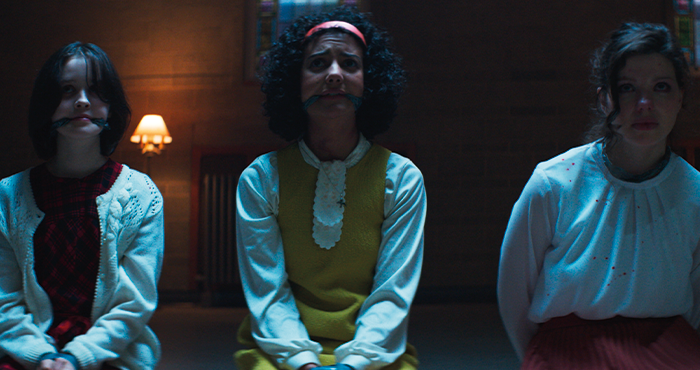
The next day, two days before Christmas, Rose is helping to organize the dinner and Doug is helping along. The two girls go to the more closed-off areas of the school building. They come across a lot of secret things, including books they’re not to read. Meanwhile the four claim their latest victim. A policeman stops their car on the road. As he inspects the car, he comes across the pieces of marked skin from their victims. He becomes the latest victim of the four. The following day, Christmas Eve, Rose has everything ready for the two girls and Doug is heading over to the school. The group of four approach Doug and kill him. They then enter the school where the three are waiting for Doug and the group kidnaps them.

This is it. It’s Christmas Eve and the group of four are now terrorizing the three girls all tied up. Jude, the de facto leader, talks about how lovely the party is in a sinister way. He terrorizes them at the dinner table and in the gift area. Then Jude tells of a force that he read in a book and he believes to be coming to this very school on Christmas Day. Rose chastises him for it, but she gets killed. Now it’s just the four and the girls as the four wait for the force to come at midnight.

Midnight happens, but the force the four were hoping for doesn’t appear immediately. Jude, who appeared to be the one in control, is now angry and out of control. The three others go searching around the school. This allows the two girls to break free and hope to escape, but their secret is revealed to one of the members. Over time, the four are both trying to look for the spirit and chase the girls down. Samantha and Clara search things out but Samantha discovers secrets about Clara. To best describe the ending without giving it all away, it becomes a twist and turn of events in which leave the four of them dead and Samantha shocked for life!

Doing any horror movie is always a challenge. Humor is welcome, but to a limit. The best element of a horror movie is to give the audience a sense of fear. People come to horror movies to be scared for fun. Adding in the theme of Christmas does set up for a risk of balancing out being funny with the aim of scaring people. This film does a good job as it tells the story over four days. The four are in search of a demon. The people they kill before they go to the school are people with a skin print they believe will connect them to the spirit they search out. They sense it at the school but they can’t find it only for an unlikely girl to be the very spirit they were looking for.

The intriguing thing about this film is that it comes close to the time another film about kids left behind during Christmas, The Holdovers, is about to come out in theatres. Here we have two female Holdovers at an all-girls school in the 70’s. This is different as the teacher is very willing to befriend the girls. She even brings her boyfriend to the dinner. Little did any of them know of the mayhem of terror to come.

The film is mostly successful in piecing the story together, but its flaws are noticeable. The most noticeable is the middle of the story where the team of murderers wait for the moment to happen. Usually in horror films, the biggest clinic would come at the very end. It comes at the middle and it seems like.it’s trying to drag the climax throughout the rest of the movie. I’m sure there are a lot of people that felt the film either get too slow or too confusing. Also that twist when it becomes Christmas and the big force they expect to come doesn’t, I think that will leave a lot people scratching their heads and wondering what’s going on. I have no problem with surprise plot twists, but as long as they’re done well. Also the portrayal of insanity in some of the characters like Jude. That seemed too over the top.

Overall I consider this to be a good film by director Jenn Wexler. This film she directs and co-wrote with Sean Redlitz is a good take on using Christmas as the setting of a horror story. Wexler has already had experience in directing horror with 2018’s The Ranger. Here she takes a story that’s unpredictable and adds a few twists to it. Although it’s not as smooth and one might question the choices she makes, it actually turns out to be better than your average horror film and doesn’t cross into the stupidity traps most horror films fall into. As far as acting, the two girls, played by Madison Baines and Georgia Acken, were the best performers. They both played two scared lonely girls who felt like misfits in a boarding school well. Acken transitioned into her horror character well. That’s what makes for a believable horror story.

You’d think it’s highly unlikely that a horror film would win awards at film festivals but The Sacrifice Game has won awards. At the Fantasia Film Festival, it won the Audience Award for the Best Canadian Feature. Even though this is an American film, it qualifies as a Canadian film in some festivals because it was filmed in Quebec. The Nashville Film Festival awarded it the Best Graveyard Shift Feature award!

The Sacrifice Game is not the first horror movie to mix a horror plot with the Christmas season, nor is it the best. Nevertheless it does take full advantages of putting the Holiday season in its plot and even paves the way for an unlikely heroine!

VIFF 2023 Review: It’s Only Life After All

It’s Only Life After All is an intimate and personal look at the Indigo Girls and their long career of establishing themselves as musicians. Not just female musicians.

Before I saw the documentary It’s Only Life After All, I wasn’t really a fan of the music of the Indigo Girls. If you like music, this is a documentary that will keep you intrigued.

The film begins with Amy Ray and Emily Saliers, the two women making up the Indigo Girls, meeting with Alexandria Bombach and bringing out a lot of old audio tapes, video tapes, old magazine articles and various pictures. They wonder what this documentary will be like. First we learn that Amy and Emily first met in elementary school but it wasn’t until attending Shamrock High School in DeKalb County, Georgia that they both learned the other likes music. A friendship began and the musical companionship started soon after. At the same time, they discovered through their own ways, they’re lesbians. Both had differing initial reactions to it as well as initial reactions from family.

As both graduated in different years and went to colleges in separate states, they both eventually became homesick and dropped out. The music led them back together. The two went through various names at first but decided on The Indigo Girls in 1985. Over time they began to draw bigger crowds in their home state of Georgia and started cutting records. First a single, then an EP in 1986 and then a full-length album Strange Fire in 1987 recorded in a studio in the ‘college rock’ town of Athens, Georgia. Their album attracted the attention of music manager Russell Carter who first dismissed their music as too ‘immature’ to get a record deal. The album changed his mind about the two and Carter agreed to be their manager which he still is to this day.

Their success grew in the coming years but they did face some difficulties in terms of establishing themselves. Folk music had commonly been known as stoic and serious. The Indigo Girls were more light-hearted and cheerful on stage. Then there’s the fact that they’re two lesbians which was becoming more acceptable, but still seen as a taboo by most. The AIDS epidemic and how it increased the public’s hostility towards LGBT people in the late-1980’s didn’t help much either.

One thing is the two did have a source of luck on their side. In the late-80’s, there came this boom in folk music. Possibly as a backlack to the loud heavily-distorted guitars of the heavy metal phenomenon from years earlier. It was also a boost for female folk acts like 10,000 Maniacs, Suzanne Vega and Tracy Chapman. The folk phenomenon also led the two to be signed on to Epic Records in 1988. Their self-titled release with Epic included participation with REM’s Michael Stipe and Irish band Hothouse Flowers. After its release in 1989, it has since gone double-platinum and spawned their biggest hit “Closer To Fine.”

Their overnight success came with both perks and problems. The perks included appearances on MTV and VH-1, a Grammy win for Best Contemporary Folk Recording, praise from critics and a growing fan base. The problems included fame coming too fast, not being a feature in Rolling Stone or musical guests on Saturday Night Live, some negative reviews from male critics whose reviews sounded more like sexism than critiquing. Even the big question or concern about whether their fame will turn them into a ‘product’ or not was of concern.

As their sudden fame cooled off, they continued making music together. They also ventured into activism. Their causes include feminism and indigenous rights but their most notable activism has been LGBT rights. With them being two lesbians from Georgia and having established a big LGBT following, they have been active in being active in LGBT issues. From dealing with AIDS, whom they lost a lot of musical friends to, to military participation, marriage and adoption, The Indigo Girls have been very vocal on many LGBT issues. The two also made a cameo appearance in an Ellen episode in 1997. Even some LGBT fans have gone as far as crediting The Indigo Girls for saving their lives.

In the 21st Century, the two started to focus more on themselves as individuals. They wanted to start families. Both married another woman and have daughters of their own. Amy did solo recordings and started exploring her gender identity more. Emily encountered a struggle with alcoholism for years and needed time to recover. Despite it all, both came back to each other and got performing again. They also have their own record label. The film ends with a recent post-COVID concert.

This is a film that will capture one’s intrigue if they like biographies about music and musicians. This is a telling story about two friends who have had a career together going on almost 40 years. Like most musician’s careers, it has not been smooth and it has had its fair share of hurdles. The Indigo Girls being two women who play folk will undoubtedly face obstacles more than just facing a general public that may accept them or not. They face the sexism that’s common to women in music. They face the homophobia of them being two lesbians. They face the music business which frequently pressure musical acts, established and rising, to make a product of themselves. They face unwelcomed intrigue of them being two lesbians who never dated each other. They even have to face their own personal demons and their own personal obstacles. It’s not just about music that they face obstacles and frustrations with.

Even though it is about a folk duo who rose to fame and are still going strong after all these years, it’s about the two as people. It shows through images and their words about what it was like growing up as lesbian teens in the late-70’s and early-80’s. It shows how the two still worked to keep themselves together as a duo and still keep themselves grounded and avoid the common pitfalls of the music business. It shows Emily’s struggle with alcoholism, It shows Amy’s path to starting her own family. It shows personal sides to them known to few including Amy’s spiritual side. It shows the close personal relations they have with family, fellow musicians and close friends. It shows the duo’s move towards activism towards various causes. This film is very in depth about showcasing the two.

This is an excellent work from director Alexandria Bombach. Bombach’s documentaries have commonly been about feminist topics. Her most renowned works involve stories of women in Islamic countries. Here, her subject matter is less intense. Nevertheless the documentary she delivers presents The Indigo Girls as musicians, as temporary celebrities, as activists, as crusaders, as mothers and as people. It’s a good documentary featuring footage on media, footage never seen before and filming during their more private moments. It does an excellent job of being three-dimensional and going beyond.

This documentary has had awards acclaim at film festivals. Nominations for Best Documentary include Seattle, Cleveland, Atlanta and the South By SouthWest (SXSW) Film Festivals. The Sidewalk Film Festival awarded it their Audience Award for Best Documentary and The Film Club made it their winner of their Lost Weekend Award for documentaries.

It’s Only Life After All is a telling look at the Indigo Girls through all the ups and downs and struggles they had to go through from their formation to now. It succeeds in getting you to respect them and what they do.

2023 Women’s World Cup: Group E Focus

The funny thing about draws for the World Cups or any other major football event is that it can give you a lot of surprising results. In this very group, we have the two finalists from France 2019! How did that happen? Also in this group, we have two teams making their Women’s World Cup debut. This is the only group with two debut teams. Without further ado, here is my look at Group E of Australia/New Zealand 2023:

-United States of America (1): What can’t be said about the USA or the USWNT? Since women’s football got their own Women’s World Cup in 1991 and was added to the Olympic program in 1996, the Stars and Stripes have reigned supreme winning four of the eight Cups and four of the seven Olympic gold medals. As time goes on, they keep on churning out new legends. Many people here are expecting the American women to “threepeat.” The American women have often been the case that the only women that can defeat the American women are the American women. And they have done that in the past. Such as missing out on Olympic gold in the last two Olympics. There are team that know how to win against the United States and have done so unexpectedly. Even in the four years since their last WWC, the American women have had issues such as player conflicts within the team and pay discrimination. The latter issue saw a lawsuit launched against the United States Soccer Federation (USSF) in 2019 and the GOALS Act (Give Our Athletes Level Salaries) passed by congress in 2021 which allowed the USSF settle the lawsuit with $24 million for the players.

Since October 2019, the USA has been coached by a Macedonian: Vlatko Andonovski. All players play for teams for the NWSL except for Lindsay Horan who play for a French team. The team is full of legends and current greats like Megan Rapinoe, Alex Morgan, Horan, Julie Ertz, Crystal Dunn and Kelley O’Hara. The team also has some promising young players like Emily Fox, Sophia Smith and Emily Rodman. In the last 12 months, their play has been mostly wins. Their most noteworthy wins have been against Canada, Japan and Brazil. They’ve had a win and a loss to Germany as well as losses to England and Spain. The team comes to Australia and New Zealand with the biggest of expectations and they will be ready to deliver.

-Vietnam (32): To think the Vietnam women’s team didn’t officially start until 1990 and play their first-ever match in 1997. Since then, Vietnam has made themselves into a team to be reckoned with. At the South East Asian Games, the women’s football tournament is often a Vietnam vs. Thailand affair with Vietnam having won eight times. They’ve also won the AFF Women’s Championship three times. Their play in the Women’s Asian Cup through overcoming old rivals Thailand and Chinese Taipei allowed them to win the playoff round and qualify for their first-ever Women’s World Cup.

The team’s coach is Mai Đức Chung who first managed in 2003 and has coached off and on. All the players play for teams in the Vietnamese league except for captain Huỳnh Như who plays for a Portuguese team. In the past 12 months, all their wins have been to Asian teams. They’ve endured losses to Philippines, New Zealand and Germany. Australia/New Zealand 2023 is the perfect arena for them to prove to the world they’re capable of breaking new ground.

-The Netherlands (9): The last Women’s World Cup was a pinnacle moment for Oranje Leeuwinnen as the reigning Euro holders made it to the final for the Cup and played well against the US despite losing 2-0. Since then, the Netherlands appears to have lost some of their spark. They only made it as far as the quarterfinals at the 2020 Summer Olympics and were even out in the quarterfinals at the 2022 Women’s Euro.

The team is coached by Andries Jonker who was hired after last year’s Women’s Euro. The team play for various teams in leagues throughout Europe. Top names include forward Lieke Martens and midfielders Danielle van de Donk and Sherida Spitse. In the past 12 months, their wins include Portugal. Switzerland and Denmark. They’ve also had losses to France, Norway and Germany. This Women’s World Cup is a chance to regain their reputation as one of the best in the World.

-Portugal (21): If there’s one European team that has made a lot of improvements over the years, it’s Portugal. Despite hosting a major women’s football tournament The Algarve Cup, the women’s team has often been lackluster. It wasn’t until 2017 when they first qualified for their first Women’s Euro. In the two times they’ve qualified, they’ve never made it past the Group Stage. A breakthrough happened in UEFA qualifying for the WWC. They finished second in Germany which allowed them to progress to playoff matches against Belgium and Iceland and won both matches. Even then, they had to go through the intercontinental route to qualify. Their playoff was against Cameroon and their win granted them their first-ever berth!

The Selecção das Quinas are coached by Francisco Neto who has coached the team since 2014. Most of the team plays for teams as part of Portugal’s Liga BPI. The team consists of many well-capped players such as forward Ana Borges, midfielder Dolores Silva and defender Carole Costa. In the past 12 months, the team has had notable wins against Ukraine, New Zealand and Iceland. They’ve also had draws against England and Wales and losses to Japan, Netherlands and Sweden. Chances are possible Portugal could be one of the surprise teams of this Women’s World Cup.

My Prediction: It’s hard not to choose teams other than the big favorites. However my basic sense tells me the qualifiers from this group will be United States and Netherlands.

And there you go. That’s my prediction for the Group E of the Women’s World Cup. Hard to believe there’s less than a week to go. Already the national teams have arrived. The excitement just grows!

2022 Oscar Shorts Review: Animation and Live-Action

Did you think with this being an Oscar year I would miss my chance to see the films nominated in the short films categories? The chance was there and I took it again. All the films had a unique style about them and all appeared worthy of their nominations. So here I go. Here are my reviews for the nominated films in the Animation and Live-Action categories.

BEST ANIMATED SHORT FILM

The Boy, The Mole, The Fox And The Horse (dirs. Charles Mackesy and Matthew Freund) –

A boy is lost in the winter snows. A mole finds him. He hopes the mole will lead him home, a home he’s never had before, and wants to grow up to be kind. The two hope the river they find will lead them there, but they’re encountered by a fox. The fox wants to hunt them both down, but finds himself in a trap. The mole frees him and the fox runs away. The next day the mole falls into the river, but is saved by the fox. The fox joins the mole and the boy on the journey to the boy’s home. Along the journey, they encounter a white horse who is an outcast. The three welcome the horse along the journey. Soon they discover the horse has a special trait. He can fly like Pegasus! Soon they come to the village where the boy’s home is. The three animals say their good-byes, but the boy makes a surprising decision.

It seems like every year, there has to be at least one animated short from the UK that’s nominated. This is this year’s nomination. This is an adaptation o f a 2019 children’s book from Charlie Mackesy, who co-directs this short film. This is a 2D short that has been on Apple TV starting this Christmas. It has a quiet soft tone that’s more touching than sentimental. It makes the right moves and is able to be soft without getting too mushy or manipulative. This is one charmer that I give both my Should Win and Will Win pick.

The Flying Sailor (dirs. Wendy Tilby and Amanda Forbis) – It’s the morning of December 6, 1917 along the coast in Halifax. Two ships collide within each other with one catching on fire. A sailor thinks nothing of it and lights a cigarette. Only the burning ship soon explodes. The sailor goes flying naked in an out-of-body experience. His life flashes before his eyes from childhood to his life at sea as Halifax is engulfed by the blast. The blast sends him out of earth and even out of the galaxy. Then all of a sudden, he’s brought back down into the galaxy, then earth, then back into Halifax into a body of water. Miraculously he’s still alive. He even stares a shocked fish in the eyes.

As I was watching this, I asked myself “Is this about the Halifax Explosion?” Yes, it was. In fact the film makers dedicate the film to a sailor who flew 2 kilometers in the explosion and lived to tell! This film from the National Film Board of Canada is one of of two animated features from The New Yorker Screening Room to be nominated. It’s a clever story that doesn’t need any dialogue for us to get the message. It lets the images and the moments tell the story of a man who’s near a sudden death contemplate his existence. A fast film, but entertaining and even humorous from start to finish.

Ice Merchants (dirs. Joao Gonzalez and Bruno Caetano) – A widowed father and son run an ice selling business. The ice comes from a box they fill with water, let freeze overnight, and break up to sell the next day. They get their freezing temperature by being up on the very mountain they have their house upon. The house is thousands of feet above the ground hanging from ropes and requires a system of pulleys and ropes to get to. They have to skydive down together into the town to sell their wares. The flight always causes their hats to fall off. They use the money from sales to buy new hats. Then one day, the son notices the water in the box didn’t freeze. The temperature is above freezing. The high temperature of the snow is causing an avalanche and the house’s ropes are breaking. The parachute falls from the house. The father makes the decision to jump with his son. Fortunately a female skydiver finds the two in the air, grabs hold of them, and opens her parachute. The two survive, but in a surprising way!

This film from a Portuguese animation company is another film from The New Yorker Screening Room. It’s a good 2D film that is as much about its art as it is about telling its story. It uses only a few colors at a time for each of its scenes. It has the visuals and the music tell the story without having any dialogue. It also does a very good job in showing the drama of the climax. It also ends on a happy and humorous note that works well with the story.

My Year Of Dicks (dirs. Sara Gunnarsdottir and Pamela Ribon) – It’s 1991 in Houston and Pam seeks to lose her virginity as she is approaching womanhood. She, however, is undecided which boy she wants to lose her virginity with. She constantly trusts the opinions of her best friend Sam, who is male. The first boy she tries to lose it with is David, a skateboarder who thinks he’s a vampire. She’s attracted to his mystique, but soon learns what a jerk he is and of the little game he had with his guy friends. The second boy is Wally, who’s a theatre usher. They try to do it in a broom closet during work hours, but it doesn’t work out. Third boy is Robert, whom she finds as nice. She soon learns he’s gay and was interested in Sam. Pam tries a party hosted by her friend Karina. She meets a boy named Joey who appears to be orderly. The party comes to a sudden halt and Pam learns Joey is a Nazi! The story ends with a surprise that Pam learns what she was searching for was there all along.

It’s a story with both intrigue and humor. The rotoscope animation adds to the story and adds to the comedic elements of the story. Pam brings an intriguing story and Sara Gunnarsdottir does a great job of animating and directing it.

An Ostrich Told Me The World Is Fake And I Think I Believe It (dir. Lachlan Pendragon) – Neil is a telemarketer trying to sell toasters. His boss confronts him of his poor performance and threatens to fire him. As he continues working, he hallucinates and notices things missing from his cubicle. He wakes up and he sees an ostrich. The ostrich can speak and tells him this world is a ‘sham’ and advises him to get a better look at his surroundings. Neil soon finds his way out of the animation world and into a prop box full of his own mouths. The following day, Neil is shocked to see all the furniture removed. A co-worker named Gaven tells him it’s a corporate decision, but Neil rips his mouth off. The creator tries to intervene, but Neil falls off the set. With Neil’s body all broken up, the creator puts him back together and on the set. The next day, Neil is confronted by his boos, and quits.

This Australian short is an amusing stop-motion animated film. It goes from the animated story to the world of the production studio. It’s funny how the film knows it’s stop-motion and knows how to joke around about that fact. That adds to the humor of the story. It’s a funny film that goes from the animated story to the real world and back to the animated story. It seems odd at first, but it’s very likeable.

BEST LIVE-ACTION SHORT FILM

An Irish Goodbye (dirs. Tom Berkely and Ross White) – Two brothers from Belfast, Turlough and Lorcan, have lost their mother. The priest gives the sons the ashes and attempts to give them their mother’s ‘bucket list,’ but Turlough thinks its useless. Turlough, who works in London, wants to sell the farm and have Lorcan, who has Down’s Syndrome, live with his aunt. Lorcan wants nothing to do with it. Lorcan says he has the bucket list and still believes they can fulfill his mother’s wishes with her urn. The two agree to try all 100. However it’s the 99th, skydiving, that her urn smashes. Turlough soon finds out the truth about Lorcan’s bucket list the priest. That leads to even bigger friction, but a resolution does occur after they proceed with the 100th item.

This Irish short film is a well-acted film that’s mixes both tragedy and comedy with the intensity of family drama. It also deals with the issue of Down’s Syndrome in a humorous manner that doesn’t tread on being insulting or having mockery. It’s a story you anticipate to be sad, but instead turns out to be humorous, enjoyable, and even heart-warming. It’s worth seeing.

Ivalu (dirs. Anders Walter and Rebecca Pruzan) – It’s morning in Greenland. The Queen of Denmark is to visit. Pipaluk is looking for her older sister Ivalu. Her father, who acts like he doesn’t care, says she ran away. Pipaluk tries looking for Ivalu. She sees a raven and thinks Ivalu’s spirit is in the bird. As she continues the search, she remembers the conversations she had with Ivalu. It’s then she faces the facts of a lot of ugly secrets about Ivalu and how her father treated her. Pipaluk feels she has to confront the awful truth. In the end Pipaluk wears Ivalu’s dress for the Queen’s visit.

This is a story that touches on a taboo rarely discussed but is well-known among indigenous peoples. Child sexual abuse is also very common in the Inuit populations of Canada. Although this is touchy subject matter, it does a good job in adapting a short story into a watchable film. The film has visuals that are both mystic and disturbing. It’s a sad story that does come as life-affirming at the end. Its imagery is the film’s best quality.

Le Pupille (dirs. Alive Rohrwacher and Alfonso Cuaron) – The story revolves around a Roman Catholic boarding school in Italy during World War II. The central character of the story is a girl names Serafina. She’s an outcast at the school and the nuns are strict to all the girls, including Serafina. Mother Superior Fioralba is the strictest of them all. Christmas is fast approaching and the girls are to put on a Nativity play. The people in the town see the girls as darlings, but Fioralba always finds something to scold them about like singing a romantic song on the radio, which Fioralba describes as ‘filthy.’ She’s angry Serafina won’t admit to singing the lyrics and tells her what a bad girl she is. On Christmas, a rich socialite, who’s frustrated by her cheating boyfriend, gives the nuns a big red cake for the girls. Fiorabla thinks the cake is a bad thing as soldiers are starving. At the Christmas dinner, the girls are about to have dessert of the cake, but Fioralba tries to convince them not to have it. Serafina, shamed by her scolding, is able to get a slice. Fioralba hoped to use the cake for the Bishop’s visit. In the end a chimney sweep is given the cake which, thanks to him falling, is enough for everyone from the schoolgirls to his chimney sweep friends to the alley-way pets to have some of the cake.

It’s a charming story. I didn’t think Cuaron would be the type to do a short film for Disney. And in Italian. At first, you think with subject matter like this, it would be a dark story. Instead it turns out to be humorous and also turns out to be a good lesson in charity the girls and the chimney sweeps end up teaching a stern but dishonest nun like Fioralba. It’s also a story that shows how freeing yourself can even triumph over in a strict religious boarding school. And during World War II in Italy to boot! That’s why I give this film my Will Win pick.

Night Ride (dirs. Elrik Tveiten and Gaute Lid Larssen) – In a town in Norway, a woman with dwarfism named Ebba is waiting for a tram on a cold night. A tram arrives, but the driver is taking a half-hour’s break. Impatiently, Ebba sneaks her way on the tram as he’s in the washroom. She plays along with the buttons in conductor’s controls and is able to get the tram moving. The conductor leaves the washroom shocked to find the tram moving, but Ebba moves on wit the runaway tram. Two rude males board the train along with a woman named Ariel. One of the males hits on Ariel, only to learn she’s trans. The two males get confrontational with Ariel, even threatening, but Ebba stops the tram to face up the men to stop. Even as the men are rude to her about her height, she doesn’t back down. She then tells the men to lead the tram and Ebba and Ariel get off. It’s just Ebba and Ariel on the bus bench as they watch a police car chase the runaway tram. They both laugh together.

It’s very rare that a film can take the topic of transphobia and make a comical situation. Here we have a case of a woman with dwarfism who steals the train and the trans woman whom the woman prevents from being attacked. It’s almost as if the runaway tram was a miracle for Ariel as it prevented physical abuse from happening. Not to mention the eventual comeuppance of the transphobes as both Ebba and Ariel see the police car chasing the tram on a bench. Both are cold, but they’re both safe, unlike the transphobes. And an unlikely friendship to boot!

The Red Suitcase (dir. Cyrus Neshvad) – Ariane, a young woman from Iran, has just arrived at the Luxembourg airport. She looks fearful. She has her red suitcase but refuses to leave past security. This causes suspicion among the guards and they check her suitcase. All that’s inside is clothes, pencil drawings. and art supplies. Nothing threatening. The true threat is past security. A middle-aged man her father arranged for her to marry. Her father even instructs her to approach the man through text message. Ariane has to escape and try to avoid catching his eye. She tries to get her money exchanged for Euros. It doesn’t exchange to much. She then tries to go out to look for an escape. She sees an airport bus and boards it, using her exchanged money to get on. Meanwhile the man is impatient as he has a big wedding planned that day. He received a message from Ariane’s father that her flight has arrived. He notices her money envelope so he knows she is outside. He searches in the bus area. He boards the very bus Ariane is on. Ariane finds an escape. He sees her suitcase but can’t find her. Ariane hides herself in the baggage area of the bus and won’t leave until it’s safe. Even a text from her father promising if she returns home, she can have anything won’t calm her. Then the bus drives off with the man on board and Ariane still at the airport.

The theme over here has to be the subject of arranged marriages. This is especially an important film as the Iranian feminist movement has been fighting for their freedoms since October. Those scenes where Ariane takes off her hijab and one where she cuts her hair are definitely part of the message. Even though the film is important because of its subject matter, the way the film plays out as we see one side of the subject matter and we learn more as it goes along is a creative element. Even the scenes of near-misses add to the intensity. We all wants Ariane to avoid being with the husband she doesn’t want, but we fear for her safety. We get the relief at the very end. Ariane is alone at the airport with all her money spent and without her suitcase, but she is free. It’s because of this that I designate this film as my Should Win pick.

And there you have it. That sums it up for the Animated and Live-Action short films nominated for this year’s Oscars. Those that aren’t normally film buffs, watching these shorts are more worth it than you think!

VIFF 2022: Music Pictures: New Orleans

Blues legend Little Freddie King one of four legendary New Orleans musical acts featured in the documentary Music Pictures: New Orleans

Sometimes if you’re tired of documentaries that try to push a one-sided political message, a musical documentary can fix that. The documentary Music Pictures: New Orleans is an insightful documentary of a town with a century of a music legacy.

The film begins with Irma Thomas. She has been dubbed the Soul Queen Of New Orleans. They show her as she’s finishing up a recording session. She had a Top 40 hit in 1964 with “Wish Someone Would Care.” She’s had many songs and albums on the R & B charts. However she’s often been overlooked by the likes of Aretha Franklin or Tina Turner. She tells of her career. She’s had a career since she was 19. She has had cases where she has been a victim of racism in music. Nevertheless she’s fought on and continues to record. She also tells of living in New Orleans, of her experience, of her loves, of raising a family.

The second part comes after the passing of one of Thomas’ band members. Leading the funeral parade is led by the Treme Brass Band. The vignette then focuses on Treme Brass Band leader Benny Jones. The marching brass band is an important part of New Orleans. They’re the band that would perform during festivals, especially Mardi Gras, and funeral processions. Benny was born in a family of musicians and he always wanted to be a part of it. He even married a woman who had family in music. The film goes into how he founded his first brass band, the Dirty Dozen Brass Band, and then goes into his latest brass band, the Treme Brass Band.

The third vignette focuses on blues legend Little Freddie King. King was actually born in Mississippi and moved to New Orleans when he was 14. He recorded his first album in 1969. In 1976 he did a European Tour with Bo Diddley and John Lee Hooker. However his second album didn’t come until 1996. Since then, he has been more active and has release twelve albums since. King has performed at the New Orleans Jazz and Heritage Festival since 1980 and is a charter member.

The fourth and final vignette is with Ellis Marsalis Jr. He himself is a renowned jazz musician who comes from a family of musicians and is widely regarded as the patriarch in the “First Family Of Jazz.” However in his latest venture, he finds himself working with his youngest son Jason and Jason’s daughter Marley Marsalis in recording his latest album For All We Know. Jason plays xylophone and Marley plays percussion and piano. Returning to a family project was the furthest thing from his mind before this project. Over time, it grew to be something he liked doing and he became happy returning to family roots. In the end we have an album of three generations of Marsalises. Also in the end, it would be Ellis’ last work. Ellis died in April 2020: one of the earliest fatalities of the COVID pandemic. The film also shows images of New Orleans’ legendary night clubs closed because of the pandemic.

For those who like music, New Orleans is a city that has some of the biggest music history. I mean what first comes to mind when you hear New Orleans? Most likely it would be things like Mardi Gras, Dixieland, brass bands. Those that know music will know that it’s the sounds of New Orleans that would be most influential in some of the biggest music of the 20th Century and sounds that are very influential today. The town gave birth to jazz before it took over all of the US. The brass bands of New Orleans are influential in the sound of jazz. New Orleans didn’t give birth to blues, but New Orleans did a lot of shaping of blues. New Orleans has done a lot of shaping of soul music, too.

This documentary is a good reminder of how New Orleans has been quite the shaper of music. It originated sounds and shaped a lot of sounds. This documentary gives good examples of New Orleans musicians and vocalists who have had an impact on these sounds. The film shows a soul legend who is often overlooked, a leader of a legendary brass band, a blues legend, and a jazz father. Through out the documentary, we learn of what led them to their sounds. Some may be for income, some to marry, some because they loved it, each one had their unique story. All of them did talk of the ups and downs. They talk of successes and setbacks. However as we hear each story and listen to the music, we get a good sense of it.

The final vignette of Ellis Marsalis and his family is especially poignant because it’s a reminder that New Orleans should not just be admired for the music of its past. New Orleans is also very much in the present of music and in the future. That is especially made aware in the vignette as he works with son Jason and granddaughter Marley. That was unique that such a vignette was done. The film could have been about Ellis, his life and the careers of his two famous sons Brantford and Wynton, but instead it focused on Ellis with his youngest son and granddaughter. Almost like a legend passing down sounds to the younger generations. And just before his death.

This is a very good work from writer/director Ben Chace. Chace is not known for doing documentary films. His previous films Wah Do Dem and Sin Alas are live-action fiction films and has only previously written and directed a single documentary short. This is his first attempt at a feature-length documentary and it’s impressive. It doesn’t offer any tricks and twists one would see in modern documentaries. Nevertheless it allows the musicians to tell the story. It allows the viewers to hear the music. It allows viewers also to witness other behind-the-scenes looks at making music and working with musicians. It’s a film one who is into music would take a lot of interest in. Especially those that would want to pursue music as a profession. Chace picks out the most signature sounds of New Orleans music, matches them up with New Orleans’ biggest living examples of the sounds, and shows off how they embody the sound of their genre and the sound of New Orleans.

Music Pictures: New Orleans is a great documentary showcasing musicians, both individuals and groups, and how their sound has an impact not only on the sounds of New Orleans but on musical genres as a whole. It’s as much about its past legacy as it is about its present and future.

VIFF 2021 Review: Queen Of Glory

The sudden passing of a doctoral student’s mother becomes a path of self-discovery, transformation and learning of her Ghanian routes in Queen Of Glory.

It’s not that often that I see American films at the VIFF. Queen Of Glory caught my attention and it turned out to be a very nice story.

Sarah Obeng has been a doctorate student at Columbia University as long as she can remember. Approaching thirty, she’s thinking of abandoning her Ivy League career and follow her married-with-children lover on a cross-country trip. She’s tired of the same life of studying, preparing for an Ivy League job, dinner with her religious mother and sharing an apartment with a male roommate who’s not her boyfriend. Then things change suddenly. Her mother has a fatal heart attack. Being the only child and more responsible than her own father, she has to take care of the funeral preparations.

Dealing with her mother’s cremation and memorial service isn’t the only thing Sarah has to deal with. She also heads back to her mother’s house as her father had arrived from Ghana. She will tend to him and hope to reconnect with him. On top of it, she has to deal with her mother’s Christian bookstore in the Bronx, named King Of Glory, that didn’t have a post mortem business plan. All this happening just as Sarah’s life was about to take off. She decides to continue studying at Columbia temporarily. She also decides to sell her mother’s Christian bookstore, but spend some time in it to understand the business. She meets Pitt, an ex-con with facial tattoos who has been loyal to the business and her mother. Especially since her mother is one of few people to give him a second chance. She also finds time to take a break from all the stress when the next-door Russian-American family welcomes her in and gives her dinner.

Lots of things change over time as the funeral nears. First there’s the Ghanaian community that wants to hold a traditional funeral. They’re surprised Sarah had her cremated before. She has to do all the cooking of traditional Ghanaian food for the services. Then she has dinner with Lyle only for him to deliver some shocking news. The attempt to reconnect with her father is not working as well as she wants it. He is more interested in watching football on television and falls in love with a New York woman, which outrages Sarah. As Sarah works at her mother’s bookstore with Pitt, they start a friendship. However this is put to the test as potential buyers of the bookstore arrive, upsetting Pitt.

The day of the funeral/memorial service happens. Sarah is all dressed in a new red dress and hair. You can tell she’s ready, nut not ready. There, she’s greeted by other members of family and members of the Ghanaian community. There she’s able to properly mourn her mother’s death. Over time she’s able to make peace with her father and found a solution to her mother’s business that pleases her and Pitt.

Immigrant identity is a common theme in a lot of films. It’s about living in your current country while still maintaining a personal bond to your motherland or fatherland. We have seen this motif done many times in films about Italian-Americans, Irish-Americans and Jewish-Americans, to name the most common. Last year, there was the story of Minari of a Korean family and their attempt to achieve their own American dream. Very rarely do we see a story of an African-American and ties to their motherland or fatherland. There have been a lot of African immigrants coming to North America in the past few decades. I’m sure there aren’t enough stories of them and their experiences. This is a great story of a young Ghanaian-American as she deals with her identity. This is something you rarely see in the cinema and I’m glad it was made.

It’s not just about a Ghanaian-American daughter. It’s of a daughter who is trying to establish herself and so much happens to her at once. Over time, she gets her biggest personality changes and has a new outlook on life and herself. She starts as business-like, making decisions about her mother’s funeral and her business. Then she starts to learn a lot more from the people around her. She gets to experience more from the Ghanaian community: a community I don’t think Sarah was too close to before. She learns more about her mother’s Christian bookstore. This is more than a business. This is a place a lot of people liked and a place where an ex-con gets a second chance, thanks to her late mother. It’s right after her immediate decisions were made she learns just how apart she was. The community wanted a traditional funeral, but Sarah rushed the cremation. Also Sarah learns how much the business meant to Pitt after she put it on sale. All this happening within the days of her mother’s death and the funeral. You can understand how stressful this would be for Sarah.

This film is an accomplishment for Nana Mensah. An American born to Ghanaian immigrants herself, she has had moderate success as an actress. In film, it’s mostly been bit parts in films like The Mysogynysts, Like Father and The King Of Staten Island. Television success has been better as she had recurring roles in An African City, New Amsterdam and13 Reasons Why. This film she directs, writes and plays the lead protagonist is definitely an achievement. It’s very multi-dimensional and it gives a quality story of a daughter and her sudden changes just as tragedy happens. She does a good job of portraying a young woman who’s hurting inside, but trying to hold it all in and keep it under control. Meeko also does a very good job with Pitt. He does a great job of playing a character you least expect to be the one that will change Sarah’s outlook or one who Sarah seems least likely to befriend.

The film does a very good job in telling its story. It divides from the world Sarah knows to the world her mother knows and the world of her ancestry. It tells the story well in color with presenting images in black and white of a traditional Ghanaian funeral. It shows the story of Sarah and the bookstore while occasionally cutting to images of the man nearby selling Ghanaian movies outside. It also shows what it’s like to live or work in the Bronx. All these added aspects add to the atmosphere of the story.

The film has had a good share of awards and nominations in the film festival circuit. It was a nominee for an American film award at the Champs-Elysees Film Festival, nominee for a New Visions Award at the Reykjavik Film Fest and a Best Film nominee at the Warsaw Film Fest. It’s also won the Best New Narrative Director award at the Tribeca Film Festival and the New York Women in Film & Television Award at the Hamptons International Film Fest.

Queen Of Glory can be seen as a triumph for actor/writer/director Nana Mensah. It’s an excellent story of how one can discover themselves during a time of grief and of great personal change. It was a great film to watch. Meeko is also good to watch as Pitt. He does a great job of playing the most unlikeliest of men that will help change Sarah’s outlook.

VIFF 2021 Review: The Scary Of Sixty-First

Supernatural hauntings of a New York apartment and a ring of famous sex offenders spark intrigue in a pair (played by director Dasha Nekrasova and Madeline Quinn) in The Scary Of Sixty-First.

The Scary Of Sixty-First is an American film that’s part of the VIFF’s series of Altered States films which set one up to expect the unknown, unusual and even bizarre. Here, bizarre is an understatement.

The story begins close to Christmas with two female friends, Noelle and Addie, searching for an affordable apartment in New York City. The come across one place in the East Side which is grand in size and has just been made available after the recent death of its tenants. The realtor however makes clear that at an affordable price any place they accept is taken as is. The girls find a place in New York’s downtown area. They are willing to clean everything up even though it was left behind with a big mess, including a moldy turkey with a dead mouse found in it. After their cleaning, they decide it’s worth staying in temporarily.

They have no problem living together, even though Addie has a boyfriend named Greg. Addie is at a crossroads in her life. She doesn’t know whether to move on and establish herself, or live with Greg. One day, a young woman visits the place while only Noelle is home. She introduces herself and informs Noelle that this suite was owned by Jeffrey Epstein before he was arrested. Just when both Addie and Noelle were already starting to sense the bad vibes of the place, it gets even worse when they notice blood underneath the mattress. They find a tarot card with a provocative image that they feel holds a clue to the place.

The other woman and Nicole start having a tempestuous relationship. It almost appears the place is becoming more like Noelle’s and the other woman’s instead of Noelle’s and Addie’s. As they both are trying to get a better understanding of the place, Addie is feels drawn to the place, despite also sensing the danger of it. Addie starts having an interest in Prince Andrew as the woman tells Noelle of the stories involving Prince Andrew to the place. Things turn for the bizarre as while she has sex with Greg, she shouts in a demonic voice for him to imagine her underage. That creeps Greg out and starts the friction in the relationship. The woman and Nicole are especially freaked out by Addie’s frequent masturbation, child-like behavior, and fixation with Prince Andrew memorabilia.

As the woman and Noelle get further and further into the Epstein connection with this place, they have had enough. They go to a crystals shop where they think the man who runs the store will know what the tarot card means and will have a good sense of what’s wrong inside. The man turns out to be creepy as he appears to deride them both of what he senses in their aura. However once they show him the card, he’s convinced of the problem and warns them to leave.

Then one day, Addie arrives to the place appearing like she’s possessed by a demon. Both of the women notice Addie worshiping whatever appears to be in the place. The two have to go in, fearing the worst. The end culminates in something you would not at all expect no matter what you had anticipated. It’s even a surprise for Addie, Noelle, the woman and Greg.

This is truly a bizarre story. The story already begins on a creepy note about a house left over by deceased people which the two have to clean up themselves, only to discover a moldy turkey in the fridge with a dead mouse in it! The bizarreness just starts there and continues into weirder territory. The weirdness grows with the mention that this was owned by an associate of Jeffrey Epstein, then comes mention of Prince Andrew, and the bizarreness grows and grows after that. Sometimes, you’re left wondering what the main theme of the film is about? Sex-offenders? The supernatural? Bizarre possessions? What is the main subject? There were even other people leaving the theatre wondering what was the point?

Despite the bizarre story, I give credit to Belarussian-born Dasha Nekrasova. This is a very ambitious film she directs, co-writes with co-star Madeline Quinn and acts in. It’s a very daring story as it reaches into the supernatural, the provocative, and even the taboo. However it’s a story that gets you wondering what is the overall point? Yes, the ending is different from what one would expect, as one should be, but it doesn’t make sense in the end. Sometimes you wonder what was the film aiming to be? A scary drama? A scary comedy? A load of shock value? What exactly?

Despite my confusion with this, I will say the acting from Dasha was very good as she did an excellent job with her part. even the scenes where it didn’t appear to make much sense. Actually if anyone should understand this story, it’s Dasha. Madeline Quinn was also very good as Noelle. Being the co-writer of the story, she would most likely be the only other person who understands the story best. Betsey Brown was also very good as Addie. Being under a bizarre possession opens the door for bad acting. But Betsey pulled it off well. Mark Rapaport is also good as Greg. He has the luxury of portraying possibly the sanest character in the story!

Despite the weirdness of the film, this film has attracted awards mention. At the Berlin Film Festival, it won the Best First Feature Award and was nominated for an Encounters Award and a Teddy Award (given to LGBT films) for Best Feature Film. At the Sitges – Catalonian Film Festival, it was nominated for a New Visions Award for Best Motion Picture. Over on Rotten Tomatoes, many critics see this film as a tribute to the bad horror movies of the 80’s. Maybe these film festivals and critics are seeing something in it most of us didn’t.

The Scary Of Sixty-First is definitely far from your conventional story. However it’s a film that is often too weird or too bizarre in either subject matter or story line to make sense. Sometimes you’re left wondering what was the point? The story or shock value?

VIFF 2021 Shorts Segment: MODES 2

With the Vancouver Film Fest comes segments of short films. That’s my second VIFF goal to see one of those segments. I achieved it when I saw the segment series MODES 2. Six films from six directors from six different nations. They all gave lots to see and hear.

-The Coast (India – dir. Sohrab Hura): The film shows people on the coast of a beach in south India as they swim around and throw themselves to the waves. The film also shows images of a religious ritual, which includes inflicting pain on one’s self. The film also shows images of a nearby carnival. Then ends again with people throwing themselves to the waves.

A video interview from the director says the images are of a religious festival where one begins by facing their personal demons and then ends as they wash their demons away. The images are seen in slow motion with disjointed music added into the score. It’s a very picturesque short film that gives us a fascinating look at people from a world away. It can even give you appreciation for such a festival as the waves form the Indian Ocean are as much of a storyteller as people.

-Happiness Is A Journey (USA/Estonia – dirs. Ivete Lucas & Patrick Bresnan): It’s very early morning of Christmas Eve 2019 at a newspaper deport in Austin, Texas. People gather at 1:30am to pick up newspapers to people’s homes. People gather them in big numbers and know they’ll need a good amount of gas. One of the delivery people is Eddie ‘Bear’ Lopez, a 62-year resident of Austin, who’s been doing this since 1997 without ever taking a day off. The film then follows Bear on his trip. Bear even brings his little dog with him. As he delivers, his trip is long. Ever since people made the move to the online news site of the paper, actual newspaper customers are less and less which means deliveries are further an wider. The film goes along Bear’s long route, which he has completed by 6am.

This is a film, shown with two different simultaneous camera images and consists strictly of the sounds around. No musical score at all. It shows about people who we either take for granted or have shunned their skills away because of our use of technology. It gives respect for a person with a low-paying job who never takes a day off, but somehow finds fulfillment in it. One of the desks in the depot has a sign that says “Happiness is a journey, not a destination.” Maybe that’s the point the two directors wanted to show. That with a job that is low-pay, facing near-extinction, and something most of us would label a ‘loser job,’ Bear finds some kind of fulfilment. Even if he has to work on a holiday.

-Show Me Other Places (Sri Lanka – dir. Rajee Samarsinghe): This film shows all sort of images: what we see on our computer, the images of suburbia, a birds-eye view of a construction site, friends, common people, and luxurious items. The film shows the many ways we see them: on a computer screen, through a VR viewing mask, and on our iWatches. Many images are seen as is, while some are meshed with colors and even other images.

I believe the point the filmmaker was trying to make was to do about imagery. It was about how we see things and also how she sees them. She allows her creativity to take place and show new and creative ways to look at things we commonly look at. In a lot of way, we’re given a new enlightenment when we see her creative imagery. Really gets you thinking.

-Adversarial Infrastructure (Russia – dir. Anna Engelhardt): The film is about a bridge that is the subject of political controversy. The bridge is the Crimean Bridge which connects a southwest tip of Russia with the Crimean town of Kerch with the bridge’s main part located on Tuzla Island. This is a bridge of great controversy as Crimea has been a subject of huge political debate as Ukraine insists is theirs while Putin proclaims Crimea to be part of Russia. This has been like that since 2014 since the Russo-Ukrainian War started. There was even a phony news story concocted by Putin that the bridge was bombed by the Ukrainian army.

The director showcases news stories with a coarsely-drawn computer map of the area in question and a rough computer graphic of the bridge as it would looked bombed out. The director even showcases how bridges are to be the opposite of walls and connect peoples, while this bridge appears to do the opposite. Or at least the media and the Russian government try to make it do the opposite. Myself being Ukrainian-Canadian, this is something of interest to me. The director is very good at using the various images in presenting a story and getting her message across. A message I personally agree with.

-The Canyon (USA – dir. Zachary Epcar): The film begins showing mostly people living in a new residential development. They’re of people relaxing, doing housework, renovating, exercising, playing tennis, a vide variety of activities. The film then shows images of luxuries and then images of peoples and what they have to say. Then the film focuses on a whirlpool-like area of Lake Berryessa in the Napa Valley of California. They talk of how the areas will no longer appear.

I believe the point of this student film and its various images is trying to make is their believe that new residential areas that are cropping up and attracting people will be empty canyons in the future. The buildings and luxuries they’re enjoying now will be swallowed up into nothingness in the future. The man-made whirlpool in Lake Berryessa conjures up images of how that area will be swallowed up over time. I believe that’s the point where they let the images they show do the storytelling as the students prove their point.

-Corps Samples (France – dir. Astrid de la Chapelle): The film begins with the focus on the year 1924. It’s the year Vladimir Lenin, the founder and first leader of the USSR dies, and the year a British mountaineer fell to his death just off Mount Everest. The only thing in common they have in common: both their bodies are perfectly preserved. The film begins with fossils found on Mount Everest during that time. Then it goes on to various images of fossils, stones, metals, minerals and crystals. It shows natural racks and crystals, and it showcases the minerals and chemicals we use for our everyday needs. It showcases on the images of the body of the mountaineer found perfectly intact after all these years. It also showcases the body of Lenin, perfectly intact in his tomb and a tourist attraction.

The filmmaker is either getting us to focus on either the association of minerals and preservation, and how it mixes into our daily lives and the everyday world, or it could be on the focus on something else. Right at the end of the film, she shows an image of a stone and asks us “Are you looking at the stone or is the stone looking at you?” Hearing that, I think it’s a case where a lot of the film is trying to get you to ask yourself that. Are you looking at the stones, crystals, fossils, and minerals? Or are they looking at you? That question of the end really gets you to change what you think the focus of the film is about. Even see it through a different light.

The six films of MODES 2 are about images and sounds. Some make their points clear, while some aren’t as clear and require your imagination to assume what you think its about. The images may be relate to each or other, or not related at all. The music or sounds may be smooth music, disjointed sounds or raw music. I guess that was the whole point of the MODES 2 short films. It’s six short films on sights and sounds and they want to get your imagination involved, and possibly even share the filmmaker’s imaginations. The films also have a message to say, but they want to convey the message creatively, and they want you to embrace the creativity as much as the message.

Even though I was hoping to see a short segment of live-action stories being played out, I’m glad I saw MODES 2. The films were loaded with images and sounds and done in their very own way. Nevertheless they were very good in sending the messages they were trying to send in their own creative way.