VIFF 2025 Review: Christy

Christy is about female boxing legend Christy Salters-Martin (played by Sydney Sweeney) who had more than her fair share of fights.

It’s very rare to see a sports film at the VIFF. Christy was one of the feature attractions of the Festival. It’s more than a film about a pioneering female boxer.

We see Christy Salters-Martin just about ready for a fight. She talks about all she went through to get there. The film flashes back to 1986 in her hometown in West Virginia. A teenage Christy Salters is into sports. She also spends a lot of time with a girl named Rosie. Rumors are going around that they’re more than best friends. The rumors upset the mother. One night, Christy attends a fighting group. She caught the attention of a boxing promoter named Larry. He believes she’s worth promoting. Christy is reluctant at first, feeling it won’t give her much of a future, but she eventually accepts.

Larry finds a local boxing coach named Jim Martin. Jim is not at all interested in training a female boxer at first but when he sees Christy punch, he sees promise in her. He believes with his coaching, she can become the best female boxer in the world. As Jim trains Christy, but he’s very suspicious of her behavior. He notices she’s a lesbian and she’s more masculine than other women. He gets her to wear a pink uniform with pink boxer trunks and give her the name the ‘Coal Miner’s Daughter.’ He even gets her to marry him. Over the years, Christy does become the top female boxer in the world. She even gets legendary boxing promoter Don King to pay attention to her and promote her in 1996. It’s after that Christy helps to pioneer the sport of women’s boxing. She becomes known for her fierce fighting and her trash-talking of her opponents. She’s also noted for calling some of her opponents ‘lesbians’ despite the secret she’s hiding.

Things change in 2003 as in one of the most hyped-up fights in women’s boxing, Christy will face the challenge of Laila Ali, daughter of legend Muhammad Ali. Once again, her title of World Champion is on the line. In a highly broadcasted fight, she loses by KO. The marriage between her and Jim Martin also starts showing friction as Jim has been getting more and more controlling over her and even abusive. Adding to the difficulty, she tries to get her mother to listen to her situation but she is so flattered by Jim, she sooner takes Jim’s word over Christy’s.

In 2010, Christy is still training in the gym, but Jim is busy training new younger fighters, male and female. Christy is unhappy about this because she still wants to fight. Jim also notices Christy meeting up again with high school friend Rosie. Jim, fueled by cocaine he and Christy both do, starts becoming more controlling of her and watches her every move, threatening to kill her. He even gets Christy to participate in super-lewd videos which upsets her mother. Once again, the mother takes Jim’s word over Christy’s.

Soon Christy develops a bigger sense of assertiveness at the urging of Rosie. Jim responds to it one day by stabbing her four times and shooting her. Miraculously, Christy survived and is able to get help from a driver to the hospital. At the hospital, Rosie is by her bedside, to the disgust of her mother. With the family by her bedside, the father and son care about her condition but the biggest thing her mother cares about is her being a lesbian. It’s there she finally puts her mother in her place. Christy recovers faster than the doctors expect. She returns to the gym and is greeted warmly by all. They are also shocked that she wants to get back into fighting. Jim is put on trial where Christy delivers a scathing speech making him confront what he did and is sentenced to 25 years in prison. The film ends with the start of one of Christy’s fights!

Normally when you go to see a biopic of an athlete, one would expect it to be about their long rise to the top. Christy is different. It does showcase a story of a boxer who wins and pioneers women’s boxing to new heights. In actuality, it becomes more about Christy Salters breaking free from her controlling and abusive manager at a time that was now or never. It’s also of Christy assuming her identity and dealing with a mother who cared more about what she thought than what Christy felt. You could understand why that fight at the end was important to Christy, win or lose.

There have been films of female boxers before. The two best known are 2000’s Girlfight and 2004 Best Picture Oscar winner Million Dollar Baby. This film is a biopic of a legendary female boxer. At a film festival, one would expect to have films that take filmmaking to new or unique artistic directions. This film isn’t as artistically inclined as most of the films at this Film Festival. One unique direction the film goes into is that it focuses on Christy and the intensity of what she goes through. It focuses on her fighting wins, her fighting losses and her abusive relationship with Jim.

It may be common for any protagonist of a film to dominate the focus of the whole film, but it’s important here as it is Christy’s tough will that gets her through the hardest of times. The abuse she endured at the hands of Jim Martin is just as important as her fights. You can understand why that fight in 2010 with Christy at the age of 42 was an important part of the film. If there’s a message to sense in this film, it has to be Christy Salters is a woman of many victories but her biggest victory was outside the boxing ring.

This film is great work from director David Michod. With the story from Katherine Fugate, Michod co-adapts the story with wife Mirrah Foulkes and creates a film that will keep you intrigued from start to finish. He does a great job in getting the actors to do their parts well. Sydney Sweeney is not only unrecognizable as Christy, but she delivers an excellent performance from start to finish. She will let you know she is not simply performing the role of an athlete. It’s about a person and her grit. Ben Foster is also as unrecognizable as Jim Martin and he succeeds in making him into a cocaine-fueled controlling megalomaniac. You will end up hating Jim. Merritt Wever is also great and hard to recognize herself as the mother Joyce Salters. It’s completely different from her Nurse Jackie role she’s known for but she does a great job of making the mother look like the parent you can’t trust. Cinematographer Germain McMicking did a great job of the shooting angles and the close-ups. The musical score of hits mixed with original music from Antony Partos fit the film well, but some hit songs were years behind the year of the scene!

Christy is more than just a biopic of a successful boxer. It’s a film that shows Christy Salters had bigger battles outside the ring. It may be imperfect, but it is a compelling story.

VIFF 2025 Review: Free Leonard Peltier

Free Leonard Peltier is about the accused crime of Indigenous activist Leonard Peltier, his imprisonment and his fight for freedom that lasted half a century.

The first documentary I saw at this year’s VIFF was Free Leonard Peltier. At a time when Canada has been made to face the music of what they’ve done to Indigenous people, Leonard’s story will remind you that the plight of the people is not strictly a Canadian problem.

The film begins with a group of American Indigenous activists on a travel. They are traveling to Florida in hopes that fellow activist Leonard Peltier be pardoned and freed just as Joe Biden is about to leave the presidency on January 20, 2025. Trying to get Peltier freed from a double-murder from 1975 he denies and most believe he’s wrongfully accused for has been going on for the last half-century. Many believe it’s Leonard’s last chance at any freedom as he just turned 80 years old and he’s ailing.

The story of the Leonard Peltier case is told through friends, family and allies of Peltier from the American Indian Movement (AIM). Footage of a 1989 news interview is also shown where Leonard states his own case. Leonard’s early life was like that of many American Indigenous people for over a century. He was born on a reserve in North Dakota to a large family and forced into a Residential School 150 miles away from his place of birth where he and others were taught to assimilate. The Bureau of Indian Affairs (BIA) dictated his life and the lives of American indigenous peoples. After he left his schooling behind in 1965, he became a man of various trades doing welding, construction or auto work.

In the late-1960’s, Indigenous activism was growing and the group AIM was founded. Leonard first started with local activism where he was elected tribal chairman of a reservation and he was introduced to AIM from a colleague. His biggest activism in that time was his appearance at 1972’s Trail Of Broken Treaties. Over time, activism became more violent and a group called the Guardians Of the Oglala Nation, or GOON, was founded. Peltier was also involved in violent conflicts and was even charged with attempted murder for an unrelated incident.

During his wait for the trial, FBI agents entered the Pine Ridge Reservation in pursuit of a man named Jimmy Eagle on June 26, 1975 wanted for theft and assault. Two FBI agents named Ronald Williams and Jack Coler were pursuing a Chevrolet with AIM members Peltier, Norman Charles and Joe Stuntz. Charles had met with the two FBI the day before and they told him of their intended pursuit. As the Chevrolet entered the ranch, the three men quickly parked the car and ran out, and that’s when a firefight between the three men and the two FBI ensued. Williams and Coler were shot to death in the shootout. Stuntz was shot to death later that day by a BIA agent. Peltier took Coler’s pistol after he died. The shootout would come to be remembered as the Battle At Wounded Knee.

In the aftermath, the FBI went to arrest three AIM members who were present at the shootout at the time: Dino Butler, Peltier and Robert Robideau. All three were AIM members and all three stole the firearms form the two FBI agents after they were killed. After Peltier was bailed out, he sought refuge in Canada, but it was unsuccessful as Hinton, Alberta RCMP agreed to extradite him back to the United States. In the end, Butler and Robideau were acquitted on grounds of self-defense but Peltier was found guilty. He was sentenced to two life terms and seven years.

In the years that followed would be a long arduous process from friends, family, Indigenous activists, human rights foundations and AIM members to get Leonard Peltier free from a crime he insisted he was innocent of. Over the decades, there was evidence proving that Peltier did not shoot any of the officers. At the same time, the FBI appeared to be playing games as they had one Indigenous women sign an affidavit claiming she was his girlfriend and he confessed to her the shooting. Truth is she didn’t even know him. They also withheld evidence and shred important documents clearing Peltier.

In later decades, Peltier would make pleas of clemency with active Presidents of the United States. Rays of hope first came in 1999 when President Bill Clinton said he would be looking into the Leonard Peltier case and have him cleared and freed. This case for clemency received support from many world leaders like Bishop Desmond Tutu and the Dalai Lama. The hope faded as the FBI held a backlash where family of FBI and their allies staged a demonstration claiming that freeing Peltier would do a dishonor to the FBI agents. Their manipulation of making this a Leonard Peltier vs. the FBI case succeeded in keeping him in prison. Peltier continued to make please with clemency with presidents in the years that followed. All would be unsuccessful.

In the 2020’s, Peltier’s health was failing. Painting and drawing, one of his passions he was able to do for decades in prison, was something he could no longer do. Joe Biden was seen as his last chance for clemency in his lifetime, especially since his friends and family knew he would not get any clemency from Trump when he re-enters the White House. Friends and family built a house for Peltier at the Turtle Mountain Indian Reservation in Belcourt, North Dakota where he could live after his release. January 19, 2025 was the last day of Biden’s presidency and the supporters at the beginning of the film are waiting to hear the news they hope to hear. Biden reduces Peltier’s sentence from life imprisonment to house arrest. They celebrate knowing he will soon stop being a prisoner.

This is a good documentary as it reminds you of a common problem in the world. Not just in Canada, in the US or in the Americas, but the whole world. The problem is nations being unable to deal with their indigenous peoples or tribal peoples well. Living in Canada, I am very familiar with news stories of how badly the Canadian government has mistreated the Indigenous peoples and how they’re doing a lackluster job to make amends and right past wrongs. The United States is just as guilty of that. They had a residential school system too, they have most of them living on reservations, they have a government that appears unable to listen to them and they’ve even had ‘Indian Wars.’ One can see how the story of the struggle of Leonard Peltier can be something all American Indigenous people can understand and relate to.

The story itself is well-told. I was first introduced to the Leonard Peltier case in 1994 through the music video of “Freedom” by the American band Rage Against The Machine. Peltier’s case has been an inspiration for many songs and films and this documentary is only the latest. In this documentary, we have news footage of the events involving the shootout, arrest, imprisonment and an interview from Peltier in 1989. We also have interviews from surviving friends and family members, Indigenous activists and even attorneys and paralegals who have worked with the Peltier case. The story becomes clear that Peltier’s imprisonment appears to have been used by the FBI just to simply give resolve to the deceased officers’ families and to protect the FBI from looking bad in the eyes of the public. The film’s inclusion of Peltier’s statement of his case makes the shootout look like a case of self-defense. Even though he has always maintained he never shot the officers, he has also stated he would defend himself and his people. One can see why the FBI would fear someone like him.

This is a very informative documentary by Jesse Short Bull and David France. They not only show the Peltier story, but they show how important the Peltier case is to his friends and allies. This is a case that’s taken so long to resolve and it’s at the point friends are even willing to travel from North Dakota to Florida by car in hopes of hearing the good news they’ve been waiting since 1976 to hear. Having AI recreate the incident with film appearing like satellite images re-enacting the heist will get you thinking of the case itself and have you try to make up your own mind about it.

This documentary has received a lot of renown this year. It got a lot of attention at the Sundance festival in January and its biggest acclaim came at the Thessaloniki Documentary Film Festival where it won three awards including the FIPRESCI Prize and the Amnesty International Award.

Free Leonard Peltier is a story about the common racism felt by Indigenous peoples in North America. It’s also a story of hope that what’s wrong can be corrected over time.

Oscars 2024 Short Films Review: Live-Action

With the Oscar nominations come the annual showing of the nominated short films. Once again, I had the luck of seeing the short films nominated for this year’s Academy Awards. Only one is an American-made film. The rest are from multiple countries. Here’s my review of the films nominated for Best Live-Action Short Film for 2024:

A Lien (dirs. Davit Cutler-Kreutz and Sam Cutler-Kreutz) – The story begins with a family, Oscar, Sophia and their daughter Nina, arriving early for an overseas trip. The trip is for all of them to get their passports. Since there are separate interviews per adult, Nina is with Oscar. Sophia has no problem getting her passport but problems are with Oscar. Turns out his appointment is a set-up with an ICE agent. They know Oscar is illegal and is getting ready to deport Oscar and possibly Nina. Things become of huge concern to Sophia as she doesn’t know why Oscar’s passport is taking so long until she finds out what’s happening.

The story is definitely on the topic of illegal immigrants and ICE cracking down. It’s a big topic as the Trump administration returns to the White House and promises the biggest deportations in US history. The focus here is on the tactic of set-up appointments where they are able to trick the alleged illegal into their trap. Even with the topic, this story presents itself in a heat-of-the-moment crisis situation where the audience fears for the worst as Sophie fears for the worst. Also seeing how Nina could be deported along with Oscar, it will make one think about what’s happening. It makes one think more harm will come from this than good. That’s why I pick this film as my Should Win pick and my WILL WIN pick.

Anuja (dir. Adam J. Graves) – Anuja is a nine year-old girl in Delhi who is a victim of child labor. She and her older sister Palak are both orphaned and they work as sewers at a garment factory to pay their rent. One day, their boss Mr. Verma calls Anuja to the office as a local schoolteacher, Mr. Mishra, has been impressed with Anuja. Mr. Mishra offers her to take an entrance exam to attend a boarding school with paid scholarship, but Mr. Verma wants to keep her for his labor. Palak lets Anuja in on a secret. Palak has made bags out of scraps to see so she can get married but she’s willing to sell them for Anuja for the *400 fee for the exam. Palak wants Anuja to seize this way out. There comes a problem. The morning of the exam will happen soon and Mr. Verma is so impressed with Anuja’s math skills, he wants her there every morning or else she or Palak will be fired. In the end, Anuja makes a crucial decision the day of the exam.

This story is a good story about child labor. The topic of child labor is an uncomfortable one since they’re too young, overworked, underpaid and they miss out on benefits like a good education. This story is one that shows of the hope of a way out, but not without the menacing boss threatening her. Even you yourself will be concerned of what Anuja’s next move will be. The story ends in an ambiguous way as it lets the audience decide for themselves what Anuja’s choice is. It takes you to the heat of that moment in both the classroom, the sweatshop’s office and where Anuja is. A smart way of ending the film.

I’m Not A Robot (dis. Victoria Warmerdam) – The film begins at a music office. One of the workers, a producer named Lara, receives an alert to restart her laptop. The update gives her CAPTCHA code after CAPTCHA code to verify her authenticity. Frustrated how the CAPTCHAs are never ending, she calls tech support, but they give her the news it’s confirmed she’s a robot. A different test consisting of many personal questions confirms she’s 87% likely to be a robot. She consults her boyfriend Daniel about this. The talk between her and Daniel is interfering with an important meeting at her record label since even he can’t confirm she’s not a robot. Even a new worker at work named Pam, but she makes things worse by telling her she’s a robot created by Daniel five years ago to be his girlfriend. It gets to the point there’s only one last thing to do. Even as she meets up with Daniel on the top level of a parkade, she’s told she’s unable to end her life. Will a suicide jump from that parkade confirm if she’s human or a bot?

Of all the nominated films in this category, this is the only comedy. This takes us into a scenario of “What if?” What if there really was a living breathing bot of a human being and they didn’t know it? What if they learned they were a bot even from their loved one? It plays around with that idea. It takes us into the moment and it gets us laughing as each situation gets weirder and weirder. It’s a good laugh break and a good film in itself too.

The Last Ranger (dir. Cindy Lee) – Khuselwa is a ranger at a game reserve in South Africa. She works alongside her fellow ranger Robert to preserve the wildlife and protect from poachers. It is during the COVID pandemic and Robert tells her they’re running out of funds and may have to cease operations, but Khuselwa refuses to stop as her job is her passion.

One day, she sees her young friend Litha walking as she is to sell her father’s carvings. She offers her a ride in the humvee and shows her the animals, including the two rhinos she adores. Both of them notice poachers attempting to go after their horns for sale on the black market. Khuselwa goes to arrest while Litha videotapes. After one of the poachers saws of the horn of a rhino, It becomes a shootout between Khuselwa and the poachers that leave her mortally wounded. After the battle, Litha learns that one of the poachers is her father. Litha is infuriated but her father begs forgiveness. As years pass, Litha is now a ranger with Robert.

This is a story worth telling as it’s of an illegal operation that is still happening now. Poaching of endangered wild animals in Africa as riches for their bodies, hides and body parts are offered. This tells of the story of a common poaching incident but it also tells of bonds between friends, father and daughter and a bond of ranger to animals. There are some rangers who are willing to give their lives for the well-being of animals. Khuselwa was one of those and she’s passed on her values and passion to Litha as she died that day. This makes for an informative story about animal protection as it’s also a good coming of age story of the girl.

The Man Who Could Not Remain Silent (dir. Nebojsa Slijepcevic) – The film begins on a train trip from Belgrade, Serbia to Bar, Montenegro in 1993 in what is still Yugoslavia and during some of the most intense days of the Balkan Wars. A man named Dragan is with four other people of various ages in the same train car. The train trip is stopped suddenly as the White Eagles army have come to inspect the train and will drag out any ‘suspicious’ passengers. One person in the car, the teenager Milan, tells Dragan he has no documentation. Dragan assures him no one in the car will hurt him. As a commander enters the car, Dragan unsuccessfully tries to rebuff him and has to watch as all passengers are inspected. With no papers, Milan is ordered out of the car until Tomo, a Croat army veteran, stops the commander and questions his authority. In turn, it’s Tomo taken off the train to be questioned while Milan is able to return to his seat. Dragan watches as Tomo is led off.

This is a story that reminds us of the Balkan war, a war that deserves not to be forgotten. The story is an example of the brutality and of the ethnic cleaning attempts that happened in the various areas. It’s also a story of goodwill as a Croat army veteran is willing to allow himself to be sacrificed so that the teenager without documents is allowed to live. All through the witnessing of one man who was just simply a passenger. It’s a story that tells a lot. This film won the short film Palme d’Or at Cannes and is the film I feel will be the Most Likely Upsetter.

And there you go. That’s my look at the films nominated in the category of Best Live-Action Short Film. I will be having one blog per category for the short films reviews so animation will be next.

2023 Oscars Best Picture Review: The Holdovers

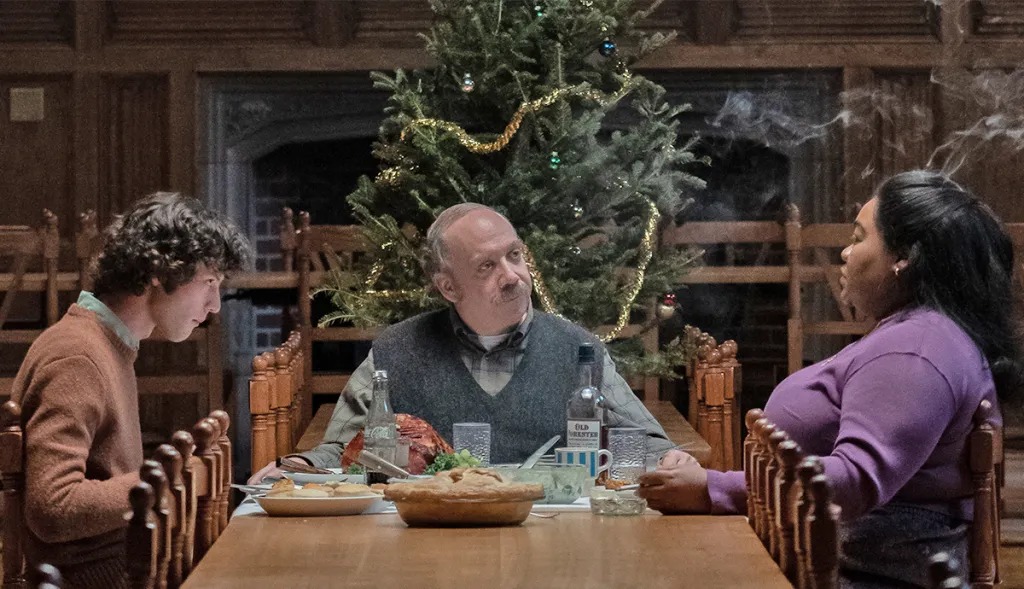
From left to right: Dominic Sessa, Paul Giamatti and Da’Vine Joy Randolph make for unlikely Christmas guests in The Holdovers.

DISCLAIMER: This is from a blog of four reviews I originally posted on March 2, 2024. The original blog has been removed.

At first, you’ll wonder if The Holdovers is the right movie for the Christmas Season or a bad movie for the Season. Not every Christmas movie is a guaranteed hit and there have been some bad ones in the past. Can The Holdovers do all the right moves?

There have been Christmas movies in the past that start as downers but then develop into a film that doesn’t just celebrate Christmas, but celebrates humanity too. It’s A Wonderful Life is possibly the biggest such film that comes to mind. Here we have another story. Set in 1970, we have a teacher at a boarding school whom all the students hate and has no real family or friends. A student of his who gets left behind at the school during Christmas because of his mother leaving him behind for Christmas with her new boyfriend. The school cook who has lost her son in the Vietnam War and feels the hurt at Christmas time. Can the Christmas spirit be present with these three together?

In a film like this, it’s hard to sense if this film has a social theme. We see see how so many of the Best Picture nominees have a social theme in the film which has something to say. I can’t really sense a theme or topic in this film that stands out in a grand way. If a theme made in a soft way, I think it’s about classism and elitism. We should remember Paul Hunhan is a teacher at the Barton Academy boarding school full of boys of some of the most privileged backgrounds. He teaches the classics and is not afraid to fail them if they’re bad, even if the student’s father is wealthy and powerful. That annoys his boss Dr. Woodrup as one of the students Hunham failed, the father stopped donating and that stopped Woodrup from being promoted to Princeton. Adding to the theme of elitism, Hunham himself was a student at the school and attended on a scholarship. Hunham almost sank his future after he deliberately hit one of his Harvard classmates with a car, but Barton was sympathetic enough to hire him as their classics teacher. Adding to elitism is the cook Mary Lamb: an African-American woman who was able to get her son Curtis to attend the Academy because of her employment. After he graduated, he had to pay his way through college and enlisted in the army to do so, only to die in the Vietnam War.

There’s no doubt the themes of privilege and classism abound in this film. There are also parts in the film that remind us all that privilege and classism is not a shelter for everything. The one who best reminds us of that is Angus Tully. Angus is a student who actually does very well in Hunham’s class, but still shows the common troubling behavior of teens, which gets on Hunham’s nerves a lot. Over time, Hunham learns Tully is not the typical privileged brat he sees him as. He learns that Tully is a lonely boy from a broken home. Tully first tells Hunham his father’s dead, but soon learns his father is in a mental hospital. A privileged background doesn’t prevent you from having parents with mental illness. On top of that, Tully has a mother who seems to care more about her new boyfriend than him. That’s another thing with privileged children; having hyper-ambition parents who care more about themselves and often neglect their kids. While Hunham and Mary appear to be victims of a system of classism and privilege, Tully appears to be one living in this privilege but experiencing the harsh side-effects of it. Seeing Tully’s background could give you empathy for Barron Trump! Even that scene where they show a memorial on Veteran’s Day and they memorialize the alumni killed in wars, it’s a reminder that privilege won’t stop you from dying young in a war.

I know I talked a lot about privilege and classism in this film, but it’s an underlying theme in the story. The story is about three different people who don’t want to be together trying to have a Christmas together. We have the classics teacher who has made the boarding school his home since his job and has no problem making a loner of himself or being hated by the students. We have one of his students who can’t stand Hunham and is frustrated with having no one for Christmas. We also have the cook who is not only struggling to be happy after the death of her son but trying to find reason to live. Can they have a good Christmas? Can they get along together? In the end, the Christmas becomes a time when they warm up to each other and get to understand each other better. Angus doesn’t see Hunham as a jerk teacher and starts to understand his love for the classics. Hunham doesn’t see Angus as a jerk student, but rather a boy who needs the closeness of his family. Most importantly, to be reunited with his mentally ill father. Mary Lamb falls in love with the janitor Danny and is reunited with her sister and her family. That scene with the four celebrating New Year’s together shows they did have a Merry Christmas after all. Even if Hunham would get fired for his actions being out of Barton protocol.

This is another great achievement from Alexander Payne. In the past, most of his films have been stories about a man’s feelings of failures. The films he’s done in the past have won him acclaim and even three Best Director nominations. Here he takes a change of direction with a Christmas story with a man as the protagonist, but also as much a story of a student who’s lonely and a cook who feels empty on the inside. It’s a story that makes for the most unlikely of Merry Christmases and somehow makes the merriness happen. We should also thank scriptwriter David Hemingson for that. Hemingson has established himself as a renowned sitcom writer. This is his first film screenplay and it comes out shining. It gets into a deep story but it also remains humorous and keeps the Christmas merry.

Excellent acting again comes Paul Giamatti. If you’ve seen Giamatti act before, you know he knows how to do excellent character work. Giamatti has worked with Payne before in 2004’s Sideways: the film that got Payne his first Best Director Oscar nod. Here, Giamatti is the perfect fit as the curmudgeonous sadistic teacher who actually is a disheartened man who becomes an unlikely friend to a troubled teen. Also worthy of respect is Da’Vine Joy Randolph. Her performance of the cook who lost her soon and tries to keep from hurting is great. Especially since you could sense that there would be a time she can’t hold it in any longer. Her performance stands out and even makes you think the story is as much about Mary Lamb as it is about Hunham. Also great is the performance of Dominic Sessa. He has never acted before and he had the luck as the prep school he attended happened to be the location of this film’s shooting location and he caught the eyes of the casting directors. He’s the right fit in playing a boy who’s smart and arrogant about it, but lonely and hurting on the inside. Sad Fact: Sessa’s own father died when he was 14. Also a great job of Eigil Bryld with the cinematography. Normally for a Payne film, it does a good job of capturing the region. This cinematography was different as it added to the story.

Some of you may remember I wrote a review of a film from the VIFF called The Sacrifice Game. Isn’t it a coincidence that two films of similar storyline of boarding school students left behind during Christmas in the early-70’s get released this very year? Sure, one is a dark comedy while the other is a supernatural horror thriller, but it is quite the coincidence!

The Holdovers is an unlikely Christmas film that does what a Christmas film should, despite the story appearing to pave the way for something depressing, at first. In the end, it’s about three people unlikely to be friends whose lives improve because of each other. An unlikely treat for those lucky to see it.

2023 Oscars Short Films Review: Live-Action

It’s interesting when the Academy deliver their nominations for feature-length films, they’re mostly for English-language films. Most of them being American films. Yet the nominees for the short films categories are often multilingual. For the films nominated for the live-action category, we have  films in French and Danish. We also have three English-language films, but two are from the UK. Not as much foreign language as the animated films but still it tells how these categories are among the most international of them all.

What’s interesting about the short films in the live-action is that many are from up-and-coming directors, as is the common case in this category, but we also have one British film directed by Wes Anderson! Also in the film are renowned star actors like Benedict Cumberbatch, Ben Kingsley, Dev Patel, Ralph Fiennes and Richard Ayoade. The other films also show actors of renown like Brittany Snow, Leif Andree and David Oyelowo. So there’s something about short films that make well-known actors want to pursue them.

Without further ado, here are my thoughts on the Live-Action short films nominated for the Oscars:

The After (dir. Misan Harriman) – Dayo is a successful businessman in London. One day, he drives his daughter to the top floor of a parkade to meet up with his wife. Suddenly a man wielding a knife commits a massacre all over the parkade. The man stabs his daughter to death. The wife, heartbroken, jumps to her death as Dayo fights to restrain him for the police. Time passes. Dayo is resigned from his position and makes his pay an Uber driver. He has cut off all contact from his friends and colleagues and won’t even meet with crisis management counselors. Although he keeps to himself, it’s obvious he’s still hurting on the inside. As he waits for his latest customers at the airport, he takes the picture of his family and sings “Happy Birthday.” The daughter of the family he’s to drive looks very much like his own late daughter. He tries to restrain his emotions at first as the parents make their way to the car. During the drive, the couple are consistently arguing in front of the child, but the daughter is sensing something is wrong with Dayo. Dayo still tries to keep his cool. As he gets out lets the family off at their house, the daughter goes to hug Dayo and Dayo just breaks down. The parents are shocked by what they see and leave him, but Dayo picks himself up.

How do you live again after you’ve lost it all? This is the type of question we don’t normally ask ourselves or don’t want to think about but unfortunately, there are some people who have to do exactly that? This is a story that does a great job of showing the before-and-after of a tragic incident that claims the lives of Dayo’s wife and daughter. Throughout the story, Dayo is the storyteller through his actions and his emotions. Even without dialogue, you can sense what Dayo is saying through his body language. He doesn’t know how to live again or deal with his emotions. It’s right after the breakdown he has after the daughter hugs him that Dayo knows he has to continue on, despite how hard it will be. This film which is the directorial debut film for Misan Harriman tells a gripping story with a profound message. David Oyelowo does an excellent job in his performance in both scenarios of the story. If they could give Oscar nominations for performances in short films, I’d say give one to David!

Invincible (dir. Vincent René-Lortie) – The film begins with a young boy in the driver’s seat in a car named Marc who telephones his mother, but doesn’t say a word. His mother tells him to come home, but police lights flash. Rather than surrender to the police, Marc drives the car off the cliff into the water. Going back weeks earlier, Marc is on a family vacation having fun with his family at the lake. He plays with his little sister but is embarrassed of how she chickens out with her finger over his lighter. This is the last set of fun Marc will spend with him before being sent to the youth detention centre. The first day, Marc can’t stand being in a sweltering room with no way to cool off. He ignites the sprinkler system which the officials put him on a stern warning. A councillor tries to deal with Marc and tells him how he has what it takes to be a smart positive influence on others and can’t understand why he’s always getting in trouble. One day, the official sees progress in Marc and how he helps others. The officials decide to take the boys to a nearby community pool. it appears Marc is having fun with all of them but when the councillor isn’t looking, Marc does his latest escape. Marc runs into a car but as the woman enters a store to call the ambulance, Marc steals it, attempting to take his escape further. As Marc stops, he calls his family. The mother, aware the police are pursuing Marc, pleads for him to return as the sister tests her pain with the candle.

This is a story inspired by a troubled 14 year-old boy from Quebec who killed himself as he drove into a lake in 2008. The story haunted the people in the area for many years. The boy, Marc-Antoine Bernier, was a friend to the director. Here, it appears the director is using his film to bring some respect back to Marc. Marc was an intelligent boy capable of a lot of good, but kept on getting into trouble. We all have known a kid like that in our childhood. Although this is a story inspired by a real-life person and based on true events, there may have been events or happening added to the story. Only Marc knows what really happened. Nevertheless Vincent makes a good effort to redeem Marc from the story he tells and even tries to get us to feel some empathy for him. We’ve all had those years when we were younger when we all felt we were trapped mentally, if not physically. If Vincent doesn’t make you feel empathy for Marc, he does make for an intriguing story. That’s why I make this film my Should Win pick.

Knight Of Fortune (dir. Lasse Lyskjær Noer) – Karl is at a multi-chapel funeral home where he comes to mourn his wife. Left alone, he can’t bring himself to open the casket. He tries to adjust a light but it breaks. Frustrated, he goes to a bathroom where he encounters another widower named Torben. Torben claims he can’t open the casket for his wife. Karl goes with Torben to the chapel and helps open the casket. As Torben attempts to say his “last words,” a family comes in. They’re the real family of the deceased woman including the real widower. They allow Torben and Karl to stay. When the widower is at a loss for words, Torben is able to say the right words as if the woman really was his wife. Karl leaves Torben angrily but he later learns from the funeral directors that Torben lost his wife in a boating accident three years ago and never had a real chance to say goodbye. Outside in a nearby bench, Karl notices Torben. Instead of anger, Karl laughs and invites Torben to the chapel where his wife is. Torben is able to open the casket and Karl is able to say his last goodbyes. As Karl gives his wife one last kiss Torben sings “Knights Of Fortune.”

Another story of loss and coping. Although this story deals with the subject of death in a gentler manner, and even includes humor, We all know that loss is never an easy thing to deal with, but it needs to be dealt with. This is a story of a widower struggling to properly say goodbye encountering an imposter who knows the right words to say goodbye to a woman he’s never really met, but makes like she was his wife. Once Karl learns about Torben that he’s not simply an imposter, but a hurting man who uses funerals of wives to say the goodbyes he always wanted to say to his own wife, could Torben be the very person to help Karl deal with his grief? This is a story of grieving, healing and saying goodbye that is greatly different from other stories. Nevertheless it does offer a message of healing and hope. It’s ironic how this imposter is exactly what Karl needs to properly deal with is loss and say goodbye, and a friendship that really shouldn’t be, happens.

Red, White and Blue (dir. Nazrin Choudhury) – Rachel, a waitress in a diner, looks at a pregnancy test and sees a positive result. Rachel is a single mother who has difficulty to support her two children. She also lives in Arkansas where abortion is illegal, thanks to the overturning of Roe v. Wade. She plans a trip for an abortion procedure in Illinois where it is legal, but it’s more than she can afford. One day, a woman customer who somehow knows what Rachel is dealing with leaves her a tip which makes up the remainder for her abortion trip. Soon, she leaves her son Jake with a friend as she takes her daughter Maddy on this trip. This is the first time out of Arkansas for both of them. Before they go to the clinic, they go to a carnival as it’s just before Maddy’s birthday. Maddy wants a merry-go-round ride, but it’s more than Rachel can afford. She agrees to one ride and Maddy chooses the elephant. At the clinic, Rachel learns she’s late for her appointment but through past recollections and as the receptionist learns the dirty facts, she tries to make it urgent.

No doubt this story is about abortion. Especially in post-Roe v. Wade United States. The thing is this story is more than that. You know the story is about the pursuit of an abortion, but it’s not what you originally think at first. You think it’s about an impoverished mother getting an abortion because she’s two-and-through, but things change as you learn more information. You wonder why on earth would a mother take her young daughter on an abortion trip? Soon you learn there’s more to the reality of unexpected pregnancy and abortion that meets the eye. Including a lot of upsetting truths. It’s also surprising how in a story that has a theme that hits close to home and presents a story that many would find upsetting, it is still able to have a heart-warming ending that works. That is something in film that is very tricky to do, but Choudhury accomplishes it!

The Wonderful Story Of Henry Sugar (dir. Wes Anderson) – Based on a short story written by Roald Dahl, Henry Sugar is the pseudonym of a wealthy bachelor who loves to gamble away his inherited riches. Thing is he never seems to have enough and wonders how can he get more money? He learns the legend of a man from India named Imdad Khan who learned the fine art of levitating and seeing with is eyes closed, thanks to the teachings of a Great Yogi. Thing is as the doctors were studying Imdad, Imdad tells his story and dies suddenly. Henry tries through great lengths to master this technique through all he can learn. Once he finally masters the sight trick, he goes out gambling and wins big! Problem is all this money isn’t making him any happier. At first he thinks the right way to give the money away is to throw it off a balcony. After it causes a riot, police recommend Henry develop a better method. Henry then spends the next twenty years traveling the world, gambling, and donating his winnings to hospitals and orphanages.

This is the last of the five shorts shown in the shorts.tv reel. After seeing four stories that were either depressing, too serious or had dark subject matter, it was refreshing to end the reel with a light-hearted comedy. The story succeeds in making the tale amusing. Already we have a major director directing it and four major actors — Cumberbatch, Kingsley, Fiennes and Patel — acting in it. Nevertheless the story telling, set changes, and the acting of all make it a delight to watch. It makes for a “guilt-free guilty pleasure” as I like to call such things. That’s why I make this film my Will Win pick!

And there you have it. Those are my reviews of the five films nominated in the Oscar category Best Live-Action Short Film for this year. That also completes all my reviews for the Oscar-nominated short films. Those short film categories are usually the hardest to pick a winner. You think you know what will win, but end up surprised in the end. We’ll see how it all goes on March 10th.

VIFF 2021 Review – Handle With Care : The Legend Of The Notic Streetball Crew

The Vancouver streetball team ‘The Notic’ are the centre of Handle With Care: The Legend Of The Notic Streetball Crew.

If you’re a fan of streetball, you should know who the Notic are. The documentary Handle With Care: The Legend Of The Notic Streetball Crew tells the story of their formation, rise, fall, afternath and reunification. There more than meets the eye in this film.

The story begins with two Canadian-born brothers from Uganda: Jonathan and David Mubanda. Growing up in a country like Canada, they feel like outsiders. Feelings also shared by Joel ‘Joey’ Haywood, son of Jamaican immigrants. They discover they have a love for basketball and they’re dazzled by watching NBA games and the tricks of the players. They succeed in making their high school’s basketball team and they recreate some of the moves. However even if they play well, it gets on the nerves of their white coaches. One of them tells one of the boys to stop playing ‘jungleball.’

Streetball and 3-on-3 tournaments was something new at the time. That caught the attention of Jeremy Schaulin-Rioux and Kirk Thomas. They were a couple of teenagers graduated from high school and undecided what to do with their lives. Their first dream was to start a punk rock band. However when they saw streetball and the play from these boys, it changed their attention and they saw a new use for their video cameras. Within time, their group of boys who gave themselves the name ‘The Notic’ would grow and include Mohammed Wenn, Jamal Parker, Dauphin Ngongo: also immigrants of first generation Canadians. In 2000, their first video of their play, entitled ‘The Notic Mix Tape’ was released.

The video was intended to just be a video strictly for them and their friends. Over time, they would sell copies of the video on the street. Little did any of them know at the time the sales would skyrocket. But while the popularity of the Notic was growing, so was the size of the group. One was discovered at a 3-by-3 tournament. His name was Andrew Liew: a Bruneian immigrant who went by the name ‘6 Fingaz’ because he had a sixth finger on his left hand! They were also joined by Rory Grace: a white boy with delayed puberty who came from a troubled family background, but delivered some mad skills on court. Rory was nicknamed ‘Disaster.’ Actually all the boys had unique nicknames: Johnny Blaze, Where U At?, David Dazzle, Delight, Kinghandles and Goosebumps.

Next tournament was a streetball tournament in Vancouver in May 2001. That’s where the Notic really got their breakthrough and wowed the crowd. All of them were strutting the stuff and sure enough, Schaulin-Rioux and Thomas had their cameras in hand. They were catching their every move. They also caught their moves as they were ‘chillin’ out by the Surrey Skytrain Station or in the gymnasiums or in their houses. Then they caught a big break as they were invited to a tournament in Seattle. There they stole the show and it was Disaster that blew everyone away with his trickery.

Soon the Notic phenomenon was born. As Schaulin-Rioux and Thomas were busy making their next video, the Notic caught the attention of ESPN and Slam magazine. They were given interviews and Slam! magazine dedicated a seven-page article that included the players and the filmmakers. A website in the UK that promoted streetball had the Notic video on and it got over 100,000 hits a month during its heydays in 2001-2002, kids were coming up to members of the Notic and getting their autographs, even EA Sports recuited them to be the models for their streetball video game where they were paid $5000 each.

Then the Notic 2 was released in 2002, but that’s when the friction was starting. Jermaine was unhappy he was not included as part of the Slam! article. Many of the players were unhappy that their videos were getting a ton of views but they weren’t seeing a single cent for themselves. On top of it, all eight boys were teenagers growing into adults. Soon they were learning that streetball was no way to make a living as an adult. They all had to find their own direction.

Only Joey Haywood took basketball into the colleges. When he didn’t make it into the NBA, he was signed to a Danish basketball league. Joey now holds coaching sessions. The other boys, they found careers or paths of their own. One found work at a mosque in Edmonton, one is a contractor for interiors, another found work in promoting a charity. Rory is the one who had the most trouble since as he felt lost after the split-up of the Notic. He first dabbled in drug dealing and became in addict himself. He spent time in jails and in rehab, but lost custody of his sons. We see as he’s being reunited with his second son. One thing that hasn’t changed with the Notic is they still dazzle and inspire young players from around the world. The spirit of the Notic lives as Schaulin-Rioux and Thomas screen for all members Notic 3 made from kept videotape of Joey.

This is quite a story. It’s the story of a group of boys who were able to dazzle the world with their play of ball. It’s commonly called ‘streetball’ but I’ve often called it ‘freestyle basketball.’ You can look at this story many ways. You could even see the Notic as a group of ‘Next Generation Globetrotters’ straight out of Vancouver. This is a story of young boys who were either immigrants or first generation Canadians trying to find themselves where they felt like a misfit elsewhere. They either felt like they were substandard in school or they were dealt with racism around them. Basketball was their escape. Basketball made them feel like they belonged. Streetball was where they stood out. Their experience as part of the Notic proved to most that yes, they do have what it takes to make it. Eventually they would have to learn they were able to succeed without streetball as adults. However it was being part of the Notic that gave self-confidence to most when they needed it.

The story reminds you that not everything is grand. Schaulin-Rioux and Thomas did acknowledge they were young filmmakers who did not know how far their grainy videos would go. They didn’t know bootleg copies would find themselves around town. They didn’t know uploaded versions of their video would make itself worldwide on the internet. They were young filmmakers who didn’t know about the obstacles and pitfalls of the business. And the eight boys that made up the Notic, you can understand why they would become angered and feel like they were done wrong. Jeremy and Kirk do acknowledge the wrongs they did and that they weren’t as transparent. I guess that exlains why the main title of the documentary is Handle With Care. Also it shows that as Rory saw the Notic as a way out of his troubling family life, it was his everything. When the Notic split up, he was lost and that’s what led to his downward spiral. It’s a story you hear over again of young starts who hit the big time, see it as their everything, and then are lost when the big time disowns them. That was Rory’s case.

This is an excellent documentary from directors Jeremy Schaulin-Rioux and Kirk Thomas. In a lot of ways, it’s a case of a documentary as they are preparing to make the Notic 3. It stars as a case where the two meet with Haywood and come across old videotapes not shown in any previous Notic videos. We shouldn’t forget Notic 3 was never made; the Notic split up before it could be made. At the same time, making Notic 3 was not easy. They had to confront former members who felt they were ripped off in their fame. Jermaine is especially angry. However he makes peace with the two as they acknowledge their past mistakes. In the end, all eight of the former Notic players meet on a basketball court in 2019 to see the screening of Notic 3 and they celebrate reminisce of the old times. When you watch the documentary, you can see it as one of three things. You can see it as the Notic members telling their stories, you can see it as the documenting of the making of Notic 3, or you can see it as Jeremy and Kirk trying to make amends for past business mistakes and trying to make it up to the boys. Either which way, it’s inciteful to watch.

Handle With Care: The Legend Of The Notic Streetball Crew is a documentary worth watching. It will remind you of the heydays of basketball in the 1990’s and early-noughts. However it’s much more. It’s about a group of lost boys who opened doors for themselves by doing something they loved to do. Also it’s two filmmakers set up to make right past wrongs.

VIFF 2019 Review: Guest Of Honour

david-thewlis-guest-of-honour
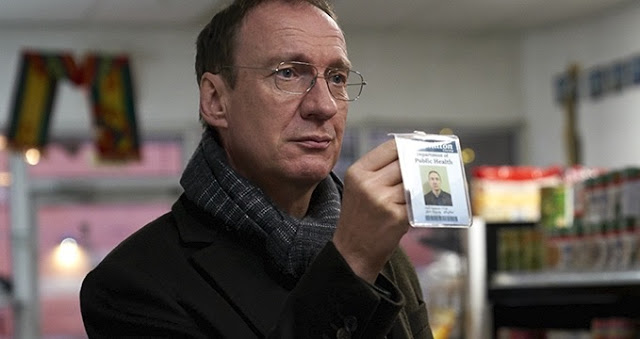
David Thewlis plays a health inspector whose inspections eventually become a lot more than simple inspecting in Guest Of Honour.

The Vancouver International Film Festival usually begins with an Opening Gala of speeches and an airing of a Canadian Feature Film: usually from TeleFilm Canada. This year it is Guest Of Honour: the latest film from Canadian director Atom Egoyan. It was a good film to open with, but not a great one.

The film begins with a priest, Father Greg, consulting with a daughter who lost her father, named Jim. Greg asks her how to best remember him, but she can’t say because she doesn’t remember him that well. She can speak for what he does remember of him.

Jim was a health inspector for restaurants most of his life. He started as a restaurateur, but failed. He had since become a health inspector. He was very strict in his job, especially to ethnic restaurants. As a family man, he married a Portuguese woman and fathered a daughter named Veronica. Veronica possessed a lot of music talent. That all changed one day when Jim introduced Veronica to a new music school. He met the instructor and she met Walter. Walter would become her partner in her glass harmonica instruction and performances, and later her boyfriend. The instructor would eventually become Jim’s mistress. Veronica knew that as she saw Jim sitting between the instructor and her mother, who was dying of cancer, and saw Jim hold the instructor’s hand.

Moving on into the future, the last time Veronica met with her father was while she was in jail for a crime she wants to take responsibility for, even though she may not have committed it. Jim is willing to do whatever it takes to get her out of jail, but she is insistent in serving her time.

Jim has to go to past videotapes and past references in order to get her justice. Sometimes he even confides to her pet rabbit about his problems and issues. As we flash back to the past, we learn more. We learn something bothered both Veronica and Walter inside. It bothered Walter so much, he committed suicide. Veronica would grow up to become a music teacher for a private school. However she has taken aback with the drummer of the school band named Clive. Clive looks so much like Walter. It even appears that she is more intimate with Clive, including to the bus driver Mike who is in love with her.

Mike is upset that Veronica won’t develop a relationship with her so one day, he sends a lewd text to Clive’s phone through Veronica’s phone during one of their performances. Clive and Veronica notice this. They want to do something, but fear they might be caught and accused of something they don’t want to be accused of. However it all falls apart at the hotel as Veronica is reminded of Walter’s suicide. Whatever problem happened at the hotel, it led to Veronica being sentenced to jail time and stripped of all teaching duties.

Jim tries to think of a way to free Veronica. He gets an idea after he sees a video of a rat inside a restaurant he inspected. The owner claimed someone with hard feelings to the restaurant put the rat in there to fix him. Another time, he comes across an Armenian restaurant with dead rabbits. He is about to close the place down, but they insist it’s for a delicacy of rabbit ears to be served at a private party. They plead with him to have mercy on them, and he decided to go to their special party.

Before the party, it’s evident Jim is up to something. He takes rabbit droppings from Veronica’s rabbit and puts them in a tube. He then goes to a German restaurant appearing to order dinner, but then goes to the bathroom to drop the droppings around, and then alert the manager. While talking with the manager, the real reason Jim is here comes out. He wasn’t to speak to his grandson, who appears in conversation to be Jim’s own son. The grandson is Clive. Clive knows why Jim is here, and is not happy. The situation between him and Veronica is just as humiliating.

Then over at the party at the Armenian restaurant, he arrives and is impressed with what he sees. The owners even treat him as a ‘guest of honor,’ despite what almost happened days ago. They ask him to give a speech. Jim tries to give a nice speech despite being intoxicated. However Jim’s feelings of his intended vengeance towards Mike come out during his speech. The speech lands him in trouble with law authorities. After he finds Veronica’s rabbit dead, he decided on one last act, and this involving the Armenian restaurant to assist with it. It is through all Veronica has told that Father Greg is able to give his requiem to Jim at his funeral. The film ends with one last flashback.

Atom Egoyan is a source of pride for Canadian filmmakers. He is one of only ten Canadian directors ever to be nominated for the Oscar for Best Director. Atom has been known for his unique style of filmmaking. At the gala, he flashed back to when he did his first student-film at a school in Victoria. He received a C- and a lot of complaints and ‘advise.’ Some even described it as ‘too artsy.’ Whatever the situation, it would pave the way for his style to have its heyday in the 1990’s and his Oscar nominations for Best Director and Best Adapted Screenplay coming for The Sweet Hereafter.

Times have noticeably changed. His films have been consistently done well and good at telling a story in his own style, but they’re not as well-hailed. Some of the meaner critics could say he is yet another director that had a directing flare and it flared out. This film does feature a lot of mystique in terms of the story. The film mixes the story with a variety of themes like restaurant inspections, music and feeling, family secrets, technology, and rabbits. The film does so in a colorful way, but it’s imperfect. There are some things that don’t make a lot of sense. Sure, Veronica’s music talent would propel her to her career as a musician and teacher, but through glass harmonica? The theme of rabbits also appears to be done in a way that doesn’t make sense. Veronica has a pet rabbit she adores, but also a lucky-rabbit’s-foot keychain. The rabbit becomes a source for Jim to confide in, use his droppings to frame a restaurant for facts, and have the dead rabbit’s feet cut off? Even how his restaurant inspections go from simple inspections to him using them as a way to get justice for his daughter, but pave the way for his downfall? It doesn’t make a whole lot of sense.

It’s not just the confusing elements of those themes, but also the storyline itself. There are a lot of moments in the story that leave many questions unanswered. How did he die? What secret made Walter commit suicide? Did Jim’s affair with his mother have something to do with it? What exactly did Veronica get arrested or convicted for? Is Clive really Jim’s son, or did Jim just say that to the grandfather? What was the significance or Jim’s personal reason of having the rabbit’s feet cut off? Now don’t get me wrong. I know the film is a puzzle and it’s about getting the pieces to fit together. I also know filmmakers leave out certain things to get the audience thinking or even trying to draw their own conclusions or write their own stories. However most of the elements or scenes don’t make a lot of sense. I felt there were a lot of critical things that were missing and it worked against the film rather than for it. Atom does a good job of creating and directing a good story, but I feel he missed in a lot of areas.

Despite the film’s flaws, the acting was one area that did come through well. David Thewlis did a good job of working with his complex role as the inspector/father. He gives his character of Jim dimension and helps it to make the role work for the story. Laysla de Oliveira makes it look like she stole the show. She makes it look like the film is more about Veronica that it is about Jim. She too is able have her role of Veronica make sense and even justify scenes that appear confusing to us. The supporting acting was also good with Rossif Sutherland playing Mike with his hidden inner anger, as well as Luke Wilson as Father Greg and the actors playing the Armenian restaurant owners. The music of Mychael Danna also adds to the feel of the film.

Guest Of Honour is not the best work of Atom Egoyan and has some noticeable flaws, but it does have a lot of qualities too. Especially the acting.

Oscars 2018 Best Picture Review: BlacKkKlansman

blackkklansman
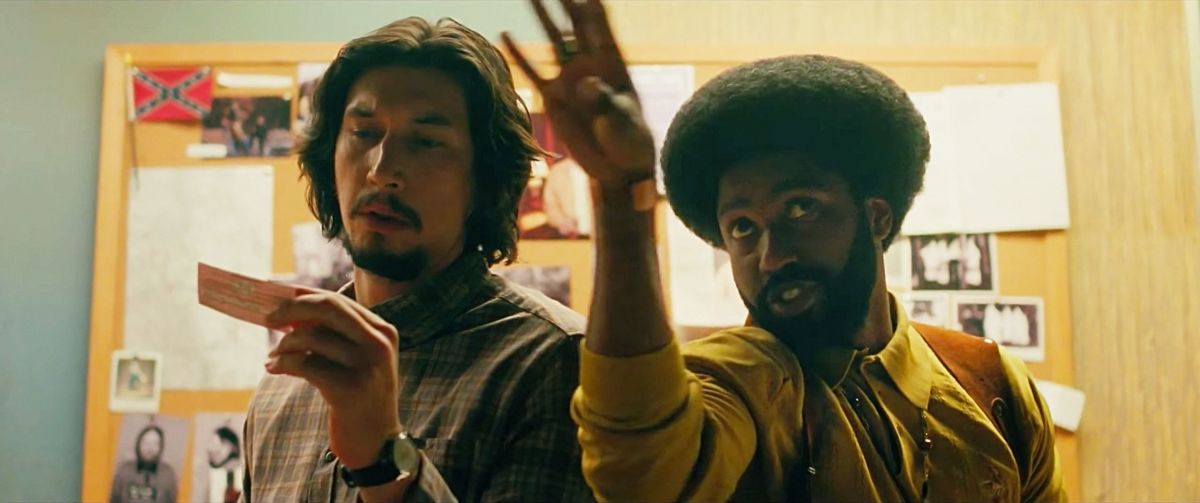
John David Washington (right) and Adam Driver (left) play a pair set out to stop a racist bomb attack in BlacKkKlansman.

I admit I missed BlacKkKlansman when it first came out. Actually I saw very few movies in the summer of 2018. I finally had the chance to see it this week, and I was very happy with what I saw.

The film begins in 1957 with Dr. Kennebrew Beauregard speaking for a propaganda film for the KKK about the ‘terrible dangers’ of desegregation. The film then proceeds to the early 1970’s in Colorado Springs. Ron Stallworth is being interviewed for the police force by a white cop and a black consultant. Through the interview process, Stallworth becomes the first black police officer for the city, but is given marginalized duties like file and document retrieval. Stallworth then decides he wants to do undercover work.

His first operation is for a rally of an African American activist Kwame Ture, whom the police view as a threat. Stallworth poses undercover with a hidden microphone to record the rally. There he meets Patrice Dumas who heads the black students union at the local university. The words of Kwame sound threatening to the ears of the white policemen. Patrice then goes with Kwame to a hotel where they’re stopped by racist white patrolman Andy Landers. At the arrest, Landers threatens Kwame and gropes Patrice. After the arrest, Ron meets Patrice at a club and they dance their cares away.

Stallworth is soon transferred to the intelligence division. One day he learns of a local chapter of the Ku Klux Klan. Stallworth decided to investigate by posing as white on the phone to chapter president Walker Breachway and having his Jewish colleague Philip ‘Flip’ Zimmerman pose as him whenever meeting the Klan in person. Zimmerman reluctantly agrees at first. He goes to the first meeting where he meets Breachway, the more hostile Felix Kendrickson and Ivanhoe, who subtly talks about an upcoming attack.

Zimmerman signs up for Klan membership under Stallworth’s name and Stallworth calls Klan headquarters to expedite his membership and speaks to Grand Wizard David Duke. The next meeting is at Kendrickson’s house. We learn that Felix’s wife Connie is just as racist. However Felix, being the loose cannon that he is, senses Zimmerman to be Jewish and tries to get him to pass a lie detector test. Before Zimmerman submits, Stallworth, who’s listening into everything with Zimmerman wired, smashes a window. Later on, the romance between Stallworth and Patrice heats up, but he doesn’t tell her he’s part of the police because of her anti-police attitude.

Stallworth is getting more active in his searching results. He learns two men of the KKK are in a branch of the US Air Force. In the meantime, Stallworth’s name is growing with the KKK. Zimmerman, while attending a shooting practice, learns of an attack planned at a student rally; the rally Patrice plans to attend. Zimmerman knows an explosion is planned as he knows Breachway makes bombs. Meanwhile David Duke travels to Colorado Springs to be at his induction and Breachway is willing to transfer his leadership to Zimmerman posing as Stallworth. Zimmerman declines, but his swearing in ceremony, along with other new members, goes as planned. However not without a KKK member noticing Zimmerman from an arrest years ago. He even remembers his nickname ‘Flip.’

As the swearing in is taking place, the attack at the student rally however does not because Connie noticed the huge police attendance. After the rally, Patrice learns the truth about Stallworth. Stallworth admits the truth and leaves Patrice in a question of principles. Her association with her anti-police group or Stallworth. With the attack at the rally botched, Connie wants to take the bombing to Patrice’s house. Connie can’t put the bomb in Patrice’s mailbox while Stallworth tracked Connie and tries to save Patrice by stopping Connie. However two policemen, who don’t know about the planned sting, think Stallworth is an attacker. It’s not until Zimmerman and another police ally arrive that they learn of the truth. Breachway sets the bomb off, but Breachway, Felix and Ivanhoe are the only fatalities.

It’s not over yet. Stallworth and Patrice are in a bar with other cops. Along comes Officer Landers. Patrice tries to get Landers to confess, which he brags about with no remorse. He tries to attack Ron and Patrice, but the police arrest Landers. With the sting over, and Connie a widow behind bars, the police order to burn all records. Stallworth makes one last call to David Duke to deliver him the shocking truth! The story ends with Ron and Patrice contemplating their future, but are interrupted by an image of a burning cross. The film, however, ends with images of the Unite The Right rally in August 2017 and Donald Trump’s lack of action to it.

There’s no doubt the object of the story is racism. Spike Lee has used racism as a theme of focus, if not the prime theme, in his films. The best example is Do The Right Thing. Spike has always maintained his films are about ‘being black in White America.’ However the film tackles the subject of hate groups. He focuses on how they don’t just have a message of racial superiority to promote. They also promote a false sense of fear and a hostility to prove their point. The groups may claim to be non-violent or not one to attack, but that’s further from the truth. That’s made most obvious when Stallworth examines the shooting targets and they’re the images of running African-Americans. The fact that they practice shooting and making bombs shows the evil behind their agenda that they try to make to look friendly. Lee makes that point in that film rehearsal at the beginning of the film. Lee shows of all the falsified news of the surrounding events the Klan deliver to their members before the bombing. Lee also shows that in the Unite The Right footage, that it’s a battle that still continues today. They may have overcome a lot, but there’s still much more to overcome. In the story, Lee sends the message that the Colorado Springs Police may have won this battle, but they didn’t win the whole war. Not while the KKK is a nationwide brotherhood.

The film obviously has a message to send, but it doesn’t forget that it’s a film that has a story to tell. It’s a good intriguing cat-and-mouse story about a local group of the KKK planning a bombing of a group of black students and the black detective who brings them down along with his Jewish guise. It has a good beginning, middle and end that will keep the viewer intrigued. It also incorporates a lot with the entertainment of African-Americans, like the music and the ‘blaxploitation’ films of the 70’s, into the story. It also includes a lot of references to entertainment that send a racist message like Tarzan and The Birth Of A Nation as to why the problem of racism still exists today. However his use of entertainment for thematic purposes doesn’t cause the film to lose its focus. Lee also mixes in another message he appears to question. At a time like where the Black Lives Matter movement has arrived, it appears Lee is critical of a lot of anti-police attitudes of these groups. The police do have history of racism, but what are they to think when the police come to their rescue? That poses as the moral question for Patrice at the end, especially since it could affect her love for Ron. I think Lee was trying to place his own viewpoint here.

No doubt about it, the top accomplishment is that of Spike Lee. Lee has had a mixed career. He’s had accomplishments like Do The Right Thing and Malcolm X, but he’s had many duds too. I still consider Do The Right Thing to be his best work, but this is an excellent story that he made work. The story he co-wrote with Wachtel, Rabinowitz and Willmott is a good complex story with a lot to say. The messages Lee tries to put in the story does not take away from the story itself. It actually adds. However it also succeeds in being a comedy with a lot of humorous moments. I think Lee also wanted to show off the stupidity of these racist groups too.

The top acting comes from John David Washington. The son of Denzel, John David delivers an excellent performance that he can rightfully call his breakthrough. He delivers the right acting for the right film. Also excellent is Adam Driver. In playing Stallworth’s Jewish partner, Driver delivers his role well while revealing the personal insecurity inside his Jewish character. I think Lee’s message was also to send how white superiority doesn’t only affect blacks. There were also a lot of excellent supporting performances coming from the likes of Laura Harrier as Patrice, Jasper Paakkonen as the walking time-bomb Felix, Topher Grace as David Duke and Ashlie Atkinson as the hyper-hostile Connie. The films inclusion of music from the past and original score from Terence Blanchard also adds to the film.

BlacKkKlansman obviously has a message to say. However it still succeeds in being a film with a thrilling plot, which makes it a winner of a film.

And there you go! This makes it the eighteenth straight years I’ve seen all the Best Picture nominees of the year before Oscar night. My predictions for the Oscar wins coming soon.


VIFF 2018 Review: Theatre Of War (Teatro de Guerra)

Theatre of War
Theatre Of War features six soldiers from the Falklands Islands War telling their stories of battle and aftermath.

Many people will consider the Falkland Islands War of 1982 a ‘forgotten war.’ Theatre Of War will show you six men who can’t forget it: the soldiers.

First off, I’ll answer what most of you are already asking; What are the Falkland Islands and why was a war fought over them in 1982? The Falkland Islands are a set of islands 300 miles east of the coast of Argentina. They’re 4,700 square miles wide and the population is almost 3,400. The islands were discovered by Europeans starting in the 16th century and were thought to be uninhabited. It was in the 18th century when Europeans started making the islands inhabitable with the French inhabiting the east island and the British inhabiting the west island. France eventually surrendered its ownership to Spain years later. The British captured the east island a year later, but a war was never started. Over time, the Spanish took over and the Argentineans, who refer to the islands as the Malvinas, attempted a garrison in the 19th century. Over time, the British asserted their rule over the land in 1832.

It would continue to be under British rule even though the Germans sought to own it in 1912. Naval conflict abounded with the British winning. However the Argentineans started another garrison in 1982: 150 years after British rule was declared. It was then Prime Minister Margaret Thatcher started what would be remembered as the Falkland Island War. The war lasted 10 1/2 weeks and left over 900 dead. The UK won the war and British rule was reasserted.

In this documentary, we are introduced to six men: three British, three Argentinian. On the British side is Lou Armour: marine corporal, David Jackson: a young soldier at the time, and Sukrim Rai: a Nepalese immigrant who fought for the UK. On the Argentinean side is Gabriel Sagastume, Marcello, Marcelo Vallejo and Ruben Otero. Throughout the film, they tell of their experiences of what it was like to go to war at such a young age. Lou Armour actually led the British Marines. They also talk of the struggles they’ve had with their lives in the years that followed. A lot of them tell of their stories of dealing with post-traumatic stress disorder, especially when it came into their lives quite late.

The unique thing about this documentary is that they don’t just talk about their stories. Very often, they act out their stories. We see all six at the pool and one talks of an incident in 2004 when he nearly drowned himself. We see two at an empty discotheque as one tells of his story of loneliness in a bar. We see one British and one Argentinean soldier showing copies of magazines published around the time of the war. It’s interesting what each magazine had to say. We see one Argentinean use tiny plastic army men to tell the story of how Argentinean soldiers first claimed the Falkland Islands and the battle that started the war. We see the six in a rock band as one ‘singer’ shouts out “Have you ever…” and tells of instances only a soldier can ever experience both in battle and in post-battle life.

However this wasn’t just simply a vanity effort what they were doing. The six also visited Argentina to tell their stories. There were times the six went to schools together telling children their stories of the war. There were times they even had to answer questions from the children. However the most interesting moment came near the end. The soldiers had six 18 year-old Argentinean men dress up like them to re-enact a moment from the war. As the soldiers were dressing them up in their war uniforms or applying scar make-up, they were telling their stories. One even showed another what it was like to wield a knife in battle. It’s interesting as they told their stories to the boys, it showed the luxury these 18 year-old boys of today have. They don’t have to be called up for battle. They can live their care free life. That was made evident just as it led to the end scene where the young men re-enacted the battle at the former soldiers’ directions.

The unique thing about this documentary is that it shows the foolish side of war. We have six men from both sides and they tell their stories. They made to be made to look like heroes in their own country but they don’t feel like heroes. They even made spoof of the political situation behind it. One scene includes soldiers in face masks of Margaret Thatcher and the Argentinean president locking lips. The film even showed that this is of a war in which the opposite sides can have a peaceful disagreement. We see that in one scene where an Argentinean and a Brit talk of the history of the Falklands/Malvinas. Both feel strongly that those islands belong to their country, but they’re able to disagree peacefully without enmity or even a fistfight.

The interesting thing is that these six soldiers did this documentary just as they were about to perform in an onstage docudrama called ‘Minefield.’ Before they performed in the play, they had the opportunity to do all this. The soldiers reunited and sorted out their differences. They went to places where they experienced these traumatic events in their lives to recreate the moment. They went to schools to educate the young children of Argentina. They even met with six young Argentinean men to give them the experience of what it is to fight in a war about a set of islands none of them really knew. This is an important docudrama worth seeing because it does tell you a lot of how a simple war that lasted three months can change lives forever, most for the worse. The film doesn’t simply show how foolish fighting over a small set of islands are, but makes other wars of past look foolish too.

Lola Arias did a very good job in creating a meaningfully documentary of what many consider a meaningless battle. Lola takes a lot of incidents from the school visits, the meeting with the young actors, the on-stage work, and various scenes solely for the documentary and brings it all together. It’s pieced together in a mixed way that may seem like it doesn’t go in a straight pattern. Maybe Arias had her reasons for doing so. She does however include a lot of important scenes and a lot of poignant moments throughout the documentary. It may not appear to have ended in a solid manner but the whole documentary tells a lot.

Theatre Of War isn’t just about six soldiers coming together, settling their differences and making peace. It’s an important reminder of that war and it shows how war is something you can’t leave behind. Even long after you’ve dropped your guns.

VIFF 2017 Review: Housewife

Housewife-4
Clementine Poidarz (left) submits herself to a ‘master of the mind’ (played by David Sakurai) in Housewife.

It’s my tradition to end the VIFF by seeing the very last film they show. It’s always on the final day and at the Rio Theatre at 11pm. This year, it’s Housewife: a horror-thriller from Turkey in English. It wasn’t just the last showing at the VIFF, but its only showing at the Festival and a Canadian Premiere too.

The film begins on a snowy day 20 years ago. Seven year-old Holly lives a quiet life with her family until one day, her sister menstruates. Her mother reacts chaotically as if it’s a curse and kills both her sister and her father. Flash forward twenty years later. Holly is married, but the memories still haunt her from that horrific night. Her husband wants to start a family, but she pops birth control pills without him knowing.

One day, a childhood friend meets up with Holly again. They reconnect after all these years. The friend even invites Holly to an event her and her husband will be attending called ‘Umbrella Of Love And Mind.’ Holly comes to the event with her husband. The two couples are having a nice time together. Then the event starts. The event gives an impression it’s like a bizarre cult. The audience is introduced to a charismatic mastermind by the name of Bruce O’Hara. Bruce picks Holly right out of the audience as the first person he ‘demonstrates’ on. He’s able to get her mind to travel to another level and even into her fears. Holly and the crowd are impressed, but her husband is unhappy and mistrusting.

Holly carries on with life after the event, but the memories are now mixed with bizarre visions of murder. Holly goes back to Bruce for help. He continues to put her under his mind control. Meanwhile the husband is getting upset. He feels this is all a hoax. Finally Holly goes back one last time. The dreams are now of Bruce committing murder on Holly, ripping off her face and even wearing it! The movie ends on a bizarre, if not ridiculous, note that makes the film look like it’s incomplete or missing a lot of stuff to make sense.

The thing about the film is that it attempts to create the intrigue of a thriller it should create, but later comes across as confusing and even clumsy at the end. The opening looks promising as the opening scene shows some elements of Carrie in it. Actually even before you go to see the film, you’d get a sense that this would be a horror film, or something close to it. The master-of-the-mind who comes off like a cult leader is where you first start thinking if this will help the story or make it look ridiculous. Especially when he comes dancing onto the stage with ‘I’m Your Boogie Man’ playing in the background. It’s as the story moves into the second half that it starts treading into areas that are either confusing or ridiculous. The film even ends on a bizarrely ridiculous note that gets you wondering what the point of this story is.

It even gets you wondering what is director Can Evrenol trying to do as far as it being a thriller movie? Is he tapping into common thriller elements? Is he trying to create new thriller elements for the cinema? What is he trying to do? I left thinking he didn’t accomplish too much in the 80 minutes of the film, except add a lot of bizarre gore that makes you wonder what its point is. Maybe if he and co-writer Cem Ozuduru gave the film more time and better script, we’d get a better understanding of it, possibly even a decent understanding of it.

The acting was not the best. This is Can’s first English-language feature and he hires either Turkish or European actors for the roles. You can notice the accents. Lead protagonist Clementine Poidarz did well with her role, despite noticeable imperfections. David Sakurai looks awkward and even wooden in his role as Bruce O’Hara and even looks like he isn’t fully in character at times.

Housewife is Can Evrenol’s first attempt at an English-language feature and his first feature-length horror film. It’s not much of an accomplishment since its imperfections are very noticeable.

And there you have it! This is the fourteenth and last review of all the films I saw at this year’s Vancouver Film Festival. Quite the experience. My wrap-up is coming soon.