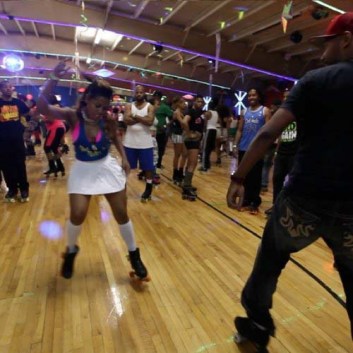
It’s usually good to take a break and watch a documentary that doesn’t have a political agenda heavily shown. I was able to see that in United Skates.
The film begins by showing various African-Americans going out and having a good time on skates. Very soon we see some of the more sensational moves that are frequently seen at the rinks. They’re stylish or they’re acrobatic. Whatever it is, they’re all out to have a good time. Young or old, single or with family, they’re all out to have fun. This is a phenomenon that has been going on for decades nationwide. A place where various African-American skaters have their own moves and their own fanfare.
Soon into the movie we learn how roller rinks are considered a top getaway for African Americans. Roller rinks may have had their biggest heyday in the late-70’s and early-80’s for most Americans, but African-Americans kept it lasting long after that. It was a getaway from the harsh realities of daily life. It was one place they could take their kids away from the harsh realities of urban living. It was also a place where the first hip-hop and rap artists found a stage to perform on. Yes, roller rinks were an integral part of the early years of hip-hop culture. When night clubs and radio stations, even the soul and urban stations, wouldn’t give those artists their time, roller rinks gave them their stage. Coolio and Salt ‘N Pepa can vouch for that. There are even scenes in Straight Outta Compton that show NWA perform at roller rinks during their early days. In fact there was even a case in the 90’s where two roller rinks in Los Angeles would be the different domains of two rival gangs: the Bloods and the Crips. When one rink closed, the other rink became neutral territory for the two.
The documentary shows how roller rinks have gone from commonplace nationwide starting in 1982 to disappearing gradually starting in the 90’s to today being probably one tenth of what it was. Modern times have proved to be a very trying time for roller rinks. Gentrification has been a pressure with turning a lot of top recreational areas into land for condos. Roller rinks, commonly seen as something of the past, have fallen prey and have seen closures. If an African-American family wanted to take their family to a roller rink, they would have to travel a longer distance.
We even meet a family from Los Angeles before the closure of the World On Wheels rink. The mother has a huge love for roller skating as she has been doing it since her child hood. She was able to share that same love with her children. When they go to World On Wheels, it is family time. It is time for the kids to show their decorated skates, time for all to show off their moves, and a time for the son who has behavioral disorders a place to avoid getting in trouble. Then World On Wheels closes in 2013. They show closing day. The rink tries to make a party of it. Young and old come to have fun one last time. We see people in their late-50’s early-60’s — people that were a part of the ‘roller boogie’ heyday– skate around with the same love. The closing day is as much a day of heartbreak as it is of fun.
Then the rink closes. We see how the owner tries to take everything out of the rink from the lockers to the concessions. We also see how the family tries to cope. They drive hours to a different rink, but face heat because the wheels their skating with are too small.World On Wheels welcomed their skating wheels with open arms. Also the rink has an urban night or soul night. African-Americans undergo security checks. There’s no security checks for white families. It’s obvious the family doesn’t feel welcome here. It gives a sense that these rinks are out to exclude African-Americans. The pressure hits the family hard too as the son committed a crime and has to spend time in prison. The film shows other rink closures too and how much it hurts those that love it.
However like one former rink owner says, patience is the true test for anyone. Over time, there would be skate clubs abounding over social media where people can go out an skate, whether it be in parks or outdoor rinks. Also World On Wheels reopens after popular demand. The re-opening is welcomed with open arms. And the family that was the centrepoint of the story can now skate as a family wearing whatever wheels they want to. We also see the son, just out of prison, having fun again.
It’s obvious the film has a point. The film obviously is showing how roller rinks are important for the vitality of African-American families. It was roller skating where there were a lot of segregation protests. Even roller rinks in the 60’s were a focal point as African-Americans simply wanted to skate on the same rinks as whites. They didn’t want to be confined to blacks-only church halls. It also shows how important roller rinks were towards hip-hop musicians. However the documentarians Tina Brown and Dyana Winkler allow the people to tell their stories. There’s no narration here. Some graphics that tell a lot but it’s the people from the owners to the families to the hip-hop musicians who tell their story about roller rinks and why they don’t just simply love it, but consider it a key part of themselves. You can bet the audience will feel the energy. There were many times people were cheering on the moves and they gave the film a big applause at the end.
United Skates has a point to say, but it doesn’t just simply say it. It shows it. It also makes you open your eyes and notice that roller rinks aren’t simply a relic from the ‘roller boogie’ phenom. They’re now and they vital.
NOTE: The website of United Skates has a page where you can donate to keep roller rinks open. Their goal isn’t just to show how important they are, but also to get the viewers to help keep them open. If you want to donate, go to: https://www.unitedskatesfilm.com/donate


 Belgium: The Red Devils should be admired. They are a collection of marvelously talented players in their own right coming together to give Belgium one of their best World Cup performances ever, if not the best. They proved to be a top challenger for the final, but the goal from France’s Unmiti in the 51st minute ended their World Cup dreams. Nevertheless the Belgian team here have the chance to give Belgium it’s best-ever World Cup finish. Belgium’s best finish ever was 4th in 1986. Here’s the chance for them to win a 3rd-place match. An excellent chance to revive the #RedTogether spirit.
 England: They came in 2018 with a new team and a new determination based on past humiliations. They came with a fairly young coach with experience playing in a World Cup. They came from the various teams of the Premier League with a lot of established talents and a lot of young rising talents. They came with the hope of winning England’s first World Cup since 1966. They delivered one of their best group stage showings in years. They delivered England’s first-ever win of a World Cup game on penalties after losing the previous three. They came with their fans chanting It’s Coming Home (in reference to the Euro 1996 theme song). Then it ended in the semifinal against Croatia. They began strong with a goal from Kieran Trippier in the 5th minute. However they were losing it after Ivan Perisic equalized in the 68th minute. It was Mandzukic in the 108th minute that took the match for Croatia and brought an end to the #ItsComingHome phenomenon.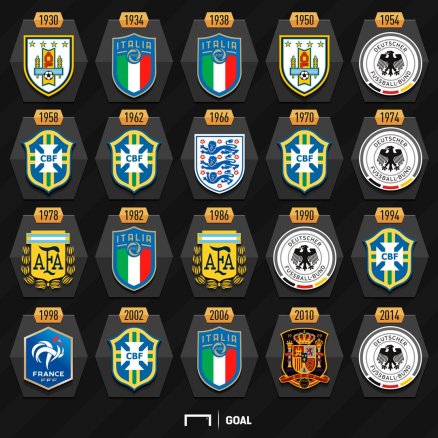
 France: France is a nation whose football greatness really only started to take off in the early 1980’s. It was in Mexico 1986 that France got its first-ever Top 3 finish. They would fail to qualify for the next two World Cups, but would host in 1998 and would go on to win. Some say France’s team of 1998 was the best World Cup team since Brazil in 1970.
 Croatia:
 France: The current French team is an example of a team that arose from the ‘ruins’ of football. Some of you may remember the 2010 World Cup. If it was not France’s worst-ever performance, it was France’s hardest World Cup trip ever. The trip started on controversy as they had qualified thanks to a fist-aided goal from Thierry Henry in their qualifying playoff match against Ireland. Then at the World Cup 2010, striker Nicolas Anelka was fired from the team after an obscenity-laden dispute with manager Raymond Domenech. A boycott of training from players in response and a lecture from the French sports minister paved the way for France’s eventual loss in their last game. The team returned home in disgrace and the president of the FFF resigned, as did coach Domenech. It would be another six years for Domenech to accept another coaching job.
 Belgium: Belgium is another example of a team that took a long time to develop. This is only Belgium’s 13th World Cup but many are already calling this team the best Red Devils ever.
 England: England has always been a subject of frustration. The Three Lions have only won a single World Cup: back in 1966 when they hosted. They have had difficulties whenever they’ve made it to the knockout rounds as they’d frequently expire in the quarterfinals or face elimination when the game ends up in penalty kicks. In fact England has been 0 for 3 at the World Cup for penalty kick matches. Then there are the embarrassments at the two most recent World Cups by expiring to Germany in a highly controversial 4-1 in the Round Of 16 and then failing to advance past the group stage in 2014. It always seemed like the case where the team is full of talent but they just couldn’t play well as a united team. Possibly they didn’t leave their Premier League rivalry at the door?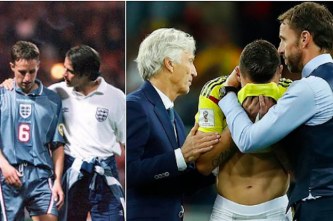
 Croatia: Croatia is another case of a team whose struggle is also paying off here in Russia. Croatia came to be in the early 1990’s after the nation of Yugoslavia fell apart in a brutal civil war. Soon after Croatia declared independence in 1991, they fielded their own national team. However they would have to wait until after the 1994 World Cup for them to play internationally. They played their first World Cup in 1998 and surprised everybody by finishing third, beating out big names like The Netherlands and Germany in the process.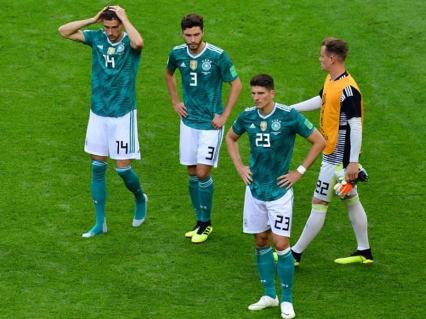

 Jon The Blogcentric