Oscars 2024 Short Films Review: Animation

Normally each year when they show the reel of the nominated films for Best Animated Short Film, there’s normally enough time in the reel to include one or two films that made the shortlist. This year’s crop of nominees are so long, their combined time length is enough to make for the whole reel! Makes sense. Each film does tell an awful lot in their time. It may be humorous or it may be serious. They all do a great job. Here’s my look at this year’s nominees for Best Animated Short Film:

Beautiful Men (dir. Nicolas Keppens) – Three brothers from Belgium are in a trip to Turkey where all go to get hair transplant operations. One brother Steven finds out at the office only one operation is booked as he forgot to book for all three. He doesn’t know how to tell his other brothers. As time passes, Steven’s insecurities are present and Bart is concerned about a lump in his testicles. The secret does unfold as Steven admits to brother Koen that he only booked one appointment and offers him to be the one since he has lost the most hair. Bart hears it from a sauna and angrily demands that he be the one. A stroke of misfortune, a hotel fire the night before the operation, ends up being the good luck they needed as two men in the hotel that were hospitalized for burns were to have the surgery and leaves open two spots for the other two brothers to take.

This stop-motion animated film deals with the dark them of male insecurities as the three brothers getting the operations are also approaching middle-age. It’s mid-life crisis mixed with the feeling of trying to live up to a masculine standard that set the theme for the story of the brothers and the wait for the surgery. It is true that women face more social pressure, but men aren’t immune either. This is a surprising deep story as the images tell a lot of the moods of depression and tension. That’s why I pick this film as the Most Likely Upsetter for the Oscar.

In The Shadow Of The Cypress (dirs. Shirin Sohani and Hossein Molayemi) – In Iran, a father who is going through PTSD decides to leave the house in a rage. His teenage daughter confronts him, but he hits her. They are unable to reconcile until they notice a whale has beached up and someone has to lead it back to the sea. Each effort they try fails. As the father returns to use his old dilapidated ship, images bring back the painful memories. It reminds him of the night of the storm and the bombing of the ship by the enemy air force that night that killed his wife. It’s then that the father attempts to use his ship to get the whale back to the ocean. It’s in the end result that the two are able to reconcile.

Of the three stories, this is the one with the saddest subject matter. Nevertheless this is a very good story. It uses colors and images to tell a story of heartbreak, of loss and eventual healing. With no dailogue, it sends a message anyone can understand and it tells it well of feelings of failure, hurt and anger. The father’s worst enemy is himself and in the end, it is the daughter and that whale who are the ones who can heal him and make amends.

Magic Candies (dir. Daisuke Nishio) – A lonely boy named Dong Dong goes to a store to get candies. what he gets are some odd-shaped candies the seller calls ‘magic candies.’ The boy first shrugs it off but as he eats the first at home, he notices the couch speaking to him and telling him things. The couch stops talking as the candy melts away. The second candy has his dog talking to him, who stopped playing with Dong Dong as he grew over the years, but still loves him. The third candy gets Dong Dong’s strict father to pay attention to him and get him to understand him better, especially since his mother’s passing. The fourth piece is bubblegum as it helps Dong Dong communicate with his late grandmother and she reassures him she’s happy in the afterlife. The fifth piece allows Ding Dong to communicate with the fallen leaves on the street. The last piece is flavorless and allows him to make a new friend.

This is another charming stop-motion story. There are three stop-motion films nominated in this category this year. This is a charming story of a child whose odd-looking candies are just what he needs to help overcome his shyness and loneliness. By looking at the shapes of the candies, it’s a clue that they’re out to help resolve issues and help Dong Dong overcome his difficulties. It’s a nice story as it is fun to watch. It has a nice mix of comedy and drama. It’s both humorous and touching at the same time.

Wander To Wonder (dir. Nina Gantz) – The story begins with the opening of a 1980’s children’s show called Wander To Wonder which is hosted by creator Uncle Gilly and consists of tiny characters named Mary, Billybud and Fumbleton. Fast forward to the present and we see that Uncle Gilly has died suddenly in his home. The three characters struggle to survive and seek a new normalcy. Mary wants to think the show is still happening and carries on as if she thinks it is, Fumbleton uses his spare time reciting Shakespeare monologues and Billybud plays around with the props. Within time, they run out of food and don’t know what to do, then a fire happens and burns everything, then a potential bird attack. It’s after Fumbleton saves them that they decide to venture out to a life outside the former home.

The third of the three stop-motion films nominated, this is a funny charming story. It’s a story that will surprise you on how something like this can get dark and serious with the creator dead and the little ones trying to save their lives. It makes for an unexpected story and an unexpected drama but in the end, it lead to a happy ending, but not without a disturbing climax. It’s funny and poignant too. This film won the BAFTA for the best British animated short film and the Annie award in the short film category. That’s why I make it my WILL WIN pick.

Yuck! (dir. Loic Espuche) – It’s summertime in France. Leo is out camping with his two siblings and good friend Lucie. They go spying in on all the people at the campground and as they watch any two kiss, they are all disgusted. You can tell by the desire to kiss as their lips glow. They go from place to place seeing the kissing, or attempts to kiss, and they’re disgusted by it all, but Leo takes a fascination with it. One day, he and his friend Lucie are all alone. It’s evident Leo and Lucie have feelings for each other and want to kiss. They go to a place where they hope to be alone. As they’re about to kiss, two friends barge in. They’re disgusted. They start taunting Leo and Lucie. Even calling Leo a pervert. However one night, it’s clear that Leo and Lucie don’t have to let it bother them and…

This is a cute two-dimensional story that will bring anyone back to the days of childhood innocence. We’ve all had that situation of a child’s first feelings of love. We also remember how we were disgusted with kissing when we were kids. This story captures that essence and makes us laugh at those days again. Also, the use of the color pink to symbolize feelings of love, especially in the lips, and the musical score of the film both add to the charm of the story. I can’t help but call it a guilt-free guilty pleasure. That’s why I give this film my Should Win pick.

And there you have it. That’s my look at the five films nominated in the Best Animated Short Film category. Interesting how none of the nominated films for this year are in the 3D computer animation format. Must be the first year in a long time. Better luck next year.

Oscars 2024 Best Picture Reviews: Part One

Ten is not a set number for the number of Best Pictures nominees. Nevertheless it’s still nice to have ten as the total of nominees.

This year, there are a wide variety of films nominated from science fiction to two musicals to a musicography to a dark comedy to a horror movie to many types of dramas. Here  are my first two reviews of the Best Pictures nominees:

Anora

This is quite the unexpected comedy that delivers an unexpected sad ending. A sad ending was anticipated but the sad ending we got was not the one anticipated. It seems odd to have a story about a stripper/hooker marrying a rich kid to be one of the best films of the year but Sean Baker has developed a reputation for directing films about people in the sex trade. This is quite the story itself. We have a stripper who plays a ‘love kitten’ day after day for lusting men, but craves real love. We have a billionaire’s son who’s too spoiled, immature and careless to get it about life and love. He thinks marrying Anora is easy like that and he can live the same irresponsible life again, but he has a lot to learn. We have Igor, the henchman hired by the Zacharovs to have the marriage annulled, but Igor becomes the first person to see Anora as a human being throughout this whole ordeal. We also have the Zacharovs who are so obsessed with their money and power, they think they can do whatever they want. This is the kind of story that brings a lot to the table to talk about.

It’s hard to pinpoint the exact theme of the story because there’s so many topics and themes this story presents a point about. One could be the theme of sex workers. As I mentioned, Baker’s films often deal with sex workers. Here we see the case of a sex worker who is treated like a piece of meat and there are times her true feelings are shown. There are moments we stop seeing Anora as ‘this thing’ and start seeing her as a person. There’s also the case of wealth and privilege. Not only do we see wealthy people having the best luxuries but we see them having a privileged son living a careless irresponsible life, we see how the rich devalue marriage both with Vanja’s eloping of Anora and the Zacharov’s own marriage, we see how being a henchman to the Zacharovs means having to leave a christening of your godchild because your boss demands so, and we also see how the rich Zacharovs know that their money gives them power and uses it against Anora. Especially when the mother insists the family doesn’t apologize to anyone just as Igor points out Vanya owes Anora an apology for the eloping. It’s quite the irony when a stripper or prostitute has a better sense of what marriage is all about than a billionaire’s son. Or even his parents.

Often overlooked, I feel one of the top themes in the film is love. We have Anora, a stripper who pretends to love the men she sleeps with, but she craves real love. We have Vanya, whom Anora thinks she found love with as she spends weeks with him and easily falls for his marriage proposal. Anora is oblivious Vanya wants to marry an American so he doesn’t have to return to Russia and work his father’s business. Even the scenes as Vanya’s playing video games after the two marry hinds at Vanya’s irresponsibility. We also have Anora’s delusion with the marriage. Even though Vanya continues to play video games after they marry, she still thinks she met her love. We have the Zacharovs who view their son marrying a sex worker to be a disgrace to the family. We also see scenes which make you question the Zacharov’s own marriage. Finally we have Igor who becomes the first person to see Anora as a human being instead of ‘that thing.’ It was made obvious in the scene where Igor says Vanya owes Anora an apology. That ending where he allows her to stay at the Zacharovs one last night to sleep, bathe and pack and the ending scene as he’s about to drop her off is also an irony. He’s first hired as a henchman to stop the marriage, even if it means brute force, and now he actually has feelings for Anora. A shock to us all, and to a disheartened Anora as well.

This is the big breakthrough film Sean Baker has been waiting for. The film world has known Baker for a long time as one knocking on the door. He’s delivered small breakthrough films before with 2015’s Tangerine and 2017’s The Florida Project. Here, he directs a story that’s intriguing and unpredictable. It first seems like a film that would give us a cartoonish story but as the film progresses, the story is a lot deeper and it’s not the story we thought it was. Also worthy of top acclaim is lead actress Mikey Madison. If you thought you’d never shed tears for the character of a stripper, you will be wrong. It’s remarkable we have a film where the character of a stripper is shown to have real three-dimensional feelings, but Mikey’s performance of Anora was deep and revealing and we actually start feelings for her. He go from seeing her as ‘that thing’ to seeing her as a frail hurt person. Also excellent is Yura Borisov. Nobody expects any of the henchmen to have feelings for Anora, but Yura catches us by surprise. It’s also he who makes the movie into something we didn’t expect. Also good is Mark Eydelshteyn in playing Vanya. His portrayal as an immature irresponsible spoiled rich son makes you want to hate him in the end. Both Aleksey Serebryakov and Darya Ekamasova are great at Vanya’s parents. They also succeed in making you hate them as much as you’ll hate Vanya. We can see why Vanya is a spoiled brat.

Anora is not your typical story of a prostitute or a stripper. It’s a story of a love gone wrong and ends with a love you don’t know if it should be. Those who see it won’t forget it.

The Brutalist

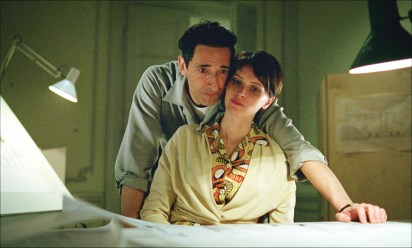
We’ve seen stories about the difficulties of achieving the American Dream before. Some are harder than others. This film takes a cynical look at an architect who achieved his American Dream. We have a Jewish architect who left post-Holocaust Hungary to find refuge in the United States and achieve his success there. We see how he has to fight his demons like his infidelity, family members that are petty, harrowing memories that cause him to take heroin, a difficult market for his Bauhaus style, rival architects, people that want to use him and above all, his own egotism. It’s not at all a pretty sight to see but it does tell a good story of a man hoping to pursue his greatness in the United States.

The thing that makes this film is not just the telling of Laszlo Toth’s story, but how it’s presented. The film begins as Laszlo’s ship sails past Ellis Island and he sees the Statue Of Liberty, but from his angle, he has to look at it upside down. He has to struggle to achieve his dream by eating at soup kitchens, living at the YMCA, embraced and then neglected by a family member who’s a successful business man, and having to prostitute himself at times. His breakthrough comes by fluke as it was the renovation unapproved by Harrison Van Buren where they first meet, and the meeting is bad. It’s after Harrison discovers who Laszlo is and of Laszlo’s pre-war success in Hungary that he’s willing to take him on. It’s not an easy task as it involves years of work and labor, supplies cancellations, dirty work form Harrison, his friendship with Gordon put to the test and Laszlo’s own ego coming to light. Then there’s how Laszlo’s attempt on success threatens his marriage to Erszebet as she has now arrived in the United States. She knows his secrets and she says she’s fine with it, but it will become obvious she’s not. His success threatens family unity with the niece as the daughter adopted after the Holocaust.

The crazy thing about the film having a half-hour intermission may have some question its purpose. We should remember many decades ago, it was common for long movies to have intermissions. This film’s intermission is very successful not only in dividing the movie properly, but give you the feeling you’re watching two different films. The first half focuses on Laszlo’s arrival, his attempt to make it in the United States, the dirty obstacles he has to face and his big break. And right while he’s writing to Erzsebet with the hopes of her coming to the United States. At the end of the intermission comes a new scenario. As Erzsebet finally arrives in the United States with niece Zsofia, there’s the added pressure of keeping a family together. Especially since Laszlo can’t keep his secrets to Erzsebet any more and she has a disability to deal with. Over time, she senses things like Laszlo’s ego and how Harrison wants to make a pet out of him. Despite being confined to a wheelchair, Erzsebet is able to muster the strength to use her walker to confront Harrison about his mistreatment of Laszlo. The ending epilogue is also something as Laszlo is saluted for his work, in Italy. It’s like he achieved his American Dream but had to achieve it at a harrowing cost and he had to get his honor from outside the US.

This is an accomplishment from Brady Corbet. Younger adults may remember his teen actor days in films like Thirteen and Thunderbirds. Like a lot of young actors, Corbet felt the need to make films of his own. This is Corbet’s fourth feature film. This film that he directs and co-wrote the story with wife Mona Fastvold is definitely something. It mixes some classic film styles while telling the story of a Holocaust survivor’s pursuit of the American Dream. There have been films where the American Dream has been achieved at a big cost before, but this film meshes Laszlo’s pursuit with the shaping of the United States and most notably Pennsylvania after World War II. As the US shapes itself after the war, Laszlo attempts to shape his success in the US, but at a huge price that comes at the cost of him, his dignity and his marriage. Right at the end as they have the tribute gala in the epilogue, you wonder if this should be a happy occasion or not with what Laszlo has gone through.

Excellent performance from Adrien Brody. Remember him from 2003’s The Pianist? He appears to have kept it low-key since. This year, he comes back with another performance of a lifetime where he shows Laszlo to be a creative man and a troubled man. He will make you hate him as much as he will break your heart. Also great is Felicity Jones as Erzsebet. It’s the appearance of Erzsebet that most turns this film into two films in one. With her arrival comes the change of environment. She appears to be one who will most interfere with Laszlo’s success and even a victim of his own selfishness but in the end, she’s the best person Laszlo needs during his most troubling time. Guy Pearce is also great as the deceptive Harrison. He’s excellent in portraying an all-American businessman who welcomes Laszlo and his talents, but as long as something’s in it for him and is willing to make a toy of Laszlo. Additional excellent acting comes from Raffey Cassidy, as the niece Zsofia who’s mute at first but soon develops her ability to talk, and from Isaach de Bankole as Gordon, Laszlo’s first friend and business associate who Laszlo later turns on in his success. Excellent technical merits are the cinematography of Lol Crawley, the production design of Judy Becker and the musical score from Daniel Blumberg.

It’s easy to see why The Brutalist is a heavy favorite to win Best Picture. It combines a graphic disturbing story of one man’s pursuit of the the American Dream and shows it in a stylish artistic fashion. Hard to outdo it.

And there’s my look at the first two Best Picture nominees for this year. If you’ve seen them, you can understand why they’ve won most of the Best Picture awards.

VIFF 2024 Review: The End

I find it quite fitting that the last film of VIFF I saw was titled The End. It’s also interesting that there would be an attempt to create a musical on a subject one would not normally create a musical about.

The musical begins in what appears to be a home of a wealthy family. The son is happy with the diorama of America he has. The father and mother consider it the idea life or the dream life. Or is it? Is it the dream life when all people need to participate in emergency raids? Turns out this ideal place of the family is a bunker underneath a salt mine they need to live in because the planet is unlikeable. The mother, father and son are among the lucky few to survive this ‘end of the world’ and this bunker is their refuge. The three aren’t the only ones living in the bunker. Also ‘lucky’ to be living there is a family friend, a doctor, the butler and the son’s ex-wife Mary. They’re the only other people the parents were willing to trust while still living on Earth’s ground. The father was an oligarch who faced death threats in his lifetime on Earth.

It should appear like they have it all in their underground bunker. They have all the luxuries they need for themselves, the friends they could trust the most on Earth living with them, samples of plants and species to keep, grow and breed for themselves, and there’s even a diorama of Earth’s site for the son to marvel at. Actually the son feels something missing in his life as he spent almost all of it below ground. Then one day, an ‘intruder’ is detected in their shelter. The intruder is a young African-American woman. She was one of the few that managed to survive the devastation as her family have all been killed. The son is attracted to her as he sees something captivating in her. Possibly because she’s the only person in his life who has lived recent time at the surface.

The romance between the son and the girl kindle, but the mother and father are not happy about it. She’s an outsider. She’s an interference to the ideal life they envisioned having once the apocalypse happened. The mother even suspects her of having an ‘agenda.’ Soon awful truths begin to unravel from the girl as she has the most knowledge of the devastation at the surface. All the pollution that was caused killed her family. Soon the news hits Mary as she learns the pollution is what caused her son’s terminal cancer and she neglected him in the end by bringing him to the surface to die. She soon dies in heartbreak. Then the parents learn of the hurt they caused. Mostly the father as on Earth, he bribed corruption in developing countries to happen for his gain, his company caused massive pollution around the world and his political ties allowed his influence and policies to be adopted around the world. A world he did his part to destroy. The mother tries explaining to her son she did all this to protect him, but he doesn’t buy it. The parents wonder is there any way they can find any redemption or forgiveness for what they’ve done? They do find it, but not in the way anyone expects.

It shouldn’t be too much of a surprise that there would end up being an ‘end of the world’ musical. Creativity is just waiting to happen. I’m sure this is not the first apocalyptic musical ever done. The story itself is an ambitious story. An oligarch family live in a bunker below the devastated Earth and live happily with themselves and the people they want. Suddenly they find an outsider in their area. The parents don’t know what to do with her. The son falls in love with her. Meanwhile as the two become closer, ugly truths about the parents and the choices they enforced caused much of this earthly destruction and they are finally facing the music about it. This musical does touch on a lot of things such as environmental damage, blood money and people who ‘ruled the world’ facing the music for the devastation they cause.

The thing about this musical is that it doesn’t feel all that together. I know it’s a musical that has most of the activity taking in one small place and it doesn’t lead too much outside, but one does get the sense a musical like this could have been done much better. Its biggest flaw is there are many times in which during many dialogue parts of the song, you forget it’s a musical until a song is thrown in. Now don’t get me wrong. Cinematic musicals are as hard to create for the big screen as stage musicals are hard to adapt to the big screen, but one can’t help but think as they watch along that this could have been a way better musical. I’ve often sensed that if Adam McKay were to do an ‘end of the world’ musical like this, it would be a lot angrier and with humor that delivers a lot more hard blows as McKay is known to do.

Despite its flaws, I give credit to Joshua Oppenheimer for his ambitious attempt to create such a musical. This film is not only Oppenheimer’s first attempts at a big-screen musical but also his first attempt at a feature-length film that isn’t a documentary. His two documentaries The Act Of Killing and The Look Of Silence have both been nominated for Oscars in the Best Documentary Feature category. In this film he directs and co-wrote the screen play with Rasmus Heisterberg, his lack of experience in directing live action shows as it’s not all together. Mind you those that know the story know it’s not an easy story to direct and set. Never mind throw in songs ever now and then. Some critics have labeled such a film an ‘experiment.’ If this film is a successful experiment, it’s an uneven success where the flaws are noticeable. The songs composed by Marius de Vries and Joshua Schmidt are good but there aren’t as many as there should be in a musical.

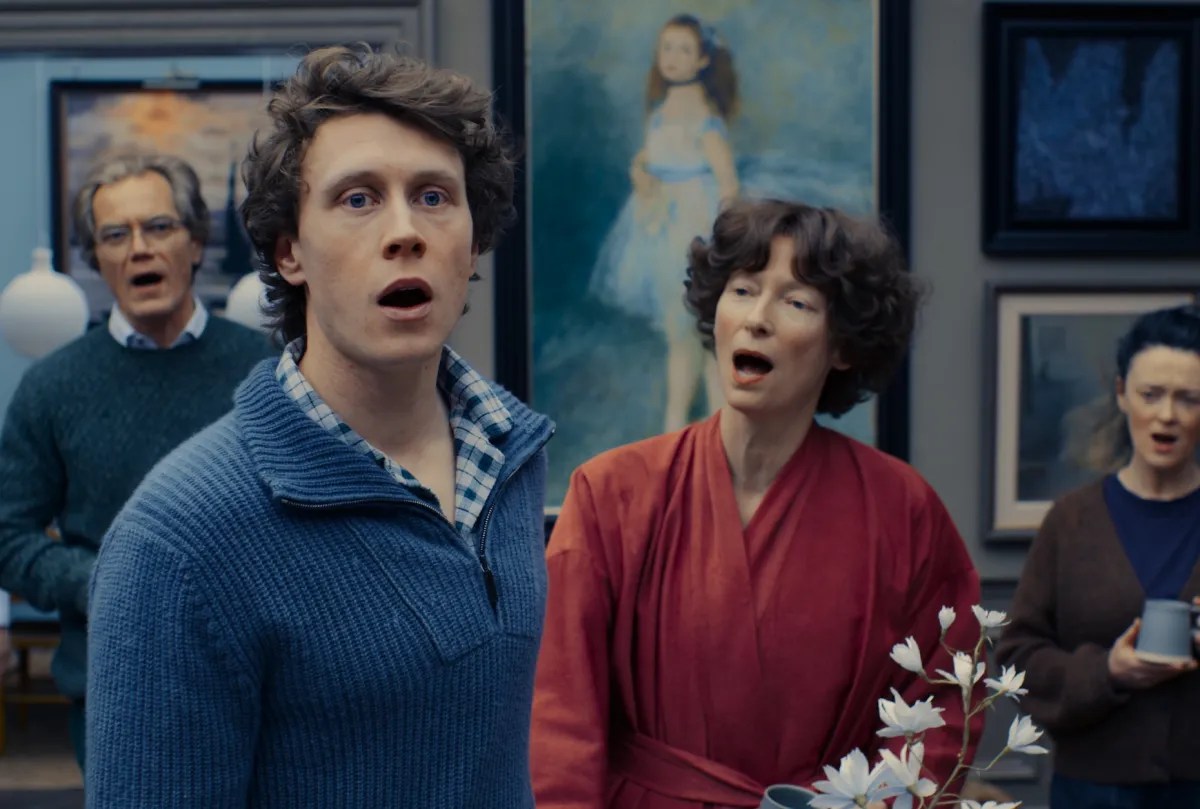
By the looks of screen time, it looks like George Mackay is the lead actor in this film. I’m unfamiliar with his experience at singing or musical theatre but he does a very good job in this film. He plays the naive son clueless about the outside world very well. His chemistry with the girl is often because she symbolizes the outside world he craves to live in. Also playing the role well is Moses Ingram. She’s most famous for playing Jolene in The Queen’s Gambit. She does a great job at playing the survivor of this catastrophe who’s able to capture the son’s love. Michael Shannon and Tilda Swinton do a good job of playing the parents. Curiously, Shannon is only 17 years older than Mackay. I didn’t think Michael looked that old! They both do a good job who are first in love with what they have and then learn this paradise is an illusion and they confront the truth of what they caused. Also great is Danielle Ryan who plays the first love of the son who soon confronts her role in the responsibility of her son’s death.

The End attempts to create a musical that attempts to be like a sad comedy. The energy and overall mood are not as fluid as they should be. The acting and singing are both good, but the film doesn’t seem to be all together.

And there you have it! Finally the last of my reviews of films from the Vancouver Film Festival of 2024. You’ll be getting my wrap-up blog soon.

VIFF 2024 Review: The Thinking Game

The Thinking Game is a documentary that makes understanding A.I. pioneer Demis Hassabis to be as much about trying to understand how A. I. came to be and how it evolved to what we have now.

The topic of A.I. is something to provoke a lot of discussion. Some will regard it as a revolutionary breakthrough in technology. Others see it as a threat that devalues human abilities. The documentary The Thinking Game gives an insight into A.I. as navigated by one of its biggest pioneers.

The film begins with a look at Demis Hassabis: the British CEO of the technology company AlphaGo. It shows of his current working with A.I. and also his intrigue of developing AGI: Artificial General Intelligence. As we learn more about attempts to develop AGI, which is like A.I. but appears closer in developing the feelings similar to that of humans, we are introduced to Hassabis and his intrigue with the human mind. Hassabis was born to a Greek-Cypriot father and a Singaporean-Chinese mother in 1976. He grew up in East London and his above-average intelligence was noticed as he developed a love for chess. Soon he became the second-ranked chess player in the world for his age range and a chess master at 13.

Everything changed one day during a chess tournament he played in. It was a game when he was thirteen that he lost and he was out of the tournament. He was sad about it, but did not leave the playing area. While sitting, it got him thinking of all these people around him still playing and all the brain power going on. It got him thinking of a human’s brain power. Are there any limits to what human thinking can solve? Soon Hassabis bought a computer with his chess winnings and learned programming from books. One day, he won a contest to win a job at a video game company: Bullfrog Productions. Soon he helped with Bullfrog’s work and invented a game of his own: Theme park.

Theme Park became a hit and helped him make enough money to attend Queen’s College at Cambridge. College was difficult because he wanted to study artificial intelligence and he was chastised by the professors about it. He did graduate from Queens College with a Computer Science Tripos. He also went to the University College London where he achieved a PhD in Neuroscience. In between and after his stints at college, he continued his work in video games and programming going from Lionhead Studios to founding his own game studios Elixir. His fascination with the human mind never left him. He felt that through computers, he can create something with artificial intelligence that can even tap into human emotions. Something commonly referred to as Artificial General Intelligence, or AGI.

In 2010, Hassabis and his colleagues Shane Legg and Mustafa Suleyman created the artificial intelligence laboratory DeepMind. The activity on artificial intelligence at DeepMind started when Hassabis worked ways to get a computer to play old video games from the 1970’s and 1980’s. The AI system was taught nothing of the game and would have to learn by constant play. Over time, the A.I.’s learning system worked and they would master the games. Interest in DeepMind grew and it attracted investors like Elon Musk and would be owned by Google from 2013 to 2014. Then in late-2015, they created AlphaGo: a computerized version of the game Go with A.I. as the opponent. They would soon challenge the world’s highest-ranked Go players to matches and win.

For DeepMind, it was enough to declare victory. For someone like Demis Hassabis, it wasn’t enough. Hassabis has a lot of ambitions on his mind. One of which was protein folding. Solving the problem can help with solving Alzheimer’s, dementia and developing new drugs. Hassabis and his colleagues would create the program AlphaFold to perform the predictions of protein structures. For years, it was all trial and error. As one of the colleagues put it, they were the best in the world at it but they were awful. Then during the pandemic while everyone had to isolate and work at home, the code was cracked. It doesn’t end there for Hassabis as it appears he wants to crack every uncracked code that’s out there.

A.I. and A.G.I. are two things that are admired for what they do and despised for what they do. Through computer technology, they’re able to solve a lot of problems human’s either can’t solve or can’t solve fast enough. Because of that, many people see this as a threat to humanity, especially in terms of employment and the constant automating of jobs. Even Hassabis himself has been both praised for his discoveries and achievements and vilified by some in aiding something that many feel devalues human abilities. There are many people from his co-workers to journalists to his former professors that ask the big question when will it stop? Yet Hassabis comes across as the type who doesn’t want to stop until everything’s all solved.

This film actually spends more time focusing on Hassabis and his accomplishments than on the subjects of A.I. and A.G.I. The film showcases Hassabis as someone who many feel deserves the praise equal to that of other computer technology pioneers like Bill Gates and Mark Zuckerberg. Sometimes the film shows Hassabis as having acclaim ‘unsung’ compared to the two. The film also shows Hassabis as one of those child geniuses who was able to find a way to make better use of his brain than winning chess tournaments. It does show Hassabis to display a lot of genius traits both in action and personality but it doesn’t show him to be as much of an eccentric like many other famous geniuses.

The film is able to mesh Hassabis’ life story of how he went from a chess prodigy to being on the forefront of A.I. development with the current developments of A.G.I. his current lab. It chronicles his achievements while it also shows how workers in his lab are working to perfect his A.G.I. technologies to match human feelings and emotions. It doesn’t spend a lot of time on the news stories involving his lab and of A.I. research. It also spends a small amount of time on people who feel threatened by the latest wave of A.I. technologies. Especially the actors who went on strike last year. The film does leave out the times Hassabis has focused on the topic of existential risk from A.I. which Hassabis has spoken out and warned against. Hassabis has even stated the risk from extinction from A.I. is as much worthy of concern as nuclear war or another pandemic, but there’s no mention of it in the film here.

It’s interesting that this documentary comes out in the very year Hassabis and his AlphaFold partner John Jumper were awarded the Nobel Prize in Chemistry for the very protein structure prediction they were experimenting on in this documentary. The documentary does make it interesting how meshing games with work appears to be Demis’ life. He calls chess a good thinking game as a child, does game development as a teenager and young adult, uses A.I. to challenge people at chess, then using A. I. to challenge the world’s best Go players, to using A.I. to work protein structures. It seems like everything Demis has worked on in his lifetime appears to be another ‘thinking game.’ Leaving the film, maybe the film shows that science itself in all of its trials, errors and experimentations has always been a ‘thinking game.’

Director Greg Kohs delivers a documentary some could find intriguing or some could find to be missing information. It does a good job in getting us to see Demis’ achievements in a topic that has many people intrigued in. It can also lead people to scratch their head about what this film is about. Is it about Demis? Is it about A.I. or A.G.I.? Is it about his inventions and contributions? Is it about a person we’re to blame for what threatens us now? Is it even the world through Demis’ eyes? Or even is it about science as a whole with all the many failures before the successes?

The Thinking Game is an ambiguous documentary that is as much about A. I. evolving over the decades as it’s a biographical film of Demis Hassabis. It doesn’t focus too much on the controversies of A.I. Instead it focuses on Demis’ intrigue into A.I. and how it would greatly pave the way to what we have now. Whether it rightly or wrongly glorifies Hassabis, that’s up for the viewer to decide.

VIFF 2024 Review: Bird

Young Bailey (played by Nykiya Adams, right) is a 12 year-old girl seeking her own identity and away from her father (played by Barry Keoghan) in Bird.

The first film I saw at 2024’s Vancouver Film Festival was Bird. It’s the latest film from renowned British director Andrea Arnold. How well does it make for a film?

Bailey is a 12 year-old girl living in the slums of North Kent. Despite living in bad conditions, she likes taking pictures and videos whenever she notices beauty. Especially beauty in nature. Bailey lives in a slummy house with her father Bug. Bug is what you’d call a ‘kidult.’ He even takes her home from school on a scooter. One day Debs, a woman his father only dated briefly, moves into the home. She’s also shocked and unhappy to find out he wants to marry her. She’s so unhappy with it, she won’t wear the pink outfit her father wants her to wear at the wedding. That leads Bug to get abusive on her, and Bailey runs off.

Bailey runs a long distance away from her neighborhood. She doesn’t only want to be away from her father but everyone she knows. Bailey finds herself in a field where horses are raised. It’s the perfect place to be alone and be captivated by nature. Suddenly she sees a stranger in the field. It’s a man in a dress who dances around like a crazy you’d see on the street. When Bailey comes face to face with him, she wants to avoid him. She later learns this man calls himself Bird and he has a message to deliver.

Bailey returns to her neighborhood but wants to avoid her father. She wants to stay at the flat with her half-brother Hunter and his girlfriend. Hunter is friendlier to Bailey than her father, but she can already tell Hunter is a bad enough influence. She tries to meet up with school friends but learns some are engaging in gang activities. She noticed another thing too. Bird is in her neighborhood. She meets face to face with him by chance. She also sees Bird from Hunter’s apartment. Bird stands atop the porch of the nearby apartment, just standing on top. She fears Bird might jump.

Over time, Bird and Bailey develop a friendship. She also learns that Bird is trying to look for his long-estranged father. One night Bailey decides to spend some time at her mother’s place after watching Bug snort cocaine. She happily meets with her younger step-siblings but learns that her mother’s new boyfriend is extremely violent and very threatening. It’s after he threatens Bailey that she has to run out.

Over time, things get better for Bailey. On the morning Bailey menstruates for the first time, Debs is able to talk to her about menstruating and give her some tampons. Another day, Bailey is able to take her younger siblings from her mother’s side out to the beach. She makes a great mother figure. Also while she herself is in the water, she finds herself in a moment of freedom.

Bug brings Bailey and all of his friends for a wedding rehearsal. Bailey is uncomfortable there. That day, she agrees to help Bird fulfil his goal of meeting face to face with his estranged father. It will be a long bus ride to a town very far out but Bailey is willing to help him. Once in town, Bailey and Bird finally get to the location of Bird’s written message. The father doesn’t notice Bird. Bailey steps in to insist to the man who has a new wife that Bird is his long-lost son.

The two return back to Kent appearing disappointed things didn’t go the way it should have. Bailey and Bird spend the night over at their mother’s place, hoping her violent boyfriend is not there. Unfortunately, he is there during the night and he assaults her mother. When Bird steps in, Bird becomes his latest punching bag. The fight escalates that it goes outdoors. Bailey notices something shocking. Bird sprouts feathers, like a bird. When the man attempts to assault Bird, Bird fights back like a bird! After beating the man unconscious, Bird flies off with the man in his claws like a bird carrying their prey. Bailey is shocked by it all.

Months later, Bug marries Debs in a court. Bailey is there in the pink outfit. That evening, the wedding happens at a bar consisting of singing performances from Bug and his friends. As Bailey takes a break from the events, she notices Bird paid a visit, wings and all. It’s a meeting of parting where he thanks Bailey for her help and bids farewell. The ending sends a message of a new beginning.

One of the focuses of the story is the difficulty of a 12 year-old girl trying to find herself. Being twelve is not easy as one is going from child to teenager. It has its own difficulties for girls. Imagine being a 12 year-old mixed race girl living in one of England’s ugliest slums and with toxic family situations and a neighborhood full of bad influences. You can imagine it would be difficult. A girl like Bailey would definitely be prone to the frustrations. Despite that, Bailey and her imaginative thinking are sources that can lead to something hopeful in the future. In fact that brief scene at the beginning of the cruise ship passing by being seen from her window is one sign Bailey is sensing something is better for her out there.

It’s her belief in something better and something hopeful in the future that keeps her going. It’s also her meeting with Bird that she helps to develop a stronger sense of herself. It’s very hard to believe that meeting with an eccentric like Bird would be the best thing for her. It’s through Bird that she’s able to discover that better things for her are out there. It’s as she helps Bird with his situation with his father that she’s able to be a stronger figure to her own family. She’s also able to show she’s a loyal friend by being determined to help Bird reunite with her father and it’s through her friendship with Bird she learns things about herself she never knew.. To think it was a chance meeting of two strangers who would be the least likely to form a friendship that turned out to be the best thing for Bailey. One who uses her imagination for her pictures and videos and the other who lives and dances out his imagination. It’s as Bird gains his wings, Bailey is able get her sense of self. Also the end of the film is both a moment of goodbye and a passing of the torch.

The story plays out well. It keeps making Bailey the prime source of the story, as it should, and it showcases her growth and her maturity over the time. It also showcases the troubles and the difficulties she goes through in both her personal life and the lives surrounding those she associates with. There are a few times when the story isn’t as steady or scenes not as fluid as it should be. Sometimes the story itself can be made confusing. Nevertheless it does all come together at the end. It makes sense that Bailey’s growth coincides with the engagement of Bug and Debs and ends with their marriage. The addition of Bird as an influence on her life also adds to the story of Bailey’s growth.

This is a good unique film from British director Andrea Arnold. Arnold first burst on the scene 20 year ago when her short film ‘Wasp’ won the Oscar for Best Live-Action Short Film. Since then, her films like Fish Tank, Wuthering Heights and American Honey have caught a lot of attention. Her latest film which she both writes and directs is a story that has a lot of ironies and twists, but it’s also smart and touching. It’s a story that shows Bailey for her uniqueness and for her common traits as a 12 year-old girl. It’s not that often a filmmaker is willing to do such a story. It’s great to see Andrea do it. Making the story work is young newcomer Nykiya Adams. This is her first acting role and having a fish actress in the role of Bailey works for the film. Nykiya did a great job in holding the film together as she did in her role as Bailey. Barry Keoghan did a great job in his role as Bug. It’s hard to picture Barry playing a thug from the slums but he masters the role and plays Bug well with his stupidities and vulnerabilities. Also excellent is Franz Rogowski. He played a believable eccentric with animalistic type of behaviors and kept Bird from looking wooden. The music added in the film also added to the quality of the film. It helped with the angry energy at times.

Bird is a unique coming-of-age story of a twelve year-long girl from the slums and her friendship with a person she’d be unlikely to befriend. It’s a unique story of a chance encounter that changes her forever.

2023 Oscars Short Films Review: Live-Action

It’s interesting when the Academy deliver their nominations for feature-length films, they’re mostly for English-language films. Most of them being American films. Yet the nominees for the short films categories are often multilingual. For the films nominated for the live-action category, we have  films in French and Danish. We also have three English-language films, but two are from the UK. Not as much foreign language as the animated films but still it tells how these categories are among the most international of them all.

What’s interesting about the short films in the live-action is that many are from up-and-coming directors, as is the common case in this category, but we also have one British film directed by Wes Anderson! Also in the film are renowned star actors like Benedict Cumberbatch, Ben Kingsley, Dev Patel, Ralph Fiennes and Richard Ayoade. The other films also show actors of renown like Brittany Snow, Leif Andree and David Oyelowo. So there’s something about short films that make well-known actors want to pursue them.

Without further ado, here are my thoughts on the Live-Action short films nominated for the Oscars:

The After (dir. Misan Harriman) – Dayo is a successful businessman in London. One day, he drives his daughter to the top floor of a parkade to meet up with his wife. Suddenly a man wielding a knife commits a massacre all over the parkade. The man stabs his daughter to death. The wife, heartbroken, jumps to her death as Dayo fights to restrain him for the police. Time passes. Dayo is resigned from his position and makes his pay an Uber driver. He has cut off all contact from his friends and colleagues and won’t even meet with crisis management counselors. Although he keeps to himself, it’s obvious he’s still hurting on the inside. As he waits for his latest customers at the airport, he takes the picture of his family and sings “Happy Birthday.” The daughter of the family he’s to drive looks very much like his own late daughter. He tries to restrain his emotions at first as the parents make their way to the car. During the drive, the couple are consistently arguing in front of the child, but the daughter is sensing something is wrong with Dayo. Dayo still tries to keep his cool. As he gets out lets the family off at their house, the daughter goes to hug Dayo and Dayo just breaks down. The parents are shocked by what they see and leave him, but Dayo picks himself up.

How do you live again after you’ve lost it all? This is the type of question we don’t normally ask ourselves or don’t want to think about but unfortunately, there are some people who have to do exactly that? This is a story that does a great job of showing the before-and-after of a tragic incident that claims the lives of Dayo’s wife and daughter. Throughout the story, Dayo is the storyteller through his actions and his emotions. Even without dialogue, you can sense what Dayo is saying through his body language. He doesn’t know how to live again or deal with his emotions. It’s right after the breakdown he has after the daughter hugs him that Dayo knows he has to continue on, despite how hard it will be. This film which is the directorial debut film for Misan Harriman tells a gripping story with a profound message. David Oyelowo does an excellent job in his performance in both scenarios of the story. If they could give Oscar nominations for performances in short films, I’d say give one to David!

Invincible (dir. Vincent René-Lortie) – The film begins with a young boy in the driver’s seat in a car named Marc who telephones his mother, but doesn’t say a word. His mother tells him to come home, but police lights flash. Rather than surrender to the police, Marc drives the car off the cliff into the water. Going back weeks earlier, Marc is on a family vacation having fun with his family at the lake. He plays with his little sister but is embarrassed of how she chickens out with her finger over his lighter. This is the last set of fun Marc will spend with him before being sent to the youth detention centre. The first day, Marc can’t stand being in a sweltering room with no way to cool off. He ignites the sprinkler system which the officials put him on a stern warning. A councillor tries to deal with Marc and tells him how he has what it takes to be a smart positive influence on others and can’t understand why he’s always getting in trouble. One day, the official sees progress in Marc and how he helps others. The officials decide to take the boys to a nearby community pool. it appears Marc is having fun with all of them but when the councillor isn’t looking, Marc does his latest escape. Marc runs into a car but as the woman enters a store to call the ambulance, Marc steals it, attempting to take his escape further. As Marc stops, he calls his family. The mother, aware the police are pursuing Marc, pleads for him to return as the sister tests her pain with the candle.

This is a story inspired by a troubled 14 year-old boy from Quebec who killed himself as he drove into a lake in 2008. The story haunted the people in the area for many years. The boy, Marc-Antoine Bernier, was a friend to the director. Here, it appears the director is using his film to bring some respect back to Marc. Marc was an intelligent boy capable of a lot of good, but kept on getting into trouble. We all have known a kid like that in our childhood. Although this is a story inspired by a real-life person and based on true events, there may have been events or happening added to the story. Only Marc knows what really happened. Nevertheless Vincent makes a good effort to redeem Marc from the story he tells and even tries to get us to feel some empathy for him. We’ve all had those years when we were younger when we all felt we were trapped mentally, if not physically. If Vincent doesn’t make you feel empathy for Marc, he does make for an intriguing story. That’s why I make this film my Should Win pick.

Knight Of Fortune (dir. Lasse Lyskjær Noer) – Karl is at a multi-chapel funeral home where he comes to mourn his wife. Left alone, he can’t bring himself to open the casket. He tries to adjust a light but it breaks. Frustrated, he goes to a bathroom where he encounters another widower named Torben. Torben claims he can’t open the casket for his wife. Karl goes with Torben to the chapel and helps open the casket. As Torben attempts to say his “last words,” a family comes in. They’re the real family of the deceased woman including the real widower. They allow Torben and Karl to stay. When the widower is at a loss for words, Torben is able to say the right words as if the woman really was his wife. Karl leaves Torben angrily but he later learns from the funeral directors that Torben lost his wife in a boating accident three years ago and never had a real chance to say goodbye. Outside in a nearby bench, Karl notices Torben. Instead of anger, Karl laughs and invites Torben to the chapel where his wife is. Torben is able to open the casket and Karl is able to say his last goodbyes. As Karl gives his wife one last kiss Torben sings “Knights Of Fortune.”

Another story of loss and coping. Although this story deals with the subject of death in a gentler manner, and even includes humor, We all know that loss is never an easy thing to deal with, but it needs to be dealt with. This is a story of a widower struggling to properly say goodbye encountering an imposter who knows the right words to say goodbye to a woman he’s never really met, but makes like she was his wife. Once Karl learns about Torben that he’s not simply an imposter, but a hurting man who uses funerals of wives to say the goodbyes he always wanted to say to his own wife, could Torben be the very person to help Karl deal with his grief? This is a story of grieving, healing and saying goodbye that is greatly different from other stories. Nevertheless it does offer a message of healing and hope. It’s ironic how this imposter is exactly what Karl needs to properly deal with is loss and say goodbye, and a friendship that really shouldn’t be, happens.

Red, White and Blue (dir. Nazrin Choudhury) – Rachel, a waitress in a diner, looks at a pregnancy test and sees a positive result. Rachel is a single mother who has difficulty to support her two children. She also lives in Arkansas where abortion is illegal, thanks to the overturning of Roe v. Wade. She plans a trip for an abortion procedure in Illinois where it is legal, but it’s more than she can afford. One day, a woman customer who somehow knows what Rachel is dealing with leaves her a tip which makes up the remainder for her abortion trip. Soon, she leaves her son Jake with a friend as she takes her daughter Maddy on this trip. This is the first time out of Arkansas for both of them. Before they go to the clinic, they go to a carnival as it’s just before Maddy’s birthday. Maddy wants a merry-go-round ride, but it’s more than Rachel can afford. She agrees to one ride and Maddy chooses the elephant. At the clinic, Rachel learns she’s late for her appointment but through past recollections and as the receptionist learns the dirty facts, she tries to make it urgent.

No doubt this story is about abortion. Especially in post-Roe v. Wade United States. The thing is this story is more than that. You know the story is about the pursuit of an abortion, but it’s not what you originally think at first. You think it’s about an impoverished mother getting an abortion because she’s two-and-through, but things change as you learn more information. You wonder why on earth would a mother take her young daughter on an abortion trip? Soon you learn there’s more to the reality of unexpected pregnancy and abortion that meets the eye. Including a lot of upsetting truths. It’s also surprising how in a story that has a theme that hits close to home and presents a story that many would find upsetting, it is still able to have a heart-warming ending that works. That is something in film that is very tricky to do, but Choudhury accomplishes it!

The Wonderful Story Of Henry Sugar (dir. Wes Anderson) – Based on a short story written by Roald Dahl, Henry Sugar is the pseudonym of a wealthy bachelor who loves to gamble away his inherited riches. Thing is he never seems to have enough and wonders how can he get more money? He learns the legend of a man from India named Imdad Khan who learned the fine art of levitating and seeing with is eyes closed, thanks to the teachings of a Great Yogi. Thing is as the doctors were studying Imdad, Imdad tells his story and dies suddenly. Henry tries through great lengths to master this technique through all he can learn. Once he finally masters the sight trick, he goes out gambling and wins big! Problem is all this money isn’t making him any happier. At first he thinks the right way to give the money away is to throw it off a balcony. After it causes a riot, police recommend Henry develop a better method. Henry then spends the next twenty years traveling the world, gambling, and donating his winnings to hospitals and orphanages.

This is the last of the five shorts shown in the shorts.tv reel. After seeing four stories that were either depressing, too serious or had dark subject matter, it was refreshing to end the reel with a light-hearted comedy. The story succeeds in making the tale amusing. Already we have a major director directing it and four major actors — Cumberbatch, Kingsley, Fiennes and Patel — acting in it. Nevertheless the story telling, set changes, and the acting of all make it a delight to watch. It makes for a “guilt-free guilty pleasure” as I like to call such things. That’s why I make this film my Will Win pick!

And there you have it. Those are my reviews of the five films nominated in the Oscar category Best Live-Action Short Film for this year. That also completes all my reviews for the Oscar-nominated short films. Those short film categories are usually the hardest to pick a winner. You think you know what will win, but end up surprised in the end. We’ll see how it all goes on March 10th.

2022 Oscar Shorts Review: Animation and Live-Action

Did you think with this being an Oscar year I would miss my chance to see the films nominated in the short films categories? The chance was there and I took it again. All the films had a unique style about them and all appeared worthy of their nominations. So here I go. Here are my reviews for the nominated films in the Animation and Live-Action categories.

BEST ANIMATED SHORT FILM

The Boy, The Mole, The Fox And The Horse (dirs. Charles Mackesy and Matthew Freund) –

A boy is lost in the winter snows. A mole finds him. He hopes the mole will lead him home, a home he’s never had before, and wants to grow up to be kind. The two hope the river they find will lead them there, but they’re encountered by a fox. The fox wants to hunt them both down, but finds himself in a trap. The mole frees him and the fox runs away. The next day the mole falls into the river, but is saved by the fox. The fox joins the mole and the boy on the journey to the boy’s home. Along the journey, they encounter a white horse who is an outcast. The three welcome the horse along the journey. Soon they discover the horse has a special trait. He can fly like Pegasus! Soon they come to the village where the boy’s home is. The three animals say their good-byes, but the boy makes a surprising decision.

It seems like every year, there has to be at least one animated short from the UK that’s nominated. This is this year’s nomination. This is an adaptation o f a 2019 children’s book from Charlie Mackesy, who co-directs this short film. This is a 2D short that has been on Apple TV starting this Christmas. It has a quiet soft tone that’s more touching than sentimental. It makes the right moves and is able to be soft without getting too mushy or manipulative. This is one charmer that I give both my Should Win and Will Win pick.

The Flying Sailor (dirs. Wendy Tilby and Amanda Forbis) – It’s the morning of December 6, 1917 along the coast in Halifax. Two ships collide within each other with one catching on fire. A sailor thinks nothing of it and lights a cigarette. Only the burning ship soon explodes. The sailor goes flying naked in an out-of-body experience. His life flashes before his eyes from childhood to his life at sea as Halifax is engulfed by the blast. The blast sends him out of earth and even out of the galaxy. Then all of a sudden, he’s brought back down into the galaxy, then earth, then back into Halifax into a body of water. Miraculously he’s still alive. He even stares a shocked fish in the eyes.

As I was watching this, I asked myself “Is this about the Halifax Explosion?” Yes, it was. In fact the film makers dedicate the film to a sailor who flew 2 kilometers in the explosion and lived to tell! This film from the National Film Board of Canada is one of of two animated features from The New Yorker Screening Room to be nominated. It’s a clever story that doesn’t need any dialogue for us to get the message. It lets the images and the moments tell the story of a man who’s near a sudden death contemplate his existence. A fast film, but entertaining and even humorous from start to finish.

Ice Merchants (dirs. Joao Gonzalez and Bruno Caetano) – A widowed father and son run an ice selling business. The ice comes from a box they fill with water, let freeze overnight, and break up to sell the next day. They get their freezing temperature by being up on the very mountain they have their house upon. The house is thousands of feet above the ground hanging from ropes and requires a system of pulleys and ropes to get to. They have to skydive down together into the town to sell their wares. The flight always causes their hats to fall off. They use the money from sales to buy new hats. Then one day, the son notices the water in the box didn’t freeze. The temperature is above freezing. The high temperature of the snow is causing an avalanche and the house’s ropes are breaking. The parachute falls from the house. The father makes the decision to jump with his son. Fortunately a female skydiver finds the two in the air, grabs hold of them, and opens her parachute. The two survive, but in a surprising way!

This film from a Portuguese animation company is another film from The New Yorker Screening Room. It’s a good 2D film that is as much about its art as it is about telling its story. It uses only a few colors at a time for each of its scenes. It has the visuals and the music tell the story without having any dialogue. It also does a very good job in showing the drama of the climax. It also ends on a happy and humorous note that works well with the story.

My Year Of Dicks (dirs. Sara Gunnarsdottir and Pamela Ribon) – It’s 1991 in Houston and Pam seeks to lose her virginity as she is approaching womanhood. She, however, is undecided which boy she wants to lose her virginity with. She constantly trusts the opinions of her best friend Sam, who is male. The first boy she tries to lose it with is David, a skateboarder who thinks he’s a vampire. She’s attracted to his mystique, but soon learns what a jerk he is and of the little game he had with his guy friends. The second boy is Wally, who’s a theatre usher. They try to do it in a broom closet during work hours, but it doesn’t work out. Third boy is Robert, whom she finds as nice. She soon learns he’s gay and was interested in Sam. Pam tries a party hosted by her friend Karina. She meets a boy named Joey who appears to be orderly. The party comes to a sudden halt and Pam learns Joey is a Nazi! The story ends with a surprise that Pam learns what she was searching for was there all along.

It’s a story with both intrigue and humor. The rotoscope animation adds to the story and adds to the comedic elements of the story. Pam brings an intriguing story and Sara Gunnarsdottir does a great job of animating and directing it.

An Ostrich Told Me The World Is Fake And I Think I Believe It (dir. Lachlan Pendragon) – Neil is a telemarketer trying to sell toasters. His boss confronts him of his poor performance and threatens to fire him. As he continues working, he hallucinates and notices things missing from his cubicle. He wakes up and he sees an ostrich. The ostrich can speak and tells him this world is a ‘sham’ and advises him to get a better look at his surroundings. Neil soon finds his way out of the animation world and into a prop box full of his own mouths. The following day, Neil is shocked to see all the furniture removed. A co-worker named Gaven tells him it’s a corporate decision, but Neil rips his mouth off. The creator tries to intervene, but Neil falls off the set. With Neil’s body all broken up, the creator puts him back together and on the set. The next day, Neil is confronted by his boos, and quits.

This Australian short is an amusing stop-motion animated film. It goes from the animated story to the world of the production studio. It’s funny how the film knows it’s stop-motion and knows how to joke around about that fact. That adds to the humor of the story. It’s a funny film that goes from the animated story to the real world and back to the animated story. It seems odd at first, but it’s very likeable.

BEST LIVE-ACTION SHORT FILM

An Irish Goodbye (dirs. Tom Berkely and Ross White) – Two brothers from Belfast, Turlough and Lorcan, have lost their mother. The priest gives the sons the ashes and attempts to give them their mother’s ‘bucket list,’ but Turlough thinks its useless. Turlough, who works in London, wants to sell the farm and have Lorcan, who has Down’s Syndrome, live with his aunt. Lorcan wants nothing to do with it. Lorcan says he has the bucket list and still believes they can fulfill his mother’s wishes with her urn. The two agree to try all 100. However it’s the 99th, skydiving, that her urn smashes. Turlough soon finds out the truth about Lorcan’s bucket list the priest. That leads to even bigger friction, but a resolution does occur after they proceed with the 100th item.

This Irish short film is a well-acted film that’s mixes both tragedy and comedy with the intensity of family drama. It also deals with the issue of Down’s Syndrome in a humorous manner that doesn’t tread on being insulting or having mockery. It’s a story you anticipate to be sad, but instead turns out to be humorous, enjoyable, and even heart-warming. It’s worth seeing.

Ivalu (dirs. Anders Walter and Rebecca Pruzan) – It’s morning in Greenland. The Queen of Denmark is to visit. Pipaluk is looking for her older sister Ivalu. Her father, who acts like he doesn’t care, says she ran away. Pipaluk tries looking for Ivalu. She sees a raven and thinks Ivalu’s spirit is in the bird. As she continues the search, she remembers the conversations she had with Ivalu. It’s then she faces the facts of a lot of ugly secrets about Ivalu and how her father treated her. Pipaluk feels she has to confront the awful truth. In the end Pipaluk wears Ivalu’s dress for the Queen’s visit.

This is a story that touches on a taboo rarely discussed but is well-known among indigenous peoples. Child sexual abuse is also very common in the Inuit populations of Canada. Although this is touchy subject matter, it does a good job in adapting a short story into a watchable film. The film has visuals that are both mystic and disturbing. It’s a sad story that does come as life-affirming at the end. Its imagery is the film’s best quality.

Le Pupille (dirs. Alive Rohrwacher and Alfonso Cuaron) – The story revolves around a Roman Catholic boarding school in Italy during World War II. The central character of the story is a girl names Serafina. She’s an outcast at the school and the nuns are strict to all the girls, including Serafina. Mother Superior Fioralba is the strictest of them all. Christmas is fast approaching and the girls are to put on a Nativity play. The people in the town see the girls as darlings, but Fioralba always finds something to scold them about like singing a romantic song on the radio, which Fioralba describes as ‘filthy.’ She’s angry Serafina won’t admit to singing the lyrics and tells her what a bad girl she is. On Christmas, a rich socialite, who’s frustrated by her cheating boyfriend, gives the nuns a big red cake for the girls. Fiorabla thinks the cake is a bad thing as soldiers are starving. At the Christmas dinner, the girls are about to have dessert of the cake, but Fioralba tries to convince them not to have it. Serafina, shamed by her scolding, is able to get a slice. Fioralba hoped to use the cake for the Bishop’s visit. In the end a chimney sweep is given the cake which, thanks to him falling, is enough for everyone from the schoolgirls to his chimney sweep friends to the alley-way pets to have some of the cake.

It’s a charming story. I didn’t think Cuaron would be the type to do a short film for Disney. And in Italian. At first, you think with subject matter like this, it would be a dark story. Instead it turns out to be humorous and also turns out to be a good lesson in charity the girls and the chimney sweeps end up teaching a stern but dishonest nun like Fioralba. It’s also a story that shows how freeing yourself can even triumph over in a strict religious boarding school. And during World War II in Italy to boot! That’s why I give this film my Will Win pick.

Night Ride (dirs. Elrik Tveiten and Gaute Lid Larssen) – In a town in Norway, a woman with dwarfism named Ebba is waiting for a tram on a cold night. A tram arrives, but the driver is taking a half-hour’s break. Impatiently, Ebba sneaks her way on the tram as he’s in the washroom. She plays along with the buttons in conductor’s controls and is able to get the tram moving. The conductor leaves the washroom shocked to find the tram moving, but Ebba moves on wit the runaway tram. Two rude males board the train along with a woman named Ariel. One of the males hits on Ariel, only to learn she’s trans. The two males get confrontational with Ariel, even threatening, but Ebba stops the tram to face up the men to stop. Even as the men are rude to her about her height, she doesn’t back down. She then tells the men to lead the tram and Ebba and Ariel get off. It’s just Ebba and Ariel on the bus bench as they watch a police car chase the runaway tram. They both laugh together.

It’s very rare that a film can take the topic of transphobia and make a comical situation. Here we have a case of a woman with dwarfism who steals the train and the trans woman whom the woman prevents from being attacked. It’s almost as if the runaway tram was a miracle for Ariel as it prevented physical abuse from happening. Not to mention the eventual comeuppance of the transphobes as both Ebba and Ariel see the police car chasing the tram on a bench. Both are cold, but they’re both safe, unlike the transphobes. And an unlikely friendship to boot!

The Red Suitcase (dir. Cyrus Neshvad) – Ariane, a young woman from Iran, has just arrived at the Luxembourg airport. She looks fearful. She has her red suitcase but refuses to leave past security. This causes suspicion among the guards and they check her suitcase. All that’s inside is clothes, pencil drawings. and art supplies. Nothing threatening. The true threat is past security. A middle-aged man her father arranged for her to marry. Her father even instructs her to approach the man through text message. Ariane has to escape and try to avoid catching his eye. She tries to get her money exchanged for Euros. It doesn’t exchange to much. She then tries to go out to look for an escape. She sees an airport bus and boards it, using her exchanged money to get on. Meanwhile the man is impatient as he has a big wedding planned that day. He received a message from Ariane’s father that her flight has arrived. He notices her money envelope so he knows she is outside. He searches in the bus area. He boards the very bus Ariane is on. Ariane finds an escape. He sees her suitcase but can’t find her. Ariane hides herself in the baggage area of the bus and won’t leave until it’s safe. Even a text from her father promising if she returns home, she can have anything won’t calm her. Then the bus drives off with the man on board and Ariane still at the airport.

The theme over here has to be the subject of arranged marriages. This is especially an important film as the Iranian feminist movement has been fighting for their freedoms since October. Those scenes where Ariane takes off her hijab and one where she cuts her hair are definitely part of the message. Even though the film is important because of its subject matter, the way the film plays out as we see one side of the subject matter and we learn more as it goes along is a creative element. Even the scenes of near-misses add to the intensity. We all wants Ariane to avoid being with the husband she doesn’t want, but we fear for her safety. We get the relief at the very end. Ariane is alone at the airport with all her money spent and without her suitcase, but she is free. It’s because of this that I designate this film as my Should Win pick.

And there you have it. That sums it up for the Animated and Live-Action short films nominated for this year’s Oscars. Those that aren’t normally film buffs, watching these shorts are more worth it than you think!

VIFF 2021 Review: The Electrical Life Of Louis Wain

Benedict Cumberbatch plays a troubled eccentric artist with a passion for cats in The Electrical Life Of Louis Wain.

Have you ever heard of artist Louis Wain? I should hope every cat lover has heard of him. You may have seen his art in the past, but may now know it. The film The Electrical Life Of Louis Wain is a colorful portrait of a colorful artist.

The film begins set in 1925. Louis Wain is in a mental institution. On the radio is a voice giving support for the troubled Louis Wain. He talks of how Wain fascinated us all with cats. He also talks of the need to raise funds to bring Wain to a better mental institute that allows him to paint and be with cats. The film then goes back to 1880. Wain is 20 years old and his father has passed. He is the first-born of six and the only son. His father’s passing now puts on him the responsibility of being the family breadwinner.

This is not a responsibility Wain can do easily. He has a history of losing jobs and his drawings and paintings are not exactly the type that can win the general public over, nor newspapers looking for illustrators. This is troubling for all the family members, but it’s oldest sister Claire who really lets Louis know through her frustrations how much of a pressure this is. On a train trip, he meets businessman Asim Chaudhry who sees his drawings and gives him advise. Wain’s drawings do attract the attention of Sir William Ingram: the Managing Director of the Illustrated London Daily News. Ingram gives him the opportunity to draw for the paper, but on a part-time basis. This, along with other odd jobs, is enough to provide for the family and allow them to hire a governess to teach the three youngest daughters: Emily Richardson. Emily is ten years Louis’ senior, but Louis can’t help but take a liking to her. During this time, Louis also keeps his drawings of his inspirations and fears inside a personal journal of his own.

Over time, the money Wain is able to provide goes so far, adding to the frustration. Wain’s fast swimming at the Turkish Baths gets on people’s nerves, even though Ingram is willing to tolerate it. Louis keeps on having recurring nightmares of drowning in a capsized ship: nightmares he’s had since childhood and may explain the scar underneath is lip. Louis’ feelings to Emily are feelings he feels he has to keep hidden, but there’s Shakepeare’s The Tempest the whole family plans to see in the theatre. Louis invites Emily by slipping the ad under the door, and she accepts. Before the Show, Emily reads his journal and is surprised by the paintings and drawings. During the play, it goes into a scene of a story boat trip, which causes Louis to leave for the bathroom. After he’s finished, he sees Emily. Emily reveals she read his journal and understands him and they kiss for the first time!

The romance of Louis and Emily does not go well with the family. They don’t want to be the source of scandal because of the class-gap and age-gap of the two. At the same time, Louis learns of photography from a boxing match he watches with Asim. Asim tells him that photography can replace illustrations for newspapers in the future. That does not settle well with Louis not just because of his job, but he feels photography lacks the imagination and electricity of drawings. Then one day, the closeness of Emily and Louis gets to the point Claire has to fire Emily. It’s then he asks Emily to marry her. He reveals to her he doesn’t care what others think of them both. Emily accepts, revealing she doesn’t care either. The two find a home in the countryside to avoid controversy and they have a happy first six months.

Then the news come Emily has fatal cancer. Louis agrees to live with her the final years of her life. Then one rainy day, they hear a meowing out in their yard. It’s a kitten and he’s freezing. The two take him in and they make a pet out of him. Making a pet out of a cat was seen as odd in British society as cats are seen as either nuisances or only good for catching mice on the farm. However the two decide to make a pet out of the cat and name him Peter. For the next three years, it’s just Louis, Emily and Peter together. However Emily’s condition deteriorates. Louis doesn’t know how to deal with life without Emily, but Emily encourages him to continue to live on and not be afraid to make his imagination come alive.

After Emily dies, Louis secludes himself and is broke. Claire gets on his case for that. However it’s after this time, he learns the more he hurts, the better he paints. He starts creating cat drawing and cat paintings. The images depict cats as charming, cute and mischievous. The works attract many a reader of the Illustrated London News. His cat paintings start selling like nobody’s business. He even gets honorary memberships to cat societies in London who always saw cats as pets long before the mass public did. This brought him considerable fame, but not fortune. It’s after receiving a lot of debts he confesses to sister Claire he didn’t copyright his works and people are copying and getting their own piece of the action. The only way he can make money is through his original paintings. Ingram came to the rescue and gave him additional work in illustrations.

Then in 1900, Peter dies. Wain is heartbroken. Soon he learns the harder he grieves, the bigger his imagination grows. He then paints multi-colored pictures of cats that take his art in a new direction. It grants him bigger fortune, which comes in time as Marie is diagnosed as schizophrenic and needs to be sent to a better hospital. Unfortunately the luck runs out after a few years and fortune went just as fast as it came. He attempts to market his work in the United States, which attracts the attention of William Randolph Hearst and Max Case. The trips to New York give him a bigger fascination with electricity, but the boat trips also bring back his recurring nightmares of drowning on a ship.

Bad business decisions continue to get Wain sudden riches and back into debt. Over the years, Wain loses people close to him like his mother, sisters Marie and Claire and his mentor William Ingram. Then in 1925, he has a violent mental outburst that puts him in a metal hospital. Asim sees him in the hospital. He notices his drawings lack the magic he once had. Also Louis appears dead inside as there are no cats. This allows Asim to team up with H. G. Wells and his three surviving sisters to start a fundraiser to help bring Wain to a better hospital where he’s allowed a better quality of life where he can draw, paint, be around nature, and cats. The hospital where he spends his last years is much better and it allows Louis to again experience his image of paradise. The paradise he and Emily possessed together.

I’m sure anyone who’s seen Louis Wain’s art may have mixed feeling about it. Some will think it’s not for them, especially people who don’t care for cats or can’t stand them. Others will wonder how one can call cat pictures art? Some can even look at some of his more colorful pictures of cats in his latter years and even see them as ‘psychedelic!’ Hard to believe they’d have this ‘psychedelic’ look many decades before the psychedelic look of the 60’s that is iconic of the term ‘psychedelia’ would come to be.

The film also shows how Louis Wain possessed a lot of traits that are common among even the most famous artists. Firstly it shows Louis Wain’s imagination: one common artistic trait. It takes you into his love of cats and his fascination of electricity and how he turned it into his art. It shows how he used his imagination to create his paintings. The best artists always did. His imagination gave Brits a new look towards cats. No longer were they seen as good just for mousing or nuisances. They could be seen as pets. The film also shows you the eccentricities he had during his lifetime. Artsy people are known for possessing eccentricities. The film showed how Wain was both a non-conformist and what we call today a ‘slacker.’ He didn’t care what society thought of him when he married Emily, and neither did she. Artists are also still seen as non-conformists in the way they lived. He was unable to maintain a real job and a steady income sweating it out; another common trait we see in a lot of artists.

The film includes the family pressures he faced, being the oldest of the Wain children and only male. Wain had to act as a provider to his family and his artistic talents were more of a hindrance in that aspect. Especially financially as there would be times he’d starve, times he’d prosper and times when his riches were all squandered. Many of the best artists would not receive their renown in their lifetime and some like Van Gogh starved. Wain received his renown, but still had periods of poverty. The film also takes one into the heartaches he experienced in his life like the death of his only wife Emily and the death of his first cat Peter. Even though he would have many cats since, Peter would still remain his beloved and he would never get over his death. It showed the deaths of his two sisters, his mother and his biggest mentor. He noticed the more he grieved the better and the more imaginative he painted.

The film also takes you into Wain’s mental torture. It’s a common belief among people that an artist should be the type to suffer for their art. Artists have been known to be people that suffer inside and Wain was no exception. One will notice early on in the film as they learn Louis had recurring nightmares of drowning upon a sinking ship. That was a nightmare that would never leave him. Many people into art want to see artists draw out or paint out their pain. Wain reminds us that even artists that do supposedly ‘happy’ pictures like his cat paintings also can possess inner demons and they make one their own worst enemy as much as they make them an artistic genius. Being type-two bipolar himself, director Will Sharpe let it be known about Wain and what it’s like to have those troubles.

Biographical films have changed a lot in the last twenty years. Most of the time, you see the story unravel itself over time without narration. Very rarely do you see a modern biographical film go from start to finish about their lives. This film does a lot of ‘traditional’ ways of going about the biographical film, but instead of it being a setback for the film, it enhances it. Hearing the narration from Olivia Colman is a delight to hear. Also the narration of the film actually adds humor to the film and the story. Seeing Louis Wain’s life unravel from the turning point of his life in 1880 up to his death in 1939 actually helps make the film instead of hinders it. The film even includes moments in his life that become picture perfect moments for his drawings and paintings. The film even shows times in Wain’s life when it becomes moments for his best work. However it’s shown imperfectly and sometimes becomes uneven with the story. I’ve seen biographic films of artists before. Often they try to mix the life experiences and mentalities of the artist in with some of their biggest art works. This film does it very well for the most part, but there are times when it comes off as lacking consistency or out of place.

This is a very good work from director Will Sharpe. He’s co-directed two films before with Tom Kingsley, but this is the first film he holds his own in. The film he directs and the story he co-wrote with Simon Stephenson is an impressive artistic biography. It’s as much of a comedy as it is a drama. It follows the ‘traditional’ way of making a biographical film, but it’s more of a benefit than a drawback. These aspects make the film. The layout of the film also works for the most part, despite the flaws being noticeable. Nevertheless it does tell us a lot about Wain. It reminds us that he was a troubled man who did not make a lot of smart decisions, had a tough family life and was mentally troubled. However it was his imaginative way of looking at things, his view of the beauty of the world, his love for cats, and the reassurance of Emily’s love for him that gave him his drive to create.

Benedict Cumberbatch did an excellent job in his portrayal of Louis Wain. He did a great job in showing both the comical side and the tragic side of the man which made the film impressive to watch. There weren’t too many standout supporting performances, but Claire Foy was very good as Emily Wain. She was very good in playing the woman that understood his mental troubles and still loved him. She was also good in showcasing how she was the one who inspired Louis to paint his imagination and to still continue to inspire even after her passing. Of the sisters, Aimee Lou Wood was the standout as Claire: the sister who was frustrated by Louis’ misdoings, but ended up admiring him as she was about to pass. Toby Jones was also an occasional scene-stealer as William Ingram, as was Taika Waititi as Max Case and Adeel Akhtar as Asim Choudhry. Standout technical elements are the cinematography by Erik Wilson and the score by Arthur Sharpe: Will’s brother.

The Electrical Life Of Louis Wain is more than just a biographical film of an artist. It takes one into the mind of the artist in his inspiration and of his troubles. Sometimes it doesn’t make complete sense or appear all together, but it is an excellent film that will get you interested in the artist and his work.

VIFF 2020 Review: Reel Youth Film Festival

Has it been five years since I last saw the Reel Youth Film Festival? It’s been a long time. Nevertheless having VIFF online gave me the chance to see it again.

This year’s films were a mix of films that looked like they were done by youth and films that were obviously directed by 20+. Some looked very professionally done while some make the amateurishness obvious. All of them did have themes and messages that appeared to be directed to the youth or would be of youth interest.

This year, there were eighteen films. There were five Canadian films, but only two local. Film entries for this year came from the United States, Brazil, India, Bulgaria, Spain, Australia, Romania, China, Ethiopia, Switzerland, Iraq and the UK. Films were a mix of animation, documentary to live-action fiction. They ranged from drama to comedy to informative.

Topics were of a wide range. Even with this pandemic, there was one Canadian film by a teen girl about the struggles of physical isolation and only being able to reach out through a computer. There was another from India of a woman using her creativity to work from home. There were other themes of focus like breaking social barriers, generation gaps, regaining silence in a world full of noise, choices that can change one’s life, a future of pollution, overcoming loneliness with your passion, dealing with post-war trauma, and dealing with autism. There were also some light-hearted films like an animated film about monkeys and baby aliens.

The two themes that most stood out among the short films were themes involving racism and racial identity, and sexuality. With racism being a hot topic in 2020, the Fest didn’t stray away from it this year. One film was about a black girl admitted into an all-white private school and made to feel inferior. Another is of a Mexican-American girl and how she deals with the identity of herself and her people at a time with calls of ‘build the wall’ from Trump and his supporters. There were two films of Inuit people. One was of an elder from Nunavut who passes down to the younger generation hunting skills, cultural traditions and the language. Another film focuses on Inuit youth and what culture means to them. The film ends with them doing traditional throat singing.

As for films about sexuality, there were three. One was a documentary about a Vancouver drag performer who performs by the rule “Don’t do drag for free.” Another was a drama of a girl from China returning home after her grandmother’s death; a grandmother who rejected her after she spoke of her orientation. The third was a comedy about a girl who never had a first kiss from a boy. She realizes she’s a lesbian and gets her first kiss from a girl during the first snowfall.

They again had the ballot for the three favorite films of this year. This year’s ballot was completely online. I had lots of problems trying to access the online ballot. So it looks like I will have to post the picks of my Top 3 here:

  1. Monochrome – The story of Essence, a 17 year-old girl who’s the only black student in an all-white private school. The teens and students don’t hesitate to make her feel like a misfit. She feels like the only way to fit in is to assimilate herself. It’s a very powerful message about the racism we don’t always notice.
  2. Little Swallow Coming Home – A Chinese film about a young girl who returns home after her grandmother died. The memories of how her grandmother rejected her when she came out as a lesbian flood her mind and make her nervous. Then she notices a photo with a message from her grandmother saying she always loved her. It’s a reminder that LGBT struggles are universal. Not just at home.
  3. Dayo – A man named Dayo is lonely at home. But when he walks into the kitchen, he’s an artist and beloved for his culinary confections by the customers and his co-workers. It’s a brief three-minute animated film, but it packs in the charm in its time.

This year’s Reel Youth Film Festival didn’t offer too much in terms of local film. Nevertheless the Festival was very good at providing a wide variety of films from around the world with common themes relating to young people.

VIFF 2019 Review: Mr. Jones

Gareth-Jones
Mr. Jones is about journalist Gareth Jones, played by James Norton (left) who seeks to expose a tragedy in Ukraine the USSR is determined to hide from the outside world.

I was interested in seeing Mr. Jones at the VIFF as it’s based on a topic of my interest: the Holodomor or Ukrainian famine of 1932-1933. It’s an intriguing story with a relevant message for today’s world.

In 1933, Gareth Jones is a 28 year-old Welsh journalist who is very good at getting stories. He was the first foreign journalist to fly with Hitler and Goebbels at the start of Hitler’s regime while working as an advisor for British statesman Herman Lloyd George. During the time, he discovered of Hitler’s intentions to wage war. His story fell to deaf ears in the press and his job as advisor is dropped due to budget cuts. Despite being dropped, George gave Jones a letter of recommendation. He hopes to use it to go to the USSR to find an investigative journalist. Before he does, he gets a phone call from a friend named Paul Kleb in the USSR. He talks of how the economy is booming in Russia, but he is about to tell of something terrible happening in Ukraine… and then he gets disconnected.

Jones arrives in Moscow. His trip is regulated from start to finish: what he does, how long he stays and where he goes. That’s how things are in the USSR. In fact his job as a foreign journalist is under heavy scrutiny by national officials during his stay and no foreign journalist is allowed outside of Moscow. He arrives at the hotel in Moscow of New York Times bureau chief Walter Duranty. Duranty welcomes him and introduces him to his assistant Ada Brooks. Jones is expected to be in the USSR for seven days but he can only stay at the hotel for two days. Duranty offers Jones to stay and partake in the late-night partying. At the parties is all kinds of debauchery from prostitutes to heroin shooting to even homosexual advances. Jones wants none of this as he knows Paul Kleb was killed in Ukraine and has to find out why.

Jones finds a train headed to Eastern Ukraine. He breezes past security to stow away on it. When he arrives in Ukraine, he steps off to see the farmed grains loaded onto trucks by the Soviet army, but people dead in the snow and farmers starving. He tries to get answers. He goes to soldiers putting the bagged grain in a truck. He asks in English where it’s going, but is suspected as a spy. Soldiers go out chasing and shooting after him. Fortunately, Jones is able to evade the pursuit. He comes across some children who sing a haunting song to him of the death and starvation happening around him. He goes to a house which is in a photograph he holds, but sees the residents dead in their beds. Jones goes into a town where he sees the Soviet army take the dead bodies in the snow and pile them in a sled to be buried in a mass grave. They even take a baby that’s alive and still crying. Jones goes into a house where he is able to find living residents. They give him something to eat, which appears to be meat, and from Kolya. He soon learns they’re staying alive by cannibalism, and Kolya is a famine fatality.

Soon Jones is captured by Soviet forces. The Communist government commands him to be silent by using the lives of six British auto workers as hostages. Jones tries to plead with Walter Duranty to expose the truth of what’s happening, but Duranty is ‘in bed’ with the Soviet regime. Duranty has a habit of writing of the ‘Worker’s Revolution’ in the USSR like he romanticizing it. In fact Duranty has the reputation of being known as ‘Our Man In Moscow.’ Ada however is more supportive towards Jones and believes he has to get the story out. This can’t be hidden and knowing that Jones is to be sent back to the UK, she encourages him to make the truth known.

Back in the UK, Jones can’t get any British paper to buy into his revelations of a man-made famine. The government either doesn’t want to believe it, or fear it will jeopardize diplomatic relations with the USSR. This upsets Jones as he knows this must be stopped. The events upset him so much, he can’t stop himself from breaking down in tears in his hometown. However he has an opportunity to talk to William Randolph Hearst while at a newspaper office. Hearst, however is extremely busy and will only allow Jones thirty seconds to state his case. However when he mentions of the death of Paul Kleb, that grabs Hearst’s ear and makes Hearst want to hear everything Jones saw. Finally the story ‘Famine In Ukraine’ makes the front page of the New York Times. Jones is defamed. He is not allowed in the USSR again. Duranty is also defamed, but never had his Pulitzer Prize rescinded. Nevertheless George Orwell is caught in the intrigue of Jones’ pursuits and it inspires him to write ‘Animal Farm’ published ten years after Jones was shot to death.

I’ll admit any story about the Holodomor catches my interest. I’m of Ukrainian ancestry. My great-grandparents arrived in Canada around the 1890’s-early 1900’s. They came here long before World War I even started, before Ukrainian land was annexed as part of the USSR and before the Holodomor. This film showcases the Holodomor and is possibly one of the best cinematic depictions of it, but the Holodomor is not the biggest theme of the film. The biggest theme of the film is about censorship in the USSR at the time. All the censorship that happened in the film is an example of the censorship that happened in the USSR since it began after World War II until it broke down in the mid-80’s to when it dissolved in 1991. All news was censored. Nothing but good news was to be published in Soviet newspapers and whatever negative news could not hit either Soviet news nor news to the outside world. Phone wires were tapped and letters were opened and investigated by authorities before it reached the mailboxes of the citizens or outsiders. Even speaking negative words of the Communist government would get one a jail sentence. The Soviet media promoted propaganda to glorify itself and its Communist system and vilify the capitalist system in the United States.

As seen through Gareth, the Soviet system was also restrictive to outsiders. The system decided if a person from an outside country could visit, where they could go and stay and for how long. There were already six British autoworkers who were treated like hostages at the time and threatened with death to have the UK comply to their demands. You can understand just what Jones had to face in order to get the truth out.

Gareth had good reason to pursue the story. It’s not just trying to find out why Paul Kleb died, but Ukraine had personal interest to him as his mother taught English in Ukraine in the 1890’s. Gareth even had barriers in journalism to overcome once he had his story. He had top journalist Walter Duranty to deal with. Duranty had a big reputation at stake and kept insisting that the Holodomor isn’t happening. It isn’t until Jones meets with William Randolph Hearst that he finally gets a willing ear. The big feud between Duranty and Jones shows how even in what is supposed to be the ‘free world,’ there is still a lot of truths that are suppressed or even denied. Seeing all that goes on can make one wonder if this is happening today in what is supposed to be free countries. If we are really getting this freedom of speech or if we’re getting a lot of concocted stories.

This film is great in making a point about journalism and getting the truth out. There are a lot of truth even in today’s world that need to be exposed, but are covered up. The film does a good job in making a moment of past history, and the journalistic feuding surrounding it, make for a relevant message for today. Even the fact that Gareth was shot to death in 1935 while investigating a story in Chinese territory bordering Russia (which many consider to be a Soviet plot of revenge) reminds us of how many journalists risk their lives to uncover truths.

The film was very good at making its point. However the story didn’t seem to be heading on a straight path. There were times when moments that only deserved a certain time, like all the debauchery at Duranty’s hotel party, was slowed down and given more screen time than necessary. Even the moments of the journalistic feuding and political feuding appeared to take too long. The moments involving Jones witnessing the Holodomor in Ukraine were given the best screen time and the best on-screen depiction. It showed a lot of brutal honesty of the Holodomor, including that of cannibalism. It may have taken over less than half the screen-time, but it was done in excellent detail and gave the right haunting feel to this moment of tragedy.

Veteran director Agnieszka Holland teams up with emerging writer Andrea Chalupa to bring this story to the big screen. The story is one of great personal interest to Holland as she is well-knowledged of the Holodomor. Holland also has renown for her depictions of the Holocaust in some of her films. She does a very good job in directing the story, even if there are some moments of irrelevance or moments drawn out longer than they should be. James Norton does a good job in his portrayal of journalist Gareth Jones, but his part could have been developed more. Most of the parts didn’t have too much development and could have had more done with it. Nevertheless, Peter Saarsgard was able to make Walter Duranty hateable on the big screen. Vanessa Kirby was able to make her role of Ada gain more dimension over time.

Mr. Jones is about more than just about the Holodomor. It’s also about the topic of censorship that is just as relevant now with the ‘freedom of speech’ we’re led to believe we have in the ‘free world.’