Oscars 2025 Shorts Review: Animation and Live-Action

Once again, the Oscar short films are back to watch in a reel of the nominees. Over the last few months, I learned there are film festivals either dedicated to short films or show a lot of them and the winners they decide have some impact on deciding the Oscar-nominated films. Here’s my look at this year’s nominated short films in animation and live-action:

BEST ANIMATED SHORT FILM:

Papillon/Butterfly (dirs. Florence Miailhe and Ron Dyens) – The film begins with an older man named Alfred swimming off the coast. As he swims, his life flashes by. We learn as a child in Algeria, he was too afraid to swim at first but became bolder as he grew up. As a young male in France, Alfred became world class but experienced a lot of anti-Semitism because he was Jewish. He won the affection of a Jewish diver and they had a daughter. He qualified for the Olympics, but it was the 1936 Nazi Olympics in Berlin. The French teammates treated him like a brother. As the years passed, France became more anti-Semitic as they faced pressure of possible invasion, but his teammates were there. During World War II, Alfred and his family were imprisoned during the Holocaust and shipped to Auschwitz. Alfred participated in a resistance movement and miraculously survived. His family was killed. Nevertheless he still was able to live his life and became seen as a swimming mentor on the coast.

This is a story of real-life French Olympic swimmer Alfred Nakache whom the father of director Florence Miailhe used to know. The story is told through a style of animation that looks like painting animate and about with colors. The images are dazzling to see and the colors mix delightfully. It’s an excellent blend of imagery and storytelling. That’s why I make it both my Should Win pick and my Will Win pick.

Forevergreen (dirs. Nathan Engelhardt and Jeremy Spears) – A young cub is lost in the woods. His path is broken apart by a valley. He’s lost his mother. A tree decides to lay the role of parent. He shelters him and feeds him. He treats the cub as if he’s his own. The tree, who I will call Father Tree, also plants a pine cone in front of the cub and promises him it will grow up to be a big tree like him. As the cub grows, he turns into an impatient teenage jerk and is unhappy with the slow growth of the pinecone. He even shows sass to Father Tree. One day, he decides he’s a grown bear and leaves Father Tree to go across to the other side of the valley. There, he meets other young bears like him and has fun eating up other people’s garbage. Unfortunately, he accidentally starts a forest fire. All the bears run away and his life is in danger. Fortunately father tree creates a bridge of himself allowing the bear to cross. Unfortunately, Father Tree dies in the blaze. He sees baby tree has grown up into a full tree. There he’s able to create a home for his wife and children.

It’s a charming story based off a bible verse done to stop-motion animation. The stop motion isn’t as smooth but it adds to the charm to the film as is a delight to watch. The story is charming and entertaining from start to finish. It does seem more like it’s aimed for young children but some adults can take a delight in this tory and the imagery.

The Girl Who Cried Pearls/La jeune fille qui pleurait des perles (dirs. Chris Lavis and Maciek Szczerbowski) – An elderly man tells a young girl his story as a child in old Montreal. He was an orphan child who found shelter in the room of a store. The room was right across from another room a family lived in. The family situation was terrible as the father was mentally ill and the mother was verbally abusive. It was especially terrible for the young daughter. One day, the boy noticed loose pearls coming from the room. How did they come? He learned the girl cries pearls. He takes two of the pearls to the pawn shop. The pawner suspects him to be a thief. The rabbi he consults uses the Genesis story of Eve crying pearls. The pawner reluctantly accepts and gives the boy two dollars. The most he’s seen. The pawner wants him to get more pearls, but that will mean seeing the girl cry more. He doesn’t want to but the greedy pawner is angry with his sentiments. He’s able to win her love by buying her chocolate and promise her a trip to Paris. Then one day, her father is killed by a streetcar. She cries endlessly and its able to give him enough pearls to give him hundreds of dollars. As he leaves for Paris, he notices a ship crate from Japan breaking and fake pearls spilling out. As it goes back to the old man, he tells her it’s about the story rather than the object. That causes her to question the truthfulness of it all.

This is another stop motion animation film. This film from the National Film Board Of Canada is more about telling a story artistically. Narrated by Colm Feore, the story is told through the magic of its images. Though the figures appear coarsely done, it’s part of the art. The endearing story is mixed with the charming images and makes the story a delight to see from start to finish.

Retirement Plan (dirs. John Kelly and Andrew Freedman) – A young man talks about his plan for retirement. He visualizes and talks of all the things he will catch up on. Lots of things undone. He visualizes also the things he will leave behind in the process. He visualizes all the life goals he plans to achieve before he dies. He also visualizes some of the plans he has for his afterlife! Including a haunting or two!

Narrated by Domnhall Gleeson, this film plays out in what appears to be coarsely-drawn two dimensional images but the coarse drawing is part of the film’s charm. As the man talks of his plans, all the images play out of his desires, shortcomings and fantasies. It’s both charming and humorous to watch. Despite it being a brief film, it makes for a nice film to enjoy.

The Three Sisters (dir. Konstantin Bronzit) – Three sisters live on a remote island with their own separate rooms to their house. They get a delivery of food and money on a Sunday but most of it is either eaten by the seagulls and the money is accidentally lost in the deep water. One sister, the shortest, decides to rent her room out to make the money back. On the Monday, an uncooked sailor arrives to make himself at home. The small sister then goes into the middle-height sister’s room. The middle-height sister will have to live with the tall sister. Tuesday, the sisters try to compete for the sailor’s love. One gives him coffee, the other washes his clothes and the other gives him his pipe. That leads to squabbling among the sisters.  Wednesday, the fighting gets more intense but he finds the money they lost off the coast. Thursday, more fun and dancing but the women are shocked that he sees them naked. Friday, he leaves the island. What are the sisters to do? February, three men arrive, all differing heights, as they came across the rental ad!

This 2D film has its charm in the drawings but the bigger highlight is the story it tells. It tells its story without dialogue. Just minor sound effects are spoken of the people. The story will tell what they’re saying so you will get the message. It’s fun to watch from start to finish with humor anyone can understand.

BEST LIVE-ACTION SHORT FILM:

Butcher’s Stain (dirs. Meyer Levinson-Blount and Oron Caspi) – Samir is an Arab-Israeli who works as a butcher in a Tel Aviv supermarket. He serves his customers professionally and with courtesy. One day, the manager brings him into the office. She mentions of the poster of kidnapped Israelis in the break room on the floor. She claims someone said it was him. She mentions surveillance cameras are broken. This comes as he has to work extra time which interferes with a family occasion. One with his sister, her Israeli husband, and their mixed son. Over time, Samir becomes more suspicious and questions who of his co-workers would do it. He goes undercover to see what goes on.  He notices one stealing items and one making the accusation and the boss admitting firing him will be hard because he’s minimum wage. In the butcher area, he confronts his co-worker who told the lies. That’s where the manager fires him. As he arrives home early he lets out his anger at his family situation. The film ends as he makes the effort to find peace.

The Israel-Palestine conflict has become a hot topic. This story tells a lot about the prejudice and increased suspicion from Israelis Palestinians face as they try to live their daily lives. It tells a story of the prejudice faced by the butcher as what he went through was something set up in the end. It also shows how it threatens peace with his family, but he chooses to go about his life peacefully. Something hard to do. The story makes you see his side of the story and what is happening now.

A Friend of Dorothy (dirs. Lee Knight and James Dean) -The film begins with the reading of an estate of an older woman. The grandson Scott is there and he’s shocked that this young man of African immigrants named JJ is here. He never knew him. The film flashes back. One day, JJ lost his football in a yard. He thinks it’s this elderly woman’s yard. He knocks to try to retrieve it. She is surprised by him. Also that he doesn’t know for sure if the football is actually in her yard. She asks him instead to help her open a can of prunes. That day, she’s impressed by his service. She also notices he has an interest in her books of plays. She makes aa deal with him. He opens her prunes on a daily basis and he can read her books. Over time he reads more. Also he notices his affection for his kind. One day she talks of how her son moved away a long time ago to another country and rarely talks to her. One day, Scott and JJ meet at her place and he’s surprised. During her daily meeting, she mentions her grandson Scott is just there to fill the void, but all Scott does is talk on his phone, does what he can and goes back to business. She also reveals her name is Dorothy. Like in The Wizard Of Oz. As the estate is read, the father inherits the house, grandson Scott inherits £50,000 to his dismay, and JJ inherits the drama collection, and something more.

This is a story about elderly neglect. Something that seems to be very common in today’s world. Nowadays it seems a lot more children are more concerned about their career pursuits in this unforgiving world and they often forget about their own parents. Despite the theme, it is a heartwarming story. The young man JJ may have come to her house to get his football, but he gets a lot more. He gets a woman who’s not afraid to let him be who he wants to. Drama instead of football and willing to admit he’s gay. Over that brief time, he becomes more of a son to Dorothy than her son and grandson are. While they’re self-absorbed, JJ gives himself to her. It makes for a nice warm story that still makes you think. That is why I declare this film my Should Win pick.

Jane Austen’s Period Drama (dirs. Julia Aks and Steve Pinder) – The film begins in a Jane Austen-style romance. Miss Talbot is finally proposed to her longtime lover Mr. Dickley. Unfortunately she menstruated and the blood spills on her white dress. Mr. Dickley thinks she was injured, but her sisters try to hide the truth from him as he appears unfamiliar with what menstruation is. Annoyed with it all, Miss Talbot takes it upon herself to tell the naive Mr. Dickley about menstruation herself, even if it means she might lose him. Miss Talbot talks to Mr. Dickley alone in a room as her family and servants eavesdrops through the door. Miss Talbot does her best to explain, but it’s hit and miss with Mr. Dickley. Then the final decision, Mr. Dickley is fine with Miss Talbot’s menstruation and will marry her. The family immediately celebrates, where we learn her name is Estrogenia!

Now menstruation humor is a very touchy subject. As a male, I refuse to tell menstruation jokes. Nevertheless, I’m fine if women joke about it. The story isn’t simply ‘period jokes.’ It is also about the naivety of the times and how people were protected from what were taboos back then. It does it in a humorous way. Some oof it may be shock humor, but most of the humor plays out well and doesn’t really. cross the line of vulgar. It’s a guilt-free guilty pleasure.

The Singers (dirs. Sam A. Davis and Jack Piatt) – A bar is full. Full of all sorts. Most of the men look like they’re weary of life. One man pesters others for either money or a drink. The bartender has had it and he says he’ll give the man a free drink if he outings an elder. The competition then spreads throughout the bar: $100 and free drinks for the best singer. Most of the patrons participate with the exception of a shy young man who actually has a good voice. The older patrons perform well without hesitation. A surprise abounds as the construction worker shows himself to be a good singer and pianist. Then the bartender delivers a moving version of ‘Unchained Melody’ that leads to a group hug from the bar. Then a surprise from one of the patrons still seated.

This is based off a 1852 short story from Russian writer Ivan Turgenev. Director Sam Davis does a great job of adapting it in the modern world and makes for an entertaining film. It makes for a great single-location short film that keeps audiences both intrigued and entertained. It can even make some feel like they’re part of the bar! Remarkable how it takes a singing contest to turn a bar full of down-on-life patrons into a celebration and a closeness with each other.

Two People Exchanging Saliva (dirs. Natalie Musteata and Alexandre Singh) – The film begins in a dystopian world with a carboard box with a living woman is tossed over a cliff by two men. The film goes back a few days. Malaise is a young woman working at a high-class department store just days before her 25th birthday. It’s a job that doesn’t look tough, but it is. All women must pass a human breathalyzer test before working. Malaise first starts serving patrons champagne. One day, she’s promoted in the women’s dress department. A wealthy housewife Angine goes looking for a dress. Malaise finds the right dress, but Angine is impressed with a lot more. Angine pays her, but not in cash. In this world, slaps taken to the face are currency. Her manager Petulante will let Malaise do her work. Over time, Petulante notices Angine coming back and coming back to Malaise. Petulant grows jealous. Angine also keeps photographs and artwork of kisses as public kissing is outlawed in this world. Soon, a woman gets arrested for public kissing. She is placed in a box sent out. A shocked Angine accidentally drops the pictures of kisses she collected. Then one day, Petulante finds out the connection between the two and has Malaise is ordered in the box. It’s as Angine goes to the clifffside where all the thrown boxes are. She finds Malaise’s body and is heartbroken. The film flashes back to a past moment of what could have been.

The story is told through black and white imagery and its dystopian world resembles the taboos and prudence of the past mixed with bizarre humor. It’s a story of two lesbians living in a prudent society where slaps are currency and public kissing is forbidden. It’s also a story of a bizarre love triangle where a boss wants to win the affection of her young worker but she’s being swayed more by her customer. Angry with her, she frames her for kissing. It’s a story told in bizarre humor of love kept private and jealous caught in the way. That’s why I pick this as my Will Win pick.

And there you have it! That’s my look at this year’s short films for the Oscars. I didn’t have the time this year to see the nominees for the documentary short but I’m sure I’ll have better luck next year.

Oscars 2025 Best Picture Reviews: Part One

The 2025 Academy Awards have announced the ten films worthy of being nominees for the Best Picture award. All ten are different in their own ways and their own styles. All of them are good at showing why they are being considered for the Best Picture award. Even in the first of my five reviews of the Best Picture nominees, we have two films that are polar opposites. One of the nominees in my review is an arthouse film by a Greek director who has become a big name in the arthouse film scene. The other film is one of the biggest summer blockbusters of the year done by a rising name in Hollywood. Both films are great in their own ways.

Bugonia

This film has two themes that are common in our modern world. The first theme that stands out is the power balance of those in control and those below that they command. That’s something of common discussion in our modern world that really gets a lot of conversation and a lot of angry responses. Especially as we see the wealth gap consistently widen in our society. I’m sure there is frequent talk on social media of revenge plots and revenge wishes that somewhat resemble Teddy’s and Don’s on Michelle. The second theme reflecting what stands out in our modern world is that of conspiracy theories. Thanks to social media, they’re all over the place. They range from government conspiracies to aliens living among us and there’s no limit to what they can be. The film is also very reflective of the type of person who believes their conspiracy theory to be true. Sammy completely believes his belief in aliens from the planet Andromeda to be the truth. Everything he read from the book fits the narrative of Michelle. The only person he will befriend is his autistic cousin Don. When he hears opposition from anyone, he becomes hostile or even violent.

The film appears to play around with a far-fetched conspiracy theory and tries to create a scenario of what if such a certain conspiracy theory turns out to be true? Sammy’s plot of revenge appears ridiculous but it’s also personal. Michelle is CEO of a pharmaceutical company that used his mother to test out a medicine that left her comatose. Teddy is convinced she is an alien and not only does he and Don commit their revenge on her, they plan it days before a lunar eclipse so they can get what they want before the mothership they anticipate will take her away. At first, this appears ridiculous as Michelle is still rational in thought while Teddy is belligerent. She knows how to use the power of the word to expose Teddy’s weakness and is very good at resisting whatever torture methods Teddy and Don inflict on her. As the eclipse looms, Michelle appears to play around with Teddy’s alleged charade but after she finds a dirty secret behind Teddy, she confronts him to give him an alternative theory to his conspiracy. A theory he can’t handle. The ending will not only leave you thinking the conspiracy is true but give you a shock ending. One that’s semi-apocalyptic!

Once again, Yorgos Lanthomos delivers a great film. This film is actually based on a 2003 film from South Korea called Save The Green Planet. Here, he teams up with Will Tracy, a former writer for The Onion, to adapt the story into an American scenario and relating to the present. Now a film set in the present is not something I would expect from Lanthimos. All the films I’ve seen from him are either set in the past or exist in another universe altogether. Those who’ve seen Poor Things know that Lanthonos can do science fiction, but a film about aliens living in human form is something many of us would not expect. Once again, he takes on a story that one would expect to make for a dreadful film and makes it work. It could be Tracy’s writing, could be Lanthimos’ directing, or it could be the acting from the actors, but they make it work. Lanthomos again does the impossible by making something that has a big risk of failing succeed with flying colors!

Excellent acting again from Emma Stone. She’s been seen in big-name films for almost 20 years and she still knows how to work the role well. She is acted in the last four Lanthimos films. Again she works the role well and takes command of the picture. She makes what could be a ridiculous character work like magic! Also worthy of praise is Jesse Plemons. He does an excellent job of playing a conspiracy-obsessed man. He does a great job of capturing the common mind of such a person on how they live a world of their own and are hostile to opposition. He really convinced me. Aidan Delbis is great in his film debut. He’s autistic in real life and he captures the chemistry between him and Sammy very well.

The film also has a lot of standout technical work such as the set design from James Peice, the makeup and hair by Torsten Witte and the original score from Jerskin Fendrix.

Bugonia is a shocker of a film. It’s a shocker in the style of film and as a film with a twist of an ending. This is one film to expect the unexpected!

F1: The Movie

A movie about fast facing cars makes for an attention-grabber for the hypercompetitive summer movie season. A pure sports film about auto racing isn’t as much of an attention-grabber like the mix of fast auto driving and action as in the Fast And The Furious films. Having Brad Pitt in the film does help but there has to be more to it. Scenes of fast racing always make for a thrill ride but there will still have to be a good story to go with it. The film does provide it with the story of a racing team that struggles to survive, an older racer who wants to prove he’s not washed up and a younger racer who has in a lot of potential and is hungry to win. There’s the clash of racer’s egos and a technical director who’s trying moves and methods that are unorthodox and even risky. Add in the fierce rivalry between the two, illegal moves and a romance in the way, and you have a good story. With many actual Formula One racers added into the film, you can tell this is a film that means serious business. It even goes into family relations of how Joshua and his mother have conflicting opinions of Joshua pursuing a Formula One race career and even the mother’s reactions after her son’s near-fatal crash. It’s not the Oscar fare type of story but it does make for a film that’s more than just the effects.

As for the effects, the film delivers on this. When you have a film about Formula One auto racing, the crowds are naturally going to expect a film that delivers the experience of race car driving. Most of us will never live that thrill and a movie is the closest we’ll ever get outside of a video game. The film does capture the high-speed moments a racer commonly experiences as well as the crashes and the intensity of the races. Outside of the effects, it also captures a lot of top training moments and the tension of the Formula One season and the difficulties of being a racer on the circuit as well as the challenges in making it for both the racer and the team. The film goes all over the spectrum in delivering a story about Formula One racing that captures the overall essence and challenges of being part of the Formula One circuit.

This film is another accomplishment for director Joseph Kosinski. It seems unnoticed, but Kosinski appears to be a rising name for blockbuster films. His success started with 2010’s Tron: Legacy and continued with Oblivion and Only The Brave, but he finally achieved Oscar acclaim with Top Gun: Maverick. Here, Kosinski works to make a fresh story about Formula One racing work with the story he co-wrote with Ehren Kruger. This story is not as deep as most of the films nominated for this year’s Oscars but the story delivers a lot more than the stories of common blockbuster fare. The story takes the audience beyond the Formula One racetrack and shows the common difficulties a Formula One racer has to face along with giving the racers Sonny and Joshua more personality and more depth than you’d see in roles of common summer blockbusters. It’s a story that goes beyond what one expects.

Brad Pitt is great as racer Sonny Hayes. A racer who never had his chance but sees a chance during a time he’s not fit to race again, that could be played off in simple manner. Brad gives the role of Sonny some depth and makes Sonny relatable as well as keeping the story from going cardboard. Damson Idris does a great job of playing rising racer Joshua Pearce. He does a very good job of playing a racer that is hungry but arrogant and has a lot to learn, His rivalry with Sonny while also being a student adds to the story. Javier Bardem is also great as the team owner Ruben Cervantes. He does a great job in showing Ruben anticipating good results but nervous because of what he fears could happen to his team. Kerry Condon does a great job in her role as a technical director who dares to pull risky moves and even challenge the rules. Sarah Niles is also very good in playing the mother who’s supportive of her son’s career but also fearful.

The technical aspects of the film area especially great. Claudio Miranda delivers winning cinematography for this story delivering the right shots to capture the excitement of racing. Stephen Mirrione delivers top editing in piecing together a story that works. Hans Zimmer adds in a score that fits the film excellently. The film’s visual effects team delivers excellent effects to give the audience the thrill ride of racing they expect to get out of a racing story.

F1: The Movie is a racing movie that goes beyond being a simple racing story. It delivers in a story with intensity and gives characters with a lot of dimension. It also doesn’t compromise in the action moments and the effects that the movie crowds expect it to deliver.

And there you go. This is my first pair of reviews of this year’s Best Picture nominees. I’m planning to have it two films per blog so you can expect to see four more blogs to come.

VIFF 2021 Review: The Scary Of Sixty-First

Supernatural hauntings of a New York apartment and a ring of famous sex offenders spark intrigue in a pair (played by director Dasha Nekrasova and Madeline Quinn) in The Scary Of Sixty-First.

The Scary Of Sixty-First is an American film that’s part of the VIFF’s series of Altered States films which set one up to expect the unknown, unusual and even bizarre. Here, bizarre is an understatement.

The story begins close to Christmas with two female friends, Noelle and Addie, searching for an affordable apartment in New York City. The come across one place in the East Side which is grand in size and has just been made available after the recent death of its tenants. The realtor however makes clear that at an affordable price any place they accept is taken as is. The girls find a place in New York’s downtown area. They are willing to clean everything up even though it was left behind with a big mess, including a moldy turkey with a dead mouse found in it. After their cleaning, they decide it’s worth staying in temporarily.

They have no problem living together, even though Addie has a boyfriend named Greg. Addie is at a crossroads in her life. She doesn’t know whether to move on and establish herself, or live with Greg. One day, a young woman visits the place while only Noelle is home. She introduces herself and informs Noelle that this suite was owned by Jeffrey Epstein before he was arrested. Just when both Addie and Noelle were already starting to sense the bad vibes of the place, it gets even worse when they notice blood underneath the mattress. They find a tarot card with a provocative image that they feel holds a clue to the place.

The other woman and Nicole start having a tempestuous relationship. It almost appears the place is becoming more like Noelle’s and the other woman’s instead of Noelle’s and Addie’s. As they both are trying to get a better understanding of the place, Addie is feels drawn to the place, despite also sensing the danger of it. Addie starts having an interest in Prince Andrew as the woman tells Noelle of the stories involving Prince Andrew to the place. Things turn for the bizarre as while she has sex with Greg, she shouts in a demonic voice for him to imagine her underage. That creeps Greg out and starts the friction in the relationship. The woman and Nicole are especially freaked out by Addie’s frequent masturbation, child-like behavior, and fixation with Prince Andrew memorabilia.

As the woman and Noelle get further and further into the Epstein connection with this place, they have had enough. They go to a crystals shop where they think the man who runs the store will know what the tarot card means and will have a good sense of what’s wrong inside. The man turns out to be creepy as he appears to deride them both of what he senses in their aura. However once they show him the card, he’s convinced of the problem and warns them to leave.

Then one day, Addie arrives to the place appearing like she’s possessed by a demon. Both of the women notice Addie worshiping whatever appears to be in the place. The two have to go in, fearing the worst. The end culminates in something you would not at all expect no matter what you had anticipated. It’s even a surprise for Addie, Noelle, the woman and Greg.

This is truly a bizarre story. The story already begins on a creepy note about a house left over by deceased people which the two have to clean up themselves, only to discover a moldy turkey in the fridge with a dead mouse in it! The bizarreness just starts there and continues into weirder territory. The weirdness grows with the mention that this was owned by an associate of Jeffrey Epstein, then comes mention of Prince Andrew, and the bizarreness grows and grows after that. Sometimes, you’re left wondering what the main theme of the film is about? Sex-offenders? The supernatural? Bizarre possessions? What is the main subject? There were even other people leaving the theatre wondering what was the point?

Despite the bizarre story, I give credit to Belarussian-born Dasha Nekrasova. This is a very ambitious film she directs, co-writes with co-star Madeline Quinn and acts in. It’s a very daring story as it reaches into the supernatural, the provocative, and even the taboo. However it’s a story that gets you wondering what is the overall point? Yes, the ending is different from what one would expect, as one should be, but it doesn’t make sense in the end. Sometimes you wonder what was the film aiming to be? A scary drama? A scary comedy? A load of shock value? What exactly?

Despite my confusion with this, I will say the acting from Dasha was very good as she did an excellent job with her part. even the scenes where it didn’t appear to make much sense. Actually if anyone should understand this story, it’s Dasha. Madeline Quinn was also very good as Noelle. Being the co-writer of the story, she would most likely be the only other person who understands the story best. Betsey Brown was also very good as Addie. Being under a bizarre possession opens the door for bad acting. But Betsey pulled it off well. Mark Rapaport is also good as Greg. He has the luxury of portraying possibly the sanest character in the story!

Despite the weirdness of the film, this film has attracted awards mention. At the Berlin Film Festival, it won the Best First Feature Award and was nominated for an Encounters Award and a Teddy Award (given to LGBT films) for Best Feature Film. At the Sitges – Catalonian Film Festival, it was nominated for a New Visions Award for Best Motion Picture. Over on Rotten Tomatoes, many critics see this film as a tribute to the bad horror movies of the 80’s. Maybe these film festivals and critics are seeing something in it most of us didn’t.

The Scary Of Sixty-First is definitely far from your conventional story. However it’s a film that is often too weird or too bizarre in either subject matter or story line to make sense. Sometimes you’re left wondering what was the point? The story or shock value?

Oscars 2019 Best Picture Review: Jojo Rabbit

Jojo rabbit
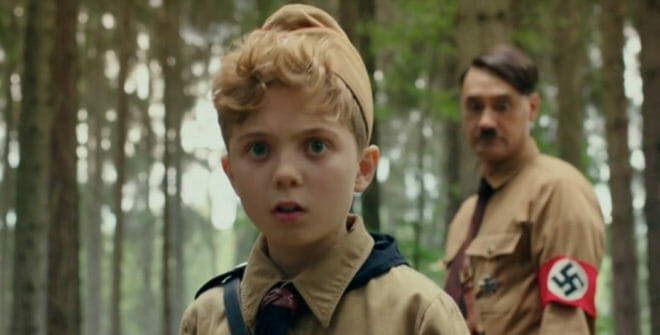
A young Hitler youth (played by Roman Griffin Davis) seeks guidance from an imaginary Adolf Hitler (played by director Taika Waititi) in Jojo Rabbit.

“You’re not a Nazi, Jojo. You’re a ten-year-old kid who likes dressing up in a funny uniform and wants to be part of a club.”

You’ll think that now is not a good time for a film like Jojo Rabbit. A film about a Hitler youth who has Adolf Hitler as an imaginary friend? I mean you have the rise of neo-Nazi groups and alt-right factions creeping up as well as the ‘woke’ people on the internet getting offended and hostile over things. Is this the right film to have out now?

The film begins in Berlin in the latter years of World War II. A ten year-old boy named Johannes ‘Jojo’ Betzler is all dress for the weekend at Hitler Youth, or Hitlerjugend, camp. He’s not confident he can do this; he’s socially awkward and can’t even tie his shoelaces right. However he does receive encouragement from his imaginary friend: Adolf Hitler. Hitler hypes him up with so much excitement, Jojo goes running down the street shouting “Heil Hitler” like a maniac! That is until he meets up with his best friend Yorki just before arriving for what he expects to be the ‘best weekend ever.’

The camp is being taught by former army officer Captain Klenzendorf and assisted with Fraulein Rahm who’s dedicated to the Third Reich and even gave birth to fifteen children! The boys are taught all sorts of attack games and they end the first night with a book burning rally. The next day during a training session, some older boys give a lecture to the younger boys about being brutal and having no mercy when killing. They hand-pick Jojo to kill a rabbit with his bare hands. Despite all the boys except Yorki urging Jojo to kill it, he doesn’t have what it takes. The older boy then snaps the rabbit’s neck and calls Jojo ‘Jojo Rabbit’ which all the other boys except Yorki do. Hitler spots Jojo alone crying. Hitler then reminds Jojo of the cunning feisty traits of the rabbit and encourages him to ‘be the rabbit.’ This pumps Jojo up so much, he’s““` all in to try the next exercise, which is throwing a Stielhandgranate. Jojo yanks it out of Klenzendorf’s hand and throws it without fear. Thing is the grenade bounces off a tree and lands by Jojo’s feet which Hitler runs off from. The grenade explodes with Jojo alone!

After months of hospitalization, Jojo has mostly recovered but his left face has visible facial scars and walks with a limp on his left leg. His mother Rosie is happy to take him home for some time. However Rosie does bring him to the office where she kicks Klenzendorf for allowing Jojo to be exposed to something so dangerous. Klenzendorf has been demoted to the office and is given the task by Rosie to make Jojo feel included. Klenzendorf agrees to let Jojo spread propaganda leaflets and collect scrap metal for the war effort, which Jojo does wearing a cardboard robot outfit and carry a wagon!

Jojo comes home one day expecting his mother. Instead he hears a rattle in the house. He senses it’s coming from the room of his older sister Inge, who died of an illness years ago. Jojo later finds out a teenage girl is hiding between the walls. The girl is a Jewish girl his mother is hiding and is a former classmate of Inge’s. Jojo threatens to expose her to the Gestapo but the girl named Elsa reminds him if he does, his mother will be executed. Hitler is shocked when he hears a Jew is hiding in the house. Hitler asks Jojo to work something out. Jojo works out he will keep Elsa a secret as long as she helps him with a book he’s writing: a book about Jews. Elsa agrees to do the writing and drawing. Elsa makes up things like Jews having horns and mind-reading. That especially shocks Hitler to learn about this girl and her powers. The book impresses Klenzendorf as he meets Jojo at the army pool as Jojo undergoes physical rehab.

This puts a strain on the relationship between Jojo and his mother, which Hitler slyly observes at the dinner table. Jojo accuses Rosie of being unpatriotic and his angry that his father has been away for a long time. Rosie tries to reassure Jojo of having a positive attitude, even as she knows the truth of what happened to her husband. There’s even one day Rosie gets Jojo out of his Nazi uniform and into real clothes for a nice day out and a fun bike ride home, much to Hitler’s chagrin! As time passes, Jojo continues to ask Elsa questions and even tries to deliver fake letters in the name of Elsa’s boyfriend Nathan. Elsa helps Jojo with his book and Jojo realizes he’s in love with Elsa. This gets on Hitler’s nerves as he’s insisting to Jojo that she’s evil.

One day the Gestapo search Jojo’s house along with Klenzendorf. They come across Elsa and she poses as Inge. She even answers the question about Inge’s birthday properly. The Gestapo decide to leave them alone. However it doesn’t stop Elsa from fearing she will die soon. That day out while collecting metal, Jojo is mesmerized when he sees a butterfly, but soon sees his mother hanged. He tries to take his heartbreak out on Elsa with a knife, but fails. Elsa nevertheless hugs Jojo as he’s crying. As the two watch the city get bombed, they both learn that they’re both orphans who lost all their family.

As the city lays in ruins, war action have to be carried out. Jojo is shocked to see Yorki as a soldier and given military actions. All the Hitler Youth have to become soldiers now! He’s even shocked to learn from Yorki that Hitler committed suicide and Germany’s being attacked by almost every front. The boys are given military actions by Fraulein Rahm including Yorki as a sniper and Jojo given a soldier’s coat to disguise himself. Jojo is shocked at everything he sees from dead civilians to children firing guns off to an explosion that kills Rahm. At first Jojo is imprisoned by Soviet soldiers. However he bumps into Klenzendorf. As he knows he will be executed by the Soviets, Klenzendorf tells Jojo he has an admiration for his late mother’s courage. He also tries to get Jojo out of any Soviet mistreatment and has him passed off as a Jew.

As the war ends, Jojo is relieved that Yorki survived the warfare. He just won’t die! However with the war over, it might mean saying goodbye to Elsa, which Jojo doesn’t want to do. Jojo gets that message as Elsa has the book completed with an image of Jojo next to a rabbit in a cage. Before he could, Hitler returns with a bullet-wound in his head. He’s lost it all, but Jojo has had it with him. Hitler tries to get one last piece of appreciation from him, but fails in grand style. The film ends on a positive uplifting note that’s fun to watch.

Now a lot of people have the attitude that Hitler and Nazism and the harms they caused should not be parodized. Especially in a time when even the slightest off-color comment from a well-known person can unleash a wave of wrath on social media like Twitter and could pave their way to their downfall. We should not forget that there have been parodies of Adolf Hitler in the past. There was animation like Looney Tunes’ The Ducktator, Walt Disney’s Stop That Tank and even Der Fuehrer’s Face where Donald Duck poses as Hitler. There has been live action film, especially from some Mel Brooks’ movies like The Producers and To Be Or Not To Be, and even recent examples like in Tarantino’s Inglourious Basterds. The most famous film parody of Hitler is 1940’s The Great Dictator. Charlie Chaplin didn’t exactly play Hitler but its obvious who he’s parodizing in his character of Adenoid Hynkel. Actually it was around World War II where Hollywood unleashed possibly released the most parodies of Hitler. And rightly so because Hitler wanted to take over the world, including the USA.

We should also keep in mind that this parody is not an original creation of Taika Waititi. Jojo is actually based off of a book by New Zealand-Belgian author Christina Leunens titled Caging Spies. The novel caught the attention of Waititi and he took a liking to it, especially since he himself is half-Jewish and half-Maori. Waititi has frequently described New Zealand as a racist country and a lot of negative comments about Jews you hear in this film are comments Waititi himself heard. So if anyone is alarmed with the Anti-Semitism they hear, basically it’s what has been said in the past and what was common belief in the past. Both the film and the novel also touch on a lot of things and experiments the Nazis used to do in the past. They may not have successfully cloned humans, but they did experiment with it. Fraulein Rahm may have shocked us in saying she had fifteen children, but there were women who bred constantly for creating more Aryan children. That scene where Yorki becomes a soldier and the scenes where the children have to fight as Germany was losing is also a disturbing truth. The Hitlerjugend was created to raise the boys to become soldiers as they reach adulthood but when it became clear Germany was losing, the Hitlerjugend became soldiers in vain to keep the Nazi regime alive. Those scenes were possibly the biggest non-comedic scenes of the film.

This film concept of a Hitler Youth having Adolf Hitler as an imaginary friend is a concept that’s supposed to fail, but somehow it works like a charm. One thing we should keep in mind is that the Adolf Hitler we see on the screen is not the Adolf Hitler we know but the Adolf Hitler in Jojo’s mind. This Adolf who’s idiotic, incompetent, immature and even jealous represents the boy’s feelings of nationalism and there are many times he’s pushed to confront his feelings or even question them. In the end it’s clear Adolf is nothing but a bad influence on him. The film does not shy away from the anti-Semitic attitudes most of the Hitler Youth had, albeit making it look comedic.

The story is also a case where that grenade accident is the best thing to happen to Jojo. Being too injured to be involved with the Hitler Youth, it’s his mother Rosie that reminds him of the truth about love and beauty and what being a child should be. It’s also Elsa who is best at teaching Jojo about love and how it helps to overcome prejudices. Not to mention that Jews are people too with similar feelings like Jojo. It’s also where we learn the true heroes are Jews like Elsa who survived and Rosie who was hanged for being part of the resistance. Even that scene where Klenzendorf is captured by the Russians and about to face execution is powerful. There he admits to Jojo that being left out of the Nazi Youth was the best thing for him and his mother is the true brave one, and Jojo should have no part in any of the imprisonment or executions the Nazis like him are about to face.

SPOILER WARNING: This paragraph has details of the end. The ending is a unique situation. Elsa experiences the freedom she never thought she’d get in her lifetime. Even though she learns Jojo lied about who won. That dance scene is important as you have two children. One is Jewish and the other was a Nazi boy who first saw her as someone to bully but fell in love with her. Elsa lucked out from being captive from the Nazis. Jojo lucked out as he isn’t seen as a Nazi and he’s spared by Russian and American soldiers. Elsa lost her family and the boy she loves. Jojo lost his family. They have nothing but each other but they dance together. That’s a powerful scene, especially as Rosie talks of how dancing means freedom. The dance represents those two free orphans who lost a lot but both won in the end.

I have to give top acclaim to director/writer Taika Waititi. He takes an oddball story about a Hitler-obsessed Nazi child and turns it into a story with both humor and heart. He doesn’t shy away from humor that punches. It doesn’t punch as brutal as some of the humor from South Park or The Family Guy, but it does punch and somehow can even make those that claim they’re ‘woke’ laugh. Even the Anti-Semitic comments. I would describe this as ‘evil genius,’ but it’s the ‘evil genius’ of the best kind! Also deserving of acclaim is Roman Griffin Davis playing the little protagonist. This is his first-ever film role but he holds the film together from start to finish and masters it with near-perfect comedic charm. I expect to see more of him in the future. Back to Waititi, he was also excellent in playing the idiotic Hitler. Playing Hitler as an idiot is a big gamble in any film. I’ve seen portrayals of idiot-Hitlers before and most fail. Waititi’s Hitler works like a charm in this film.

Also worthy of acclaim is Scarlett Johannson. She does an excellent job of portraying a mother who’s hurting of loss of her husband and daughter, knows that her days are numbers as being a member of the resistance, and trying to get her son to adopt human values and lose his Nazi ways. Thomasin McKenzie is also excellent as Elsa, the girl who is determined to make Jojo see the light, but knows she’s up for a big challenge. Archie Yates is also a delight as Yorki, Jojo’s best friend, who adds in the right comedic touches. Additional humorous performances include Sam Rockwell as the depressed Captain Klenzendorf and Rebel Wilson as the ruthless, but colorful, Fraulein Lahm.

Jojo Rabbit also has a lot of standout technical efforts too. There’s the editing from Tom Eagles, the costuming from Mayes Rubio, the set designs from Ra Vincent and Nora Sopkova and the music from Michael Giacchino. Actually the mix of Giacchino’s score and classic rock songs, including some with a German-language version from the original artist, fit the film perfectly.

At the end, you will be convinced that Jojo Rabbit is the ideal comedy to be having in a hostile time right now. I will guarantee that even the ‘superwoke’ on Twitter who are set out to vilify any famous person who makes even the slightest off-color comment will be laughing too.

Oscars 2019 Best Picture Review: The Irishman

Irishman
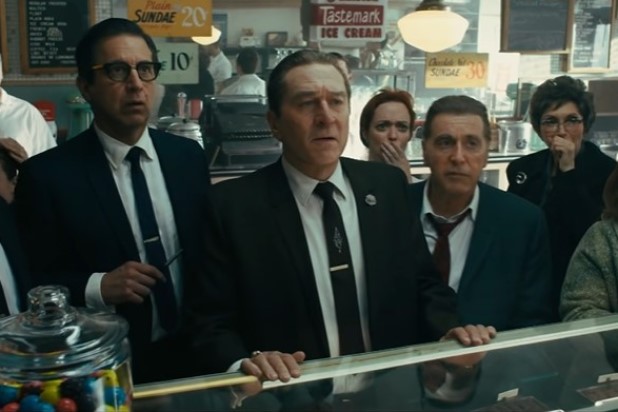
Robert de Niro (second from left)  plays Frank Sheeran and Al Pacino (second from right) plays Jimmy Hoffa in Martin Scorsese’s The Irishman. A story about loyalty and betrayal.

Just when you think Martin Scorsese has done everything he could in film, along comes The Irishman. This film may not be his best, but it adds to his stack of films one can call great works.

Martin Scorsese is undoubtedly the master of gangster films or Mafia films. We have sensed there would be successors in the likes of Quentin Tarantino, but that has not yet come to be. Tarantino has his own gangster style, but Scorsese films are the Mona Lisa’s of gangster movies, if you can truly call a gangster movie a Mona Lisa! Scorsese has shown his versatility in film making since the beginning of this century. His films since the new century began have taken a wide range of genres from epic to fantasy to a family film to business-scam drama to dark comedies to religious biopics. However when watching The Irishman, his first gangster movie since The Departed, it only seems natural that gangster movies were what Scorsese was born to do. Although films in the other genres he tackled are very good, it just seems natural that way. Even the excitement of having Scorsese ‘all-stars’ like Robert De Niro, Joe Pesci, Al Pacino and Harvey Keitel adds to the excitement. Additions like Ray Romano, Bobby Cannavale and Anna Paquin also add to the excitement.

Now the film has a lot of common elements you’ll expect from a Scorsese gangster movie. It tells of a man and his involvement with the mafia and of his daily duties. It also goes back to his past in how he developed the right type of insensitivity to become as consistent hitman. It also tells of some of his more legendary kills. The film also adds something different. It adds in the story of the ‘vacation of a lifetime.’ It’s not something you’d expect to be in a Scorsese film, but it’s done in a fashion you’d expect to see from Scorsese.

However it’s the aftermath that one would not expect to see in a Scorsese film. It’s like it almost shifts to a completely different film for the last half-hour. That’s what hit me about the film. It not only tells the story of a man who committed a lot of murders and also allegedly committed the murder of the man behind the most intriguing missing person case in the past half-century. It tells of the aftermath of how he would come to regret his actions over the years. Even of how he appeared to have it all and win it with fear during his lifetime, but would be doomed to die alone. You can pinpoint exactly where in the scene where Peggy ask Frank about Jo and Frank calls a distraught Jo up trying to comfort her, but knowing he’s the one who killed her husband. That’s a change of pace from Goodfellas about a mobster who lived the mob life, was imprisoned for it and regrets nothing. Even before the scene of the killing of Hoffa, there are freeze-frame montages that mention of the aftermaths of others involved in the Philly mob Frank Sheeran and Russell Bufalino were a part of, including those shot dead or imprisoned for life.  I think the whole theme of the movie wasn’t just mob life, but how everyone involved pays in the end.

Now one thing we should remember is that we should not completely embrace this story as a true story, even though it’s very accurate. The film is based off the book I Heard You Paint Houses by Charles Brandt. Brandt is a former homicide prosecutor, investigator and defense attorney and he’s the man who interviewed Frank Sheeran shortly before his death. During the interview, Sheeran told of his life as a hitman and of his own involvement with Jimmy Hoffa. Sheeran confessed it all to Brandt months earlier and saw a priest the last few months of his lives so he could die with a clear conscience in December of 2003. The case of Jimmy Hoffa is still unsolved and his body has never been found. The FBI have had a lot of stories and sources, but it’s Sheeran’s story that’s the one they’re most going with. However there are still some naysayers that are claiming that Sheeran lied in the interview. Whatever the situation, this missing case is still unclosed. I won’t completely call Sheeran’s story the whole truth, but I believe he makes a strong case and it’s hard for me to sense him lying.

Once again, Martin Scorsese proves himself to the be master of gangster movies. Quentin Tarantino may take ruthless killers to a new level, but Martin is still the master. This film that he directs with a script written by Steve Zaillian is a complex film to pack into 3 hours and 20 minutes. Usually if a film is that long, I would expect the director to justify it. Martin has delivered a lot of three-hour films in the past, but I’m convinced he has justified the time here. If you yourself are one of the people that has been fascinated by Jimmy Hoffa and his missing story, this will be a film that will intrigue you.

It’s not just the story that will intrigue you, but how the Scorsese/Zaillian creates it and arranges it from beginning to end. It starts as the audience visits a nursing home, tours around seeing family after family and comes across a lonely man: Frank Sheeran. Then it jumps into 1975 and the story of how Frank, his wife, his mob boss Russell Bufalino and Russ’ wife Carrie were going on a ‘trip of a lifetime’ from Philadelphia to Detroit. Then it paves on how it led to all this from Frank’s days of truck driving to introduction to the mob to being a hitman for hire to a close friend of Jimmy Hoffa. The story shows of Hoffa’s rise, downfall and attempted comeback. It also shows Frank’s struggle of who should he be loyal to: Hoffa or the mob? It slows the moment of the ‘big day’ down and it delivers the aftermath with feeling that cuts deep. Also it treats the film as if Sheeran is giving us an interview. Almost like we’re Charles Brandt! I have to say the format of the film works and will keep one intrigued whether they’re a fan of Scorsese films, fan of mob films, or just have an interest in Jimmy Hoffa. It’s interesting how the film begins with “In The Still Of The Night” and it’s nice to hear and is replayed at the end, but it sounds haunting at the end. The film and its layout of the story makes it work.

Big credit to Robert de Niro for playing the role of Frank Sheeran. To do Frank, he has to cut deep into the man and how he went from a fearless killer who was able to adopt the coldness of killing to being the man with regrets in the end and wants to die with a clear conscience. Robert does an excellent job of it. Also excellent is Joe Pesci playing the mob boss who wants to call the shots of Sheeran and Hoffa. Pesci really knew how to steal the scenes in the film. Al Pacino was also great as Hoffa. He did an excellent job in delivering a multi-dimensional and complex performance of a man in history who was just as complicated as he was a legend. There were a lot of good supporting performances from Ray Romano, Bobby Cannavale and Harvey Keitel. However one of the biggest standout performances came from one with little dialogue: that of Anna Paquin. Her role of Peggy Sheeran required her to say with her physical actions and facial expressions and she did an excellent job. Even one of the few spoken lines she had in the film “Why haven’t you called Jo?” would pave the way to where the film changed from a story of mob work to the story of regret.

The film should also be admired for its technical merits too. There’s the visual effects team that did the top-notch CGI effects to take the ages of de Niro, Pesci and Pacino back 30 years without them needing heavy make-up. It’s not just the actors acting younger than their ages but the CGI too! There’s also the costuming of Sandy Powell and the set designs by Bob Shaw and Regina Graves to take the film back to the 1950’s, 1960’s and 1970’s. There’s also the inclusion of music into the film that takes the film back to its set times. The score from Robbie Robertson also ads to the film.

The Irishman may be a true story, or it may be one big lie. However you put it, it’s a very telling story that paints a vivid but dark picture of what might have happened in one of the most intriguing missing cases ever. It’s also another film Scorsese directs and puts together in excellent fashion. It’s easy to see why it’s another contender for this year’s Oscars.

VIFF 2019 Review: In The Tall Grass

In-The-Tall-Grass
In The Tall Grass is a thriller of people lost in a field of tall grass and come across something of the paranormal that’s terrifying to their existence.

With the VIFF comes the return of films in the Altered States category: of thrillers, horror and even the paranormal. My first chance came with the film In The Tall Grass. It was worth it.

The film starts with a pregnant Becky DeMuth and her brother Cal traveling to San Diego to find a way to give up her baby. They pass an old bowling alley and stop by a church. Just as they stop by, they hear the voice of a young boy crying for help. The voice is coming from a field of tall grass they’ve parked beside. They also hear the mother of the boy begging anyone to not come in. Becky and Cal are naturally curious and walk in top help the boy. It’s only a matter of time they find themselves lost and even risk getting stuck by the wet sticky mud. Even as they’re distant, they hear each other’s voices which is not really theirs, but mystically transmitted. They decide to leave, but they can’t and are stuck for the night.

During the night, Cal encounters Tobin, the lost boy, who is scared, bruised and holding a dead crow. Becky meets up with a man named Ross, who is very friendly and offers to lead her. Tobin reveals to cal that the field the grass does not move dead things and Becky will not make it out of the field alive. Tobin leads Cal to the centre of the field which consists of cut grass bordering a big mystical rock with hieroglyphics which Tobin tells Cal to touch. Before he does, Becky arrives, but is taken away by an unseen figure.

Travis, the father of Becky’s child, arrives in the same area of Becky and Cal. He notices the car parked by the church. He also notices the field of tall grass. He hears Tobin’s voice and is led into the field. Tobin leads Travis to Becky’s corpse. Travis breaks down, but loses sight of Tobin. At the same time, we see Tobin with his father Ross and mother Natalie at the church along with their dog Freddie. Possibly a reference of what happened earlier. Freddie runs into the field of tall grass and the three chase after him. It’s there where Travis hears Tobin’s voice and the three of the family are scattered around the field. Ross comes to the centre with the rock and touches it as night falls. Tobin is discovered by Becky and cal all all are confused by the timelines.

As the three are one group, Becky and Cal decide to leave and use Tobin to navigate a path back to the road on top of Cal’s shoulders. Becky receives an unknown phone call saying that Cal should quit hunting Travis.The grass soon appears to be entering Becky’s uterus and she becomes unconscious. Cal and Tobin come across Ross, who reunites with Tobin. Ross brings them to the rock but are startled when they see Natalie and she says she saw Becky’s corpse earlier. As they try to make their escape, Ross is chasing them all down and gives them the impression there’s no escape and they’re all under Ross’ control. Ross tells them all the rock shows them of what’s happening.

Becky, Cal, Travis and Tobin succeed in escaping the field into the abandoned bowling alley. As Cal and Travis make their way to the top, they discover the dog Freddie escaped via a hole. However a spat between Travis and Cal brew as Travis brings up he senses incestuous feelings between Cal and Becky. Cal throws Travis off the roof. That succeeds in alerting Ross to their location. Tobin, knowing how this alerted Ross to their whereabouts, runs back into the field. Becky and Cal try to escape together, but Becky won’t leave Travis alone in the field. After she runs off to find Travis, Cal is strangled by Ross. It’s evident anyone in the grass field is affected by a time loop. If anyone dies, there will be another of them alive. If anyone touches the rock, they get a sense of control and invincibility.

During the return to the grass, Becky admits she was going to give the baby up for adoption. Becky is soon captured by Ross who tries to sexually assault her, but she escapes. Grass creatures however emerge and grab a hold of her and carry her to the rock. There, the rock develops imagery that detail the baby will die and Becky will be tortured. Becky passes out in reaction. As she awakens, she is tricked by Ross who poses his voice as Cal. Travis meanwhile stumbles across Becky’s unconscious body. Ross then kills Travis and captures Tobin to get him to touch the rock. Becky stops him, but dies. Travis decides to touch the rock to get a better understanding of the grass.

The film ends with one last scene involving Becky, Cal, Tobin and Travis. It gives the impression that all know what is happening and the film ends with what should be.

This film is a film that is based off of a short story written by Stephen King and his son Joe Hill. We’ve had Stephen King adaptations before and often adapting a Stephen King story to the big screen is hit-or-miss. This is a very complex story. This involves six people who go into a field of grass with paranormal powers. It threatens their lives and creates another life for them. Then there’s the rock that gives whoever it touches a sense of invincibility and control and threatens others.

Overall this film is a maze and a puzzle. Trying to piece this puzzle together is a tricky thing. Trying to create this maze of confusion is also a tricky thing. Watching it, it’s easy to get thrilled by the paranormal and nervous for what will happen next. However in looking back, I felt there were some areas that didn’t make too much sense. Even when it becomes clear that Ross starts as the controlling one and then it becomes Travis, that seemed odd. Even how Ross was the controlling conniving one, that even seemed cheesy at times.

The film does however keep one intrigued in the paranormal elements. Depite its flaws in the script and storyline, it does succeed in grabbing a hold of your attention and keeping you intrigued in the story. The paranormal elements don’t come across as cheeseball as it adds to the thriller aspect of the film. Overall despite its flaws as a film, I feel this is a good story for fans of paranormal fiction. I just feel it could have been done better as a movie.

This story is a mixed bag for Vincenzo Natali. Yes, it’s confusing, but the paranormal will keep one intrigued from start to finish and it will keep one hoping for the best for the main characters. Laysla de Oliveira was very good as Becky. Isn’t it something how the first two VIFF films I saw starred Laysla? She captured the role well in both it’s comedic elements and it’s dramatic elements.

Avery Whitted was also good as Cal. Will Buie Jr. also did an excellent job as Tobin: the frightened boy in the middle of it all. His role was the best at keeping the horror/thriller aspect of the film and was the most no-nonsense performance of all. Patrick Wilson was hard to make sense of as Ross. He came across as a conniver, but I feel he lacked the sinister element. Harrison Gilbertson was good as Travis, but he appeared he could have done more.

In The Tall Grass is a Netflix thriller that works well to be shown on the big screen, if imperfectly. It may not make the most sense, but it does keep people thrilled and intrigued about what will happen next and how it will end.

Oscars 2017 Best Picture Review: Get Out

Get Out
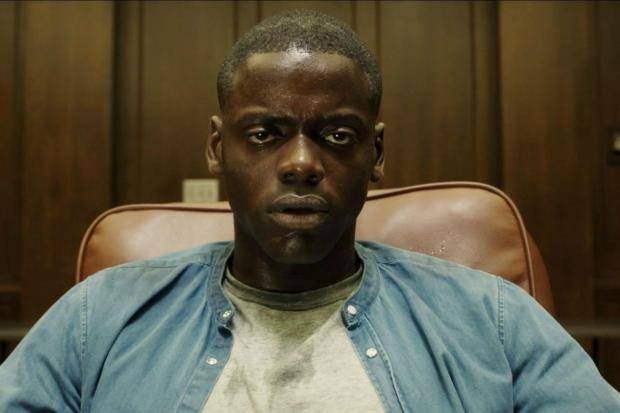
Get Out is a horror-thriller that’s definitely out of the ordinary.

I admit I was very late on the draw for watching Get Out. Could’ve been the schoolwork I had to deal with or I just didn’t rush out like I should’ve. I finally had the chance to see it a month ago and I can easily see why it’s one of the best films of 2017.

The story begins with a young black man abducted on the street. Soon after, black photographer Chris Washington is packing with white girlfriend Rose Armitage for a meet-the-parents visit. Rose insists to Chris that his race won’t matter, even though he is her first black boyfriend. Chris says goodbye to his friend Rod, a black TSA agent, and insists to him things will be fine. On the ride there with Rose driving, they hit a deer. The police visit the two and the white officer wants to look at Chris’ identification, even though he wasn’t driving. It took Rose’s intervention to stop this.

The two arrive at the home where they meet Rose’s brain-surgeon father Dean, hypnotist mother Missy and student brother Jeremy. All three make discomfiting comments about black people. Additional uneasiness to Chris comes when he notices housekeeper Georgina and groundskeeper Walter, both black, show strange behavior. Things get even weirder when Chris steps outside to smoke and notices Walter sprinting through the grounds and Georgina prowling through the house.

To try and take his mind off things, Missy gives Chris a hypnotherapy session to cure his smoking. During the session, he’s taken back to his childhood and the memory of his mother’s hit-and-run death: a death he feels guilty of. After that comes the void Missy calls ‘the sunken place.’

Chris wakes up the next morning wanting to think it was all a nightmare. Instead he’s surprised to learn that cigarettes turn him off and Walter even confirms Chris was in Missy’s office. Chris also notices Georgina unplugged his phone leaving the battery to die, but she claims it was an accident.

The next day, Chris is at a get-together hosted by the Armitage with dozens of wealthy couples; most of them white. However the topic is almost always the same from person to person. They all ask about his race and even bring up talk of prominent black figures. The only person who doesn’t bring up race is Jim Hudson, a blind art dealer, who takes an interest in Chris’s photography.

Chris meets one other black person at the party. His name’s Logan; he’s married to a white woman and he acts rather strangely. Chris telephones his friend Rod and lets him know of all the suspicious activity at the Armitage house. Chris snapped a flash photo of Logan from his phone, but Logan’s personality changes to a hostile manner, shouting for him to ‘get out.’

Despite Dean claiming it’s an epileptic seizure, Chris isn’t fooled. He knows there’s something wrong happening and persuades Rose to leave with him. Meanwhile Rod notices the Logan in the photo is Andre Hayworth: the man who went missing earlier. Rod tried to get his police department to go to the Armitage household, get Chris, and arrest whoever’s involved. His colleagues all think it’s a joke. Rod is on his own.

As Chris is about to leave, Chris comes across photos of Rose with other black boyfriends. As he tries to leave, Chris is blocked by the family from leaving and even Rose is part of the heist to abduct him. Jeremy acts violent but as Chris tries to fight back, Missy imposes hypnosis to make him weaker. While wrapped in bondage in a chair, Chris watches a video from Rose’s grandfather Roman where they take the brains of white people and puts them into black people. The host remains in the ‘sunken place’: watching but powerless. Hudson tells Chris through the screen he wants his body for his sight and his artistic talents. Meanwhile Rod telephones Rose to find out what’s happening, but Rose declines, making like Rod is a past boyfriend.

The night before surgery, Chris puts the cotton stuffing from the chair in his ears to block the hypnosis. The day of a surgery is when Chris has to make his getaway. The movie ends with a lot of surprises– including some surprising facts about the surgery — but it ends with the pleasing ending many would have hoped for.

This is a rarity. A horror film where racism is one of the main themes of the film. The story starts out as something simple: boyfriend meets girlfriends’ parents. The fact that he’s black shouldn’t make that much of a deal. I mean Guess Who’s Coming To Dinner was 50 years ago and lots has changed, right? You get the first impression race will be a topic when they hit a deer and Chris is asked for his identification. It becomes further evident when Chris is with Rose’s family and the father brings up Jesse Owens. I was actually surprised to see how often race was brought up in conversations between Chris. It was always a topic in Chris’ conversations with people, if not the first. And then a case of mental enslavement: white brains in black bodies. I notice the familiarity here.

I’m sure race has a lot to do with the police scenarios, but even then, there was one area that didn’t seem about race. That’s when Rod describes the situation to the police and all three laugh. The three Rod talked to were of various races, even one black woman. I felt that was trying to send me a message that even African Americans in the police force look at their own in a negative light. The end definitely had something to say. A cop car arrives with Rose shot and dying on the ground and Chris thinks he’s about to get arrested, only for Rod to be the cop. Glad to see it gave a happy ending. I think it was also trying to say something; about the importance of having friends who know the truth.

Even without the subject of race, this stands out as a psychological thriller in its own right. One of the difficulties of horror or thriller movies is including supernatural or paranormal things without looking ridiculous. The theme of hypnosis and mind control really makes itself present in a smart way. The inclusion of such themes even the addition of the brain surgery right in the family’s house didn’t look cheesy at all, fitting well within the story. Showing how Chris broke the mind-control aspect when he took a photo of Andre/Logan is shown intelligently and added to the story without looking ridiculous. The scene near the end where Walter shoots himself after shooting Rose didn’t appear dumb as it showed this mind-control was something only death can free them of.  Even the goriness of the deaths didn’t look dumb. In summary, all the thriller or horror aspects had to make sense in order for them to work, and they did.

This film had to be 2017’s ‘sleeper success.’ The film made its debut at the 2017 Sundance Film Festival. Lately Sundance movies haven’t been as big of a draw to the box office as they were ten or even twenty years ago. This film really caught people’s attention and grossed $176 million at the box office. It was no wonder it would be one of the stand-out films of 2017. It reminds you that 2017 wasn’t such a bad year in movies after all, and Get Out was one of the highlights. Get Out also contributed highly to the resurgence of the horror/thriller genre. Sure, the biggest news came from It, but Get Out is admired for its ability to create an original story and even add African-American elements to the horror genre, which is extremely rare.

The person who deserves the most acclaim here is writer/director Jordan Peele. He is one driven person. Past work of his includes acting and writing for MadTV as well as stand-up comedy. This is his first feature-length film as a writer and director and it really stands out because of its excellent story line. Also excellent is the lead acting from Daniel Kaluuya. He succeeded in making a performance in a horror movie three-dimension: something very rare. There were also good standout supporting performances from Lil Red Howery as Rod. Makes sense as Rod was the comic relief. Also a good scene-stealer was Betty Gabriel. Her portrayal as Marianne/Georgina best personified what it was like to be under this mind-control lobotomy. Smiling on the outside, but mentally-enslaved on the inside. Alison Williams also made a good villain, switching from the loving girlfriend to helping the family get their next ‘slave.’

Get Out did two things that most people would believe is impossible to do nowadays. The first is create a horror film that is as intense as it is smart. The second is for an African-American to create such a horror film. The film achieves all that, and more.

Oscars 2017 Best Picture Review: Darkest Hour

Darkest Hour
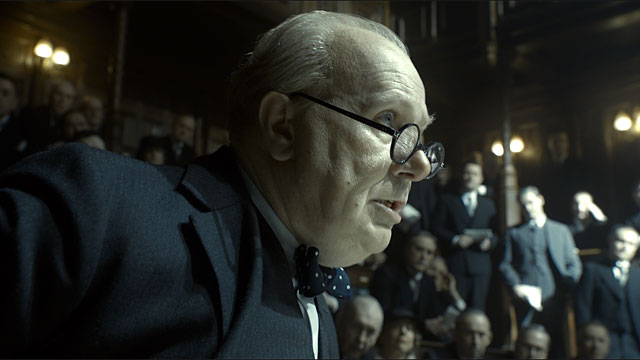
Darkest Hour is the story of Winston Churchill (played by Gary Oldman) and his struggle to convince the people of the UK that fighting Hitler is the right thing to do.

Usually around the latter part of the year, historical dramas are common for release. Darkest Hour is one, focusing on Winston Churchill and World War II. The question is does it fare well as a film? And does it have relevance to the present?

The film is set in May 1940. World War II had just begun eight months ago with the fall of Poland. France is next. The film hits hard in the UK as they fear war is looming. It hits so hard, Prime Minister Neville Chamberlain is pressured by the opposing Labour Party to resign for not doing enough. Neville needs to find a successor, but his first choice, Lord Halifax, declines. He goes for his second choice: Winston Churchill.

Now Winston Churchill was seen as a bad choice as the successor to Chamberlain. He has a bad record with his roles in the Admiralty, the Gallipolli Campaign During The First World War, his views on India, and his support for Edward VIII during the Abdication Crisis. Even his own personal manner is of question as he is oafish and has a reputation for infidelity and a quick temper. He’s even temperamental to his new secretary when she mishears him, but his wife Clementine gets him to come to his senses.

King George VI encourages Churchill to form a coalition government along with Halifax and Chamberlain. Churchill’s first response to Hitler’s invasion of France is fast and immediate: no surrender to Hitler and fight if we have to. He made it clear on May 13 1940 in his ‘blood, toil, tears, and sweat’ speech.

The speech is not well-received by the Parliament. They think he’s delusional. The Nazi army is too powerful. It even gets flack from King George VI. The French Prime Minister thinks he’s delusional for not admitting the Allies lost in the Battle Of France. People in his party offer Churchill to accept Hitler’s offer to negotiate for a peaceful end to the War, but Churchill declines. He does not trust Hitler.

The situation gets frustrating to the point both Halifax and Chamberlain are looking to use the Italian Ambassador as a route to negotiate peace with Hitler. Both plan to resign from the Government if Churchill doesn’t comply, hoping to cause a ‘vote of non-confidence’ to allow Halifax to become Prime Minister. Meanwhile Churchill is trying to seek support from the US with President Franklin Roosevelt, but he declines as the US signed an international agreement preventing military action in Europe years ago.

However war is pressing. The UK find themselves in battles in Dunkirk and Calais. Churchill, against the wishes of the War Brigade, orders a 30th Infantry Brigade in Calais to organize a suicide attack to distract the Nazis allowing the soldiers in Dunkirk to evacuate.

The defeat at Calais causes the War Cabinet to want to negotiate with Germany. However as Churchill is about to make his way to Parliament, he receives support from his wife, support from King George VI fearing exile if Germany wins, and support from a group of citizens in the London Underground he takes to parliament. Even members of the Outer Cabinet and other members of Parliament give him their support. News comes that the evacuation in Dunkirk ‘Operation Dynamo’ is successful. At parliament in front of cabinet members and members of the War Cabinet, Churchill delivers his speech of ‘we shall fight on the beaches’ to the support and applause of all, even Halifax and Chamberlain.

Lately there have been a lot of biographical films that don’t thoroughly focus on the person’s life, but instead focuses on the one moment that defined them as a person. We saw in Lincoln how getting the Emancipation Proclamation made constitutional and the political fight to get it done is what defined Abraham Lincoln the most. We saw in Capote that it was the making of In Cold Blood that would become Truman Capote’s biggest legacy of a writer, and would eventually lead to his downfall. Here we see the period of one month how Churchill couldn’t just simply say that Hitler needed to be fought, but had to convince the people and especially the parliament that fighting him is the right thing.

Such a situation in our world history is not uncommon. If you remember Lincoln, you will remember that Abraham Lincoln had to do political campaigning in order to get the Emancipation Proclamation made constitutional. The Proclamation itself was up for vote in the House. Just a reminder that even the most righteous political laws still have to go through the same political processes. Even for powerful speeches, it’s about saying it at the right time and the results to follow. We may remember how back in 1987, Ronald Reagan stood at the Berlin Wall and said, “Mr. Gorbachev, tear down this wall!” This is something JFK could have told Nikita Khruschev to do, or Nixon telling Brezhnev to do, or even Reagan himself telling Brezhnev or Andropov to do, but it would not result. The Soviet leaders were just that stubborn and dead-set on their rigid ways and dismiss what the POTUSes said at hot air. But Reagan said that just during a time when it appeared the Cold War appeared to be thawing and Gorbachev was the first Soviet leader to appear cooperative with the US, but not without its friction. That sentence is memorable because the Wall did come down in a matter of two years.

Here in Darkest Hour, we see another example of how words that are true in conviction and the right thing to say still faced political opposition. When Churchill was placed as Prime Minister, he didn’t waste time in speaking his opposition to Hitler and that the UK should not surrender. However those in the office all thought his words were deluded. They knew of the Nazi army and the invasions it’s caused already in less than a year. Hitler and the Nazi army were just that menacing. They also saw the efforts, or lack thereof, from the previous Prime Minister fail. On top of that, France had just fallen to the Nazis. They were simply afraid.

It was easy for people to think of Churchill’s words as deluded. He already had a reputation in the British parliament of being quite the buffoon. In fact the opening scene of the film shows his buffoonish nature. Churchill knew in his heart that the UK had to fight the Nazis, but he had to convince the British parliament. And he had to do it fast. Over time, more tyranny from the Nazis occurred and the UK was feeling the heat. Churchill was denied support from US president Franklin Roosevelt because of an agreement signed the year before. That negotiation for peace from the Germans would seem like something one would cave into and it was easy to see why the British politicians thought it right, even though we all know it to be wrong.

The last fifteen minutes of the film just as Churchill is about to deliver the ‘fight on the beaches’ is a very powerful scene as it shows how Churchill is able to win support in his stance from his wife, the King of England and even people on the subway as he makes his way to parliament. I don’t know if that really happened to Churchill in real life, but that subway scene is a powerful scene. Sometimes I think that scene is telling me that all too often, the common person has a better sense of what’s right than the people in power.

For the most part, the film is as much of a biographical drama as it is an historic drama. The film is very much about the speeches of Churchill and the start of the mission of British forces to fight Nazi Germany. The film not only focuses on Churchill’s quest to fight in the war, but his quest to convince the people in political power to believe him. It focuses on Churchill as a man of great conviction, but also a man of noticeable flaws. That had a lot to do with why people first thought he was a madman or deluded. It reminds you that a head of state can sometimes be reduced to a pawn in their political building. The film does remind people of the common saying that: ‘What’s right isn’t always what’s popular and what’s popular isn’t always what’s right.” Churchill knew in his heart he was right, but he had to fight to make it believed by all. It was necessary as the Battle of Dunkirk would soon happen

It’s interesting how Darkest Hour is release in the same year Dunkirk is. I find it very appropriate because it was actually just right after the Battle Of Dunkirk and the subsequent evacuation that Churchill delivered his speech of “We shall fight on the beaches.” The fight on the beaches of Dunkirk and the evacuation and rescue mission was the first significant sign of what the UK needed to do to win against the Nazis. Churchill was there to pay all respect to those heroes, the survivors and fatalities, who were a part of it.

Director Joe Wright and writer Anthony McCarten deliver a very good historical story. However there are times when it does feel like it’s completely restricted to being about Winston Churchill. I understand what the story is all about, but they could have explored some additional angles to go with it. Without a doubt, the film is owned by Gary Oldman. He does an excellent job of delivering a performance of Winston Churchill. His depiction of Churchill first appears cartoonish at the beginning, but the depth and dimension develops over the film and he really comes out shining.

Although the film is dominated by the portrayal of Winston Churchill, there are supporting performances from Kristin Scott Thomas as Clementine Churchill and Lily James as Elizabeth Layton that are able to steal the moment. Also capturing the moment are Ben Mendelsohn as King George who slowly supports Churchill and Ronald Pickup as Neville Chamberlain who supports Churchill despite his own political downfall. The film also does an excellent job in the technical aspects such as the Production Design to reconstruct parliament, costuming from Jacqueline Durran and the makeup and hairstylists to fit the era, the cinematography from Bruno Delbonnel and the musical score from Dario Marianelli which capture the intensity and triumphs of the moments.

Darkest Hour is more than just an historical drama or biographical drama. It’s an excellent film about standing by your convictions without crossing the line of being preachy.

Oscars 2017 Best Picture Review: Lady Bird

Lady Bird
Lady Bird is about a 17 year-old girl (played by Saoirse Ronan) dealing with her life and her future, and her mother (played by Laurie Metcalf) trying to steer her in the right direction.

Lady Bird is a top contender for this year’s Academy Awards. If you’ve seen it, you can see how this film is not a typical ‘teen movie’ and actually a story with a lot packed in.

Christine McPherson is a frustrated 17 year-old girl living in Sacramento in 2002. She has a stormy relationship with her parents as well as her adoptive brother and his girlfriend. To make things more frustrating, she’s put in Catholic school for Grade 12 because there was a shooting at her public school. She appears unclear about her life direction and frequently insists that all people refer to her as ‘Lady Bird,’ including family.

Starting school, she has a close friendship with Julie Steffans whom she joins the drama club with. Through the club, she meets a sweet talented boy named Danny O’Neill. They soon start dating and they appear to be a match made in heaven until Lady Bird catches Danny in a bathroom stall kissing another boy.

Throughout her time at the school, Lady Bird develops a mean streak of rebelliousness. One minute, she’s consuming Eucharist wafers with Julie. The next, she vandalizes the nuns’ car with a sing saying “Just married to Jesus.” Another moment, she lashes out at a pro-life speaker who visits her school, which leads to a two-week suspension. This leads to a lot of friction with her friend Julie who sees her as one who does things for attention.

During this time, it all leads to a lot of friction with her mother Marion, who has a lot of high expectations for Lady Bird and her life, especially with applying for colleges. Marion often feels that Lady Bird lacks goals or appears like she doesn’t want to do anything meaningful with her life. Marion feels that way because she had to work hard to achieve. This generation gap appears to Lady Bird that her mother is an interference to her life and her own goals. To make family struggles worse, her father loses his job and is struggling with depression.

Lady Bird tries to escape from those headaches. She gets a job at a cafe where she meets Kyle Schieble, a boy from school she knows is part of a rock band. She strays away from Julie and starts hanging out with popular girl Jenna Walton. She sees opportunity after Jenna was reprimanded by the school for wearing short skirts. Thus Lady Bird bring Jenna into the ‘just married to Jesus’ prank. However none of her efforts to mix with the ‘cool kids’ works out. She lied to Jenna about her house so she can fit in, but Jenna finds the truth out. Also she agrees to have sex with Kyle, believing his claim that he’s a virgin, only to find out he’s had other girls before.

As graduation nears, things change for the better for Lady Bird. She gets a letter from a college in New York saying she’s on the waiting list, though she tells her mother she’s been accepted. She’s willing to go shopping for a prom dress with her mother. Her relationship with her brother and his girlfriend gets better as he gets a major job. On prom night, she forsakes a party with Jenna and Kyle to meet up with Julie. There, she rekindles the friendship and they go to the prom together. She even attends Danny’s school performance.

Over at the graduation party, Lady Bird admits to her mother that she was on the waiting list to the university in New York, to which Marion appears either hurt or angry. Lady Bird’s 18th birthday comes soon after. Marion has a letter written for Lady Bird to read when she’s settled in her college dorm. Then it’s the flight to New York. Marion does not talk to Lady Bird, appearing like she’s disappointed with her. Marion even drives away when Lady Bird enters the airport, but cries soon after. It’s in her first month in New York after reading the letter and a near-fatal bout of alcohol poisoning that she leaves a heartfelt message to her mother.

The biggest quality of this film is that it’s a story many people can relate to. Sure, it’s about a 17-year-old tart-tongued girl from Sacramento who’s clueless about which direction to go, but one will find themselves relating to this story. Many can watch what Lady Bird is going through at school, through her job, through falling in love, or through her stormy relationship with her mother and say: “That’s also what I went through,” or “That was my attitude at 17,” or “I knew someone like that.”

One of the things is about the character of Lady Bird is that despite her eccentricities, it also captures the essence of being a seventeen year-old well. Seventeen is that bizarre age where one is just a year away from becoming an adult. It’s a bumpy road as they are in the process of defining one’s self and making choices of what direction in life they want to pursue. We see that in all of the seventeen year-old characters in the film like Julie, the best friend who’s a social misfit, Jenna who thinks she’s too cool, Kyle who thinks he’s all that just like every rock star, and Danny who’s struggling with being gay in a conservative Catholic family.

Lady Bird is at the centre of being seventeen. The character of Lady Bird captures being 17 in a lot of its best traits, but also in some of its worst traits too. Lady Bird is all about her self-definition where she feels she has to find herself in the drama club. Lady Bird is one who also still feels social pressures despite her individualism and tries to fit in with the cool students despite leaving close friends behind. Lady Bird is also about her spiritual confusion too. She wants to be an individual and think for herself, even rebel against the Catholic Church at times, but somehow shows that she longs to believe in a god despite her rebellion.

Lady Bird is also about having that teen frustration towards her parents, especially her mother. In fact, the mother-daughter relationship between Lady Bird and Marion has to be one of the biggest elements of the film, if not the biggest. Lady Bird has desires for her life, but Marion has goals for her. Often Lady Bird feels she has to explode at Marion, but she learns to calm down and have the normal frustration a 17 year-old has to their mother. As for parent-teen relations, the film is also about Marion too. The personalities of Marion and Lady Bird are like oil and water trying to mix. Marion had her own upbringing and her own difficulties resonate in her personality and even how she raises Lady Bird. Marion feels that the best way she can steer Lady Bird down the right path is to tell her off about her misdoings and wrong directions. She has expectations for Lady Bird, but often feels she falls short. Over time, Marion becomes more accepting of Lady Bird, but she does show disappointment when she finds out Lady Bird lied about her application. That scene near the end where Marion is unemotional in the ride to the airport but cries after dropping Lady Bird off is an example of her personality.

I’m sure many people first thought that this film would be about Lady Bird Johnson. The funniest thing about this film is that there is not a single reference to the former First Lady! Not even a case of one of her classmates uttering out: “Hey Lady Bird, where’s LBJ?”

The true star of the film isn’t exactly an actor, but writer/director Greta Gerwig. After years of having an acting career of mixed results, she came up with this story that is not completely biographical. There are some similarities in Lady Bird that tie into Greta’s own teenage years, but Gerwig insists it’s its own story. Whatever the situation, Gerwig did an excellent job of constructing an entertaining story about a 17 year-old that anyone could relate to. I’m sure anyone no matter what race or gender can identify with moments in Lady Bird to moments in their own life at 17.

Additional top kudos go to Saoirse Ronan for delivering a character that is quirky, but shares a lot of common traits of teens. She does an excellent job of making the role of Lady Bird multi-dimensional. Also worthy of praise is the performance of Laurie Metcalf. She succeeds in turning this film into Marion’s story as much as it is Lady Bird’s story. She’s good at capturing the essence of the mother of a teenager both inside and out. She also does a good job of blending in Marion’s own personality traits of hardship and having a hard attitude. Laurie’s also very good at leaving out all traces of Jackie from Roseanne. Fans of the show would be surprised how different she acts here.

The actors in their supporting roles also did a great job of owning their moment. The most noticeable being Beanie Feldstein as the best friend who sometimes appears to be Lady Bird’s better half, Lucas Hedges as a boy who loves to act but is troubled by his sexuality in school, Timothee Chalamet as the teenage bad boy girls drool over but parents hate, Stephen McKinley Henderson as the priest that’s troubled on the inside, Jordan Rodrigues as the brother caught in the middle, and Tracy Letts as the father trying to make sense of it all.

Lady Bird is a quirky and humorous film about a mother-daughter relationship and the difficulties of being seventeen. Despite its off-the-wall humor, it’s also deep and touching and will resonate with the audience.

VIFF 2017 Review: Indian Horse

Indian-Horse-Film-1
Indian Horse follows the life of Saul Indian Horse (played here by Ajuawak Kapashesit) and his struggle with himself and his Indigenous heritage.

I was lucky to see a lot of Canadian film this year at the VIFF. The last Canadian film I saw was Indian Horse. It touches on a dark moment of Canada’s history, but it also gives a ray of hope.

The story begins with Saul Indian Horse in a rehab clinic for alcoholism. He is around other First Nations people who tell of their experiences being raised in a Residential School. It’s there where Saul needs to make sense of his past.

His first memories come back to 1958: before he was taken to the School. He had a grandmother who spoke in her Ojibway language and still practiced Indigenous spirituality. Her daughter, Saul’s mother, was raised in the School. It changed her terribly. She called the mother’s religion blasphemy and would only speak English. The grandmother would be undaunted and would comment on how she was drinking the ‘white man’s drink.’ Their first son, Saul’s older brother, was to be home from the School temporarily, but was terribly sick. Eventually the brother died. Saul never saw his parents again.

It was just Saul and his grandmother shortly after. The grandmother took Saul to a remote location to try to hide Saul from being taken by authorities to the School, but she died. The authorities did find Saul and took him to the School. The first day was terrible. Saul was joined by a boy named Lonnie who spoke nothing but Ojibway. They were told how they would be made to speak English, revoke their ‘pagan Indian religion’ and not act like ‘savages.’ It all started with the cut of Saul’s ponytail.

The School was where the First Nations children were ‘schooled’ and ‘raised.’ They weren’t taught much in school as far as education went, but they were taught a lot of the Catholic religion. As far as ‘raising’ the children, the priests and nuns ‘raised’ them through abuse and humiliation, even keeping them captive in the basement cage at times. Saul witnesses it all and is even victim to the abuse. He witnesses Lonnie constantly beaten for speaking Ojibway, Lonnie’s failed escape and being held captive for punishment, one girl held captive for behavior and even dying in the cage, and her sister later committing suicide.

Saul did find a way out of the horror. There was one priest, Father Gaston, who appeared to be less strict than the others. He introduced the boys of the school to the sport of hockey. The school had a hockey team and the boys were allowed to watch Hockey Night In Canada. Saul wanted to play but he was too small at first. Fr. Gaston allowed him to tend the uniforms and clean the ice. That time allowed Saul to learn skating for himself and to learn hockey…using frozen horse turds as pucks. Fr. Gaston is astounded by Saul, but the head priest is reluctant to let Saul on the team. After a year, Saul is allowed on. It was a smart decision as the team came the surprise winner at many games with Saul outpowering and outplaying players way bigger than him.

Saul improves so much over the years in hockey, he’s allowed to leave the school early to play for a team on a nearby reserve. Before he leaves, he promises Lonnie he’ll see him again. He’s given a rooming home by an Indigenous couple who are empathetic to what he went through. He even blends well with his new team: The Moose. The Moose are not just a team that plays well, but a team with a brotherly bond. Whenever they win, they celebrate together no matter who the big star is. When they go to a bar to drink, they stand their ground against any bigoted white men why try to fight them.

Years later, Saul is offered a big opportunity to play with a team from a big city, and play professionally for money. The coach, Jack Lanahan, makes an offer in from of Saul’s teammates. Saul refuses at first, but his teammates encourage him to go for it. Saul accepts. Saul is the only member of the team that isn’t white and the team makes him feel like a misfit. On the ice, things aren’t any less discomforting. The crowds taunt him and whenever he scores a goal, they throw Indian figures on the ice. The media isn’t any kinder as a drawing depicts him as a warrior and even the journalist writes him as a warrior. Saul can’t take it anymore and he quits the team, and hockey as a whole. Years later, Saul is doing menial jobs like dishwashing for a restaurant. As he walks the streets of the town, he sees so many First Nations people with drinking problems. Then one day he notices Lonnie on the street with a bottle in his hand. That leads to Saul dealing with his own bout of alcoholism.

It’s 1989. Saul was hospitalized with liver problems. The doctor tells him any more drinking, and he will die soon. Saul check into a rehab centre specifically for First Nations people. There he hears many residential school stories similar to what he endured or what he saw happen to others. One of the counselors ask him if he ever cried. He never has; Saul has always made himself stoic in emotions. He’s asked to go retrace his past. Saul goes back to all the places he knew. First place he returns to is the residential school. It’s no longer running and is now just a shabby building. As he tours the place, he’s reminded of the memories of the ice rink where he learned to play, of the basement where students were locked up, and even the stairway where we learn Fr. Gaston used to perform ‘abuse’ on him. Saul returns to the land in the woods where he lived as a child before being sent to the school. It’s there Saul cries for the first time. It’s also there where he experiences a reconnection with his family and his indigenous heritage. This time he feels the pride. Then he returns to the reserve and is welcomed by his foster parents and The Moose with open arms.

This film is remarkable because it touches on a subject that remains the darkest blemish in Canadian history. The residential school system was set up with contempt in indigenous culture. The white English-French Canadians who ran Canada over a century ago always saw indigenous culture as ‘pagan,’ ‘wicked’ or ‘demonic.’ They felt they were doing the right thing by ‘whitewashing’ the indigenous people. Instead they created a huge mess that was very hurtful to the indigenous people. I attended high school in downtown Winnipeg and I saw firsthand the social problems the indigenous people endured from the late 80’s onward like alcoholism, drug abuse, homelessness, teenage pregnancies, gang violence and suicides. One scene that stuck out for me was when the white authorities were taking Saul away to the schools as his grandmother lay dead beside him. They only cared about taking Saul: they didn’t care about the recently-deceased grandmother at all. What does that tell you?

It’s only until revelations of abuse at the schools, both physical and sexual, surfaced in the 90’s after the system was dismantled that we finally got our answers why the indigenous had all these problems. It’s only now since the beginning of the 21st century that efforts have been made to reconcile and to clean up this mess. The stories experienced by the children that were put in the schools were echoed in the 2012 novel Indian Horse by Richard Wagamese. The novel has earned huge renown and even won awards since its release. The story of Saul is a story commonly echoed by many indigenous people that were ‘prey’ to this system.

Now adapting Wagamese’s novel into a film would prove to be a challenge. This was a story that needed to be told, no matter how painful the details. However the goal was not just to simply create a film, but create it in a ‘movie’ format so it can be viewed by a wider audience. Direction ended up in the hands of Stephen Campanelli who actually has a reputation in Hollywood as a cameraman, mostly for Clint Eastwood’s films. Campanelli has become Clint’s most trusted ‘camera eye’ since The Bridges Of Madison County. Scriptwriting was given to reputed Canadian scriptwriter Dennis Foon, but not without consultation with Wagamese himself.

The film had to include a lot of important elements of what happened both in the lives of the protagonist and what the indigenous peoples endured over the decades. However if this was to be a movie, the film had to be made into something watchable. The days back in the 90’s when we used to admire directors like Harmony Korine and Lars von Trier who’d take the unwatchable and shoved it in people’s faces are long gone. Making it ‘watchable’ would be a huge challenge. The subject of child abuse is never easy to write about. Seeing images of bigotry toward the indigenous children makes it additionally harder to watch. I don’t deny that anyone who went through the system will say that the depictions of abuse were ‘light’ in comparison to their experiences. However they were very good in telling exactly what they went through. The priests and nuns insulted them, humiliated them and even tortured them whenever they did wrong or didn’t live up to their standards. I may be Catholic, but I felt a lot of wrath towards the priests and nuns who taught at the schools when I was watching. I even thought: “They’re in hell now!” However the film also pointed to their mindset too. The film gave the impression that the priests felt the using abuse to teach and punish was the right thing to use not just on the indigenous, but in raising children as a whole. We shouldn’t forget there were people back in the 50’s that thought using abuse to raise children and punish them was the right thing.

Another element the film had to include was the common prejudices indigenous people received which helped lead to their lifelong identity crisis. The image of indigenous people has always had a difficult time. I don’t want to get started about all those ‘cowboys and indians’ movies of decades past. Imagine an indigenous child watching one of those. How’s he supposed to feel about his identity? The film does a good job in showing the identity crisis the indigenous continued to face just after Saul leaves the school. They would face prejudice whenever they’d go into a bar or any other place mostly filled with white people. Whenever an indigenous would make news of an accomplishment, they would be subject to journalism depicting them as a ‘warrior.’ That scene of Saul reading over that news story is something very common. There are a lot of white people who think that depicting the indigenous as ‘warriors’ through sports names like Redskins or Tomahawks are doing the right thing. Instead it only adds to their inferiority complex.

I think the purpose of the film is to show Saul’s experience as an indigenous person from childhood to adulthood as difficulties shared by most indigenous people in Canada. Throughout the film, I was thinking that this film is not based on a true story. It’s based on a thousand true stories. I’m sure there are many indigenous people who will see the abuse or bigotry or feelings of inferiority happening to Saul and the people around him and feel that this is their story too. This is a mirror of what happened in their lives too.

However going back to how this film was to be in a ‘movie’ format, it still needed to be watchable. There were certain harsh truths that could not be hidden from the movie, but the story is about finding a way out of the harshness and even finding a feeling of belonging after it all. The story of hockey makes for excitement and gets you cheering for Saul. Those in the audience who never read the novel want Saul to come out the winner. Even after we see all that Saul has been through, we want Saul to come out triumphant after all the ordeals he had been through in his life. The ending is the highlight because the end scene of Saul’s recovery and coming to terms with his past shows a ray of hope. All of Canada has seen the harm the system has done to the indigenous people. Even the indigenous peoples of Canada themselves don’t want to hurt anymore. They want to live their lives and be seen as people deserving of respect. The end scene may be a bit simple and may be seen as ‘sugar coated’ by some, or even a ‘prodigal son’ moment by a few, but it’s also part of the theme of hope. That scene where Saul returns to his foster parents and the Moose greeting him is a reminder of those that will never leave you no matter what. There are people that will find you when you’re lost.

Director Stephen Campanelli and writer Dennis Foon did a very good job of bringing the novel to the big screen in movie format. There were some noticeable imperfections and even a thing or two that could have been done better, but that doesn’t stop this for being an accomplishment for Canadian cinema. As for author Wagamese, unfortunately Wagamese died on March 10th of this year at the age of 61. It’s unfortunate Wagamese didn’t live to see its debut at the TIFF. Many in the indigenous communities say he’s still here in spirit.

The actors did a very good job in their roles. All the actors who played Saul did very well, but the standout had to be Sladen Peltier who played Saul at 9. He never acted before, but he was excellent. Forrest Goodluck was also very good too. The 19 year-old from Albuquerque has professional experience already through roles like Hawk in The Revenant and has two films to be released soon. Even newcomers like Ajuawak Kapashesit and Bo Peltier were impressive. The film shows a lot of good young indigenous talent in Canada that have a promising future. The music was a good mix of original score by Jesse Zubot and modern-day indigenous music or indigenous pop.

I know I’ve often said about Canadian film that there’s two groups: Quebec and English Canada. I’ve often elaborated how Quebec is the class of the field while English Canada is struggling with its identity in film. This is a film that I feel can change that. This is a very professionally-done film about a story that creates a lot of intrigue and gets one hoping for the protagonist. Oh, remember I said that Campanelli was a cameraman on many of Clint Eastwood’s films? Well, Eastwood himself is an executive producer of this film! This film was a big hit at the TIFF and won the Audience Award at the VIFF. I heard during a Q&A that this film will have an American release in April. That could open more doors for Canadian film in the future.

Indian Horse attempts to do something tricky in film making: attempt to make a ‘movie’ out of a hard subject in Canadian history. It succeeds in doing so, albeit imperfectly, and even serves as a ray of hope for the future.