DVD Review: The Salesman

Salesman
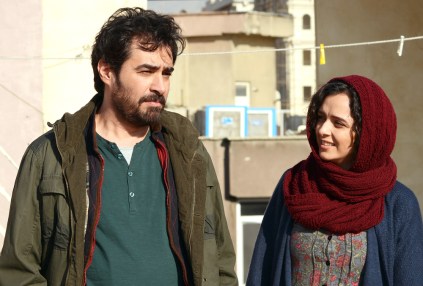
The Salesman is an Iranian film about a husband (Shahab Hosseini) going after the man who assaulted his wife (Taraneh Alidoosti)

The Salesman won the Academy award for Best Foreign Language Film. It is the second film by Asghar Farhadi to win the Oscar in that category. It was worth watching.

Emad is an acting instructor at a local school in Tehran. He and his wife Rana are also actors and are rehearsing the production of Death Of A Salesman where Emad plays Willy and Rana plays Linda. One day, their apartment is on the verge of collapsing. All the residents flee including Emad and Rana along with their son. Their fellow actor Babak, who plays Charley, finds a shelter for them in an apartment suite recently abandoned by a woman and still consisting of most of her belongings.

One night, Rana returns to her apartment alone and bathes. Emad returns to the apartment finding Rana absent and blood on the bathroom floor. He learns from neighbors that she is in the hospital after being badly assaulted. Neighbors also reveal that the former tenant of the apartment was a prostitute.

Rana recovers from her injuries and is able to come home, but is traumatized. Despite Emad changing the locks, she’s afraid to bathe fearing a repeat of what happened. She is afraid to go to the police, feeling they’ll question her about her own lifestyle. The frustration leads Rana to break down during rehearsal. When Emad finds the car keys of the culprit left behind in the apartment, he decides to take things into his own hands. He discovers they belong to a pickup truck parked outside. The culprit even left behind his cellphone and money. The stress of trying to locate the man who assaulted Rana adds up on Emad as he falls asleep during one of his film lectures He even blames Babak for what happens and calls him a ‘degenerate’ during rehearsal, despite it not being in the script.

Emad finally gets a lead from one of his students. He learns the truck belongs to a man names Majid who runs a business in downtown Tehran and shares the truck with his father-in-law. Emad learns that the older man is in fact the culprit. Emad calls the culprit to meet with him in the apartment. The man claims he didn’t assault her, but startled her instead. Emad doesn’t believe it. He locks the man in a room to get him to confess everything to Rana and his own family. As the family is just making their way to the apartment, the man appears to have a heart attack. Emad calls Rana in a panic but Rana warns him if he pursues revenge, she will leave him.

Just as the family arrives, Emad offers assistance to the older man. The man doesn’t want his family to know his sordid actions and Emad complies. The family is relieved to see the man and even thank Emad for saving his life. However Emad has one last thing to settle with the man in private. Emad gives the man his money and slaps him, which leads the man to collapse again and the family to fear for his life. The film ends leaving the viewer questioning and even assuming what happened.

This story has a lot of similar aspects with A Separation, Farhadi’s first Oscar-winning work from five years earlier. It presents a story in Tehran and features a male character resorting to his own means to get to the bottom of things. In both cases, it’s likely to sense Farhadi is making a statement about Iranian society. First we have a case where the husband takes the law into his own hands because the police may suspect something of the wife, whether it be done by Iranian law or the nature of the police. Secondly we have the ending climax where the man carries out his intentions and we don’t know what will happen next. Thirdly, we have a case where the protagonist tries to play either the judge, jury or executioner. Finally we have an ending that is ‘silent’ and leaves you wondering what happened and of the relationship of the couple. Those are usually the best endings where one would try to guess what happened or come to their own judgement.

This story is a cat-and-mouse story as Emad willfully takes the law into his own hands and plays vigilante in this situation. You wonder if it’s simply because he’s going along with his wife or because he too knows how one-sided the law is and how they would come down hard on women. As the viewer sees clue after clue, they start to get their own assumption. Once we know, it leads to the climactic ending. However this is a climactic ending that takes a long time to end. The drama in the climatic ending however justifies its lengthiness and even adds a second part to the ending. The final end scene where we only see what we saw and nothing is spoken between Emad and Rana as they’re getting their makeup applied also gets you questioning what happened. Even drawing your own conclusions. Those are usually the best endings where they get the viewer to create their own ending.

The unique thing about this story is how it’s mixed in with theatre. We see the story unfold right as the couple are both rehearsing and performing for Death Of A Salesman. The story in The Salesman does not come across like the story of Willy Loman. Emad is far from the pathetic character Willy Loman is known to be and Rana appears to be stronger-willed than Linda Loman. Yet somehow you sense a connection and try to think back if there is.

Asghar Farhadi does it again. He writes and directs an excellent story that has you following the story and guessing what happens in the end. He also succeeds in again making a statement about Iranian society through the story. This time, he adds the art of theatre intertwined with the story with excellent results. Shahab Hosseini does a very good job in his performance as Emad. He played the temperamental Hojjat in A Separation. Here he delivers a performance that both embodies the character of Emad and says more in Emad’s silence than in his dialogue. Taraneh Alidoosti also did a very good job in her role as Rana. She first comes across as someone hurt and troubled, but reveals at the end she possesses more inner strength than you think. Farid Sajadhosseini also did a very good job in playing the older man with secrets he wanted to hide.

The Salesman is another great film from Asghar Farhadi. It’s a story that says a lot in the drama it presents.

DVD Review: Elle

elle-03
Isabelle Huppert plays a woman caught is a troubling time in her life in Elle.

Elle was one of those films that came around the time of the Academy Awards. It has a lot of interesting elements, but it features a lot of elements some would first find unwatchable. Is it worth it?

The film begins with a cat witnessing the rape of her owner Michele LeBlanc (that’s right). The masked rapist immediately leaves. Michele just calmly cleans up themes and resumes her life, but doesn’t call the police. Michele returns back to her job as CEO of a video game company where her male employees either lust after her or view her as a ‘bitch.’ She tries to maintain a relationship with her son Vincent but feels detached as she feels he’s being controlled by her pregnant girlfriend. She has a troubled relationship with her mother who is narcissistic and has a thing for younger men. She’s having a love affair with Robert, the husband of her best friend and business partner Anna, but also has caught the eye of her new neighbor Patrick, although his devoutly Catholic wife Anna is unaware of this. Michele also has a troubled past.

The reason why Michele doesn’t call the police is because she has a sordid past. She is the daughter of a mass murderer who was arrested and imprisoned over 40 years ago when Michele was 10 years-old and even involved Michele in his murder spree. His parole hearing is coming up and the events from the past still haunt her. Her friends plead for her to report the rape to the police but Michele won’t, fearing the police have it in for her. Life is hard for Michele as she receives harassing text messages form a man claiming to watch her. She’s also the victim of a hacked video game which shows an alien with her face being raped by another alien. She learns the male colleague who made the hacked video game is infatuated with her but not the rapist. Her ex-husband learned of the news and tried looking out for her safety.

Christmas only adds to the stress as her mother falls into a stroke and her dying wish to Michele is to see her father. Michele tells her son Vincent she believes he’s not the father of his girlfriend’s child. The rapist returns for the third time, but Michele takes of the mask to discover it’s Patrick. Even though she now knows, she still doesn’t call the police nor have an alarm installed in her house.

Michele goes to visit her father in prison only to learn he hung himself. On the ride home, she gets into a car accident. She calls her friends instead of an ambulance, but the only one who responds to the call is Patrick. Michele gives Patrick a shocking confession of her feelings toward him which leaves Patrick shocked and confused. Then the day of the celebration of the launch of the new video game. At the party, she confessed to Anne her affair with Robert, which breaks Anna’s heart. The story ends with a tensely climactic moment and an ending that comes across as triumphant.

The thing about this film is that it deals with a complicated cat-and-mouse situation. Michele wants to get her rapist arrested but she is afraid to call the police, feeling they’re after her. That could also explain why she wouldn’t call an ambulance after the car crash: because of her past. She has a sense of who did it, but she feels an attraction to him. She is caught in situations in her work, in her family and even within her circle of friends at the same time. It’s enough to make anyone snap. It even turns her into a spiteful bitter person to whomever she meets up with. You hope that her rapist is caught but you’re left wondering how will it end? Will he be caught? Will Michele be the one who ends up killed? Will her rapist end up her new lover? It keeps you intrigued.

One thing about this is that this film is a psychological thriller that succeeds in taking subject matter that is disturbing and even unwatchable and turns it into a story that becomes positive in the end. Normally I am very nervous about the subject of rape in a film. In fact the very opening scene of the rape (as witnessed by the cat) and her bleeding vagina in the bath really had me questioning what Paul Verhoeven was up to. I’ll admit I had a mistrust to Verhoeven because I know he has a reputation for films like Basic Instinct and Showgirls. I still haven’t forgotten the misogyny of the latter and I was anticipating misogyny in the film at first. Even the scene that appears like Michele is consenting to the rape of Patrick makes me wonder, in addition to knowing Michele actually gets sexual satisfaction from it. In the end, the film delivers a strong female character who is able to piece the puzzle together. It’s at the end we see Michele as if she triumphed in the situation.

SPOILER ALERT – IF YOU DO NOT WANT TO KNOW THE ENDING, BYPASS THIS PARAGRAPH: The ending is a surprise as well. Throughout the whole film, you see Michele as a bitter, hurting, troubled woman with the world seemingly against her or bothering her in every which way. However it’s right after Patrick is killed that everything magically becomes right. We see how Rebecca isn’t as hurt over Patrick’s death as she’s moving out, and makes it obvious she knew what Patrick was up to. We see how Vincent has been able to get better in his career and relationship. We see how Michele is finally able to make peace with her father. We also see how Michele makes peace with both Josie and Anna as they’ve both left Robert, and even resumes the strong friendship with Anna. It’s like life for all during the time of Michele being raped was what was causing friction in the lives of Michele and those around her, and it was Patrick’s death at the hands of Vincent that set everything right for all. Normally something like that wouldn’t work in terms of a story. I mean how is it possible for a rape victim to recover from what happened seemingly overnight? But the way it was played out in the story made it look very believable and made it look like the story ended on the right note. Quite an accomplishment, especially for a psychological thriller.

This film is actually an adaptation of a French novel titled Oh. I’ve never read the novel but David Birke does a very good job in creating a story that’s both a psychological thriller and a big puzzle that somehow is able to get all the pieces to fit in the end. Paul Verhoeven also did a good job of directing. I will admit I did get suspicious with him, especially after seeing certain scenes. However it’s in the end that I feel he did a very good job of creating a strong female character despite appearing to push the envelope at times. However making the story work also came down to Isabelle Huppert in her performance of the protagonist Michele. She had to portray a character who seemed to have everything pushing her to snap but somehow keep her composure throughout the ordeal, despite being bitter and spiteful, and appear triumphant in the end. She accomplished that feat excellently. Supporting performances of note include Laurent Lafitte as the troubled neighbor Patrick and Anne Consigny as Anna: the friend caught in the love triangle.

Elle begins as a film that one would expect to be misogynist, but instead paves the way for a female character who triumphs in the end. It’s the film’s surprising twists and turns that make it.

DVD Review: Jackie

Jackie
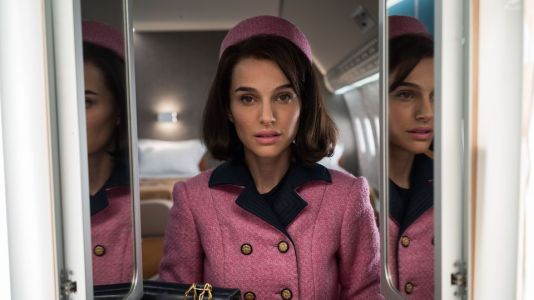
Natalie Portman showcases a deep personal angle of Jackie Kennedy in Jackie most of us never saw.

At first I wasn’t too interested in seeing Jackie. I mean there have already been enough made-for-TV movies of JFK and Jackie Kennedy. The film would not only have to justify being made but also its big-screen release.

The film begins with a journalist interviewing Jackie Kennedy in her home just days after JFK’s assassination. It’s like one minute she’s the First Lady living in the White House and the next, she’s a young widowed mother living in a private home miles away. The journalist begins with small talk but the questions move to the assassination and the aftermath.

It is from that point the film flashes back to various moments. Moments when Jackie and John attended Camelot: a musical JFK was captivated by. Moments like Jackie right after the shooting cleaning the blood off her clothes. Moments like being comforted by Bobby Kennedy, Lyndon and Lady Bird Johnson, and White House social secretary Nancy Tuckerman whom Jackie would later confide in. Moments like making funeral plans. Moments like her dealing with the priest and her questioning her faith more than ever.

It’s moments like those where Jackie feels more lost than ever as a person. It’s moments like these where Jackie wonders what to leave as a legacy for her husband. It’s during that time she uncovers truths many tried to hide from her, but she knew. It’s also moments when Jackie learns to be strong on the inside. In the end, she regains her faith while talking to the priest. In the end, she makes the final decisions on her husband’s funeral. In the end, she chooses to have her husband’s legacy remembered as ‘Camelot.’

Now keep in mind when this film came out, I was not too interested in seeing it. I mean the role of Jackie Kennedy has been included in too many made-for-TV film. When I saw this film about to be released, I was thinking “This film had better justify its big screen format.” This is not just simply a film that’s a biography. This film focuses on Jackie not even during ten days of her life. This is one of the most critical times of her life as she went from being Jackie Kennedy to a widow in an instant. Many of us know a lot of Jackie Kennedy, but this film presents an angle of Jackie Kennedy few of us knew. The smile and happy charm of Jackie Kennedy we are all familiar with is now replaced with a Jackie Kennedy that is hurting inside. She feels like she’s nothing without JFK. Her faith both in God and in the magic of Camelot has been challenged to more than what she can handle. She even feels like she’s worthless as a mother to her children. That was Jackie right after JFK died. That was Jackie those many days later dealing with the journalist.

We also see another angle to Jackie. This film goes through scenes happening in various moments of time in Jackie’s life. We see some scenes when JFK was still alive but most scenes are various times after his assassination. With those scenes, we see the different aspect of Jackie few knew. We have always known Jackie Kennedy the First Lady to be charming, charismatic, sweet and outgoing. Here in the film, we notice that Jackie is not the prissy, naive Jackie as most of us thought she was. She knew of her husband’s infidelity. She knew of Wanted For Treason posters published by dissenters days before his assassination. She did have concern about tax dollar use for her husband’s funeral. She even considered her publicity an interference: “I never wanted fame. I just became a Kennedy.” She even questioned her faith with the priest. These are all aspects most never knew of Jackie Kennedy. However the film also shows Jackie as a person who doesn’t lose faith in the things she believes in. Despite going through the hardest moment of her life, she still finds the inner strength to keep her faith in God and to believe in the power of books and theatre. “I believe the characters we read on the page become more real than the men who stand beside us.” That would take a lot for someone to still believe in especially after what happened.

This is an excellent breakthrough film for Pablo Llarain. This is his first English-language feature and he does a very good job in directing the story and scenes. Also done well is the script from writer Noah Oppenhein. He’s most famous as the scriptwriter for The Maze Runner. Jackie is a big change of pace for him. It’s very common nowadays to do films of a certain famous person and have it focus on a certain brief period of their life instead of the common biography-style film you’d expect. It’s done many times in films like The Queen, Capote and Sophie Scholl: The Final Days. It’s also a difficult challenge because in doing so, they have to construct a story that looks like it sums up the protagonists lifetime in that brief period of time. Oppenheim succeeded in constructing a very 3D Jackie Kennedy in that brief period of her life.

It’s not just Oppenheim’s story of Jackie that worked well but also the performance of Natalie Portman. At first, I was skeptical of the idea of having Portman play Jackie Kennedy. She did not come as the type of personality to play her at first. However Portman did an excellent job in her portrayal of Natalie and portraying the personal traits and feeling of Jackie in the scenes of the story. The film also shows an excellent maturity in the acting of Natalie Portman. Sometimes we forget she was 35 when she was filming this film and Jackie Kennedy was 34 when this incident happened. This film shows Natalie’s acting maturity very well. For all intents and purposes, Jackie Kennedy was the role with the most depth and range in the film. Nevertheless there were supporting performances that delivered well despite their limited range, like Peter Saarsgard and Bobby Kennedy and Greta Gerwig as Nancy Tuckerman. The costuming from Madeline Fontaine and the music from Mica Levi also added to the quality of the film.

Jackie did justify its big screen format in the end. It’s an excellent film about carrying grace under such devastating heartbreak and reminded us why we admire Jackie Kennedy so much.

DVD Review: Silence

silence
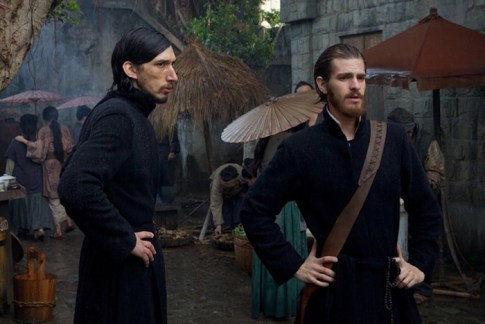
Adan Driver (left) and Andrew Garfield are Portuguese missionaries in Japan whose mission is a huge test of faith in Silence.

Learning of Martin Scorsese doing Silence caught my intrigue: Scorsese doing a film about Catholic missionaries. The big question would be how would it turn out? Would it be pro-Catholic or anti-Catholic? Or something else entirely?

It it the 17th Century. Portuguese Jesuit priests Rodrigues and Garupe  are sent to Japan to spread the faith and to find Father Ferreira. Ferreira was sent as a missionary from Portugal, but has been forced to watch the brutal executions of people he helped convert to the faith and has since apostatized. In their first stop in Macau, they came across one of the converts who himself watch executions happen. He’s now a paranoid alcoholic.

Once they arrive in Japan, they arrive in the village of Tomogi. They learn that Catholics have resorted to an underground church. The people are relieved to see they have a full priest available but the priests learn of the samurai searching out Christians to execute: commonly called ‘The Inquisitor.’

Both priests go to different islands. Garupe goes to Hirado Island to avoid having the village threatened and Rodrigues goes to Goto Island in search of Ferreira. He comes across the man from Macau who betrays him in front of an old samurai. The samurai has Rodrigues and the Catholic converts arrested and taken to a prison in Nagasaki. The samurai warns Rodrigues to renounce his faith or else the other captured Christians will be tortured. The samurai give the Christians a chance to step on a rudely-carved crucifix to renounce their faith. One man refuses and he’s beheaded on the spot. Rodrigues has to witness this from his prison cell. Later, Rodrigues is taken to a shoreline where three Christians from Hirado and even father Garupe are to be executed by drowning. Even though Garupe refuses to apostatize, Rodrigues is horrified by what he witnesses.

Finally Rodrigues gets to meet up with the apostate Ferreira. Ferreira tells him after 15 years in Japan, Christianity is futile in Japan. It’s best that he apostatize. They day before Rodrigues goes on trial, he hears the torture of five Christians who had apostatized. Then the day comes. Rodrigues is brought to trial by the shogun and is presented the chance to step on the crude carved crucifix to apostatize. Rodrigues appears to hear permission from Christ and steps on it. He is distraught. Rodrigues spent his remaining years in Japan married and searching out goods from ships incoming from Europe. His job was to identify Christian items from non-Christian items. The ending will definitely lead to a lot of conversation.

We should keep in mind this is not exactly a true story. Instead this is a film adaptation of a book of the same name written in 1966 by Japanese author Shusaku Endo. Whatever the situation, this is a film that presents a huge challenge to one’s faith. Even one with the strongest of faith and convictions can find themselves questioning what they would do in a situation like this. We should remember this is not a case of Christian martyrdom where the priest is the first to be executed. The followers are executed first as a pressure to get the priest to apostatize. The methods of execution are also horrific such as slowly dousing prisoners in hot spring water slowly and painfully to burning them alive wrapped in grass. I’m sure some would ask what would they do in this situation? Is it a selfish thing to hang on to one’s faith while the others are tortured and killed?

I’m sure a lot of people would be suspicious of a film like this coming from Martin Scorsese. Scorsese has had a reputation of a lot of negative and even blasphemous depictions of Catholicism and the Catholic faith. The biggest controversy was in 1988 when The Last Temptation Of Christ hit the theatres and there were protests galore. This film does not give a negative depiction of the priests. Instead it presents the challenges of faith such as the pressure to apostatize or the treatment of sacred images. One thing about the film is that the ending of the film is sure to give a lot of discussion of the final fate of Rodrigues. They say endings should have you asking questions rather than give you answers. It sure worked here as a lot of debate of the ending has sure come about. Even the end scenes after Rodrigues apostatized prompted a discussion between me and another person. This film will have you talking.

One thing it goes to show about this film is that it shows just how difficult it is for a director to make a labor-of-love film. No matter how many hit movies a director may produce, they still have stories deep in their heart they can only dream of putting on film. Even a renowned director like Scorsese would face such challenges. It’s not just in the amount of time it would take to develop such an idea on film– this film is 25 years in the making– but also the willingness of executives to allow it. We forget that film making is a business first and foremost, and business is ruthless. Even after all is completed, it’s then up to how the general public will receive it. In the end, Silence became Scorsese’s lowest-grossing film since 1997’s Kundun. It is a shame because the film is wonderful to watch and showcases a lot of excellent aspects. The film did make the AFI’s annual Top 10 list of the best films as well as the Top 10 list of the National Board of Review.

Martin Scorsese does another good job of directing, even if it’s not his best. He works the film very well and presents it well without his usual trademark of over-the-top blood-and-guts. Sure, there were torturous scenes, but they were a far cry from what you’d normally see in Scorsese film. I feel the adaptation he wrote along with scriptwriter Jay Cocks included the right parts and right moments from the novel as none of the scenes seemed pointless. Also he did a good job of maintaining the dignity of the priests and of the Catholic faith. Maybe this is a change in Scorsese.

Andrew Garfield did a very good job in his portrayal of Rodrigues. This was one year where Garfield played roles of people with strong faith. First was Hacksaw Ridge and now this. He did a very good job in presenting a man with a huge spiritual struggle. Adam Driver was given less screen time and it didn’t allow well for his part to develop. He did do well with what he had. Lia Neeson was also good in his part despite how brief and how limited it was. If there was one supporting actor who could steal the film from Garfield, it’s Issey Ogata as Inquisitor Inoue. He came off as cartoonish at the odd time but he succeeded in making you hate him. Other great works in the film include the cinematography from Rodrigo Prieto. He did a lot of good shots in creating the drama and even capturing the beauty of the scenery. Also worth noting is the excellent production design from Dante Ferreti in both the natural and man-made settings and the costuming also by Ferreti which were top notch.

Silence will most likely go down as Scorsese’s most overlooked masterpiece. It was a labor of love of his that didn’t pan out at the box office. Nevertheless, it’s a good think he made this film as it features a lot of cinematic qualities and gives a lot to marvel at.

DVD Review: Loving

Loving
Loving is the depiction of Richard and Mildred Loving–played by Joel Edgerton and Ruth Negga– and why they fought for their love.

DISCLAIMER: In the next while, you will see a lot of film reviews that have been delayed for the longest time. I’m passing them off as DVD reviews.

“Can’t you just go and speak to Judge Bazile? We ain’t hurting anybody.”

Loving was actually the very first film I saw in 2017. Pardon the delay of the review. It’s still worth reviewing as it is a unique film, and not just because of its subject matter.

Richard and Mildred Loving want to marry. It’s the right time; they’ve been dating for a long time she’s having a baby. Problem is Mildred is black and Richard is white and they live in Virginia where interracial marriage is forbidden by law. They travel to Washington, D.C. to marry, but it causes problems as the couple are raided by the police and told their marriage certificate is not valid.

The couple were tried in the court of law in Virginia and they plead guilty. They received a suspended sentence, but decided to move to Washington, D.C. Life in Washington doesn’t work out for them as the oldest of their three children was hit by a car. The child survives, but Mildred decides she prefers the calm life of the country and wants to move back to Virginia. Especially since their families are there. In addition, Mildred writes to Robert F. Kennedy of her situation. Kennedy sends her letter to the ACLU. Bernard Cohen, a lawyer associated with the ACLU, agrees to contest the marriage ruling in the state of Virginia, but is slapped by disapproval in the court based on Virginia’s constitutional law.

Mildred then has Cohen take the case to the Supreme Court of the United States. In 1967, the US Supreme Court overturned their convictions and ruled that the criminalizing of interracial marriages violates the Fourteenth Amendment. The Lovings could now live in Virginia without fear of threat and love each other peacefully.

This film is of a relevant topic. Interracial marriage is a topic that still develops some heated discussion in the United States today. Many countries like Canada, the UK and even France don’t see interracial love as much of a problem. However there are still a significant number of people in the United States that look down upon it. Even seeing how Richard’s mother was disapproving of the marriage and even telling Richard he ‘did a wrong thing’ really gets one thinking at first how someone, including many millions around the world, can think loving a person of a different race is ‘wrong.’ Even hearing how the courts of Virginia ruled that: “God created the continents to keep the races separate and that they don’t mix.” I thought that was bizarre that they thought that but the courts in the Commonwealth Of Virginia considered that to be the truth. Me, I’d demand they pull out the Bible and show me where marrying someone of another race is a sin. Which of the Ten Commandments did that violate?

I was anticipating the subject of race to be included in the film. I know the prime topic of interracial love would be the prime topic but I figured the topic of race would be present too,, especially since this is in Virginia. The topic of race was not focused too heavily. However there were some moments when the subject of race was present. Like the case when Richard was going for a beer with his brothers-in-law from Mildred’s side of the family. I remember one of them questioning “You think you’re black?’ That too had me thinking about the racial divide in the US that still hits today.

The most surprising thing about Loving is that it wasn’t as dramatic as one would expect it to be. In fact the film appeared less focused on the events and more focused on the people Richard and Mildred Loving. It focused on the two as a couple, but mostly on both Richard Loving and Mildred Loving as individuals. Richard was seen of having the personality of a man who’s both hard and sensitive at the same time, but fearful of what would happen. Possibly because he’s white and he knows about a lot of racism that he could be subject to hate and even violence for. Mildred, whose actually half-black and half-Native American, was seen as a person who was soft and smart, but always optimistic. She had that look on her like she had nothing to lose and whatever else to gain.

It first seems like an odd choice to be more focused on the people instead of the events. I often wondered too about why it was done so. Over time, I saw it as something that made sense. We should not forget that it was the Lovings’ love for each other that made this happen. Sure, history will record Richard and Mildred for making history for their interracial marriage, but they made history because of their love for each other. The feelings for each other are made very obvious to us as are their feelings towards the events in their lives. This angle of focus was a very good choice in making such a film. We more of a look at the couple that made history rather than the history they made.

I admire writer/director Jeff Nichols for using that angle in creating the story of the Lovings. It is a unique angle and keeps their story from coming off as a made-for-TV movie. The portrayals of the Lovings by Joel Edgerton and Ruth Negga were excellent and very telling of Richard and Mildred both as individuals and as a couple. The other actors in the film didn’t have such well-developed roles, but they did own the scenes when they had them, like Sharon Blackwood as Richard’s disapproving mother and Nick Kroll as Bernie Cohen the lawyer. The score from David Wingo didn’t occupy too much of the film, but its presence helped with the storytelling.

Loving is an excellent film that shows a focus to a story many know, but a focus overlooked. It’s also a film relevant now as interracial marriage is still a hot topic to many today.

Movie Review: Guardians Of The Galaxy Vol. 2

gallery-1486477910-guardians-of-the-galaxy-vol-2-team
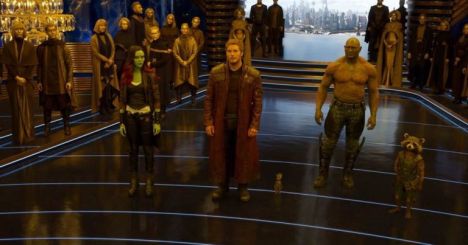
The Guardians are back, even with a Baby Groot, in Guardians Of The Galaxy Vol. 2.

We first met the Guardians Of The Galaxy back in 2014. The Guardians are back in Guardians Of The Galaxy Volume 2. But do they have what it takes to deliver this time?

Back when the first Guardians Of The Galaxy came to the big screen, most people have not heard of them. This was a chance for Marvel to introduce them to the world. It was a unique mix of quirky characters, both virtual and live, loads of action, and a mix of both music and humor that made it a hit with families and superhero movie fans alike. The movie became the third-highest grossing movie of 2014 and turned the Guardians into household names. In fact “I am Groot,” became the top movie line of that year.

This time around is about bringing about the sequel.  Most of you already know my feeling of Hollywood sequels in my review of Furious 7. However sequels can either propel a movie franchise further or sink it. Sequels are hit and miss. I’ve seen so many sequels where they simply rehash the formula of the first movie plot-for-plot, moment-for-moment. That’s why I’m mostly turned off sequels. That’s also often all one needs to do to end a franchise. Nevertheless there are a good number of sequels or second-movies that do differ a lot from the original. That’s often the better idea but even that’s a gamble. One example is the second and third film of The Matrix. It was too different from the original film that blew audiences away in 1999 and they disappointed fans.

This sequel for Guardians takes the chance of being very different from the first film. One can already notice the differences here: animosity between the members, the stormy family relations of Peter and his father and Gamora and her sister, the people of the various galaxies going against each other and all galaxies being threatened by Ego. I appreciate them creating a scenario different from the original. Nevertheless there were some things from the original that they had to bring back into the sequel like the humorous tones in various scenes, the unique and sometimes crazy personalities of each of the Guardians, and of course the use of 70’s songs in the many scenes. It was all a case of making the right choices of what to include from the first and what to change up. I feel they made a lot of the right choices here.

Another difference I noticed in Volume 2 is that there are a lot more ‘salty’ and ‘spicy’ things in the film. For example, I noticed there was more swearing included and a lot more lewd talk. There were even scenes hinting towards sex or even showing suggestive situations like a stripper bar in another galaxy. Sometimes I think ever since Deadpool shook things up in the world of superhero movies, directors are less afraid of including risque stuff even if they know children will be watching. However unlike Deadpool, the film knows it’s supposed to be a superhero movie and the theme of heroes and the values they stand for and fight for is definitely not forsaken. Whether it’s okay for parents to take their children to see it or not is completely the parents’ call. I’d say it’s best for 11 and older.

James Gunn again delivers as a director and a writer in this sequel. He takes some of the first, some new ideas, and some racy choices and turns it into a movie that works. Chris Pratt delivers again as Peter and Kurt Russell does a very good job in playing a deceptive villain. Zoe Saldana again proves why she’s the top actress in sci-fi movies with her performance as Gamora. Dave Bautista was hilarious as Drax as was Bradley Cooper as Rocket. Michael Rooker was also good as Nebula. Baby Groot had a lot of funny moments but there are times I felt in retrospect that he went too much on the ‘cutesy’ side. Michael Rooker was also good as Yondu. The two newcomers–Karen Gillan as Nebula and Pom Klementieff–were good in their roles even if Mantis did come across as too weird or ditzy. Judianna Makofsky did a very good job in designing the costumes to fit the story, Tyler Bates delivers a fitting score to the film, and the visual effects team with hundreds of credits again delivered effects to make the action and drama that more exciting.

It seems appropriate that Guardians Of The Galaxy Volume 2 kicks off the 2017 Summer Movie Season. It’s a sequel that delivers the right stuff most of the time. It’s able to deliver some new magic without compromising the magic of the original and keeps one thrilled one moment, laughing another moment, and entertained throughout.

My Predictions For The 2016 Academy Awards

DISCLAIMER: There was an incomplete post like this yesterday. The reason was I was editing from my smartphone and intended to update the draft, not publish the blog. It published anyways. This blog here is my complete blog for Oscar predictions.

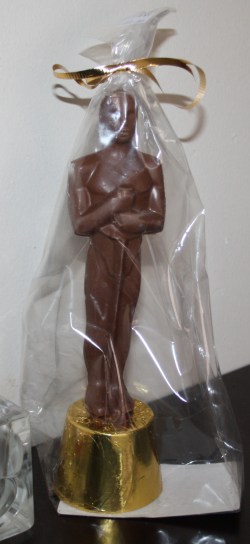
Chocolate Oscar

The Academy Awards are here. I’ve seen enough movies to make up 82 of the nominations this year. It was quite the year with lots to offer and a lot of things that appeared guaranteed weren’t. So without further ado, let’s get on with the predictions:

BEST PICTURE WRAP-UP

You all saw my three summaries of all nine nominees. Doing shorter summaries were better for me this year. Maybe next year I won’t be so busy or have as many ailments. So here goes for predicting the winner:

-Arrival-  This is the first movie about aliens to be nominated for an Oscar. A very smart film that was loaded with buzz when it first came out. However its awards excitement faded over time as did its Best Picture chances.

-Fences- I like it when I see a celebrated play brought to the big screen. Especially around Oscar time. I felt it was done excellently. However it is up in this category against meatier competition. This is one category I think Fences won’t win.

-Hacksaw Ridge- Very rarely does a pro-religion movie have a chance for Best Picture. Hacksaw Ridge is the pro-religion film in the past 15 years most deserving of a nomination. However it does have some formulaic elements that come up every now and then and it has better chances in the technical categories instead of Best Picture.

-Hell Or High Water-  This year’s ‘summer survivor.’ Those like me who missed out on it during the summer missed out on a gem. A crime story that’s funny and entertaining, but smart too. However I’m not too optimistic in its Oscar chances here.

-Hidden Figures- This movie started with very little Oscar buzz at first but it increased as rapport from the film–from both critics and audience alike– grew. It seems like it doesn’t have good chances to win Best Picture but it could pull a surprise. A very slim chance of that but it is likely.

-La La Land- What can I say? People have been embracing it in droves. Why? Because people just really like a good musical? Because of its feel? Because it reminds one of the charm of old Hollywood? Whatever it is, it’s made it the frontrunner that looks hard to beat. That’s why it’s my Will Win pick. the biggest reason why I hope it win is because last year I said: “One more Best Picture winner that fails to gross $100 million and I’m done Oscarwatching.” I don’t know what made me carry on even after Spotlight won– and it didn’t even make $50 million— but La La Land makes me glad I did.

-Lion- I’m no expert in Oscar trivia but I think this is the first Australian film to be nominated for Best Picture, and a deserving nominee. It’s won over everyone I know who has seen it. It may have had better Best Picture chances in another year.

-Manchester By The Sea- This is a film that was loaded with buzz at the beginning of the Oscar race and looked to be the one film that could beat out La La Land. The buzz faded over time, despite how great the film was. May have an outside chance but not too likely.

-Moonlight- This is one film that proves that less is more. Less dialogue, more of a feel of what’s happening. Less showy characters, more knowing who the characters are. Less singing and dancing, more feel for the music in the film. This is the surprise of the Oscar race that was able to let it speak for itself. I know it faces a hell of a fight against La La Land to win Best Picture but I give this my Should Win pick.

BEST DIRECTOR:

Should Win – Barry Jenkins, Moonlight

Will Win – Damien Chazelle, La La Land

I felt that Moonlight is the better picture and Jenkins did an excellent job of directing but I know this is the year of La La Land and it’s Damien Chazelle’s to take.

BEST ACTOR:

Should Win and Will Win – Denzel Washington, Fences

These past two years saw the rise of the #OscarsSoWhite outcry. This year there are seven non-white acting nominees. Denzel may have won twice before but his performance as Troy Maxson has been getting loads of buzz and even surprised favorite Casey Affleck at the SAG Awards. The only way I can see Casey winning instead of Denzel is if the Academy doesn’t want to make this his third Oscar, and it is a possibility.

BEST ACTRESS:

Should Win – Isabelle Huppert, Elle

Will Win – Emma Stone, La La Land

Some are saying that Isabelle Huppert looks to be the biggest threat to Emma Stone’s win. It is a possibility but I think Casey Affleck beating out Denzel appears more likely. It’s Emma’s to lose.

BEST SUPPORTING ACTOR:

Should Win and Will Win – Mahershala Ali, Moonlight

Mahershala Ali may have only been seen in the first part of Moonlight but there was something about his performance of Juan that stood out like no other supporting performance this year. Was it Juan’s charisma? Was it his silent coolness? Whatever it is, it’s what made Mahershala stand out this year among all the supporting actor performances.

BEST SUPPORTING ACTRESS:

Should Win and Will Win – Viola Davis, Fences

What can I say? If there’s anyone who can steal the show from Denzel, it’s Viola Davis. She reminded us very well that Fences wasn’t just about Troy Maxson. It was about Rose too.

BEST ORIGINAL SCREENPLAY:

Should Win – Taylor Sheridan, Hell Or High Water

Will Win – Kenneth Lonergan, Manchester By The Sea

A lot of people are expecting Damien Chazelle to do it again here but I feel that Kenneth Lonergan will take it for one of the best scripts of the year. It was a film that cuts deep and doesn’t water down.

BEST ADAPTED SCREENPLAY:

Should Win and Will Win – Barry Jenkins and Terell Alvin McCraney, Moonlight

It all started with a short story by McCraney, then Jenkins developed a screenplay, and now it’s one of the best of the year. No stopping it.

BEST ANIMATED FEATURE:

Should Win: Kubo And The Two Strings

Will Win: Zootopia

Kubo was the best at taking your imagination away this year. However in comparison to frontrunner Zootopia, it isn’t really all that family friendly and that I believe is where it will hurt it. Zootopia was without a doubt this year’s crowd charmer. Besides this is the one category Disney wants to take year after year.

BEST ART DIRECTION:

Will Win: La La Land

Let’s face it. Any movie that shows off the classic areas in Los Angeles and even meshes it into the present will win this category.

BEST CINEMATOGRAPHY:

Will Win: Linus Sandgren, La La Land

BEST COSTUME DESIGN:

Will Win: Madeline Fontaine, Jackie

BEST DOCUMENTARY FEATURE:

Will Win: O. J. Simpson: Made In America

BEST FILM EDITING:

Will Win: Tom Cross, La La Land

BEST FOREIGN LANGUAGE FILM:

Will Win: The Salesman (Iran)

Salesman director Asghar Farhadi has been the subject of news as it was believed Donald Trump’s travel ban could prevent him from attending the Oscars. Whatever the situation, he boycotted the Oscars in protest of Trump’s policies.

BEST MAKEUP AND HAIRSTYLING:

Will Win: A Man Called Ove

BEST ORIGINAL SCORE:

Will Win: Justin Hurwitz, La La Land

I’m sure we’ve all been waiting for the longest time for a musical of original composition. Especially the Academy.

BEST ORIGINAL SONG:

Should Win: ‘Audition (The Fools Who Dream)’, La La Land

Will Win: ‘City Of Stars’, La La Land

BEST SOUND MIXING:

Will Win: La La Land

BEST SOUND EDITING:

Will Win: Hacksaw Ridge

BEST VISUAL EFFECTS:

Will Win: The Jungle Book

I think the reason why Star Wars lost this category last year is because having the best digital effects of the year is expected for a Star Wars movie. That’s where The Jungle Book has the edge for this year.

BEST LIVE-ACTION SHORT FILM:

Click here for reviews and predictions.

BEST ANIMATED SHORT FILM:

Click here for reviews and predictions.

BEST DOCUMENTARY SHORT SUBJECT:

Will Win: Joe’s Helmet

JUST ONE MORE – TOP OSCAR UPSETS

I did this for the first time last year. I want to do it again this year.:

  • Moonlight wins Best Picture
  • Casey Affleck wins Best Actor for Manchester By The Sea
  • Kubo And The Two Strings wins Best Animated Feature
  • Arrival wins Best Adapted Screenplay
  • Greig Fraser wins Best Cinematography for Lion.

And there you have it. My predictions for Hollywood’s night of nights. Let’s see how Jimmy Kimmel does as host this time.

Oscars 2016 Shorts Reviews: Animation and Live-Action

Cinema

I’m lucky to be living in Vancouver. It’s one of the few cities one can be able to see the nominated shorts in a big-screen theatre. Gives me a chance to review them myself and even make a should-win pick for myself. This year is quite an array of nominees in both animation and live-action. So without further ado, here are my thoughts on the nominated shorts:

ANIMATED:

-Blind Vaysha (Canada/France): dir. Theodore Ushev- This is a unique 2D animation story of a Bulgarian folk-tale. A story of a girl with one eye that can see the past and one eye that can see the future and cannot live in the present. The story also shows the attempts of others to fix Vaysha’s blindness. The linocut-style animation, however, was unique and had a lot of style and flare to it.

The story doesn’t really end. Instead the film ends asking the audience their perspective. It has a unique narrative point and I get why it’s done that way, but I often wonder if the film ended on the right note.

-Borrowed Time (USA): dirs. Andrew Coats and Lou Hamou-Lhadj – At first you’ll think this is a family-friendly story at the beginning but soon learn it’s not such as you move on. It’s a dark Western story of a man returning to the spot of a family tragedy from his childhood. The hurt comes back from it and he decides to do something drastic but something happens.

I have to admire Pixar animators Coats and Hamou-Lhadj for making a brief departure from their traditional family fare and doing something more mature under Quorum Films. No, it’s not R-rated like Pear Cider And Cigarettes but it’s dark enough to be adult. I think this short is most likely to upset my pick for the winner.

-Pear Cider and Cigarettes (Canada): dirs. Robert Valley and Cara Speller- Now this is a refreshing R-rated alternative. It sometimes reminds you of a Grand Theft Auto video game or the film Waltz With Bashir. However it is a personal story from director Valley. It’s a story that makes you wonder how far would you go for a friend? Especially if that friend is selfish, conniving, irresponsible and manipulative?

It’s a story that entertains and charms and even gets you to hate Techno too. Sometimes I wonder why was he friends with that jerk? I don’t know if it’s because it was set in Vancouver or because it was an R-rated alternative but it won me over and I make it my Should Win pick.

-Pearl (USA): dir. Patrick Osborne- This is the first VR short to be nominated for an Academy Award. A musician and his daughter travel in a hatchback with a song as a bond between the two. We see the two age, the daughter mature into a musician of her own and have her own version of the song. The viewer gets a 360 degree view of the whole 5-minute story.

Looks like something Richard Linklater would do. Actually it might remind you of Waking Life. An excellent short that’s entertaining and will touch you too. Might even make you go to iTunes and download No Wrong Way Home.

-Piper (USA): dirs. Alan Barillaro and Marc Sondheimer- This is the short shown before Finding Dory. A baby bird looking for food on the beach with her mother looking on and guiding her. Pixar does it again by delivering a clever, charming, and entertaining short with the dialogue absent and the animation as detailed to a tee as it gets. It’s excellent, but it’s something we’ve come to expect from Pixar even with their shorts. Nevertheless this is my Will Win prediction.

And those are my thoughts for the Animated Shorts up for the Oscar. A lot of styles of animation between Canadian and American companies. All five were very entertaining. We’ll see who wins.

LIVE-ACTION SHORT FILMS

This year there are no films with English as the language of the majority. All five are from European countries. Here’s the rundown:

-Ennemis interieurs (France): dir. Selim Azzazi – A man from Algeria seeks to be a French citizen but the interrogator at immigration has big questions for him about meeting with a group of Algerian men back some years ago which led to him being arrested and imprisoned for two years. The interrogator keeps insisting he answers but he’s very reluctant to do so. Even to the point of neglecting his chances of French Citizenship. Why? What will make the man give his answers?

It’s a story that appears boring at first but grows with intrigue with each minute and with each new detail. The interest builds over time. It even makes you wonder why is he withholding the names of the other men? Feelings of brotherhood? Fear of retaliation from them? Also this may be about an incident in the past but it’s very relevant, especially with the Paris bombings happening in November 2015. This is my Will Win pick.

-La Femme et le TGV (Switzerland): dirs. Timo von Gunten and Giacun Caduff – Elise is a woman who wave her Swiss flag at the passing TGV train to Zurich every time it passes her house at 6 in the morning and 6 in the evening . After that she bicycles to her job at the town patisserie. It’s her daily routine for 30 years; a routine she doesn’t want to change. One day, she comes across a letter that was thrown to her by a man who goes on that daily TGV. He’s a man from France looking for work. The two develop a friendship only by mail and packages. Over time she hopes to meet this man. Then one day the train stops coming. It’s changed route? How will she deal with the change? Will she ever see the man?

It’s a charming comedy that has you engaged with the character (based on a person who has existed and did wave her Swiss flag at passing TGV trains). Gets you thinking about the woman. Is she an eccentric? Is she naive? Lonely? Unpredictable ending but a happy one.

-Silent Nights (Denmark): dirs. Aske Bang and Kim Magnusson – Inger is a young Danish woman who helps at the Salvation Army during the day and looks after her ailing mother at night. Kwame is a Ghanian immigrant who came to Denmark for a better future and to support his wife and children at home. However he’s been left homeless and makes money from recycling.

They both meet as Kwame agrees to help. The two develop a mutual friendship and even progress into something more. However it’s put to the test when Kwame steals money from the charity to pay for his daughter’s malaria treatments. Even though Kwame is banned for life, Inger forgives him and still loves him. Then Inger’s mother dies and she learns about Kwame’s family in Ghana just as she learns she is pregnant. It’s over between the two. However Inger sees Kwame one last time where she gives him advice, and something else.

It’s obvious that this story is about the immigrant situation in Denmark and the difficultly of the times for all. It presents both Inger’s side and Kwame’s side. However it’s more. It’s about a love that’s true. Inger loves Kwame so much, she’s willing to forgive him for all the terrible things he did. It makes the choice she makes for her and her baby look like the right thing. This is my Should Win pick.

-Sing (Hungary) dirs. Kristof Deak and Anna Udvardy – Zsofi is the new girl at a school. She most looks forward to singing in the choir. However on her first rehearsal, the instructor talks of a choir competition where the prize is a performance in Sweden. She also tells Zsofi her voice is not ready for the choir and tells her to lip sync. Along the way, Zsofi finds a friend in star singer Liza. The two become good friends. However Liza notices Zsofi not singing but others. When she brings this up with the instructor, she not only admits it but tries to convince the children it’s the right thing for the competition. All of which leads to a surprise ending and the ending you think is right.

Often I question what the point of this film is. Is it about competitiveness to the point the ‘lesser’ singers are not allowed to sing for the sake of the big prize? Or is it a reminder of Hungary’s past communist regime; of how those that fit in are allowed to and those that don’t aren’t, but make like everything’s okay?  Even the choir director could remind you of a communist dictator on retrospect. Whatever the point, the story was entertaining and sweet. Reminds you of the joys of childhood and the right thing paying off in the end.

-Timecode (Spain) dir. Juanjo Gimenez – It starts as a check for a woman on a security job during the day. One day she learns of a broken car light. Upon viewing the video of what happened, she sees the worker before her dancing before hitting the car. She decides to give him a dancing video of her own. Video after video follows. Then on their last day, magic happens.

At first you think the man is something eccentric but this story builds into something that ends on a bizarre note. A very good film.

And there are my thoughts on this year’s nominated shorts. Now remember both categories are the hardest to predict the winner. For example, last year the consensus of critics ranked Stutterer the least likely to win Best Live Action Short and it won. Even Annie wins for Piper and Pear Cider and Cigarettes are not a guarantee that either will win.

With my shorts predictions out of the way, I just have my main predictions for all the categories to deliver. But not before my last Best Picture summary. Coming up tomorrow morning.


Oscars 2016 Best Picture Summary: Part 3

Most of you have already seen my first summary or even my second summary. This last summary will have a look at the last three Best Picture nominees I saw. They were Lion, Hidden Figures and Hell Or High Water.

film-lion
Dev Patel plays Saroo Brierley, an Australian searching for his family back home in India in Lion.

LION

Lion is one of those films which came out of nowhere to surprise everyone who has been lucky to see it.

We have seen many against-all-odds stories in the past. This is something because this is a true story of something that really was against all odds. It wasn’t just about making it happen but also of the family relations Saroo has developed over his lifetime. What will happen? Will he leave the family he’s always known? Is the family he’s searching for still alive? The best quality of this story is that it keeps us intrigued and hoping Saroo reunites, but also has us concerned of what will happen after.

Another quality of this story is that it does not forget the cause of the problem. Saroo is seen as the lucky one who was able to reunite with his family after all these years. However throughout the film, especially at the beginning, we see the cause of the problem. Saroo was unsupervised when he boarded the express train. The language barriers caused problems. Even Saroo’s mispronunciation of Bengali words caused problems. The train stations of Calcutta are loaded with stray children ready for abductors to prey on, and station police looking the other way. Even the missing posters advertised before his adoption were no good as his mother is illiterate. India failed Saroo and Saroo succeeded thanks to Google Earth and his fierce will. The film at the end lets people aware of the problem; 80,000 children go missing in India each year. The film’s website informs people of how they are making a difference in aiding to protect children in India.

This film is an accomplishment for the Australian film industry. I don’t know if Australia has ever had a film nominated for Best Picture before. This is director Garth Davis’ first ever feature length film. Bet you wouldn’t believe that. Luke Davies did an excellent job in adapting Saroo’s biography into a winning screenplay that keep the audience intrigued and hoping for the best in the end. Dev Patel’s performance as Saroo was the highlight as he did a great portrayal of a young man who’s angry on the inside and knows what he needs to do. Nicole Kidman was also excellent as the mother who appears grateful on the outside but has some inner hurt waiting to come out. Young Sunny Pawar was also very good playing the young Saroo. He was cute but he didn’t take it overboard. He played his part well. The film also featured top notch cinematography from Greig Fraser and excellent original music from Dustin O’Halloran and Hauschka.

Lion is an excellent film featuring a story you won’t forget. A surprise contender this year and a worthy one.

hidden-figures
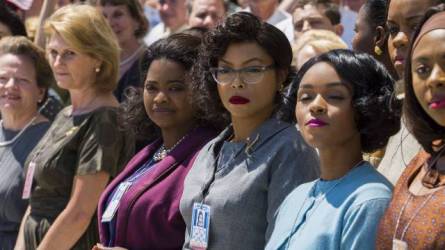
Hidden Figures is the story of three African American women working for NASA who broke new ground and brought down racial barriers.

HIDDEN FIGURES

It’s good that we have a film like Hidden Figures to tell us about a piece of history that we never knew about.

The film comes at the right time as it deals with a lot of situations that are relevant in our world. This may be set in the early 60’s and revolves around a moment in space history but it has a lot of situations relevant to today. One is of workplace racism. It’s not as bad now as it is then but there are still a lot of unsolved problems. The second is of technology being so good, it can replace workers. These three women had iron wills. They knew they had potential, they knew they had what it takes and they wouldn’t let racism or the threat of modern technology stop them from reaching for their achievements.

The year of 2016 was a crushing year. It was a year that constantly reminded us that there was still a lot of racism to overcome. Despite the improvement over the decades, it was able to show its ugly head with low employment rates and police beatings. This is a film that reminds us that racism can be overcome. When you look at it, the women were doing this all during a turning point in the history of African Americans. African Americans in Virginia had less rights than they do now and discrimination was perfectly legal. Back then there were still separate washrooms for colored people, separate library books for white and colored people, and police beatings during civil rights marches. The women overcame these barriers and they opened doors for other colored people for generations to come.

This is only the second film Theodore Melfi has directed and written. This is the first feature-length script Alison Schroeder has written. Does come across as like something you’d get from Hollywood, but it’s not a weakness. It does all the right moves. Taraji Henson was great as the protagonist Katherine Goble-Johnson, but the show-stealer was Octavia Spencer. She was not only good at playing a woman who wouldn’t let technology kill her job, and the jobs of 30 other black women, but she was a colorful scene-stealer too. Janelle Monae completes the trio as one who just wouldn’t say die to her ambitions. The male actors were mostly supporting roles but Mahershala Ali was the biggest one as Jim Johnson, Katherine’s new husband. The mix of Motown music mixed in with the original score from Hans Zimmer, Pharrell Williams and Benjamin Wallfisch also added to the spirits of the movie.

Hidden Figures showcases a little-known fact about a big moment in American space history. It’s also the right uplifting movie needed at this time.

hell-or-high-water
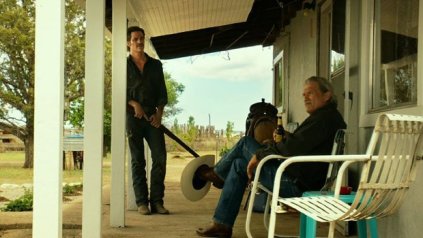
Hell Or High Water is about two Texas brothers on a robbing spree and a policeman (played by Jeff Bridges, right) trying to chase them down.

HELL OR HIGH WATER

I missed Hell Or High Water when it first came out in the theatres in August. I admit I was caught up in the summer fare and I overlooked it. I finally saw it recently and I’m glad I did.

One thing is I miss seeing is crime comedies. You know, the dark comedies featured in crime stories. This film has a good amount of comedy to it with their failures at robbing first. Even the situation where the brothers rob the Texas Midlands Bank and pay the mortgages they have with the bank off with the robbery money is full of surprising irony. It’s not even the robbery spree that has all the comedy. There’s the comedy when the rangers visit the places they question. There’s even comedy with that hard waitress at a restaurant they eat at: “What don’t you want?” The comedy doesn’t last as the story gets darker later on. However it does end on an ironic note as the now-retired Officer Hamilton does meet up with Toby Howard, perfectly free, and inquires of the robberies he and brother Tanner committed together.

One thing about this crime drama is that it has a lot to say. We have two brothers–Tanner who appears to have no redeeming values and Toby who’s as cool as a cookie– robbing various branches of the same bank. You see signs advertising debt relief. You hear from people– both family and people the brothers run into– talking of their own economic hardships. You see the indigenous people, who are still referred to as ‘Indians’ with their own outlook on things. Mostly negative. Looks like this story has a lot to say. Even hearing Alberto Parker say that he believes the true criminal is the Texas Midlands Bank does get you thinking. Maybe it’s the Bank that are the true robbers around here.

This is actually the first American production from Scottish director David MacKenzie. He has a reputation back in the UK with films like Young Adam, Hallam Foe and Starred Up. His first American production is top notch and really delivers as both a crime story and an offbeat Western. This is also an accomplishment for writer Taylor Sheridan. Already having made a name for himself in Sicario, he delivers again in what is actually his second feature-length script. Of all acting performances, Jeff Bridges is the one that was the best. He delivered a top job in character acting from head to toe. He was completely solid in character. Chris Pine was also good as the brother Toby who’s smart, tries to play it cool and possibly the one person in the world who could see redeeming qualities in brother Tanner. Ben Foster was also a scene-stealer as Tanner who a complete ruthless loose cannon who appears to have a bone to pick with everyone over anything and possesses a false sense of invincibility. Gil Birmingham was also good coming across as the wise partner who plays it cool. The country music in both recorded format and original from Nick Cave and Warren Ellis fit the film perfectly.

Hell Or High Water makes for an intense thrill ride that’s big on thrills but also takes you to the heat of the moments. The story even gets you thinking. Now why did I miss it during the summer?

That does it. My final summary of the Best Picture nominees for 2016. After seeing Hell Or High Water, that makes it 16 straight years of seeing all the Best Picture nominees before Oscar night. My predictions for the wins coming on Saturday.


Movie Review – Rogue One: A Star Wars Story

rogue-one1
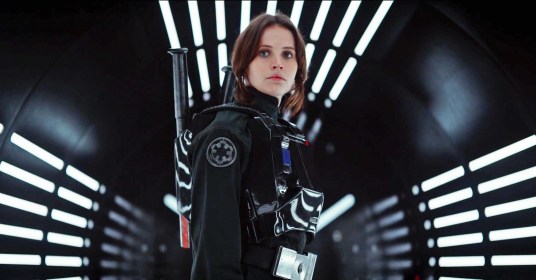
Felicity Jones plays Jyn Erso: the heroine of Rogue One: A Star Wars Story.

One of my Christmas treats was seeing Rogue One: A Star Wars Story. I’m glad I had my chance because it was an excellent movie.

Now just a reminder to you all, this is not part of the nine-episode Star Wars saga we all know. This is part of the Anthology Films of the Star Wars franchise. Actually this is the very first Anthology film to be released. The film is a triumph for writers of ‘fan fiction’ or ‘fanfic’ as it’s commonly called on the internet. However bringing fanfic like this to wide release on the big screen was no easy task. We all know how Star Wars has become a cinematic phenomenon like no other. George Lucas knows about it. Lucas himself is comfortable with ‘standalone’ films based on the Star Wars stories but wanted to make very clear that any standalone stories could not carry characters between the Saga films.

Here we have a story that is to take place between Episode III: Revenge Of The Sith and the very verse Star Wars film that’s now referred to as Episode IV: A New Hope. It’s a pretty lengthy amount of time between when Anakin Skywalker becomes Darth Vader and Luke Skywalker seeks to become a Jedi. Nevertheless it does make for ample time for any Star Wars fan to create a story of what happens in between. Storywriters John Knoll and Gary Whitta aren’t just any Star Wars fans. Knoll has done camera operations and visual effects supervision for many science-fiction films including four Star Trek films and the three Star Wars prequels. Whitta is a scriptwriter for The Book Of Eli and After Earth.

The adaptation of the story to screenplay had to fall into the right hands as well. Scriptwriter Tony Gilroy may have had his biggest renown with 2007 Best Picture nominee Michael Clayton (for which he himself was nominated for Best Director and Best Original Screenplay) but his he’s also made his biggest impact in writing the scripts for all four Jason Bourne movies. Chris Weitz has an eclectic resume of writing and directing from Antz to American Pie to About A Boy to The Golden Compass to one of the Twilight films. Then there’s the film being directed properly. Gareth Edwards may have not had the most experience in directing but he has developed his reputation in recent years upon films like 2010’s Monsters and 2014’s Godzilla.

Then there’s the story itself. There are possibly loads of Star Wars-inspired stories. The story would have to be true to the Star Wars saga without it being a rip-off. There’s lots of that and even professional writers can make something that’s a Star Wars rip-off. Most Star Wars fans will not go for something insulting. True, there are a lot of people that are Star Wars-crazy but most will not go for something if they sense it’s a rip-off. Don’t forget many felt insulted by the prequels so that’s a reminder.

They succeeded. They provided a very good story about the completion of the Death Star and the family behind it and the rebellion attempting to steal the plans leading to the hope in the end. The story had to be well-researched in order for it to make the right connection between Episode III and IV. Any new characters like the Ursos, Cassian Andor and K-2SO had to fit with the story as well as include original Star Wars characters like C3P0 and Darth Vader properly. On top of that, it had to have the right action scenes and the right battles done. Basically the whole movie had to have it all to work. The story could not be compromised despite the action sequences. The acting also had to be top notch from Felicity Jones, Diego Luna, Mads Mikkelsen, Ben Mendelsohn and Forest Whitaker. Even the theme of the story of heroism has to be present. It’s there, but in a way like no other Star Wars saga film does it. For the first time, self-sacrifice is needed for heroism.

The story worked very well. The critics on Rotten Tomatoes gave a total percentage of 85% approval. Many praised it for its depth in the Star Wars mythology and for breaking new narrative and aesthetic ground while paving way to a potential future for other blockbusters. The film scored well with crowds too as it would become the 20th movie to gross over $1 billion worldwide.

Rogue One: A Star Wars Story is not just an excellent movie. It’s an accomplishment. It’s proof that Star Wars standalone movies can not only be a hit but be excellent in their own right.